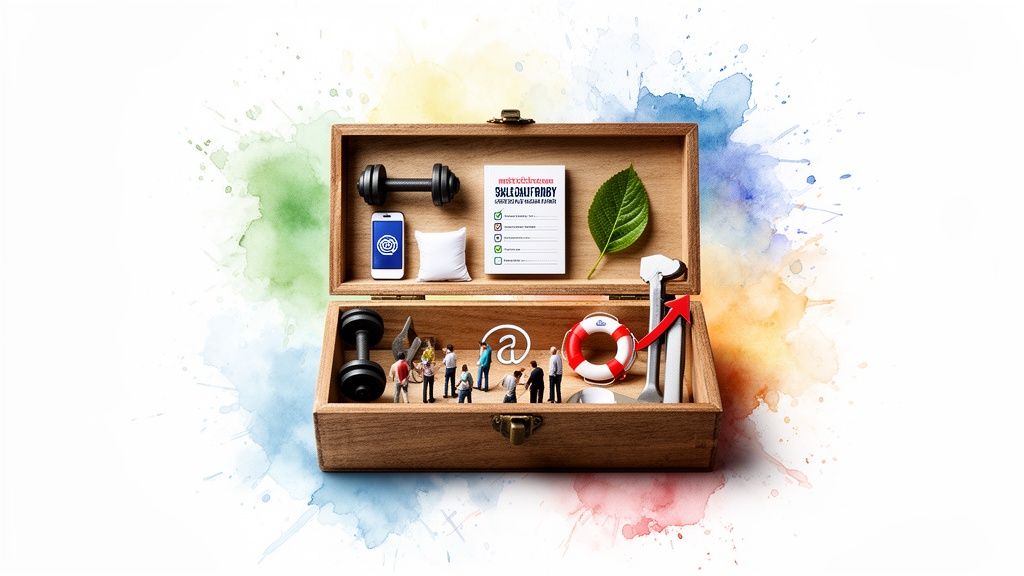
Anxiety can feel like an inescapable prison, shrinking your world and convincing you that professional therapy is the only key. While therapy is an invaluable resource, it's not the only path to a calmer, more fulfilling life. For a variety of reasons—from cost and accessibility to personal preference—you may be searching for powerful alternatives to therapy for anxiety. The wonderful news is that a vast toolkit of effective, evidence-informed strategies is available, ready to help you heal and reclaim your peace.
This guide is your roadmap to hope and empowerment. It moves beyond generic advice like "just relax" and instead provides a comprehensive roundup of 10 structured, practical methods you can use to overcome anxiety and live free from panic attacks. These are not quick fixes but sustainable practices that build resilience and retrain your brain for a life of calm and confidence. We will explore everything from self-guided cognitive-behavioral techniques and mindfulness practices to the profound impact of lifestyle changes.
For example, many people underestimate the power of physical movement as a primary tool for healing from anxiety. To truly appreciate its potential, delve into the surprising link between exercise and anxiety, uncovering the science behind its therapeutic effects as a powerful alternative.
Each item in this list offers actionable steps, real-world examples, and implementation tips to help you build a personalized plan for lasting change. Healing from anxiety is not just a distant possibility—it is absolutely within your reach. Let's unlock the door to a life where you are in the driver's seat, navigating challenges with newfound confidence and peace.
1. Cognitive Behavioral Therapy (CT) Self-Help
Cognitive Behavioral Therapy (CBT) is one of the most rigorously studied and effective treatments for anxiety disorders. The incredible news is that you don't always need a therapist to benefit from its core principles. CBT self-help involves using structured resources like workbooks, apps, and online programs to independently tackle the root causes of anxiety, paving the way for a life of freedom.
This approach operates on a simple but powerful premise: your thoughts, feelings, and behaviors are interconnected. By identifying and challenging the negative or distorted thought patterns that fuel anxiety, you can change your emotional response and behavior, creating a clear path to living a calmer, panic-free life.
How to Get Started with Self-Guided CBT
This method is particularly effective because it’s not just about thinking positively; it’s about thinking realistically. It provides a concrete framework that empowers you to become your own therapist, making it a powerful alternative to therapy for anxiety.
- Start a Thought Record: This is a foundational CBT tool. Create columns to log a situation that caused anxiety, your automatic negative thoughts, the emotions you felt (and their intensity), and then a more balanced, alternative thought.
- Use a "Feelings Thermometer": Rate your anxiety on a scale of 0-10 before and after challenging a thought. This helps you see tangible progress and recognize that anxiety levels are not static; you have the power to influence them.
- Conduct Behavioral Experiments: If you have an anxious prediction (e.g., "If I go to the party, everyone will think I'm awkward"), design a small, safe experiment to test it. Go to the party for 30 minutes and observe what actually happens. This provides real-world evidence to dismantle anxious beliefs.
Key Insight: The goal of CBT isn't to eliminate all negative thoughts. It's to develop a new relationship with them, where you can see them for what they are—just thoughts, not facts—and strip them of their power to control your life.
Recommended resources include Edmund Bourne's classic "The Anxiety and Phobia Workbook," which provides structured exercises, or free apps like MindShift CBT (developed by Anxiety Canada), which guide you through these techniques on your phone.
2. Mindfulness and Meditation Practices
Mindfulness is the practice of paying attention to the present moment on purpose, without judgment. Rather than getting lost in anxious thoughts about the past or future, it anchors you in the here and now, a place where you are safe and in control. Meditation is the formal exercise you use to build this "mindfulness muscle," training your brain to break free from cycles of worry and find lasting peace.
This approach works by fundamentally changing your relationship with anxious thoughts. Instead of fighting them, you learn to observe them as temporary mental events, which dissolves their power over you. Consistent practice can actually rewire the brain’s threat detection system, calming the hypervigilance that drives anxiety and paving the way for a truly serene mind.
How to Get Started with Mindfulness and Meditation
This practice is a powerful tool because it teaches you that you are not your anxiety. It creates a space between you and your feelings, providing a clear and reliable alternative to therapy for anxiety by equipping you with an internal sanctuary of calm and control.
- Start Small and Be Consistent: Don’t aim for an hour-long session on day one. Begin with just 5-10 minutes of guided meditation each day. Consistency is far more important than duration, as each session strengthens your ability to find peace.
- Use a Guided Meditation App: For beginners, apps provide essential structure. A narrator guides your focus, making it easier to return to the present moment when your mind wanders. This prevents frustration and keeps you feeling successful.
- Practice a Body Scan: Lie down comfortably and bring your attention to different parts of your body, from your toes to your head. This practice helps you notice physical sensations of anxiety early, without judgment, allowing you to respond with calm compassion instead of reacting with panic.
Key Insight: The point of meditation isn't to empty your mind or stop all thoughts. It's to notice when your mind has wandered and gently, without criticism, guide it back to the present. Each time you do this, you are building the skill of an unshakable inner peace.
Leading resources include apps like Headspace and Calm, which offer structured courses for beginners. For a vast, free library of guided meditations from various teachers, Insight Timer is an excellent option, while the UCLA Mindful app provides simple, accessible practices based on the work of the Mindful Awareness Research Center.
3. Physical Exercise and Movement Therapy
Regular physical activity is one of the most potent and accessible alternatives to therapy for anxiety. It works on a neurochemical level to rebalance your brain, releasing mood-boosting endorphins, reducing the stress hormone cortisol, and fostering the growth of new neural connections. This isn't just a distraction; it's a biological intervention that helps heal the very systems impacted by anxiety.
Movement therapy operates on the principle that your body and mind are deeply connected. By engaging your body in rhythmic, intentional activity, you can release stored tension, joyfully interrupt the cycle of anxious thoughts, and build a powerful sense of self-efficacy. This creates a tangible pathway toward a calmer state of being, empowering you to regain control and feel at home in your body again.
How to Get Started with Movement for Anxiety
This method is particularly effective because it provides immediate feedback, allowing you to feel a positive shift in your mood and stress levels in real time. It offers a concrete, physical outlet for the "nervous energy" that so often accompanies anxiety, transforming it into strength.
- Find Your Joyful Movement: The best exercise is the one you'll actually do. If you hate running, don't force it. Try a dance class, a hiking group, or a yoga app like Down Dog. Joyful movement is sustainable movement.
- Schedule It Like an Appointment: Block out 20-30 minutes in your calendar for movement. Treating it as a non-negotiable commitment to your well-being prevents it from getting lost in the shuffle.
- Track Your Mood, Not Just Your Miles: Before and after a workout, rate your anxiety on a scale of 1-10. Seeing a consistent drop from an 8 to a 4 provides powerful reinforcement that your efforts are working and that you have a reliable tool to change how you feel.
Key Insight: The goal of exercise isn't to punish your body or achieve a certain look. It's to celebrate what your body can do and show yourself, through action, that you can directly influence your own mental state. Each session is a powerful step toward a calmer, more resilient you.
Aim for the WHO-recommended 150 minutes of moderate activity per week, but don't be intimidated. Even a 10-minute brisk walk can break the cycle of panic and provide immediate relief, proving that you have agency over your anxiety.
4. Lifestyle and Dietary Modifications
Anxiety isn't just a mental state; it's a physiological one, deeply connected to your body’s biochemistry. Lifestyle and dietary modifications are about addressing the biological roots of anxiety by optimizing factors like nutrition, sleep, and substance intake. This provides your nervous system with the stability it needs to thrive.
This approach works on the principle that your brain's health is inseparable from your body's health. By providing your body with the right fuel, rest, and environment, you create a stable foundation that makes you resilient to anxiety spirals. It empowers you to influence your mood from the inside out, offering a tangible path to a calmer, more vibrant existence.
How to Get Started with Lifestyle and Dietary Modifications
This method is a powerful alternative to therapy for anxiety because it focuses on foundational, daily habits that govern your neurochemistry. Rather than just managing symptoms, you are actively building a more resilient system from the ground up.
- Audit Your Caffeine and Alcohol Intake: These substances are major anxiety triggers. Try a 30-day "elimination experiment" where you significantly reduce or cut them out. Many people are amazed to find this single change dramatically lowers their baseline anxiety.
- Prioritize Sleep Hygiene: Aim for 7-9 hours of consistent, restorative sleep. Set a strict bedtime and wake-up time, even on weekends, to stabilize your circadian rhythm. A well-rested brain is naturally calmer and better equipped to handle challenges.
- Stabilize Your Blood Sugar: Avoid sugary snacks and refined carbohydrates that cause energy crashes and mood swings. Focus on balanced meals containing protein, healthy fats, and fiber (like the Mediterranean diet) to maintain stable energy and neurotransmitter function. Increasing omega-3 intake through fish or flaxseed can also provide crucial neurological support.
Key Insight: Your daily choices are a form of communication with your nervous system. Every meal, every hour of sleep, and every beverage you choose can either send a signal of safety and stability or a signal of stress and alarm. You have the power to send calming signals.
Consider using a sleep tracking app like Sleep Cycle to monitor your rest patterns or a food journal to identify potential dietary triggers. For a deeper dive into the gut-brain connection, explore resources from nutritional neuroscience experts like Dr. David Perlmutter.
5. Journaling and Expressive Writing
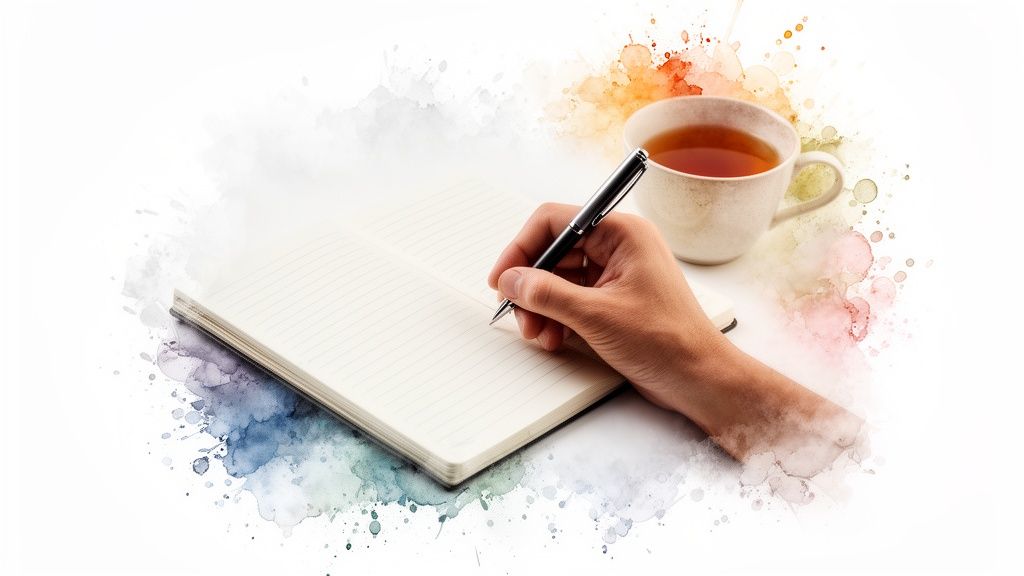
Journaling and expressive writing are powerful, cost-effective methods for healing from anxiety by externalizing the thoughts and feelings that often feel overwhelming inside your mind. This practice helps you process emotions in a safe, private space, creating a tangible record of your inner world and revealing patterns that lead to profound self-understanding.
This approach is grounded in the idea that giving structure to your anxious thoughts reduces their power. By translating abstract worries into concrete words, you engage both creative and analytical parts of your brain, allowing for both cathartic release and logical problem-solving. This creates a clear path toward understanding your anxiety and watching it dissolve.
How to Get Started with Journaling
This method is particularly effective as an alternative to therapy for anxiety because it provides a dedicated space to untangle your thoughts without judgment. It builds self-awareness and offers a reliable tool for emotional regulation, giving you a way to navigate distress and find lasting relief.
- Schedule a "Worry Time": Designate 15 minutes each day to write down everything you're anxious about. This technique, researched by experts like James Pennebaker, contains rumination to a specific window, freeing up the rest of your day for peace and presence.
- Use a Structured Format: Instead of free-writing, use columns: "Anxious Thought," "Evidence Against It," and "Realistic Alternative." This mirrors CBT techniques and actively challenges distorted thinking, training your brain for optimism.
- Try Specific Prompts: If you’re unsure where to start, use prompts like, "What specific event is triggering my anxiety right now?" or "What is the absolute smallest step I can take to address this worry?"
Key Insight: Journaling is not about eliminating anxiety; it's about changing your relationship with it. By observing your thoughts on paper, you create critical distance, realizing you are the observer of your anxiety, not a victim of it. This perspective is the beginning of freedom.
For structured guidance, you can use journaling apps like Day One or Penzu, or explore the customizable worksheet systems in resources like The Anxiety Checklist, which are designed specifically for tracking anxiety patterns and celebrating progress.
6. Breathing Techniques and Breathwork
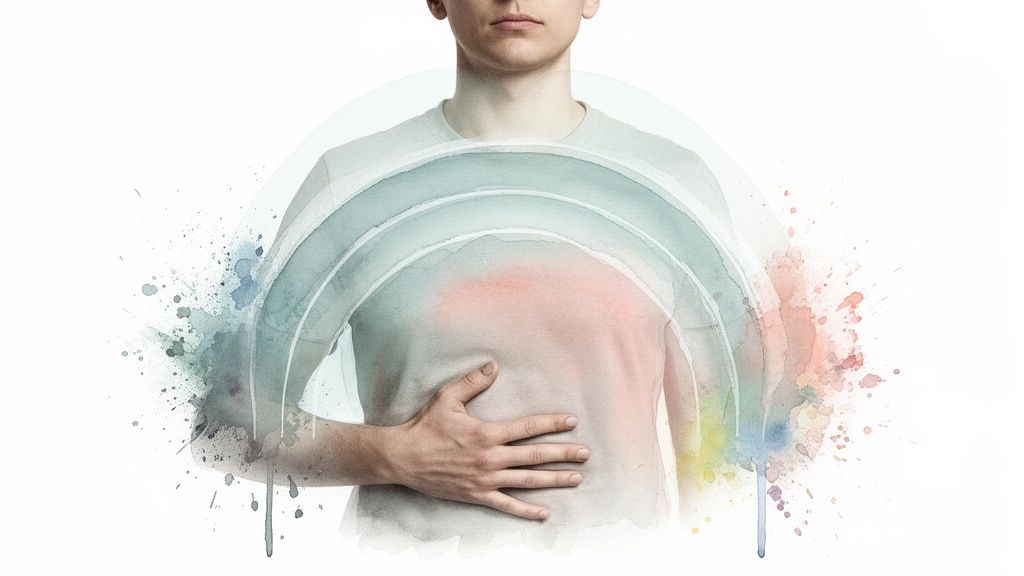
Controlled breathing is one of the most immediate and powerful alternatives to therapy for anxiety because it directly influences your body's physiological stress response. Breathwork techniques intentionally shift your nervous system from the frantic "fight-or-flight" state to the calm "rest-and-digest" mode. This is not just a mental trick; it creates a real, physical change that can stop rising panic in its tracks and restore a feeling of safety.
This approach is built on the biological connection between your breath and your autonomic nervous system. Slow, deep, and controlled breathing, particularly with a longer exhale, signals to your brain that you are safe. This immediate feedback loop can de-escalate anxiety symptoms within minutes, offering a reliable tool to regain control and find a path toward a panic-free life.
How to Get Started with Breathwork
This method is highly effective because you can do it anywhere, at any time, without any equipment. It provides a tangible anchor when your thoughts feel overwhelming, making it an essential skill for mastering your response to anxiety. Beyond general relaxation, specific breathwork can also enhance physical performance and mental clarity. For example, athletes often focus on precise breathing to improve stamina; you can learn more about how to breathe while running for better endurance and speed.
- Practice Box Breathing: A technique used by Navy SEALs for focus under pressure. Inhale for 4 counts, hold your breath for 4 counts, exhale for 4 counts, and hold again for 4 counts. Repeat this cycle for 3-5 minutes.
- Use the 4-7-8 Technique: Popularized by Dr. Andrew Weil, this is deeply calming. Inhale through your nose for 4 seconds, hold your breath for 7 seconds, and exhale slowly through your mouth for 8 seconds. The extended exhale is key to activating the relaxation response.
- Practice Proactively: Don't wait for a panic attack to try these. Practice daily when you are calm so the technique becomes an automatic, ingrained habit. Set a phone reminder to do a few rounds each morning to start your day with peace.
Key Insight: Your breath is a remote control for your nervous system. By learning to consciously regulate it, you gain the power to manage your body's anxiety response directly, proving that you have far more control than you think.
Guided breathing exercises in apps like Calm or Insight Timer can be excellent starting points. More intensive practices like the Wim Hof Method combine breathwork with cold exposure for advanced stress resilience.
7. Social Connection and Support Networks
Loneliness and isolation are powerful amplifiers for anxiety, often making worries feel insurmountable. Conversely, strong social connections act as a natural buffer against stress. Building and nurturing a support network provides a sense of belonging, shared perspective, and emotional validation—all essential for healing from anxiety.
This approach works on a principle of co-regulation and shared experience. Knowing you are not alone in your struggle can dramatically reduce feelings of shame and fear, replacing them with hope and solidarity. For those with social anxiety, engaging with supportive communities offers a safe, graduated way to face social fears, creating a path to greater confidence and a joyful, panic-free social life.
How to Get Started with Building Your Network
This method is a powerful alternative to therapy for anxiety because it directly counters the isolating nature of the condition. It provides real-time support and encouragement from people who genuinely understand and believe in your recovery.
- Find a Peer Support Group: These groups provide a structured, non-judgmental space to share experiences. Look for local chapters of national organizations like the Anxiety and Depression Association of America (ADAA) or peer-led programs like SMART Recovery.
- Explore Online Communities: Platforms like 7 Cups offer free, anonymous emotional support from trained listeners. Moderated Facebook groups or specialized forums can also provide a sense of community, but be mindful of your time spent there.
- Create an Accountability Partner: Ask a trusted friend or family member to be your partner in your healing journey. This person can check in on your goals, encourage you when you're struggling, and celebrate your progress.
- Volunteer for a Cause You Love: Volunteering connects you with like-minded individuals and shifts your focus from internal worries to external purpose, naturally building community while reducing anxious self-preoccupation.
Key Insight: The goal isn't to build a massive circle of friends overnight. It's about cultivating a few deep, meaningful connections where you feel safe enough to be vulnerable and know you will be supported, not judged. This connection is a powerful force for healing.
Start small by simply listening in a group setting before you feel comfortable sharing. Researcher Brené Brown's work highlights how vulnerability fosters connection; sharing your journey strategically with the right people can be a profound step toward healing and living a more connected, calmer life.
8. Acceptance and Commitment Therapy (ACT) Principles
Acceptance and Commitment Therapy (ACT) offers a powerful and compassionate shift for overcoming anxiety. Instead of focusing on eliminating or fighting anxious feelings, ACT teaches you to make space for them, which dramatically reduces their power over your life. The goal is not to feel less anxiety, but to be so empowered by your values that anxiety no longer controls your choices.
This approach is built on the idea that struggling against anxiety often makes it worse. ACT helps you unhook from this struggle by combining mindfulness skills with value-driven action. It guides you to accept what is outside of your personal control while committing to actions that improve and enrich your life, allowing you to build a meaningful existence even when anxiety is present. This is the path to true freedom.
How to Get Started with ACT Principles
This method is one of the most compassionate alternatives to therapy for anxiety because it validates your internal experience while empowering you to live fully. It redefines victory not as the absence of fear, but as moving toward what you care about with courage.
- Clarify Your Values: Start by identifying what truly matters to you in different life domains (relationships, career, health, personal growth). Ask yourself: "If anxiety wasn't an issue, what would I be doing? Who would I want to be?" This becomes your compass for a fulfilling life.
- Practice Cognitive Defusion: Instead of getting entangled with an anxious thought like "I'm going to fail," rephrase it as "I'm having the thought that I'm going to fail." This simple linguistic trick creates distance, helping you see thoughts as transient mental events, not objective truths.
- Take Committed Action: Choose one small, value-driven action you can take despite feeling anxious. If you value connection, your committed action might be sending a text to a friend, even if you feel social anxiety. Each small action builds momentum toward the life you want.
Key Insight: ACT teaches that a rich and meaningful life is not about waiting for anxiety to disappear. It's about learning to carry your anxiety with you, like a passenger on your bus, while you remain firmly in the driver's seat, heading toward a destination you've chosen.
Excellent resources to begin this journey include Russ Harris's book "The Confidence Gap" and the classic "Get Out of Your Mind and Into Your Life" by ACT founder Steven C. Hayes. Apps like ACT Companion can also provide daily exercises to build these skills.
9. Progressive Exposure and Desensitization
Exposure therapy is a powerful, evidence-based technique often considered the gold standard for freeing people from specific phobias, social anxiety, and OCD. The exciting part is that its core principle, progressive exposure, can be adapted for self-guided use. This method involves intentionally and gradually confronting the situations you fear in a controlled way, retraining your brain for confidence.
The underlying mechanism is habituation: the more you expose yourself to a trigger in a safe context, the less your brain reacts with fear. Your nervous system literally learns that the feared outcome doesn't happen, and the anxiety signal weakens and fades away. It’s a direct way to reclaim your power from anxiety, proving to yourself that you are stronger than your fears.
How to Get Started with Self-Guided Exposure
This approach is highly effective because it directly targets the avoidance that maintains the anxiety cycle. It’s a proactive strategy that offers a clear, structured path to confronting fears, making it an excellent alternative to therapy for anxiety and a direct route to freedom.
- Build a Fear Hierarchy: List all your fears related to a specific trigger (e.g., social situations, driving on the highway). Rate each one on a scale of 0-100 based on how much anxiety it causes. This is your personal roadmap to fearlessness.
- Start Small and Be Consistent: Begin with an exposure item rated around 30-40 on your hierarchy. The goal is to feel some anxiety, but not to become completely overwhelmed. Repeat this specific exposure multiple times until your peak anxiety level drops by at least 50% before moving up the list.
- Track Your Progress: During each exposure, rate your anxiety at the beginning, middle (at its peak), and end. For example, if your anxiety starts at a 6/10, peaks at an 8, and drops to a 4 by the end, you’ve successfully completed the exposure. This data provides tangible proof that you are winning.
Key Insight: The purpose of exposure is not to feel comfortable. It’s to learn that you can handle the discomfort of anxiety and to allow your brain to habituate. The feeling of empowerment comes from staying in the situation until the anxiety naturally subsides, proving your own strength.
For a structured approach, you can create a simple exposure log in a notebook to track your hierarchy, SUDS ratings, and successes. For those interested in technology-assisted options, some apps like nOCD specifically incorporate Exposure and Response Prevention (ERP) principles.
10. Hobby, Creative Expression, and Flow Activities
Engaging in hobbies and creative pursuits can be a surprisingly powerful tool for healing, leveraging a psychological concept known as the "flow state." Coined by psychologist Mihaly Csikszentmihalyi, flow is the experience of being fully immersed in a feeling of energized focus, full involvement, and joy in the process of an activity.
This approach works as a potent alternative to therapy for anxiety by redirecting your cognitive resources. When you are deeply absorbed in an activity like painting, playing an instrument, or even strategic gaming, your brain doesn't have the bandwidth to entertain anxious thoughts. This provides a natural, restorative break from the cycle of anxiety, building confidence and a sense of accomplishment along the way.
How to Get Started with Flow Activities
This method is effective because it’s not about fighting anxiety but rather replacing it with a positive, absorbing experience. It provides an escape that is both productive and healing, offering a tangible path toward a calmer and more joyful state of being.
- Find Your Genuine Interest: The key to flow is intrinsic motivation. Experiment with different activities—gardening, knitting, coding, playing chess, or learning a language—until you find something you do for the sheer enjoyment of it, not out of obligation.
- Schedule Your Hobby Time: Treat your hobby like a non-negotiable appointment. Block out 30-60 minutes in your calendar. This dedicated time ensures you get a regular break from anxious thought patterns and nurtures your spirit.
- Balance Challenge and Skill: Flow occurs when a task is challenging but not overwhelming. If an activity is too easy, you'll get bored; if it's too hard, you'll get frustrated. Adjust the difficulty as you go, such as trying a more complex musical piece or a harder level in a game.
Key Insight: The goal isn't to become a master artist or musician overnight. It's to experience the process of creation and focus, which naturally quiets the anxious mind and proves you can experience moments of deep peace and total engagement.
Look for local community classes in pottery or writing to add a social element. Online platforms like Skillshare offer endless opportunities to learn new creative skills, while communities on Reddit or Discord centered around specific hobbies can provide connection and encouragement.
Top 10 Alternatives to Therapy: Comparison
| Approach | Implementation Complexity 🔄 | Resource Requirements ⚡ | Expected Outcomes ⭐📊 | Ideal Use Cases 💡 | Key Advantages |
|---|---|---|---|---|---|
| Cognitive Behavioral Therapy (CBT) Self-Help | 🔄 Moderate — structured, requires self-discipline | ⚡ Low — books/apps/time | ⭐📊 Strong evidence; ~40–60% symptom reduction for many users | 💡 Motivated self-starters with mild–moderate anxiety; supplement to therapy | Scientifically backed; concrete skills; cost-effective |
| Mindfulness and Meditation Practices | 🔄 Low–Moderate — consistent practice needed | ⚡ Low — guided apps/classes or self-practice | ⭐📊 Reduces rumination; neurobiological changes (amygdala ↓) over weeks | 💡 Chronic worry/stress management; emotion regulation | Portable; improves self-awareness; broad wellness benefits |
| Physical Exercise and Movement Therapy | 🔄 Low–Moderate — requires routine and adherence | ⚡ Low–Moderate — time, possible equipment or classes | ⭐📊 Immediate mood boost; 20–30% anxiety reduction with regular exercise | 💡 Mild–moderate anxiety, sleep problems, boosting confidence | Multiple physical health benefits; quick mood effects |
| Lifestyle and Dietary Modifications | 🔄 Moderate — habit change and monitoring required | ⚡ Low–Moderate — dietary changes, supplements, tracking | ⭐📊 Targets biological drivers (sleep, nutrients); variable individual effects | 💡 Anxiety linked to caffeine, sleep, diet; adjunctive treatment | Addresses root causes; improves energy and overall health |
| Journaling and Expressive Writing | 🔄 Low — simple to implement but needs consistency | ⚡ Very low — pen/app and time | ⭐📊 ~20–30% symptom reduction with consistent practice | 💡 Identifying triggers, emotional processing, tracking progress | Free; enhances insight; creates tangible progress record |
| Breathing Techniques and Breathwork | 🔄 Very low — quick to learn, practice needed for reliability | ⚡ Minimal — no equipment | ⭐📊 Fast short-term relief (2–5 min); HRV improvements with practice | 💡 Acute panic/peak anxiety; immediate calming before other strategies | Fast-acting; discreet; no side effects |
| Social Connection and Support Networks | 🔄 Moderate — requires vulnerability and effort | ⚡ Low — time and access to groups/peers | ⭐📊 Reduces isolation; supportive relationships lower symptoms 30–40% over time | 💡 Isolation-driven anxiety; social anxiety exposure in safe settings | Emotional support; accountability; real-world perspective |
| Acceptance and Commitment Therapy (ACT) Principles | 🔄 Moderate–High — requires mindset shift and practice | ⚡ Low–Moderate — workbooks/apps or therapist guidance | ⭐📊 Comparable to CBT; ~40–60% reduction plus improved life meaning | 💡 Anxiety-about-anxiety; those wanting values-driven change | Builds long-term resilience; reduces avoidance; values-focused |
| Progressive Exposure and Desensitization | 🔄 High — careful planning, repeated practice needed | ⚡ Low–Moderate — time; therapist recommended for severe cases | ⭐📊 High efficacy: ~60–70% significant symptom reduction when done correctly | 💡 Specific phobias, OCD, panic, social anxiety requiring behavior change | Directly reduces avoidance; durable neural change |
| Hobby, Creative Expression, and Flow Activities | 🔄 Low–Moderate — time to find and sustain engagement | ⚡ Low–Moderate — materials/classes or community | ⭐📊 30–45% anxiety reduction; improves mood and resilience over time | 💡 Stress relief, identity-building, sustained low-level anxiety | Enjoyable, sustainable; builds competence and intrinsic motivation |
Building Your Personal Toolkit for Fearless Living
Navigating the landscape of anxiety can feel like searching for a single, perfect path out of a dense forest. As we've explored, the journey toward a calmer, more present life isn't about finding one magic cure. Instead, it's about skillfully assembling a personalized toolkit filled with diverse, powerful strategies that empower you to face challenges with confidence and resilience. You now have a comprehensive blueprint of evidence-based alternatives to therapy for anxiety, from the cognitive reframing of CBT and ACT to the physiological regulation of breathwork and the restorative power of creative flow.
The path to living free from panic is paved not with grand, sweeping gestures, but with small, consistent, and intentional actions. Each strategy we've covered, whether it's a five-minute mindfulness practice or a commitment to regular exercise, is a tool you can pull out whenever you need it. The power lies in knowing which tool to use and when, and building the confidence to use it to create lasting change.
The Power of Proactive Choice
One of the most debilitating aspects of anxiety is the feeling of powerlessness it creates. The true value of building this toolkit is the profound shift it creates, from a reactive state of fear to a proactive state of empowerment. You are no longer just surviving; you are actively creating a life of peace and meaning.
By consciously choosing to engage with these techniques, you are actively rewiring your brain's response to stress. You are teaching your nervous system that it can return to a state of calm. You are proving to yourself, one small step at a time, that you have complete agency over your well-being. This is not about eliminating anxiety entirely; it's about transforming your relationship with it, so it no longer dictates the terms of your life.
Your Actionable Next Steps to a Fearless Life
Feeling overwhelmed by the options is a common and understandable reaction. The key is to start small and build momentum. Do not feel pressured to implement everything at once. Your immediate goal is simply to begin your healing journey.
Here is a simple, actionable plan to get started:
- Review and Select: Look back through the ten strategies. Which one or two genuinely resonate with you right now? Perhaps it’s the structured logic of self-guided CBT or the physical release found in vigorous exercise. Trust your intuition.
- Make a Micro-Commitment: Choose one technique and commit to practicing it for just five minutes a day for the next seven days. For example, you might commit to a five-minute guided breathing exercise every morning. The goal is consistency, not intensity. Each small win builds confidence.
- Observe Without Judgment: As you practice, simply notice how you feel. Don't worry about getting it "perfect." The act of showing up for yourself is the victory. Keep a simple log of your practice and any observations in a notebook.
Remember, this journey is uniquely yours. Some tools will feel natural and effective immediately, while others may require more practice. The beauty of having a diverse toolkit is the flexibility it affords you. You have the capacity to manage anxiety, overcome panic, and live a full, expansive, and fearless life. Believe in your inherent ability to heal, and take that first small step today.
Ready to stop guessing and start building your toolkit with a proven, step-by-step system? The Anxiety Checklist integrates many of the powerful principles we've discussed into a single, structured program designed to give you clarity and control. Start your journey toward a panic-free life by visiting The Anxiety Checklist to learn more.