
For the panic moment
Stage 1: Calm Now
Fast support when anxiety spikes: the SOS button, calming affirmations and grounding exercises.
See Calm NowStage 1
For the panic moment
Stage 2
Lower everyday anxiety
Stage 3
Change the pattern
Get the app before you need it
Free SOS panic relief. Premium with a free trial.


No sign-up needed.
Free library
Learn how anxiety works



If you live with anxiety or panic attacks, this loop may feel familiar.

Your heart races. Your chest feels tight. It feels like something is badly wrong.
You stay away from the place, the plan or the feeling that set it off. It helps, for now.
“What if it happens again?” Your mind scans for danger and plays out the worst.
Each round teaches your brain the threat is real. So the next wave comes easier.

To break the loop, you need two things: something that helps in the moment, and something that slowly changes the pattern. Anxiety Checklist gives you both.
The app is organized around how anxiety really shows up. What you see here is exactly what you’ll find when you open it.
Break free from anxiety and take back control of your life.

For the panic moment
Fast support when anxiety spikes: the SOS button, calming affirmations and grounding exercises.
See Calm Now
Lower everyday anxiety
Breathing, soundscapes, hypnosis, sleep, meditation and more, so your body can settle day by day.
See Feel Better Daily
Change the pattern
CBT tools that help you question anxious thoughts and face fears, step by step, with AI help when you’re stuck.
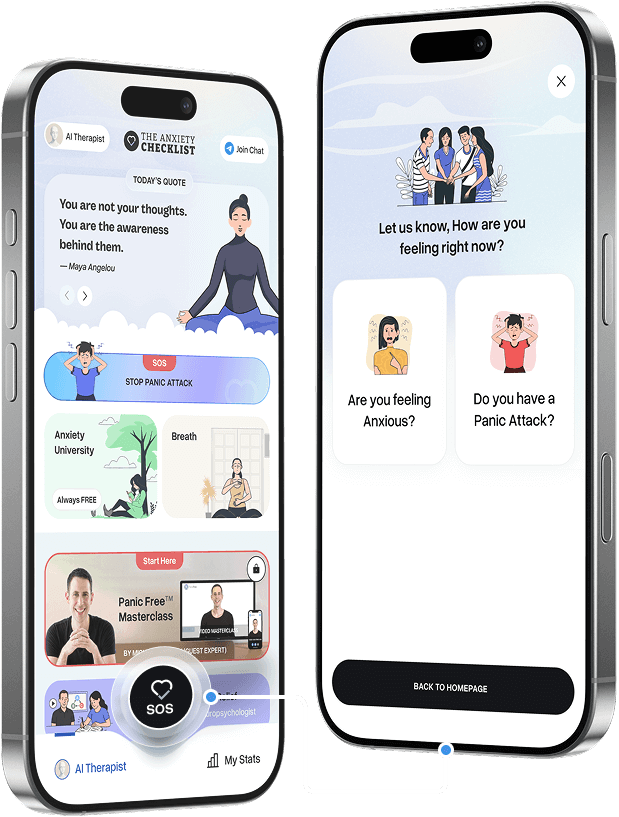
See Feel more in ControlIn a panic attack, it’s hard to think straight. So you don’t have to. The SOS button sits in the middle of every screen. One tap, and the app guides you through it.
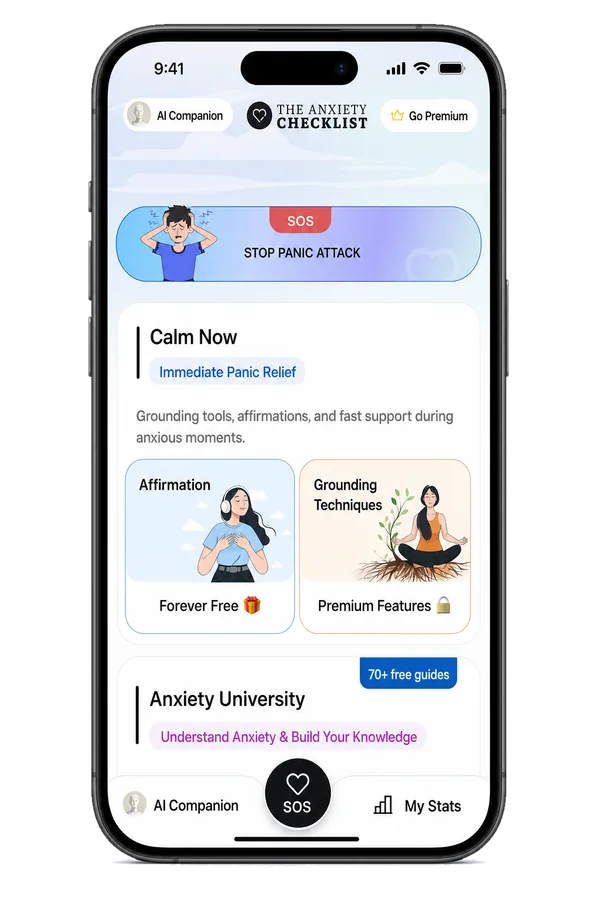
It’s always there, at the bottom of your screen.
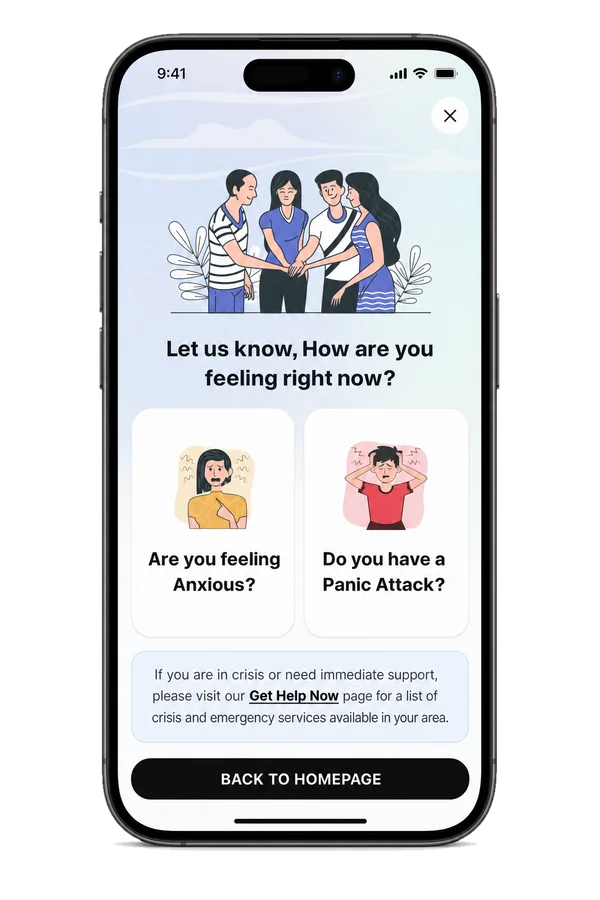
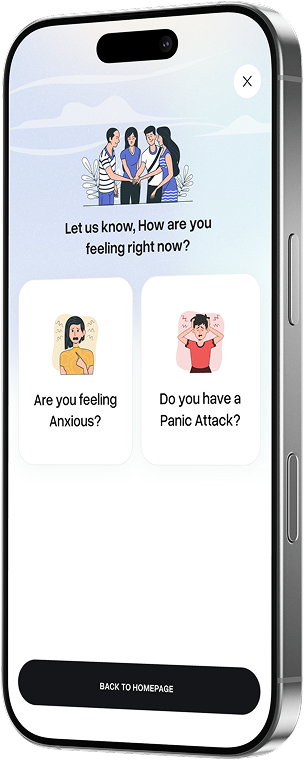
Choose “Are you feeling Anxious?” or “Do you have a Panic Attack?”
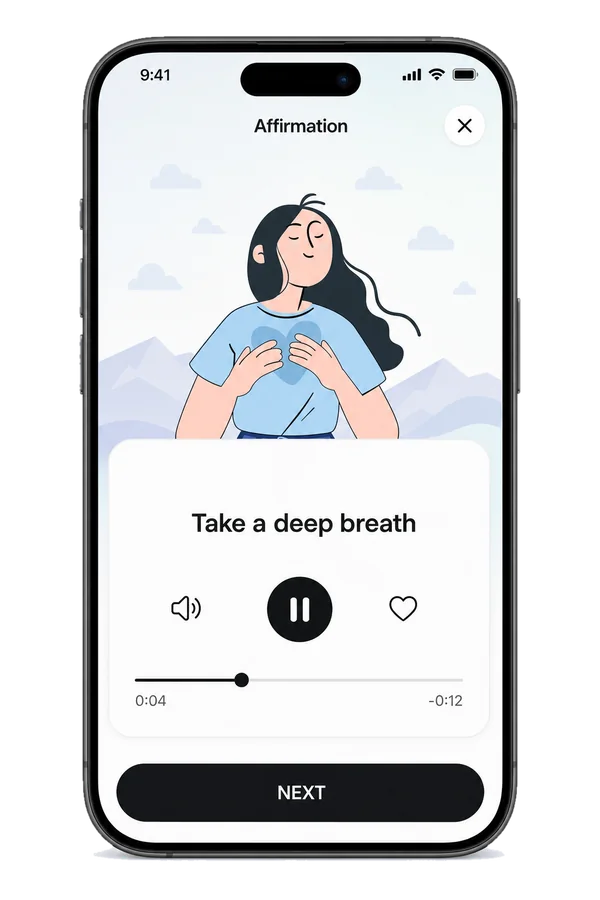
Calming affirmations play one by one, in a steady human voice.
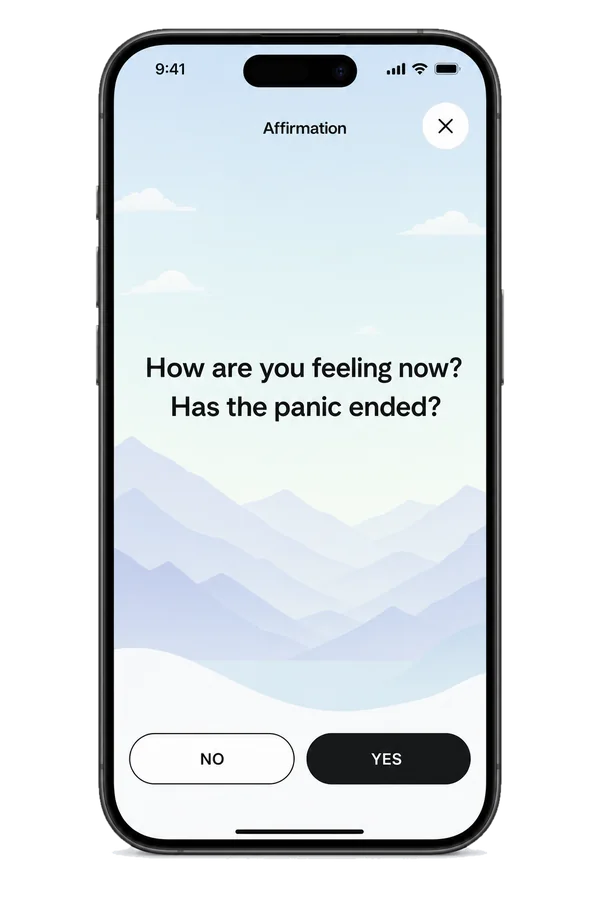
The app asks: “Has the panic ended?”
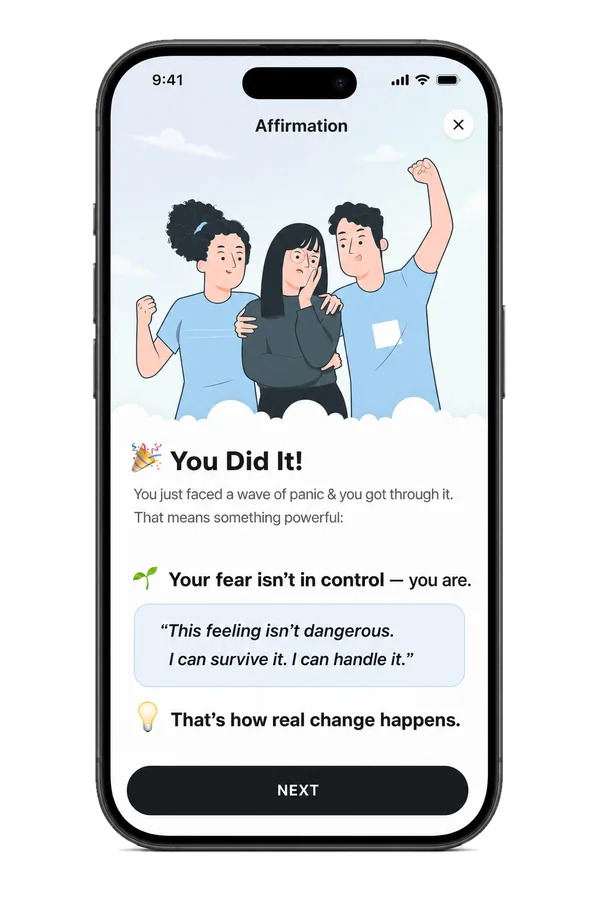
“Your fear isn’t in control — you are.” Still struggling? The app suggests something else to try.
“This feeling isn’t dangerous. I can survive it. I can handle it.”
Listen to the Therapist Voice
Simon Candlish
Simon Candlish voices the affirmations you’ll hear in SOS. A real human voice, not AI.
SOS is support for a hard moment, not an emergency service. If you think you may be in danger, go to Get Help Now.
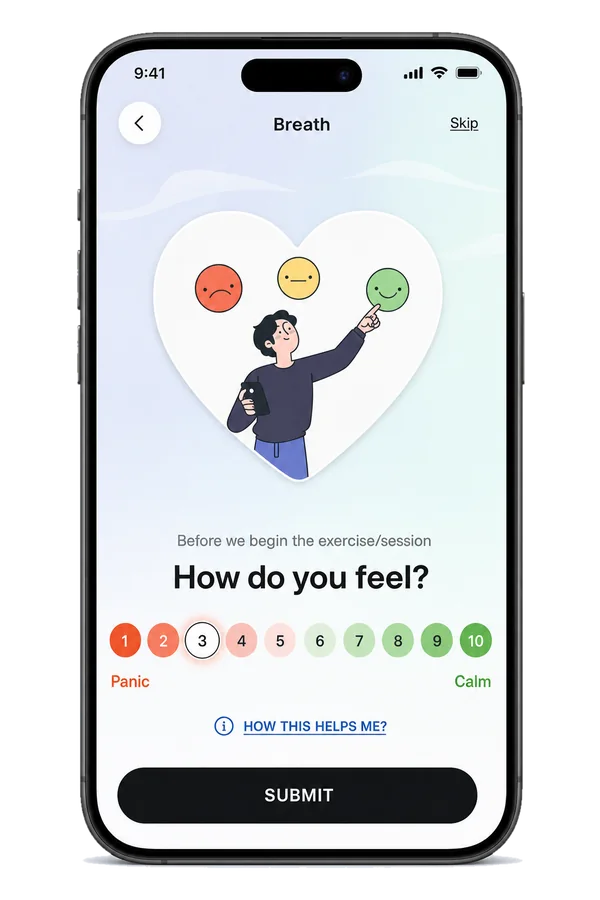
Before and after most exercises, the app asks one simple question: “How do you feel?”
How do you feel right now, from 1 (Panic) to 10 (Calm)?
Affirmations, breathing, a journal entry, whatever you choose.
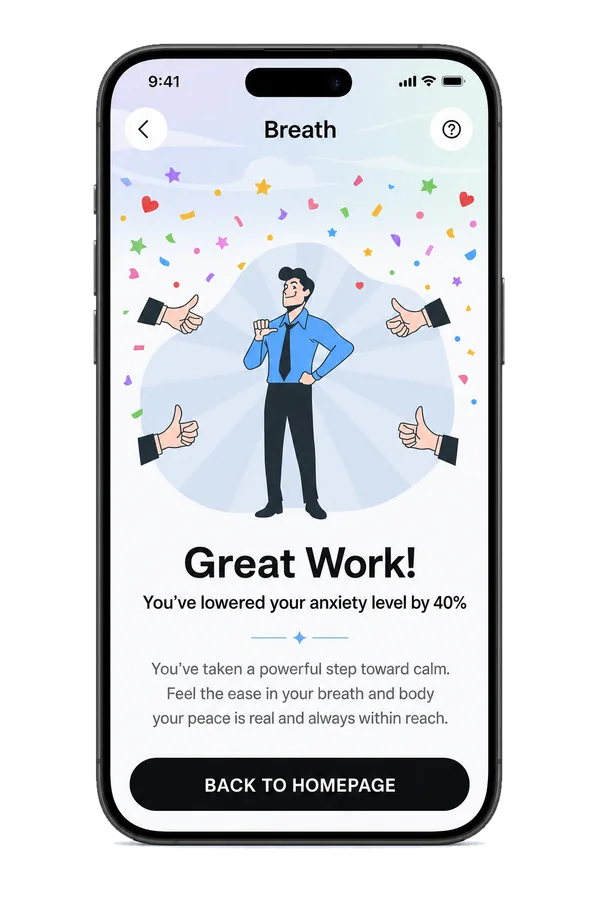
Check in again and see the difference.
Exercise impact shows how you felt before → after each tool, so you know which ones really help. A calendar marks the days you practiced.
Tap a number from 1 (Panic) to 10 (Calm).
Scale from 1, Panic, to 10, Calm. Higher is calmer.
Before we begin the exercise
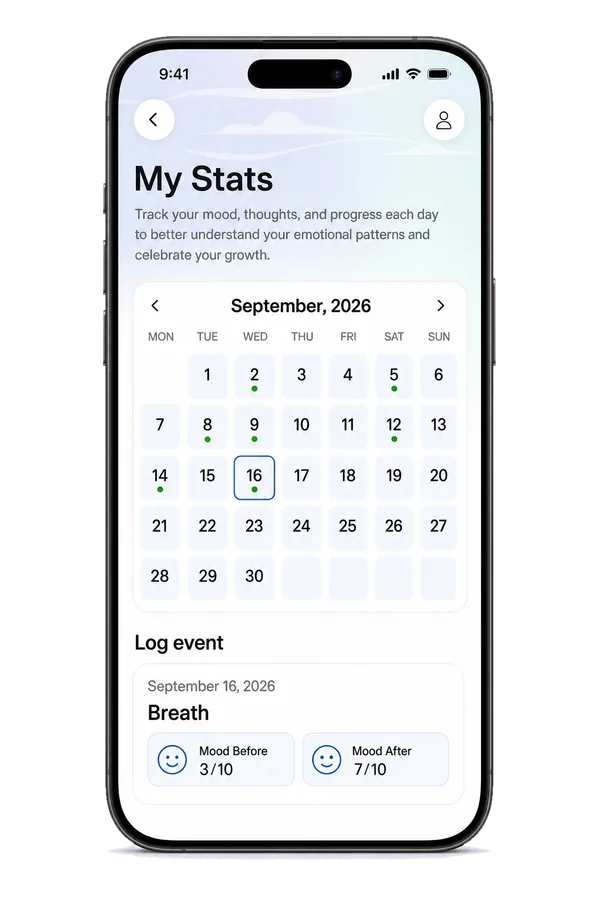
Once a day, pick how you feel, tag what you did and add a note if you like. Over time, the app shows the patterns behind your good and hard days.


Self-monitoring, noticing and noting how you feel, is a key part of CBT. It helps you see patterns instead of guessing.
Over time, your scores show which tools bring you real relief. So next time, you know where to turn.
Even a 1-point change is proof that something helped. The app celebrates it with you.
If a number doesn’t move, that’s okay. It’s a check-in, not a test or a diagnosis.
Anxiety isn’t only panic attacks. It’s also the tension humming in the background. These tools help your body and mind settle, day by day.
Slow your breath and calm your body.
What's inside: Box Breathing, the Physiological Sigh and 4-7-8 Breathing, each with its own guided animation + Dan Brulé’s 5-video breathwork masterclass
Support before and during the drive.
What's inside: 3 audio sessions for before you drive, on the road, and tough moments
Train your attention toward what’s going right.
What's inside: Prompts in 10 categories, photos, voice notes and a Gratitude Jar
Listen to the Therapist Voice
Sophie Shaw
Every session starts with a short voice sample, so you know the guide feels right. This is Sophie Shaw, who guides the Grounding Meditation.
Layer rain, nature sounds, gentle music and brainwave tones into a mix that settles you, then let it play while you rest, read or fall asleep.

Calming down helps today. Changing how you respond to anxious thoughts helps for the long run. That’s what CBT (cognitive behavioral therapy) is for. CBT is the most widely researched talking therapy for anxiety, and these tools bring its core exercises to your phone.
Catch an anxious thought, spot the thinking trap, and rewrite it in a kinder, more realistic way. Stuck on a step? Tap “Get an idea”.
See how the Thought Journal works
Write the thought that’s bothering you.
Spot the pattern, like Fortune Telling.
Challenge it in a balanced way.
Write a kinder, more realistic alternative.
Break a fear into small steps and face it at your own pace. Run several fear ladders at once, and let AI suggest the steps.
Test an anxious prediction in real life and see what really happens.
Every step of the Thought Journal and the Fear Ladder now has a small help row, so a blank page never stops you.

These aren’t quick fixes. They’re skills. Think of it like physical rehab: each practice makes the next one a little easier.
Anxiety University is a free library in the app and on this site. Short, clear articles explain what’s happening in your body and mind, with quizzes to check what you’ve learned.

A supportive chat that uses CBT techniques to help you work through an anxious thought, instead of going round and round it. Type, or talk to it out loud with Voice Mode. When talking isn’t enough, it suggests a real exercise from the app and opens it for you.
One question at a time, at your pace.
Breathing, grounding, a thought journal and more.
Only if you allow it. Memory is off by default.
Talk instead of typing. It listens, answers out loud, and your words appear in the chat too.
It is not therapy and not a therapist. It doesn’t diagnose, and it can’t help in an emergency.

Many people use Anxiety Checklist while they see a therapist, or while they wait to start. Looking for one? Our therapist directory can help.
CBT often comes with homework. The Thought Journal, Fear Ladder and Belief Experiments give it a simple, guided structure.
Your Thought Journal history and My Stats show what came up and how you felt. You choose what to share in your session.
Anxiety doesn’t wait for your next session. SOS and the calming tools are there at 3 a.m.

Anxiety Checklist is a self-help app. It doesn’t replace a therapist, a doctor or emergency care. If anxiety is affecting your work, relationships or health, please talk to a professional.
The tools you need most in a hard moment are free forever. Premium unlocks the full toolkit.

Free trial: 7 days on the monthly plan, 14 days on the yearly plan. A weekly plan is also available. Cancel anytime. No sign-up needed to start.
I’ve lived with anxiety and panic attacks for years, and like most people, I tried everything I was told to try. CBT, breathing exercises, medication, meditation. Some things helped a little, but nothing was there for me in the moment when panic hit. The Anxiety Checklist app was the first thing that actually helped me feel safer right away. The SOS tools don’t try to fix you or talk you out of fear. They help you slow down, feel less alone, and get through the moment. For the first time, I feel like I have something steady to turn to when anxiety shows up
This isn’t just an anxiety app. It’s something you can rely on, every time anxiety shows up.
Yes, you can start free. SOS panic relief, the Panic Attack Relief affirmations, the CBT Thought Journal, Box Breathing, the Bubble Pop grounding game, a free Soundscape selection, Anxiety University and My Stats are free forever. Premium unlocks the rest, with a free trial: 7 days on monthly, 14 days on yearly.
No. Open the app and start. There’s no sign-up or login.
No. It’s a self-help app built on CBT techniques. Many people use it alongside therapy, to practice between sessions. If anxiety is affecting your daily life, please talk to a professional.
Yes. Our therapist directory lists therapists who work with anxiety, in person or online. Search by city, region or country, and see which credentials we’ve checked before you reach out.
Please don’t rely on the app. Call your local emergency number or go to Get Help Now for immediate support.
Three stages. Calm Now: SOS, affirmations and grounding exercises like 5-4-3-2-1 and Bubble Pop. Feel Better Daily: breathing (Box, Physiological Sigh, 4-7-8), Soundscape, hypnosis, sleep, meditation, walking, driving, EFT tapping and a gratitude journal. Feel more in Control: the CBT Thought Journal, fear ladders and belief experiments, with AI help when you’re stuck. Plus a daily Mood Tracker that shows what works for you, 75+ Anxiety University articles and the AI CBT Companion, which you can type to or talk to.
Most features need an internet connection, because audio, videos and articles load when you open them. The Dan Brulé breathwork masterclass videos can be downloaded to watch offline.
A supportive chat that uses CBT techniques to help you work through anxious thoughts, and opens exercises from the app for you. It isn’t therapy, doesn’t diagnose and isn’t for emergencies. Memory is off unless you turn it on. Learn more.
Both. SOS and grounding help in the moment. Daily tools help lower background anxiety. CBT tools help change the pattern over time.
Free SOS panic relief, a free CBT Thought Journal and 75+ free articles. No sign-up. Open it and start.
Break free from anxiety and take back control of your life.