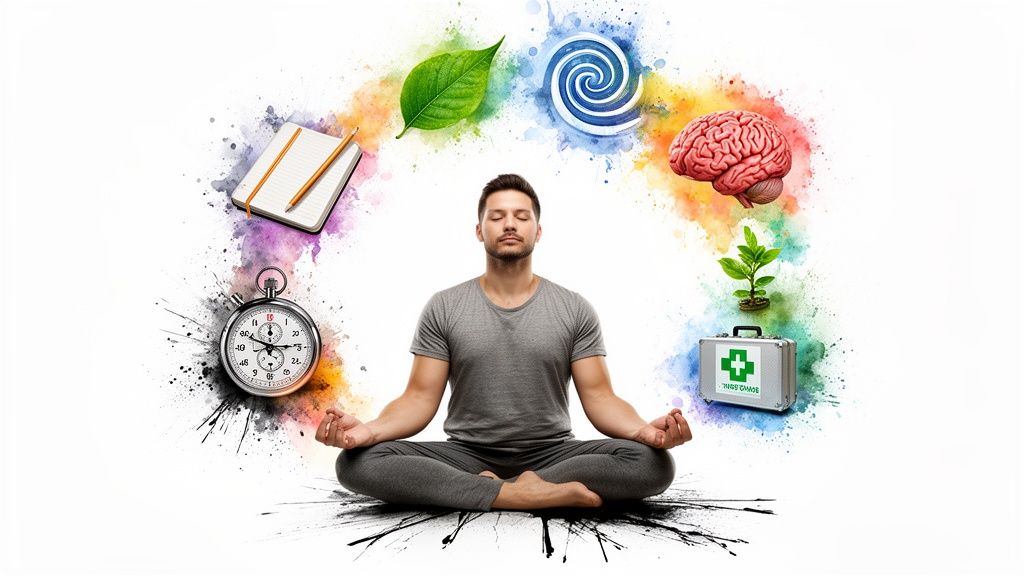
Anxiety can feel like a relentless storm, leaving you feeling isolated, overwhelmed, and powerless. But what if you had a toolkit filled with proven strategies to not only weather that storm but to calm the skies for good? This guide is built on a foundation of hope, showing you that healing from anxiety and living a full, panic-free life is not just possible-it's within your reach. Managing anxiety is about more than just momentary relief; it's a critical component of long-term well-being. Understanding the health risks associated with chronic anxiety, for example, underscores the importance of developing effective coping mechanisms for your physical and mental health.
This article moves beyond generic advice to provide a comprehensive roundup of 10 powerful, evidence-informed anxiety coping skills for adults. We will explore actionable, step-by-step techniques you can start using today, covering everything from cognitive reframing and grounding exercises to lifestyle adjustments and crisis-management strategies. Each skill is presented with practical implementation details, making them easy to integrate into your daily life. Whether you're dealing with persistent worry or sudden panic attacks, these skills are your building blocks for lasting resilience and control.
A great way to start this journey is by systematically tracking your progress, turning abstract goals into concrete achievements. Tools like The Anxiety Checklist are designed to facilitate this process, helping you identify patterns and measure your success as you build a new relationship with anxiety. This guide is your first step toward reclaiming your peace and building a life defined by courage, not by fear. Let's begin.
1. Cognitive Behavioral Therapy (CBT) Techniques (includes Cognitive Reframing)
Cognitive Behavioral Therapy (CBT) is one of the most effective, evidence-based treatments for anxiety. It operates on the principle that your thoughts, feelings, and behaviors are interconnected. By identifying and changing unhelpful thinking patterns, you can change your feelings and reactions, offering a clear path toward healing from anxiety and living a panic-free life.
This approach isn't about ignoring negative feelings; it's about understanding and challenging the automatic thoughts that fuel them. One of the core skills within CBT is cognitive reframing. This involves actively questioning the validity of anxious thoughts and replacing them with more balanced, realistic ones.
How to Apply CBT Techniques
Getting started with CBT techniques is a practical step you can take today. A simple yet powerful tool is the "thought record."
- Identify the Situation: Note what was happening when you started to feel anxious. (e.g., Received an email from my boss asking for a quick chat.)
- Record Your Automatic Thought: Write down the first thought that popped into your head, without judgment. (e.g., "I'm in trouble. I'm going to get fired.")
- Analyze the Evidence: List evidence that supports this thought and, more importantly, evidence that contradicts it. (e.g., Against: My last performance review was positive. My boss is generally supportive. A "quick chat" is usually just a check-in.)
- Create a Balanced Alternative: Develop a new, more realistic thought based on the evidence. (e.g., "My boss probably just wants an update on a project. Even if there is an issue, I can handle it constructively.")
Key Insight: The goal of cognitive reframing isn't forced positivity. It's about achieving a more accurate, less catastrophizing perspective that reduces the power of anxiety.
This process, used consistently, is a foundational anxiety coping skill for adults that builds mental resilience and disrupts the cycle of panic. By practicing these techniques, especially with the help of resources like The Anxiety Checklist worksheets, you actively retrain your brain to respond to triggers with calm clarity instead of fear.
2. Progressive Muscle Relaxation (PMR)
Progressive Muscle Relaxation (PMR) is a powerful mind-body technique designed to manage the physical symptoms of anxiety. It operates on the simple principle that muscle tension is the body’s physical response to anxious thoughts. By systematically tensing and then releasing different muscle groups, you can teach your body the difference between tension and relaxation, giving you direct control over your physical state.
This approach offers a tangible way to counteract anxiety’s physical grip, making it an essential skill for anyone who experiences muscle tightness, restlessness, or somatic symptoms. PMR provides a clear, physical pathway to calmness, demonstrating that you have the power to soothe your own nervous system and find relief from the physical manifestations of stress.
How to Apply Progressive Muscle Relaxation
You can begin practicing PMR right away, even while sitting at your desk or lying in bed. This guided process helps you release stored tension you may not even be aware of.
- Get Comfortable: Find a quiet place to sit or lie down. Close your eyes and take a few slow, deep breaths.
- Tense and Release: Start with your feet. Tense the muscles for 5-10 seconds, focusing on the feeling of tightness. (e.g., Curl your toes and arch your foot.)
- Notice the Relaxation: Release the tension completely and notice the feeling of limpness and warmth that follows. Stay in this relaxed state for 15-20 seconds before moving to the next muscle group.
- Work Your Way Up: Systematically repeat the tense-and-release cycle for other muscle groups, moving up your body: legs, abdomen, arms, hands, shoulders, and face. (e.g., Clench your fists tightly, then let them go completely limp.)
Key Insight: The goal of PMR is not just relaxation but also heightened awareness. By practicing, you become better at noticing where you hold tension, allowing you to release it before it escalates.
Consistent practice of PMR is a foundational anxiety coping skill for adults that directly addresses the body’s stress response. For a guided experience to help you master the technique, you can follow along with a video like the one below. Using The Anxiety Checklist to track physical symptoms can also show you how effectively PMR reduces your tension over time, reinforcing your ability to achieve a state of calm.
3. Diaphragmatic Breathing (Deep Belly Breathing)
Diaphragmatic breathing, often called deep belly breathing, is a powerful and immediate anxiety coping skill for adults. It works by directly activating the body’s parasympathetic nervous system, our natural "rest-and-digest" response. This physiological shift counteracts the "fight-or-flight" state that anxiety triggers, offering a quick and accessible path to calmness and demonstrating that you can reclaim control over your body's panic response.
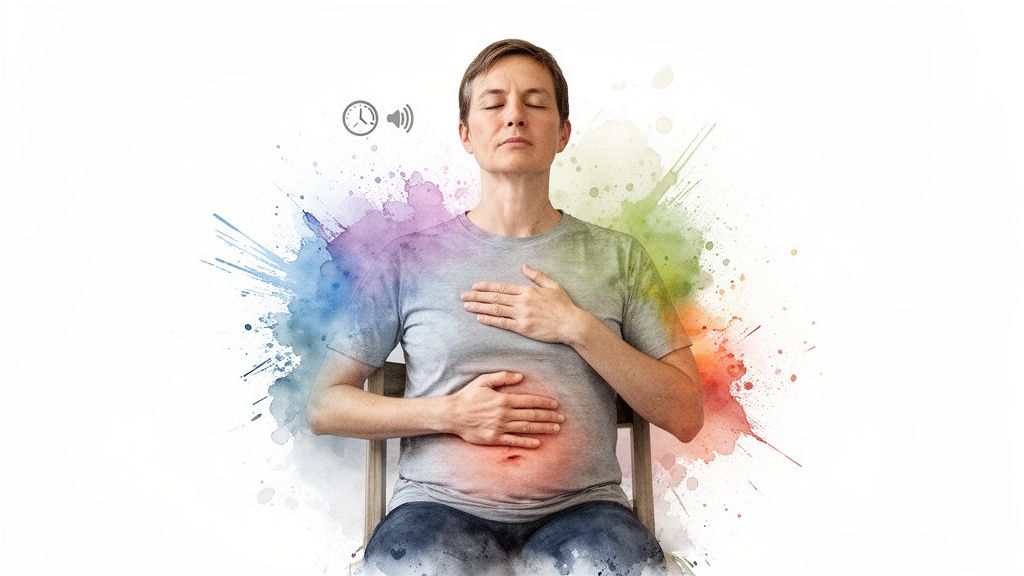
Unlike the shallow chest breathing that often accompanies anxiety, this technique involves engaging the diaphragm, a large muscle at the base of the lungs. By focusing on deep, intentional breaths, you can lower your heart rate, reduce blood pressure, and send a signal to your brain that the perceived danger has passed, providing hope that healing from anxiety is possible.
How to Apply Diaphragmatic Breathing
One of the most effective methods is the 4-7-8 breathing technique, popularized by Dr. Andrew Weil. It serves as a natural tranquilizer for the nervous system.
- Get Comfortable: Sit or lie down in a comfortable position. Place one hand on your belly and the other on your chest to feel the movement.
- Exhale Completely: Gently push all the air out of your lungs through your mouth, making a whooshing sound.
- Inhale Through Your Nose: Close your mouth and inhale quietly through your nose for a mental count of four. Feel your belly expand.
- Hold Your Breath: Hold your breath for a count of seven.
- Exhale Through Your Mouth: Exhale completely through your mouth, making another whoosh sound, for a count of eight.
Key Insight: The power of diaphragmatic breathing lies in its ability to interrupt the physical symptoms of anxiety. By consciously slowing your breath, you are taking direct, physiological action to calm your nervous system.
This technique is not just for panic attacks; practicing it daily builds resilience. Using tools like The Anxiety Checklist to log your practice can help you see a clear connection between consistent breathing exercises and a reduction in your overall anxiety levels, paving the way for a panic-free life.
4. Mindfulness and Meditation
Mindfulness is the practice of paying attention to the present moment without judgment, while meditation is a structured exercise to cultivate that awareness. This approach operates on the principle that you are not your thoughts. By learning to observe anxious thoughts and feelings from a distance, you can break the cycle of reactivity, offering a powerful way to heal from anxiety and live a more peaceful life.
This skill isn't about stopping or ignoring anxious thoughts; it's about changing your relationship with them. Instead of getting swept away by a spiral of worry, you learn to see thoughts as temporary mental events, like clouds passing in the sky. This metacognitive awareness is a transformative anxiety coping skill for adults that reduces the intensity of panic and builds lasting emotional regulation.
How to Apply Mindfulness and Meditation
Integrating mindfulness into your life is a practical skill you can begin developing today. A simple body scan meditation is an excellent starting point.
- Find a Quiet Space: Sit or lie down comfortably in a place where you won't be disturbed for a few minutes. Close your eyes if you feel comfortable.
- Bring Awareness to Your Breath: Simply notice the sensation of your breath entering and leaving your body, without trying to change it.
- Scan Your Body: Slowly bring your attention to different parts of your body, starting from your toes and moving up to your head. Notice any sensations like warmth, tingling, or tension without judging them. If your mind wanders, gently guide it back to the part of the body you are focusing on.
- Practice Non-Judgment: The goal is not to feel a certain way but simply to notice what is present. Treat any distracting thoughts or feelings with gentle curiosity before returning your focus to the body scan.
Key Insight: Mindfulness teaches you that you can experience anxious thoughts and physical sensations without being controlled by them. This creates a crucial space between a trigger and your reaction.
Consistent practice, starting with just 5-10 minutes a day, retrains your nervous system to remain centered even amidst turmoil. Using guided meditations on apps like Calm or Headspace can provide structure as you begin. By tracking your practice and its effects with tools like The Anxiety Checklist worksheets, you can clearly see your progress toward a calmer, more present life.
5. Physical Exercise and Movement
Physical exercise is a powerful, science-backed strategy for managing anxiety. It works on a biological level to counteract the body's stress response by reducing cortisol levels and boosting the production of mood-elevating endorphins. Regular movement effectively "burns off" the adrenaline associated with anxiety, helping to regulate your nervous system and build long-term stress resilience.
This approach offers a proactive way to manage both acute and chronic anxiety. Instead of just reacting to anxious feelings, incorporating movement into your routine provides your body with a natural outlet for nervous energy, creating a sustainable path toward a calmer, more balanced life. It's a fundamental anxiety coping skill for adults that empowers you to physically process stress.
How to Apply Physical Exercise and Movement
Integrating movement into your life doesn't require intense gym sessions. Consistency is more important than intensity.
- Choose an Enjoyable Activity: Select something you genuinely like to ensure you stick with it. This could be a brisk 30-minute walk, a gentle yoga class, cycling, or dancing in your living room.
- Schedule It: Treat exercise like any other important appointment. Block out time in your calendar, even if it's just for 20-30 minutes, to establish it as a non-negotiable part of your day.
- Start Gradually: If you are currently sedentary, begin with low-impact activities like walking. The goal is to build a positive habit, not to burn yourself out. You can increase the duration or intensity over time.
- Track Your Progress: Use a simple journal or The Anxiety Checklist worksheets to note your activity and corresponding anxiety levels. This helps you see the direct correlation and reinforces the positive impact of your efforts.
Key Insight: The goal of exercise for anxiety isn't peak physical performance. It's about using intentional movement to regulate your nervous system and process stress hormones, paving the way for lasting emotional healing.
Beyond the immediate physical benefits, research highlights the profound impact of physical activity on mental well-being. To delve deeper into how movement can specifically counteract anxiety, explore the therapeutic effects of exercise on anxiety. By consistently engaging in physical activity, you are actively building a more resilient mind and body, making it one of the most effective tools for living a panic-free life.
6. Journaling and Expressive Writing
Journaling is a powerful tool for externalizing internal anxiety, transforming chaotic thoughts and feelings into a coherent narrative. Research pioneered by Dr. James Pennebaker on expressive writing shows that translating emotional experiences into language reduces their psychological hold, offering a clear path toward understanding and managing anxiety for a more peaceful life.
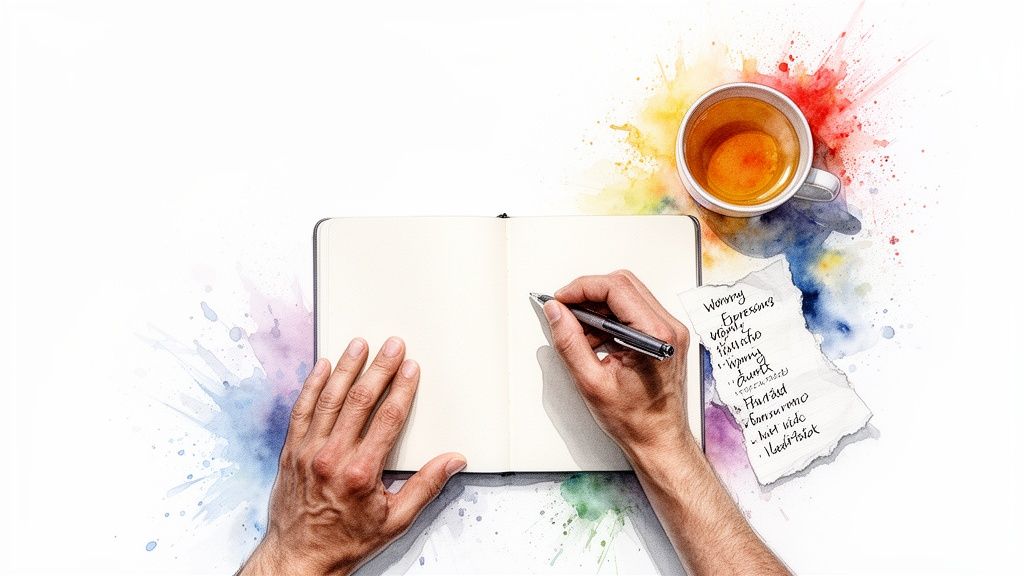
This practice isn't just about recording events; it's about creating psychological distance from your anxious thoughts. By writing them down, you move from being overwhelmed by a feeling to observing it on the page. This simple act of separation diminishes the thought's power and allows for more objective cognitive processing, a vital anxiety coping skill for adults.
How to Apply Journaling
Getting started with journaling is an accessible and immediate step toward clarity. Consistency is more important than length or perfection.
- Start Small and Be Consistent: Dedicate 10-15 minutes each day, perhaps in the morning or before bed. Consistency helps build the habit.
- Use a Structured Format: While free-writing is useful, structured logs can be more effective for anxiety. Try a "worry log" where you note an anxious thought and then write a compassionate, rational response to it.
- Focus on Expression, Not Perfection: Write without censoring or editing your thoughts. The goal is to get the feelings out, not to create a literary masterpiece.
- Review for Patterns: Once a week, review your entries. Look for recurring triggers, themes, or unhelpful thought patterns. This awareness is the first step toward change.
Key Insight: Journaling moves anxiety from a tangled internal mess to an organized external form. This process not only provides immediate relief but also reveals the patterns you need to address for long-term healing.
Using a journal is a proactive way to engage with your anxiety, rather than letting it control you. Integrating this practice with tools like The Anxiety Checklist worksheets can help you track your progress, identify triggers with greater accuracy, and see tangible evidence of how you are retraining your brain for calm.
7. Social Support and Connection
Human connection is a fundamental need, and when it comes to managing anxiety, it’s a powerful buffer against feelings of isolation and overwhelm. Building a strong support network operates on the principle that sharing your burdens makes them lighter. It provides validation, perspective, and practical assistance, reassuring you that you are not alone on your path toward healing from anxiety.
This coping skill isn’t about merely being around people; it’s about fostering genuine, reciprocal relationships where you feel safe to be vulnerable. Whether it's a trusted friend, a support group, or a therapist, connection counteracts the inward-spiraling nature of anxious thoughts, offering a vital external anchor and a clear reminder that a panic-free life is achievable with others by your side.
How to Build Your Support System
Actively cultivating your network is one of the most effective anxiety coping skills for adults. It requires intentional effort but provides immense returns.
- Identify Your Core Support: Make a short list of 1-2 people (a friend, family member, or partner) you trust. These are individuals who listen without judgment.
- Communicate Your Needs Clearly: When you reach out, be specific. Instead of just saying you feel anxious, try, "I'm feeling overwhelmed and just need to vent for a few minutes. I don't need advice, just a listening ear."
- Explore Structured Support: Consider joining an anxiety-specific support group, either in-person or online. Hearing from others with similar experiences can be incredibly validating and reduces stigma.
- Seek Professional Guidance: A therapist or anxiety coach provides a structured, confidential space for support. They offer professional tools and accountability, which is especially crucial for chronic anxiety.
Key Insight: A support system isn't just for crises. Regular, positive check-ins build strong relational foundations, making it easier and more natural to reach out when you truly need help.
Strengthening your social connections disrupts the isolating cycle of anxiety. By using The Anxiety Checklist worksheets, you can track your social interactions and note their impact on your mood, reinforcing the direct link between connection and relief. This practice builds a resilient network that actively supports your journey to a calmer, more connected life.
8. Time Management and Lifestyle Structuring
Chronic anxiety often thrives in an environment of chaos and unpredictability. Implementing deliberate structure through time management and lifestyle adjustments can significantly lower your baseline anxiety levels. This approach operates on the principle that by controlling your environment and routines, you reduce uncertainty and create a predictable foundation that minimizes triggers and builds resilience.
This isn't about creating a rigid, joyless schedule; it's about making intentional choices that support your mental well-being. A key component of this strategy is habit formation, as popularized by thinkers like James Clear. By creating consistent routines for sleep, nutrition, and work, you free up mental energy that would otherwise be spent on decision-making and reacting to stressful situations.
How to Apply Lifestyle Structuring
You can start creating a more anxiety-friendly lifestyle by focusing on a few key areas that have a high impact on your nervous system.
- Establish a Sleep Routine: Go to bed and wake up at the same time every day, even on weekends. This stabilizes your circadian rhythm, which is crucial for emotional regulation. (e.g., Set a "wind-down" alarm for 9:30 PM to start a screen-free routine before a 10:30 PM bedtime.)
- Time-Block Your Day: Use a calendar to schedule your most important tasks, including breaks and meals. This prevents overwhelm by creating a clear, manageable plan. (e.g., Schedule a 90-minute block for a key project, followed by a mandatory 15-minute walk.)
- Prioritize Nutrition: Maintain stable blood sugar by eating regular, balanced meals. Avoid excessive caffeine and processed foods, which can mimic or trigger physiological anxiety symptoms.
- Schedule Self-Care: Make activities like exercise, journaling, or quiet time non-negotiable appointments in your calendar. This ensures they don't get pushed aside when life gets busy.
Key Insight: A structured lifestyle reduces "decision fatigue" and external chaos, creating a stable internal environment that makes it much harder for anxiety to take hold.
This method is a powerful, proactive anxiety coping skill for adults that addresses the root causes of chronic stress. By consistently applying these principles, especially when tracking your progress with tools like The Anxiety Checklist, you build a life that inherently supports calmness and makes a panic-free existence achievable.
9. Grounding and Sensory Techniques
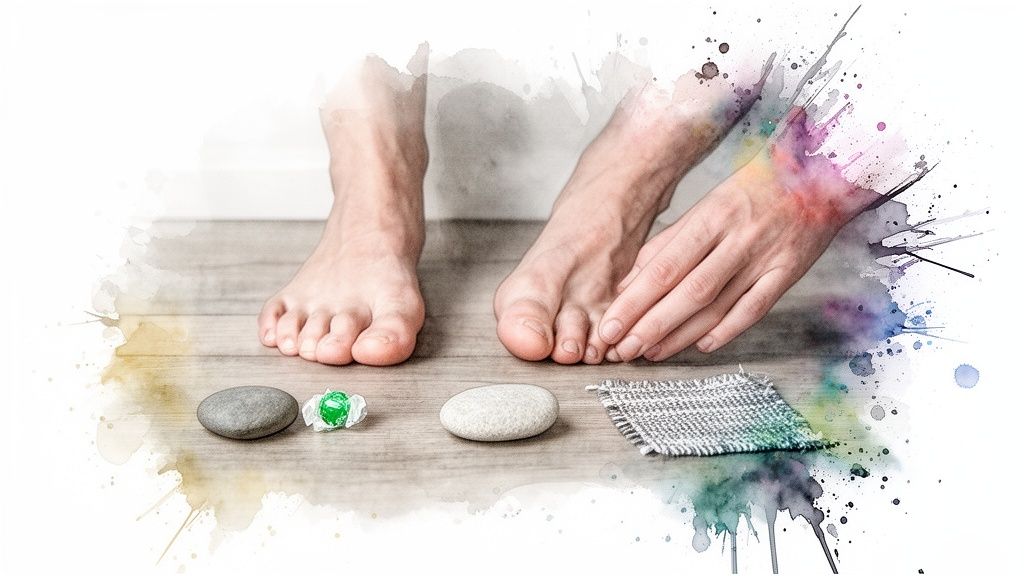
Grounding techniques are powerful, in-the-moment strategies designed to pull you out of the spiral of anxious thoughts or dissociation. They work by anchoring you to the present moment, using your five senses to interrupt the overwhelming internal experience of anxiety and reconnect you with your physical surroundings. This provides immediate relief and a tangible sense of safety, reminding you that you are in control.
These sensory-based methods are particularly effective during moments of escalating panic or when you feel detached from reality. By focusing on external sensations, you disrupt the feedback loop between your anxious thoughts and your body's panic response, offering a clear path toward regaining composure and stability.
How to Apply Grounding Techniques
One of the most recognized and portable grounding techniques is the 5-4-3-2-1 method. It requires no special equipment and can be done anywhere, anytime.
- Acknowledge 5 things you can SEE: Look around and name five distinct objects. Notice their color, shape, and texture. (e.g., I see a blue pen, a crack in the ceiling, a green leaf outside the window, my white computer mouse, a scuff on my shoe.)
- Acknowledge 4 things you can FEEL: Focus on physical sensations. (e.g., I feel the smooth texture of my desk, the fabric of my shirt on my shoulders, the cool air on my skin, my feet firm on the floor.)
- Acknowledge 3 things you can HEAR: Listen carefully to the sounds in your environment, no matter how subtle. (e.g., I hear the hum of the computer, a bird chirping, the distant sound of traffic.)
- Acknowledge 2 things you can SMELL: Take a moment to notice scents in the air. (e.g., I smell the faint scent of coffee, the clean smell of a book's pages.)
- Acknowledge 1 thing you can TASTE: Focus on the taste in your mouth. You can also take a sip of water or have a mint. (e.g., I can taste the lingering flavor of my morning toothpaste.)
Key Insight: Grounding isn't about ignoring or suppressing anxiety. It's about shifting your focus to the concrete reality of the present, which starves the anxiety of the attention it needs to grow.
Consistent practice of these anxiety coping skills for adults builds the muscle of self-regulation, making it easier to deploy them during a crisis. Keeping a small grounding toolkit with a strong mint, a smooth stone, or a scented balm can also be incredibly effective. By tracking your progress and identifying your most effective grounding tools in The Anxiety Checklist, you empower yourself to face anxious moments with confidence and calm.
10. Worry Containment and Acceptance Strategies
Constant worry can feel like a relentless stream that hijacks your attention and drains your energy. Worry containment and acceptance strategies offer a powerful, counterintuitive approach: instead of fighting the worries, you learn to manage your relationship with them. This method gives you control over when you worry and teaches you to coexist with anxious thoughts without letting them dominate your life.
This approach combines two effective techniques. Worry containment, developed by researchers like Thomas Borkovec, involves scheduling a specific, limited time to engage with your worries. Acceptance, a core principle of Acceptance and Commitment Therapy (ACT), involves allowing anxious thoughts to be present without judgment or struggle, which paradoxically reduces their power. Together, they provide a structured way to stop anxiety from ruling your entire day.
How to Apply Worry Containment and Acceptance
Putting these strategies into practice involves creating structure and shifting your mindset from resistance to allowance.
- Schedule a "Worry Time": Designate a specific 15-20 minute period each day to actively worry. Choose a time that is not right before bed. (e.g., 4:30 PM in the living room.)
- Postpone Worries: When an anxious thought arises outside of your scheduled time, acknowledge it and make a note to address it later. (e.g., Think to yourself, "That's a worry for 4:30 PM," and jot down "Worry about project deadline.")
- Use Worry Time Productively: During your scheduled time, review your list. For each item, decide if it's a solvable problem you can take action on or an uncontrollable worry to let go of.
- Practice Acceptance: When anxious feelings persist, instead of fighting them, acknowledge their presence with a simple acceptance statement. (e.g., "I'm noticing the feeling of anxiety, and I can still continue making dinner.")
Key Insight: This strategy isn't about eliminating worry but about containing its impact. By giving worry a designated time and place, you reclaim the rest of your day and learn that you can function effectively even when anxiety is present.
Using these anxiety coping skills for adults helps you break the cycle of constant rumination, offering a clear path toward a more peaceful and present life. Tracking your worries with a tool like The Anxiety Checklist can help you distinguish between productive problem-solving and unhelpful rumination, further empowering you to live a panic-free life.
Comparison of 10 Adult Anxiety Coping Skills
| Technique | 🔄 Implementation Complexity | ⚡ Resource & Time Requirements | 📊 Expected Outcomes | 💡 Ideal Use Cases | ⭐ Key Advantages |
|---|---|---|---|---|---|
| Cognitive Behavioral Therapy (CBT) Techniques (includes Cognitive Reframing) | Moderate–High: structured skill-building; therapist-guided speeds progress | Moderate: worksheets/therapist sessions; weeks–months for durable change | High efficacy for many anxiety disorders; durable cognitive change (4–12 weeks) | Chronic or disorder-specific anxiety, panic, social anxiety, those wanting skill-based change | Evidence-based; targets root causes; sustainable self-management |
| Progressive Muscle Relaxation (PMR) | Low: straightforward sequence to learn | Low: 10–20 min sessions; guided audio optional; quiet space ideal | Immediate physical relaxation; effects temporary unless practiced regularly | Somatic anxiety, tension headaches, pre-sleep routines | Fast physical relief; measurable tension reduction |
| Diaphragmatic Breathing (Deep Belly Breathing) | Low: simple technique but needs repetition to automate | Very low: 2–5 min portable practice; learn in days–weeks | Immediate calming within minutes; improved regulation with daily practice | Acute anxiety/panic, before presentations, on-the-go crises | Fastest-acting for acute symptoms; highly portable |
| Mindfulness and Meditation | Moderate: training and regular practice required | Low-cost tools/apps; 15–30 min/day typical; benefits in 2–8 weeks | Reduces rumination and chronic anxiety; builds meta-awareness over time | Chronic worry, emotion regulation, long-term stress resilience | Sustained emotional regulation; extensive research support |
| Physical Exercise and Movement | Low–Moderate: scalable by fitness level | Low–Moderate: 20–60 min sessions, 3–5× weekly; weeks for full effect | Physiological stress reduction and mood lift; notable by 4–8 weeks | Lifestyle intervention, sleep-related anxiety, building resilience | Dual physical and mental health benefits; accessible and routine-forming |
| Journaling and Expressive Writing | Low: easy to start but needs consistency | Minimal: 10–15 min/day, pen or digital; pattern recognition in 1–2 weeks | Improves insight and cognitive processing; can reduce rumination when structured | Tracking triggers, complementing CBT, emotional processing | Low-cost; increases self-awareness; creates tangible records |
| Social Support and Connection | Moderate: relational effort and maintenance | Variable: time for interactions, groups, or therapy; immediate relief on disclosure | Reduces isolation and normalizes experience; sustained benefit with consistency | Loneliness-driven anxiety, need for validation, accountability | Provides perspective, practical help, low/no-cost options available |
| Time Management and Lifestyle Structuring | Moderate: requires planning, habit change | Low: tools/habit trackers; routine solidifies over weeks (1–4 wks) | Reduces overwhelm and physiological triggers; improves functioning | Overwhelm, chronic stress, sleep-related anxiety | Addresses root lifestyle contributors; prevents crisis escalation |
| Grounding and Sensory Techniques | Low: simple to learn; practice needed for crisis use | Minimal: seconds–minutes; small toolkit optional; deployable anywhere | Immediate interruption of acute anxiety/dissociation; temporary relief | Acute panic, dissociation, moments of escalation | Rapid, portable, multiple personalization options |
| Worry Containment and Acceptance Strategies | Moderate: counterintuitive and discipline-based | Minimal: 15–30 min "worry time" daily; effects in 1–6 weeks | Paradoxical reduction in overall worry; improved functioning despite anxiety | Chronic ruminators, worry-driven anxiety, ACT-oriented clients | Reduces suppression-driven escalation; promotes values-based action |
Building Your Personal Toolkit for a Fearless Life
We've journeyed through a comprehensive collection of evidence-informed anxiety coping skills for adults, from the cognitive power of CBT and the physical release of Progressive Muscle Relaxation to the present-moment awareness of mindfulness. Each strategy represents a potent tool, a distinct instrument you can use to dismantle the architecture of anxiety and build a foundation of resilience.
The path to managing anxiety isn't about finding a single "magic bullet." Instead, it's about becoming a skilled artisan of your own well-being, learning which tool to select for which specific challenge. Deep breathing might be your go-to for calming a sudden surge of panic, while journaling becomes your trusted confidant for untangling chronic worry.
From Knowledge to Mastery: The Power of Practice
Think of this article as your blueprint. The real work, and the real transformation, begins when you put these plans into action. The ultimate goal is not just to survive anxiety, but to build a life where you are in control, where fear no longer dictates your choices or limits your potential. This is not a distant dream; it is an achievable reality built on the foundation of consistent, intentional practice.
Key Takeaway: The most effective anxiety coping skills for adults are not those you simply read about, but those you integrate into your daily life. Consistency transforms a coping technique from a theoretical concept into a reliable, automatic reflex against stress.
True healing and lasting change come from creating a personalized system. This involves experimenting, observing, and refining your approach based on what truly works for you. You are the expert on your own experience.
Your Actionable Next Steps to a Panic-Free Life
Feeling empowered is wonderful, but having a clear plan is what creates momentum. Here’s how you can move forward from this moment with purpose:
- Choose Your Starting Point: Don't try to implement all ten strategies at once. Select just one or two that resonated with you the most. Perhaps it's the 5-4-3-2-1 grounding technique for its immediate, sensory relief, or the simple act of scheduling a daily 15-minute walk.
- Create a Practice Schedule: Integrate your chosen skills into your daily routine. Commit to five minutes of diaphragmatic breathing each morning or use a cognitive reframing exercise every time a specific anxious thought appears. Consistency is more important than intensity.
- Track Your Journey: This is arguably the most crucial step. How will you know what's working? Monitoring your progress provides tangible evidence that your efforts are paying off, which builds motivation and turns abstract hope into concrete confidence. Note your anxiety levels before and after using a skill, identify your common triggers, and celebrate small victories.
This process of self-discovery and consistent application is the very essence of building a fearless life. It’s a journey of courage, compassion, and reclaiming your power one mindful breath, one reframed thought, one courageous step at a time. The path to living panic-free is real, and you now have a map and a compass. Your journey starts now.
Ready to turn these strategies into a structured, actionable plan? The Anxiety Checklist provides the interactive worksheets and tracking tools you need to identify your most effective coping skills and witness your progress in real-time. Start building your personalized toolkit today at The Anxiety Checklist.