
A cognitive distortion is essentially a faulty mental filter. These are predictable, inaccurate thinking habits that unconsciously twist how we see reality, almost always for the worse. They aren't signs of a personal flaw or weakness; they're just common mental shortcuts the brain takes. The problem is, when left unchecked, these shortcuts fuel vicious cycles of anxiety and self-doubt. But here is the most important truth: what has been learned can be unlearned. You have the power to challenge these patterns and heal from anxiety.
What Are Cognitive Distortions, Really?
Imagine you’re trying to navigate a new city, but the map you’re using is wrinkled, smudged, and missing entire streets. You’d get lost, frustrated, and probably pretty stressed out, right? That’s exactly what it’s like to live with cognitive distortions. They’re faulty mental maps that steer our emotions.
These thought patterns are convincing. They can make an anxious interpretation of an event feel like an objective fact. For example, a vague text message suddenly becomes definitive proof that a friend is furious, or a minor mistake at work feels like a career-ending catastrophe. But here’s the most important takeaway, and the real source of hope: you can learn to redraw your mental map.
Recognizing Your Internal Map
The first step is realizing these thought patterns aren't your fault. They are often learned habits the brain adopted as a protective shortcut at some point in your life. By learning to simply spot these distortions as they happen, you start to create a little space between you and the thought. This separation gives you the power to question it.
This isn't about fighting your mind. It’s about becoming a curious, compassionate observer of it. This shift in perspective is the foundation for real change and healing. It’s how you go from being a passenger on a chaotic emotional ride to the driver, capable of steering your thoughts toward a calmer, more balanced reality. A huge part of this is learning how to stop the cycle of overthinking and anxiety that these distortions feed.
The most liberating realization is that you are not your thoughts. Cognitive distortions are just habits of the mind, and like any habit, they can be unlearned and replaced with healthier, more accurate ways of thinking. This is the path to living panic-free.
A Growing Modern Challenge
Interestingly, these unhelpful thinking patterns aren't just an individual struggle—they seem to be a growing societal trend. Research analyzing language in books published over 125 years found a dramatic surge in cognitive distortions, particularly after 1984.
The trend shot up even more sharply after 2007, lining up with major global stressors and the rise of digital life. It just goes to show how common these thought patterns have become. You can read the full research on this historical trend to see the data for yourself.
Knowing this is empowering. It confirms you’re not alone in this, and that the path to a calmer mind involves learning practical, tangible skills. Tools like The Anxiety Checklist are designed to give you a structured way to do just that—to identify and reframe these thoughts, paving the way toward a panic-free future.
How Distorted Thinking Fuels the Anxiety Cycle
Have you ever had a small, fleeting worry suddenly spiral into a full-blown panic attack? That escalation isn’t random. It’s a predictable pattern called the anxiety cycle—a powerful feedback loop where your thoughts, feelings, and body are all tangled up.
Cognitive distortions are the fuel that keeps this engine running at full speed.
But here’s the good news: understanding this cycle is the first step to dismantling it. When you can see exactly how a distorted thought triggers a chain reaction of emotions and physical sensations, you regain the power to step in and break the chain. This isn't just theory; it's a practical roadmap to taking back control and finding lasting relief.
The Chain Reaction of Anxiety
Let's walk through a real-world scenario. Imagine you send an important text to a friend, and hours later… still no reply. For an anxious mind, this is where the cycle can ignite in an instant.
- The Trigger: An ambiguous situation happens (in this case, the unanswered text).
- The Distorted Thought: Your mind doesn't wait for an explanation. It leaps straight to the worst-case scenario—a cognitive distortion known as catastrophizing. You might think, "They're definitely angry with me. I must have said something wrong and ruined our friendship."
- The Emotional Response: That thought isn't just a passing idea; it hits you like a wave of dread, worry, and sadness. Your entire mood shifts based on a conclusion with zero actual evidence behind it.
- The Physical Symptoms: Your body, believing there's a real threat, flips on its internal alarm system. Your heart starts pounding, your palms get sweaty, and you might feel a knot in your stomach or a tightness in your chest. These are classic signs of the body's stress response. (If you want to dig deeper into this, our guide on the fight-or-flight response is a great resource).
- The Misinterpretation: This is where another distortion often kicks in. You feel the physical symptoms and misinterpret them as proof of danger. A thought like, "My heart is beating so fast—I must be having a heart attack!" takes over, which pours gasoline on the fire and intensifies the panic.
This loop—thought, feeling, sensation, misinterpretation—can spin faster and faster, turning a tiny spark of concern into an overwhelming inferno.
But the most hopeful part of understanding this is realizing you can break the chain at any point. By learning to spot that initial distorted thought, you can stop the entire process before it ever gains momentum. This skill is the key to unlocking a panic-free life.
The infographic below shows what it looks like to intercept these thoughts and redraw your mental map.
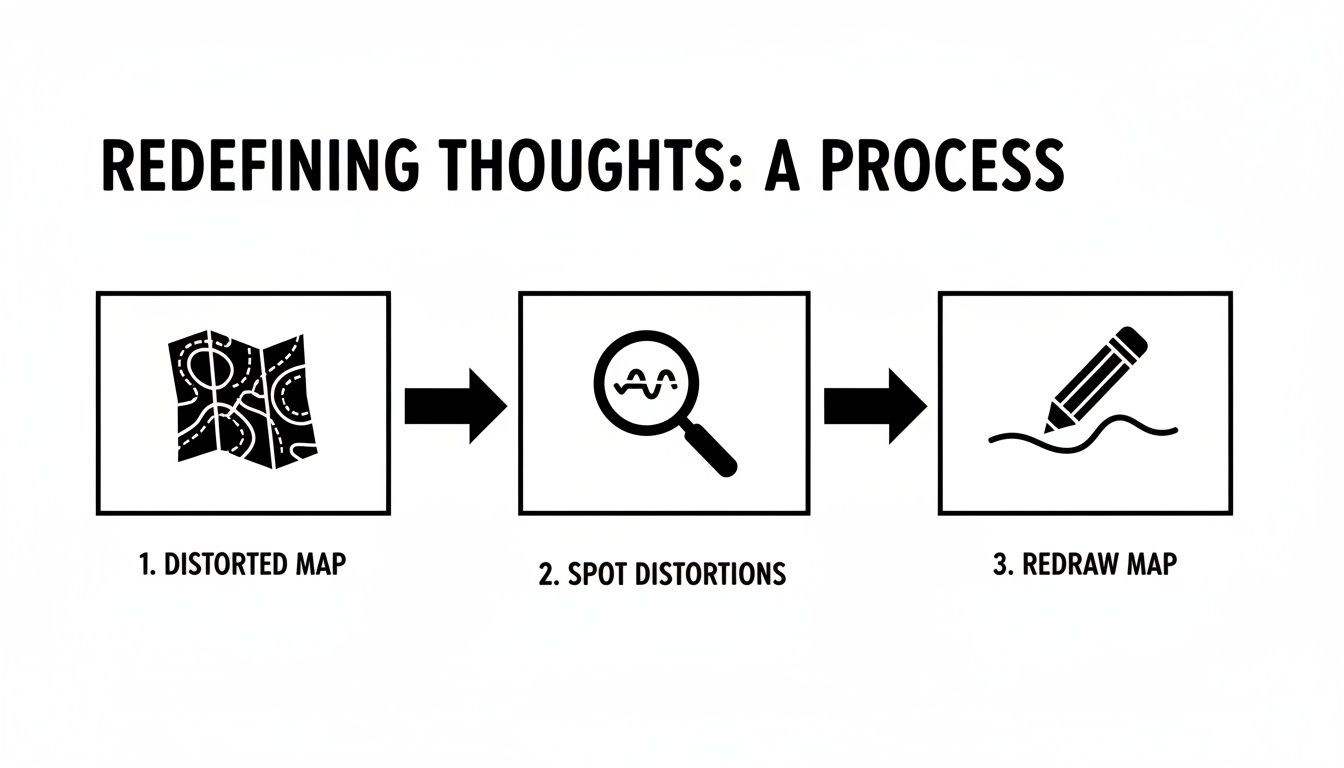
This simple flow illustrates a powerful truth: healing isn’t about trying to stop anxious thoughts from ever appearing. It’s about learning to recognize when your mental map is distorted, spotting the specific errors in thinking, and actively redrawing a more accurate version of reality. Each step is a chance to intervene and take back control.
The 10 Common Thought Patterns That Worsen Anxiety

This is where things usually start to click for people. As we walk through these common thinking traps, you’ll probably see your own thoughts staring back at you. When that happens, don't be alarmed. That moment of recognition is the first, most powerful step toward getting your peace of mind back.
Seeing these patterns clearly is like flipping on a light switch in a dark room. All of a sudden, you can see the mental habits that have been tripping you up all this time. We’re going to break down each distortion with a simple explanation, a real-world anxiety example, and a hopeful, actionable reframe you can use right away.
The goal isn’t to shame yourself for having these thoughts. It's about learning to greet them with awareness and gently guide your mind toward a more balanced, truthful perspective. This is how you start to heal from anxiety and build a panic-free life, one thought at a time.
Here’s a quick overview of the 10 most common cognitive distortions we see in our work with clients struggling with anxiety.
Common Cognitive Distortions and Anxiety-Specific Examples
| Cognitive Distortion | Simple Definition | How It Sounds (Anxiety Example) |
|---|---|---|
| All-or-Nothing Thinking | Seeing things in absolute extremes—perfect or terrible, success or failure. | "I missed one workout, so my entire fitness plan is ruined. I might as well give up." |
| Overgeneralization | Turning one negative event into a never-ending pattern of defeat. | "I stumbled over my words in that meeting. I'm always so awkward in public." |
| Mental Filter | Focusing on a single negative detail while ignoring all the positives. | "My boss praised my project but suggested one change. He must think the whole thing was terrible." |
| Disqualifying the Positive | Actively rejecting positive experiences, insisting they "don't count." | "They complimented my work, but they're just being polite. They don't really mean it." |
| Jumping to Conclusions | Making negative assumptions without evidence (Mind Reading, Fortune Telling). | "I know I'm going to mess up this job interview. I can just feel it." |
| Magnification/Minimization | Blowing negative things out of proportion or shrinking positive ones. | "I made a typo in that email. Everyone is going to think I'm incompetent." |
| Emotional Reasoning | Believing something must be true because you feel it so strongly. | "I feel so anxious right now. Something terrible must be about to happen." |
| "Should" Statements | Using rigid rules like "should" or "must," leading to guilt and frustration. | "I should be able to handle this without feeling anxious. What's wrong with me?" |
| Labeling | Attaching a negative, global label to yourself based on one mistake. | "I forgot that appointment. I'm such an idiot." |
| Personalization | Blaming yourself for negative events that are not entirely your fault. | "My child got a bad grade. This is all my fault. I'm a terrible parent." |
Recognizing your own thought patterns in this table is a huge win. It means you’re already becoming more aware. Now, let’s dig a little deeper into each of these traps so you can start calling them out when they appear.
1. All-or-Nothing Thinking
This is also known as black-and-white thinking. It’s the habit of seeing everything in absolute extremes. A situation is either perfect or a total disaster. You're either a complete success or an utter failure. There's no room for nuance or a middle ground.
- Anxiety Example: After missing a single workout, you think, "My entire fitness plan is ruined. I might as well just give up completely."
- Hopeful Reframe: "One missed day doesn't erase my progress. I can get back on track with my next scheduled workout. Consistency over perfection is my goal."
2. Overgeneralization
This pattern takes one single negative event and blows it up into a never-ending cycle of defeat. You start using words like "always," "never," or "every time" based on just one piece of evidence. It’s like seeing one rain cloud and assuming it’s going to storm for the rest of your life.
- Anxiety Example: You stumble over a few words during a presentation and think, "I'm always so awkward. I can never speak well in public."
- Hopeful Reframe: "I felt nervous during that one part of the presentation, but I got through it. What's one specific thing I can practice to feel more confident next time?"
3. Mental Filter
The mental filter is like wearing a pair of sunglasses that only lets you see the negative stuff. You could have 100 positive things happen in a day, but you'll latch onto the one thing that went wrong. That single negative detail gets magnified until it completely blots out all the good.
- Anxiety Example: You receive positive feedback from your boss on a project but fixate on one minor suggestion for improvement, thinking, "He must think the whole thing was terrible."
- Hopeful Reframe: "It's great that my boss liked the project overall. This one piece of feedback is helpful advice to make my next project even stronger."
4. Disqualifying the Positive
This is the mental filter’s more destructive cousin. Instead of just ignoring positive things, you actively reject them. You tell yourself they "don't count" for some made-up reason. A compliment is just someone "being nice." An achievement is written off as "pure luck."
- Anxiety Example: Someone praises you for your hard work, and you think, "They're just saying that to be polite. They don't really mean it."
- Hopeful Reframe: "I'm going to accept this compliment at face value. I worked hard, and it's okay to feel proud of my effort."
5. Jumping to Conclusions
This trap involves making negative interpretations without any actual facts to back them up. It usually shows up in two classic forms: mind reading and fortune telling.
Mind Reading: You assume you know what other people are thinking—and it's always negative. You don't bother checking if you're right; you're already convinced.
Fortune Telling: You predict that the future will be awful, treating your anxious forecasts as if they're already set in stone.
- Anxiety Example (Mind Reading): Your friend seems quiet, and you immediately think, "She's definitely mad at me for something I did."
- Anxiety Example (Fortune Telling): You have a job interview next week and think, "I'm going to mess it up. I know I won't get the job."
- Hopeful Reframe: "I can't know what someone else is thinking. I'll ask my friend if everything is okay. For the interview, I'll prepare as best I can and focus on showing them what I can do."
6. Magnification and Minimization
Often called the "binocular trick," this is where you either blow things way out of proportion (magnification) or shrink their importance until they seem tiny (minimization). You might magnify a small mistake into a life-altering catastrophe. On the flip side, you might minimize a real accomplishment until it feels completely insignificant.
- Anxiety Example: You make a small typo in an email and think, "This is a catastrophe! Everyone will think I'm incompetent."
- Hopeful Reframe: "It was a small typo that most people probably won't even notice. I can be more careful next time, but it’s not a reflection of my overall ability."
7. Emotional Reasoning
This is the sneaky belief that because you feel something, it must be true. Your emotions become your evidence for reality. It sounds like, "I feel anxious, therefore I must be in danger," or "I feel overwhelmed, so my life must be unmanageable."
- Anxiety Example: You wake up with a feeling of dread and think, "I feel like something terrible is going to happen today, so it must be true."
- Hopeful Reframe: "Feelings are not facts. This is just anxiety talking. I can acknowledge the feeling without letting it dictate my day."
8. "Should" Statements
This is the inner critic who loves using words like "should," "must," "ought," and "have to." When you direct these statements at yourself, they create a mountain of guilt and frustration. When you aim them at others, they lead to anger and resentment.
- Anxiety Example: You think, "I should be able to handle this without feeling anxious. What's wrong with me?"
- Hopeful Reframe: "There is no 'should' about feelings. It's okay that I feel anxious right now. I can be patient with myself as I work through this."
9. Labeling and Mislabeling
This is an extreme, toxic form of overgeneralization. Instead of describing an error you made, you slap a negative, all-encompassing label on yourself or someone else. It's the difference between saying, "I made a mistake," and declaring, "I am a failure."
- Anxiety Example: After forgetting an appointment, you think, "I'm such an idiot. I can't do anything right."
- Hopeful Reframe: "I made a mistake by forgetting that appointment. I'm human. I'll set a reminder so it doesn't happen again."
10. Personalization
Personalization is when you take the blame for something that isn't entirely your fault. You see yourself as the sole cause of a negative event that you had little or no control over.
- Anxiety Example: Your child gets a bad grade, and you think, "This is all my fault. I'm a terrible parent."
- Hopeful Reframe: "There are many factors that affect a child's school performance. I'll talk with them to understand what's going on and see how I can support them."
If these thought patterns feel intensely familiar, you're in good company. Research has shown that distortions like fortune telling and mind reading were found in nearly 100% of study participants with mental health challenges, and the average prevalence across all distortion types was over 90%. You can discover more insights about these prevalence rates and see just how universal this experience is.
This data isn't meant to be discouraging; it’s proof that you are far from alone in this. What you're experiencing is a known, treatable pattern. Recognizing these thoughts for what they are—glitches, not facts—is the first step toward your freedom.
Where Do These Thinking Habits Come From?
Cognitive distortions don’t just pop up out of nowhere. These deeply rooted thinking habits aren't signs of weakness or personal flaws; they're usually outdated survival strategies your brain learned a long time ago. Once you understand their origins, you can start to let go of the shame that keeps you stuck and realize you have the power to unlearn them.
Think of your brain as a brilliant survival machine. When you were younger or going through a period of intense stress, it created mental shortcuts to try and protect you. For instance, a child raised in a highly critical environment might have learned to personalize negative events, thinking, "It's always my fault." This wasn't about self-pity; it was a desperate attempt to make sense of the chaos and feel some sense of control.
At the time, these patterns felt useful. They helped you navigate difficult, painful experiences. The problem is that the brain holds onto these strategies long after the original threat has passed, applying them to new, safer situations where they just don't fit anymore.
Learned Patterns from Key Life Stages
These thinking habits often take root during specific, high-pressure periods when we're most vulnerable and our brains are still developing.
- Childhood Experiences: Early family dynamics, constant criticism from caregivers, or traumatic events can lay the foundation for these distorted patterns.
- Adolescence and Young Adulthood: The intense pressure to fit in, succeed academically, and figure out who you are makes this a prime time for distorted thinking to become deeply entrenched.
- Major Life Stressors: Big events like a job loss, the end of a relationship, or a health crisis can trigger or strengthen these patterns as your brain defaults to old, familiar coping mechanisms.
Research backs this up, showing that these thought patterns are particularly intense during the teenage and early adult years. One study on social media use found that cognitive distortions were highly concentrated in adolescents and young adults—the exact time people are navigating huge life transitions and immense social pressures. You can read more about the connection in this research on distorted thinking across age groups.
When you reframe these thoughts as outdated coping mechanisms instead of core parts of who you are, you shift from self-blame to self-compassion. This is the crucial first step toward healing. You are not broken; you just learned a set of mental habits that no longer serve you.
This compassionate perspective is everything. It validates your struggle and gives you the power to start building new, healthier habits. Digging into the common causes of anxiety can offer even more clarity on how these patterns form.
Here's the most hopeful truth of all: what has been learned can be unlearned. You absolutely have the capacity to recognize these old survival strategies, thank them for trying to protect you, and gently replace them with more accurate, balanced ways of thinking. This is how you build a life that supports you now—a life with less anxiety and a lot more freedom.
Practical CBT Strategies to Reframe Your Thoughts

Spotting your cognitive distortions is a huge first step. But the real, lasting change happens when you start doing something about them. This is where you roll up your sleeves and learn to actively reshape the thought patterns that have been fueling your anxiety.
Using proven strategies from Cognitive Behavioral Therapy (CBT), you can start building new mental habits that lead to a calmer, more grounded perspective.
This isn't about fighting a war with your own mind or trying to force anxious thoughts away. Think of it more like becoming a skilled detective. You're learning to calmly examine the evidence for your thoughts, see them for what they are, and gently guide your mind toward what’s actually true.
The techniques we’re about to cover are practical, learnable, and incredibly empowering. They give you a structured way to step in when the anxiety cycle kicks off, allowing you to dismantle it before it ever gains momentum. This is the roadmap to healing from anxiety and living panic-free.
The Four-Step Method to Restructure Your Thoughts
One of the most effective ways to tackle a cognitive distortion is with a simple but powerful four-step process. Treat it like a mental checklist you can pull out whenever you notice an anxious thought starting to spiral.
- Catch It: The first job is just to notice the thought. Become aware of the automatic negative thought as it pops into your head, without judging it. Just acknowledge its presence.
- Check It: Next, hit the pause button and investigate. Ask yourself, "What specific cognitive distortion is at play here?" By naming the pattern (like Catastrophizing or All-or-Nothing Thinking), you create distance. You start to see it as a mental habit, not an undeniable fact.
- Challenge It: This is where you put the thought on trial. Look for evidence that proves it wrong. Ask yourself, "Is this 100% true? What’s a more realistic way of seeing this?"
- Change It: Finally, you create a new, more balanced and compassionate thought to take the place of the distorted one. This isn't about slapping on a fake positive statement; it's about finding a perspective that’s actually grounded in reality.
This systematic approach takes the mystery out of reframing your thoughts, turning it into a skill you can practice and sharpen over time. Every single time you walk through these four steps, you're actively rewiring your brain for resilience.
Putting It Into Practice: The Courtroom Technique
To make the "Challenge" step feel less abstract, you can use a powerful exercise known as the Courtroom Technique. This method transforms you from a passive victim of your thoughts into an impartial judge on a mission for the truth.
Imagine your anxious thought is the one on trial. Your job is to play the part of both the prosecutor and the defense attorney. This structure helps strip away the emotional charge and lets you evaluate the thought on its merits.
How the Courtroom Technique Works
Let’s say the anxious thought on trial is: "I'm going to fail my presentation, and everyone will think I'm incompetent."
- Step 1: The Prosecutor's Case: First, gather all the "evidence" that supports this anxious thought. Write it all down. Your list might include things like, "I felt nervous the last time I did this," or "One of my slides isn't perfect."
- Step 2: The Defense Attorney's Case: Now, it's time to switch sides. Your job is to argue against the thought. Gather all the evidence that contradicts it. This list could include, "I've given plenty of successful presentations before," "I know this material inside and out," and "My boss trusted me with this project for a reason."
- Step 3: The Judge's Verdict: Finally, as the judge, you review the evidence from both sides. Is the initial thought really a fact, or is it just one possible—and likely distorted—interpretation? A fair verdict would likely sound something like this: "While I feel nervous, the evidence clearly shows I am prepared and capable. It is highly unlikely that I will 'fail,' and even a small mistake does not make me incompetent."
This technique systematically pulls the cognitive distortion apart, replacing it with a conclusion based on balanced evidence, not just raw emotion.
The goal of CBT isn't to eliminate negative thoughts entirely—that’s impossible. It's to shrink their frequency and, more importantly, their power over you. It's about learning to steer your thoughts instead of letting them steer you.
These practical strategies are the heart of effective anxiety management. CBT is a powerful tool for reframing distorted thoughts, and it's especially effective for specific issues like social anxiety. For anyone looking to dig deeper, there are fantastic resources explaining how cognitive behavioural therapy for social anxiety can help you break free.
And if you’re looking for a deeper dive into these methods, our guide on understanding CBT for anxiety offers even more detail on how these principles work in the real world.
Tools like The Anxiety Checklist are designed to make this whole process even easier. The structured exercises literally walk you through these reframing techniques, giving you prompts to help you catch, check, challenge, and change your thoughts consistently. This kind of support turns a theory into a daily practice—an essential step on your path to a life free from panic.
Your Path Forward to a Calmer Mind
This whole journey starts with one powerful, game-changing realization: you are not your thoughts. Cognitive distortions aren't permanent parts of who you are; they're just well-worn mental habits. And habits can be changed.
The path to a calmer, more present life isn't about some dramatic overnight transformation. It's about small, consistent steps forward. Start with just one thing today: notice a single thought without judging it. That's it. That's the first step.
A life with less anxiety and more freedom isn't some far-off dream. It's an achievable reality you build one moment at a time. Every distorted thought you challenge is a concrete step in that direction.
Think of a tool like The Anxiety Checklist as a supportive guide, giving you a bit of structure as you start building these new mental muscles. As you practice, you'll find that seeing things from a more balanced perspective starts to feel less like work and more like your new normal. For those moments when anxiety spikes, learning a few grounding techniques for anxiety can be a real lifesaver.
And for anyone who feels a pull to go deeper—maybe to help others or just to formalize their own understanding—exploring something like an online mental health certificate can offer some incredibly valuable frameworks.
But ultimately, the power to redraw your own mental map is right where it's always been: in your hands, one thought at a time.
Frequently Asked Questions
When you start digging into cognitive distortions and how to challenge them, a few practical questions almost always come up. Getting clear on the answers can make all the difference, helping you feel more confident that what you're experiencing is both normal and manageable.
Can I Get Rid of Cognitive Distortions Completely?
The short answer is no, and that’s actually okay. The goal isn’t to erase these thoughts entirely—they’re a natural, universal part of the human experience. Nobody has a perfectly "clean" mind.
The real aim is to dial down their frequency and, more importantly, strip them of their power over you. Think of it like learning to drive; you don’t get rid of other cars on the road, you just learn how to navigate around them safely. This is about skillful management and building resilience, not a battle for some imaginary state of perfection. It is absolutely possible to reduce their impact so significantly that you can live free from panic.
How Long Does It Take to See a Difference?
This is a bit like asking how long it takes to get in shape. It really depends on where you’re starting from and how consistently you practice. Some people start feeling small but meaningful shifts in their mindset within a few weeks. For others, it might take a bit longer.
The key ingredients here are patience and consistency. Every single time you catch and challenge a distorted thought, you’re strengthening a new, healthier neural pathway in your brain. It's crucial to celebrate the small wins, because each one is a genuine step toward a calmer, more empowered life.
What If I Struggle to Identify My Own Distorted Thoughts?
Don't worry, this is completely normal. When you first start out, trying to spot your own cognitive distortions can feel like a fish trying to see the water it's swimming in. It’s hard to get perspective when you’re right in the middle of it.
This is where a structured tool like a thought record can be a game-changer. It gives you prompts that walk you through the process, making it much easier to untangle your thoughts.
If you still feel stuck, talking it over with a therapist trained in CBT can provide that outside perspective you need. They’re skilled at spotting patterns you might miss and can offer personalized guidance, reinforcing the hopeful truth that you absolutely can learn to manage your thoughts and find relief from anxiety.
Ready to start redrawing your mental map? The tools in The Anxiety Checklist are designed to give you a clear, structured path to follow. Take the first step toward a calmer, more fearless life by exploring the complete system at https://anxietychecklist.com.