
The core difference between panic disorder and anxiety is pretty straightforward when you break it down. Anxiety is like a persistent, low-grade hum of worry—it builds gradually and can stick around for a while. A panic attack, on the other hand, is a sudden, piercing alarm that blares without warning and hits its peak within minutes.
Figuring out whether you're dealing with a slow burn or a flash fire is the key to choosing the right path toward healing and a calmer, more peaceful life.
Anxiety and Panic: A Clear Side-by-Side Comparison
Understanding the line between generalized anxiety and panic disorder is the first real step toward getting the right kind of help. It’s easy to mix them up because both involve fear and discomfort, but they operate on completely different timelines and intensity levels.
Getting clear on the distinction isn’t about slapping on a scary label. It’s about gaining the clarity you need to use the right tools to reclaim your peace of mind and live a life unburdened by fear.
Think of it like this: feeling your stomach in knots for days before a big work presentation is anxiety. Your heart might beat a little faster, and the worry is tied to a specific, identifiable stressor.
Now, imagine you’re just walking through the grocery store on a Tuesday afternoon when a tidal wave of terror hits you out of nowhere. Your chest seizes up, and you’re absolutely convinced you’re dying. That sudden, seemingly random explosion of intense fear is the signature of a panic attack—the defining feature of panic disorder.
The Core Distinctions at a Glance
For a quick visual, this chart boils down the fundamental difference between the slow, simmering nature of anxiety and the abrupt, overwhelming burst of panic.
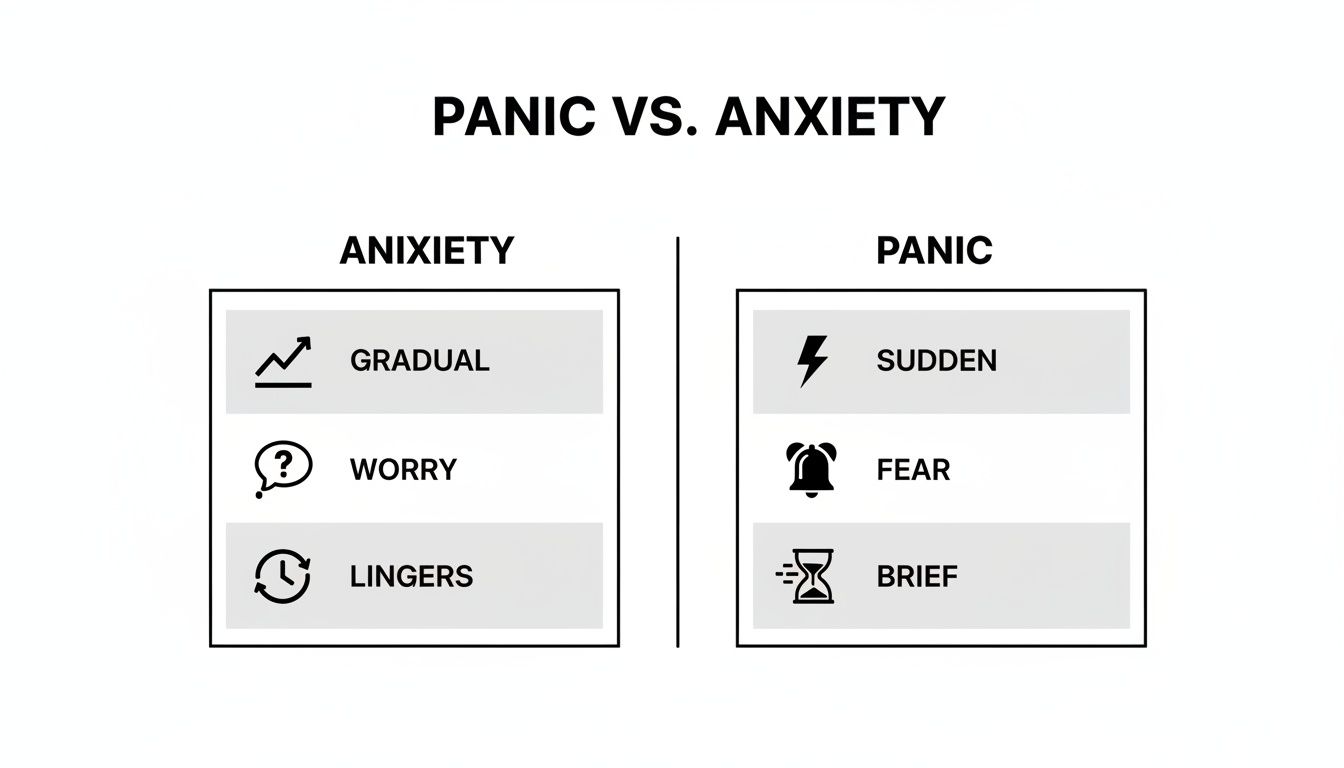
As you can see, anxiety is all about that gradual onset and lingering worry. Panic is defined by its suddenness and brief, but incredibly intense, fear.
If this sounds familiar, you're far from alone. The National Institute of Mental Health (NIMH) reports that about 2.7% of U.S. adults have dealt with panic disorder in the past year. That’s nearly 6 million people.
Here's the most important thing to remember: both anxiety and panic are highly treatable. Once you can identify your specific experience, you can shift from feeling overwhelmed by confusing symptoms to feeling hopeful and confident in your ability to heal.
To make these differences even clearer, let's break them down in a simple table.
Quick Guide: Panic Disorder vs. Generalized Anxiety
This table provides a side-by-side summary of the core differences between generalized anxiety and panic disorder, looking at how they start, how long they last, how intense they feel, and what the primary focus of the fear is.
| Feature | Generalized Anxiety | Panic Disorder |
|---|---|---|
| Onset | Builds up gradually, often in response to real or perceived stressors. | Strikes suddenly and unexpectedly, often with no obvious trigger. |
| Duration | Can be persistent, lasting for days, weeks, or even months. | The intense peak usually lasts only a few minutes, subsiding in 20-30 minutes. |
| Intensity | A chronic, nagging feeling of dread, tension, and worry. | An overwhelming, terrifying, and debilitating wave of fear and physical symptoms. |
| Primary Focus | Worry is directed outward—at future events, finances, health, or relationships. | Fear is directed inward—at the terrifying physical sensations themselves or the fear of having another attack. |
While these conditions are distinct, they are part of a broader family of challenges. To see how they all fit together, you might find it helpful to read our guide on the different types of anxiety disorders. Knowing is the first step toward healing.
The Science Behind Why Panic and Anxiety Feel So Different
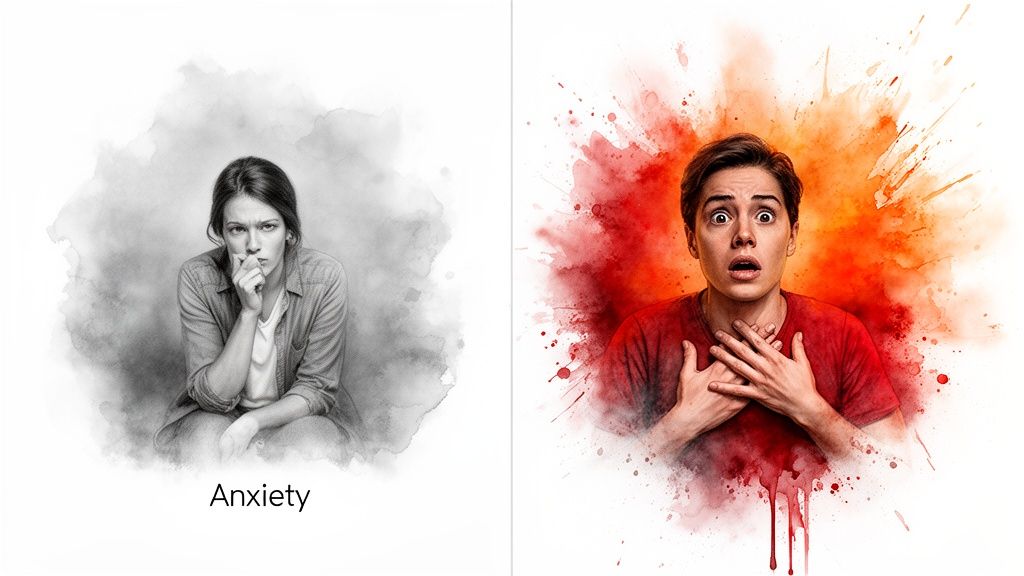
To really get the difference between anxiety and panic, we have to look under the hood at what’s happening in your brain and body. This isn't about willpower or a personal failing; it’s biology. Once you grasp the science, you can start seeing these experiences as understandable—and most importantly, manageable—biological processes that you can learn to control.
Chronic anxiety essentially keeps your brain’s fear center, the amygdala, on a constant low-level alert. Think of the amygdala as your body's smoke detector. When you have generalized anxiety, that detector is way too sensitive. It's constantly picking up faint signals of potential threats, keeping your nervous system simmering.
This is what creates that familiar grind of anxiety—the muscle tension, the fatigue, the racing thoughts. Your body is perpetually braced for a danger that never quite arrives, which is both physically and mentally exhausting.
Anxiety: A State of Persistent Overdrive
When anxiety becomes your default state, your brain gets stuck in a feedback loop that you can absolutely learn to interrupt. The amygdala continuously bombards your prefrontal cortex—the part of your brain that handles planning and decision-making—with "worry" signals.
This never-ending crosstalk keeps you tangled up in "what if" scenarios, making it almost impossible to relax or focus on what’s right in front of you. Your body is simply responding to a psychological state of readiness, which is why the symptoms feel so persistent.
This simmering, long-burn state is worlds away from the sudden, overwhelming surge of a panic attack. That's a much more dramatic biological event.
Panic: The Body's False Alarm
A panic attack, the defining feature of panic disorder, is a different beast entirely. It’s a sudden, powerful, and often misinterpreted activation of your body's core survival system.
This isn’t your smoke detector being a little sensitive. This is the full-blown fire alarm, sprinklers, and emergency broadcast system going off at maximum volume—even when there’s no fire. Your body is utterly convinced you're in mortal danger and acts accordingly.
A panic attack is your body's 'fight-or-flight' response firing at the wrong time. It’s a powerful survival mechanism designed to save you from immediate physical threats, but in panic disorder, this system gets hijacked and triggers a false alarm. The good news is, you can learn to rewire this alarm system.
This sudden activation unleashes a tidal wave of adrenaline, causing the terrifying physical symptoms. Getting this is a huge step toward recovery. You can learn more about this reaction in our detailed guide to the fight-or-flight response.
The catastrophic thoughts that come with it—"I'm having a heart attack," "I'm losing my mind," or "I'm going to die"—are just your brain's desperate attempt to make sense of the intense physical chaos.
Reframing the Sensations for Recovery
Knowing the science behind these experiences is incredibly empowering. It allows you to reframe what’s happening in your body and mind, which is a critical part of healing.
- Heart Palpitations: That's not a heart attack. It's just adrenaline preparing your heart to pump blood so you can flee a perceived threat.
- Dizziness or Lightheadedness: This is caused by changes in your breathing and blood flow as your body redirects resources to your major muscles for action.
- Feelings of Detachment: This is a protective mechanism called depersonalization. Your brain is trying to distance you from an experience it finds overwhelmingly scary.
When you understand these connections, you can start to see the symptoms for what they truly are: predictable, harmless (though deeply uncomfortable) biological glitches. This knowledge is your first and most powerful tool for dismantling the fear of the fear itself. It turns a terrifying mystery into a solvable problem.
A Detailed Symptom Analysis
To really get the difference between panic disorder and general anxiety, we need to go deeper than just textbook definitions. It’s about looking at how the symptoms actually show up in your body and mind. Getting clear on these specifics is the first real step toward figuring out what you're dealing with and, more importantly, how to start feeling better.
This isn't just about labeling your experience for the sake of it. When you can pinpoint a racing heart as a classic panic symptom or persistent tension as a hallmark of anxiety, you strip away some of its power. That terrifying sensation starts to feel less like a sign of impending doom and more like a predictable pattern—and patterns can be managed and overcome.
The Slow Burn of Anxiety Symptoms
The symptoms of generalized anxiety are often defined by their chronic, simmering nature. They don't just appear out of nowhere in a dramatic burst. Instead, they become a persistent, draining background noise to your daily life.
Think of someone weeks away from a major exam. They might feel a constant, low-grade sense of dread that makes it tough to focus, sleep, or even just sit still. That's a perfect real-world picture of how anxiety often works.
Key symptoms of anxiety often include:
- Persistent Worry: A nagging feeling of apprehension about the future—finances, health, relationships—that feels nearly impossible to shut off.
- Muscle Tension: That chronic tightness in your shoulders, neck, or jaw that leads to aches and pains you can't otherwise explain.
- Fatigue and Sleep Issues: Feeling completely wiped out, even after a full night's sleep, or struggling with insomnia because your mind just won't stop racing.
- Irritability and Restlessness: A constant on-edge feeling, like your internal motor is stuck in high gear, making you easily annoyed or unable to relax.
The Sudden Storm of Panic Disorder Symptoms
Panic disorder, on the other hand, is all about recurrent, unexpected panic attacks. These are abrupt, intense waves of fear that peak within minutes and feel utterly overwhelming. The symptoms are so severe that many people first rush to the emergency room, convinced they're having a heart attack or some other medical catastrophe.
Someone could be doing something as mundane as grocery shopping, feeling perfectly fine one moment, and then a tidal wave of terror hits them the next. Their heart pounds, the world feels strange and unreal, and an overpowering urge to escape takes over. This sudden, out-of-the-blue intensity is the signature of a panic attack.
According to the DSM-5, a panic attack involves at least four of these symptoms:
- Heart Palpitations: A pounding, racing heartbeat that feels frighteningly out of control.
- Shortness of Breath: A sensation of smothering or feeling like you just can't get enough air.
- Chest Pain or Discomfort: Often so intense it's mistaken for a cardiac event.
- Trembling or Shaking: Uncontrollable shaking, especially in the hands.
- Derealization or Depersonalization: A disturbing feeling of detachment from yourself or your surroundings, as if you're watching a movie.
- Fear of Losing Control or Dying: An overwhelming conviction that something catastrophic is about to happen.
This experience is so terrifying that it often creates a deep-seated fear of having another one—a core feature of panic disorder itself. To get a better sense of this, you can learn more about what happens during a full-blown panic attack.
Comparing Symptoms Head-to-Head
Global statistics highlight just how different the prevalence of these conditions is. Anxiety disorders are incredibly common, affecting about 4.4% of the world's population, which was 359 million people back in 2021. Panic disorder is far less widespread, with a lifetime prevalence of around 1.7% to 2.7%. This data, provided by the World Health Organization, makes it clear that while they might feel related, they are distinct conditions impacting people on very different scales.
To really nail down the differences, let's put the physical and cognitive symptoms side-by-side.
Symptom Breakdown Physical vs Cognitive
The way anxiety and panic feel can be worlds apart. While one is a persistent hum of unease, the other is an all-out alarm. This table breaks down the common physical and cognitive symptoms to make the distinction clearer.
| Symptom Type | Common in Generalized Anxiety | Common in Panic Attacks |
|---|---|---|
| Physical | Muscle tension, fatigue, headaches, restlessness, digestive issues. | Pounding heart, chest pain, sweating, shaking, shortness of breath, dizziness, chills or hot flashes. |
| Cognitive | Persistent "what if" thoughts, difficulty concentrating, constant worry. | Intense fear of dying, losing control, or "going crazy"; feelings of detachment from reality. |
Understanding these differences is the first step toward regaining control. It shows that what you're experiencing, no matter how scary, follows a known pattern. And once you see the pattern, you can start to manage it, and eventually, change it for good.
Understanding Triggers and How Cycles Begin
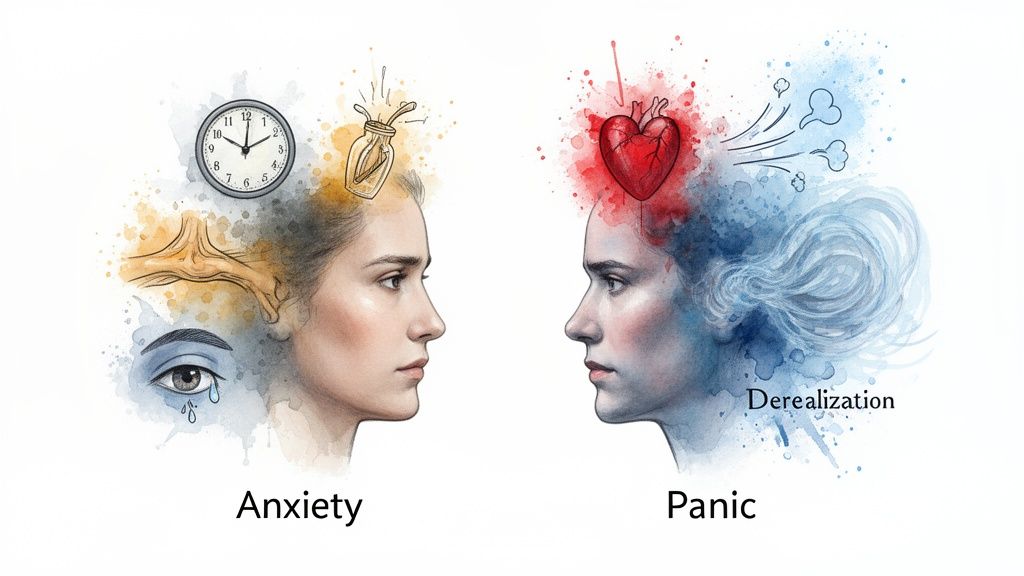
If you want to break the cycle and get back in the driver's seat, you first need to know what’s setting off your anxiety or panic. While both can feel completely chaotic, they actually follow predictable patterns. This isn’t meant to scare you—it’s meant to empower you. Healing isn't about fighting some unpredictable monster; it's about learning to interrupt these cycles so you can live a panic-free life.
For generalized anxiety, the triggers are often broad and build on each other. Think of it as a slow, simmering stress that gradually boils over, rather than a sudden explosion.
Panic disorder, on the other hand, has a much sharper and more powerful trigger cycle. It’s often kicked off by the sheer terror of that very first attack. Once that happens, your brain can become hyper-vigilant, creating a feedback loop that feels debilitating but is absolutely breakable.
The Slow Buildup of Anxiety Triggers
Anxiety tends to draw its fuel from the persistent, everyday grind. It’s less about one dramatic event and more about the cumulative weight of ongoing worries.
Imagine a dripping faucet. A single drop is nothing, but over time, it can fill a bucket until it overflows. That overflow is the heightened state of anxiety you’re feeling.
Common triggers for generalized anxiety often include:
- Life Stressors: Ongoing financial pressure, a demanding job, or conflicts in your relationships can keep your nervous system stuck on a low-level alert.
- Health Concerns: Chronic worry about your own health or a loved one's can feed a relentless cycle of "what if" thinking.
- Habitual Patterns: Even small habits like too much caffeine or not getting enough sleep can contribute to a constant feeling of unease.
These triggers are often so woven into the fabric of daily life that they can be tough to spot. To start pinpointing your own patterns, you can explore our detailed guide to common anxiety triggers.
The Panic Cycle: Fear of the Fear Itself
The trigger pathway for panic disorder is often much more specific and internally focused. While the first panic attack might feel like it came out of nowhere, the ones that follow are frequently set off by one of two things: a specific situation or an internal bodily sensation.
But the most powerful trigger of all? The intense fear of having another attack. This "fear of fear" is the engine that drives the cycle of panic disorder, often leading to avoidance of places or activities you once loved.
You are not broken or weak for experiencing this. You are having a perfectly understandable reaction to a terrifying biological false alarm. The key is learning to recognize the alarm for what it is—a glitch in the system, not a real threat. This is a skill you can learn, and it is the foundation of recovery.
This unique cycle is precisely why the medical community formally separated panic disorder from broader anxiety in the DSM-III back in 1980. Its discrete attacks and the powerful fear cycle they create set it apart. While 4.7% of U.S. adults will experience panic disorder in their lifetime, its unique nature also makes it highly treatable once understood.
Just knowing that these triggers follow a pattern is the first, most hopeful step toward a life free from panic. It proves that what you're feeling isn't random chaos. It's a series of steps you can learn, intercept, and ultimately, overcome.
Your Path to a Panic-Free Life
Understanding the difference between panic disorder and anxiety is a huge first step. But real change happens when you pair that knowledge with action. So, let’s be clear about one thing: recovery isn't just a possibility; it's a reality for millions of people. They've learned to manage these conditions and take back their lives—and you can, too.
This isn't about "toughing it out" or trying to will the fear away. It's about building a personalized toolkit of proven strategies that systematically break the cycles of fear and worry. You are not broken. You are experiencing a treatable condition, and your journey toward a life with less panic starts now.
The Pillars of Effective Recovery
Lasting relief from both anxiety and panic disorder is built on a foundation of evidence-based strategies. While everyone's path is different, it usually involves some combination of professional guidance, medication (if it’s right for you), and empowering self-help techniques.
These pieces work together to get to the root of your symptoms. They give you the in-the-moment skills to handle that sudden wave of fear and the long-term strategies to build genuine resilience. The goal isn't just to survive anxiety, but to thrive.
Here are the core components of a solid recovery plan:
- Professional Therapy: Working with a therapist gives you a structured, supportive space to learn new coping skills and challenge the thought patterns that keep panic and anxiety going.
- Medication: For some, medication can be an incredible tool. It can lower the intensity of symptoms, making it easier to actually engage in therapy and use self-help strategies.
- Lifestyle Adjustments: It sounds simple, but consistent changes to your daily routine—like movement, nutrition, and sleep hygiene—can have a massive impact on your nervous system's baseline stress level.
- Empowering Self-Help: This is where you take back control. Learning and practicing techniques like mindfulness, cognitive reframing, and grounding exercises puts you in the driver's seat.
Proven Therapies That Bring Relief
When it comes to therapy, Cognitive Behavioral Therapy (CBT) is widely seen as the gold standard for treating both generalized anxiety and panic disorder. Decades of research back this up, showing it helps the vast majority of people find lasting relief.
CBT works by teaching you to identify, challenge, and reframe the negative thought patterns—often called cognitive distortions—that trigger and maintain your fear. For panic disorder, a specific type of CBT called exposure therapy is often key. This involves gradually and safely confronting the physical sensations or situations you fear, which slowly teaches your brain that they aren't actually dangerous.
The core idea behind CBT is simple but incredibly powerful: if you can change your thoughts, you can change your feelings and your actions. You learn to become an observer of your own mind, spotting the difference between a false alarm and a real threat.
Panic Attack First-Aid: In-the-Moment Techniques
When that wave of panic hits, having a few simple, concrete techniques can make all the difference. The goal isn’t to fight the panic—that usually just makes it stronger. Instead, you want to ground yourself in the present moment until the wave passes.
Think of these as your first-aid kit for acute fear.
The 5-4-3-2-1 Grounding Method:
This technique yanks your focus away from the internal storm and plants it firmly in your external environment.
- Acknowledge 5 things you can see: Look around and name five objects. A lamp, a crack in the ceiling, your shoelaces—anything.
- Acknowledge 4 things you can feel: Notice the texture of your shirt, the chair under you, the cool air on your skin.
- Acknowledge 3 things you can hear: Listen for sounds you might normally ignore—a clock ticking, distant traffic, your own breathing.
- Acknowledge 2 things you can smell: Try to pick out two scents in the air. Coffee? Soap? Fresh air from an open window?
- Acknowledge 1 thing you can taste: Focus on whatever taste is in your mouth, or take a small sip of water and notice the sensation.
This process short-circuits the panic feedback loop by engaging your senses and anchoring you in the here and now.
Building Your Personalized Healing Toolkit
While professional support is a game-changer, your daily habits are where the real, lasting change takes root. Weaving small, consistent practices into your life builds a strong foundation for mental well-being.
Consider adding these strategies to your routine:
- Mindfulness and Meditation: Even five minutes a day can train your brain to be less reactive to anxious thoughts.
- Cognitive Reframing: Actively question your anxious thoughts. Ask yourself, "Is this thought 100% true? What's a more balanced way to look at this?"
- Prioritize Sleep: Aim for 7-9 hours of quality sleep. A well-rested brain is far less vulnerable to anxiety and panic.
- Regular Movement: Physical activity is one of the most powerful natural anxiety relievers out there. Find something you enjoy and make it a habit.
If you're looking for more practical, medication-free approaches, this guide on 10 evidence-based ways to reduce anxiety without medication is a great place to start. This whole journey is about discovering what works for you, and you can find a more detailed roadmap by exploring these essential anxiety recovery steps to guide your progress.
Remember, healing happens through small, consistent actions that add up over time to create profound change.
Frequently Asked Questions About Panic and Anxiety
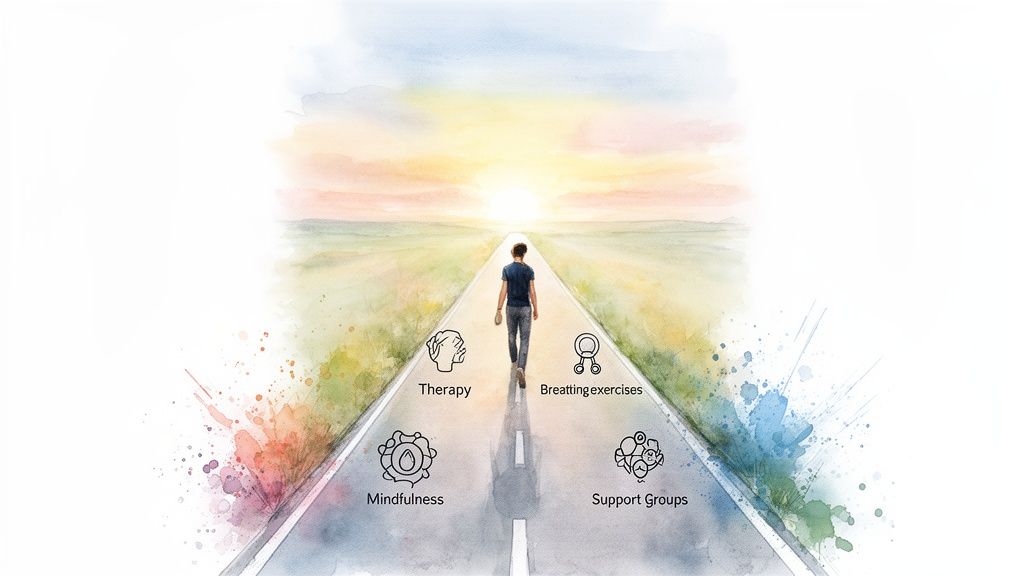
Starting the journey toward a calmer life is bound to bring up some questions. This last section tackles the most common concerns head-on, giving you clear, reassuring answers. The goal here is to reinforce a core truth: a life free from the grip of panic and chronic anxiety isn’t just a dream—it's an achievable reality.
Can I Truly Recover from Panic Disorder and Anxiety?
Yes, absolutely. Recovery isn't just possible; it's highly probable when you have the right strategies and support. In fact, both panic disorder and generalized anxiety are among the most treatable mental health conditions out there.
Modern therapies, especially Cognitive Behavioral Therapy (CBT), have an excellent track record. These approaches don't just talk about the problem; they give you practical skills to dismantle the thought patterns fueling the fear cycle. You learn to manage your body’s responses, which is incredibly empowering. Healing is a journey of learning new skills, not a sign of weakness.
Is It Possible to Have Both Panic Disorder and Anxiety?
Yes, and it’s actually very common for these conditions to show up together. Think of it this way: living with generalized anxiety can sometimes make a person more susceptible to panic attacks because their nervous system is already on high alert.
The good news is that effective treatment often addresses both conditions at the same time. The skills you learn to manage chronic worry—like challenging catastrophic thoughts—are also incredibly effective in reducing the background stress that can trigger panic. It creates a positive upward spiral toward well-being.
The most important takeaway is this: you are not your diagnosis. With understanding and consistent action, you can learn to see the symptoms as manageable signals rather than terrifying threats, transforming your relationship with fear itself.
How Long Does It Take to See Improvement?
This really varies from person to person, but many people start feeling a sense of relief and control within the first few weeks of consistent effort. The key word here is action. When you start engaging with therapeutic techniques, making lifestyle adjustments, and practicing self-help strategies, you build momentum.
Progress isn't always a straight line; there will be good days and challenging ones. But every single step forward, no matter how small, is a victory. Each one strengthens your resilience and moves you closer to a life of freedom and peace.
- Initial Weeks: You might start noticing you can spot triggers more easily or use a grounding technique to cut a panic attack short.
- A Few Months: Many people find that the frequency and intensity of their symptoms have dropped significantly.
- Long-Term: The ultimate goal is lasting resilience, where you feel confident in your ability to handle life's stressors without being derailed by anxiety or fear.
This path is about reclaiming your power. It’s about understanding the difference between panic disorder and anxiety not to feel defined by a label, but to arm yourself with the right knowledge to heal and live a life unburdened by fear.
Ready to take the next step on your path to a panic-free life? The Anxiety Checklist provides a structured, actionable system to help you understand your triggers, challenge fearful thoughts, and build a personalized toolkit for lasting relief. Start your journey toward fearless living today.