Feeling like your emotions are a tidal wave you can’t control is isolating and deeply frustrating. If you're reading this, you probably know that feeling all too well—the exhaustion of living with an internal alarm system that seems perpetually stuck on high alert.
Small setbacks can feel like catastrophes. Moments of joy might be followed by intense sadness or anger, leaving you feeling whiplashed and misunderstood by the people around you. It's a tough way to live, but it is not a life sentence.
The journey to emotional balance begins with a simple but profound shift in perspective. Instead of seeing these intense reactions as a personal flaw, what if we see them for what they are? A sign that your nervous system is working overtime to protect you. The key is learning how to gently recalibrate it, moving from a state of constant reaction to one of intentional response. This is a skill you can learn, and it is the key to living a life free from anxiety and panic.
It's Not Just You
It’s so easy to feel like you're the only one wrestling with this kind of emotional intensity, but the reality is quite different. Emotional dysregulation is far more common than you might think.
In fact, studies show a mean prevalence of 9.2% among adults across ten diverse societies. That means roughly 1 in 11 adults worldwide is grappling with this challenge. It often goes hand-in-hand with conditions like anxiety, ADHD, and depression, creating a silent barrier to feeling good and getting things done.
This journey isn't about erasing your emotions. It's about learning to navigate them with skill and compassion—transforming the tidal wave into something you can ride with confidence. Healing isn't just possible; it's the natural outcome of understanding and consistent effort.
A Hopeful Road to Healing
The most important thing to know is that there is a clear path forward. You absolutely can learn to live a life free from the constant grip of emotional chaos and anxiety. It really comes down to three core steps:
- Recognition: Clearly identifying the specific emotional dysregulation symptoms you experience, without judging yourself for them.
- Understanding: Exploring where these patterns came from to build a sense of self-compassion.
- Action: Using practical, evidence-based strategies to build emotional resilience, one small step at a time.
Think of this guide as your roadmap. We’re going to break down complex ideas into simple, actionable steps, giving you a compassionate framework for your recovery. By learning to spot your triggers and apply effective coping skills, you can move from feeling overwhelmed to empowered. The life of intention and emotional balance you want is within reach, and you can learn more about the anxiety recovery steps that make it possible.
Recognizing the Core Symptoms of Emotional Dysregulation
Spotting the signs of emotional dysregulation is the first real step toward getting your life back from the grip of anxiety and panic. It’s a lot like flipping a light switch in a dark room—suddenly, all the confusing shapes and shadows become things you can actually recognize.
This isn’t about slapping a label on yourself. It’s about validating what you’re going through and seeing that these intense reactions are part of a known pattern. A pattern that plenty of people share and have successfully learned how to manage.
Emotional dysregulation isn’t just being “moody” or “oversensitive.” We’re talking about intense, persistent patterns that show up in your thoughts, your actions, and even your body.
Think of it like an emotional thermostat that’s gone haywire. It either skyrockets to boiling or plummets to freezing with almost no warning, leaving you scrambling to deal with the extreme temperatures. The good news? You can absolutely learn to recalibrate this internal system.
The Behavioral Signs of Dysregulation
Behavioral symptoms are usually the most obvious signs. These are the things you do (or don't do) when your feelings become too much to handle. They start as attempts to cope but often end up causing more problems down the line.
A classic behavioral pattern is impulsivity. This can look like making rash decisions when you’re on an emotional high or low, like splurging on something you can’t afford or picking a fight over something tiny.
On the flip side is avoidance. You might find yourself dodging people, places, or situations you’re afraid will trigger a difficult emotion. Slowly but surely, your world starts to shrink just to feel a little safer. The hopeful part is recognizing this pattern is the first step to gently expanding your world again.
Cognitive and Mental Symptoms
Emotional dysregulation messes with your thinking in a big way. When your emotions are cranked up to ten, trying to think clearly can feel impossible. People often call this "brain fog," where your ability to concentrate, solve problems, or make a logical choice feels completely out of reach.
Another huge cognitive sign is all-or-nothing thinking—you might know it as black-and-white thinking. Situations are either perfect or a total disaster. People are either saints or devils. This rigid way of thinking leaves zero room for nuance and can blow emotional reactions way out of proportion, making a minor hiccup feel like a complete catastrophe. But just like any thought pattern, this is something you can learn to notice and change.
If you want to dig deeper into how these thought patterns fuel anxiety, check out our guide on overthinking and anxiety.
The Physical Toll of Emotional Storms
Your body keeps the score, always. When you're dealing with chronic emotional dysregulation, your nervous system is stuck in a state of high alert, and that puts a massive strain on your physical health. This constant stress response can show up in a few key ways:
- Chronic Muscle Tension: Ever notice your neck, shoulders, or jaw are constantly tight? That’s your body bracing itself for a threat that never seems to go away.
- Digestive Issues: The gut-brain connection is incredibly strong. Ongoing emotional distress can lead to things like indigestion, stomach aches, or IBS.
- Exhaustion: Riding emotional rollercoasters is draining. The bone-deep exhaustion that hits after an intense emotional episode is a tell-tale physical symptom.
- Sleep Disturbances: High anxiety or racing thoughts can make it a nightmare to fall asleep or stay asleep, robbing your body of its chance to repair itself.
This diagram helps visualize the path from emotional chaos to calm—a journey that starts by recognizing these very symptoms.
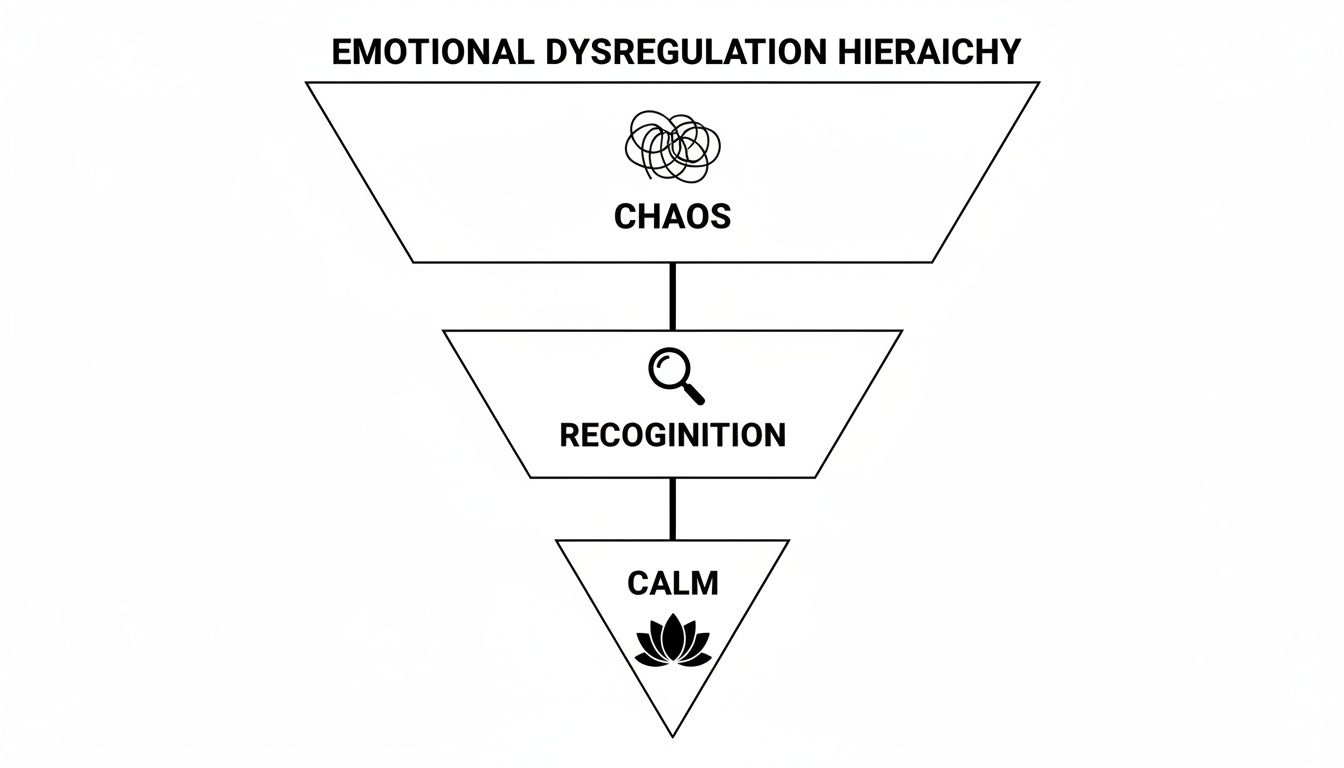
As the image shows, getting from tangled chaos to a state of calm requires that crucial middle step: recognition.
To help you connect the dots in your own life, the table below contrasts a typical, healthy emotional response with a dysregulated one in a few common scenarios.
Healthy Emotional Response vs. Dysregulated Symptom
| Situation | Healthy Emotional Response | Dysregulated Symptom |
|---|---|---|
| A friend cancels plans at the last minute. | Feeling disappointed but understanding that things come up. You reschedule for another time. | Feeling intense anger and abandonment, believing "no one ever cares about me." You might send an angry text or decide to cut them off completely. |
| Receiving constructive feedback at work. | Feeling a brief sting of criticism but being able to listen, reflect, and use the feedback to improve. | Feeling deeply ashamed and attacked, interpreting the feedback as proof that you are a failure. You might obsess over it for days or become defensive. |
| Sitting in traffic and running late. | Feeling frustrated and annoyed, but taking deep breaths and accepting the situation is out of your control. | Experiencing overwhelming panic or rage. You might honk excessively, drive recklessly, or feel the entire day is ruined. |
Seeing your own experiences mirrored in these examples can be a huge moment of clarity. It’s confirmation that what you're going through is real and that it has a name.
This recognition isn't the end of the road; it’s the starting line. It’s the first step toward building a life where you are in control of your emotions, not the other way around. This is where the hope truly begins.
Where Does All This Emotional Intensity Come From?
Figuring out why your emotions feel so big is one of the kindest things you can do for yourself. It’s the moment you stop blaming yourself for being "too much" and start seeing your reactions as a logical, even protective, response to your unique life story and biology. This isn't about making excuses—it's about finding the real reasons so you can start healing the right things.
Think of your emotional response system like the foundation of a house. If the ground was shaky or unpredictable while it was being laid, the foundation would develop cracks just to adapt. Your emotional wiring works the same way, shaped by your earliest experiences.
When you finally get the 'why' behind your emotional dysregulation, you can shift from self-criticism to gentle understanding. This perspective is the first, most crucial step toward targeted, effective healing and finally finding a life free from constant anxiety and panic.
How Early Life Wires Your Brain
Our brains are sculpted by our experiences, and this is especially true in childhood when they're at their most impressionable. If a child grows up in an environment that feels unsafe, unpredictable, or where their feelings are dismissed, their nervous system learns to stay on high alert. This isn't a choice; it's a survival mechanism kicking in.
This state of high alert, often called the fight or flight response, becomes the default setting. The brain essentially gets stuck in emergency mode, making it incredibly difficult to return to a state of calm even when there’s no real danger.
The impact of these early experiences is huge and can last a lifetime if not addressed. Emotional dysregulation in children actually peaks early, with a striking 11.26% prevalence among 5- to 8-year-olds. Research shows that about a third of adult mental health issues can be traced back to childhood trauma, and brain scans even reveal developmental differences from maltreatment that increase the risk of anxiety. For a deeper dive, you can read the full research on childhood emotional development.
The Connection to Neurodevelopmental Conditions
Sometimes, intense emotional responses are just a core feature of how someone's brain is wired from the get-go. For people with neurodevelopmental conditions like Attention-Deficit/Hyperactivity Disorder (ADHD), emotional intensity isn’t just a side effect—it's a fundamental part of their experience.
People with ADHD often feel emotions more powerfully and have a harder time shifting from one emotional state to another. This is sometimes called emotional hyperarousal. A minor frustration for someone else can feel like an unbearable injustice, while a moment of happiness can be pure euphoria.
Realizing this connection can be incredibly freeing. It means your emotional struggles aren't a character flaw or a failure of willpower, but a neurobiological reality. This knowledge empowers you to find strategies that are actually designed for your specific brain wiring.
Emotional Dysregulation in Mental Health
Emotional dysregulation isn’t a diagnosis on its own, but it's a core symptom that runs through several mental health conditions. Spotting these links can bring a lot of clarity and point you toward the right kind of support. It helps you see that you aren’t broken; you’re just dealing with a common set of challenges that have known solutions.
- Anxiety Disorders: In conditions like Generalized Anxiety Disorder or Panic Disorder, emotional dysregulation is what fuels the cycle of worry and fear. Learning to regulate your emotions is a direct path to breaking this cycle.
- Borderline Personality Disorder (BPD): This condition is defined by intense, unstable emotions, making emotional dysregulation a central and defining feature.
- Depression: Dysregulation in depression often shows up as an inability to feel positive emotions or being stuck in an overwhelming state of sadness and hopelessness.
When you start seeing your emotional intensity through the lens of your history and biology, you take your power back. You can finally stop fighting against yourself and start working with yourself. That's the path to lasting relief from anxiety and a more peaceful, balanced life.
Practical Strategies to Begin Regaining Control Today
Understanding your emotional patterns is a huge step forward, but this is where the real work of healing begins. It’s time to turn that understanding into action. Learning practical, evidence-based skills is what transforms your relationship with your emotions and helps you build a life that isn’t dictated by constant anxiety.
You can start putting these techniques to work today to get a handle on emotional intensity and find solid ground when you feel like you're in the middle of a storm.
Many of these strategies are core skills from Dialectical Behavior Therapy (DBT), a powerful approach designed specifically to help people manage overwhelming feelings. Think of it as a concrete toolbox for getting through a crisis, dialing down reactivity, and building a life you actually enjoy living.
The goal isn't to get rid of your feelings or push them down. It’s about learning to sit with them, figure out what they’re trying to tell you, and then choose how to respond instead of being dragged along for the ride. This is how you reclaim your life from panic and anxiety.
Mastering Mindfulness: The Art of Observation
Mindfulness is really just about paying attention to what's happening right now, without judging it. When you’re stuck in an emotional spiral, your mind is almost always somewhere else—either stewing over the past (regrets, anger) or freaking out about the future (what-ifs, worst-case scenarios).
Mindfulness gently pulls you back to the present moment. It teaches you to become an observer of your own emotions, almost like you’re watching clouds drift across the sky. You see the anger, the panic, or the sadness, but you don't get swept up and carried away by them. That tiny gap between feeling an emotion and reacting to it? That’s where your power is.
By simply observing your emotional dysregulation symptoms as they arise, you create space. In that space, you find the freedom to choose a skillful response instead of an automatic, and often painful, reaction.
A dead-simple way to start is by focusing on your breath. Just notice the feeling of the air coming in through your nose, filling your lungs, and then leaving your body. Your mind will wander—that’s what minds do. When it happens, just gently guide your focus back to your breath. This act alone can start to soothe a nervous system that's on high alert.
Building Distress Tolerance Skills for a Crisis
Think of distress tolerance skills as your emotional first-aid kit. These are the practical, in-the-moment things you do when you feel completely overwhelmed and are on the verge of doing something impulsive that you'll later regret. Their job isn’t to make the pain disappear, but to help you survive the crisis without making it worse.
Some seriously effective techniques include:
- Temperature Change: Splashing ice-cold water on your face or holding an ice cube can trigger the "mammalian dive reflex," a built-in physiological response that quickly slows your heart rate and calms your whole system down. It's a biological reset button.
- Intense Exercise: Got a surge of frantic energy? Channel it. A short, sharp burst of physical activity—like sprinting in place or doing jumping jacks for a minute—gives that intense emotional energy a safe place to go.
- Paced Breathing: This one is simple but powerful. Slowly breathe in for a count of four, and then breathe out even slower, for a count of six. This sends a direct signal to your brain that the threat is gone, helping to switch off that fight-or-flight alarm.
For a deeper dive into similar strategies, check out our guide on effective grounding techniques for anxiety.
The Power of Tracking Your Triggers
You can’t fix a pattern you don’t understand. This is where self-monitoring comes in—it’s the crucial process of figuring out what, exactly, sets off your intense emotional reactions. A trigger could be something external (like a critical comment from your boss) or internal (like a painful memory that pops up out of nowhere).
By systematically keeping a log of these moments, you start to turn the overwhelming chaos into clear, understandable data. This isn't about blaming yourself; it's about becoming a detective in your own life. You begin to spot the connections: "When X happens, I tend to feel Y, and my go-to reaction is Z."
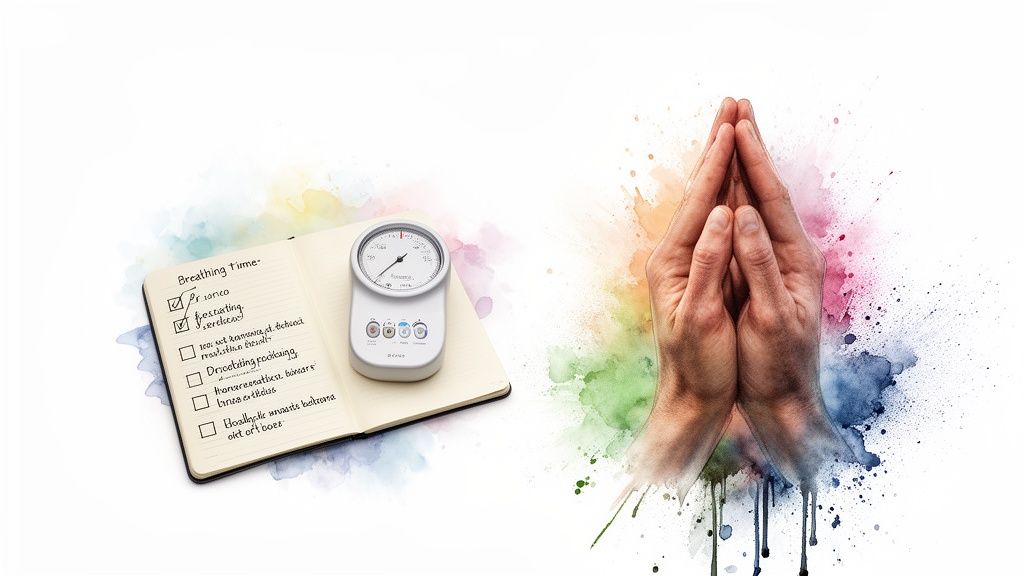
Using a structured tool, like a dedicated checklist or a journal, makes this process so much more effective. It gives you a framework to capture the important details about your emotional dysregulation symptoms, helping you see the patterns that were invisible before.
This systematic process—observing, tolerating, and tracking—is what gives you the clarity and control to find your way back to emotional balance. It’s the practical, day-by-day work that builds a solid foundation for a life where you are in charge of your emotions, not the other way around.
Building Your Personalized Emotional Wellness Toolkit

While having skills to manage intense emotions in the moment is crucial, the real path to a calmer life isn't just about reacting to crises. Lasting change comes from building a lifestyle that supports you from the ground up, day in and day out. It’s about being proactive, not just putting out fires.
Think of it like building a house. You wouldn't just run around patching leaks as they pop up. You’d make sure the foundation is solid and the frame is strong. Your emotional health works the same way. When you focus on these core lifestyle pillars, you create a baseline of stability that makes emotional storms less frequent and far less destructive when they do roll in.
This approach shifts the focus from just managing emotional dysregulation symptoms to creating a life where emotional balance becomes your natural default state. This is how you build a panic-free future.
Laying the Foundation with Sleep and Nutrition
You can't separate your physical health from your emotional state—they're deeply connected. Ignoring your body's basic needs is like trying to drive a car on an empty tank. It just won't work. Two of the most powerful things you can control for mood stability are sleep and what you eat.
Consistent, good-quality sleep is non-negotiable for a regulated nervous system. When you sleep, your brain is hard at work processing emotions and locking in memories. Skimp on it, and you're left with a short fuse and a heightened sensitivity to stress, making dysregulation almost a given.
What you eat also directly impacts your brain chemistry. A diet full of whole foods—think lean proteins, healthy fats, and complex carbs—gives your brain the steady fuel it needs. On the flip side, highly processed foods and sugar overload can send you on a rollercoaster of energy crashes and mood swings that make emotional instability worse.
Creating a life that feels calm and predictable starts with the simplest, most fundamental choices you make every single day. Prioritizing your physical health is one of the most powerful messages of safety you can send to your nervous system.
The Regulating Power of Movement and Rest
Physical activity is one of the most effective and accessible tools for managing emotional intensity. When you move your body consistently—even with just a brisk walk, some yoga, or a swim—it releases endorphins, which are basically natural mood elevators.
Movement helps your body burn off the excess stress hormones, like cortisol and adrenaline, that fuel anxiety and panic. It gives a healthy outlet to all that pent-up energy that might otherwise come out as an emotional outburst. This isn’t about grueling workouts; it’s about finding ways to move that feel good and help you release tension.
Just as important as movement is intentional rest. That means actually scheduling downtime to do things that recharge you, whether it’s reading a book, listening to music, or just sitting quietly without a goal. If you're looking for a more structured way to reflect, you can learn about the benefits of journaling for anxiety and see how it can become a cornerstone of your wellness routine.
Cultivating Your Support System
Feeling connected to other people is a powerful emotional regulator. When you feel seen, heard, and understood, it sends a profound signal of safety straight to your nervous system. Building a solid network of friends, family, or community members is a critical piece of your toolkit.
This means learning how to communicate what you need and how to set healthy boundaries. It’s being able to say, "I'm feeling overwhelmed and need some space," or "I could really just use someone to listen without trying to fix it." These skills aren't always easy to pick up, but they're essential for creating relationships that fill you up instead of draining you.
As you build this toolkit, you might find it helpful to explore different social emotional learning activities to strengthen these skills. By weaving all these strategies together, you’re not just coping with symptoms—you’re actively building a life where peace and stability have a real chance to thrive.
Common Questions About Emotional Regulation
Working toward emotional balance is a journey, and it's natural to have questions along the way. In fact, questions are a good sign—they mean you're engaged, curious, and ready to take charge of your own healing. Getting clear answers demystifies the process, replacing fear and confusion with confidence.
Let's walk through some of the most common questions people ask about emotional dysregulation. The goal here is to give you straightforward, compassionate answers that empower you to move forward. A calmer, more stable life isn't just a dream; it's an achievable reality.
Is Emotional Dysregulation a Mental Illness?
This is a really important question, and the short answer is no. Emotional dysregulation isn't a standalone mental illness or a formal diagnosis you can receive.
It’s better to think of it as a core symptom—a key feature that shows up across a number of different mental health conditions.
Think of it like a fever. A fever isn't the illness itself; it's a sign that your body is fighting something off. In the same way, emotional dysregulation is a signal pointing to a deeper challenge. It describes a very specific pattern: emotional responses that are intense, come on fast, and feel almost impossible to manage.
This pattern is a central piece of conditions like:
- Anxiety Disorders
- Borderline Personality Disorder (BPD)
- Attention-Deficit/Hyperactivity Disorder (ADHD)
- Post-Traumatic Stress Disorder (PTSD)
The hopeful part is that because it's a learned pattern of response, it can be unlearned. With the right tools and support, you can absolutely learn to manage the intensity and get better at regulating your emotions, no matter what the root cause is.
Can I Learn to Regulate My Emotions on My Own?
Absolutely. Many people make incredible strides in managing their emotions through self-guided work. The strategies we've talked about in this guide—like mindfulness, distress tolerance, and building a supportive lifestyle—are powerful tools you can start using on your own, right now.
Using structured resources like journals or checklists can give your efforts a framework, turning an abstract goal like "get better at managing emotions" into small, concrete actions you can take every day. This kind of self-directed work builds a deep sense of empowerment. You prove to yourself, one step at a time, that you're capable of change.
That said, it’s also crucial to be compassionate with yourself. If your emotional dysregulation is linked to deep-seated trauma, or if the symptoms just feel too severe to handle alone, combining self-help with professional therapy is often the most effective path. Therapies like DBT were literally designed for this and can provide the expert guidance you need to navigate the tougher stuff. It’s your journey, and you get to decide what level of support feels right.
How Can I Support Someone with Emotional Dysregulation?
Watching someone you care about ride the waves of intense emotions can be painful and confusing. Your first instinct might be to jump in and try to "fix" it, but that can often make things worse. The most powerful support you can offer comes from a place of validation, patience, and zero judgment.
The greatest gift you can give someone in emotional pain is to listen not to reply, but to understand. Your calm, steady presence can be a powerful anchor in their storm, reminding them that they are not alone.
Here are a few practical ways you can offer real support:
- Validate Their Feelings: Instead of saying, "You're overreacting," try something like, "That sounds incredibly painful. I can see why you're so upset." Validation doesn’t mean you agree with their reaction; it just means you see that their pain is real for them.
- Listen Without Judgment: Hold a safe space for them to get it all out without fearing criticism. Fight the urge to offer solutions unless they ask for them.
- Encourage, Don't Push: You can gently encourage them to use their coping skills. Try saying, "I'm here for you. Is there anything from your toolkit that might help right now?"
- Set Your Own Boundaries: Supporting someone through this can be draining. It's absolutely essential to protect your own well-being so you don't burn out. You can't pour from an empty cup.
How Long Does It Take to Feel Better?
This journey is deeply personal, so there's no magic timeline. However, if you consistently practice the strategies in this guide, most people start to notice a real, tangible shift in their ability to manage emotions within a few weeks to a few months.
Progress is almost never a straight line. You'll have great days and hard days. You'll have breakthroughs and moments that feel like you've gone backward. That's a totally normal and expected part of the process. To really get a handle on dysregulation, it helps to first understand what emotional regulation entails, because it's all about building skills over time, not flipping a switch.
The key is patient persistence. Celebrate the small wins. Seriously. The time you used a breathing technique instead of lashing out? Win. The night you stuck to your sleep routine even when you didn't feel like it? Win. The moment you noticed a trigger before it took over? Huge win. These small victories are the building blocks of lasting change, paving the way to a life where you feel in control and at peace.
At The Anxiety Checklist, we believe a fearless, fulfilling life is within everyone's reach. Our comprehensive system is designed to give you the practical, action-oriented tools you need to move from understanding your anxiety to actively overcoming it. If you're ready to build your personalized toolkit and start your journey toward lasting mental wellness, explore The Anxiety Checklist today.