
When you're overwhelmed by anxiety, asking "how long does therapy take to work?" is really a search for hope. You're looking for a promise that a life free from panic is not just possible, but achievable.
The short answer is that most people start to feel a sense of relief and hope within just a few sessions. More significant, lasting changes often take root within 3 to 6 months. This isn’t a guess—it’s based on decades of research showing a clear, structured path to healing from anxiety and panic.
Finding Hope on Your Path to Healing
Living with anxiety can feel like being lost in a thick fog with no clear path forward. Therapy is the process of finding your compass and learning to navigate out of that fog, one step at a time, toward a calmer, panic-free life.
You don't have to wait years to feel a shift. The first few sessions plant the seeds of change. This is where you build trust with your therapist and feel truly heard—perhaps for the first time. It's the moment you stop feeling alone with your struggles and start building a partnership for healing. This is where hope begins.
The Journey Unfolds in Stages
As you move forward, therapy becomes more active. Think of it like tending a garden; real growth requires consistent nurturing. You’ll start to pinpoint the specific thought patterns fueling your anxiety and learn practical skills to challenge them. This is the "active work" phase, where you’ll begin to notice the intensity of panic attacks lessening or the constant hum of worry finally starting to quiet down.
The final stage is about enjoying the harvest. This is when the skills you’ve learned become second nature. You start to feel confident handling situations that once triggered panic. A sense of calm becomes your new normal, not just a fleeting moment.
A panic-free life isn't a distant dream; it's the destination this structured journey is designed to reach. This visual timeline breaks down the typical stages, showing a clear progression from building foundations to solidifying your gains.
As you can see, healing is a structured process, not an endless commitment. There are distinct phases of progress you can anticipate and celebrate along the way.
Therapy provides a roadmap to a place of inner peace. It’s not about erasing your past experiences, but about learning that you have the strength to write a new, calmer future for yourself.
It's also worth remembering that your path is unique. As you move through therapy, you might discover other practices that support your progress. This could include powerful mind-body tools like Trauma Release Exercises, which can add another valuable layer to your wellness kit. Your journey is yours alone, but the destination—a life free from the grip of constant anxiety—is absolutely achievable.
What Research Reveals About Therapy Timelines
When you're struggling, one of the biggest questions is, "How long until I feel better?" It’s a fair question. You want to know that your investment of time, energy, and hope is going to pay off.
The good news is that therapy isn't some endless, undefined journey. Research paints a surprisingly clear and hopeful picture, showing it’s a structured process designed to get you tangible results—often faster than you might think.
This is especially true for proven, goal-oriented methods like Cognitive Behavioral Therapy (CBT), often called the gold standard for anxiety treatment. Studies consistently show that many people find significant relief within just 12 to 20 weekly sessions. Think about that: in just a few months, you can go from feeling completely overwhelmed by anxiety to actively managing it with a new set of skills and reclaiming your life.

Benchmarks for Meaningful Progress
The path to feeling better isn't just a vague hope; it often follows a measurable timeline. Research gives us some really encouraging benchmarks that show just how quickly change can start.
Many studies report that roughly 50% of clients feel meaningful improvement after just eight therapy sessions. That’s about two months. Bump that out to the six-month mark, and the number jumps to a remarkable 75%.
These aren't just empty statistics. They are proof that healing is a predictable outcome for most people who commit to the process. They offer real, tangible hope that a life without constant anxiety is within reach.
And for those of you dealing with trauma alongside anxiety, the outlook is just as encouraging. The American Psychological Association found that, on average, it takes about 15 to 20 sessions for half of patients to report recovery. That means many people see substantial changes after four to five months of weekly work—a timeline that feels both realistic and inspiring. You can learn more about these treatment guidelines and see what the experts say about recovery.
The Science of Hope and Healing
Knowing these evidence-based timelines helps pull back the curtain on therapy. It shifts the perception from an uncertain, open-ended chat to a structured, goal-focused strategy for getting well. When you know that science is on your side, it’s much easier to find the motivation to take that first step toward a panic-free life.
Hope is not just a feeling; it's a cognitive shift. When you see evidence that change is possible within a realistic timeframe, you become an active partner in your own healing, which accelerates progress.
This scientific backing gives you a solid foundation to build your expectations on. The road to a calmer life is well-traveled and well-documented. With the right support, you can trust a process that has helped millions find their way out of the fog of anxiety and into a brighter, more peaceful existence.
As you move forward, learning more about the data behind different anxiety conditions can offer even more clarity. You can explore detailed anxiety statistics to see just how common these challenges are—and how effective the right treatment can be.
Exploring Effective Therapies for Anxiety and Panic
Finding the right therapy for anxiety is a lot like finding the right key for a stubborn lock. Not every approach will work for everyone, but some are exceptionally good at helping you regain control and find a sense of lasting calm.
Getting a handle on these methods is the first step toward having a real, informed conversation with a therapist and choosing a path that feels right for you.
And here’s some genuinely good news: we don't have to guess how long it takes to feel better. The timelines are backed by solid research. Meta-reviews show that about 50% of people notice a measurable improvement by their eighth session, and a whopping 75% feel significantly better by the 26th session.
For most, this means real, tangible hope isn't years away—it’s often just a few months down the road. A life where you are in control is closer than you think.
Before we dive into the specific therapies, it's helpful to see how the leading approaches compare. Each has a unique focus and timeline, which can help you figure out what might be the best fit for your needs.
A Comparison of Leading Anxiety Therapies
| Therapy Type | Core Focus | Typical Duration for Anxiety |
|---|---|---|
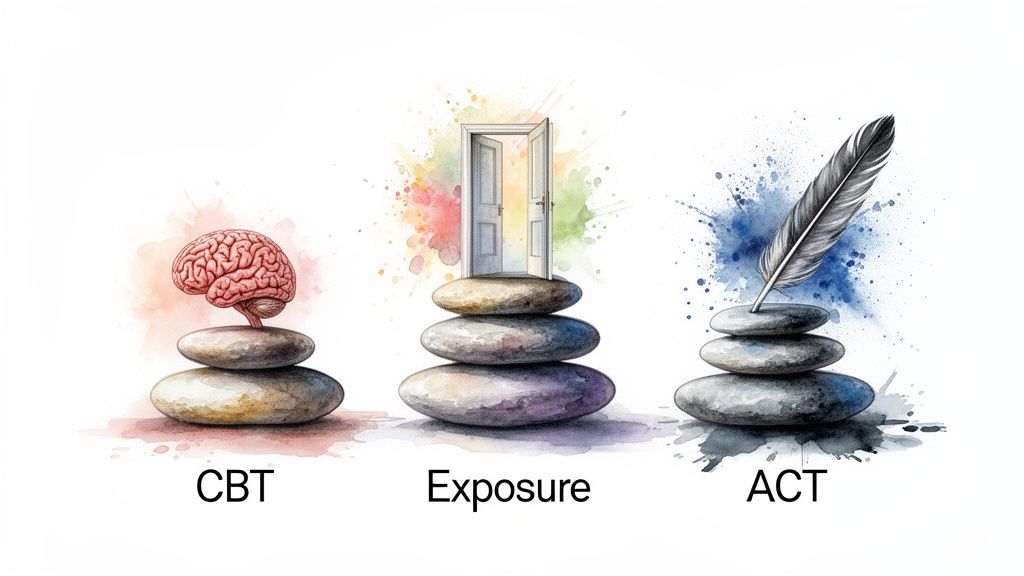
| Cognitive Behavioral Therapy (CBT) | Identifying and changing unhelpful thought patterns and behaviors that fuel anxiety. It's a structured, goal-oriented approach. | 12-20 sessions on average. It's designed to be a short-term, skills-based therapy. |
| Exposure Therapy | Gradually and safely facing feared situations, objects, or thoughts to reduce their power and prove that anxiety is manageable. | Can be part of CBT or a standalone treatment. Duration varies, often between 8-16 sessions. |
| Acceptance and Commitment Therapy (ACT) | Learning to accept anxious thoughts and feelings without letting them control your life, while committing to actions aligned with your values. | Typically lasts 8-16 sessions, but can be adapted for longer-term work. |
This table gives you a quick snapshot, but remember that these are just averages. The best therapy for you will depend on your specific challenges, goals, and what resonates most with your personality. Now, let's look at these in more detail.
Cognitive Behavioral Therapy (CBT)
Think of Cognitive Behavioral Therapy (CBT) as learning to recalibrate your brain's internal alarm system. When you live with anxiety, that system often sends out false alarms, triggering panic when there’s no real danger. CBT gives you the tools to spot these faulty thought patterns and systematically challenge them.
It's a very practical, hands-on approach where you and your therapist work like a team. You’ll learn to see the direct link between your thoughts, feelings, and actions, which allows you to effectively rewire your responses to triggers.
As one of the most researched therapies out there, it’s a powerful method for creating lasting change. For a more detailed guide, you can learn about how CBT works for anxiety.
CBT empowers you to become the expert on your own mind. It’s not about avoiding fear, but about understanding it so thoroughly that it no longer has power over you.
Other Powerful Approaches
While CBT is a heavy hitter, other highly effective therapies offer unique pathways to feeling better.
Exposure Therapy is a game-changer for many. It helps you gradually and safely face the situations or thoughts you fear, which systematically robs them of their power. It’s a courageous process, but one that proves your fears are far more manageable than your mind lets you believe.
Then there’s Acceptance and Commitment Therapy (ACT), which teaches a different but equally powerful skill: acknowledging anxious feelings without letting them run the show. Instead of fighting anxiety, you learn to make room for it while staying focused on living the life you actually want to live.
Beyond these well-established treatments, some people find comfort in complementary practices to support their therapeutic work. Things like mindfulness, yoga, or even using calming crystals for anxiety can help foster a sense of peace and groundedness.
Personal Factors That Shape Your Therapy Timeline
While research can give us some encouraging timelines, your healing journey is exactly that—yours. Several personal factors play a huge role in how quickly you'll start to feel a shift, and understanding them can make all the difference.
Knowing what these elements are helps you move from passively waiting for change to actively creating it.
It might surprise you, but the single biggest predictor of success in therapy isn't a fancy technique. It's the connection you build with your therapist. This is what we call the therapeutic alliance—a genuine bond of trust, respect, and teamwork.
When you feel truly seen, heard, and supported, it creates a safe space for real healing to begin. Feeling that connection can often speed up your progress in ways you wouldn't expect.
That alliance also fuels your own engagement, which is the other massive piece of the puzzle. Therapy isn’t like taking a pill and waiting for it to work; it's an active partnership. Your commitment is the fuel for the engine of your recovery.
Your Active Role in Healing
Honestly, your timeline is directly tied to the effort you put in, both during your sessions and in the days between. Committing to the process is a powerful statement of hope and a vote of confidence in your own ability to get better and live panic-free.
Here’s what your active participation looks like:
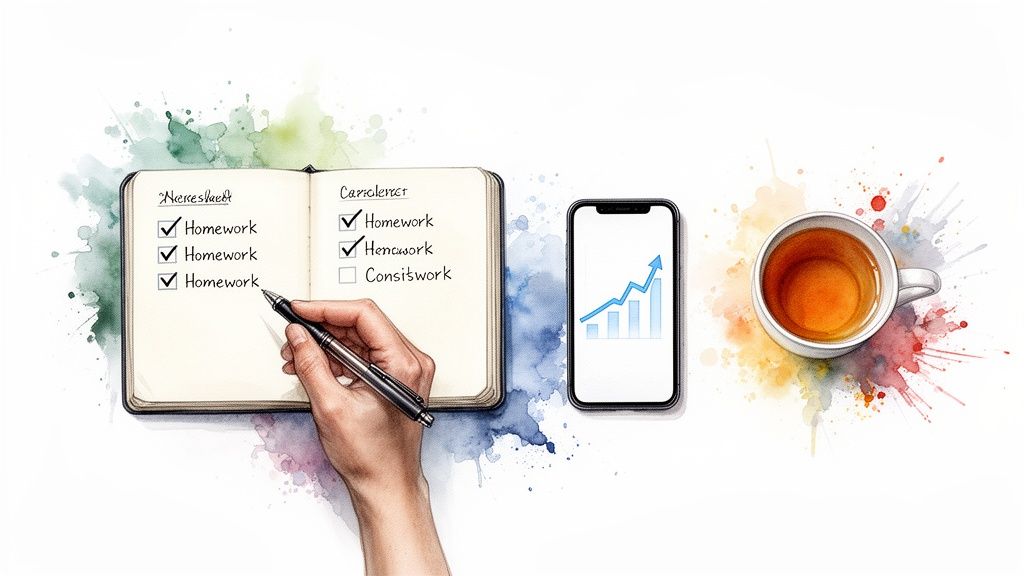
- Doing the Homework: When a therapist suggests practicing a breathing exercise or challenging a negative thought, that's where the magic really happens. It’s like a musician practicing scales after a lesson—it turns a concept into an instinct.
- Being Open and Honest: The more you can share about your fears, struggles, and even your doubts about therapy itself, the better your therapist can tailor their approach to you. Vulnerability is the shortcut to healing.
- Consistency: Showing up for your sessions regularly builds momentum. Each appointment is a stepping stone that builds on the last, creating a steady path forward.
Other Influential Factors
Beyond your own engagement, other parts of your life can definitely shape your therapy timeline. For instance, the initial severity of your anxiety is a key factor. Deeper-rooted patterns of thinking and behaving understandably take more time to gently untangle and rebuild.
You might also be juggling other challenges, like depression or past trauma, which can add layers to the work and require a bit more time.
And research backs this up. A large 2018 study confirmed that things like your specific diagnosis and how severe your symptoms are at the start really do influence how long treatment takes. It’s a great reminder that a one-size-fits-all timeline just doesn't exist. You can read more about these findings on treatment duration to see how these personal variables play out.
Ultimately, your journey is a collaboration between you, your therapist, and your unique life circumstances. If you're curious about where your own symptoms land on the spectrum, a tool like an online anxiety test can be a helpful starting point for a conversation with a professional.
Recognizing these factors doesn't just explain your timeline—it gives you a roadmap for where to focus your energy for the best possible results.
How to Accelerate Your Progress in Therapy
While therapy moves at its own pace, you’re far from just a passenger on this ride. You actually have a surprising amount of say in how fast you see results. Learning how to lean into the process can make a huge difference in your timeline.
Think of your therapist like a personal trainer for your mind. They can show you all the right moves and give you a solid game plan, but the real strength gets built when you practice those exercises on your own time. This is where your effort can seriously speed things up and get you closer to a life free from panic.
Become an Active Partner in Your Healing
What you do between your therapy sessions is just as crucial as what happens during them. This is your chance to take the ideas you're talking about and turn them into real-life skills. The more you put them into practice, the faster those new, healthier habits start to stick.
Making a conscious effort to show up and engage is one of the most powerful things you can do. Here are a few ways to start today:
-
Treat Appointments as Non-Negotiable: Consistency is what builds momentum. When you prioritize your sessions, you're sending a strong signal to yourself that your mental health comes first. Every meeting builds on the last, creating a steady, reliable path forward.
-
Do the ‘Homework’: If your therapist gives you a worksheet, a thought journal, or a new breathing exercise to try, dive in. This is where you translate what you've learned into actual change. It’s like a musician practicing scales after a lesson—this is how you build mastery.
-
Arrive with an Intention: Before each session, take five minutes to think about what you want to get out of it. Did a specific situation throw you for a loop this week? Is there a thought pattern you feel stuck in? Coming in with a focus helps make every minute count.
Tools to Enhance Your Journey
Beyond your sessions, a few simple tools can round out your work and give both you and your therapist a clearer picture of what’s going on. Using these resources helps you spot patterns and track your progress in a way you might otherwise miss.
True empowerment in therapy comes when you realize you're the expert on your own experience. Your therapist is your guide, but you're holding the map. Being radically honest and engaged is the fastest route to where you want to go.
Try adding a symptom journal or a mood-tracking app to your daily routine. This gives you a log of your experiences, helping you connect the dots between triggers and your reactions, and it lets you see and celebrate the small wins along the way.
Even simple lifestyle shifts—like making sleep a priority or adding some gentle movement to your day—support your brain’s ability to heal. Every positive step, no matter how small, adds up to the bigger picture of recovery. To help give this process some structure, you can explore actionable anxiety recovery steps that fit perfectly with the work you’re already doing.
Common Questions About the Therapy Timeline
Starting the therapy journey always brings up a lot of questions. Let’s tackle some of the most common concerns that come up on the path to a panic-free life, so you know exactly what to expect.
Is It Normal to Feel Worse Before Feeling Better?
Yes, absolutely. In fact, it’s often a sign that you’re starting to do the real work. Confronting deeply rooted emotions and patterns can feel messy and overwhelming at first.
Think of it like cleaning out a cluttered closet. You have to pull everything out and make a bigger mess before you can start sorting through it and putting things back in an orderly way.
This initial discomfort almost always fades as you start building new coping skills in a safe, supportive space. The key is to be open with your therapist about how you’re feeling so they can guide you through this important—and totally normal—phase.
What Should I Do If My Therapy Feels Stuck?
Hitting a plateau is a common experience, and the best way forward is honest communication. Start by bringing it up directly with your therapist. A good therapist will see this feedback not as a criticism, but as a vital part of the process, and they’ll be open to adjusting their approach or revisiting your goals together.
If you’ve had a few conversations and still feel like you’re spinning your wheels, it is perfectly okay to seek a second opinion. The "fit" between you and your therapist is one of the most critical parts of successful treatment. Finding the right partner in your healing is essential.
Sometimes, you may even need to find a psychiatrist for anxiety to explore whether medication could help support your progress in therapy.
How Do I Know When I Am Finished with Therapy?
Finishing therapy is a collaborative decision you make with your therapist, not an abrupt stop. You’ll know you’re getting close when you’re consistently meeting your goals, feel confident in your ability to manage anxiety on your own, and notice that symptoms no longer get in the way of your daily life.
The goal of therapy isn't to never feel anxiety again; it's to reach a place where you have the tools and confidence to manage it, so it no longer controls you.
The final stage of therapy usually involves creating a relapse prevention plan, which equips you with a strategy for future challenges. Many people also choose to transition to less frequent "maintenance" sessions—maybe once a month or every few months—to stay sharp and feel supported.
At The Anxiety Checklist, we believe everyone deserves to live a life free from the grip of panic. Our Fearless Living program offers a practical, step-by-step system to help you regain control and build lasting resilience. Start your journey toward a calmer, more confident life with The Anxiety Checklist today.