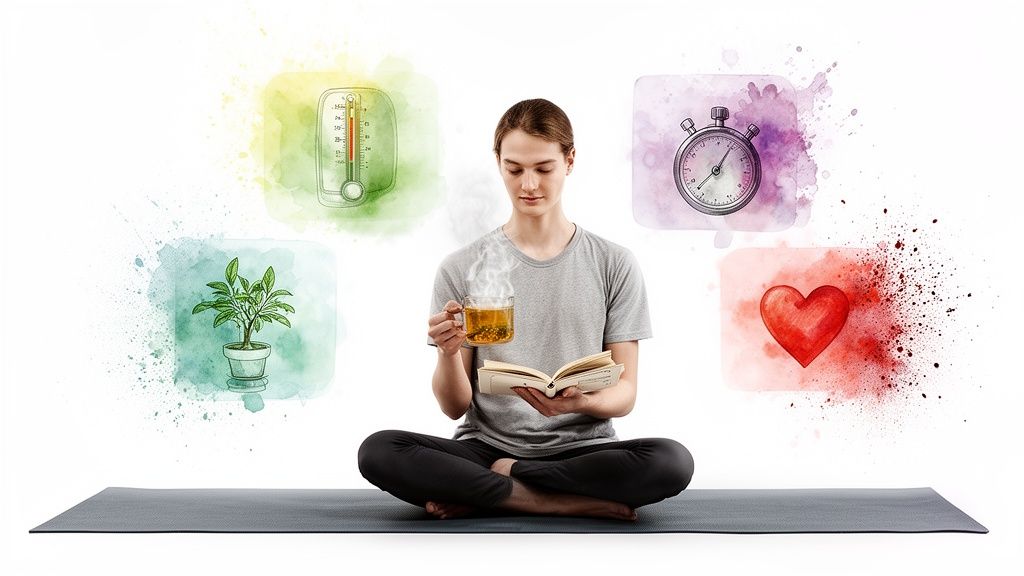
Living with chronic anxiety can feel like a relentless storm, leaving you convinced that a life without constant worry is out of reach. But healing is possible, and a clear, actionable plan can help you navigate that storm and find calm seas. This guide offers exactly that. It's not another list of vague suggestions; it's a practical roadmap built on proven, effective mental health self care tips designed to dismantle the mechanics of anxiety and panic from the ground up. True healing is within your reach, and your journey toward a panic-free life can begin right now.
Each strategy we cover is a powerful tool you can use today to regain control and build a life defined by peace, not fear. We move beyond generic advice to give you specific, step-by-step instructions. You will learn not only what to do, but exactly how and why it works, empowering you to move from merely surviving to truly thriving. We will explore ten fundamental pillars of anxiety management, from cognitive techniques and structured breathing to the often-overlooked impacts of nutrition and sleep. This is your toolkit for building resilience, understanding your triggers, and creating lasting, hopeful change. Let’s get started.
1. Cognitive Behavioral Techniques (CBT)
Cognitive Behavioral Therapy (CBT) is a powerful, evidence-based approach that empowers you to identify and challenge the negative thought patterns fueling anxiety. It operates on the principle that our thoughts, feelings, and behaviors are interconnected, offering a structured path to retrain your brain and find lasting relief. By addressing the root cognitive distortions, you can dismantle the foundations of chronic anxiety and build your path toward a panic-free life.
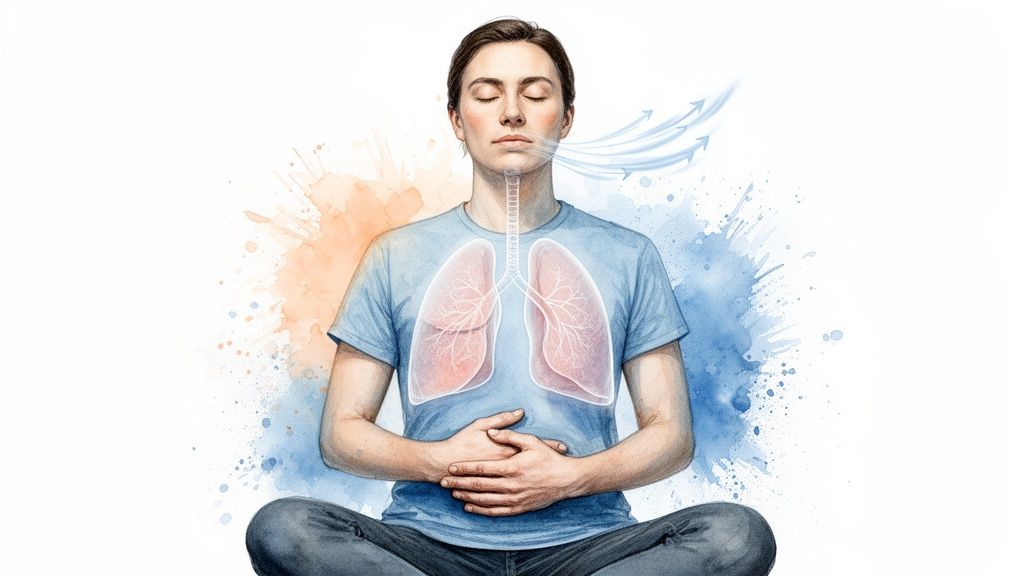
This method isn't just about "thinking positive"; it's about thinking realistically and reclaiming your power. Research from institutions like Harvard Medical School shows that consistent CBT practice can lead to a 60-80% improvement in symptoms, demonstrating that real healing is achievable.
How to Apply It
CBT provides practical tools for everyday use. For instance, when you experience a racing heart and think, "I'm having a heart attack" (a cognitive distortion called catastrophizing), you learn to pause and assess the evidence. You might ask, "What is a more likely explanation? This feels exactly like past panic attacks, which have always been harmless." This simple act is a step toward freedom.
Actionable Steps:
- Start a Thought Record: Use a simple three-column technique to track your responses. Log the Situation (e.g., getting stuck in traffic), the Automatic Thought (e.g., "I'm going to be late and get fired"), and an Evidence-Based Response (e.g., "My boss knows traffic is bad; I can call to let them know I'm running a few minutes behind.").
- Challenge One Distortion: Focus on identifying a single common pattern, like 'mind-reading' ("Everyone thinks I'm incompetent"), and actively search for evidence that contradicts it. Every time you do this, you weaken anxiety's hold.
- Build a 'Thought Library': Create a list of balanced, realistic responses to your most common anxious thoughts that you can refer to when you feel overwhelmed. This is one of the most effective mental health self care tips for building resilience and hope.
2. Daily Anxiety Monitoring and Tracking
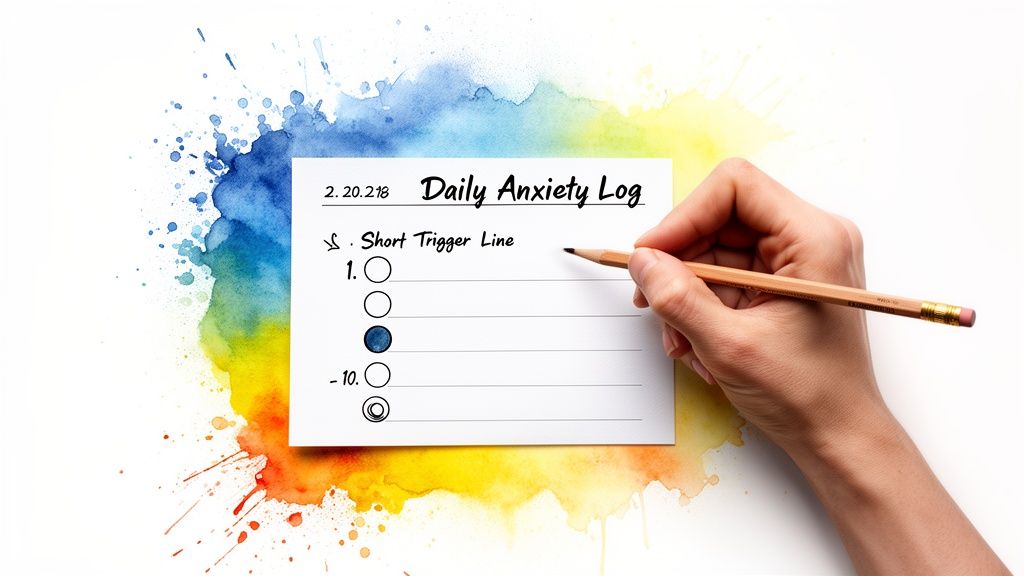
Systematic tracking of your anxiety symptoms, triggers, and intensity levels is a foundational step toward taking control. This practice transforms vague feelings of dread into concrete data, allowing you to recognize patterns, measure progress objectively, and gain personalized insight into what escalates or soothes your anxiety. By making the invisible visible, you can stop reacting to anxiety and start proactively managing it, paving a clear path toward a calmer, more hopeful life.
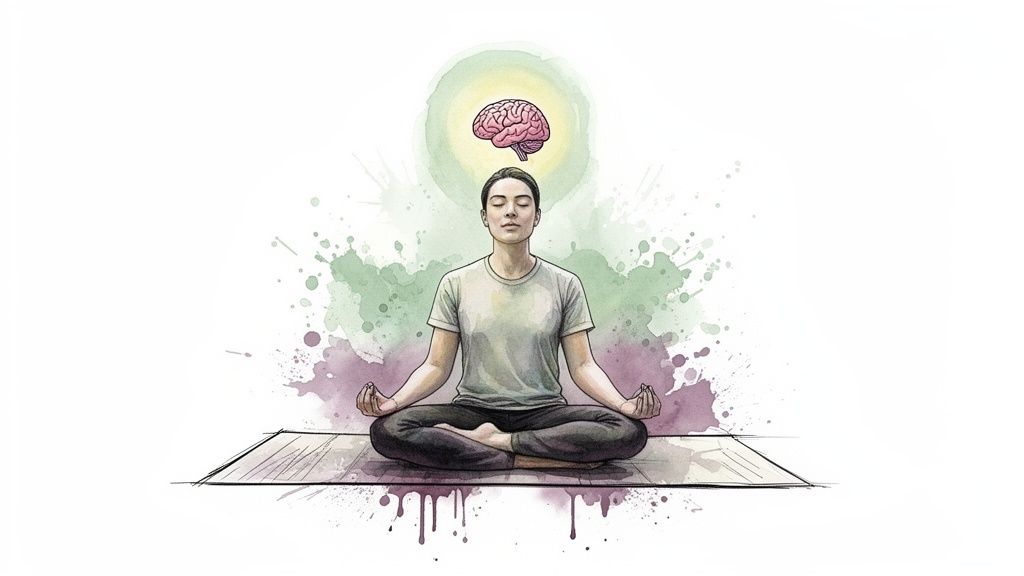
This method provides the evidence you need to see your own healing journey unfold. For instance, consistent tracking might reveal that your anxiety consistently peaks around 3 PM, helping you connect it to your afternoon caffeine habit. This is one of the most powerful mental health self care tips because it puts you in the driver's seat, armed with information and proof of your progress.
How to Apply It
The goal isn't to obsess over every fluctuation but to become an objective observer of your own mind. When you log your experiences, you create distance from the overwhelming feelings. This process helps you identify specific triggers, such as Monday morning anticipatory anxiety or certain social situations, and discover which coping mechanisms are truly effective for you.
Actionable Steps:
- Establish a Consistent Log: Choose a specific time each day, like in the morning or before bed, to reflect and record your experiences. Consistency is key to identifying meaningful patterns and seeing your progress.
- Track Key Elements: For each entry, note the Trigger (what was happening?), Intensity (on a 1-10 scale), Physical Symptoms (e.g., racing heart, tight chest), and the Coping Response you used.
- Review Weekly Patterns: Set aside time each week to look over your logs. Focus on celebrating downward trends in intensity or noticing how a new coping skill is helping, rather than focusing on individual bad days. This data-driven approach builds momentum and reinforces hope.
3. Structured Breathing Techniques
Structured breathing techniques are your body's built-in emergency brake for anxiety and panic. These controlled exercises directly activate your parasympathetic nervous system, counteracting the fight-or-flight response. By intentionally regulating your breath, you send a powerful signal to your brain that you are safe, providing an immediate, body-based tool to regain control during acute panic and build long-term nervous system resilience. This is a skill you can learn and master, putting calm within your reach.
This isn't just about taking a deep breath; it's a physiological reset that you can initiate anytime. Techniques popularized by figures like Dr. Andrew Weil and used by elite performers like U.S. Navy SEALs prove that mastering your breath is a fundamental step toward mastering your anxiety. Beyond generalized breathing, specific methodologies like those found in breathing techniques for Pilates can significantly enhance control and focus, contributing to your overall sense of peace.
How to Apply It
During a panic attack, your breathing becomes shallow and rapid, perpetuating the cycle of fear. Structured breathing interrupts this pattern. For instance, the 4-7-8 method forces a longer exhale, which is scientifically proven to slow your heart rate. By concentrating on the count, you also distract your mind from spiraling anxious thoughts, anchoring you in the present moment and reminding you that you are in control.
Actionable Steps:
- Start with Box Breathing: This is a simple and effective technique. Inhale for 4 seconds, hold for 4, exhale for 4, and hold for 4. Repeat until you feel your nervous system begin to settle.
- Practice When Calm: Dedicate 3-5 minutes each day to practice a technique like 4-7-8 breathing (inhale 4, hold 7, exhale 8). This builds the mind-body connection, making it an automatic, reliable response when you need it most.
- Pair with Grounding: During acute anxiety, combine your breathing with a grounding technique. As you do your box breathing, focus on the feeling of your feet on the floor or the texture of the chair you're sitting in. This is one of the most powerful mental health self care tips for immediate relief and reassurance.
4. Physical Exercise and Movement
Regular physical activity is a powerful, science-backed strategy for managing anxiety and preventing panic attacks. It works by naturally lowering stress hormones like cortisol while boosting mood-elevating neurochemicals such as endorphins and serotonin. Movement provides a constructive outlet for pent-up anxious energy, helping to calm both the body and mind and paving the way for a hopeful, panic-free life.
This isn't about becoming a marathon runner; consistency is far more important than intensity. Research from Harvard Health Publishing confirms that individuals who exercise at least three times per week report significantly lower baseline anxiety than their sedentary peers. Even a single 30-minute walk can reduce anxious feelings by 20% immediately, showing how quickly you can influence your own well-being.
How to Apply It
Integrating movement into your routine gives your nervous system a chance to reset. Instead of viewing exercise as a chore, reframe it as a dedicated time to process stress and invest in your healing. When you feel the physical symptoms of anxiety building, like a racing heart or restlessness, engaging in physical activity can mimic and then release that tension, leaving you feeling calmer and more in control.
Actionable Steps:
- Start Small and Build: Aim for 15-20 minutes of movement daily rather than an intimidating 60-minute session. This could be a brisk walk, a short yoga routine, or dancing to your favorite songs. Every step is progress.
- Use Habit Stacking: Pair exercise with an existing routine to make it automatic. For example, go for a walk immediately after breakfast or do a few stretches right before bed.
- Find Joy in Movement: Choose activities you genuinely enjoy. If you hate running, don't force it. Try hiking, swimming, or a team sport to ensure you stick with it. This is one of the most sustainable mental health self care tips for long-term success and a happier life.
5. Sleep Optimization and Sleep Hygiene
Quality sleep is a non-negotiable foundation for managing anxiety and finding hope. Poor sleep doesn't just make you tired; it primes your brain for hyper-reactivity, making you more vulnerable to panic and worry. Robust sleep hygiene systematically calms your nervous system, reduces next-day anxiety, and enhances the cognitive functions you need for emotional regulation. This is one of the most impactful mental health self care tips for regaining control, stability, and a brighter outlook.
This approach is about creating the ideal conditions for restorative rest, which directly supports your healing. For instance, creating a 30-minute device-free wind-down routine can improve sleep onset latency by 20 minutes, giving your racing mind less time to spiral. Improving your sleep can significantly impact your mental well-being; explore these 10 refined sleep hygiene tips for optimal wellness for even more detailed strategies.
How to Apply It
Sleep hygiene involves creating a consistent, soothing pre-bed routine and an optimal environment. Instead of scrolling on your phone until you fall asleep (a major source of sleep-disrupting blue light and mental stimulation), you might read a physical book in dim light. If you wake up with your heart pounding at 3 AM, you'll have a pre-planned strategy to avoid catastrophizing and gently guide yourself back to sleep, reminding yourself you have the tools to cope.
Actionable Steps:
- Set a Strict Schedule: Go to bed and wake up within the same 30-minute window every single day, including weekends. This stabilizes your circadian rhythm, the body's internal clock that governs sleep and mood.
- Create a Sleep Sanctuary: Make your bedroom dark, quiet, and cool (between 65-68°F). Use blackout curtains and a white noise machine to eliminate disturbances that can trigger nighttime anxiety.
- Implement a Screen Curfew: Power down all screens (phones, tablets, TVs) at least 60 minutes before bed. Blue light exposure is a known suppressor of melatonin, the hormone that signals your brain it's time to sleep.
- Reserve Your Bed for Sleep: Your brain should associate your bed with rest, not with work, scrolling, or worrying. If you can't sleep after 20 minutes, get up and do a calming, low-light activity until you feel sleepy again.
6. Mindfulness and Meditation Practices
Mindfulness and meditation offer a powerful way to break the cycle of chronic anxiety by training your brain to stay in the present moment. This practice involves observing your thoughts and feelings without judgment, which directly interrupts the patterns of rumination and catastrophizing that fuel panic. Regular meditation rewires the brain’s threat-detection systems, reducing reactivity in the amygdala and strengthening prefrontal cortex regulation. It offers a clear, gentle path to calm your nervous system and find peace from within.
This isn't just a spiritual practice; it's a scientifically validated mental exercise that shows healing is possible. Studies show that programs like Mindfulness-Based Stress Reduction (MBSR) can reduce anxiety symptoms by up to 40%, an improvement often comparable to medication.
How to Apply It
When anxiety strikes, your mind often jumps to worst-case scenarios. Mindfulness creates a crucial gap between a thought and your reaction to it. For example, instead of getting swept away by the thought, "Something terrible is about to happen," you learn to observe it as a mental event: "I am having the thought that something bad will happen." This simple shift in perspective detaches you from the thought’s power, preventing it from spiraling into a full-blown panic attack and restoring your sense of control.
Actionable Steps:
- Start with Guided Meditations: Use apps like Calm, Headspace, or Insight Timer to begin. They provide structure and make it easier to stay focused. Start with just five to ten minutes a day.
- Practice a Body Scan: Before sleep, lie down and bring your attention to each part of your body, from your toes to your head. This technique anchors you in physical sensation and can significantly reduce insomnia linked to anxiety.
- Gently Return Your Focus: Your mind will wander; that's normal and part of the process. The core practice is to notice when it has wandered and gently, without self-criticism, guide your attention back to your breath. This is one of the most vital mental health self care tips for building mental discipline and self-compassion.
7. Social Connection and Support Network Building
Cultivating a strong support network is a powerful buffer against chronic anxiety and panic. Humans are wired for connection, and isolation can significantly worsen anxiety symptoms. Building meaningful relationships provides validation, perspective, and a sense of belonging, directly countering the loneliness that often fuels anxious thought cycles. This approach isn't about forced socialization; it's about intentionally creating a safety net of understanding individuals who can support your journey to a hopeful, panic-free life.
This strategy is grounded in tangible, hopeful results. Research shows that individuals with strong support networks experience up to 40% faster recovery from anxiety. Having people in your corner who understand your struggles provides the encouragement needed to stay consistent with your healing process. You don't have to do this alone.
How to Apply It
A support network acts as both an emotional and practical resource. When you feel overwhelmed by a panic trigger, a quick call to a trusted friend can offer immediate grounding. Instead of feeling like you're facing anxiety alone, you have a team to lean on. For instance, explaining your anxiety mechanics to a family member can transform their well-intentioned but unhelpful advice into genuinely supportive actions.
Actionable Steps:
- Educate Your Inner Circle: Share simple, clear information about what anxiety feels like for you. Start with one or two trusted people, explaining what helps and what doesn't during a panic attack.
- Be Specific With Your Needs: Instead of saying "I feel anxious," try "I'm feeling overwhelmed and just need you to listen for a few minutes without offering solutions." Clear requests lead to better support.
- Schedule Connections: Make social interaction a non-negotiable part of your routine. A weekly coffee, a scheduled phone call, or a walk with a friend builds consistency and reliability.
- Find Your Tribe: Consider joining an anxiety-specific support group, either online or in person. Connecting with others who have lived experience provides unparalleled validation, making it one of the most effective mental health self care tips for reducing isolation and building hope.
8. Nutrition, Hydration, and Supplementation
What you eat and drink directly impacts your brain's chemistry and your body's physiological stress response. Nutritional psychiatry shows that targeted dietary changes, proper hydration, and specific supplements can stabilize your mood, regulate neurotransmitters like serotonin, and reduce the physical symptoms that often trigger panic. By nourishing your body correctly, you can create a stable internal environment less prone to anxiety, paving the way for a calmer, more controlled life and proving you have the power to heal.
This isn't about a restrictive diet; it's about making strategic choices that support your nervous system. Studies consistently show the power of this approach. For example, eliminating caffeine can reduce baseline anxiety by up to 40%, while supplementing with magnesium has been shown to decrease anxiety symptoms significantly. These are powerful mental health self care tips that give you direct control over your well-being.
How to Apply It
This approach works by minimizing physiological triggers. For instance, a common trigger for a panic attack is a sudden blood sugar crash, which can cause symptoms like a racing heart, dizziness, and shakiness. By eating balanced meals with protein, healthy fats, and complex carbs every few hours, you prevent these crashes and keep your body's stress signals quiet, demonstrating that you have the power to manage your physical state.
Actionable Steps:
- Stabilize Your Blood Sugar: Eat a small, balanced meal or snack every 3-4 hours. Include a source of protein (chicken, fish, legumes), healthy fat (avocado, nuts, seeds), and a complex carb (quinoa, sweet potato) to prevent energy dips that mimic anxiety.
- Hydrate for Calm: Dehydration is a known anxiety amplifier. Aim to drink 2-3 liters of water daily to ensure your brain and nervous system are functioning optimally.
- Consider Key Supplements: Talk to your doctor about adding Magnesium Glycinate (200-400mg) at night to support sleep and calm the nervous system, or L-theanine (100-200mg) during the day for non-drowsy focus.
- Reduce or Eliminate Triggers: Gradually reduce caffeine to avoid withdrawal-induced anxiety. Minimize alcohol, as it disrupts sleep and can cause rebound anxiety the next day. This is a foundational step toward a sustainable, panic-free life.
9. Exposure Therapy and Gradual Avoidance Reduction
Exposure therapy offers a structured, science-backed path to reclaim your life from fear by systematically confronting the situations you avoid. This powerful approach operates on the principle of habituation: by facing your fears in manageable steps, your brain learns they are not dangerous, breaking the cycle of anxiety and avoidance. It empowers you to prove to yourself that you can handle these situations, dismantling the very foundation of panic and phobias and opening up your world again.
This isn't about recklessly diving into your worst fears; it's a carefully calibrated process of building confidence and proving your own strength. Research shows that up to 80% of individuals who complete graded exposure therapy for specific phobias achieve significant, lasting relief, offering incredible hope for a life without avoidance.
How to Apply It
The core of this method is the "anxiety hierarchy," a personalized ladder of feared situations ranked from least to most frightening. If you have social anxiety, waving to a cashier might be a low-level step, while attending a crowded party is at the top. You start at the bottom and only move up once the anxiety at your current step has noticeably decreased through repetition. Each step is a victory.
Actionable Steps:
- Create Your Hierarchy: List 8-12 specific situations related to a single fear. Rate each on a 0-100 anxiety scale. Start with a situation rated around 20-30.
- Practice and Remain: Intentionally enter the situation and stay until your anxiety naturally reduces by about half. This teaches your nervous system that it can self-regulate and that you are safe.
- Resist Avoidance: The most critical learning happens when you resist the urge to escape. Use coping tools like deep breathing to help you stay present until the anxiety subsides. This is you, winning.
- Track Your Progress: Note your anxiety levels before, during, and after each exposure. This is one of the most effective mental health self care tips for visualizing your progress and building unstoppable momentum.
10. Boundary Setting and Stress Reduction
Setting healthy boundaries is a foundational act of self-care that directly combats chronic stress and baseline anxiety. It involves clearly defining what is and isn't acceptable in your interactions, protecting your energy from overcommitment, people-pleasing, and emotional absorption. By creating these limits, you reduce the constant activation of your body's stress response, preserving vital resources for your own well-being, healing, and recovery.
This practice is not about being difficult; it's about being sustainable and honoring your needs. Research and clinical examples show significant benefits: a parent who begins saying "no" to non-essential volunteer roles can reduce personal anxiety by 30%, while simply limiting work email check-ins to twice daily can vastly improve focus and lower stress. This is about creating space for your own peace.
How to Apply It
When you feel stretched thin or resentful, it's often a sign that a boundary has been crossed. Instead of automatically saying "yes" to a request that triggers your anxiety, you learn to pause and honor your own capacity. This might mean saying, "Let me check my schedule and get back to you," giving you space to decide without pressure and putting your well-being first.
Actionable Steps:
- Identify One 'Leak': Pinpoint one area where your energy is consistently drained, whether it's a demanding colleague or a family obligation. Your goal is to establish one clear boundary here first.
- Use a Simple Script: Prepare a kind but firm "no." For example: "I appreciate you thinking of me, but I can't take on any new commitments right now." Practice saying it aloud so it feels more natural.
- Set a Digital Boundary: Designate specific times you will check email or social media. For instance, commit to putting your phone away after 8 PM to create a peaceful evening routine, a crucial mental health self care tip for calming your nervous system and reclaiming your time.
10-Point Mental Health Self-Care Comparison
| Intervention | Implementation complexity 🔄 | Resource requirements | Expected outcomes ⭐📊 | Ideal use cases 💡 | Key advantages ⚡ |
|---|---|---|---|---|---|
| Cognitive Behavioral Techniques (CBT) | Moderate–High; structured sessions + homework 🔄 | Therapist or self-help workbooks/apps; regular time commitment | High effectiveness for anxiety disorders; 60–80% symptom improvement with consistent practice 📊⭐ | Chronic anxiety, panic disorder, maladaptive thought patterns | Durable, skill-based change; evidence-based; complements other treatments ⚡ |
| Daily Anxiety Monitoring and Tracking | Low; daily logging habit 🔄 | Low: app or spreadsheet & 5–10 min/day | Improved insight, pattern recognition, measurable progress over weeks 📊⭐ | Identifying triggers, evaluating interventions, therapy adjunct | Objective data, accountability, low-cost implementation ⚡ |
| Structured Breathing Techniques | Low; simple to learn but needs practice 🔄 | Minimal: no equipment; practice time | Immediate physiological calming and symptom reduction (minutes) 📊⭐ | Acute panic, pre-performance anxiety, in-the-moment regulation 💡 | Fast-acting, portable, no side effects; first-line acute tool ⚡ |
| Physical Exercise and Movement | Moderate; habit formation and consistency 🔄 | Low–Moderate: time (30+ min), space or basic equipment | Immediate mood boost and long-term anxiety reduction; clinically effective for mild–moderate anxiety 📊⭐ | General anxiety, comorbid sleep or mood issues, energy regulation | Broad physical + mental health benefits; sustainable and low-cost ⚡ |
| Sleep Optimization and Sleep Hygiene | Moderate; requires routine and environmental changes 🔄 | Low: schedule discipline, environmental adjustments (curtains, noise) | Substantial resilience improvement (40–60%) over 1–2 weeks; better cognitive control 📊⭐ | Anxiety worsened by poor sleep, insomnia comorbidity, to amplify other treatments 💡 | Foundational intervention that amplifies other methods; minimal side effects ⚡ |
| Mindfulness and Meditation Practices | Low–Moderate; learning curve and daily practice 🔄 | Low: apps/guided sessions & daily time (5–20 min) | Reduces rumination and amygdala reactivity; measurable neural changes over weeks 📊⭐ | Chronic worry/rumination, prevention, complement to CBT | Improves emotional regulation and resilience; accessible and scalable ⚡ |
| Social Connection and Support Network Building | Moderate; requires sustained effort and vulnerability 🔄 | Low–Moderate: time, community or group resources | Reduces isolation, increases coping speed and adherence; faster recovery 📊⭐ | Isolation-driven anxiety, relapse prevention, need for practical/emotional support 💡 | Provides validation, accountability, and practical help; low-cost ⚡ |
| Nutrition, Hydration, and Supplementation | Moderate; dietary habit change and planning 🔄 | Low–Moderate: food choices, possible supplements, professional guidance | Improves physiological contributors to anxiety within 2–4 weeks; stabilizes energy 📊⭐ | When caffeine, blood sugar, or nutritional deficits exacerbate anxiety 💡 | Targets root physiological factors; broad health benefits and sustainable ⚡ |
| Exposure Therapy and Gradual Avoidance Reduction | High; requires careful hierarchy planning and repetition 🔄 | Moderate–High: therapist guidance recommended or structured self-guided plans | Highest efficacy for anxiety disorders (60–80% remission); lasting behavioral change 📊⭐ | Specific phobias, avoidance behaviors, panic/agoraphobia treatment 💡 | Breaks avoidance cycle and produces durable remission when well-implemented ⚡ |
| Boundary Setting and Stress Reduction | Moderate; emotional work and ongoing maintenance 🔄 | Low–Moderate: time, communication practice, possible therapy | Lowers chronic stress and baseline anxiety; improves functioning and time for self-care 📊⭐ | Overcommitment, caregiver burnout, work-life imbalance, people-pleasing patterns 💡 | Preserves energy, prevents burnout, increases agency and consistent self-care ⚡ |
Build Your Personalized Toolkit for a Fearless Life
Navigating the landscape of chronic anxiety and panic can often feel like an overwhelming, solitary journey. However, the path to a calmer, more present life is not about discovering a single, elusive cure. Instead, it’s about intentionally building a personalized toolkit of mental health self care tips that you can rely on, day in and day out. You now have ten powerful, evidence-based tools at your disposal, each designed to address a different facet of anxiety and empower you on your healing journey.
From the cognitive restructuring of CBT and the gradual courage-building of Exposure Therapy, to the immediate grounding power of Structured Breathing, you’ve seen how these strategies work in tandem. The insights you’ve gained are not just theoretical; they are practical, actionable steps toward a better life. Remember, your mind and body are interconnected. Optimizing your sleep, nourishing your body with proper nutrition, and engaging in consistent physical movement are not secondary concerns. They are foundational pillars that support your mental resilience and make every other technique more effective.
From Knowledge to Lasting Habit
The true power of these mental health self care tips is unlocked through consistency. The goal is to move from simply knowing what to do, to instinctively doing it. This is where tracking your progress becomes invaluable. By monitoring your anxiety levels, noting your triggers, and celebrating small victories, you create a feedback loop that reinforces positive change and builds momentum. You begin to see, with concrete evidence, that you have agency over your own well-being and that you are healing.
This journey is about empowerment. It’s about understanding that while you may not control every external stressor, you absolutely can control your response. Each time you set a firm boundary, practice a mindfulness exercise instead of spiraling, or reach out to your support network, you are rewriting your relationship with anxiety. You are shifting from a state of reaction to one of proactive self-care and hope.
Your Journey to a Panic-Free Life
Embrace the idea that healing is a process of small, sustained efforts. You don’t have to implement all ten strategies at once. Choose one or two that resonate most deeply with you right now and commit to integrating them into your routine. Perhaps it’s a five-minute breathing exercise each morning or a short walk after dinner. Every single step, no matter how small it seems, is a declaration of your commitment to yourself and a powerful move toward a life defined not by fear, but by freedom and possibility. You have the capacity to heal, and your journey toward a panic-free life is not just a hopeful wish; it is a tangible, achievable reality.
Ready to turn these insights into a structured, daily practice? The Anxiety Checklist provides an interactive system with guided exercises and tracking tools to help you consistently apply these mental health self care tips and build lasting resilience. Start your journey to a calmer life today at The Anxiety Checklist.