
That sudden, overwhelming feeling of anxiety that washes over you for what feels like no reason at all can be incredibly confusing. It's isolating. You're not just "worrying too much"—what you're feeling is real, and it’s a shared human experience.
Most importantly, this feeling isn't a life sentence. There’s a clear path toward understanding it, and that's where healing begins. A panic-free life is absolutely possible, and this guide will show you the first steps on that hopeful path.
Why You Feel Anxious for Seemingly No Reason
If you’ve ever felt your heart race or your thoughts spiral without an obvious trigger, you've experienced what many call anxiety for no reason. The good news is that this sensation, while unsettling, almost always has hidden roots. It doesn't mean you're broken; it just means your internal alarm system is a bit too sensitive right now, and you have the power to recalibrate it.
Think of your stress tolerance as a bucket. Every small stressor—a poor night's sleep, a looming deadline, a minor disagreement, or even too much caffeine—adds a little water. On their own, these things seem insignificant. But over time, they fill the bucket to the brim. The final drop that makes it overflow might be tiny and unnoticeable, yet it triggers a flood of anxiety that feels completely random.
This experience is far more common than people realize. In fact, anxiety disorders are the most prevalent mental health conditions globally.
In 2021, an estimated 359 million people worldwide were affected by an anxiety disorder. In the United States alone, about 19.1% of adults—roughly 40 million people—have dealt with an anxiety disorder in the past year, with a staggering 31.1% facing one at some point in their lives.
This isn't just about being a worrier. These feelings often signal that your brain’s threat detection system, the part designed to keep you safe, has become overly vigilant. The hopeful part is that you can learn to work with this system, teaching it to feel safe again.
Understanding Is the First Step to Healing
The most powerful thing you can do right now is realize that your anxiety isn't some mysterious force acting upon you. It’s a response to a collection of underlying factors that have built up over time. This understanding transforms the feeling from a scary unknown into a solvable puzzle.
To help you start connecting the dots, here's a quick look at some common, yet often overlooked, triggers.
Quick Guide to Hidden Anxiety Triggers
This table provides a snapshot of common hidden triggers, helping you quickly identify potential sources of anxiety that you may not have considered.
| Trigger Category | Common Examples |
|---|---|
| Biological Factors | Poor sleep, nutrient deficiencies (e.g., magnesium), hormonal fluctuations, too much caffeine, dehydration. |
| Cognitive Habits | Perfectionism, negative self-talk, "what if" thinking, taking things personally, replaying past mistakes. |
| Environmental Stressors | A cluttered living space, constant noise, financial pressure, relationship tension, information overload from news/social media. |
| Unresolved Experiences | Past trauma (big or small), learned worry patterns from childhood, lingering grief or loss. |
By recognizing that there are concrete, identifiable causes for your feelings, you take the first real step toward regaining control. This guide is designed to demystify the experience and give you a hopeful, actionable roadmap forward.
You can learn more about the common anxiety causes that often operate just beneath the surface. From here, you can start building the tools you need to empty your stress bucket and live a calmer, more present life.
Uncovering the Hidden Roots of Your Anxiety
That unsettling feeling of anxiety that pops up out of nowhere isn't a sign that you're broken. It's a signal.
Think of yourself as a detective and your anxiety as the mystery. The clues might feel subtle—almost invisible—but they are always there, hidden just beneath the surface of your awareness. Uncovering them is the single most empowering step you can take toward feeling in control again.
This isn't about blaming yourself. It's about understanding that your anxiety is a logical response to a combination of factors you may not even realize are at play. When you start exploring these hidden roots, you transform a confusing, overwhelming feeling into a solvable problem. Healing starts to feel less like a distant hope and more like an achievable reality.
This map gives you a simple visual of where these roots often lie, showing how your unique brain wiring, past experiences, and day-to-day stress all connect to create that feeling of anxiety.
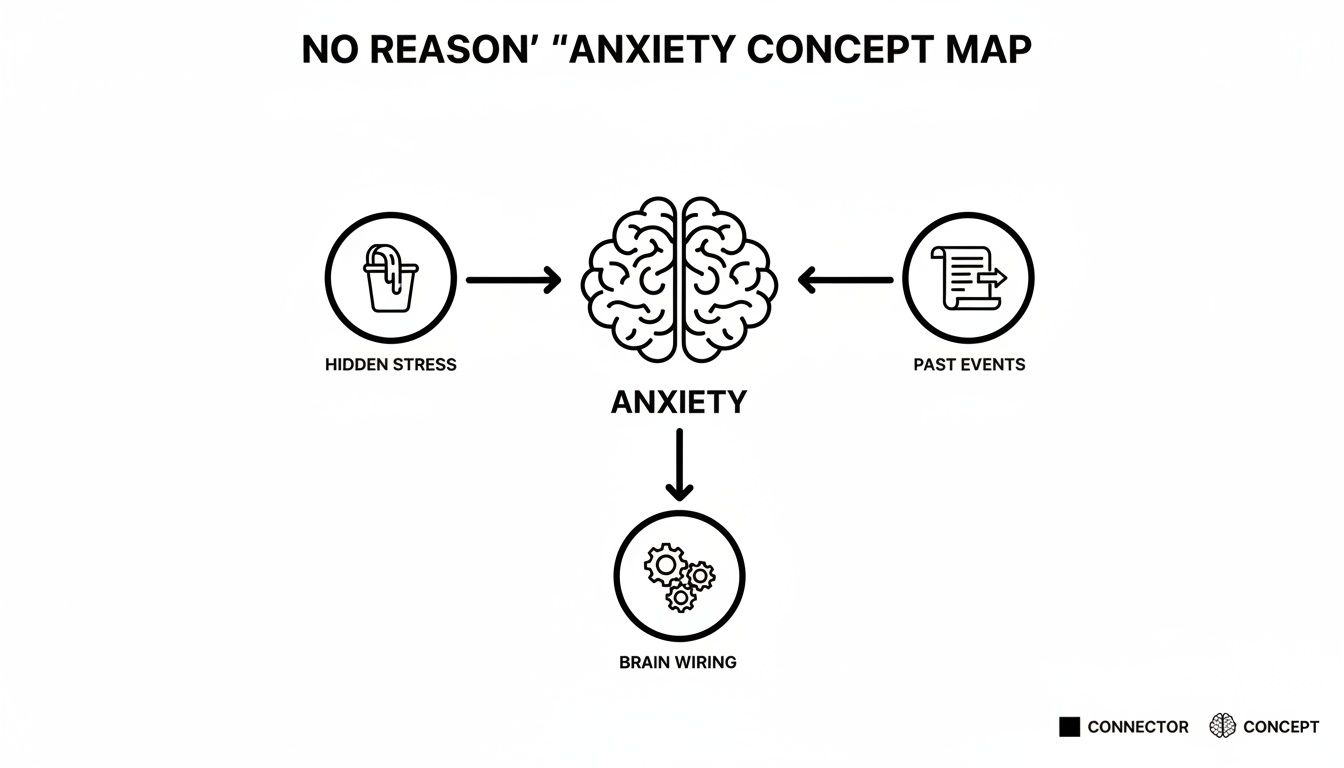
As you can see, "anxiety for no reason" is rarely caused by a single event. It's more of a convergence of different underlying pressures. Let's start digging into these areas to see how they connect.
Your Unique Biological Blueprint
Your body has a built-in alarm system designed for one thing: survival. A key part of this system is the amygdala, a tiny region in your brain that acts as a threat detector. For some of us, that alarm can become overly sensitive, getting stuck in the "on" position even when there's no real danger.
This heightened sensitivity isn't a personal failing; it’s often influenced by biological factors you have no control over.
- Genetics: Research shows that a predisposition to anxiety can run in families. If your parents or other relatives have struggled with it, your own alarm system might just be naturally more sensitive.
- Hormonal Fluctuations: Hormones are powerful mood and stress regulators. Changes during a menstrual cycle, postpartum, or due to a thyroid issue can throw your system off balance, making you far more vulnerable to anxiety.
- Brain Chemistry: Neurotransmitters like serotonin and dopamine are the brain's messengers. When these chemicals are out of balance, it can disrupt your mood and stress regulation, making you more prone to those anxious feelings.
Understanding your biological blueprint helps you see that this isn't "all in your head." There are real, physical reasons you might feel this way, and acknowledging them is a critical piece of the puzzle on the path to healing.
The Cognitive Traps Running in the Background
Beyond biology, your thoughts play a starring role. Many of us have automatic negative thought patterns that run like old, outdated software in the background of our minds. These cognitive traps can generate anxiety without you even consciously realizing it's happening.
Think of it like a quiet, constant hum of negativity that colors your perception of everything. Over time, this hum becomes so normal that you stop noticing it, but your nervous system is listening—and it’s responding with anxiety.
These thought patterns are learned habits, not unchangeable truths about who you are. The most hopeful part of this discovery is that what was learned can be unlearned. You have the power to update your mental software.
Common cognitive traps include jumping to worst-case scenarios ("what if?"), assuming you know what others are thinking, or being relentlessly self-critical. These aren't just thoughts; they are triggers. Recognizing them is the first step to disarming them. If you want to dive deeper, you can find a helpful list of common anxiety triggers that often stem from these hidden thought patterns.
Environmental Undercurrents and the Full Stress Bucket
Finally, your environment and daily life contribute massively to your baseline stress levels. Imagine your resilience as a bucket. Every small, chronic stressor adds a little bit of water.
A demanding job, financial worries, tension in a relationship, lack of sleep, poor nutrition, or even just constant exposure to negative news—these are the environmental undercurrents that slowly fill your bucket. None of these things on their own might seem like a big deal, but their cumulative effect is powerful.
When your bucket is already full, even a tiny, insignificant event can cause it to overflow. This triggers a wave of anxiety that feels completely disproportionate and random, leaving you wondering, "Why am I panicking now?" The real cause has been building for weeks, months, or even years. Many people also find this unease surfaces when grappling with deeper existential questions; exploring the purpose and meaning of life can uncover significant hidden roots of anxiety.
By identifying these biological, cognitive, and environmental factors, you start to demystify your anxiety. It’s no longer a nameless monster but a series of interconnected issues that can be addressed one by one. This knowledge is your roadmap back to calm.
Differentiating Everyday Worry From An Anxiety Disorder
Worry is part of being human. A looming presentation, a job interview, or a difficult conversation—it’s natural to feel on edge. That kind of worry is like a passing rain shower: tied to a clear reason and gone when the moment passes.
But what if those clouds never clear? Instead, you live under a steady, low hum of unease with no obvious cause. That’s the main line dividing normal worry from an anxiety disorder: its persistence, intensity, and impact on daily life.
This sense of “anxiety for no reason” has only grown. A 2024 poll showed 43% of U.S. adults felt more anxious than the year before, up from 37% in 2023 and 32% in 2022. Even more alarming, among those living with Generalized Anxiety Disorder (GAD), only 43.2% receive treatment. You can read more about these important mental health trends.
Pinpointing The Key Differences
Before jumping to conclusions, it helps to see how everyday worry and GAD really differ. This clarity can soften fear and guide you toward the right support.
Here’s a quick glance at what sets them apart:
Comparison Table: Normal Worry vs Generalized Anxiety Disorder
| Characteristic | Everyday Worry | Generalized Anxiety Disorder |
|---|---|---|
| The Trigger | Connected to a specific, real-life problem or upcoming event | Often free-floating, attaching to anything—or nothing at all |
| The Intensity | Proportional to the situation | Excessive, overwhelming, and often disproportionate |
| The Duration | Temporary—fades once the issue resolves | Persistent and chronic, lasting most days for six months or more |
| The Impact | Generally manageable—doesn’t stop you from daily tasks | Disruptive—interferes with work, relationships, and enjoyment of life |
| The Focus | Worries are about one or two areas at a time | Uncontrollable, spreading across multiple life domains (health, money, family) |
This breakdown makes it clear: worry itself isn’t the problem—it’s when it settles in like an uninvited houseguest. But the hopeful truth is that you can learn to show this guest the door.
Physical Symptoms As A Clue
Our bodies can betray us. Momentary stress might give you a jittery stomach. But when anxiety is chronic, it often sends a full-body alert.
- Muscle Tension especially around the neck, shoulders, and back
- Fatigue And Sleep Disturbances feeling wiped out but tossing and turning at night
- Digestive Upset like stomachaches, nausea, or IBS
- Restlessness a constant buzz that won’t let you relax
These aren’t just in your head—they’re your body’s SOS signals crying out for support.
Anxiety also shows up differently depending on your situation. For instance, new parents may face postpartum anxiety—learn more about the postpartum depression and anxiety warning signs.
Getting clear on these signs is your first step out of confusion and into action. When you understand what’s happening, you can start exploring coping techniques, from quick grounding exercises to long-range strategies for a panic-free life. For deeper reading on different conditions, check out our guide on various anxiety disorders.
Your Toolkit for Calming Sudden Anxiety
When a wave of anxiety crashes over you out of the blue, it can feel like you’re being pulled under. In that moment, you don’t need a complicated explanation—you need a lifeline. This is your immediate action plan. These are simple, powerful tools designed to pull you back to the safety of the present moment.
These techniques are all about interrupting the panic cycle. They shift your focus from the scary internal storm of thoughts and physical sensations and plant you firmly back on solid ground.
Most importantly, they are a profound reminder that you are in control, not the anxiety. A panic-free life is absolutely possible, and it all starts with learning how to navigate these moments with confidence.
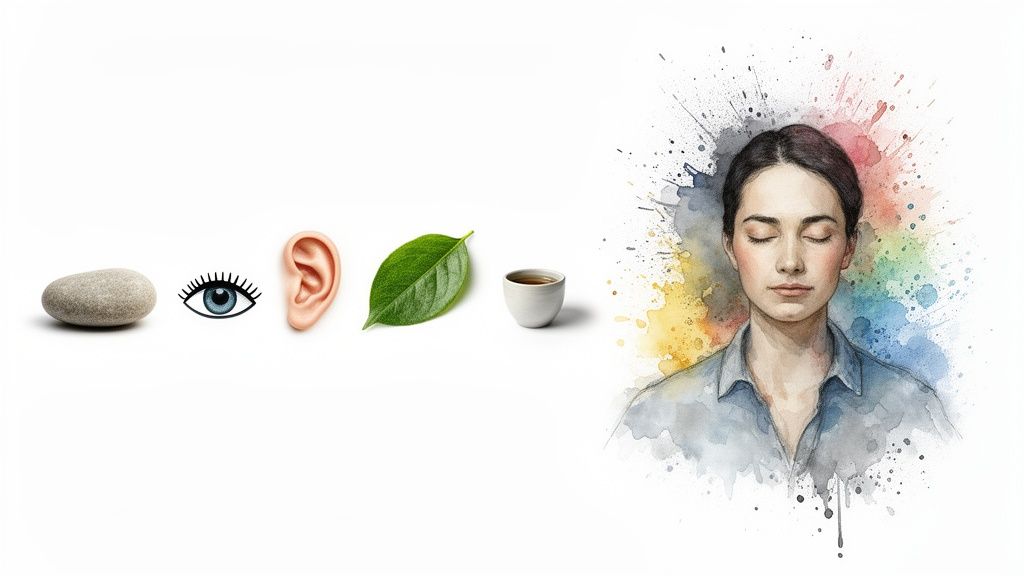
The 5-4-3-2-1 Grounding Method
When your mind is racing a million miles an hour, your senses are the most reliable anchor you have. The 5-4-3-2-1 technique is a deceptively simple way to reconnect with your surroundings and calm your nervous system right down.
The best part? You can do it anywhere, anytime, without anyone even noticing.
Here’s how it works:
- Acknowledge 5 things you can see. Look around you and mentally name five objects. Really notice their color, their shape, their texture. "I see the blue pen on my desk, the green leaves of that plant, the light reflecting off the window."
- Acknowledge 4 things you can touch. Focus on the physical sensation of four things you can feel. It could be the rough texture of your jeans, the cool surface of your phone, or just the feeling of your feet flat on the floor.
- Acknowledge 3 things you can hear. Listen closely and pick out three distinct sounds. Maybe it’s the low hum of a computer, the distant sound of traffic, or the quiet rhythm of your own breathing.
- Acknowledge 2 things you can smell. Tune into your sense of smell. Can you detect the faint scent of coffee? Soap on your hands? The fresh air coming through a window?
- Acknowledge 1 thing you can taste. Bring your awareness to your mouth. You might notice the lingering taste of your last meal, or you can just focus on the simple, neutral taste that's there.
This exercise forces your brain to switch gears from abstract worry to concrete, present-moment awareness, effectively short-circuiting the anxiety response.
Master Your Breath with Box Breathing
Your breath is one of the most powerful tools you have for regulating your nervous system. When anxiety strikes, our breathing often becomes shallow and rapid, which just signals more danger to the brain. Box breathing is a simple technique used by everyone from Navy SEALs to therapists to restore calm.
This method works because it stimulates the vagus nerve, which activates your body's relaxation response. It's a direct, biological way to tell your brain that you are safe and there is no immediate threat.
Picture a square with four equal sides. You're going to breathe along each side for a count of four:
- Breathe in slowly through your nose for 4 seconds.
- Hold your breath at the top for 4 seconds.
- Breathe out slowly through your mouth for 4 seconds.
- Hold your breath at the bottom for 4 seconds.
Repeat this cycle for just a few minutes. If you want to explore other powerful methods, you can find a whole range of breathing exercises for anxiety that can offer immediate relief.
Drop Anchor and Observe the Storm
Sometimes, the best strategy isn't to fight the wave of anxiety but to learn how to drop anchor and let it pass. This technique, rooted in Acceptance and Commitment Therapy (ACT), is all about observing your feelings without getting swept away by them.
Picture yourself as a sturdy boat in a storm. The wind and waves are your anxious thoughts and feelings—intense, for sure, but they can't sink you as long as your anchor is down. "Dropping anchor" means acknowledging the storm ("Wow, I'm feeling intense anxiety right now") while simultaneously connecting with the present moment.
Plant your feet firmly on the ground. Push them down and feel that stability. You are not the storm; you are the boat. And this will pass.
Building Long-Term Resilience for a Panic-Free Life

While in-the-moment coping skills are your lifeline during a storm, real freedom from anxiety comes from building a foundation so strong that the storms show up less often and with far less power. This isn't about finding a quick fix. It's about creating a life where you feel fundamentally safer and more at ease, day in and day out.
Building long-term resilience means you stop living in fear of the next wave of panic and start proactively creating a state of calm. You're shifting from a reactive stance to a powerful, forward-thinking one. This is the path to a life where anxiety no longer calls the shots.
This journey is more important than ever. That feeling of anxiety bubbling up 'for no reason' isn't just a personal struggle; it’s a growing global concern, especially for young people. The WHO noted a staggering 26% surge in anxiety after 2019, yet huge gaps in treatment remain. In 2022, only about half of U.S. mental illness cases got care, and globally, just one in four people with anxiety get the help they need. This is a massive problem, but you can learn how cognitive tools and expert-backed strategies are interrupting this cycle and helping people build lasting resilience.
Rewire Your Thoughts with Cognitive Reframing
Your thoughts are not facts. This simple but powerful idea is the heart of cognitive reframing, a technique that gives you the power to challenge and rewrite the anxious thoughts that fuel the cycle of panic. When you feel anxiety for no reason, it's often because automatic negative thoughts are running wild in the background.
Think of your mind as a garden. Anxious thoughts are like weeds—if you don't tend to them, they can quickly take over. Cognitive reframing is the simple act of pulling those weeds and planting flowers, or healthier, more realistic thoughts, in their place.
The process is pretty straightforward:
- Catch the Thought: The second you feel that jolt of anxiety, stop and ask yourself: "What was I just thinking?"
- Challenge It: Look for the evidence. Is that worst-case scenario really the most likely outcome? What proof do you have against it?
- Create a Balanced Thought: Swap the anxious thought for one that’s more realistic and compassionate. For example, instead of, "I feel awful, something is terribly wrong," try, "This is just anxiety. I’ve felt this before, and I know it will pass."
This isn’t about forced positivity; it's about being accurate. By consistently challenging distorted thoughts, you slowly weaken their hold and build new, more resilient pathways in your brain. You can get a deeper look at this approach in our guide to understanding Cognitive Behavioral Therapy for anxiety.
Fortify Your Nervous System with Lifestyle Pillars
Your mental and physical health are completely intertwined. The choices you make every day can either prime your nervous system for anxiety or build a strong, stable foundation of well-being. Focusing on these three pillars can make a massive difference in your long-term resilience.
1. Mindful Movement
Regular physical activity is one of the single most effective long-term strategies for managing anxiety. Exercise helps burn off excess cortisol (the stress hormone) and ramps up the production of endorphins, your body's natural mood-lifters. It doesn't have to be a punishing workout; a brisk daily walk, some gentle yoga, or even dancing in your living room can work wonders for regulating your nervous system.
2. Nourishing Nutrition
What you eat directly impacts your brain chemistry and mood. A diet heavy in processed foods, sugar, and caffeine can leave you feeling jittery and anxious. Instead, focus on whole foods—fruits, vegetables, lean proteins, and complex carbs—to keep your blood sugar steady. And don't forget to hydrate. Even mild dehydration can trigger anxiety symptoms.
3. Restorative Sleep
Sleep is when your brain and body repair and reset. When you don't get enough quality sleep, your amygdala—the brain's threat detector—can get stuck in a hyper-alert state, making you far more vulnerable to anxiety. Aim for 7-9 hours of solid, restful sleep per night by creating a calming bedtime routine and a dark, quiet sleep space.
You are not your anxiety. By cultivating self-compassion, you learn to see the anxiety as something you experience, not something you are. This separation is where your power lies.
Ultimately, building a panic-free life is a practice of self-compassion. There will be good days and challenging days. The goal isn't perfection; it's progress. By consistently investing in these long-term strategies, you're sending a powerful message to yourself: you are worthy of peace, and you have the strength to create it.
Where Do You Go from Here?
We’ve covered a lot of ground together, moving from the confusion of "why is this happening?" to the clarity of knowing what’s going on under the surface. We've untangled the hidden reasons for anxiety, armed you with skills for the heat of the moment, and sketched out a roadmap for building lasting calm.
If there's one thing to take away from all of this, it's this: you are not destined to live a life run by fear. A panic-free life isn't some far-off fantasy; it's an absolutely achievable reality. This guide is your starting point—a collection of tools and insights to empower you on that path.
Think of It Like Learning a New Skill
Healing from anxiety isn't a straight line with a finish line you cross one day. It’s much more like learning to navigate by the stars. At first, it feels clumsy and you’re not sure you trust yourself, but the more you practice, the more you start to recognize the patterns and feel confident you can find your way.
Every time you use a grounding technique when your heart starts racing, or gently question a catastrophic thought, or even just choose to go to bed a little earlier, you're laying down a new brick in the foundation. These small actions compound, creating new pathways in your brain and strengthening the resilience that's already in you.
The goal isn’t to get rid of anxiety forever—it’s a normal human emotion that has a purpose. The goal is to shrink its power over you. It’s about turning that terrifying tidal wave into a predictable current you know how to navigate.
That shift in perspective changes everything. It takes you out of the passenger seat and puts you firmly in control of your own well-being.
Your Next Small Step Is the Only Thing That Matters
Anxiety loves to overwhelm us with a massive to-do list for "getting better." The trick is to ignore the noise and focus only on what you can do right now. You don’t need to master every strategy overnight. The whole journey starts with one small, kind step in the right direction.
Maybe that next step is simply:
- Trying one breathing exercise for just two minutes.
- Jotting down one anxious thought and asking if it's 100% true.
- Putting on your shoes and going for a five-minute walk to get your body moving.
- Just noticing your feelings with kindness instead of judging yourself for them.
Each of these small acts sends a powerful message of hope to your nervous system: you are capable of healing. With practice and a lot of self-compassion, you can and will shift from a life defined by fear to one built on freedom, courage, and a quiet, steady sense of calm. You’ve already started.
A Few More Things You Might Be Wondering
As you begin putting these tools into practice, it's natural for questions to pop up. Think of this as a quick chat to clear up some common concerns. The main takeaway? You have the power to heal and build a life that isn't dictated by fear.
Can Anxiety for No Reason Ever Be Cured Completely?
While "cure" can be a tricky word in mental health, you can absolutely learn to manage anxiety so well that it no longer runs your life. The goal isn't to erase a normal human emotion—it's to dial down its intensity and frequency until you feel free and in charge again.
It's all about building resilience and having the right tools in your back pocket. With consistent practice, a full and vibrant life isn't just a possibility; it's what we expect for you.
Hope isn't about pretending anxiety doesn't exist. It's about believing in your own power to navigate it. You're not just surviving these moments—you're learning from them, growing stronger, and building a foundation for lasting peace.
This journey changes your relationship with anxiety from one of fear to one of understanding and genuine empowerment.
How Do I Explain This to Loved Ones?
It can be really tough for people who haven't felt it to truly get it. Using an analogy often helps. Try explaining it like a smoke alarm with faulty wiring—it sometimes goes off at full blast even when there's no fire.
Make it clear that this is a real physiological and neurological response, not just "worrying too much" or a flaw in your character. Sharing a helpful resource, like this article, can also give them some context and show them how they can best support you. Patience and clear communication are the keys to building that bridge of understanding.
Is Medication the Only Answer for Severe Anxiety?
Medication can be an incredibly effective and life-changing tool for many people, but it’s rarely the only answer. It's much more powerful when you see it as just one part of a complete toolkit for building long-term mental wellness.
It often works best when paired with other powerful strategies, such as:
- Therapy: Working with a pro to dig into the root causes and build practical coping skills.
- Cognitive Techniques: Actively learning how to challenge and reframe those anxious thought loops.
- Lifestyle Changes: Making sleep, nutrition, and mindful movement a priority to help regulate your nervous system.
Ultimately, your path is your own. The most important thing is knowing that healing is possible and that you have plenty of options to create a life where you feel calm, confident, and in control. Every step you take, no matter how small, is a victory.
At The Anxiety Checklist, we're all about providing structured, actionable tools to support your journey. Our Fearless Living system combines a detailed eBook with a 93-point interactive checklist designed to help you systematically dismantle anxiety's hold on your life. If you're ready for a clear, step-by-step plan to regain control and build lasting resilience, take a look at the system.