
It’s a frustratingly common story: the moment your head hits the pillow, your mind decides to throw a party for every worry you’ve ever had. This isn't some personal failing; it’s often just biology, amplified by the sudden quiet of the night. The good news? This cycle is absolutely breakable, and a life of peaceful sleep is entirely possible.
Why Your Anxious Mind Activates at Night
That sudden surge of dread just as you’re drifting off can feel incredibly isolating, but you are far from alone. For millions, the switch from a busy, noisy day to a quiet, dark bedroom opens the floodgates for stress and fear. Understanding this is the first step toward healing.
During the day, our minds are constantly jumping from task to task, conversation to conversation—an endless stream of distractions that keeps our deeper anxieties pushed down. When the lights go out, that buffer disappears. The silence creates a vacuum, and our unresolved thoughts and latent stress rush in to fill it. This isn't a sign of weakness; it’s just how our brains are wired.
The Biology of Bedtime Worry
At its core, nighttime anxiety is often just a misfiring of your body’s natural alarm system. All the stress you’ve accumulated during the day can leave your nervous system stuck in a heightened state of alert.
When you finally lie down to rest, your brain can misinterpret the quiet and stillness not as safety, but as a reason to be extra vigilant. This can activate a low-grade version of its threat response, which is why you might suddenly feel physical symptoms like a racing heart, tense muscles, or shallow breathing. You can learn more about this biological process in our detailed fight-or-flight response guide.
This experience is a massive sleep disruptor affecting millions. In fact, a recent survey found that 52% of respondents said anxiety and depression keep them from sleeping. It’s a two-way street: poor sleep makes anxiety worse, and anxiety disorders significantly increase the risk of insomnia.
The crucial takeaway is this: Your nighttime anxiety is a solvable problem, not a life sentence. By understanding why it happens, you can begin to use strategies that teach your mind and body that bedtime is a time for safety and rest. Healing is possible.
From Vicious Cycle to Virtuous Path
The link between anxiety and sleeplessness creates a particularly nasty feedback loop. You worry about not being able to sleep, which causes anxiety, which then makes it even harder to fall asleep. The next day, you’re exhausted and more vulnerable to stress, setting the stage for another difficult night. To really get a handle on this pattern, it helps to explore in depth what causes insomnia and how to help and its various triggers.
Breaking this pattern starts with one powerful idea: hope. You have the ability to reframe your entire relationship with sleep. The following sections will walk you through practical, step-by-step techniques to calm your nervous system, challenge those worried thoughts, and build a routine that signals safety to your brain. This is the path to living panic-free.
In-the-Moment Techniques to Stop Nighttime Panic
When your heart is pounding and your mind is looping through worst-case scenarios at 2 AM, you don’t need a long-term strategy—you need an emergency stop button. This is your toolkit for getting immediate relief and proving to yourself that you can find calm again.
The goal isn't to fight the anxiety head-on. That usually just adds fuel to the fire. Instead, these techniques are about gently guiding your body and mind back to a state of calm, creating a window for sleep to find you again.
They work because they tap directly into your body's wiring. You're sending signals to your nervous system that you are safe, right here and now, which interrupts the panic cycle. Realizing you can manage an attack in the moment is the first and most empowering step toward breaking the hold anxiety has on your sleep.
Nighttime anxiety often follows a predictable pattern. It starts with the leftover stress from your day, which gets amplified by the sudden quiet and stillness of the evening.
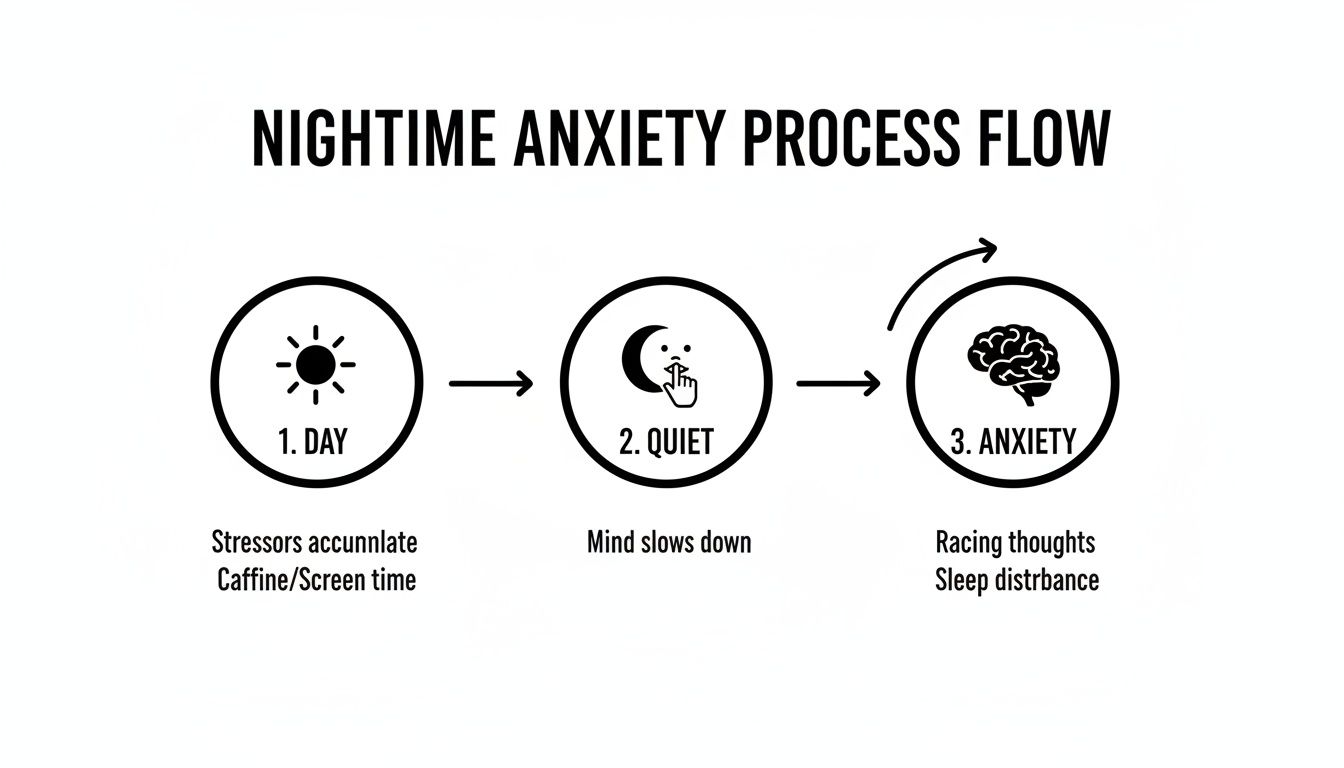
This simple flow shows how easily daily pressures can spiral into nighttime distress. But by using the right tools, you can disrupt this sequence and find calm. There is always a way back to peace.
Use Your Breath as an Anchor
When panic hits, your breathing gets shallow and fast, which only makes the physical symptoms of anxiety worse. By deliberately slowing down your breath, you can actively slow your heart rate and tell your entire nervous system to stand down.
One of the most effective methods is Box Breathing.
It’s simple. Imagine drawing a box with your breath.
- Breathe in slowly through your nose for a count of four.
- Hold that breath gently for another count of four.
- Breathe out completely through your mouth for a count of four.
- Hold with empty lungs for a final count of four.
Repeat this cycle for a few minutes. The steady rhythm gives your racing mind one simple thing to focus on, pulling it away from whatever was fueling the panic. If you want to explore more methods, check out our complete guide to breathing exercises for anxiety.
Release Tension with Progressive Muscle Relaxation
Anxiety isn't just in your head; it’s stored in your body. Think clenched jaw, tight shoulders, a knotted stomach. Progressive Muscle Relaxation (PMR) is a fantastic way to methodically release that tension, one muscle group at a time.
Lying in bed, start with your toes. Squeeze them as hard as you can for about five seconds, really focusing on that feeling of tightness. Then, let go completely. Notice the difference for ten seconds as the tension melts away.
Slowly work your way up your body, using the same tense-and-release pattern:
- Feet and calves
- Thighs
- Hips and glutes
- Stomach and chest
- Arms and hands
- Shoulders and neck
- Face and jaw
By the time you're done, your entire body will feel heavier and far more relaxed. This practice does more than just relieve physical stress—it sharpens your awareness of where you hold tension, giving you more control over it in the future.
PMR shows you that you have direct control over your body's physical response to anxiety. This realization is incredibly empowering and a key step toward believing you can overcome nighttime panic for good.
Ground Yourself in the Present Moment
When you’re anxious in bed, your mind is almost always stuck in the future ("What if…") or the past ("I should have…"). Grounding techniques are designed to pull you out of your head and back into the present by engaging your five senses.
The 5-4-3-2-1 method is a powerful way to do this without even getting out of bed. Lying in the dark, silently identify:
- 5 things you can see: The shadow on the ceiling, the outline of the door, the faint light from your alarm clock. It doesn't have to be much.
- 4 things you can feel: The texture of your blanket, the cool spot on the pillow, the weight of your body on the mattress, the air on your skin.
- 3 things you can hear: The hum of the refrigerator, a distant car passing by, your own quiet breathing.
- 2 things you can smell: The scent of laundry detergent on your sheets, the faint smell of lotion on your hands.
- 1 thing you can taste: The lingering taste of toothpaste or just the neutral taste in your mouth.
This sensory scan forces your brain to shift focus from abstract fears to concrete, immediate sensations. It breaks the momentum of racing thoughts and proves that you can redirect your attention—a tangible feeling of control in a moment that feels totally chaotic.
Rewiring Your Brain to Defeat Bedtime Worry
While in-the-moment techniques are a lifeline when panic strikes, lasting freedom from anxiety when trying to sleep comes from changing your relationship with your thoughts. This isn't about forcing your mind to go blank—that's a battle you'll never win. It's about learning to observe your worries without letting them hijack the night.
The goal is to build a new skill, one that proves you're in the driver's seat. It’s a process that rewires your brain to see bedtime not as a threat, but as a genuine chance to rest and recharge. This is how true healing happens.

Unmasking Your Anxious Thoughts
First things first: you have to become a detective of your own mind. Anxious thoughts love to disguise themselves as hard facts, especially in the dead of night when you're most vulnerable. They often follow predictable, unhelpful patterns called cognitive distortions.
One of the biggest culprits at bedtime is catastrophizing. This is when your mind grabs a small concern and spins it into a full-blown, worst-case scenario.
It usually starts small:
- "I'm still awake."
- Which quickly morphs into, "If I don't fall asleep right now, I'll be a wreck tomorrow."
- And before you know it, you've spiraled into, "I'll bomb my presentation, get fired, and ruin my entire life."
Sound familiar? Just recognizing this pattern is the first step to taking its power away. You can't challenge an enemy you can't see.
Offload Your Worries Before Bed
Instead of wrestling with these thoughts in the dark, give them an exit ramp hours before your head even hits the pillow. This is where a "Worry Journal" or a "brain dump" can be a game-changer.
About an hour or two before you plan to sleep, grab a notebook. Spend 10-15 minutes just writing down everything that's buzzing around in your head. Don't filter or judge it. Let every fear, to-do list item, and random anxiety spill onto the page.
Next to each worry, jot down one small, actionable step you can take to address it tomorrow. This simple act signals to your brain that the concern has been heard and scheduled, giving it permission to let go for the night. You're essentially closing all the mental tabs before you try to shut down your system.
This practice can be profoundly healing. It externalizes the anxiety, moving it from a chaotic loop inside your head to a manageable list on paper. This creates a real sense of control and tells your mind that the workday for worrying is officially over.
Systematically Dismantling Negative Thoughts
Once you get better at spotting your anxious thoughts, you can start actively challenging them. A simple but powerful tool for this is a Thought Record, a core technique in Cognitive Behavioral Therapy (CBT). It's one of the most effective, evidence-based ways to tackle anxiety. If you're interested in the nuts and bolts, you can learn more about how CBT helps you understand and manage anxiety in our detailed guide.
A Thought Record helps you look at your worries logically, almost like a friendly debate with yourself. You identify the anxious thought, then find a more balanced and realistic way to reframe it.
Challenging Your Anxious Bedtime Thoughts
Here’s a look at how this works in practice. Notice the shift from an automatic, distorted thought to a more grounded, realistic one. This is a skill you can build, and it gets easier with practice.
| Anxious Thought (Cognitive Distortion) | The Realistic Reframe (Balanced Thought) |
|---|---|
| "I'll never get to sleep. Tomorrow will be a complete disaster." | "I've had sleepless nights before and still managed. I might be tired, but I can handle it. Resting my body is still beneficial, even if I'm not fully asleep." |
| "This racing heart means I'm having a heart attack." | "I know this feeling. It’s my body’s anxiety response. My heart is strong and healthy. I can use my breathing exercises to help it calm down." |
| "I have so much to do tomorrow. I must sleep for eight hours straight." | "While eight hours would be nice, it’s not an absolute requirement for functioning. I will prioritize my most important tasks tomorrow and be compassionate with myself if I'm not at 100%." |
This isn't about pretending everything is perfect. It’s about finding a more balanced and truthful perspective. Doing this consistently retrains your brain’s automatic, knee-jerk reaction to bedtime worries.
It's a fact that the burden of sleep disruption often falls harder on women. Recent Gallup data shows that young women face the most severe sleep deficit, with only 27% reporting they get enough sleep. That’s a staggering 19-point gender gap compared to young men at 46%. This gap has widened significantly since 2001, when 42% of young women reported getting sufficient rest.
By actively using these cognitive tools, you're not just coping—you're building a more resilient mindset. You're teaching yourself, night after night, that thoughts are just thoughts. They aren't prophecies. And that is the foundation of a life where you can finally look forward to your bed as a sanctuary of peace.
Crafting Your Anti-Anxiety Bedtime Routine
A consistent evening routine is one of the most powerful signals you can send your brain that it’s time to wind down. It creates a predictable buffer zone between the chaos of the day and the calm needed for sleep, retraining your nervous system to associate the evening with safety and rest—not with the dread of potential anxiety when trying to sleep.
This isn't about adding more chores to your day. Think of it as building a personalized ritual that actively calms you down. Forget the generic advice; let's build a menu of proven, anxiety-reducing activities for your own 30-to-60-minute wind-down period.
Embrace the Digital Sunset
One of the simplest yet most effective changes you can make is to declare a "digital sunset." This means putting away all screens at least 60-90 minutes before you plan to sleep. The blue light from phones, tablets, and computers is notorious for suppressing melatonin, the hormone your body needs to feel sleepy.
But it’s more than just a chemical disruption. The constant stream of information, notifications, and emotionally charged content keeps your brain on high alert. Swapping your scroll for a screen-free activity tells your mind that the time for problem-solving is over.
Build Your Wind-Down Menu
Your routine should be something you genuinely look forward to—a collection of calming activities that feel restorative, not forced. The magic is in the consistency. Repetition is what builds that powerful connection between these actions and deep rest.
Here are a few ideas to mix and match for your perfect wind-down:
- Gentle Movement: Try a few minutes of light, restorative stretching. Focus on areas where you hold tension, like your neck, shoulders, and lower back. This isn't a workout; it's a conversation with your body, encouraging it to let go of physical stress.
- Calming Audio: A racing mind often needs a gentle anchor. Put on a playlist of soft instrumental music, a nature soundscape, or a guided meditation. Calming audio helps drown out intrusive thoughts and gives your brain something neutral and soothing to focus on. To go deeper, you can explore the connection between meditation and anxiety relief to find practices tailored to your needs.
- A Warm Bath or Shower: The magic here is twofold. First, the warmth is inherently relaxing for tense muscles. Second, the drop in your core body temperature after you get out mimics a natural process that helps kickstart sleep.
- Mindful Reading: Choose a book that is engaging but not overly stimulating. A physical book is often better than an e-reader, as it helps you avoid the temptation of notifications and blue light.
Creating this routine is a profound act of self-compassion. You are carving out non-negotiable time to care for your mind and body, sending the message that your peace is a priority. This is the foundation of healing from anxiety and reclaiming your nights.
The Ultimate Sleep Hygiene Checklist
Beyond your personal routine, the environment you sleep in plays a massive role in managing anxiety. A bedroom that feels like a true sanctuary can dramatically lower the baseline stress you feel when you lie down. The goal is to optimize every sensory input—from light and sound to temperature—to signal safety and calm to your nervous system.
This checklist is your framework for creating that ideal, anxiety-reducing sleep environment.
| Category | Action Item | Why It Helps Reduce Anxiety |
|---|---|---|
| Light Control | Use blackout curtains or an eye mask to make the room as dark as possible. | Darkness signals the brain to produce melatonin. Even small amounts of light can disrupt this process, keeping you in a lighter, more anxious state of sleep. |
| Temperature | Keep your bedroom cool, ideally between 60-67°F (15-19°C). | A cool environment supports the natural drop in body temperature required for deep sleep. A room that's too warm can increase restlessness and discomfort. |
| Sound | Use a white noise machine, a fan, or earplugs to block out disruptive noises. | A consistent, neutral soundscape prevents sudden noises from startling you awake, which can trigger a spike in adrenaline and anxiety. |
| Comfort | Invest in a comfortable mattress, pillows, and breathable bedding. | Physical discomfort from a lumpy mattress or scratchy sheets creates low-level stress signals that can prevent your body from fully relaxing. |
| Association | Use your bed only for sleep and intimacy. Avoid working or worrying in bed. | This strengthens the mental association between your bed and rest. If you're awake for more than 20 minutes, get up and do a calming activity until you feel sleepy again. |
By thoughtfully crafting both a personal wind-down routine and an optimized sleep environment, you build a powerful two-pronged defense against nighttime anxiety. You’re not just hoping for a good night's sleep; you're actively creating the conditions for it to happen. That sense of control is an essential step on the path to living panic-free.
A Structured Path to Panic-Free Living
Knowing a few calming techniques is one thing. Actually using them consistently enough to make a real difference? That’s the hard part. This is where shifting from random, in-the-moment tactics to a deliberate, structured plan can completely change your nights.
Hope isn't just a feeling you wait for—it's something you build, one intentional action at a time.
When you're dealing with anxiety when trying to sleep, everything can feel chaotic and out of your control. Using a structured tool, like a personalized checklist, takes the guesswork out of it. It’s about turning your good intentions into a concrete plan that shows you exactly what works for you.
Turning Knowledge into Lasting Habits
Imagine tracking how you feel and what you do each night. You might notice that Box Breathing brings your heart rate down way faster than the 5-4-3-2-1 method. Or maybe you discover that your new screen-free hour before bed has a massive impact on how quickly you fall asleep.
This isn't about getting a perfect score. It's about gathering personal data.
Each small win builds momentum. You start to see patterns, connect the dots between your day and your night, and prove to yourself that you actually have the power to influence how you feel.
This systematic approach makes you an active participant in your own healing. You’re no longer just reacting to anxiety; you are proactively building a framework for a panic-free life, one small, consistent step at a time.
This structured method is also crucial for building new pathways in your brain. When you consistently follow a routine and use calming techniques, you're physically retraining your nervous system to associate your bed with safety and rest, not fear.
Building Your Personalized Recovery Plan
A structured system gives you the power to create a toolkit that's genuinely yours. You can systematically test out different strategies and track what happens, fine-tuning your own unique anti-anxiety formula.
Your personalized plan could include things like:
- A Daily Log: Make a quick note of your stress levels, when you had caffeine, and how much screen time you got. You'll start seeing what might be triggering your nighttime anxiety.
- Technique Tracker: On a simple scale of 1 to 5, rate how effective different strategies (like PMR or grounding) were for you in the moment.
- Routine Adherence: Simply check off each step of your bedtime routine. It builds consistency and gives you a reason to celebrate your commitment.
This whole process gives you tangible proof that you're making progress, which is incredibly motivating on the tough nights. To round out your efforts, it’s also incredibly helpful to understand how to improve sleep quality for a refreshed morning, because better sleep hygiene makes everything else easier.
When you see your progress laid out, it helps you stay the course. It’s a visual reminder that you are moving forward and taking back control. This journey from chaos to clarity is what recovery is all about, and you can explore more of these foundational anxiety recovery steps to see how each piece fits into the bigger picture.
You have the ability not just to manage your anxiety, but to build a life where it no longer gets to call the shots.
Knowing When to Seek Professional Support
While all the strategies we've talked about are powerful tools for managing nighttime anxiety, there's also incredible strength in knowing when to call for backup. Reaching out isn’t a sign of failure; it's a confident move toward feeling better for good. This is your journey, but you don't have to walk it alone.
Let's be real: sometimes, self-guided techniques just aren't enough. And recognizing that is a breakthrough in itself. If anxiety when trying to sleep is consistently wrecking your nights and derailing your days, it’s probably time to consider professional support.
Signs It's Time to Reach Out
Making that first call to a doctor or therapist can feel like a huge step, but certain signs make it clear it’s the right one. You deserve support if any of this sounds familiar:
- Persistent Insomnia: You’ve given new routines and sleep hygiene a fair shot for several weeks, but you’re still staring at the ceiling at 3 AM.
- Daily Life Disruption: The exhaustion and anxiety are making it hard to focus at work, connect with people you love, or even enjoy your favorite hobbies.
- Overwhelming Panic: Nighttime brings on intense panic attacks that feel completely out of your control, leaving you drained and genuinely afraid of going to bed.
Reaching out for help is an act of empowerment. It means you are taking your well-being seriously and are committed to finding a solution that brings you peace, no matter what it takes.
What Professional Treatment Actually Looks Like
Seeking help opens the door to proven, evidence-based treatments that really work. One of the gold standards for this specific issue is Cognitive Behavioral Therapy for Insomnia (CBT-I).
This isn't just venting on a couch; it's a structured, practical program. A therapist trained in CBT-I will help you identify and reframe the unhelpful thoughts that fuel your sleep anxiety. More importantly, they’ll guide you in establishing new behaviors that actively promote deep, restorative rest.
The struggle is more common than you think. Globally, over a third of adults report dealing with insomnia. This isn't just a personal problem; it has a massive economic footprint, costing the United States up to $411 billion a year in lost productivity and health expenses. If you want to dive deeper, you can discover more insights about sleep statistics.
So, where do you start? The process is simpler than it sounds. Just talk to your primary care doctor. They can screen for any underlying medical conditions that might be contributing and give you a referral to a qualified therapist or a sleep specialist.
Taking this step is a hopeful, proactive move toward taking back your nights—and ultimately, your life. You can heal from this. You can live a life free from panic.
A Few Common Questions
It’s completely normal to have questions as you start untangling nighttime anxiety. Finding clear answers helps you trust the process and feel confident that you’re moving in the right direction. Let’s tackle a few common ones.
What If I Wake Up with Anxiety in the Middle of the Night?
You jolt awake, heart hammering against your ribs. The first rule? Do not, under any circumstances, check the clock. It's a guaranteed stress-spike.
Instead, get out of bed. Go to another room, keep the lights dim, and stay there for about 15-20 minutes.
The key is to do something calming but mind-numbingly dull—think folding laundry, organizing a bookshelf, or reading the user manual for your microwave. Only head back to bed when you genuinely feel sleepy again. This is a powerful way to retrain your brain to see your bed as a place for rest, not a stage for late-night panic.
Can My Diet Make My Sleep Anxiety Worse?
Absolutely. What you eat and drink, especially in the evening, can have a direct line to your nervous system.
Stimulants like caffeine are the most obvious culprits and can hang around in your system for hours. It’s best to cut it off at least 8 hours before you plan to sleep.
But it’s not just coffee. Big meals, spicy food, or sugary snacks too close to bedtime can cause indigestion and physical discomfort that your anxious brain easily mistakes for a threat. And while a glass of wine might feel relaxing at first, alcohol actually disrupts your sleep cycle later in the night, leading to fragmented, poor-quality rest that almost always makes anxiety worse the next day.
Hope isn’t about being perfect; it’s about being persistent. Every time you practice a healthy habit, you're casting a vote for a future where you are in control of your nights.
How Long Does It Take for These Techniques to Work?
This is a big one, and the honest answer is: it varies.
In-the-moment tools like deep breathing can bring a wave of relief right when you need it most. But building real, lasting freedom from anxiety when trying to sleep—the kind that comes from new routines and healthier thought patterns—is a more gradual process.
You might notice small wins within the first week or so. However, seeing significant, sustainable change often takes several weeks of consistent effort. Be patient with yourself. Be compassionate. Consistency will always beat perfection on this journey. You can heal from this.
Ready to stop guessing and start building a real plan? The Anxiety Checklist is designed to help you turn these strategies into a structured, personalized roadmap. It gives you the tools to track your progress, see what actually works for you, and build habits that stick.
Take the next step toward a panic-free life and get your copy of The Anxiety Checklist today.