Anxiety can feel like a relentless storm, trapping you in a cycle of worry, panic, and fear. It often whispers that this overwhelming feeling is your permanent reality, but that is a lie. Hope is not just a distant concept; it is an actionable plan. There is a tangible way to heal, to quiet the internal noise, and to live a life free from the constant grip of panic. This guide is your first step on that path.
Inside this article, you will find 10 powerful art therapy techniques designed to help you manage and overcome anxiety. Think of them not as mere distractions, but as structured, evidence-informed tools to help you process complex emotions and build lasting resilience. Each entry provides a practical, step-by-step method to help you externalize your anxiety, transforming it into something you can observe, understand, and ultimately control.
You will learn how to implement specific methods like Mandala Creation, Expressive Scribbling, and Clay Modeling, each broken down with clear instructions, material lists, and time estimates. We will cover a range of activities, including:
- Collage and Vision Boarding
- Zentangle and Pattern Drawing
- Art Journaling
- Paint Pouring and Fluid Art
- Mindful Photography
This is not about creating a masterpiece or becoming a professional artist. It is about using simple creative processes to access the calm, focused, and capable person you are beneath the anxiety. Let’s begin the journey toward reclaiming a life where you are in control.
1. Mandala Creation and Coloring
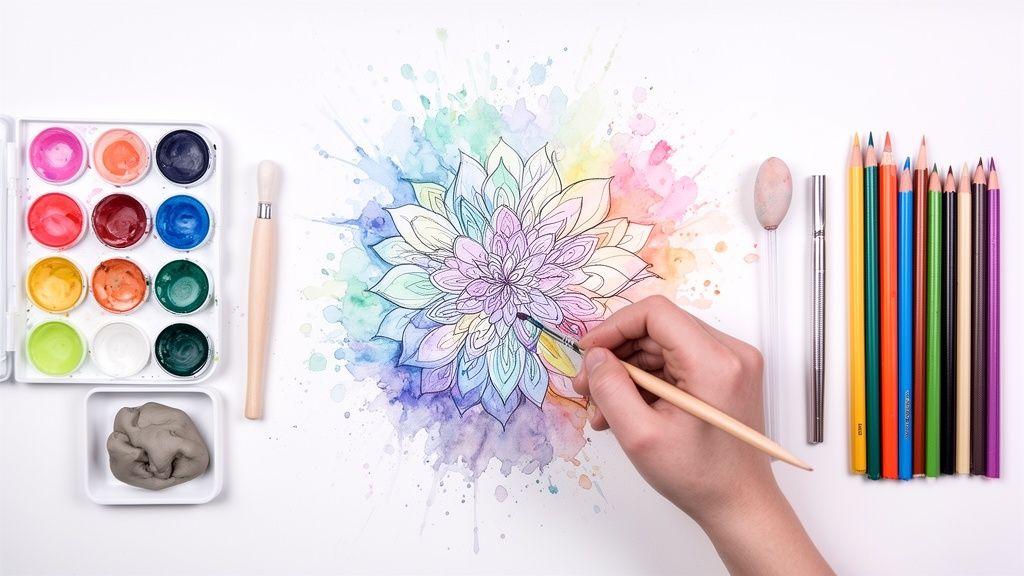
Mandala creation is a powerful art therapy technique centered on drawing or coloring intricate, circular designs. The word "mandala" comes from the Sanskrit term for 'circle,' and these patterns symbolize wholeness, balance, and the universe. The process of engaging with a mandala serves as a focal point for the mind, offering a structured, contained space to pour your attention into. This focused activity helps interrupt the cycle of anxious thoughts and grounds you firmly in the present moment, providing a tangible way to find calm and feel more in control.

Pioneered in modern psychotherapy by Carl Jung, who saw them as a representation of the self, mandalas are a simple yet profound tool for self-soothing. The repetitive, rhythmic motions of coloring or drawing within the lines create a meditative state, slowing your heart rate and easing physical tension associated with anxiety. It’s an accessible practice that offers a pathway to inner peace, showing that healing from anxiety is possible through consistent, gentle effort.
How to Implement Mandala Art Therapy
Materials:
- Pre-printed mandala coloring pages or a blank sheet of paper
- Compass and ruler (if drawing your own)
- Colored pencils, markers, or fine-tip pens
Instructions:
- Set Your Intention: Before you begin, take a moment to acknowledge how you are feeling. Set a simple intention to release anxiety and find a moment of peace.
- Choose Your Mandala: Select a pre-printed design that appeals to you or draw a basic circle to start your own. Don't worry about perfection; the goal is expression.
- Begin Coloring or Drawing: Start from the center and work your way outward, or vice versa. Focus on the sensation of the pencil on the paper and the act of choosing colors.
- Practice Mindful Awareness: As you work, notice your breath. If anxious thoughts arise, gently acknowledge them and return your focus to the colors and patterns. The structure of the mandala provides a safe container for your attention.
- Reflect: Once finished, or after a set time (e.g., 20 minutes), observe the completed piece and notice any shifts in your mood or physical state.
Clinical Insight: Research shows that coloring complex geometric patterns like mandalas induces a meditative state that can significantly reduce anxiety levels. The structured nature of the activity provides predictability and control, which is often reassuring for individuals experiencing anxiety. While this is a wonderful self-help tool, exploring other engaging arts and crafts experiences can also open up new avenues for creative self-expression and emotional regulation.
2. Expressive Drawing and Scribbling
Expressive drawing is a dynamic art therapy technique that encourages creating spontaneous, non-representational marks, lines, and scribbles. This method frees you from the pressure of making something look "right" and instead focuses on externalizing your internal state. For those struggling with anxiety, this can be a direct line of communication for feelings that are too chaotic or overwhelming for words, allowing you to pour distress onto the paper and transform it into a visible, tangible form. This act of release can make overwhelming emotions feel more manageable and less intimidating.
Pioneered by art therapy figures like Edith Kramer and Natalie Rogers, this approach values the process over the final product. The physical motion of scribbling can dissipate pent-up energy, frustration, and tension stored in the body. It’s an immediate, visceral way to confront and release anxious feelings without judgment. By giving form to the formless, you begin to see that even the most intense anxiety can be contained and processed, offering a powerful sense of agency and hope on the path to living a calmer, panic-free life.
How to Implement Expressive Drawing
Materials:
- Blank paper (any size) or a dedicated "scribble journal"
- Crayons, charcoal, markers, or pens (using different colors can be helpful)
Instructions:
- Check In With Your Body: Take a moment to notice where you feel anxiety in your body. Is it a tightness in your chest? A knot in your stomach?
- Choose a Color: Select a color that represents this feeling. Don't overthink it; just grab the one that feels right.
- Translate Feeling to Motion: Begin making marks on the paper that reflect the physical sensation. Let the movement come from your arm and shoulder, not just your wrist. Scribble, press hard, make jagged lines, or create soft, flowing ones.
- Focus on Release: Continue for 5-10 minutes with the sole intention of releasing the emotion onto the paper. Don't worry about what it looks like. If new feelings arise, you can switch colors to represent them.
- Observe and Breathe: After the timer goes off, put your drawing tool down. Look at the page from a distance and take several deep breaths. Notice the energy you've transferred from your body to the paper.
Clinical Insight: This technique is grounded in the idea that unprocessed emotions manifest as physical tension. Expressive drawing provides a kinesthetic outlet for this somatic energy, reducing symptoms of anxiety and preventing emotional buildup. Keeping a 'scribble journal' for daily use can be an effective habit for tracking and managing anxiety triggers. When combined with cognitive strategies, such as those found in resources like the Fearless Living eBook, this practice can become a foundational part of your emotional regulation toolkit.
3. Clay Modeling and Hand-Building
Clay modeling is a highly tactile art therapy technique that involves shaping and molding clay to create three-dimensional forms. The sensory experience of touching, squeezing, and manipulating the material offers a powerful grounding effect, pulling your focus away from anxious thoughts and into the physical world. This direct, hands-on process allows for non-verbal emotional expression, providing an outlet for feelings that are too difficult to put into words. The malleable nature of clay mirrors our own capacity for change and resilience, offering a powerful reminder that we can reshape our own experiences and heal.

Pioneered in part by art therapist Edith Kramer and now widely used in occupational therapy, clay work is a profound method for managing anxiety. The physical act of kneading, rolling, or even punching the clay can be a safe and constructive way to release pent-up energy, anger, or frustration. This process helps regulate the nervous system and discharge stress from the body. It’s a tangible way to work through complex emotions, demonstrating that even when things feel knotted and tense, you have the power to smooth them out and create something new.
How to Implement Clay Modeling Therapy
Materials:
- Air-dry clay, polymer clay, or traditional pottery clay
- A flat, non-porous work surface (like a wooden board or mat)
- Small container of water
- Optional: basic sculpting tools
Instructions:
- Connect with the Clay: Begin by holding the clay in your hands. Notice its temperature, texture, and weight. Squeeze it, roll it into a ball, and flatten it out.
- Release Physical Tension: If you feel anxious, use the clay to physically express it. You can punch it, tear it apart, or squeeze it tightly to release built-up energy.
- Create a Symbolic Form: Think about your anxiety. What shape, form, or texture does it have? Create a symbolic representation of it, such as a tight knot or a spiky ball.
- Transform the Form: Once you have created your anxiety symbol, mindfully begin to change it. Smooth the rough edges, untie the knot, or reshape it into something that represents calm, such as a smooth stone or a spiral.
- Reflect on the Process: After about 20-30 minutes, observe your final creation. Notice how you feel. Did the physical act of transforming the clay shift your emotional state?
Clinical Insight: The sensory input from clay work is a core element of its effectiveness. This art therapy technique engages the proprioceptive and tactile systems, which helps regulate the nervous system and promotes a sense of body awareness. For individuals with anxiety, this can be incredibly centering. You can explore other powerful grounding techniques for anxiety to build a robust toolkit for managing difficult moments.
4. Collage Creation and Vision Boarding
Collage creation is an expressive art therapy technique that involves assembling various images, texts, and materials onto a single surface. By cutting or tearing elements from magazines, newspapers, or photographs, you create a new composite image. This process allows you to bypass the analytical part of your brain and tap into your intuition, creating a visual representation of your feelings, thoughts, and hopes without needing words. It's a way to externalize the chaos of anxiety and begin to make sense of it visually, offering a tangible step toward regaining control.
A specific type of collage, vision boarding, focuses on curating images and words that represent your future goals and desired life. This forward-looking practice helps shift your focus from present worries to a hopeful, positive future. Popularized by figures like Louise Hay, this technique builds motivation and serves as a powerful reminder that a life free from the grip of panic is not only possible but something you are actively creating.
How to Implement Collage and Vision Boarding
Materials:
- A poster board, canvas, or large sheet of heavy paper
- A stack of old magazines, newspapers, or printed images
- Scissors and glue or tape
- Markers, pens, or paint for adding words or details
Instructions:
- Set Your Intention: Decide if you are creating an "anxiety-release" collage to process current feelings or a "vision board" to build hope. Take a few deep breaths to center yourself.
- Gather Your Images: Flip through magazines and intuitively cut or tear out images, words, and colors that resonate with you. Don't overthink this step; simply collect what catches your eye.
- Arrange Your Elements: Before gluing, arrange the pieces on your board. Notice any themes or patterns that emerge. For a vision board, you might group images by life areas like career, health, or relationships.
- Assemble Your Collage: Glue your chosen elements onto the board. You can overlap them, leave space, or create a specific flow. Add your own words or affirmations to amplify the message.
- Reflect and Display: Place the finished piece somewhere you will see it regularly. When you feel anxious, look at your creation. Let it remind you of your ability to create order from chaos or of the positive future you are working toward.
Clinical Insight: Collage and vision boarding are effective art therapy techniques because they engage associative processing, which can interrupt the rigid, cyclical thinking patterns common in anxiety. Creating a vision board, in particular, helps externalize goals, making them feel more attainable and providing a concrete source of motivation. This process aligns well with setting clear, actionable objectives to manage and reduce anxiety, helping you build a roadmap for your healing journey. For more guidance on structuring your goals effectively, exploring SMART goals for anxiety can provide a helpful framework.
5. Zentangle and Pattern Drawing
Zentangle is a meditative drawing method that uses structured, repetitive patterns, or "tangles," to create beautiful abstract images. Created by Rick Roberts and Maria Thomas, this art therapy technique is built on the idea that "anything is possible, one stroke at a time." Unlike free-form doodling, Zentangle uses a specific set of intentional strokes, which provides just enough structure to quiet the mind without feeling restrictive. The process of building complex designs from simple, repeated marks is deeply absorbing, shifting your focus away from anxious thought loops and into a state of mindful flow.
The Zentangle method is non-representational, meaning you aren't trying to draw a specific thing. This liberates you from the pressure of a final outcome and the fear of making mistakes; in Zentangle, there are no errors, only opportunities. This philosophy is especially powerful for managing anxiety, as it reframes perfectionism and self-criticism. It provides a reliable, portable tool for grounding yourself, showing that a calm, panic-free state is accessible through consistent, small actions.
How to Implement Zentangle Art Therapy
Materials:
- A small square piece of paper (a "tile," traditionally 3.5×3.5 inches)
- A fine-tip black pen
- A soft graphite pencil for shading
Instructions:
- Prepare Your Space: Find a quiet spot where you can sit comfortably for 10-15 minutes without interruption. Take a few deep breaths to center yourself.
- Create Your Border and String: Use the pencil to lightly draw a square border near the edges of your tile. Then, draw a light, free-flowing line or "string" that divides the border into smaller sections.
- Draw Your Tangles: Switch to your pen. Begin filling one of the sections with a simple, repetitive pattern. Focus entirely on each stroke: a line, a curve, a dot.
- Embrace the Process: Move to the next section and fill it with a different pattern. Don't plan ahead; let the design unfold organically. If your mind wanders to anxious thoughts, gently guide your attention back to the tip of your pen.
- Shade and Appreciate: Once your tile is filled with patterns, use the pencil to add shading for depth and contrast. Take a moment to look at your finished creation, appreciating the unique piece of art you made.
Clinical Insight: The structured repetition in Zentangle activates the parasympathetic nervous system, promoting relaxation and lowering cortisol levels. Its accessibility has made it a popular tool in workplace wellness programs for stress breaks and in schools for test-anxiety management. The practice shares many benefits with focused attention practices, and you can explore meditation for anxiety to see how these two methods can complement each other for a more robust anxiety management plan.
6. Art Journaling and Mixed Media
Art journaling combines visual expression with written reflection, creating a powerful private space to process complex emotions. This technique involves using a journal as a canvas for drawings, paintings, collage, text, and other mixed media. It creates a dialogue between your visual and verbal self, allowing you to explore anxious thoughts and feelings on multiple levels at once. The journal becomes a living document of your journey, tracking triggers, celebrating progress, and storing insights.
Popularized by authors like Lucia Capacchione, art journaling is a cornerstone of expressive arts therapy. It offers a tangible method for externalizing internal struggles, making them feel more manageable. Instead of letting anxiety spiral internally, you give it form and context on the page. This practice shows that recovery is an ongoing process of discovery, and that you can actively build a record of your resilience and find a path to living panic-free.
How to Implement Art Journaling
Materials:
- A blank journal or sketchbook (mixed media paper is ideal)
- Pens, pencils, markers
- Paints (watercolor or acrylics)
- Old magazines, photos, fabric scraps for collage
- Glue stick or art medium
Instructions:
- Set the Stage: Find a quiet space where you feel comfortable. Take a few deep breaths to center yourself before opening your journal.
- Start with a Feeling or Prompt: Tune into how you are feeling. You can start by writing a word, drawing a shape that represents your anxiety, or using a prompt for inspiration.
- Create Without Judgment: Let your intuition guide you. Splatter paint, tear paper, scribble with a pen, or write freely. There are no rules; the goal is authentic expression, not artistic perfection.
- Add Layers: Combine different materials. Paste images over a painted background, then write your thoughts over the collage. This layering can mirror the complexity of your emotions.
- Reflect and Write: After creating your visual entry, write down any thoughts, feelings, or memories that emerged. What does the page tell you? What did you release in the process?
Clinical Insight: Art journaling helps integrate the left (logical, verbal) and right (creative, emotional) hemispheres of the brain. This whole-brain approach can lead to deeper self-understanding and emotional regulation. By creating a visual and written record of your anxiety patterns, you can identify triggers and measure the effectiveness of coping strategies over time. Exploring the benefits of journaling can provide additional context for how this powerful practice supports mental well-being.
7. Paint Pouring and Fluid Art
Paint pouring is a dynamic art therapy technique where you mix liquid acrylic paints and pour them onto a surface, allowing gravity and movement to create abstract, flowing designs. The process is inherently unpredictable, yielding organic compositions that are impossible to fully control. This fluid nature mirrors the often chaotic and overwhelming feelings of anxiety, but it channels that energy into something surprisingly beautiful and meaningful. For those who struggle with a need for control, this method is a powerful exercise in letting go and embracing uncertainty.

Popularized within contemporary art communities by artists like Rene Proulx, paint pouring helps reframe your relationship with unpredictability. Instead of fearing the unknown, you learn to find beauty and opportunity in it, a core cognitive shift needed for anxiety recovery. Watching the colors merge and flow can be incredibly mesmerizing, providing a moment of respite from intrusive thoughts. It demonstrates that releasing control doesn't have to lead to catastrophe; instead, it can open the door to unexpected and wonderful outcomes, offering tangible hope that a life free from panic is within reach.
How to Implement Paint Pouring Art Therapy
Materials:
- Acrylic paints in various colors
- Pouring medium (like Floetrol or a professional medium)
- Small canvas, wood panel, or ceramic tile
- Plastic cups for mixing, and a larger cup for the final pour
- A tray or plastic sheeting to protect your workspace
Instructions:
- Prepare Your Space: Cover your work area completely. This process is messy, and being prepared allows you to let go without worrying about cleanup.
- Mix Your Paints: In separate cups, mix each paint color with a pouring medium until it reaches a thin, liquid consistency (like warm honey).
- Set Your Intention: Choose colors that represent the emotions or anxieties you want to release. As you layer them into a single cup, visualize pouring those feelings out.
- Pour and Tilt: Quickly flip the cup onto your canvas and lift it away. Alternatively, pour the paint directly onto the surface. Gently tilt the canvas in different directions, watching the colors flow and interact.
- Observe and Accept: Resist the urge to over-manipulate the design. The beauty of this technique lies in surrender. Observe the final piece and reflect on the experience of letting go.
Clinical Insight: The act of 'letting go' in paint pouring is a direct behavioral parallel to cognitive-behavioral strategies for managing anxiety, where individuals practice accepting uncertainty. The unpredictable results can challenge catastrophic thinking by providing evidence that the unknown can be beautiful, not just threatening. As you practice this on the canvas, you are also training your brain to apply this mindset to life's anxieties.
8. Sculpture and Three-Dimensional Building
Sculpture and three-dimensional building is an art therapy technique that moves expression beyond the flat page and into the physical world. This method involves creating artworks from materials like clay, wood, wire, or even found objects. The hands-on process of constructing and problem-solving in a three-dimensional space engages different parts of the brain than drawing or painting, offering a powerful, tactile way to process complex emotions. Building something tangible provides solid evidence of your ability to create stability and permanence, a direct counter to the feelings of chaos and insufficiency that anxiety often brings.
This method gives a physical form to your inner world, allowing you to externalize, examine, and reshape difficult feelings. The act of building something structurally sound can metaphorically reinforce your own sense of emotional resilience. Whether you are molding clay or assembling found objects, you are actively turning formless anxiety into a concrete object that you can see, hold, and control. This process shows that you have the power to transform your experiences and construct a new reality, giving you hope that healing from anxiety is not just possible, but achievable through tangible action.
How to Implement Sculpture and 3D Building
Materials:
- Air-dry clay, modeling clay, or polymer clay
- Found objects (twigs, stones, bottle caps, fabric scraps)
- Wire, pipe cleaners, or small blocks of wood
- Glue or other adhesives
Instructions:
- Ground Yourself and Your Materials: Before starting, handle your chosen materials. Feel their weight, texture, and temperature. Set an intention to build something that represents either your anxiety or your strength.
- Begin Building: There is no right or wrong way to start. You can mold a single lump of clay, connect different found objects, or bend wire into a shape. Let your hands guide the process.
- Focus on the Physical Sensation: Concentrate on the feeling of pressing, pulling, and joining the materials. This sensory focus anchors you in the present, pulling your attention away from racing thoughts.
- Embrace Problem-Solving: If a piece falls or doesn't fit, see it as an opportunity. The act of repairing and strengthening your sculpture is a metaphor for building resilience against life's setbacks.
- Reflect on Your Creation: Once you feel complete, step back. What does the sculpture represent? You can choose to keep it as a symbol of your strength or deconstruct it as an act of releasing what it symbolizes.
Clinical Insight: The tactile and kinesthetic nature of sculpture is highly effective for grounding individuals during moments of high anxiety or dissociation. Art therapists often use 3D art to help clients externalize trauma or overwhelming emotions, making them more manageable. The act of creating a lasting object can bolster self-esteem and provide a tangible reminder of one's capability and endurance, which is fundamental to anxiety recovery.
9. Painting and Color Therapy
Painting as an art therapy technique combines the expressive power of color, the physical motion of brushwork, and the act of creating a composition. It is deeply connected to color therapy, or chromotherapy, which studies the psychological and physiological effects of different colors. By intentionally selecting and applying colors, you can directly influence your emotional state. This makes painting a potent tool for regulating anxious feelings, as different hues can trigger specific responses: blues and greens often calm the nervous system, while yellows can uplift a low mood.
The connection between color and emotion was explored by artists like Wassily Kandinsky, who believed colors could provoke deep emotional responses. In a therapeutic context, painting gives form to feelings that are difficult to verbalize. The process of mixing colors and applying them to a canvas provides an immediate, non-verbal outlet for stress and worry. It offers a constructive way to process emotions, demonstrating that you have the ability to transform a blank canvas, and by extension, your inner state, paving a path toward a life free from panic.
How to Implement Painting and Color Therapy
Materials:
- Canvas, watercolor paper, or a mixed-media art journal
- Paints (watercolor, acrylic, or gouache)
- Brushes in various sizes
- A palette for mixing colors and a cup of water
Instructions:
- Set Your Intention: Take a moment to check in with your body and mind. Ask yourself, "What color is my anxiety today?" Or, "What color would I like to feel?"
- Select Your Palette: Choose colors intentionally. If you feel overwhelmed, gravitate toward cool, calming colors like blues, lavenders, and soft greens. If anxiety makes you feel withdrawn, consider adding touches of warm, energizing yellows or oranges.
- Begin Painting: Don't aim for a masterpiece. You can paint abstract shapes, a calming landscape, or simply fill the page with colors that represent your emotions. Focus on the sensation of the brush gliding across the surface.
- Practice Mindful Creation: Pay attention to how your body feels as you paint. Notice your breathing and posture. If your mind wanders to worried thoughts, gently guide your focus back to the physical act of mixing a color or making a brushstroke.
- Reflect on Your Work: After 20-30 minutes, step back and look at your painting. What do you notice? Did your feelings change as you worked? The finished piece can serve as a visual record of your journey from distress to calm.
Clinical Insight: Color psychology is a key component in many therapeutic settings. Art therapists often guide clients to create a 'feelings palette,' where each color corresponds to an emotion, helping them identify and process complex feelings associated with anxiety. This practice can be an effective part of a broader treatment plan, which might also include various forms of psychotherapy for anxiety to address root causes and develop coping strategies.
10. Mindful Photography and Visual Observation Art
Mindful photography is an art therapy technique that shifts focus from creating art to intentionally observing the world around you. It involves using a camera or sketchbook to document beauty, patterns, and details in everyday environments. This practice interrupts the internal loop of anxious thoughts by directing your attention outward, toward the visual richness of the present moment. By consciously looking for things to appreciate, you retrain your brain to notice the positive, which can directly counter the pessimistic bias often fueled by anxiety.
This process serves as a form of mindfulness in action, grounding you in your senses and environment. The act of framing a shot or sketching a found object requires concentrated awareness, which calms the nervous system and provides a welcome escape from worry. It’s a gentle reminder that even when your inner world feels chaotic, there is still beauty and order to be found outside yourself, offering tangible proof that a peaceful, panic-free life is within reach.
How to Implement Mindful Photography
Materials:
- A camera (a smartphone camera works perfectly) or a small sketchbook
- A pen or pencil (if sketching)
Instructions:
- Set an Intention: Before you start, decide to look for beauty, no matter how small. Your goal is not to take a perfect photo but to simply notice and appreciate what you see.
- Go for a Mindful Walk: Step outside or walk through your home with the sole purpose of observing. Pay attention to light, shadows, textures, colors, and shapes.
- Capture What Catches Your Eye: When something interests you, pause. Take a moment to truly see it. Use the '5 senses' technique: what do you see, hear, smell, and feel? Then, take a photo or make a quick sketch.
- Find Your "Three Things": As a daily practice, make it a goal to photograph or sketch three beautiful or interesting things you encounter. This creates a simple, achievable routine.
- Create a "Beauty Collection": Save your photos in a dedicated album on your phone or computer. When anxiety spikes, review this collection to remind your mind of the positive things you’ve observed, restoring perspective and calm.
Clinical Insight: Mindfulness-based stress reduction (MBSR) programs often incorporate mindful observation to reduce rumination and anxiety. This technique acts as a form of cognitive restructuring, actively building a collection of positive evidence to challenge anxious thought patterns. Sharing these observations in a supportive community can further reinforce these new, healthier ways of seeing the world. For a deeper dive into changing your mindset, consider integrating this practice with the principles found in lifestyle change guides for fearless living.
Comparison of 10 Art Therapy Techniques
| Technique | 🔄 Implementation Complexity | 💡 Resource Requirements | ⚡ Speed / Efficiency | ⭐ Expected Effectiveness | 📊 Ideal Use Cases & Key Advantages |
|---|---|---|---|---|---|
| Mandala Creation and Coloring | Low — template-based, predictable process | Minimal — printed templates, colored pencils/markers | Quick relief (15–30 min) | ⭐⭐⭐⭐ — reduces rumination and promotes present-moment focus | Daily habit tracking, waiting rooms, self-guided therapy; advantage: low barrier, cost-effective |
| Expressive Drawing and Scribbling | Very Low — spontaneous, process-focused | Minimal — paper and pencil (optional color) | Immediate (5–10 min) | ⭐⭐⭐⭐ — rapid emotional release and catharsis | Acute panic management, bedtime processing, workplace breaks; advantage: bypasses perfectionism |
| Clay Modeling and Hand-Building | Moderate — tactile steps, requires space for work/cleanup | Moderate — clay, basic tools, workspace | Moderate sessions (20–40+ min) | ⭐⭐⭐⭐ — strong grounding via sensory input and physical discharge | Grounding exercises, occupational therapy, group sessions; advantage: intense sensory regulation |
| Collage Creation & Vision Boarding | Low–Moderate — intuitive but material-gathering needed | Low — magazines, scissors, glue, board | Moderate to slow (project-based) | ⭐⭐⭐ — builds hope and future orientation | Goal-setting, life-coaching, long-term motivation; advantage: creates visible reminders and positive framing |
| Zentangle & Pattern Drawing | Low — repeatable small pen strokes, easy to learn | Minimal — pen and paper (portable) | Very quick (5–15 min) | ⭐⭐⭐⭐ — induces meditative focus and concentration | Stress breaks, exam prep, portable mindfulness; advantage: highly portable and low-cost |
| Art Journaling & Mixed Media | Moderate — combines writing and multiple media, needs consistency | Moderate — journal, mixed media supplies | Slow — best with regular practice | ⭐⭐⭐⭐ — deep processing + longitudinal tracking of mood | Long-term therapy, symptom monitoring, personalized coping toolkit; advantage: multimodal record of progress |
| Paint Pouring & Fluid Art | Moderate–High — setup, protective prep, technique for effects | Medium — acrylics, pouring mediums, disposable surfaces, ventilation | Quick creation but prep/cleanup increases time | ⭐⭐⭐ — fosters acceptance of uncertainty and embodied surrender | Workshops, experiential therapy, expressive groups; advantage: challenges control-based anxiety with creative unpredictability |
| Sculpture & 3D Building | High — tool use, spatial problem-solving, technical demands | High — materials (wood/metal/clay), tools, workspace | Slow — multi-session projects | ⭐⭐⭐ — builds tangible accomplishment and resilience | Maker spaces, intensive therapy, long-term projects; advantage: permanent evidence of capability |
| Painting & Color Therapy | Moderate — technique plus intentional color choices | Medium — paints, brushes, surfaces, workspace | Variable — quick exercises to long sessions | ⭐⭐⭐⭐ — effective mood regulation via color psychology | Mood regulation, clinical art therapy, expressive practice; advantage: versatile and directly modulates emotion |
| Mindful Photography & Visual Observation | Low — intentional observation practice, simple technique | Very Low — eyes or smartphone camera | Immediate and portable (minutes) | ⭐⭐⭐⭐ — interrupts rumination and increases present-moment awareness | On-the-go mindfulness, nature-based practice, habit-building; advantage: highly accessible and portable |
Your First Brushstroke Towards a Fearless Life
We've explored a vibrant collection of ten distinct art therapy techniques, from the structured focus of Zentangle to the uninhibited release of expressive scribbling. Each method offers more than just a creative distraction; it represents a tangible tool, a physical anchor you can use to pull yourself out of the turbulent waters of anxiety and panic. The journey you’ve taken through this article is the first step: recognizing that you possess the power to actively participate in your own healing.
The true value of these practices lies not in artistic skill but in the process itself. It’s about externalizing what feels overwhelming and internal. When you shape clay, you give form to a feeling that was previously a formless dread. When you create a collage, you piece together a vision of a future that anxiety tries to obscure. This is the core principle: making the invisible visible, and therefore, manageable. You are learning to communicate with the parts of yourself that words cannot reach.
Key Takeaways for Lasting Calm
Let's distill the most important insights from the techniques we’ve covered. These are the foundational ideas to carry with you as you begin your practice:
- Process Over Product: The goal is not to create a masterpiece for a gallery. The goal is to experience the release, focus, or insight that comes from the act of creation itself. Let go of perfectionism; your messy, authentic expression is more valuable than a polished but empty image.
- Mind-Body Connection: Each technique, whether it's the rhythmic motion of drawing a mandala or the sensory experience of paint pouring, reconnects your mind with your body. Anxiety often makes us feel disconnected and stuck in our heads. Artmaking grounds you firmly in the present moment, one brushstroke or pencil line at a time.
- Safe Expression: Your art is a confidential space. It’s a place where you can express anger, fear, or sadness without judgment or consequence. This creative outlet provides a vital release valve for pent-up emotions that might otherwise fuel panic attacks.
Your Actionable Path Forward
Reading about these art therapy techniques is enlightening, but true change begins with action. The path to a life free from the grip of chronic anxiety is paved with small, consistent steps. It is not an overnight cure, but a steady, hopeful progression.
Start by choosing just one technique from this list that felt intriguing or accessible to you. Was it the tactile nature of clay? The structured calm of pattern drawing? The visual storytelling of collage?
Your first assignment is simple: Dedicate just ten minutes in the next 24 hours to that single activity. Set a timer, gather your simple materials, and begin. Don’t overthink it. This small commitment is a powerful declaration that you are prioritizing your well-being and taking back control.
This single action is your first brushstroke. It is a concrete step away from the cycle of fear and a deliberate move toward a life of resilience and peace. You are not just making art; you are actively rewiring your brain's response to stress. You are building a new habit, one that serves your mental health and proves that you have the ability to soothe your own nervous system. Remember, hope is not a passive feeling; it's an active choice. You are choosing it right now, with your intention to create.
To organize your creative practice and see how it impacts your anxiety levels over time, consider pairing it with a structured system. The Anxiety Checklist helps you track your triggers, symptoms, and the effectiveness of different coping strategies, including the art therapy techniques you've just learned, turning your creative work into measurable progress. Explore how this tool can add structure to your healing journey at The Anxiety Checklist.