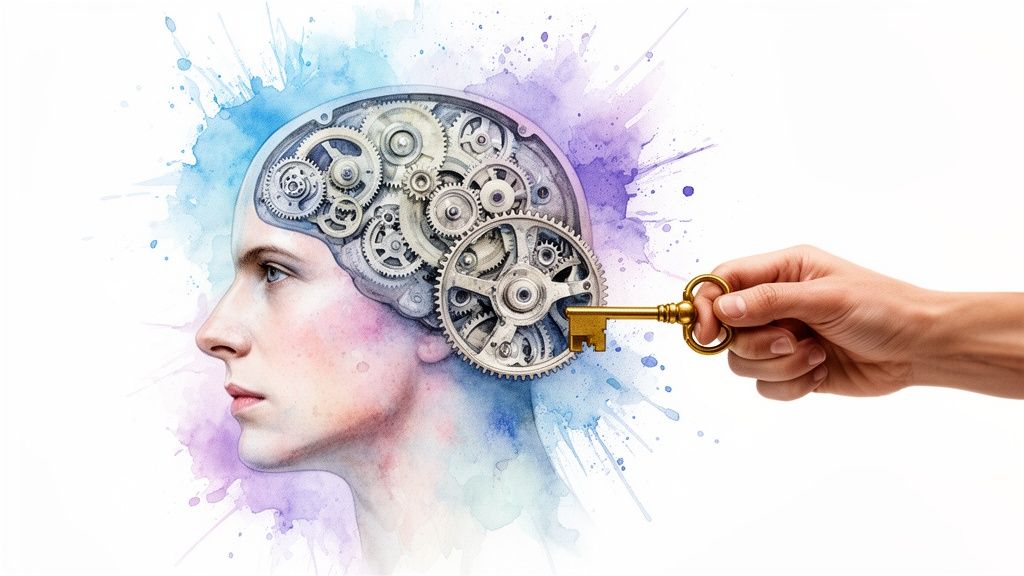
Ever feel like your anxiety has a mind of its own? That is because, in many ways, it does. Your brain is wired for efficiency, creating mental shortcuts and emotional reflexes that operate without your conscious consent. This powerful system is known as 'automatic processing,' and while it builds helpful habits like driving a car, it can also create devastating cycles of panic, worry, and avoidance.
This article isn't just about identifying these patterns; it's a hopeful guide to understanding that you are not broken. By demystifying these automatic processing examples, we reveal a clear, actionable path to reclaiming your mind. We will interrupt the anxiety machine at its source and prove that a panic-free life is not only possible but achievable.
This list provides more than just definitions. For each of the 8 critical examples we cover, you will find:
- A clear breakdown of how the automatic process works.
- Actionable steps to interrupt the pattern today.
- Practical ways to spot it in your own life.
By recognizing how these automatic brain processes function, you can begin to intentionally manage them. While these mental systems can be challenging, understanding other forms of automation, such as modern using voice to text tools, can help free up mental space for this important work. The goal is to move from being a passenger in your own mind to taking the wheel. Let's begin exploring the specific mechanisms that hijack your peace and learn how to take back control.
1. Habit Loops and Automatic Anxiety Triggers
Automatic processing is at the heart of how habits form, creating efficient mental shortcuts that govern much of our daily behavior. When it comes to anxiety, this same efficiency can build powerful, unconscious patterns where a specific trigger instantly activates an anxious response. This cycle, often called a habit loop, consists of a cue, a routine, and a reward. Understanding this structure is the first step toward dismantling it and finding a path to living panic-free.
The concept, popularized by authors like Charles Duhigg, shows how a cue (like a crowded room or a critical email) triggers an automatic routine (catastrophic thoughts, shallow breathing, avoidance). The brain perceives a reward (temporary relief from the perceived threat), reinforcing the loop and making it more likely to repeat. Over time, this becomes one of the most ingrained automatic processing examples in anxiety, happening so fast it feels uncontrollable. But the hopeful truth is that what has been learned can be unlearned.
How to Spot and Interrupt an Anxiety Habit Loop
Recognizing these loops in your own life requires focused observation. They often hide in plain sight, disguised as your personality or "just the way you are."
- Spotting the Cue: What happens right before the anxiety spikes? A specific place, time of day, person, or even an internal thought can be the trigger. Many people struggle to identify their specific triggers; learning more about common anxiety triggers can provide crucial clarity.
- Identifying the Routine: What is your immediate, automatic reaction? This could be a mental habit (self-blame, predicting the worst) or a physical one (fleeing a social situation, tensing your shoulders).
- Analyzing the Reward: What brief sense of relief does the routine provide? Avoiding a feared situation feels safe in the moment, even though it strengthens the anxiety long-term.
Strategic Insight: The key to breaking the cycle isn't fighting the cue; it's consciously choosing a new routine. The trigger will still happen, but your response can change. This is where your power lies.
Actionable Steps for Regaining Control
Interrupting an automatic process requires deliberate, conscious effort. Start small to build momentum and prove to yourself that change is possible. Healing is a journey of small, courageous steps.
- Map Your Loop: Use a journal or worksheet to write down the cue, routine, and reward for one specific anxiety pattern you experience.
- Plan a Replacement Routine: When the cue appears, what is a simple, healthy action you can take instead? Instead of automatically ruminating after a conflict (the old routine), your new routine could be a five-minute walk or deep breathing exercises.
- Practice Grounding: When a trigger activates an intense physical response, use the 5-4-3-2-1 technique. Name five things you see, four things you can feel, three you can hear, two you can smell, and one you can taste. This pulls your focus from the automatic anxious spiral to the present moment, reminding you that you are safe.
2. Thought Suppression and the Rebound Effect
One of the most counterintuitive automatic processes in anxiety is thought suppression. This is the brain’s reflexive attempt to push away, ignore, or forcefully stop an unwanted thought or feeling. However, this mental effort often backfires spectacularly due to a psychological principle known as the rebound effect, making the unwanted thought return with even greater intensity. This dynamic, a cornerstone of Ironic Process Theory, shows how trying not to think about something guarantees that you will.
This automatic reaction to "just stop thinking about it" is a common but flawed coping mechanism. The cue (an intrusive thought like, "What if I have a panic attack in this meeting?") triggers an immediate routine (mentally yelling "Stop!" or trying to distract yourself). The perceived reward is a fleeting moment of control, but this only teaches your brain that the thought is dangerous and requires constant monitoring. This cycle makes thought suppression one of the most self-defeating automatic processing examples, trapping people in a loop of anxiety they are unknowingly feeding.
How to Spot and Interrupt the Rebound Effect
Recognizing this pattern is crucial because the very act of fighting your thoughts becomes the source of your distress. The solution isn't to fight harder; it's to change the rules of engagement entirely, offering a path to genuine peace.
- Spotting the Cue: Identify the specific thoughts that trigger your suppression reflex. Is it a health fear, a social worry, or a catastrophic "what-if" scenario?
- Identifying the Routine: What is your go-to mental action for unwanted thoughts? Do you immediately search for distractions, argue with the thought, or try to replace it with a positive one? For example, trying not to think about health symptoms often leads to increased bodily scanning.
- Analyzing the Reward: Does suppression provide any real, lasting relief? Usually, it creates a brief pause before the thought returns stronger, confirming its perceived importance and making the anxiety worse.
Strategic Insight: The goal is not to eliminate anxious thoughts but to change your relationship with them. By allowing thoughts to exist without a fight, you strip them of their power and reclaim your inner peace.
Actionable Steps for Regaining Control
Interrupting the automatic suppression loop requires a shift from resistance to acceptance. These steps help you build a new, more effective response that leads to genuine peace of mind.
- Practice Mindful Observation: Instead of pushing the thought away, simply notice it. Label it internally: "There is the thought that I might fail." This creates distance and acknowledges it as a mental event, not a reality.
- Schedule "Worry Time": Designate a specific 10-15 minute period each day to allow yourself to engage with anxious thoughts fully. When a worry appears outside this time, gently remind yourself, "I will think about this during my scheduled worry time." This validates the thought without letting it take over your day.
- Implement the AWARE Technique: This five-step process guides you through an anxious moment without suppression. Accept the anxiety. Watch it without judgment. Act as if you aren't anxious. Repeat the steps. Expect the best. This builds the skill of coexisting with anxious thoughts until they naturally lose their charge.
3. Automatic Negative Thought Patterns (ANTs)
Automatic Negative Thoughts (ANTs) are reflexive, anxiety-driven cognitions that flash through the mind without conscious effort. Pioneered by cognitive therapy founders like Aaron Beck, this concept explains how our brains create instant, distorted judgments about situations. These thoughts, like catastrophizing or mind-reading, are not a result of deliberate reasoning but are instead a deeply ingrained, automatic response to perceived threats, forming the mental bedrock of sustained anxiety.
These patterns are prime automatic processing examples because they operate below the level of conscious awareness. A trigger, such as a critical comment, instantly activates a routine of negative self-talk ("I've failed completely"). The brain's perceived reward is a sense of explanation or preparation for the worst, which paradoxically reinforces the anxious thought loop. This cycle happens so quickly it feels like an undeniable truth rather than a fleeting, biased thought, but recognizing it is a crucial step toward living a life free from panic.
How to Spot and Interrupt an ANT Cycle
Identifying ANTs requires you to become a detective of your own thoughts. They are often so familiar they feel like part of your personality, but they are learned patterns that can be unlearned, offering incredible hope for change.
- Spotting the Cue: What event or feeling immediately preceded the surge of negative emotion? It could be a mistake at work, a vague text message, or an unexpected physical sensation.
- Identifying the Routine: What was the first thought that popped into your head? Was it an all-or-nothing conclusion ("This is ruined"), fortune-telling ("This meeting will be a disaster"), or mind-reading ("They all think I'm incompetent")? Learning about these specific cognitive distortions can help you name them.
- Analyzing the Reward: What false comfort does the thought provide? Often, it creates a deceptive sense of certainty in an uncertain situation, even if that certainty is negative.
Strategic Insight: The goal is not to stop thoughts from appearing, which is impossible. The strategy is to question their validity and consciously choose a more balanced perspective. This is a skill you can learn.
Actionable Steps for Regaining Control
Challenging these automatic thoughts requires consistent, deliberate practice. With each small victory, you weaken the old neural pathways and strengthen new, healthier ones, paving a new road to peace.
- Create a Thought Record: Use a simple journal or worksheet. When you feel a spike in anxiety, write down the situation (trigger), your automatic thought, the emotion it caused, and then consciously challenge it by listing evidence for and against the thought.
- Practice the ABC Model: Identify the Activating event (the trigger), the Belief (your automatic negative thought), and the Consequence (the anxiety you feel). This separates the event from your interpretation of it, creating space for change.
- Develop a Balanced Replacement: After identifying an ANT, craft a more realistic and compassionate thought. Instead of "I messed up everything," try "I made a mistake on that task, but I can fix it and I have succeeded on many other projects." This new thought becomes your new, intentional routine.
4. Avoidance Behavior and Negative Reinforcement
Avoidance is one of the most powerful engines driving the anxiety cycle. It’s an automatic survival instinct where you instinctively sidestep a feared situation, person, or place to prevent an anxiety spike. While this action provides immediate relief, it teaches your brain a dangerous lesson: that the only way to be safe is to run. This process, known as negative reinforcement, is one of the clearest automatic processing examples of how anxiety strengthens itself over time, leading to a smaller, more restricted life.

The cycle is insidious because the cue (the thought of giving a speech) triggers an automatic routine (declining the opportunity). The immediate reward is a wave of relief as the perceived threat vanishes. However, this relief reinforces the belief that the situation was truly dangerous and that you were incapable of handling it. Over time, this automatic process can lead to significant limitations, but the beautiful part is that reversing it opens your world back up again.
How to Spot and Interrupt an Avoidance Cycle
Recognizing avoidance requires an honest look at what you are not doing. It often masquerades as preference ("I'm just not a social person") or practicality ("It's too much trouble to drive on the highway").
- Spotting the Cue: What situations, thoughts, or feelings consistently precede your decision to back out? This could be an invitation, a work assignment, or even the physical sensation of a racing heart.
- Identifying the Routine: How do you avoid it? Common avoidance routines include making excuses, procrastinating until an opportunity passes, or physically leaving a situation.
- Analyzing the Reward: Acknowledge the powerful, immediate feeling of safety or calm that floods you right after you decide to avoid something. This feeling is the glue that holds the cycle together.
Strategic Insight: Every time you avoid something you fear, you are casting a vote for a more anxious future. The path to freedom lies in deliberately choosing to face the discomfort, proving to your brain that it can handle the challenge and that you are stronger than you think.
Actionable Steps for Regaining Control
Interrupting an automatic avoidance pattern means intentionally and gradually re-engaging with what you fear. This process shows your brain that the feared outcome is unlikely and that you are more capable than you believe.
- Create a Fear Hierarchy: List the situations you avoid. Rank them from least scary to most terrifying. This gives you a clear, manageable roadmap for healing.
- Schedule Intentional Exposures: Start with an item low on your hierarchy. If you fear social events, your first step might be a ten-minute coffee with one friend. Deliberately plan and execute this small act of courage. Learning more about this method is a great next step, and there is extensive information about using exposure therapy for anxiety to guide you.
- Record Your Courage: After completing an exposure, write down what happened. Note that your catastrophic prediction did not come true and that your anxiety, while present, eventually decreased. This creates a powerful evidence log that directly contradicts your anxious thoughts and builds real confidence.
5. Automatic Fight-Flight-Freeze Responses
The autonomic nervous system’s fight-flight-freeze response is one of the most powerful and primal examples of automatic processing. When your brain perceives a threat, whether it's a real physical danger or a psychological one like a looming deadline, it automatically floods your body with stress hormones like adrenaline and cortisol. This ancient survival mechanism evolved for acute physical threats, but in anxiety disorders, it triggers in response to thoughts and situations that are not life-threatening, creating intense physical symptoms that can perpetuate panic cycles.

This response, first described by Walter Cannon and further explored through modern frameworks like Stephen Porges' Polyvagal Theory, happens without conscious thought. Your heart pounds (fight/flight), you feel an overwhelming urge to escape a situation (flight), you get irritable and agitated (fight), or you feel completely paralyzed and unable to speak (freeze). Understanding that these are automatic bodily functions, not a sign of personal weakness, is a critical step toward regaining control and finding a path to living panic-free.
How to Spot and Interrupt Your Primary Threat Response
Recognizing your personal pattern is the first step toward managing it. While everyone experiences a mix, most people have a dominant, automatic reaction to perceived threats. This knowledge is not meant to scare you, but to empower you.
- Spotting Your Pattern: Do you become angry and irritable when anxious? That’s a fight response. Do you immediately look for an exit or avoid situations? That’s flight. Do you feel detached, numb, or mentally stuck? That’s freeze.
- Identifying the Physical Sensations: Pay close attention to what happens in your body. A racing heart, muscle tension, and rapid breathing are classic signs of fight-or-flight activation. A sense of heavy limbs, dizziness, or feeling "spaced out" points to a freeze response.
- Analyzing the Aftermath: How do you feel after the peak of anxiety passes? Exhausted, shaky, and drained are common indicators that your nervous system has just gone through this intense automatic process. A deeper understanding of this reaction is crucial; you can learn more about the complete fight-or-flight response guide to better identify your own patterns.
Strategic Insight: You cannot stop the initial trigger, but you can learn to send your body safety signals to manually deactivate the automatic alarm and activate the parasympathetic (rest-and-digest) nervous system. You can become the master of your own nervous system.
Actionable Steps for Regaining Control
Interrupting this deep-seated biological process involves working with your body, not against it. These steps help communicate safety to your nervous system and show it how to return to a state of calm.
- Activate Your Vagus Nerve: To counteract the stress response, stimulate your vagus nerve. Splash your face with cold water, hum a song, or gargle. These actions activate the parasympathetic nervous system, which calms the body down.
- Breathe with Intention: Manually override hyperventilation by focusing on your exhale. Inhale for a count of four, hold for a moment, and then exhale slowly for a count of six. The extended exhale is a powerful signal to your body that the danger has passed.
- Process the Energy: If your primary response is flight, your body is primed for movement. Don't just sit with the anxious energy. Stand up, shake your arms and legs, or do a few jumping jacks to help productively release the adrenaline.
6. Automatic Hypervigilance and Threat Scanning
Hypervigilance is an automatic state where the brain continuously scans the environment for threats, operating in a heightened state of alert. For those with anxiety, this threat-detection system becomes overactive, misinterpreting neutral events, physical sensations, or social cues as dangerous. This creates a powerful feedback loop where the mind is always finding “evidence” of impending disaster, reinforcing the need to stay on guard.

This constant scanning is one of the most exhausting automatic processing examples because it consumes immense mental energy without conscious direction. Pioneering research from experts like David Clark and Colin MacLeod shows this isn't just about feeling worried; it's a cognitive bias where attention is automatically and uncontrollably drawn to potential threats. This keeps the nervous system in a fight-or-flight mode, but the good news is that you can retrain your brain's attention system.
How to Spot and Interrupt Hypervigilance
Recognizing this automatic scanning is the first step toward teaching your brain that it can stand down and that safety is possible. It often manifests as a constant "what if?" narrative running in the background.
- Spotting the Scan: Do you find yourself immediately locating all exits when you enter a room? Do you analyze every physical sensation (like a heart flutter) as a sign of a serious medical issue?
- Identifying the Interpretation: What is the automatic conclusion? A vague comment from a friend is immediately interpreted as criticism, or a news headline feels like a direct personal threat.
- Analyzing the 'Reward': The perceived reward is a false sense of control or preparedness. By anticipating the worst, your brain believes it is protecting you, even though this behavior fuels the anxiety it's trying to prevent.
Strategic Insight: You can't just tell your brain to stop scanning. You have to consciously redirect its focus, proving through repeated action that the environment is safer than it automatically assumes. This creates new neural pathways based on safety, not fear.
Actionable Steps for Regaining Control
Interrupting this deep-seated automatic process requires deliberate, gentle redirection, not forceful suppression. The goal is to build a new habit of noticing safety.
- Document Threat Interpretations: Use a simple journal or a worksheet to log each perceived threat. Next to it, write down at least two alternative, non-threatening explanations for the same event or sensation.
- Practice Deliberate Attention: Set a timer for three minutes and intentionally focus your attention on neutral or pleasant details in your environment. Notice the color of a wall, the texture of your chair, or the sound of distant birds. This trains your attentional "muscle."
- Create a 'Safety Evidence' List: Keep a running list on your phone or in a notebook of all the times a feared outcome did not happen. When your brain presents a "what if," review this list to provide concrete counter-evidence that you are safe.
7. Automatic Rumination and Worry Loops
Worry and rumination often feel like necessary mental work, but they are classic examples of automatic processing hijacking our cognitive resources. Rumination is a repetitive, backward-looking thought cycle about past events or perceived failings, while worry is a forward-looking spiral of "what if" scenarios. Both create the illusion of problem-solving but rarely lead to resolution, instead keeping the brain's anxiety circuits endlessly activated.
These automatic thought loops become deeply ingrained because they feel productive, tricking the brain into believing it's preparing for a threat. A trigger, such as a minor social mistake or an upcoming deadline, kicks off the routine of obsessive analysis. The perceived reward is a temporary sense of control or preparedness, which only reinforces the habit. This pattern is one of the most stubborn automatic processing examples to break, but it is entirely possible to step out of the loop and find mental quiet.
How to Spot and Interrupt a Worry Loop
Identifying these cycles is the first step toward reclaiming your mental energy. They often manifest as a feeling of being "stuck" in your head, replaying the same thoughts without any new insight or conclusion.
- Spotting the Cue: What triggers the spiral? It might be receiving a vague text, making a small mistake at work, or simply having unstructured time before bed.
- Identifying the Routine: Is your mind replaying a past conversation endlessly? Are you generating a long list of worst-case scenarios for a future event? These repetitive, unresolved thought patterns are the routine.
- Analyzing the Reward: Does the worry make you feel like you're "doing something" about the problem? This false sense of action is the temporary reward that keeps the loop going.
Strategic Insight: The goal is not to stop anxious thoughts from ever occurring, but to consciously disengage from the automatic process of feeding them. You can notice the thought without getting caught in the loop, and this is a freedom you can learn.
Actionable Steps for Regaining Control
Interrupting automatic rumination requires redirecting your focus with intentional, structured action. These strategies create a new response to the old cues, paving the way to live with less panic.
- Schedule a "Worry Window": Designate a specific, limited time each day (e.g., 15 minutes at 5:00 PM) to actively think about your worries. When a worry arises outside this window, gently tell yourself, "I'll deal with this during my scheduled time," and return to the present moment.
- Postpone the Worry: Instead of fighting a ruminative thought, acknowledge it and deliberately postpone it. Say, "I notice I'm worrying about X. I will put that thought aside and address it later tonight." This breaks the immediacy of the automatic reaction.
- Shift from Thinking to Doing: When you catch yourself in a loop, choose a simple, engaging physical activity. This could be stretching, organizing a drawer, or taking a short walk. Behavioral activation redirects your mental energy and proves that you don't have to stay stuck in the cycle. Understanding the connection between overthinking and anxiety can provide more strategies for this vital shift.
8. Automatic Bodily Sensation Amplification (Symptom Focusing)
Symptom focusing is a powerful automatic process where your attention involuntarily latches onto normal bodily sensations, amplifying them and interpreting them as catastrophic threats. This interoceptive hypervigilance creates a dangerous feedback loop: a minor sensation (like a muscle twitch or slight dizziness) is noticed, attention intensifies it, and the brain’s fear center confirms the worst-case scenario. This cycle happens in milliseconds, making it one of the most frightening automatic processing examples for those with health anxiety or panic disorder.
This cognitive-attentional habit, explored by researchers like David Clark and Paul Salkovskis, shows how the cue (an internal sensation) triggers an automatic routine (hyper-focus and catastrophic interpretation). The brain’s false reward is a sense of vigilance, a feeling of "catching" the danger early. In reality, this process only strengthens the connection between normal bodily functions and terror, but the hopeful truth is that you can learn to see your body as a safe home again.
How to Spot and Interrupt the Symptom Amplification Loop
Recognizing this automatic pattern is the first step toward reclaiming your body as a safe place. It’s not the sensation that’s the problem; it’s the automatic, fearful attention you give it.
- Spotting the Cue: What physical feeling initiates the spiral? It’s often subtle: a slight pressure in your chest, a random heart palpitation, a feeling of lightheadedness upon standing, or a stomach gurgle.
- Identifying the Routine: What is your instant reaction? Do you immediately freeze and scan your body for more "evidence"? Do your thoughts jump to conclusions like "I'm having a heart attack" or "This is a stroke"? This mental and attentional reaction is the routine.
- Analyzing the Reward: What brief illusion of control does this provide? By focusing intensely, you might feel you’re being responsible and monitoring a threat, but this only teaches your brain that these sensations are genuine emergencies.
Strategic Insight: The goal is to demote sensations from "critical threat alerts" back to "background noise." You achieve this by consciously redirecting your attention and challenging the automatic interpretations. Peace in your own body is possible.
Actionable Steps for Regaining Control
Interrupting this deep-seated habit requires consistent, deliberate practice. With these steps, you can teach your brain that your body is not a danger zone.
- Schedule "Symptom Time": Designate two 10-minute periods per day to deliberately scan your body and notice sensations without judgment or fear. Outside of these times, practice gently redirecting your focus outward whenever you notice the urge to scan.
- Practice Deliberate External Focus: When you catch yourself amplifying a sensation, engage your senses with the outside world. Name five blue objects in the room, feel the texture of your chair, or listen for the three furthest sounds. This actively shifts your attention away from the internal feedback loop.
- Establish a "Normal" Baseline: Consult with a doctor to rule out any serious conditions. Once cleared, accept their professional opinion as your baseline truth. When a feared sensation arises, you can consciously refer back to the fact that it has been deemed non-threatening, which helps dismantle the catastrophic thinking.
Automatic Processing: 8-Point Comparison
| Approach | 🔄 Complexity | ⚡ Resources & Effort | ⭐ Expected outcomes / 📊 Impact | 💡 Ideal use cases | ⭐ Key advantages |
|---|---|---|---|---|---|
| Habit Loops and Automatic Anxiety Triggers | Medium — requires mapping & habit replacement | Medium — tracking tools, repeated practice | ⭐⭐⭐⭐ — durable behavioral change with consistent work; 📊 reduces automatic reactions over time | Situationally triggered anxiety, routine disruptions | ⭐ Targeted interventions; momentum from small wins |
| Thought Suppression and the Rebound Effect | Medium — conceptually simple, behavior change counterintuitive | Low — mindfulness/acceptance practice; minimal tools | ⭐⭐ — prevents worsening; 📊 reduces intrusive thought intensity when acceptance is used | Intrusive thoughts, efforts to "push away" anxiety | ⭐ Promotes acceptance-based alternatives; reduces futile effort |
| Automatic Negative Thought Patterns (ANTs) | Medium — cognitive restructuring practice needed | Medium — thought records, worksheets, therapist support helpful | ⭐⭐⭐⭐ — measurable cognitive shifts; 📊 improves perceived control and mood | Cognitive distortions, rapid anxiety thoughts | ⭐ Highly addressable with CBT techniques; clear progress tracking |
| Avoidance Behavior and Negative Reinforcement | High — graded exposure planning and support often required | High — guided exposure, accountability, repeated exposures | ⭐⭐⭐⭐⭐ — one of the most effective long-term fixes; 📊 restores functioning but may increase short-term anxiety | Phobias, social avoidance, functional impairment from avoidance | ⭐ Proven efficacy (exposure); builds strong self-efficacy |
| Automatic Fight-Flight-Freeze Responses | Medium — requires physiological education + practice | Low–Medium — breathing, grounding, vagal techniques | ⭐⭐⭐ — immediate symptom relief often achievable; 📊 reduces panic recurrence with rehearsal | Panic attacks, acute physiological anxiety reactions | ⭐ Clarifies physiology; provides immediate interrupting techniques |
| Automatic Hypervigilance and Threat Scanning | High — attention retraining is gradual and effortful | Medium–High — training, therapy, practice over time | ⭐⭐⭐ — meaningful quality-of-life gains with sustained work; 📊 reduces false alarms | Constant scanning, exaggerated threat detection, PTSD-related vigilance | ⭐ Targets attention bias; can markedly reduce perceived threat |
| Automatic Rumination and Worry Loops | Medium — needs habit interruption and scheduling | Low–Medium — worry windows, behavioral activation, tracking | ⭐⭐⭐ — reduces time spent ruminating and improves sleep; 📊 improves clarity and action | Chronic worry, night-time spiral thinking, unproductive problem-solving | ⭐ Practical interruption techniques; distinguishes rumination vs. planning |
| Automatic Bodily Sensation Amplification (Symptom Focusing) | Medium — requires interoceptive training and external validation | Medium — symptom monitoring, medical checks, baseline practice | ⭐⭐⭐ — lowers catastrophic interpretations; 📊 reduces symptom-driven escalation | Health anxiety, panic disorder, interoceptive sensitivity | ⭐ Restores objective tracking; redirects attention externally for relief |
From Automatic Panic to Intentional Peace: Your Path Forward
Throughout this guide, we've illuminated the hidden architecture of anxiety. From the habit loops that trigger panic to the automatic negative thoughts that cloud your judgment, we have systematically unpacked how your brain’s shortcuts can inadvertently build a prison of fear. Seeing these patterns for what they are—a series of conditioned responses—is the first and most powerful step toward reclaiming your life.
Anxiety thrives in the shadows of the mind, convincing you that its frantic whispers are your true voice. But as we have demonstrated with numerous automatic processing examples, this is a deception. The hypervigilance, the worry loops, and the fight-or-flight reactions are not your identity; they are learned programs that can be rewritten.
The Power of Recognition: Your First Tool for Healing
The core takeaway from our exploration is this: awareness is the antidote to automaticity. You cannot change a program while it runs undetected in the background. Each example we covered, from automatic rumination to bodily sensation amplification, shares a common vulnerability: it loses its power the moment you can step back and say, "Ah, there it is. That's a pattern, not a fact."
This recognition creates a crucial space between stimulus and response. In that space, you find your power to choose a different path. It's the moment you notice your shoulders tensing and consciously decide to breathe, or you catch a catastrophic thought and question its validity instead of accepting it as truth.
Key Insight: Your journey out of anxiety isn't about eliminating thoughts or feelings. It's about changing your relationship with them, moving from an automatic reactor to a conscious observer who can make intentional choices. This is the foundation of lasting healing.
Rewiring Your Brain, One Conscious Choice at a Time
Understanding these concepts is one thing; applying them is what creates real, lasting change. Hope is not a passive wish for things to get better. Hope is the active knowledge that you possess the tools to influence your own neural pathways. The brain is not fixed; it is remarkably adaptable.
Every time you intentionally interrupt an automatic process, you are doing more than just managing a moment of anxiety. You are providing your brain with new data.
- Interrupting Avoidance: When you face a small, manageable feared situation instead of automatically avoiding it, you teach your brain that you can handle the discomfort and that the anticipated catastrophe does not happen.
- Reframing Thoughts: When you challenge an Automatic Negative Thought (ANT), you weaken its neural pathway and begin building a new, more balanced one.
- Grounding Your Body: When you respond to a physical panic symptom with a grounding technique instead of more fear, you are retraining your nervous system to associate those feelings with safety, not danger.
This is the practical, day-by-day work of healing. It’s not about a single, dramatic breakthrough. It is the cumulative effect of hundreds of small, intentional decisions that gradually reroute your brain’s default settings from panic to peace. You are not broken; you have simply been running a program that no longer serves you. Now, you have the administrator access to install a new one. Your path forward is paved with these small acts of courage. The journey from constant, automatic panic to a life of intentional peace begins now, with the very next conscious choice you make.
Ready to turn this knowledge into a structured, daily practice? The Anxiety Checklist provides the exact tools discussed in this article to help you identify, track, and interrupt your unique automatic processing examples. Get your personalized roadmap to a calmer mind and start building your path to freedom today at The Anxiety Checklist.