
Breaking the anxiety cycle is not just a possibility—it's your future. It begins when you recognize the cycle for what it is: a learned pattern of a trigger, a thought, a feeling, and a reaction. Once you see this pattern, you can use powerful strategies to interrupt it at every stage. Lasting relief comes from rewiring these automatic responses, proving that a life free from constant panic is entirely within your reach.
Your Path to a Panic-Free Life Is Possible
If you’re caught in the exhausting loop of anxiety, it can feel like a life sentence. But the truth is, lasting peace isn’t some distant fantasy; it’s an achievable reality. This guide is built on the firm belief that you have the power to fundamentally change your relationship with anxiety and reclaim your life.

Forget the idea that chronic anxiety is just part of your personality. Think of it instead as a deeply ingrained but changeable habit—a pattern that has been learned and, therefore, can be unlearned. Healing is possible, and this is where it starts.
A Reassuring Roadmap to Freedom
We’re going to start by demystifying the core pattern that keeps you stuck. Imagine you get a vague email from your boss that just says, "We need to talk." A trigger like this can instantly launch a cascade of anxious thoughts ("I'm getting fired!"), intense feelings (dread, racing heart), and reactive behaviors (endless worrying, avoiding the conversation). This is the anxiety cycle in action. It’s a self-reinforcing loop that can feel impossible to escape.
But once you see this pattern clearly, you can begin to dismantle it piece by piece. This guide provides a clear, reassuring roadmap filled with practical, evidence-based strategies to help you do just that, empowering you to live panic-free.
The goal isn’t to eliminate anxiety entirely—it's a normal human emotion. The goal is to stop anxiety from controlling you, allowing you to live a full and meaningful life without the constant fear of panic.
Throughout this journey, we'll explore actionable methods that provide both immediate relief and long-term resilience. Think of it as building a toolkit designed to empower you at every stage of the healing process.
Here’s what we’ll cover:
- Mapping Your Personal Anxiety Cycle: We’ll identify your unique triggers, thought traps, and physical warning signs so you can see the pattern before it takes hold.
- Instant Interruption Techniques: You'll learn powerful, in-the-moment tools to stop acute anxiety and panic before they spiral out of control.
- Cognitive Restructuring Exercises: This is about rewiring the anxious thoughts that fuel the cycle and replacing catastrophic thinking with more balanced, hopeful perspectives.
- Protective Lifestyle Habits: We’ll build a foundation of resilience through small, sustainable changes to your daily routines.
This is all about taking small, manageable steps forward. For a deeper look into what this path entails, you can explore these detailed anxiety recovery steps that align with our approach. You are not alone, and there is a clear way forward. This guide is designed to make you feel seen, understood, and—most importantly—ready to take that first step toward a calmer, brighter future.
Mapping the Anatomy of Your Anxiety Cycle
To heal from anxiety, you first need to see how the machine actually works. Anxiety doesn't just pop up out of nowhere; it follows a predictable, four-stage pattern that loops back on itself, gathering steam each time. Understanding this structure is the first real step toward taking it apart and reclaiming your peace.
This isn't just some abstract theory—it's a deeply personal experience. The more you can spot this sequence playing out in your own life, the more power you'll have to step in and stop it. This is where you start taking back control.
The Four Stages of the Anxiety Cycle
Think of your anxiety as a chain reaction. Each link directly triggers the next, creating a loop that can feel impossible to escape. But once you can identify each link in the chain, you can find its weakest point and break it.
Here’s a breakdown of the four stages that make up the anxiety cycle. Recognizing these stages in your own moments of anxiety is the first step toward interrupting them.
| Stage | Description | Example Scenario A: Vague Work Email | Example Scenario B: Unexpected Physical Sensation |
|---|---|---|---|
| 1. The Trigger | The spark that ignites the cycle. It can be an external event, an internal thought, or a physical sensation. | You receive an email from your boss with the subject line "Quick chat tomorrow morning." | You feel an unexpected flutter in your chest while watching TV. |
| 2. The Interpretation | The meaning you assign to the trigger. This is where anxiety adds its distorted filter, turning a neutral event into a perceived threat. | "This is it. I'm getting fired. What did I do wrong?" | "This isn't normal. It feels like my heart skipped a beat. Am I having a heart attack?" |
| 3. The Feeling | Your interpretation fuels your emotional and physical response, creating the dread, panic, and physical symptoms. | Your stomach drops, your palms get sweaty, and a wave of dread washes over you. You can't focus on anything else. | You feel a surge of adrenaline, your heart starts racing even faster, and you become lightheaded and dizzy. |
| 4. The Behavior | In response to the intense feelings, you do something to cope. This often provides temporary relief but reinforces the cycle for next time. | You spend the rest of the night replaying every mistake you've made, and you draft three different emails trying to guess what the meeting is about. | You immediately stop what you're doing, sit down, and start Googling "heart attack symptoms," avoiding any physical exertion for the rest of the day. |
By learning to map these four stages, you turn a confusing storm of emotions into a clear, understandable process. This clarity is the foundation for lasting change and the key to healing.
From Vague Fear to a Clear Map
A vague sense of dread is almost impossible to fight. But a specific, mapped-out cycle? That’s something you can work with.
Take the example from the table: you feel a harmless heart palpitation. The momentary avoidance—sitting down, Googling symptoms—brings a quick hit of relief. But what it really does is teach your brain that heart palpitations are a sign of imminent danger. This makes you even more hyper-aware and fearful of the next one. That's exactly how the loop strengthens itself.
These physical sensations are often just your body's natural alert system kicking in. You can get a deeper understanding of how this works by reading our guide on the fight-or-flight response.
Identifying Your Unique Triggers
Triggers are incredibly personal and can be surprisingly subtle. They aren't just about stressful situations; physiological factors can play a huge role too. For instance, understanding how blood sugar impacts your emotional state can be a game-changer for some people.
Your triggers might fall into a few different buckets:
- Situational: Things like public speaking, crowded places, or specific social events.
- Physical: Dizziness, a racing heart, fatigue, or shortness of breath.
- Emotional: Feeling overwhelmed, stressed, uncertain, or even overly excited.
- Cognitive: A specific memory, a worry about the future, or a pattern of self-critical thoughts.
If this feels familiar, you are far from alone. The World Health Organization reported a dramatic rise in anxiety disorders globally, from 311 million people in 1990 to 458 million in 2019. Despite this, only about 27.6% of those affected actually receive any form of treatment, which underscores just how critical these skills are.
When you become a detective of your own experience, you can start to anticipate and prepare for your triggers instead of constantly being ambushed by them. This is the beginning of breaking the cycle and moving toward a life where you're back in the driver's seat.
When your heart is pounding and your thoughts are spiraling, you need more than just vague advice. You need real, in-the-moment tools that can slam the brakes on your nervous system. Think of this as your emergency toolkit for stopping acute anxiety in its tracks, giving you the power to find solid ground again.
The key to breaking the anxiety cycle isn't just about understanding it on paper; it's about having a set of actions you can deploy the second you feel that familiar wave of panic begin to build. Doing this proves to your brain, in real time, that you are safe and in control.
The anxiety cycle usually follows a predictable, four-step path that takes you from a simple trigger to a full-blown behavioral response.
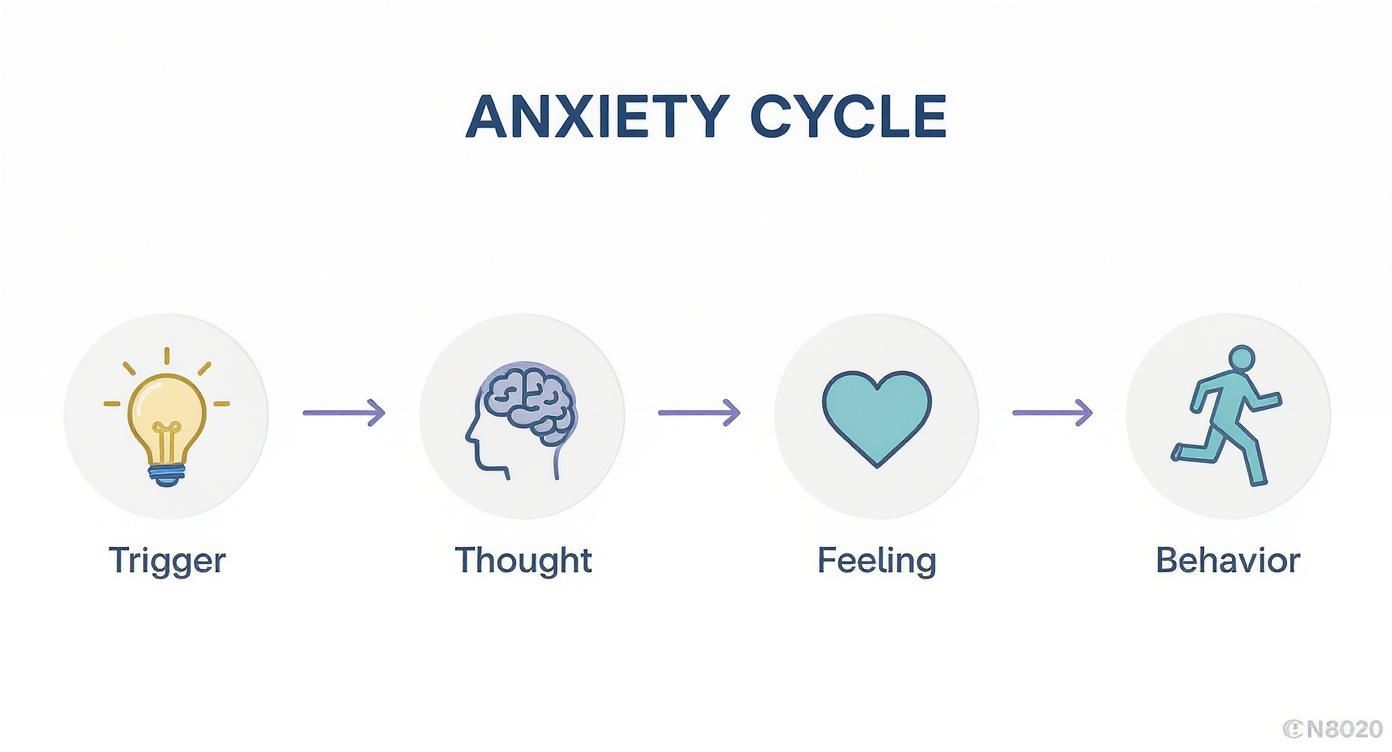
As you can see, a trigger sparks an anxious thought, which then fuels intense feelings and leads to a coping behavior—like avoidance—that just reinforces the whole loop. Let's get into the techniques that can throw a wrench in that process.
Anchor Yourself with the 5-4-3-2-1 Grounding Method
When anxiety takes over, your mind is usually stuck in the future, obsessing over what might happen. The 5-4-3-2-1 method yanks your attention back to the present by systematically engaging all five of your senses. It’s simple, you can do it anywhere, and it works surprisingly well.
Here’s the breakdown:
- See 5 things. Look around and actually acknowledge them, either silently or out loud. The bright red cover of a book, a scuff mark on the wall, the way light hits a water glass.
- Feel 4 things. Tune into physical sensations. This could be the solidness of the floor under your feet, the soft fabric of your shirt, or the cool surface of a desk on your fingertips.
- Hear 3 things. Really listen. You might notice the low hum of a computer, birds chirping outside, or the sound of your own breathing.
- Smell 2 things. What scents are in the air? Maybe it's leftover coffee or the clean smell of hand soap. If you can’t pick up anything, just imagine two of your favorite smells.
- Taste 1 thing. Pop a mint, take a sip of water, or simply notice the current taste inside your mouth.
This sensory scan forces your brain to pivot from internal chaos to external reality, effectively short-circuiting the anxious spiral.
Reset Your Nervous System with the Physiological Sigh
"Just breathe" is probably the most frustrating piece of advice you can get during a panic attack. But the physiological sigh is different. It’s a specific breathing pattern, backed by neuroscience, designed to rapidly calm your nervous system.
It’s just two quick inhales followed by one long, slow exhale.
The double inhale pops open the tiny air sacs in your lungs, which allows you to offload carbon dioxide more efficiently on the long exhale. This sends a direct signal to your brain to slow your heart rate and shift you out of fight-or-flight mode.
To do it, take a deep breath in through your nose. Then, without letting any air out, take another short sip of air in to completely fill your lungs. Finally, exhale as slowly and completely as you can through your mouth. Just one to three of these can create a noticeable shift in how you feel physically. For more on this, check out these powerful breathing exercises for anxiety.
Use Temperature to Your Advantage
Ever splashed cold water on your face and felt an instant sense of clarity? That's not a coincidence. You’re activating a powerful physiological response called the mammalian dive reflex.
This reflex is an ancient survival tool that helps mammals conserve oxygen when underwater. When cold water hits your face, it signals your vagus nerve to slow your heart rate and redirect blood flow to your core organs. It’s a powerful, full-body reset.
You can trigger this reflex to quickly calm a panic response:
- Splash your face with cold water for 15-30 seconds.
- Hold an ice pack or a bag of frozen peas against your cheeks and temples.
- If you can, dip your face into a bowl of cold water.
This simple act can be a lifesaver when your mind feels too scrambled for other techniques. Having these tools ready offers more than just relief—it gives you hope, proving you can actively manage and move through even the most intense moments of panic.
Rewiring Your Thoughts for Long-Term Freedom
While grounding techniques are a godsend for stopping a panic attack in its tracks, true, lasting freedom from anxiety means going deeper. It’s about getting to the source of the fire: the anxious thoughts that keep the whole cycle spinning. This is where you fundamentally change your relationship with anxiety—shifting from being a victim of your thoughts to an observer who can challenge and reshape them. This is how you heal for good.
This process is the heart and soul of Cognitive Behavioral Therapy (CBT), a powerful, well-researched approach for managing anxiety. And the best part? You don't need a Ph.D. to apply its principles. We're going to break it down into a simple framework you can start using today to build a panic-free life.
Recognizing Your Anxious Thinking Habits
First things first: you have to become aware of the distorted thinking patterns, or cognitive distortions, your anxious mind loves to use. Think of them as biased mental filters that twist reality, making situations seem way more threatening than they actually are. They're so automatic we often don't even notice them running in the background.
Here are a few common culprits:
- Catastrophizing: This is the "what if" game on steroids. A small, negative event gets blown up into a worst-case scenario. For example, a minor headache isn't just a headache; your brain leaps straight to, "What if this is a brain tumor?"
- Black-and-White Thinking: Also called all-or-nothing thinking, this pattern sees things in absolute extremes. You’re either a complete success or a total failure. If you make one small mistake in a presentation, your mind concludes, "The whole thing was a disaster."
- Mind Reading: You assume you know what others are thinking—and it's almost always negative. You might think, "Everyone in this meeting thinks I'm an idiot," with zero actual evidence to back it up.
- Fortune Telling: You predict a negative future, treating your anxious feelings like cold, hard facts. Before a party, you might think, "I'm going to be so awkward, and no one will talk to me."
Just spotting these patterns is a massive step in breaking the anxiety cycle. When you can name the distortion, you strip it of its power. It’s no longer an undeniable truth; it's just a common thinking error. If you want to go deeper on this, you can get a more complete picture by understanding CBT for anxiety in our detailed guide.
The C-C-C Framework for Taking Back Control
Once you can spot these unhelpful thoughts, you need a practical way to dismantle them. I'm a big fan of the "Catch, Check, Change" method—it’s a simple yet powerful framework for doing exactly that.
This isn't about suppressing thoughts or forcing yourself to "just be positive." It's about questioning the validity of your initial anxious interpretation and choosing a more balanced, realistic perspective.
Here’s how it works:
- Catch the Thought: The second you feel that familiar spike of anxiety, pause. Ask yourself, "What thought just ran through my mind?" Name it without judgment. For example: "I'm going to get fired for that mistake I made on the report."
- Check the Evidence: Now, put on your detective hat. Look for objective evidence that supports and contradicts that anxious thought. Is it 100% true you'll be fired? Has this ever happened before for a similar mistake? What's a more likely outcome?
- Change the Perspective: Based on the evidence, create a new, more balanced thought. This isn't a fake positive affirmation but a realistic reappraisal. It might sound like: "I made a mistake, and I'm anxious about it. But I can talk to my manager to fix it. It's really unlikely I'd be fired for a single error."
This simple three-step process, when practiced consistently, starts forging new neural pathways in your brain. You are literally teaching your mind not to default to the worst-case scenario.
The COVID-19 pandemic was a stark reminder of how collective stress can fuel anxiety on a massive scale. In the UK, the percentage of adults reporting high anxiety levels shot up from 30% in late 2019 to nearly 50% by March 2020. This global event highlighted just how critical accessible mental health tools are, and reinforced the importance of breaking the anxiety cycle with timely support. This data shows just how resilient we have to be in challenging the anxious thoughts that arise from widespread uncertainty.
Building a Lifestyle That Protects Your Peace
Interrupting panic and rewiring anxious thoughts are crucial for immediate relief. But if you want to break the anxiety cycle for good, the real work lies in building a life where anxiety has less room to take root. Think of your daily habits as the bedrock of your mental resilience. They create a foundation that protects your peace from the inside out and makes healing a sustainable reality.

Don’t worry, this isn’t about some massive, intimidating life overhaul. It's about making small, sustainable tweaks that add up over time, gradually turning down the volume on anxiety's influence.
Nourish Your Mind Through Your Gut
The connection between your gut and brain is surprisingly direct. An unhappy gut can fire off stress signals to your brain, pouring fuel on feelings of anxiety. You don't need a restrictive diet to fix this; just focus on crowding in more of the good stuff.
Start by adding foods rich in magnesium (like leafy greens and nuts) and omega-3s (found in fish like salmon). These nutrients are known to help regulate the nervous system, which is exactly what we want. For more practical ideas, check out our guide on lifestyle and diet changes for anxiety management.
Embrace 'Movement Snacks'
You don’t need to train for a marathon to feel the mental health perks of exercise. In fact, short bursts of activity, which I like to call 'movement snacks,' can be incredibly effective at managing stress hormones like cortisol.
Think in five-minute intervals. It could be:
- A quick, brisk walk around the block after a tense meeting.
- A few jumping jacks or a deep stretch when you feel restless.
- Putting on a great song and just dancing it out in your living room.
These little activities burn off nervous energy and trigger a release of endorphins, giving you a natural mood lift without ever feeling like a chore. The goal here is to make movement a joyful, regular part of your day.
Prioritize Restorative Sleep
Anxiety and poor sleep are locked in a vicious cycle: anxiety keeps you up at night, and being sleep-deprived makes you more anxious. Seriously, improving your sleep hygiene is one of the most powerful moves you can make for your mental health.
Sleep isn't a luxury; it's a non-negotiable biological necessity. It's when your brain cleanses itself of metabolic byproducts and consolidates memories, essentially resetting your emotional equilibrium for the next day.
Start with a simple wind-down routine. An hour before bed, kill the screens, dim the lights, and do something genuinely calming. Creating a serene environment is key. Some people find incorporating calming scents can help signal to the brain that it's time to relax, like using Peace and Calming essential oil in a diffuser.
Schedule a Time to Worry
This one might sound strange, but hear me out. Setting aside a specific, limited time to worry can stop anxious thoughts from hijacking your entire day. Pick 15-20 minutes each afternoon and make it your official "worry time."
When an anxious thought pops into your head outside of this window, just jot it down. Tell yourself you’ll deal with it during your scheduled slot. This simple practice helps contain the anxiety and proves that you have more control than you think over when and where you engage with these thoughts.
It's also important to acknowledge that building a peaceful life isn't just about individual choices. Broader factors are at play. Research shows anxiety disorders are more prevalent in countries with higher Socio-demographic Index (SDI) levels. Globally, women are 1.6 times more likely to be affected than men, and young adults aged 18–29 are the most impacted group. Recognizing this helps us see that breaking the anxiety cycle requires equitable and targeted support that addresses the unique challenges different people face.
Your Questions About Breaking the Anxiety Cycle
As you start this journey, it's completely normal for questions and doubts to pop up. The path to getting better isn't a straight line, and having a clear idea of what to expect can bring a lot of comfort and keep you going. This section gives you straightforward, compassionate answers to the most common worries people have when they decide to finally break the anxiety cycle.
The whole point here is to offer reassurance and real advice. It’s about reinforcing the hopeful truth that a life without constant panic isn't just some far-off dream—it's a destination you’re actively walking toward. Every single step, no matter how small, builds momentum.
How Long Does It Take to Break the Anxiety Cycle?
There’s no magic timeline here. Think of it less like flipping a switch and more like learning a new skill. You might start feeling more in control during moments of high anxiety within just a few weeks, especially if you're consistently practicing grounding techniques.
But reshaping those deep-seated thought patterns that fuel the cycle? That can take a few months of dedicated effort.
The real goal is progress, not perfection. Celebrate the small wins—like catching an anxious thought before it spirals or remembering to use a breathing exercise when you feel that familiar tightness in your chest. Each success builds on the last, moving you closer to a life where anxiety no longer calls the shots. There is so much hope for a life free from panic.
What if I Have a Setback? Does It Mean I Failed?
Absolutely not. Setbacks are a normal, even expected, part of healing and growth. It's crucial to reframe them as learning opportunities, not failures. If you have a panic attack after a period of calm, it doesn't erase all the incredible progress you've made.
A setback isn't a step backward; it's a chance to fine-tune your strategy. It’s your brain showing you where you still need to build resilience.
Instead of feeling defeated, get curious. What might have triggered it? Have you been letting your self-care routines slide? Use the tools you have to get through the moment, and then take some time to reflect on what you can learn from it. Each time you navigate a tough day and come out the other side, you strengthen your resilience and prove to yourself that you can handle it. This is a vital part of the healing process.
Can I Do This on My Own, or Do I Need a Therapist?
Plenty of people make incredible progress using self-help strategies just like the ones in this guide. Arming yourself with knowledge and practical tools is a huge first step toward taking your life back from anxiety.
That said, therapy can be a powerful accelerator. A good therapist offers personalized guidance, helps you see blind spots you might miss on your own, and provides a level of accountability that can make all the difference.
If your anxiety feels completely overwhelming, is getting in the way of your daily life, or if you just feel stuck, reaching out for professional support is a sign of incredible strength. Think of this guide as your starting point, or maybe the perfect companion to the work you do with a mental health professional. Healing is possible, and you don't have to do it alone.
Ready to turn these insights into real-world action? The Anxiety Checklist gives you a structured, step-by-step system to dismantle the anxiety cycle and build a more confident life. Get your complete toolkit, including our comprehensive eBook and interactive worksheets, by visiting https://anxietychecklist.com.