
Yes, anxiety can absolutely cause dizziness. If you've ever felt the room spin during a moment of high stress, you know how unsettling it is. But that feeling is a real, physical response—not just "in your head," and it’s almost certainly not a sign of something more dangerous.
Understanding this connection is the first, most powerful step toward feeling grounded, in control, and realizing that a panic-free life is entirely possible.
Yes, Anxiety Can Cause Dizziness—And You Can Heal
That sudden feeling of unsteadiness, lightheadedness, or vertigo when you're anxious? It’s your body's natural alarm system becoming a little too sensitive. Think of it as a smoke detector that goes off every time you make toast. It’s a common—though deeply unsettling—symptom that comes directly from what’s happening in your mind and body during stress or panic.
The feeling is real, but the cause is manageable. And that’s where the hope comes in.
Once you know that anxiety is the trigger for your dizziness, the whole experience becomes less mysterious and a lot less scary. When you understand the 'why' behind the sensation, you can start using strategies that actually work to calm both your mind and body. The goal isn’t just to survive these moments, but to build a life where they no longer have power over you. A life where you feel stable, confident, and free.
The Overlooked Link Between Mind and Body
The connection between our emotional state and physical symptoms is incredibly strong, especially when it comes to anxiety and balance. This isn't just a theory; clinical research confirms that anxiety isn't just an emotional struggle—it's physically disorienting.
For instance, a detailed 2016 analysis of 544 patients experiencing dizziness found that a staggering 21.5% had elevated levels of anxiety or depression. Even more telling, this group reported feeling significantly more handicapped by their dizziness than those without anxiety. This proves that managing your emotional health is a critical piece of the puzzle when it comes to resolving physical symptoms like dizziness.
To give you a clearer picture, here’s a quick breakdown of how anxiety’s main mechanisms can make you feel off-balance.
Quick Guide to Anxiety-Related Dizziness
This table shows exactly how a mental trigger like stress can create a very real, very physical sensation of dizziness.
| Symptom Trigger | What Happens in Your Body | What It Feels Like |
|---|---|---|
| Hyperventilation | Rapid, shallow breathing messes up your blood's oxygen and CO2 balance, constricting blood vessels to the brain. | Lightheadedness, tingling, feeling faint, like you might pass out. |
| Vestibular Sensitivity | Your brain's "fight-or-flight" mode makes your inner ear's balance system hypersensitive to any movement. | A dizzy, "rocking on a boat" sensation, vertigo, or feeling unsteady on your feet. |
| Autonomic Arousal | A surge of stress hormones like adrenaline causes your heart to race and blood pressure to fluctuate wildly. | A sudden head rush, feeling woozy, weak knees, or a sense of disorientation. |
Seeing it laid out like this helps reinforce that these feelings aren't random; they are predictable physiological responses to anxiety.
Feeling dizzy from anxiety is not a sign of weakness or failure. It is a sign that your nervous system is working overtime to protect you. Learning to soothe that system is the key to healing and finding stability.
This knowledge is your starting point for stopping the cycle of fear. Instead of spiraling into worry about a serious underlying medical issue, you can redirect your focus to the true cause. A calm, panic-free life is entirely within your reach, and the practical steps for anxiety recovery can show you the path forward. Your journey begins right here, with accepting that what you're feeling is a very real—and very treatable—symptom of anxiety.
How Your Body Creates Dizziness From Anxiety
When anxiety makes you feel dizzy, it isn't just "in your head." It's a very real, physical chain reaction happening inside your body. By pulling back the curtain on what’s going on, you can start to see these sensations not as a random threat, but as predictable responses you can learn to manage and heal.
Let's break down the three key ways your body turns a worried thought into a dizzy spell, without the confusing jargon. Understanding this is a huge step toward realizing your body isn’t failing—it’s just trying to protect you.
The Fight-or-Flight Flood
Your body's built-in alarm system is the fight-or-flight response. When your brain senses danger—whether it’s a real threat or just a scary thought—it hits the panic button, flooding your system with stress hormones like adrenaline and cortisol.
This hormonal surge immediately kicks your cardiovascular system into high gear. Your heart starts pounding, and your blood pressure can jump all over the place. This rapid change in blood flow, which is designed to get you ready to run or fight, can mess with the oxygen levels reaching your brain. The result? A sudden head rush or a feeling of lightheadedness.
Want to learn more about this powerful survival instinct? Our guide explains the fight-or-flight response in detail.
This image shows just how direct the link is between the anxiety in your mind and the dizzying response in your body.
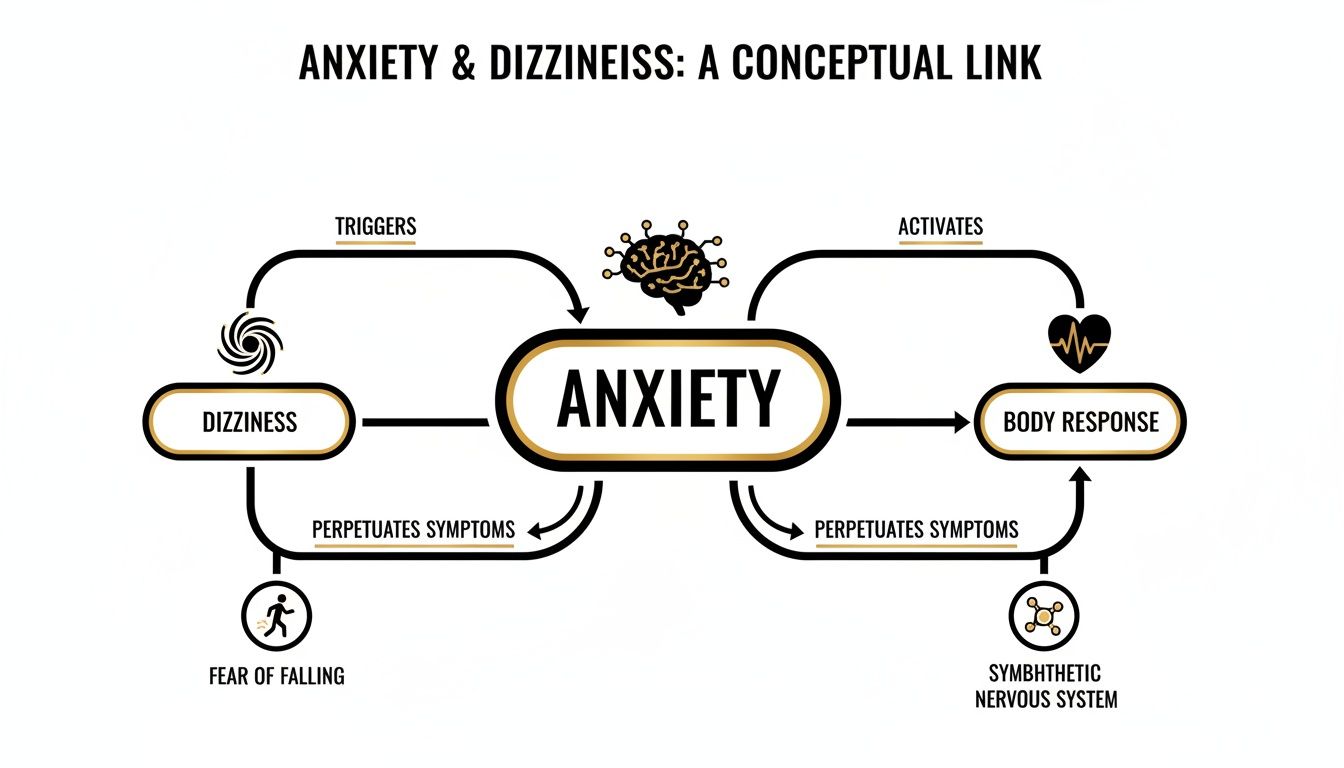
As you can see, a single fearful thought can trigger a cascade of physical reactions that create dizziness. That dizziness then causes more fear, locking you into a nasty, self-feeding cycle. But the most hopeful part is this: you can learn to break this cycle.
The Over-Breathing Effect
In the heat of an anxious moment, your breathing pattern changes without you even noticing. You might start taking quick, shallow breaths from your chest. This is called hyperventilation.
This style of anxious breathing rapidly lowers the carbon dioxide (CO2) levels in your blood. You might think more oxygen is always a good thing, but your body actually needs a careful balance of both. When CO2 levels drop too low, the blood vessels leading to your brain constrict, which reduces blood flow and creates that classic feeling of lightheadedness, tingling, or thinking you might faint.
Your breath is a powerful anchor. A racing, shallow breath can make you feel unmoored and dizzy. A slow, deep breath can instantly tell your nervous system that you are safe and grounded.
This is actually great news because it puts you back in the driver's seat. By consciously slowing down your breathing, you can reverse this process, restore your body’s chemical balance, and often ease the dizziness within minutes. You have direct control over this.
A Hypersensitive Balance System
Tucked away deep inside your inner ear is the vestibular system—your body's internal balance center. Think of it as a super-sophisticated motion detector, constantly sending signals to your brain about where you are in space to keep you upright and steady.
When you're dealing with chronic anxiety, this entire system gets put on high alert. Your brain, already primed to look for danger, becomes overly sensitive to the signals coming from your vestibular system. It starts misinterpreting even tiny shifts in movement as major threats. This can make you feel unsteady, off-balance, or like you’re gently rocking on a boat, even when you're standing perfectly still.
This heightened sensitivity explains why anxiety-related dizziness often feels different. It’s less of a true "spinning" vertigo and more of a persistent, disorienting sense of instability. Knowing this helps you see the sensation for what it is: a side effect of a sensitized system that can be calmed, not a sign that something is physically broken.
Is It Anxiety Dizziness or Something Else?
When a sudden wave of dizziness hits, it’s easy for your mind to jump straight to the worst-case scenario. Is it my heart? Am I having a stroke? This fear is often the scariest part of the whole experience, trapping you in a cycle of "what if?" thoughts that only dial up the anxiety—and, you guessed it, the dizziness.
Learning to tell the difference between anxiety-related dizziness and symptoms that need a doctor's attention is a huge act of self-reassurance. It gives you the power to respond with clarity instead of fear, which is the first real step toward feeling in control again.
What Anxiety Dizziness Feels Like
Anxiety-related dizziness rarely feels like true, room-spinning vertigo you might get from an inner ear problem. Instead, most people describe it as a deeply unsettling feeling of being unsteady or lightheaded.
You might feel:
- A floating or woozy sensation, as if you're slightly disconnected from your body or walking on a boat.
- Off-balance or unsteady, like you could tip over at any moment, especially in wide-open spaces or crowded stores.
- Vaguely lightheaded, almost like you stood up too fast, but the feeling just lingers.
These sensations usually spike during moments of high stress or a panic attack and can hang around long after, creating a nagging sense of instability. This is a direct, physical sign that your nervous system is on high alert.
The most important thing to remember is that these feelings, while terrifying, are not dangerous. They are a predictable side effect of your body's stress response. Knowing this helps strip them of their power and opens the door to healing.
Red Flags That Mean It's Time to See a Doctor
While anxiety is a common cause of dizziness, it's crucial to know when your symptoms might be pointing to something else. Being able to calmly check in with your body is key to breaking the cycle of health anxiety. True medical emergencies involving dizziness almost always come with other distinct, severe symptoms.
Seek immediate medical attention if your dizziness is accompanied by any of the following:
- A sudden, severe headache (often called a "thunderclap headache" or "the worst headache of your life")
- Fainting or loss of consciousness
- Chest pain, pressure, or trouble breathing
- Numbness, weakness, or paralysis in your face, arm, or leg
- Sudden trouble speaking, seeing, or walking
- Double vision or sudden hearing loss
This checklist isn't meant to scare you—it's meant to empower you. By knowing these clear red flags, you can confidently reassure yourself when that familiar floating or off-balance feeling is likely just your anxiety talking.
If your dizziness is persistent and you're still worried, understanding when to see a psychiatrist for anxiety can provide a clear diagnosis and a targeted treatment plan. That clarity is the foundation for a panic-free life.
How to Stop Dizziness During a Panic Attack
When dizziness hits in the middle of a panic attack, it can feel like the world is tilting off its axis. That terrifying sensation often sends your fear into overdrive, making you feel completely out of control. But there is profound hope in knowing you have the power to stop this feeling in its tracks.
The key isn’t to fight the dizziness—that just adds fuel to the fire. Instead, you can learn to gently guide your brain’s attention away from it. These simple, in-the-moment techniques act as anchors, pulling you back to a place of safety and stability. They are concrete proof that you can regain your footing, even when panic feels like it’s swallowing you whole.

Use Your Senses to Get Grounded
The fastest way to interrupt the dizziness-panic cycle is to ground yourself in your immediate environment. The 5-4-3-2-1 method is a powerful exercise that forces your brain to focus on external sensations instead of the frightening internal ones.
Here’s how to do it right now:
- Look for 5 things you can see. Acknowledge them without judgment. Notice the color of the wall, a crack in the ceiling, or the pattern on your sleeve.
- Focus on 4 things you can feel. Pay attention to the texture of your pants, the solidness of the floor under your feet, or the coolness of a nearby table.
- Listen for 3 things you can hear. Tune into the hum of a refrigerator, the distant sound of traffic, or the rhythm of your own breathing.
- Identify 2 things you can smell. Maybe it’s the faint scent of coffee in the air or the clean smell of your laundry detergent.
- Name 1 thing you can taste. Focus on the lingering taste of your last meal or simply the neutral taste inside your mouth.
This simple act shifts your brain's focus, sending a powerful signal that you are safe in the present moment.
Reclaim Control with Your Breath
Dizziness during panic is often fueled by hyperventilation—that rapid, shallow breathing that throws your body's CO2 balance out of whack. You can reverse this almost instantly by intentionally slowing your breath. Doing this tells your nervous system that the danger has passed.
A simple technique is box breathing. Imagine drawing a square with your breath: breathe in for a count of four, hold for four, breathe out for four, and hold for four. Repeat this several times. This rhythmic pattern is incredibly effective at calming the fight-or-flight response. To explore more ways to calm your system, check out these powerful breathing exercises for anxiety.
Anchoring your gaze on a single, stationary object can provide your brain with a stable reference point, helping to steady your world when it feels like it’s tilting.
Find a spot on the wall or an object across the room and just rest your eyes on it. Don't stare intensely; let your gaze soften. This small action gives your vestibular system—your internal balance center—a fixed point to orient itself, which can dramatically reduce the sensation of spinning or floating.
Each of these techniques is a step toward proving to yourself that you are not helpless. You have the tools to navigate these moments and emerge stronger on the other side.
Long-Term Strategies for a Panic-Free Life
Grounding techniques are lifesavers when a panic attack hits, but the real goal is to build a life where you don't need to be saved in the first place. This is where we shift from merely surviving the dizziness to proactively creating a foundation of calm so strong that panic loses its power.
It’s all about sustainable change. Think of it as gently retraining your nervous system, showing it day after day that it's safe. Over time, that feeling of security becomes your new normal, proving you have the power to reshape your response to fear and build a life of freedom.

Rewiring Your Thoughts with CBT Principles
Cognitive Behavioral Therapy (CBT) is one of the most powerful tools for making this happen. At its heart, CBT is about learning to notice and question the fearful thoughts that kickstart the anxiety-dizziness cycle. It teaches you to become an observer of your thoughts instead of a prisoner to them.
When dizziness strikes, the anxious brain often jumps to a catastrophic thought like, "Something is terribly wrong with me." This thought alone sends a jolt of fear through your body, which, you guessed it, makes the dizziness feel even worse.
A CBT approach helps you catch that thought and challenge it with calm curiosity.
You can learn to ask yourself:
- "What's a more likely reason for this feeling? Am I stressed? Did I sleep poorly?"
- "I've felt this way before and been okay. What happened last time?"
- "What's a more balanced, reassuring thought I could focus on instead?"
This isn’t about pretending you don't feel dizzy; it’s about untangling the physical sensation from the terrifying story your anxiety is telling you. With practice, you literally build new neural pathways, making calm, rational responses your automatic go-to. If you want to dive deeper into this method, you can learn more about how CBT helps with anxiety.
Building a Foundation of Physical Calm
Your mind and body are in constant conversation. Making lifestyle choices that soothe your nervous system can dramatically reduce how often—and how intensely—you experience anxiety-related dizziness.
Hope isn't just a feeling; it’s a strategy. Every time you choose a habit that nourishes your nervous system, you are actively building a future where you feel grounded, safe, and in control.
Consider weaving these practices into your daily life:
- Mindful Movement: You don't have to run a marathon. Gentle activities like yoga, tai chi, or a simple walk in nature are fantastic for releasing stored tension and calming that fight-or-flight alarm.
- Restorative Sleep: Dizziness and poor sleep often go hand-in-hand. Aiming for 7-9 hours of quality sleep isn't a luxury; it’s essential for nervous system repair.
- Nourishing Nutrition: Wild blood sugar swings can feel a lot like anxiety and lightheadedness. Eating regular, balanced meals helps keep everything on an even keel, preventing dips that might trigger panic.
Exploring other calming methods can also be a game-changer. For example, understanding the science behind deep pressure therapy for anxiety offers another practical way to ground your body when it feels overwhelmed.
The connection between lifestyle and dizziness isn't just anecdotal. A 2023 study involving over 4,000 adults found a strong link between chronic dizziness, high stress levels, and short sleep duration. It's clear that these foundational habits truly make a difference.
Your Path Forward to a Calmer Life
This whole journey of untangling anxiety from dizziness can feel like a heavy lift, but you’re not climbing this mountain alone. Healing is more than just possible—it’s within reach.
The path forward isn’t about waging a war against your own nervous system. It’s about gently, and consistently, showing it that it’s safe. Every time you ground yourself, every time you breathe through a wave of panic, you’re reclaiming a piece of your life. You’re rewriting the story.
Let’s be clear about one thing: the dizziness is real. It’s not in your head, and it’s not a sign that you’re broken. It’s an understandable, physical symptom of an alarm system that’s working a little too hard. Now you have the tools to help it recalibrate and find its way back to calm.
Building a Life Beyond Anxiety
Consider this guide your roadmap. We’ve walked through the science behind your symptoms, given you in-the-moment tools to find solid ground, and outlined long-term strategies for a sustainable sense of peace. This isn’t just information; it’s the foundation for building a life where you feel in control.
The goal here isn't just to manage anxiety. It’s to build a life so full, so grounded, and so aligned with who you are that panic has very little room to thrive. Think of it less like fighting a battle and more like tending to a garden—nurturing your own well-being until it flourishes.
The point isn’t to get rid of anxiety forever—it's a normal human emotion, after all. The goal is to get to a place where it no longer dictates your choices, shrinks your world, or triggers distressing physical symptoms like dizziness.
You Are Capable of This
Remember, every time you use a grounding technique, challenge a runaway thought, or choose to get a good night's sleep, you're casting a vote for a calmer you. These small acts build on each other, creating a momentum that pulls you forward.
So, can anxiety cause dizziness? Yes. But the more important truth is that you can heal from both.
This is a process of rediscovering your own strength. Each day is a new chance to practice a little self-compassion and take one more step toward the life you deserve—one defined by stability and freedom, not fear. You’ve got this.
For a structured, step-by-step system to guide you on this journey, The Anxiety Checklist provides a comprehensive set of tools and strategies to help you build a panic-free life. Learn more and get your copy at https://anxietychecklist.com.