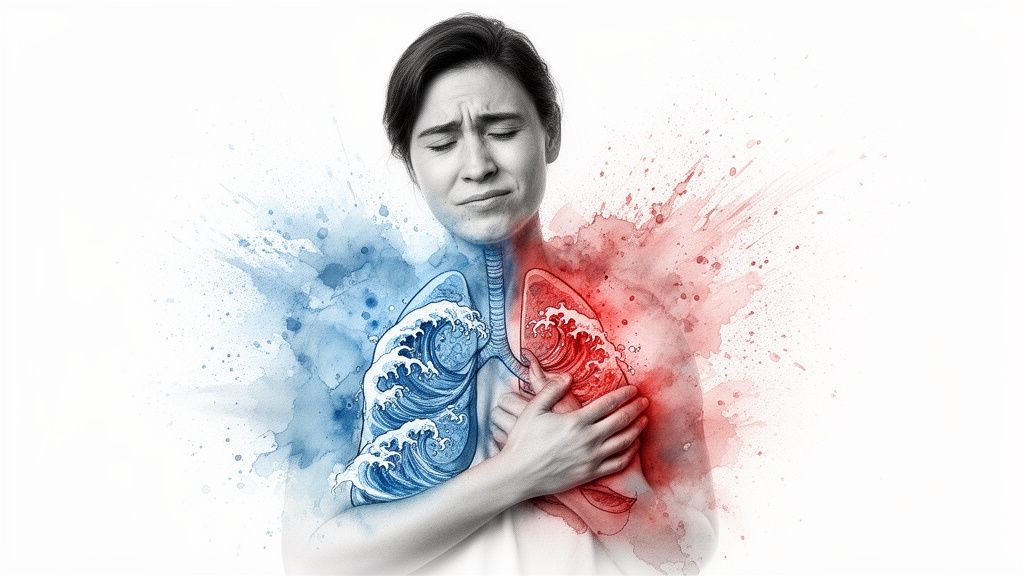
Yes, anxiety can absolutely cause shortness of breath. If you’ve ever felt like you couldn’t quite catch your breath during a stressful moment, you’re not just imagining it. That frightening sensation is a very real, very physical symptom of anxiety, but it is not a life sentence.
Understanding why this happens is the first, most powerful step toward regaining control, healing your nervous system, and living a life free from panic.
Your Breathless Feeling Is Real and You Can Heal

When your chest tightens and a wave of panic hits, it's easy to feel scared and totally isolated. But what you're feeling is one of the most common physical manifestations of anxiety. It's not "all in your head," and more importantly, it's not a sign that you are in physical danger from the anxiety itself.
This whole sensation is driven by your body's powerful, primitive fight-or-flight response kicking into high gear.
Think of it as an ancient, highly sensitive alarm system designed to protect you from legitimate danger. When anxiety triggers this alarm—even without a real threat—your body prepares for action by ramping up your heart rate and breathing. You can learn more about the mechanics in our complete fight-or-flight response guide.
This biological reaction is precisely why you feel breathless. Recognizing it for what it is—a false alarm—is the key to disarming its power over you and teaching your body it is safe.
Distinguishing Anxiety from an Emergency
The link between anxiety and feeling breathless is incredibly well-established. In fact, population-based research shows that anxiety and depression are present in up to 52% of individuals who report shortness of breath. The odds of this symptom increase dramatically with anxiety severity, highlighting a strong connection that doesn’t rely on any underlying lung disease.
While it’s always smart to be cautious, learning to recognize the typical patterns of anxiety-induced breathlessness can bring immense peace of mind.
Here’s a quick guide to help you tell the difference in the moment.
Anxiety Breathlessness vs Medical Emergency Quick Guide
This table is a starting point to help you differentiate common signs, but it is not a substitute for a professional diagnosis.
| Symptom | Often Linked to Anxiety | May Indicate a Medical Emergency |
|---|---|---|
| Onset | Tends to happen during moments of high stress, worry, or a building panic attack. | Can strike suddenly without an obvious trigger, even when you're completely at rest. |
| Associated Sensations | Often comes with racing thoughts, tingling in your hands or feet, or a sense of impending doom. | Paired with severe, crushing chest pain that might radiate to your arm, jaw, or back. |
| Breathing Pattern | Feels like you can't get a deep, satisfying breath in (sometimes called "air hunger"). | An actual inability to speak in full sentences; may be accompanied by wheezing or coughing up blood. |
| Other Signs | May also include dizziness, sweating, trembling, or a feeling of detachment. | Includes loss of consciousness, sudden confusion, or a bluish tint to your lips or skin. |
Ultimately, your journey to a life free from panic starts with knowledge and hope. You are not broken. And with the right tools, you absolutely can learn to manage these sensations and live without that constant fear.
Why Anxiety Hijacks Your Breathing
Ever had that terrifying feeling where you just can't seem to catch your breath, even though you’re not physically exerting yourself? It’s a classic, unnerving symptom of anxiety, and it all starts with your body’s ancient survival wiring getting its signals crossed. The hopeful part? You can learn to rewire these signals.
Think of your nervous system like an overly sensitive car alarm. Instead of going off for a real threat—like a burglar—it starts blaring because a cat walked by. That’s your fight-or-flight response kicking into gear, mistakenly treating your anxious thoughts like a life-or-death emergency.
When this false alarm sounds, your body doesn't pause to ask questions. It just reacts, preparing you to either fight off a predator or run for your life. This triggers a flood of physical changes, and two key players are responsible for that suffocating feeling that you can't get enough air.
The Hyperventilation Effect
The first thing to go haywire is your breathing. Without you even noticing, you start taking quick, shallow breaths, pulling air into your chest instead of deep into your belly. This is called hyperventilation.
Your body is trying to be helpful by pumping your muscles full of oxygen for the impending "danger." The problem is, it does its job a little too well, throwing the delicate balance of oxygen and carbon dioxide in your bloodstream completely out of whack.
"Hyperventilation doesn't mean you aren't getting enough air—it means you're getting too much oxygen, too quickly, while expelling carbon dioxide too fast. This imbalance is what creates the dizzying, lightheaded sensation often described as 'air hunger'."
This chemical disruption tricks you into feeling like you can't get a satisfying breath, which, ironically, makes you try to breathe even faster. This is a temporary, harmless state you can absolutely reverse.
The Muscle Tension Trap
At the same time, anxiety is telling your muscles to brace for impact. Every muscle in your body tightens, but you feel it most acutely in your chest, shoulders, and neck. These are your secondary breathing muscles, and when they clench up, they literally squeeze your rib cage.
Imagine trying to inflate a balloon inside a small, rigid box. No matter how hard you blow, it can't fully expand. That’s what’s happening to your lungs. This tension physically restricts their movement, making a deep breath feel impossible.
- Chest Tightness: It can feel like a heavy weight or a tight band is wrapped around your chest.
- Stiff Shoulders: You might notice your shoulders creeping up toward your ears, adding to the tension.
- Restricted Diaphragm: Your diaphragm, the main muscle of respiration, can’t move freely when everything around it is locked up.
When you combine the chemical chaos of hyperventilation with this physical clamping down, you've got the perfect storm for breathlessness. It’s not just in your head; clinical data backs this up. An umbrella review of 315 studies found that breathlessness was present in up to 87% of people in clinical settings, with anxiety being a major driver. You can dig into the specifics in the comprehensive study published by PMC.
Understanding what’s happening under the hood is the first step toward taking back control. Your body isn’t failing you—it’s just running an old, outdated program. By learning specific breathing exercises for anxiety, you can manually override this response, soothe your nervous system, and remind your body that you’re safe.
Knowing When to Seek Medical Help
Okay, let's talk about the big question: when is shortness of breath "just anxiety," and when is it something more? Getting a handle on this is a huge step toward healing. It’s not about ignoring scary feelings, but about replacing that fearful uncertainty with clear, calm guidelines. This knowledge is power—it helps you build trust in your body and your own judgment.
Anxiety-related breathlessness usually follows a familiar script. It tends to show up during moments of high stress, brings along its classic sidekicks like racing thoughts or tingling hands, and often eases up once you start using calming techniques. It feels terrifying, yes, but it’s part of a recognizable pattern you can learn to manage.
Think of it like a decision tree. This can help you visualize whether your breathlessness is pointing toward an anxiety trigger or a potential medical issue.
As you can see, the context matters. Did this start after a huge stressor at work, or did it come on with sudden, crushing chest pain? The surrounding symptoms help point you in the right direction.
Anxiety Symptoms Checklist
When that breathless feeling hits, do a quick mental scan. Is it traveling with any of these common anxiety companions?
- A sense of impending doom or a gut feeling that something awful is about to happen.
- Tingling or numbness, often in your hands, feet, or face.
- A racing heart or palpitations that feel like a fluttering in your chest.
- Dizziness, lightheadedness, or that scary sensation that you might faint.
- A familiar pattern of symptoms that you recognize from past anxiety or panic attacks.
If your experience lines up with this list, there's a good chance anxiety is the culprit. But that doesn't mean you should ignore everything. There are some serious red flags that demand immediate attention.
Red Flags That Require Immediate Attention
Your health and safety always come first. The rule of thumb here is simple: when in doubt, get checked out. It is always, always better to seek medical care and be told it was just anxiety than to dismiss a potentially serious condition.
Call for emergency services immediately if your shortness of breath is paired with any of the following:
- Severe, crushing chest pain, especially if it spreads to your arm, jaw, or back.
- Loss of consciousness or sudden, severe confusion.
- A bluish tint to your lips, skin, or fingernails.
- An inability to speak in full sentences.
- Sudden swelling in your feet or ankles.
It’s also important to tell the difference between anxiety-driven symptoms and physical injuries. For instance, knowing how to tell if you've broken a rib can help you make a clear-headed decision in a painful moment.
Learning these distinctions creates a foundation of safety. It allows you to confidently address the psychological roots of your symptoms, a journey where working with a specialized psychiatrist for anxiety can make all the difference. This clarity is a critical piece of the puzzle to living a panic-free life.
How to Reclaim Your Breath in a Panic
When you feel that familiar tightness in your chest and the desperate need for air, it’s easy to feel powerless. But this is the moment where you can actively intervene and remind your body it's safe. You have tools that can calm the storm, and practicing them is the key to reclaiming your sense of control and building lasting confidence.
The feeling of breathlessness during anxiety is remarkably common. Recent data reveals a breathlessness prevalence of 12.5% in the general population, but that number skyrockets to 37.5% in clinical settings where anxiety is a known factor. This data confirms that what you're experiencing is a significant issue that responds incredibly well to targeted coping strategies, and you can read more about these important findings on anxiety and respiratory symptoms.
Calm Your Nervous System with Breathing Exercises
Anxiety hijacks your breathing, forcing you into a shallow, rapid pattern. The antidote is to consciously switch to slow, deep, diaphragmatic breathing. This sends a powerful signal to your brain that the danger has passed and you are safe.
Here are two simple yet powerful techniques:
-
Box Breathing: This method is used by Navy SEALs to stay calm under pressure. It's easy to remember and incredibly effective.
- Inhale slowly through your nose for a count of four.
- Hold your breath for a count of four.
- Exhale slowly through your mouth for a count of four.
- Hold at the bottom for a count of four. Repeat the cycle.
-
4-7-8 Breathing: Developed by Dr. Andrew Weil, this technique acts as a natural tranquilizer for the nervous system.
- Exhale completely through your mouth, making a whoosh sound.
- Close your mouth and inhale quietly through your nose for a count of four.
- Hold your breath for a count of seven.
- Exhale completely through your mouth with another whoosh sound for a count of eight. Repeat three more times.
Anchor Yourself with Grounding Techniques
Breathing exercises are crucial, but sometimes the physical sensations are so overwhelming you need to pull your mind away from them. This is where grounding comes in. It anchors your awareness in the present moment, rather than the internal chaos of anxiety.
The 5-4-3-2-1 Sensory Method is a fantastic tool for this:
Acknowledge 5 things you can see around you. Next, notice 4 things you can feel. Then, listen for 3 things you can hear. Identify 2 things you can smell. Finally, name 1 thing you can taste.
This simple exercise forces your brain to focus on the external world, breaking the feedback loop of panic. By shifting your attention, you interrupt the cycle of fear that fuels shortness of breath. You can explore more powerful ways to stay present with our guide on grounding techniques for anxiety.
Using these tools provides immediate relief and builds long-term confidence. Each time you successfully manage an episode, you are rewriting your relationship with anxiety, proving that you are capable of navigating these moments and finding calm on the other side.
Your Path to Long-Term Freedom From Anxiety
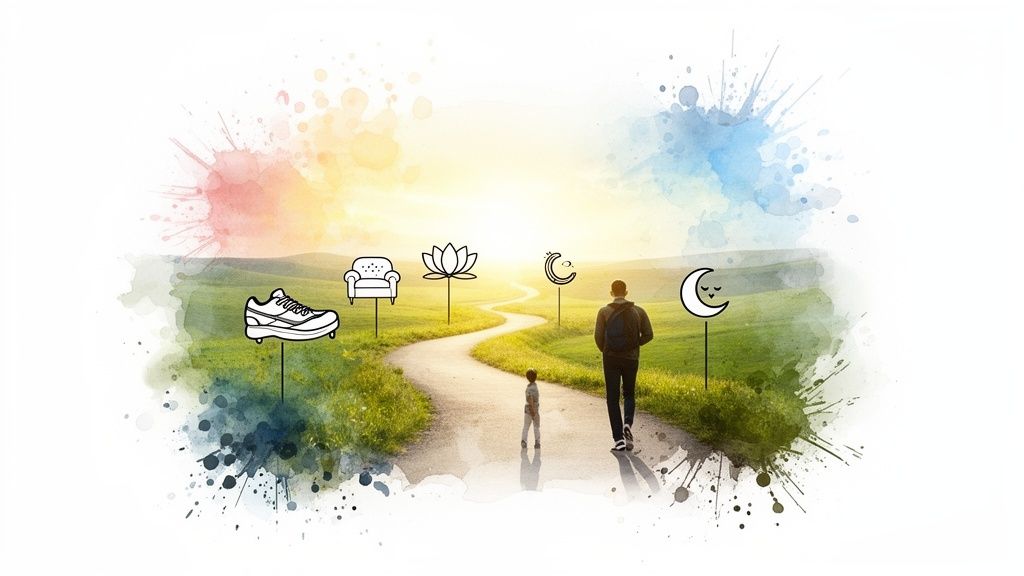
While in-the-moment techniques are your lifeline, true and lasting freedom from anxiety is about more than just surviving the next panic attack. It’s about building a life where that sense of panic—and symptoms like shortness of breath—no longer has the upper hand.
This is a journey of healing from the ground up. It means getting to the root of what’s triggering your nervous system and learning to reframe your entire relationship with anxious thoughts.
Imagine living a life where the fear of not being able to breathe doesn't dictate your choices. This is absolutely possible. This hopeful journey begins by creating a strong foundation of resilience and calm, so your fight-or-flight response doesn't get hijacked in the first place.
Reshaping Your Thoughts with Cognitive Behavioral Therapy
One of the most powerful and effective tools for creating this lasting change is Cognitive Behavioral Therapy (CBT). The core idea of CBT is simple but life-changing: your thoughts, feelings, and physical reactions are all connected.
When you're hit with shortness of breath from anxiety, it's often fueled by catastrophic thoughts like, "I can't breathe," or "Something is terribly wrong with me." These thoughts don't just stay in your head; they pour gasoline on the fire of your physical panic.
CBT teaches you to become a compassionate observer of your own mind. You learn how to spot these automatic negative thoughts, challenge their validity, and gently replace them with more realistic, balanced ones. This process breaks the cycle of panic before it can take hold of your breathing, giving you back control.
By changing your thoughts, you can change your entire physical and emotional response. It's not about ignoring fear, but about systematically dismantling the thought patterns that give it power. A life with less panic is truly achievable through these proven methods.
Building Resilience Through Lifestyle Adjustments
Beyond therapy, the daily habits you cultivate play a massive role in regulating your nervous system and lowering your baseline anxiety. These aren’t just minor tweaks; they're powerful ways to build a buffer against stress and create a life that feels safer and more stable.
Here are a few game-changers:
- Consistent Physical Activity: Getting your body moving—whether it's a brisk walk, yoga, or a gym session—is one of the best ways to burn off excess stress hormones like adrenaline and cortisol. It also triggers the release of endorphins, your body's natural mood-lifters, which brings a wonderful sense of calm.
- Mindfulness and Meditation: Practicing mindfulness trains your brain to stay grounded in the present moment instead of getting swept away by worries about the future. Even just five to ten minutes a day can make a real difference, teaching your nervous system that it can relax and feel safe.
- Prioritizing Sleep Hygiene: When you're sleep-deprived, your nervous system is much more reactive. Creating a consistent, relaxing bedtime routine signals to your body that it's safe to power down, which profoundly improves both your mental and physical resilience.
Each of these strategies works together to create a powerful foundation for healing. Every positive choice you make is a step away from fear and toward a future where you feel confident, in control, and able to breathe freely and easily.
Common Questions About Anxiety and Breathing
Even after understanding the mechanics, you might still have some nagging questions. That’s completely normal. Getting clear, compassionate answers is a huge part of taking the fear out of the equation and feeling in control again.
Let’s tackle some of the most common concerns to empower you with knowledge and hope.
Can Anxiety Cause a Constant Feeling of Shortness of Breath?
Yes, absolutely. While we often think of breathlessness as part of a dramatic, short-lived panic attack, chronic anxiety or Generalized Anxiety Disorder (GAD) can create a persistent feeling of not getting enough air.
This feeling often comes from low-level, sustained muscle tension in your chest and diaphragm, a subtle clench you might not even notice. It can also be caused by a persistent habit of shallow breathing. Unlike the sudden "air hunger" of a panic attack, this feels more like a frustrating, nagging struggle to take a single deep, satisfying breath.
It’s exhausting, but it's a direct signal that your nervous system is stuck on high alert. The hopeful truth is that you can teach your nervous system to stand down and find its natural, calm rhythm again.
How Long Does Anxiety-Related Breathlessness Usually Last?
The timeline really depends on the type of anxiety you're dealing with.
- During a Panic Attack: That intense, terrifying feeling of not being able to breathe typically peaks within 10 minutes. It then gradually fades as the attack subsides, usually within 20 to 30 minutes.
- With Chronic Anxiety: This is a different beast. The sensation can come and go in waves for hours, or even linger at a low level for most of the day, getting better or worse depending on your stress levels.
The good news is that using breathing exercises and grounding techniques can dramatically shorten how long these episodes last and how intense they feel. Every time you use a tool to calm yourself down, you’re actively teaching your body how to recover more quickly.
Your body has an incredible capacity to find its balance again. The goal isn’t to never feel anxiety—it’s to build the confidence that you can handle the feeling when it shows up, without letting it run the show. You can learn to trust your breath again.
What Is the First Step I Should Take to Manage This Symptom?
The best first step is a two-part approach that combines safety with self-empowerment, setting you on a hopeful path to recovery.
First things first: if you have any doubt about what’s causing your shortness of breath, see a doctor. Getting a medical check-up to rule out any underlying physical issues is the most important thing you can do. It provides a solid foundation of safety and peace of mind, and it shuts down all those "what if" fears that anxiety loves to exploit.
Once you have that medical reassurance, your next step is to start practicing a calming breathing exercise for a few minutes every single day. Don't wait until you're already in a panic. By doing something simple like Box Breathing when you’re calm, you're building "calm muscle memory." The technique becomes a reliable, almost automatic tool you can grab when you need it most. This proactive habit is one of the most powerful first steps you can take toward reclaiming your life from anxiety.
At The Anxiety Checklist, we believe you deserve to live a life free from the grip of panic. Our system offers a structured, actionable path to understand your anxiety, track your symptoms, and build a personalized toolkit of skills that actually work. It’s time to stop letting anxiety call the shots and start building a future defined by confidence and calm. Learn more and get your copy at https://anxietychecklist.com.