
Yes, stress and anxiety can absolutely make you feel lightheaded. If you've ever had that dizzy, off-balance sensation during a tense moment, you’re not imagining it. That feeling isn't a sign that you are broken; it's a direct, physical consequence of your body's powerful, built-in alarm system kicking into gear. More importantly, it's a signal you can learn to understand and manage on your path to a calmer life.
Your Body’s Alarm System and Lightheadedness
Think of your body's stress response like a highly sensitive fire alarm. When you face a genuine danger—say, a car swerving into your lane—this "fight-or-flight" system floods you with adrenaline, sharpens your senses, and gets you ready to act. It’s a brilliant survival tool.
The problem is, in our modern world, that same alarm gets tripped by things that aren't life-threatening at all. A looming deadline, a tough conversation, or even just a spiral of anxious thoughts can set it off.
When the system fires up without a real physical threat to fight or run from, all those intense physiological changes—like rapid breathing and shifting blood flow—have nowhere to go. This internal chaos can create some really unsettling physical symptoms, and one of the most common is lightheadedness.
The Mind-Body Connection is Real
This isn't just a theory; science backs it up. A landmark 2016 study of 544 patients with dizziness found that 21.5% also had high levels of anxiety or depression. Crucially, those individuals reported their dizziness was far more severe and disruptive. This shows just how much our psychological state can crank up the volume on physical sensations.
Understanding this link is the single most important step you can take toward feeling better. It transforms that scary, out-of-the-blue dizziness into a predictable signal from your body that you can learn to work with.
Once you see lightheadedness as a side effect of your stress response, you can stop fearing the symptom and start addressing its root cause. That knowledge is power. It's the beginning of your journey toward a life where anxiety doesn't call the shots.
Below, we'll connect the dots between common stressors and that dizzy feeling. It's surprisingly straightforward once you see it laid out.
How Common Stressors Trigger Lightheadedness
Ever wonder exactly how a stressful thought leads to a physical sensation? This table breaks down the direct chain reaction between everyday triggers and that wobbly, lightheaded feeling.
| Common Stress Trigger | Your Body's Automatic Reaction | The Sensation You Feel |
|---|---|---|
| Anxious thoughts about an upcoming presentation | Your breathing quickens (hyperventilation), reducing CO2 in your blood and narrowing blood vessels to the brain. | A sudden, floaty feeling or lightheadedness, maybe with tingling fingers. |
| Sudden shock or bad news | A vasovagal response can be triggered, causing a rapid drop in both your heart rate and blood pressure. | A wave of dizziness, feeling faint, or seeing spots, as blood flow to the head dips. |
| Standing up too quickly while stressed or dehydrated | The autonomic nervous system struggles to adjust blood pressure fast enough, causing a temporary drop (orthostatic hypotension). | A brief but intense head rush or feeling like you might pass out for a second. |
| Getting stuck in an unexpected traffic jam | Adrenaline surges, your heart races, and blood is diverted from your head to your major muscles for "fight or flight." | A sense of being unsteady or dizzy, coupled with a pounding heart. |
Seeing the pattern helps demystify the experience. It’s not random; it's a predictable (and manageable) biological process.
This article will give you the tools to calm that alarm system down, manage these symptoms when they pop up, and understand the common anxiety triggers that might be setting them off. You have the power to heal from anxiety and live a panic-free life.
How Your Body Creates Dizziness Under Stress
To stop fearing a sensation like lightheadedness, it helps to pull back the curtain and see exactly what's happening backstage. Think of your body as a high-performance car. When stress hits, your brain doesn't just tap the brakes—it slams the gas pedal, kicking off a series of powerful, automatic reactions designed for pure survival.
Knowing these reactions aren't random but are predictable biological processes is the first step toward getting back in the driver's seat.
The following graphic breaks down the simple, yet powerful, chain reaction that takes you from a daily stressor to that dizzy, off-balance feeling.
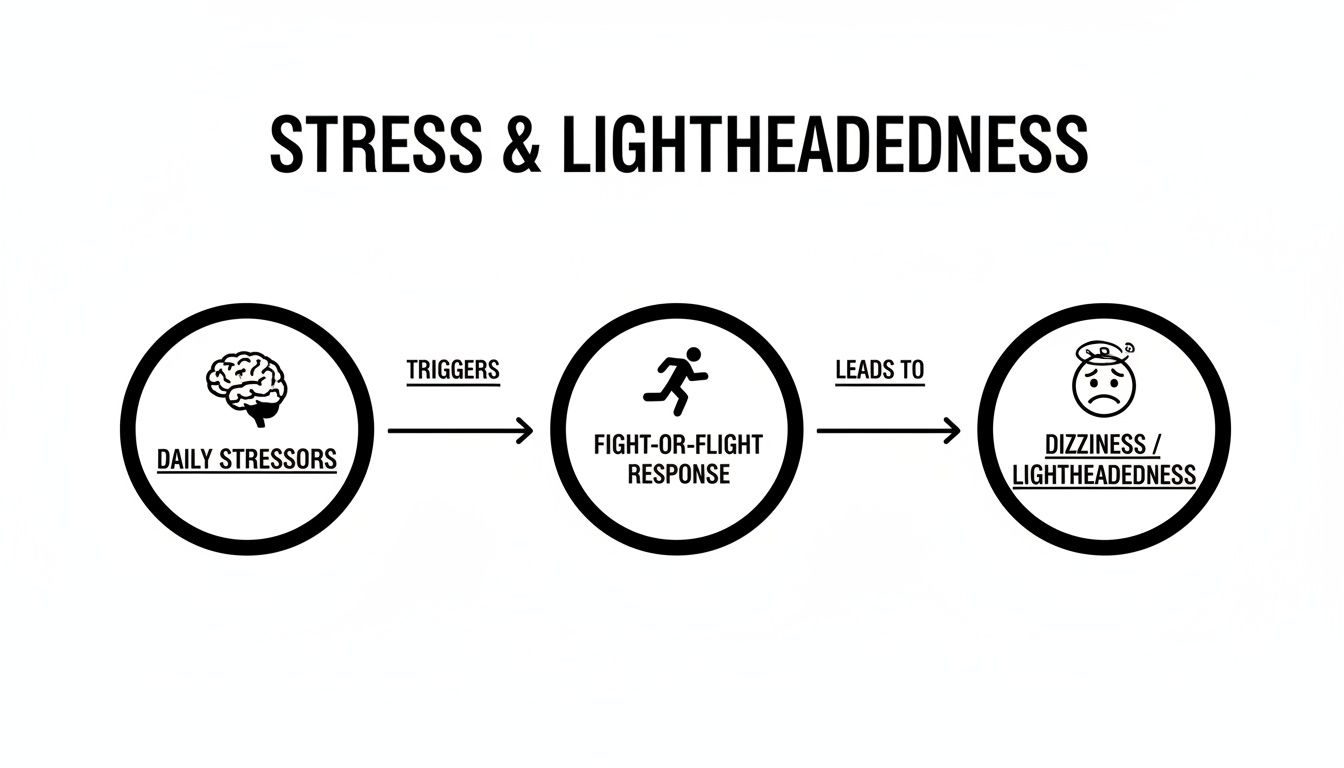
This visual journey shows that the path from stress to dizziness isn't a mystery; it's a direct physiological response that starts in the mind.
The Hyperventilation Connection
One of the fastest ways stress makes you feel lightheaded is by changing your breathing. During a surge of panic or high anxiety, you might start breathing very quickly and shallowly—often without even realizing it. This is called hyperventilation.
Imagine your body needs a perfect balance of oxygen and carbon dioxide to run smoothly. Hyperventilation is like flooding the engine with too much air. As you rapidly exhale, you blow off too much carbon dioxide, causing its levels in your blood to drop.
This chemical shift causes the blood vessels that supply your brain to constrict, directly leading to that woozy, floaty, and sometimes tingly sensation. It's pure chemistry, and more importantly, it's reversible with simple breathing techniques.
Adrenaline and Blood Flow Changes
When your brain perceives a threat—whether it's a snarling dog or just an overwhelming inbox—it unleashes a flood of stress hormones like adrenaline and cortisol. This is the heart of the famous fight-or-flight response, a primal system designed to prepare your body for immediate, intense physical action.
This hormonal surge triggers a few key changes in your circulatory system:
- Increased Heart Rate: Your heart starts pumping faster and harder to move blood where it's needed most.
- Blood Redirection: Blood is rerouted away from areas considered non-essential for survival (like your head and digestive system) and sent to your large muscles in the arms and legs.
- Blood Pressure Spikes: Your blood pressure can temporarily shoot up.
This sudden diversion of blood flow away from the brain can easily make you feel dizzy or off-balance. It's not a sign that something is medically wrong; it's just your body's ancient survival wiring doing its job. You can learn to calm this response. For a deeper look into this mechanism, check out our guide on the fight-or-flight response.
The Inner Ear Interference
Your sense of balance isn't in your legs; it's managed by a delicate system in your inner ear called the vestibular system. This system is incredibly sensitive to changes in blood flow and pressure.
The same stress hormones that reroute blood can also scramble the signals being sent from your inner ear to your brain. This creates a mismatch of information—your eyes see that you're standing still, but your balance system is sending wonky signals. That conflict can create a powerful sensation of dizziness or being unsteady on your feet.
Beyond these direct physiological links, anxiety can show up in many ways, and dizziness is one of the most common physical symptoms. To learn more about the physical symptoms of anxiety and how to find relief, that guide is a great next step.
By understanding these mechanisms, the feeling of lightheadedness starts to transform from a terrifying mystery into a manageable bodily function. This knowledge is your foundation for building control and starting your journey to a calmer life.
When to See a Doctor for Your Dizziness
While it’s incredibly reassuring to know that stress can bring on a wave of lightheadedness, it’s just as important to recognize when your symptoms might be pointing to something else. This isn't about creating more fear—quite the opposite. It’s about empowering you to take charge of your health with confidence, so you get the right care exactly when you need it.
Learning to tell the difference between anxiety-related dizziness and a potential medical issue is a huge step in your healing journey. It helps you build trust in your body's signals again and gives you the peace of mind needed to break the anxiety cycle for good.
Red Flags That Warrant a Medical Check-Up
Most of the time, dizziness from stress feels awful, but it isn’t dangerous. However, if your lightheadedness comes with any of the following "red flag" symptoms, it's time to seek prompt medical attention to rule out other conditions.
- Fainting or Loss of Consciousness: Actually passing out is very different from just feeling like you might.
- Sudden, Severe Headache: Think of a "thunderclap" headache—the absolute worst you've ever experienced.
- Chest Pain or Shortness of Breath: Especially if it feels like pressure or squeezing, or if your heart is pounding and won't calm down.
- Vision Changes: Things like sudden double vision, blurry vision, or a partial loss of sight.
- Numbness or Weakness: Pay close attention if this happens on just one side of your face or body.
- Difficulty Speaking or Walking: Slurred speech or a sudden lack of coordination are serious signals.
Think of these symptoms as your body’s way of saying, "Hey, this is different." Recognizing them allows you to act decisively, which is a powerful way to reclaim a sense of control over your health. This is the crucial knowledge that separates manageable anxiety from a situation needing a doctor’s immediate care.
Understanding Other Possible Causes
Your sense of balance is a complex dance between your inner ear, your eyes, and your brain. While stress is a major player, other conditions can throw off this dance and cause dizziness, and it's helpful to know what they are. This way, you can have a much more informed conversation with your healthcare provider.
For example, Benign Paroxysmal Positional Vertigo (BPPV) is a common inner-ear problem caused by tiny, dislodged calcium crystals. It typically triggers intense, brief episodes of vertigo (a true spinning sensation) when you move your head in certain ways. Another possibility is vestibular migraines, which cause dizziness with or without a headache and are often—you guessed it—triggered by stress.
Knowing about these possibilities isn't about self-diagnosing on the internet. It’s about arming yourself with information so you can be an effective partner with your doctor. When you can describe your symptoms clearly, it helps them connect the dots and get you the right treatment, faster.
Feeling dizzy can also be a hallmark symptom of a panic attack, where intense fear and physical sensations feed off each other in a terrifying loop. Learning to interrupt these episodes is a key part of recovery.
Ultimately, getting a medical evaluation gives you a clear path forward. If it turns out to be "just" anxiety, you can focus on management strategies with total confidence. If it’s something else, you’re on the right track to getting the proper care. Either way, you're taking a step toward a calmer, steadier you.
Grounding Techniques for Immediate Relief
When a wave of lightheadedness hits, that feeling of losing control can send your anxiety into overdrive, locking you in a nasty feedback loop. But what if you had a few simple, powerful tools you could use in that exact moment? Think of these grounding techniques as your first line of defense—they're designed to pull your focus out of the dizzying spiral and plant you firmly back in the present.

These aren't just mental distractions. They're physiological tools that prove you have agency over your body's stress response. By deliberately engaging your senses, you send a clear signal to your nervous system that you are safe. This interrupts the fight-or-flight cascade and helps you reclaim your stability, one breath at a time. It’s the first step in realizing that a life without panic is entirely possible.
The 5-4-3-2-1 Sensory Method
One of the most effective ways to stop a dizzy spell in its tracks is the 5-4-3-2-1 method. It works by forcing your brain to focus on the tangible world around you instead of the chaos happening inside. The goal is just to notice, not to judge.
- Acknowledge 5 things you can see: Look around and name five distinct objects. It could be a lamp, a crack in the sidewalk, the color of your shirt, a picture on the wall, or a car driving by.
- Acknowledge 4 things you can feel: Bring your awareness to physical sensations. Notice the texture of your jeans against your skin, the cool surface of a table, the weight of your feet on the floor, or the feeling of a breeze.
- Acknowledge 3 things you can hear: Listen carefully for three separate sounds. You might pick up on the hum of a refrigerator, distant traffic, birds chirping outside, or even your own breathing.
- Acknowledge 2 things you can smell: Tune into your sense of smell. Maybe you can detect the faint scent of coffee from the kitchen, fresh-cut grass from an open window, or soap on your hands.
- Acknowledge 1 thing you can taste: Focus on one simple taste. This could be the lingering flavor of your morning toothpaste or just the neutral taste inside your mouth.
Regulate Your Breathing, Calm Your Mind
When stress triggers lightheadedness, it's often tied to hyperventilation. The direct antidote to this is controlled breathing. One of the best techniques out there is Box Breathing, a simple but powerful method used by everyone from Navy SEALs to yoga instructors to instantly calm the nervous system. You can find many more helpful techniques in our complete guide to breathing exercises for anxiety.
Box Breathing is all about rhythm and control. Inhale slowly for a count of four, hold your breath for four, exhale slowly for four, and hold again for four. Repeating this cycle just a few times can dramatically lower your heart rate and counteract the dizziness caused by shallow, rapid breathing.
The impact of chronic stress on dizziness isn't just anecdotal. Research from the Korea National Health and Nutrition Examination Survey found that experiencing high levels of stress tripled the odds of suffering from chronic dizziness. This happens because persistent stress throws the autonomic nervous system out of whack, leading to the exact hyperventilation and blood flow changes that grounding and breathing techniques are designed to correct. You can learn more about these neurological findings from the study.
By practicing these simple, in-the-moment tools, you're not just managing a symptom—you are actively retraining your brain and body. You're building the skills and confidence for a life free from anxiety's grip.
Long-Term Strategies for a Calmer Life
While those in-the-moment grounding techniques are your first-aid kit for a dizzy spell, real freedom comes from building a life that’s more resilient to stress. This isn’t about trying to avoid stress altogether—that’s just not possible. It's about creating such a strong foundation of well-being that you can handle life's storms without getting knocked off balance.

Think of it like weatherproofing a house. You can patch a leaky window during a storm (that's your immediate relief), but reinforcing the foundation and sealing the roof (these are your long-term strategies) is what keeps you safe and dry season after season. Taking this proactive approach means you stop just reacting to dizzy spells and start building a life of empowered, lasting calm.
Building a Resilient Nervous System
The link between stress and lightheadedness runs straight through your nervous system. The whole point of a long-term strategy is to regulate it, making it far less likely to sound that false fight-or-flight alarm. You’d be surprised how powerful simple, consistent lifestyle shifts can be.
Prioritize Sleep: Seriously. Aim for 7-9 hours of quality sleep a night. Sleep is when your brain and body do their repair work, balancing out stress hormones like cortisol and shoring up your emotional regulation. A well-rested nervous system is a calm nervous system.
Mindful Movement: Getting your body moving is one of the best things you can do for anxiety. Things like a brisk walk, yoga, or swimming help your body burn off all that excess adrenaline and release endorphins—your body’s own natural mood lifters.
Nourish Your Body: Wobbly blood sugar can be a huge trigger for dizziness. Steer clear of caffeine and sugary snacks that send you on a spike-and-crash roller coaster. Instead, focus on balanced meals with protein, healthy fats, and complex carbs. And staying hydrated? That’s non-negotiable.
These habits are the bedrock of your well-being. To get into the nitty-gritty, check out our guide on lifestyle and diet changes for anxiety management.
Challenging Anxious Thought Patterns
Often, a dizzy spell doesn't start with a physical trigger at all. It starts with a thought. Learning to catch and challenge the anxious thought patterns that kickstart your body’s stress response is a total game-changer on the path to healing.
This whole process is about becoming an observer of your own mind. When you feel that familiar wave of anxiety start to build, pause and ask yourself: What was I just thinking about? More often than not, you'll find a sneaky "what if" thought lurking just below the surface.
The connection between our minds and that dizzy feeling is no small thing. It's estimated that psychophysiological dizziness—the kind driven by anxiety—accounts for a whopping 10-25% of all dizziness cases seen in neurology clinics. That just goes to show how much power our mental state has over our physical reality.
Once you spot the anxious thought, you can start to gently question it. Is it really true? What's a more balanced way to look at this? This practice, which is a cornerstone of Cognitive Behavioral Therapy (CBT), helps break the automatic chain reaction between a worry and a physical symptom. For more on this, "The Cure For Stress Anxiety Really" offers some great insights.
When you combine these lifestyle shifts with a more mindful approach to your thoughts, you're not just putting a band-aid on the symptoms—you’re getting to the root of the problem. It’s an approach that builds a deep, unshakable sense of calm and control from the inside out.
You're Not Broken. You're Capable of Healing.
This whole journey starts with one simple realization: knowing that stress can make you lightheaded is the first, and most powerful, step you can take. It breaks the punishing cycle of dizziness leading to panic, which only leads to more dizziness.
The goal isn’t to get rid of stress—that’s impossible. The goal is to build resilience, to teach your nervous system that it doesn’t have to pull the alarm every time life gets a little shaky. You’re not a victim of these sensations; you’re fully capable of becoming the architect of your own recovery.
A calm, steady, and panic-free life isn’t some far-off dream. It's an achievable reality, built one conscious choice at a time. Every strategy you put into practice is actively retraining your nervous system and reclaiming your sense of safety.
You now have a real plan. Every small step, from a single, slow breath to finally committing to a consistent sleep schedule, is a win. It's about turning knowledge into action and building a foundation of wellness that lets you live a life defined by confidence, not by dizziness.
You can do this.
Frequently Asked Questions
When you're dealing with something as unsettling as stress-induced lightheadedness, questions are bound to pop up. Getting clear, straightforward answers is a huge part of feeling in control again. Let's tackle some of the most common concerns to help you better understand what's happening in your body and how to move forward.
How Long Does Stress-Induced Lightheadedness Usually Last?
For most people, a dizzy spell that hits during a sudden spike of stress or a panic attack is over pretty quickly. It usually lasts just a few seconds to several minutes, and it tends to fade as you use grounding techniques to tell your nervous system that the coast is clear.
But if you're dealing with a constant feeling of dizziness that sticks around for hours or even days without a break, that's your cue to see a doctor. Persistent dizziness like that can be a sign of an underlying medical issue that needs a proper evaluation.
Can Diet and Hydration Affect Stress-Related Dizziness?
Absolutely. They play a massive role. Think of your body like a high-performance engine; things like caffeine and sugar can act like cheap fuel, revving up your stress response and making you much more prone to dizziness. Dehydration and low blood sugar from skipping meals are also huge culprits that can easily bring on that unsteady feeling.
Staying hydrated and eating regular, balanced meals are two of the simplest and most powerful things you can do. They stabilize your entire system from the inside out, which can dramatically reduce how often and how intensely these episodes happen. It's a foundational step in building a more resilient you.
What Is the Difference Between Lightheadedness and Vertigo?
This is a really important distinction, especially when you're explaining your symptoms to a doctor.
Lightheadedness is that woozy, swimmy sensation where you feel like you might faint or lose your balance. It’s a feeling of being unsteady on your feet.
Vertigo, on the other hand, is a very specific illusion of movement—the feeling that you, or the room around you, are actively spinning or tilting. While intense anxiety can sometimes trigger both sensations, true vertigo is often linked to inner ear problems. Being able to clearly describe what you’re feeling is key to getting the right diagnosis and an effective treatment plan.
At The Anxiety Checklist, we believe knowledge is the first step toward freedom. Our Fearless Living system provides a complete roadmap with practical, actionable tools to help you understand your anxiety, manage your symptoms, and build a life defined by confidence, not fear. Take control of your well-being by exploring our resources at https://anxietychecklist.com.