
If you're tired of the constant noise in your head—the worry, the panic, the endless loop of "what ifs"—this is where you begin your journey toward quiet and calm. That feeling of being trapped by your own thoughts can be exhausting, and it’s easy to believe it’s permanent.
But there’s a clear, hopeful path forward. It begins with one simple, life-changing truth: your thoughts are not facts.
This realization is the bedrock of a proven method for healing from anxiety. A challenging negative thoughts worksheet, a practical tool straight from Cognitive Behavioral Therapy (CBT), can become your most reliable ally in this process. This isn't about abstract theory; it's a hands-on way to reclaim your peace and prove to yourself that a life free from panic is possible.
"The core idea is simple but powerful: your anxious thoughts are not facts, and you have the ability to question them. This worksheet provides a clear, structured path from feeling overwhelmed by your thoughts to actively reshaping them."
Finding Hope in a Proven Method
This isn't just wishful thinking; it's a strategy backed by decades of research. Cognitive Behavioral Therapy has shown incredible results, with studies indicating that 60-70% of patients with major depressive disorder see significant improvement.
Specifically, the regular use of thought-challenging worksheets has been shown to cut depressive symptoms by 40-50% in just 8-12 weeks. Tools like these are a major reason why the global CBT market is valued at around $4.2 billion—it’s an accessible and effective approach. For a deeper dive into how CBT works, check out MVS Psychology's insights into CBT.
How This Worksheet Empowers You
Imagine your anxious thoughts are bullies shouting claims that feel true in the heat of the moment. This worksheet is your guide to standing up to them and asking for proof, empowering you to take back control.
It works by helping you:
- Get thoughts out of your head. Writing things down makes them feel less overwhelming and more manageable.
- Spot your thinking traps. You’ll start to recognize common cognitive distortions like catastrophizing or all-or-nothing thinking.
- Look for objective evidence. The process forces you to act like a detective, separating emotional assumptions from the actual facts.
- Create balanced alternatives. Instead of forcing "positive thinking," you’ll learn to develop more realistic and believable thoughts.
This guide will show you exactly how to create and use this worksheet, turning a simple piece of paper into a powerful instrument for change. It’s one of the most important anxiety recovery steps you can take because it directly targets the engine of anxiety—your own thoughts.
This process offers real, tangible hope. A life with less panic and more peace isn't just possible; it's well within your reach.
Setting Up Your First Thought Challenging Worksheet
Taking that first step to create this tool can feel like a huge relief in itself. It’s an act of hope, a tangible way of saying, “I’m ready to stop letting these thoughts run my life.” Building your own challenging negative thoughts worksheet is about creating a personalized refuge—a quiet space where you can gently untangle the knots of anxiety.
Whether you prefer a simple notebook and pen or a digital document, the structure is what gives it power. You're not just making a list; you're building a logical framework to guide you from that familiar feeling of panic back to a place of clarity. Think of it as constructing a simple, sturdy bridge from overwhelming emotion to calm observation.
This is the path you're creating—a way to interrupt the spiral.
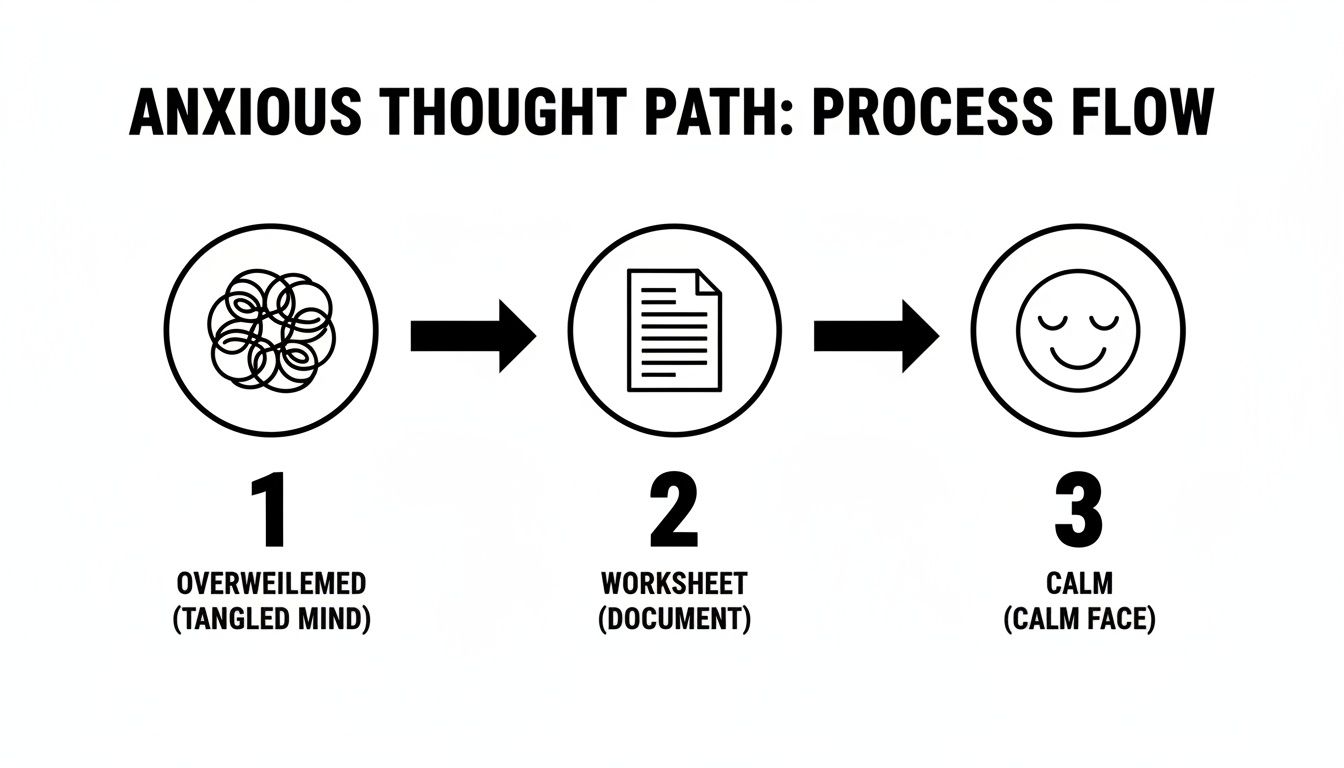
As you can see, the worksheet acts as that crucial middle step. It breaks the direct line between an anxious trigger and an emotional tailspin, giving you the space you need to breathe and think.
The Essential First Columns
To get started, you only need three columns. These initial sections are designed to capture the thought in the moment, right when it hits, preventing it from spiraling while it's still fresh. This is the foundation of your entire practice.
Go ahead and draw three columns on a page or set them up in a spreadsheet. Label them:
- Situation
- Automatic Negative Thought (ANT)
- Feelings & Intensity (0-100%)
Each column has a specific, vital role. The Situation grounds you in reality. The Automatic Negative Thought gives a name to the bully in your head. And the Feelings column connects that thought to your emotional and physical state, making its impact real and measurable. This structured approach is a core part of what makes CBT for anxiety so effective.
Column 1: Capturing the Situation
This is your starting point. In this column, you’ll jot down a brief, factual description of what was happening right before the anxiety spiked. The key here is to be an objective reporter. Stick to the who, what, when, and where.
Try to avoid emotional language or interpretation for now. For instance, instead of writing "My boss gave me a judgmental look," you would simply write, "Spoke up during the team meeting." This simple act of separating fact from feeling is the very first step toward regaining control.
Column 2: Identifying the Automatic Negative Thought (ANT)
Now we get to the heart of it. As soon as you feel that familiar spike of dread, ask yourself: “What exactly just went through my mind?” Write down the thought verbatim—exactly as it appeared, in its own words.
Don’t pretty it up. Don’t judge it or try to correct it yet. If the thought was, “I’m going to have a panic attack right here,” write that down. If it was, “They all think I’m an idiot,” capture that precise, painful phrase.
By writing down the raw, unfiltered thought, you externalize it. You move it from being an undeniable truth inside your head to just a collection of words on a page. And words on a page can be examined, questioned, and ultimately, disarmed.
Column 3: Rating Your Feelings and Intensity
Finally, let's connect the thought to your emotions. In this last column, list the main feelings the ANT sparked—anxiety, fear, shame, sadness. Next to each feeling, rate its intensity on a scale from 0% (not at all) to 100% (the most intense you can imagine).
Here’s what that looks like in practice:
- Situation: Received an email from my manager asking for a "quick chat."
- Automatic Negative Thought (ANT): "I'm in trouble. I'm going to get fired."
- Feelings & Intensity:
- Anxiety: 90%
- Fear: 95%
- Dread: 80%
This initial setup is your complete starting toolkit. With just these three columns, you’ve already accomplished something huge: you’ve stopped the spiral. You've taken an overwhelming internal experience and translated it into a structured, manageable format. This is the first, most powerful step toward showing yourself that a calmer mind isn't just a distant dream—it's something you can actively build, one thought at a time.
Putting Your Worksheet into Action with Real Examples
Alright, this is where the theory starts to feel real. You’ve got the basic structure of your worksheet down, which is a huge first step. Now for the empowering part: actively challenging the thoughts that have been holding you captive.
This is how we turn a simple piece of paper into a powerful tool for relief, right when you need it most.
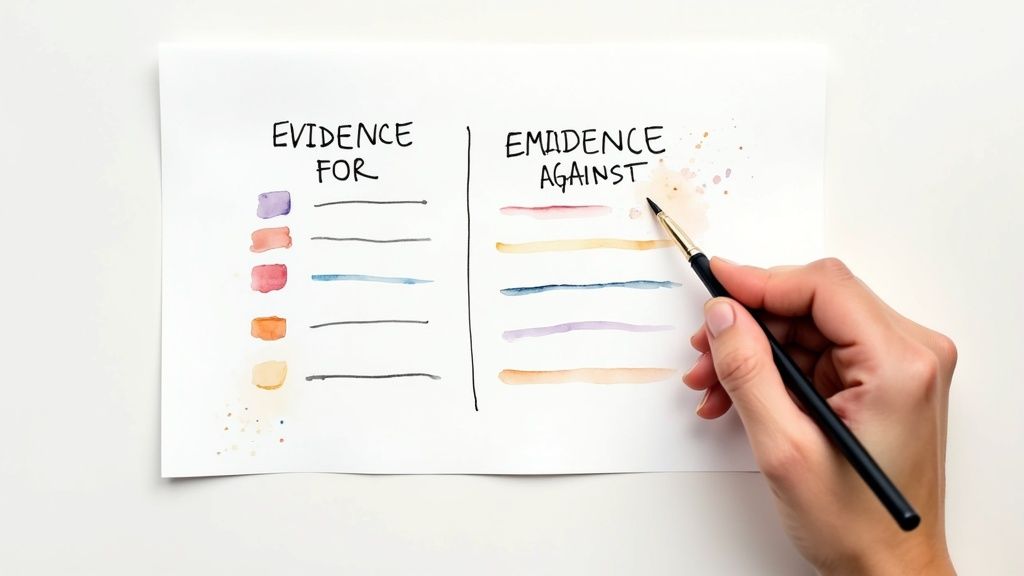
The heart of this practice comes down to two new columns we’re about to add: Evidence For and Evidence Against. Think of these as your personal detective toolkit. They help you systematically pick apart the story anxiety has been feeding you. This isn't about pretending everything’s fine; it's about separating raw emotion from objective reality to find the truth.
Unpacking a Common Anxiety Scenario
Let's walk through a scenario that fuels a lot of panic: the fear of having a panic attack in a public place. This example will show you how the worksheet evolves from a simple log into an active tool for finding a more balanced perspective.
Scenario One: The Fear of Panic at the Grocery Store
- Situation: Thinking about going to the grocery store this afternoon.
- Automatic Negative Thought (ANT): "If I go to the store, I'm going to have a panic attack and lose control. Everyone will stare at me, and I'll be trapped."
- Feelings & Intensity: Fear (90%), Dread (85%), Embarrassment (95%)
Now, let's bring in our two new columns to really challenge this thought.
The Detective Work: Evidence For and Against
This is where you put that automatic negative thought on trial. First, you'll play the prosecutor, gathering any shred of evidence that seems to support the thought. Then, you'll switch roles and become the defense attorney, meticulously searching for facts that prove it wrong.
Column 4: Evidence For the Thought
In this column, jot down anything that makes the thought feel true. Be honest here, but try to stick to facts, not just feelings.
- "I’ve felt dizzy and panicky in crowded places before."
- "My heart is already racing just thinking about it."
- "Once, I had to leave a store because I felt overwhelmed."
See how these points are rooted in past experiences and current physical sensations? They feel very real, and it’s important to acknowledge them.
Column 5: Evidence Against the Thought
This is where the magic happens. Your job is to find any piece of evidence, no matter how small, that contradicts or casts doubt on your ANT. This takes practice, so be kind to yourself.
- "The vast majority of times I've gone to the store, I did not have a full panic attack."
- "Even when I felt anxious, I was still in control of my body and was able to leave."
- "No one has ever actually stared at me or pointed me out before."
- "I have grounding techniques I can use if I start to feel overwhelmed."
- "The feeling of panic is temporary; it has always passed before."
This column is your lifeline. It's the collection of truths that anxiety tries to make you forget. By actively seeking out counter-evidence, you are strengthening the rational part of your brain and weakening the grip of fear.
Another Real-World Example
A lot of anxious thoughts are tangled up in social fears or performance anxiety. These often involve cognitive distortions, like assuming you know what others are thinking (mind-reading) or jumping to the worst possible conclusion (catastrophizing). You can get a much deeper look into these common thinking traps and learn more about identifying cognitive distortions on our site.
Let's run another common ANT through the full worksheet.
Scenario Two: The Fear of Failing at Work
- Situation: My boss pointed out a small error in my report.
- Automatic Negative Thought (ANT): "Everyone at work thinks I'm failing. I'm incompetent, and I'm going to lose my job."
- Feelings & Intensity: Shame (80%), Anxiety (90%), Hopelessness (75%)
- Evidence For:
- "My boss did find a mistake in my work."
- "I feel like my coworker has been avoiding me."
- "I've been stressed and less focused lately."
- Evidence Against:
- "My boss also praised three other sections of the report."
- "Mistakes are a normal part of any job; others make them too."
- "I received a positive performance review three months ago."
- "My coworker might just be busy with their own deadline."
- "There is no actual evidence that my job is in jeopardy."
The challenging negative thoughts worksheet isn't new, but its widespread adoption shows just how effective it is. Since being formalized in the 1980s, mental health professionals estimate that 75-85% of therapists using CBT now include some form of thought record in their treatment. With versions translated into over 30 languages, it has become a globally recognized tool for evidence-based self-help.
Walking through these examples, you can see the clear path the worksheet creates. It guides you from a place of overwhelming fear to a more centered, realistic viewpoint. This isn't about telling yourself your feelings are wrong—your fear is real. It's about showing yourself that your fearful thoughts are not always the whole truth.
Hitting a Wall? Let's Talk About the Common Roadblocks
Taking on the work of challenging your thoughts is a huge act of self-compassion. It's you telling yourself that you deserve peace of mind and you're ready to put in the effort to get there. But just like learning any new skill, it's completely normal to hit a few snags along the way.
Feeling stuck doesn't mean you're failing; it just means you're human. The path to a calmer, more centered life is rarely a straight line. Think of these challenges as signposts, not stop signs—they're just showing you where you might need a little extra attention. Recognizing them is the first step to moving forward with more confidence.
"I Can't Find Any Evidence Against This Thought!"
This is probably the most common—and most frustrating—roadblock. You're staring at the "Evidence Against" column, and your mind draws a complete blank. The negative thought feels so real, so undeniably true, that finding even one piece of evidence against it feels impossible.
This usually happens when a belief has been running on a loop in your head for years. It's like a well-worn path in your brain; your thoughts just follow it automatically. When you get stuck here, don't try to force an answer. Instead, gently shift your perspective.
Ask yourself: "What would a kind, compassionate friend say to me right now?"
Seriously, picture someone you trust and admire hearing you say this thought out loud. What would they point out? This simple trick can often unlock a point of view your anxious mind has been hiding from you.
Another tactic is to hunt for tiny exceptions. Instead of trying to blow the whole thought apart, just ask, "Has there ever been a single moment when this wasn't 100% true?" Finding that one small crack is often all you need to let a little light in.
The "I Feel Like I'm Faking It" Trap
So you've done the work. You found the evidence against your negative thought and came up with a new, more balanced alternative. But as you write it down, a cynical voice in your head sneers, "You don't really believe that. You're just going through the motions." This feeling of being an imposter in your own recovery is incredibly common.
Your old thought patterns are familiar. They might be painful, but they're comfortable. The new, balanced thought feels strange and awkward, like you’re trying on clothes that aren't your style. Of course it feels weird at first!
The goal isn't to believe the new thought with 100% conviction right away. The goal is simply to introduce it as a possibility. Think of it like a scientist with a new hypothesis. You're just testing to see if this new way of looking at things could be true, even just a little. Over time, as you keep introducing this alternative, it will start to feel less like an act and more like your own.
"I Keep Forgetting or Losing Motivation"
Life happens. When you’re already feeling overwhelmed, the last thing you want to do is pull out a worksheet. That initial burst of motivation can fade, and you might go a few days without using the tool, which then leads to guilt. This isn't a sign of weakness; it's a sign that you need to make the process easier on yourself.
To build consistency, lower the barrier to entry.
- Set a Really Low Bar: Commit to filling out just one worksheet a week. Or even just one column when a particularly strong thought hits. Small, consistent actions build momentum way more effectively than big, infrequent efforts.
- Piggyback on an Existing Habit: Do you already have a morning coffee ritual or a few quiet minutes before bed? Link your worksheet practice to something you already do automatically.
- Ground Yourself First: When a thought feels massive and overwhelming, trying to challenge it head-on is tough. Before you even touch the worksheet, use a few simple exercises to calm your nervous system. Our guide on powerful grounding techniques for anxiety can bring immediate relief, making it much easier to approach your thoughts with a clear head.
Remember, every single time you sit down with your challenging negative thoughts worksheet, you're casting a vote for a calmer future. Each small effort strengthens the rational parts of your brain and loosens the grip of fear. This is your journey, and you get to navigate it with kindness, patience, and the knowledge that a life with less panic isn't just possible—it's waiting for you.
Making This a Sustainable Part of Your Daily Routine
A single worksheet can feel like a breakthrough. It’s that moment of clarity in the middle of an anxiety storm. But the real, lasting peace comes from weaving this practice into the fabric of your daily life. This is how you shift from simply reacting to anxiety to proactively building a foundation of resilience. It's how you show yourself that a panic-free life isn't just a dream—it's an achievable reality.
The goal is to turn your challenging negative thoughts worksheet from an emergency tool into a consistent, gentle habit. Think of it like stretching in the morning or winding down before bed. It becomes a proactive part of your mental wellness toolkit, not just a reactive fix.

From Chore to Ritual
For any new habit to stick, it has to feel less like a chore and more like an act of self-care. This is about creating a small, quiet space in your day just to honor your mental health. You don't need a huge time commitment; even five dedicated minutes can make a world of difference.
Try pairing this practice with something you already do. Do you have a journaling habit? Integrating your thought record into that process can feel completely seamless. If you want to explore this idea further, the many benefits of journaling for anxiety show how powerfully these two practices can complement each other.
The idea is to find a natural home for this new habit. Maybe it’s with your morning coffee, on your lunch break, or as a final check-in before sleep.
The key is consistency, not intensity. A small, daily check-in with your thoughts is far more powerful than a frantic, hour-long session once a month. This gentle, steady practice is what rewires your brain for calm over time.
Turning Triggers into Cues
As you get more familiar with your thought patterns, you'll start noticing your personal triggers—the specific situations, feelings, or even physical sensations that tend to kick off a spiral of negative thinking. Instead of dreading them, you can learn to reframe them as helpful cues.
Think of them as gentle alarms from your mind saying, "Hey, this might be a good time to check in."
- Physical Sensation: Does a racing heart immediately make you think, "I'm having a panic attack"? Let that feeling become your cue to pull out your worksheet and investigate the thought.
- Situational Trigger: Do you get a wave of dread before a weekly team meeting? Use the five minutes before it starts to challenge the specific fears that are cropping up.
- Emotional State: When you notice a persistent feeling of irritability or sadness, see it as an invitation to explore the underlying thoughts that might be fueling it.
By transforming triggers into cues, you shift from being a passive victim of your anxiety to an active participant in your own healing. You’re taking back control, one thought at a time.
The Power of Reviewing and Celebrating
Don't just fill out your worksheets and forget about them. Your collection of completed thought records is a treasure trove of personal data. Once a week or once a month, take some time to look back over what you’ve written.
This review process serves two crucial purposes:
- Spotting Recurring Patterns: You might see that the same cognitive distortions pop up again and again, or that a specific core belief is at the root of many different anxious thoughts. This insight allows you to do deeper, more focused work.
- Celebrating Your Progress: This is the most important part. When you look at older worksheets, you'll see thoughts that used to send your anxiety soaring to 95%. You might notice that the same thought now only registers at 40%, or that you can dismiss it almost immediately.
This is tangible proof that you are changing. It's hard evidence that this work is paying off, and that provides the motivation to keep going. If you're looking to solidify this practice, various habit tracking apps can offer the structure and reminders needed to make it stick.
Integrating this worksheet into your life is an act of profound hope. It's a daily commitment to yourself—a promise that you are worthy of peace and that you have the power to create it.
Your Questions, Answered
Starting something new always brings up a few questions. That's a great sign—it means you're really digging in and taking this seriously. Let's tackle some of the most common ones so you can feel confident making this worksheet a core part of your toolkit.
How Often Should I Use the Worksheet?
There's no hard-and-fast rule here, but consistency is your best friend, especially when you're just starting out. Aim to pull it out whenever a strong, distressing thought really throws off your mood or changes your behavior. In the beginning, that might be once a day or even a few times a week as you get the hang of it.
After a while, you'll notice something amazing happens. The whole process starts to become second nature. You'll get so good at catching and questioning your thoughts that you can do it in your head, no pen and paper needed. But always keep the worksheet handy. Think of it as your go-to tool for grounding yourself during those high-stress moments when you need that extra bit of clarity.
What if I Can’t Find Any Evidence Against My Thought?
This happens to everyone, so if you hit this wall, please be kind to yourself. When a negative thought feels 100% true, trying to argue with it feels impossible. That's usually because it's been living in your head for a very, very long time.
First, try changing your point of view.
Ask yourself: "What would a kind, supportive friend say to me right now?" Or, "If someone I loved was stuck on this thought, how would I help them see it differently?"
Another great tactic is to hunt for tiny exceptions. Has there ever been a single moment in your life when this thought wasn't completely, totally true? Just finding one small crack in its armor is a huge win.
And if you’re still stuck? That’s okay. The simple act of writing the thought down is a massive step. It creates distance. You can always come back to that page later with fresh eyes.
Is This a Replacement for Professional Therapy?
While this worksheet is a powerful tool built on proven therapeutic techniques, it is not a substitute for therapy. It’s most effective when used to support professional care or as a method for personal growth and self-discovery.
If you're dealing with severe anxiety, panic, depression, or trauma, working with a qualified therapist is the best path forward. A professional can provide personalized guidance and help you safely explore the deeper roots of your thoughts.
Think of this worksheet as a fantastic co-pilot on your journey—a practical, hands-on way to apply what you're learning and take an active role in your own healing.
At The Anxiety Checklist, we believe you deserve to feel in control of your own mind. Our Fearless Living system is designed to be a complete, actionable toolkit to break free from anxiety's grip. It combines our comprehensive eBook with the interactive 93-point Anxiety Checklist, creating a clear path toward lasting calm and confidence.
Start your journey to fearless living with The Anxiety Checklist today!