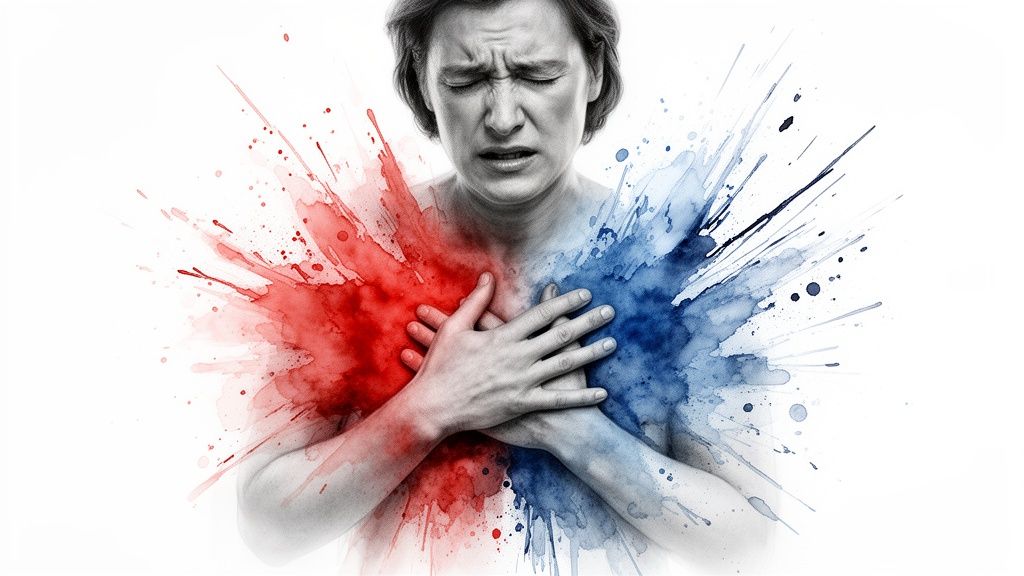
It starts with a sudden, sharp pain in your chest. Instantly, your mind leaps to the worst possible conclusion.
This terrifying sensation is a hallmark of chest pain caused by anxiety—a very real, physical response to psychological distress. If this has happened to you, know you're not alone. More importantly, there's a clear path forward to understanding what's happening and taking back control. A life free from this panic is not just possible; it's within your reach.
The Moment Your Body Betrays You With Chest Pain
It’s a terrifying moment that sends a jolt of pure fear through you. One second you’re fine, and the next, a gripping, stabbing pain in your chest makes your heart pound and your thoughts spiral.
Is it a heart attack? Am I dying? This guide is for anyone who has felt this overwhelming fear, and it's here to show you that there is a hopeful path forward.
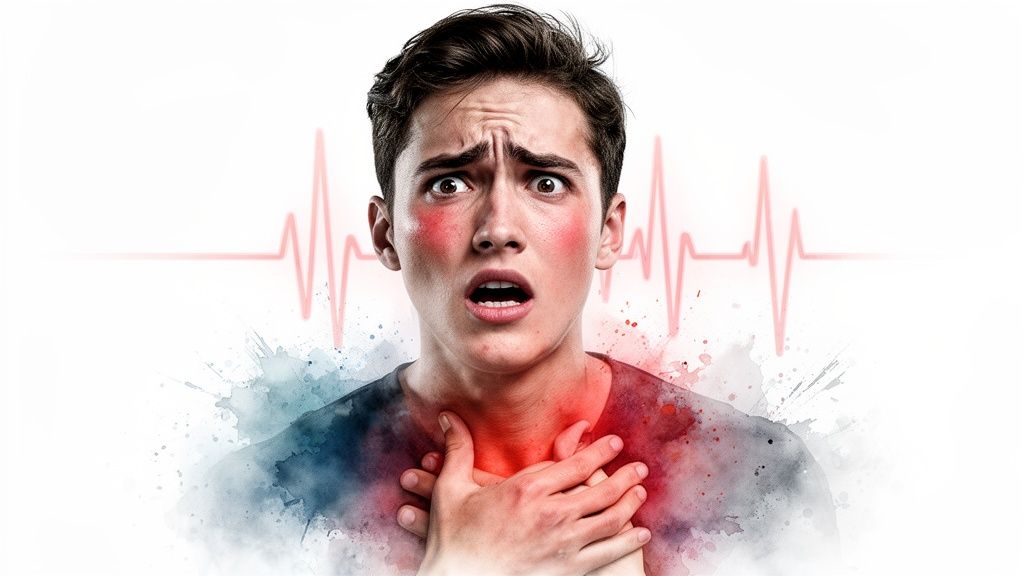
This experience is far more common than you might think. Imagine rushing to the emergency room, convinced you're having a heart attack, only for a doctor to tell you it's "just" anxiety.
This exact scenario plays out constantly with what's known as non-cardiac chest pain (NCCP), where the discomfort stems from psychological factors, not a heart problem. In fact, some studies show NCCP is behind as many as 70% of ER visits for chest pain. Data from multiple countries estimates it affects between 20% and 40% of all patients reporting chest pain. You can find more insights on the prevalence of NCCP and its deep connection to anxiety.
Understanding the Anxiety-Pain Cycle
The connection between your mind and body is incredibly powerful. When you feel anxious, your brain hits the panic button, triggering the "fight or flight" response and flooding your system with stress hormones.
This response is designed for survival, but when it’s activated by psychological stress instead of a physical threat, it can cause some very real and frightening physical symptoms.
This includes things like:
- A Racing Heart: Your heart kicks into high gear to pump blood faster, preparing you to face danger.
- Shallow Breathing: You might start breathing quickly (hyperventilating) or even holding your breath without realizing it.
- Tense Muscles: The muscles in your chest wall can tighten up like a vise.
This cascade of physical reactions is what creates the sensation of anxiety chest pain. It feels just as real as pain from an injury because, physiologically, your body is in a state of alarm.
The most crucial thing to understand is that your pain is valid. It's not "all in your head." It's a genuine physical sensation created by your body's natural, albeit overactive, response to what it perceives as danger.
Recognizing this link is the first step toward reclaiming your sense of safety and control. By understanding what's happening inside your body, you can begin to untangle the fear and start on a path to lasting peace. This journey isn't about ignoring the pain, but about learning its source and building the tools to manage it effectively.
Why Your Mind Can Create Real Physical Pain
It’s easy to hear "it's just anxiety" and feel dismissed, as if the pain isn't real. But let's be clear: the chest pain you're feeling is 100% real. Your mind isn't just inventing a sensation out of thin air; it's triggering a genuine, powerful physical response in your body. This isn't some strange mystery—it’s the direct result of your body's built-in survival system doing its job a little too well.
When your brain perceives a threat—whether that’s a real danger like a speeding car or an imagined one like a "what if" thought—it flips the switch on the fight-or-flight response. This ancient, hardwired mechanism is designed to prime your body for immediate, life-saving action.
Think of it like a smoke detector. Its purpose is to protect you, and it's incredibly sensitive. But sometimes, it blares just because you burnt a piece of toast. The alarm is real, the sound is jarring, and your heart leaps into your throat—but the danger isn't what it seems. That’s precisely how your body’s alarm system functions when anxiety is the trigger.
The Science Behind the Sensation
The second your brain sounds that alarm, it unleashes a cocktail of stress hormones, mostly adrenaline and cortisol. These chemicals are pure survival fuel, creating dramatic and instantaneous changes throughout your system.
Adrenaline, for example, immediately cranks your cardiovascular system into high gear.
- Your heart starts pounding: It beats faster and more forcefully to pump oxygen-rich blood to your arms and legs, getting you ready to either fight off a threat or run from it.
- Your breathing gets fast and shallow: This is your body's attempt to suck in more oxygen, fast. This rapid breathing, also known as hyperventilation, can throw off the carbon dioxide levels in your blood, leading to dizziness, lightheadedness, and even muscle spasms.
- Your muscles clench up: The muscles across your chest, back, and shoulders tighten like a protective shield. This constant tension is a major source of pain, causing everything from sharp, stabbing sensations to a persistent, dull ache.
These physiological shifts happen in a matter of seconds and are the direct cause of chest pain anxiety. That racing heart can feel like scary palpitations, and those constricted muscles can create a crushing feeling that is, understandably, terrifying. The link between your thoughts and physical symptoms is cemented by stress hormones; understanding what high cortisol means for your body helps explain why anxiety feels so intensely physical.
Connecting Your Pain to Your Body's Response
The specific type of pain you feel almost always ties directly back to these fight-or-flight reactions. Each sensation, while frightening, has a logical, biological explanation that has nothing to do with your heart failing.
Here’s the most important thing to grasp: The pain is a real physical event caused by a misfiring alarm system. Your body is doing exactly what it's built to do to keep you safe—it's just reacting to the wrong signal.
Simply understanding this mind-body connection is a huge first step toward feeling better. It validates that what you’re experiencing is real while demystifying the terrifying sensations. Once you learn that the pain is a symptom of anxiety—not a sign of a heart attack—you can start shifting your focus from fear to management.
You're not broken, and you're not imagining things. You're just experiencing a powerful, natural response that has gone into overdrive. The path forward isn't about ignoring the pain; it's about learning how to gently turn down the volume on the alarm system that creates it. If you want to go deeper, you can learn more about the fight-or-flight response in our detailed guide. With this knowledge, you can begin building the tools to live a life where you are in control, not your panic.
How to Tell the Difference Between Anxiety and a Heart Attack
In the middle of a panic attack, your mind often jumps to one terrifying question: "Am I having a heart attack?"
That single thought is like gasoline on the fire of fear. It can turn an already overwhelming moment into a genuine belief that your life is in danger. This is why learning to spot the differences between the physical sensations of anxiety and the true red flags of a cardiac event is such a powerful step toward healing.
Having this clarity can help you respond the right way when you're in crisis. But it comes with one non-negotiable rule: when in doubt, always seek immediate medical help.
Think of this information as a guide to build your understanding, not as a substitute for a professional diagnosis. Your safety is always priority number one.
Key Differences in Pain and Sensation
Even though they can feel terrifyingly similar, there are often subtle but important differences in how chest pain from anxiety presents versus pain from a heart attack. Paying close attention to these details can offer important clues.
For many people, anxiety-related chest pain feels like this:
- Sharp, stabbing, or twitching: It might feel like a quick, localized jab rather than a deep, crushing sensation that spreads.
- Localized: The pain often stays in one specific spot and doesn't radiate out to other parts of your body, like your arm or jaw.
- Brief and fleeting: The most intense pain may only last a few minutes, usually peaking and fading within 10-20 minutes as the panic subsides.
- Worsened by focus: The more you zero in on the pain and worry about it, the more intense it can actually feel.
On the other hand, cardiac chest pain often has a different signature:
- Dull pressure, squeezing, or fullness: People frequently describe it as feeling like an elephant is sitting on their chest.
- Radiating pain: The discomfort often begins in the center of the chest but can spread to the jaw, neck, shoulders, back, or down one or both arms (especially the left).
- Persistent and escalating: This pain typically lasts longer than a few minutes and may get worse with physical activity.
- Accompanied by other symptoms: Shortness of breath, cold sweats, nausea, and lightheadedness are very common partners to cardiac pain.
Anxiety Chest Pain vs Heart Attack Symptoms: A Quick Guide
This table breaks down the typical characteristics of chest pain caused by anxiety versus a potential heart attack. Remember, this is just a guide. Always seek emergency medical help if you are ever unsure.
| Symptom Feature | Typical in Anxiety-Related Chest Pain | Potential Red Flag for a Heart Attack |
|---|---|---|
| Pain Quality | Sharp, stabbing, or like a muscle twitch. | Squeezing, heavy pressure, or a feeling of fullness. |
| Pain Location | Stays in one specific, localized spot in the chest. | Starts in the center of the chest and may radiate to the jaw, neck, back, or arms. |
| Duration | Lasts for a short time, often peaking and fading within 10-20 minutes. | Persistent; lasts longer than a few minutes and may get worse over time. |
| Triggers | Often occurs at rest, triggered by stress or anxious thoughts. | Frequently triggered by physical exertion, but can also happen at rest. |
| Other Symptoms | Accompanied by other anxiety symptoms like racing thoughts, fear of dying, or trembling. | Often accompanied by shortness of breath, cold sweats, nausea, and dizziness. |
Ultimately, your body is the only one you have. It's always better to be safe and get checked out than to risk guessing wrong.
Understanding the Mind-Body Pathway
The pain you feel during a panic attack isn't "all in your head"—it's a very real physiological response. This infographic shows exactly how an anxiety trigger can set off a powerful chain reaction in your body.
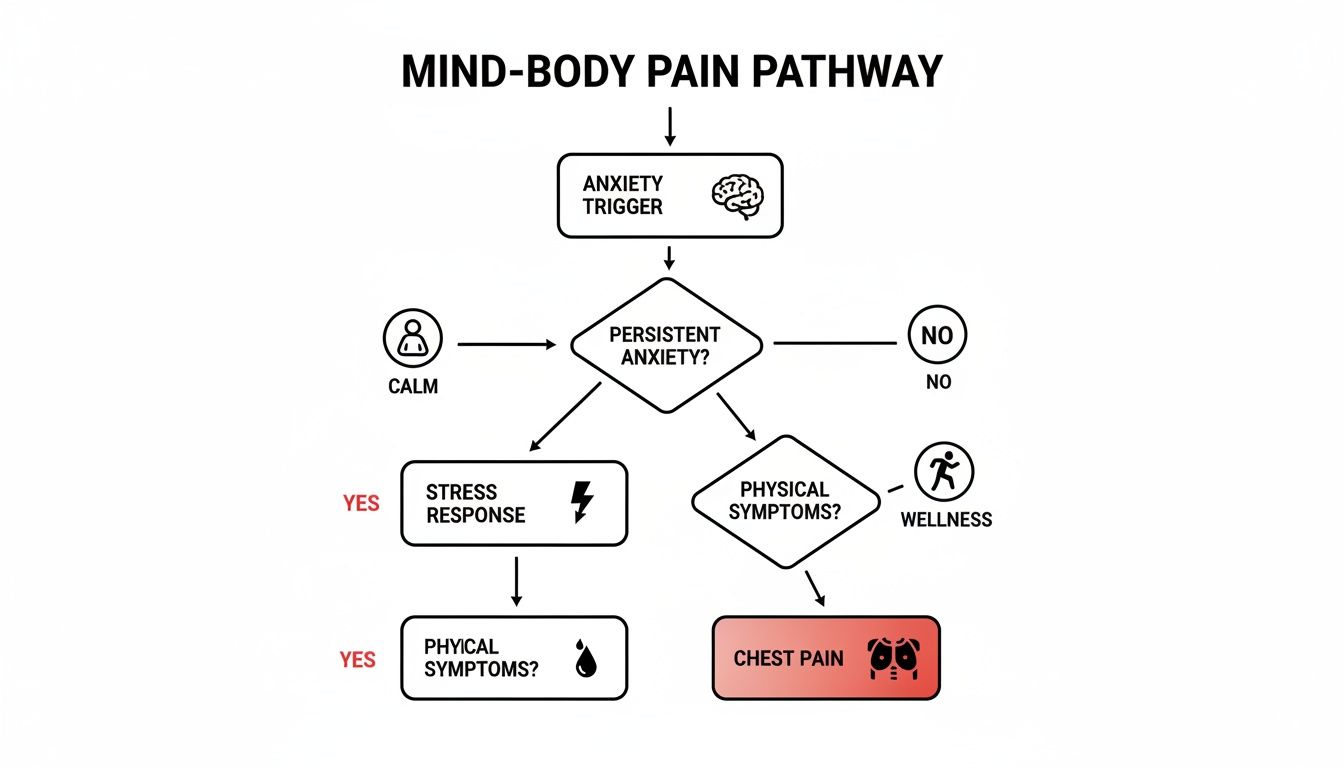
As you can see, a simple thought or an external trigger can flick on your stress response, flooding your system with adrenaline and causing the very real chest tightness and pain you experience.
This feeling sends millions of people into a spiral of fear each year. Research shows that about 28.5% of people who suffer from panic attacks experience this terrifying chest pain, which dramatically amplifies their fear. In the United States, 27.3% of people will face a panic attack at some point in their lives, and anxiety disorders are a global issue, affecting an estimated 359 million people worldwide in 2021. You can discover more insights about these statistics on MedicalNewsToday.com.
Important Takeaway: This knowledge is a tool, not a diagnostic instrument. Its purpose is to help you build awareness and reduce fear, empowering you to manage your anxiety more effectively. It is not meant to replace a doctor’s evaluation.
Hope on the Horizon: A Panic-Free Life Is Possible
Understanding these differences is more than just an academic exercise. It's a foundational step toward freedom.
Every time you recognize that your chest pain is linked to your anxiety, you weaken the power of panic. You begin to sever the automatic connection between that physical feeling and the catastrophic thought that follows.
This process takes time and practice, but it's the start of a new relationship with your body—one built on understanding, not fear. It opens the door to a life where a random muscle twitch doesn't have to send you into a full-blown crisis. A life where you feel in control, confident, and, most importantly, safe in your own body.
If you are struggling, please remember that support is available. Check out our guide on how to handle a panic attack for more immediate strategies.
Calming the Storm: Immediate Relief Techniques
When anxiety-induced chest pain suddenly takes hold, it feels like being thrown into a violent storm without an anchor. Your heart pounds, your thoughts spiral, and the physical sensations are completely overwhelming. In these moments, you need a practical, immediate way to calm the waves and find solid ground.
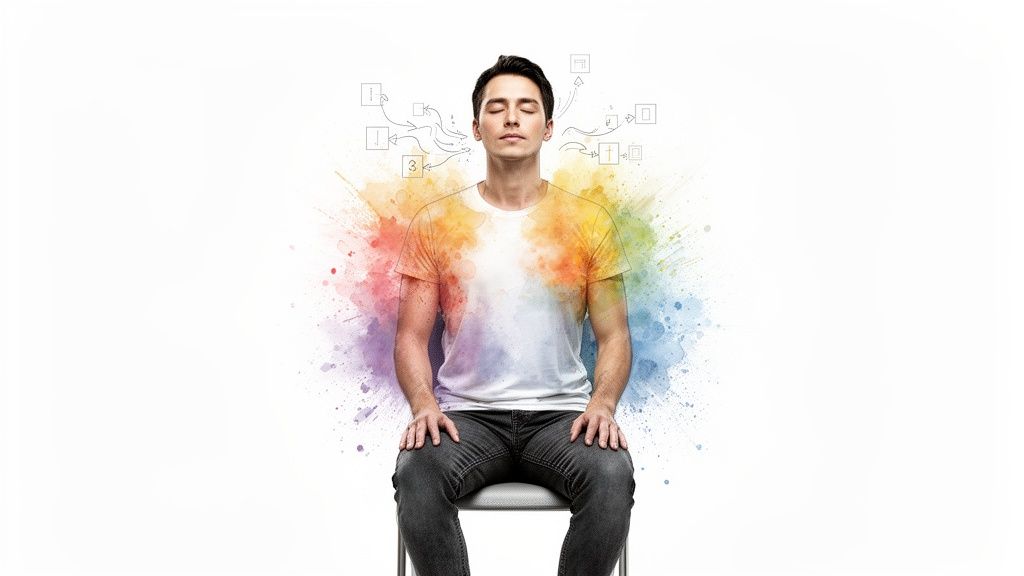
Think of this as your first-aid kit for regaining control. These aren't just simple distractions; they are powerful methods for communicating directly with your nervous system, telling it that you are safe. Each one is simple, easy to learn, and can be used absolutely anywhere to interrupt the cycle of panic and find fast-acting relief.
Reconnect with the Present Moment
Anxiety chest pain thrives when your mind gets lost in a catastrophic future. The fastest way to break its hold is to pull your focus back to the immediate, tangible world right in front of you. This is where grounding techniques are incredibly effective.
One of the most trusted methods is the 5-4-3-2-1 exercise. It works by forcing your brain to shift its attention from internal fear to external sensory input.
Here’s how you do it:
- Acknowledge 5 things you can see: Look around and name five objects. Notice their color, shape, and texture without judging them.
- Acknowledge 4 things you can feel: Bring your awareness to physical sensations. This could be the feeling of your feet flat on the floor, the fabric of your clothes against your skin, or the temperature of the air.
- Acknowledge 3 things you can hear: Listen for three distinct sounds. It might be the hum of your computer, distant traffic, or even just your own breathing.
- Acknowledge 2 things you can smell: Try to identify two scents in the air, whether they're pleasant or just neutral.
- Acknowledge 1 thing you can taste: Focus on the taste in your mouth. You could also take a small sip of water or pop in a piece of gum to create a new sensation.
By the time you finish this simple exercise, you’ve successfully anchored yourself back in the present, interrupting the panic and dialing down the intensity of the physical symptoms.
Master Your Breath to Master Your Body
During an anxiety attack, your breathing becomes fast and shallow, which is a direct cause of that awful tightness in your chest. By consciously changing your breathing pattern, you can send a powerful signal of safety straight to your brain.
Controlled breathing is one of the most direct ways to switch off your body's "fight-or-flight" response and activate your "rest-and-digest" system. It tells your body the danger has passed, allowing your heart rate to slow and your muscles to relax.
A simple yet profound technique is Box Breathing. It’s easy to remember, even when you're feeling distressed:
- Step 1: Inhale slowly through your nose for a count of four.
- Step 2: Hold your breath for a count of four.
- Step 3: Exhale slowly through your mouth for a count of four.
- Step 4: Hold your breath again for a count of four.
Repeat this cycle for a few minutes. This steady, rhythmic pattern helps regulate the oxygen and carbon dioxide levels in your blood, calming your nervous system and easing the chest pain caused by hyperventilation. To explore more ways to use your breath as a tool for calm, check out our guide on breathing exercises for anxiety.
Release Physical Tension
Anxiety causes the muscles in your chest to clench up like a fist. You can fight back with simple physical actions that help release this tension and provide immediate relief from the pain.
Gentle stretches can work wonders. Try slowly raising your arms over your head, clasping your hands, and gently arching your back to open up your chest. Another great one is to stand in a doorway, place your hands on the frame, and gently lean forward until you feel a light stretch across your pectoral muscles.
These techniques are more than just coping mechanisms; they are the first steps on the path to healing. Each time you use one successfully, you are rewriting your relationship with anxiety. You are proving to yourself that you have the power to calm the storm, reinforcing the hopeful truth that you can heal and live a life free from panic.
Your Long-Term Strategy for a Panic-Free Life
The immediate calming techniques are your anchor in a storm. But real freedom from chest pain anxiety comes from building a life where those storms are less frequent and far less powerful. This is where you shift from just coping with crises to creating lasting change. It's about gently getting to the roots of your anxiety, not just trimming the branches every time they grow back.
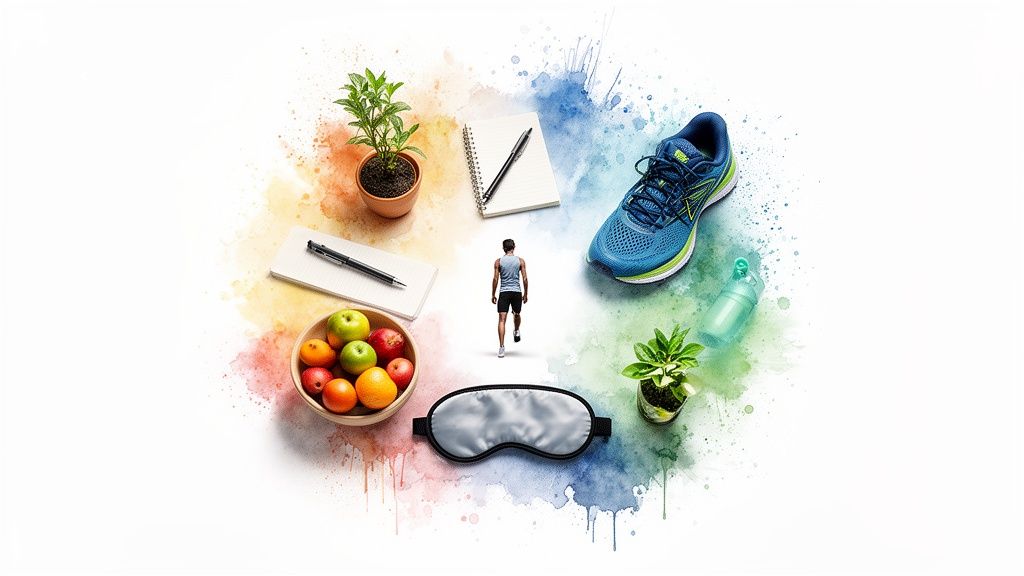
Think of it as building a personalized toolkit for sustainable healing. It involves understanding your unique triggers, learning to challenge the fearful thought patterns that fuel panic, and making simple but powerful adjustments to your lifestyle. This isn't a quick fix; it's a solid plan for systematically reducing anxiety's hold on your life and building a future where you feel confident and in control.
Identify Your Personal Triggers
The first move toward dismantling your anxiety is to figure out what sets it off in the first place. Triggers are like the sparks that ignite the fire of panic. Sometimes they’re external, like a stressful meeting at work. Other times, they're internal, like a sudden muscle twitch in your chest that your mind latches onto.
Becoming a detective in your own life is a total game-changer. Start simple by keeping a journal or just using the notes app on your phone.
When you feel that wave of anxiety or chest pain coming on, jot down a few key details:
- What was I doing? (e.g., driving on the highway, scrolling through social media)
- What was I thinking? (e.g., "I'm going to be late," "What if this pain is serious?")
- How did my body feel? (e.g., heart racing, feeling hot, chest getting tight)
- What time of day was it? (e.g., late at night, first thing in the morning)
Over time, you'll start to see patterns emerge from the noise. Maybe your anxiety spikes after too much caffeine or when you're running on fumes from poor sleep. Recognizing these patterns is the first real step toward taking their power away.
Challenge Fearful Thought Patterns
Anxiety is often fueled by a runaway loop of negative, catastrophic thoughts. You feel a twinge in your chest, and your mind instantly jumps to the worst-possible-case scenario. That thought creates more fear, which, in turn, makes the physical sensations even stronger. It’s a vicious cycle. Learning to interrupt and question these thoughts is a core skill for long-term healing.
This process isn't about pretending the fear isn't real. It's about questioning its validity and gently guiding your mind toward a more balanced, realistic perspective. You're teaching your brain that it doesn't have to believe every scary thought it produces.
This is the central idea behind Cognitive Behavioral Therapy (CBT), one of the most effective methods out there for treating anxiety disorders. It teaches you to catch, check, and change the thought patterns that keep you stuck. For a deeper dive, you can learn more by understanding CBT for anxiety in our detailed guide.
Build Resilience with Simple Lifestyle Adjustments
Your mental health is deeply connected to your physical health. Making small, consistent changes in your daily routines can build a strong foundation of resilience that makes you far less vulnerable to anxiety's tricks.
Focus on these key areas—they really work:
- Prioritize Sleep: Seriously. Aim for 7-9 hours of quality sleep a night. A well-rested brain is far less likely to get hijacked by anxiety.
- Move Your Body: Regular physical activity is one of the most powerful anti-anxiety tools we have. Even a 20-minute walk can release feel-good endorphins and dial down stress hormones.
- Nourish Your Mind: Start paying attention to how certain foods make you feel. Limiting caffeine, processed sugars, and alcohol can have a surprisingly big impact on your anxiety levels.
- Practice Mindfulness: Just a few minutes of daily meditation or deep breathing can train your brain to stay grounded in the present moment, rather than getting lost in a spiral of "what-if" scenarios.
Taking control of your well-being is a worldwide concern. In 2021, the global prevalence of anxiety reached a staggering 138.3 million people. While getting treatment remains a challenge—with only about 27.6% of individuals receiving care—structured, self-guided tools can help bridge this gap. This is where a system like The Anxiety Checklist shines. It offers a clear path for busy professionals and families to demystify chest pain, build support, and curb panic with practical, evidence-based strategies. You're not just managing symptoms; you're building a life defined by peace, not panic.
Taking Your First Step Toward Fearless Living
So, there you have it. You’ve seen just how tangled the wires between your mind and body can get. You now get why a wave of anxiety can trigger very real, very frightening chest pain. More importantly, you know how to tell the difference between anxiety and something more serious, and you have a game plan for immediate relief and long-term peace.
This isn't just trivia for your next doctor's visit. It’s the groundwork for real, lasting hope.
The big takeaway is as simple as it is life-changing: you are not broken, and this is not a life sentence.
The fear is real, I get it. But it doesn't have to be the one in charge. Just by understanding the nuts and bolts of what happens during chest pain anxiety, you've already done the hardest part. You’ve started to demystify the very thing that felt so powerful and terrifying.
From Fear to Empowerment
This whole journey is about flipping the script—from being scared and reactive to feeling empowered and in control. Every single time you use a breathing technique to slow your racing heart or you challenge one of those runaway "what if" thoughts, you're literally rewiring your brain. You're teaching your nervous system that you are safe.
The goal isn't to get rid of anxiety forever. That’s not realistic. It's about building a life where anxiety isn't calling the shots anymore. It’s about getting back to a place where your mind and body feel like they're on the same team again.
Think of this as your invitation to keep going. You've got the tools and the knowledge now to build a future that's defined by peace, not by panic. To see what comes next on this path, check out our guide on the essential anxiety recovery steps you can start taking today. Every small step builds momentum, and before you know it, you're living a bigger, braver life.
Your Questions Answered
When you're dealing with something as scary as chest pain anxiety, it’s natural to have lingering questions, even after you understand the basics. Let's tackle some of the most common concerns head-on to give you clarity and confidence.
Can Anxiety Really Cause Chest Pain Every Day?
Yes, it absolutely can. When you're living with chronic, persistent anxiety, your body can get stuck in a high-alert state. Think of it like a muscle that’s always tensed, never quite getting the chance to relax. This constant tension in your chest wall can easily lead to daily aches and pains.
This doesn't mean you're having a full-blown panic attack every day. It’s more subtle. Your baseline stress level is just high enough to keep those physical symptoms simmering. The only way to turn down the heat is by consistently using strategies to manage the root anxiety.
What’s the Best Way to Handle Anxiety Chest Pain?
The most effective game plan is a two-part strategy: one for the immediate crisis and one for the long haul.
- In the moment: Your first job is to calm your nervous system. Grounding techniques, controlled breathing (like box breathing), and even some gentle stretches can work wonders to release that muscle tightness.
- For long-term relief: This is where the real change happens. You need to focus on lowering your overall anxiety. That means regular exercise, mindfulness practices, figuring out your personal triggers, and learning to challenge the fearful thoughts that fuel the fire. Methods like Cognitive Behavioral Therapy (CBT) are fantastic for this.
Ultimately, you’re not just treating the pain; you’re managing the anxiety that causes it. When the anxiety subsides, the physical symptoms follow.
What if the Pain is on the Left Side?
It’s completely normal for anxiety-related chest pain to show up on the left side. Honestly, this is one of the main reasons it’s so often mistaken for a heart attack, which just amps up the fear.
The sensation is almost always muscular. When you're stressed, the pectoral muscles (your chest muscles) and the intercostal muscles (between your ribs) tighten up. While it feels incredibly alarming, left-sided pain from anxiety isn't a sign that your heart is in trouble.
But because the location is so sensitive, getting a medical check-up is always the smartest move. It's the only way to rule out other causes and give yourself the peace of mind you truly deserve.
Hope is not just a feeling; it's a strategy. Believing in your ability to heal is the first and most critical step. Recovery from anxiety is not about becoming a person who never feels fear, but about becoming someone who is no longer controlled by it.
A life without panic isn't a fantasy—it's entirely possible. It's a journey of understanding your body's signals, retraining your brain's responses, and consistently using the right tools. Every time you successfully navigate a moment of panic, you're building resilience. With patience and a solid strategy, you can shift from a life dictated by fear to one defined by freedom.
Your journey to a calmer, more confident life starts now. The Anxiety Checklist provides a structured, actionable system to help you understand your anxiety, manage panic, and build a toolkit for lasting peace. Take the first step toward fearless living and discover how you can regain control. Find your personalized path to wellness at https://anxietychecklist.com.