
Yes, anxiety can absolutely cause real, physical chest pain.
It’s a frightening sensation that often sends your mind racing to the worst-case scenario, but it is a very common physical symptom of anxiety and panic. The good news? Understanding why it happens is the first step toward regaining control and finding lasting relief. This guide is designed to give you hope and show you the path toward a life free from panic.
Your Path From Fear to Freedom Starts Here

If you've ever felt a sudden tightness or sharp pain in your chest during a moment of stress, you are not alone. It's a terrifying experience that can make you feel powerless, convinced something is terribly wrong with your heart.
The goal of this guide is to give you hope and clarity. We want to validate your experience—the pain is real, not imagined—and show you that there is a logical reason for it. More importantly, we want to show you that a life free from this fear is not just possible; it's achievable. You can heal from anxiety and live a full, confident life.
Understanding the Mind-Body Connection
The connection between your mind and body is incredibly powerful. When your brain perceives a threat—whether it's a real danger or an anxious thought—it triggers a primal defense mechanism known as the fight-or-flight response.
This reaction floods your body with adrenaline and other stress hormones, preparing you to face the challenge. Think of it as a hyper-sensitive internal alarm system. To learn more about its mechanics, you can explore our detailed fight-or-flight response guide.
This response causes several physical changes that directly contribute to that feeling of chest discomfort:
- Muscle Tension: Your pectoral muscles and the intercostal muscles between your ribs tighten up instantly.
- Increased Heart Rate: Your heart begins to pound faster and harder to pump more blood to your limbs.
- Shallow Breathing: Your breathing pattern shifts, becoming quick and shallow (hyperventilation).
This combination of muscle clenching, a racing heart, and rapid breathing creates the very real sensation of pain, pressure, or tightness in your chest. Acknowledging that anxiety is the trigger, not a cardiac event, is the first powerful step toward healing.
This symptom is particularly common during panic attacks. In fact, research shows that about 28.5% of people experiencing a panic attack report chest pain, making it one of the most distressing features.
Why Your Anxious Mind Creates Real Physical Pain
Ever felt a sharp, scary pain in your chest during a moment of high stress and wondered what on earth was going on? It's confusing and, frankly, terrifying. But that connection between your mind and your body isn't imaginary—it's a direct, hardwired response from your body's built-in survival system.
Once you understand the logical, science-backed reasons this happens, the pain starts to lose its power over you. This knowledge is a cornerstone of recovery, giving you the power to see the symptom for what it is.
Think of your nervous system like a highly sensitive alarm system. When you're calm, it's quiet. But the second your brain senses danger—whether it’s a real threat or an anxious thought—it hits the panic button.
This floods your body with stress hormones like adrenaline, which are designed to get you ready for immediate action. Those hormones are responsible for the very real, very physical sensations you feel, creating what we know as anxiety chest pain.
The Three Main Culprits Behind Anxiety Chest Pain
This hormonal surge creates a perfect storm for chest discomfort through three main physical reactions. Each one plays a part in the tightness, sharpness, or strange pressure you might feel.
- Intense Muscle Tension: Adrenaline makes your muscles contract instantly, preparing you to either fight or run. This includes the large pectoral muscles across your chest and the smaller intercostal muscles between your ribs. When they tighten up, it can cause soreness, spasms, and even sharp, stabbing pains.
- Rapid Heart Rate: Your heart kicks into high gear, beating faster and harder to pump more oxygen to your limbs. While this is totally harmless, the feeling of your heart pounding (palpitations) can feel like a heavy, uncomfortable thudding in your chest, adding to the fear that something is seriously wrong.
- Shallow "Panic" Breathing: Anxiety almost always changes your breathing. You shift from deep, calm belly breaths to quick, shallow breaths from the top of your chest. This pattern, known as hyperventilation, not only strains your chest muscles but can also cause air to get trapped in your esophagus, creating a feeling of pressure or fullness.
The moment you realize your pain comes from these predictable biological reactions, you can start to see it differently. It's not a sign of a failing heart; it's a sign of a highly effective—but overly sensitive—protection system.
This insight is the first real step toward getting better. It shifts your focus from fearing the symptom itself to addressing what’s actually causing it: the anxious thought patterns that are keeping your internal alarm system on high alert.
When you learn to manage those thoughts, you can calm your nervous system, and in turn, calm your body. If you want to dive deeper into this connection, our article on overthinking and anxiety offers some powerful strategies.
There's real hope here. If an anxious mind can create pain, a calm mind can create peace. Healing isn't just possible—it's the natural outcome of learning to work with your body instead of against it.
Anxiety Chest Pain vs. a Heart Attack: How to Spot Key Differences
When chest pain hits, your mind instantly leaps to the scariest possible conclusion: "Am I having a heart attack?"
That fear is completely normal and understandable. But arming yourself with knowledge is the single best way to dial down that immediate terror and start regaining a sense of control.
While they can feel frighteningly similar, there are often distinct characteristics that help differentiate between chest pain caused by anxiety and a true cardiac event. Knowing these isn't about self-diagnosing—it's about short-circuiting the panic that can make the physical symptoms feel so much worse.
The Telltale Signs: Decoding the Pain
Let's break down the typical patterns. Understanding how anxiety-related pain usually behaves can bring a wave of relief when you're in the thick of it.
- Sensation and Location: Anxiety chest pain often feels sharp, stabbing, or like a quick muscle twitch. You can usually point to a specific spot, and it might even feel like it's moving around.
- Duration: The intense, sharp pain from a panic attack is usually fleeting. It tends to peak within 10 minutes before it starts to fade, though a dull, lingering ache can sometimes stick around for a bit.
- Triggers: This one is key. Anxiety pain is almost always tied to your emotional state. It can pop up out of nowhere during a period of high stress or a full-blown panic attack and often starts to ease up as you begin to calm down.
Cardiac pain, on the other hand, usually has a different signature. It's more often described as a heavy, crushing pressure—like an elephant is sitting on your chest. This pain is typically more widespread and can radiate to your left arm, jaw, neck, or back.
The infographic below shows a simple flowchart of how a stressed-out mind can trigger a real hormone surge, leading to very real physical pain.
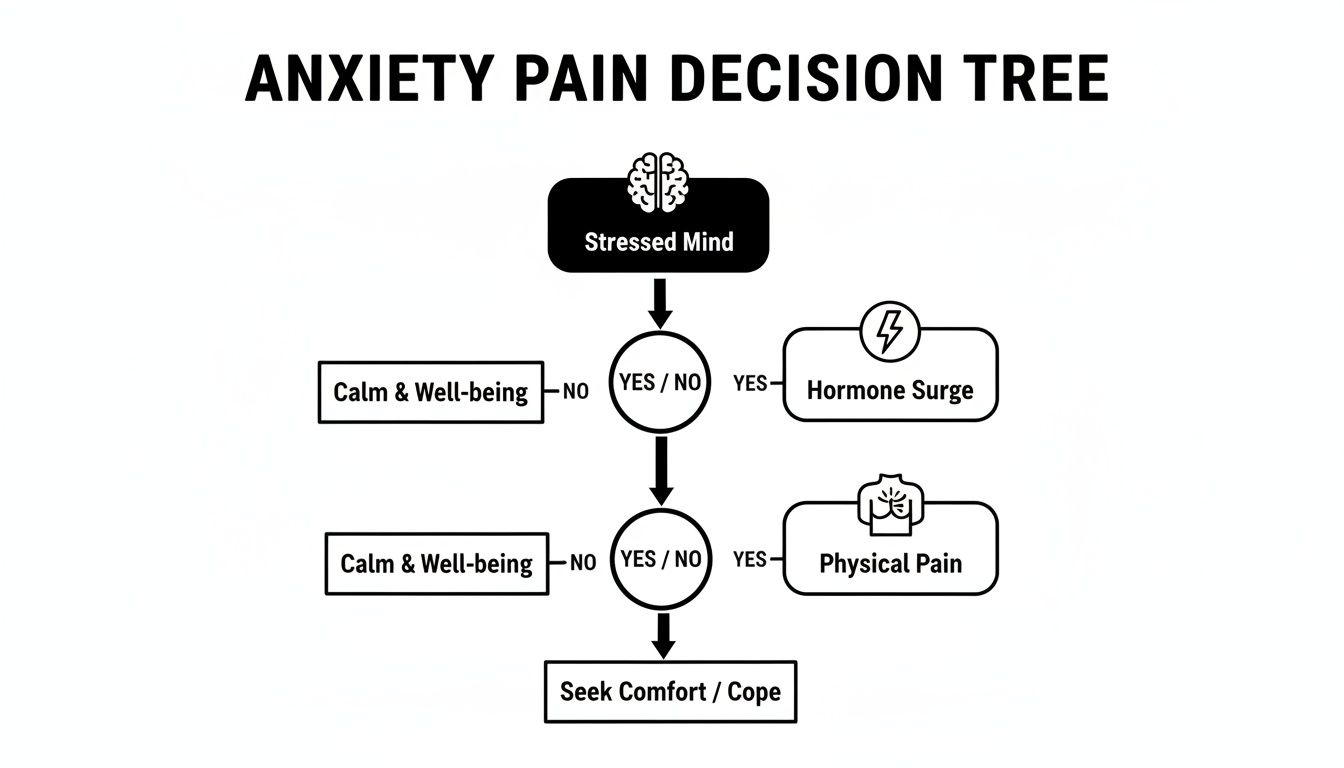
This visual reinforces a crucial point: the pain is real, but its origin is your body's natural (though overactive) stress response, not a failing heart.
Comparing Chest Pain From Anxiety vs Cardiac Issues
This table offers a side-by-side look at the common characteristics of chest pain from anxiety versus symptoms that might signal a heart attack.
| Symptom Characteristic | Typical of Anxiety Chest Pain | Typical of Cardiac Chest Pain |
|---|---|---|
| Sensation | Sharp, stabbing, twitching, or a dull ache. | Crushing pressure, squeezing, heaviness, or burning. |
| Location | Often localized to one spot, may move around. | Centered or left-of-center; can radiate to the arm, jaw, or back. |
| Onset | Sudden, often during a period of stress or a panic attack. | Can be sudden or build gradually; often linked to exertion. |
| Duration | Usually brief, peaks within 10 minutes, may linger as an ache. | Persistent, lasting more than a few minutes; doesn't improve with rest. |
| Response to Calm | Pain often lessens as anxiety or panic subsides. | Pain is not affected by changes in emotional state. |
| Other Symptoms | Often accompanied by racing heart, hyperventilation, dizziness, tingling. | Often accompanied by sweating, shortness of breath, nausea, lightheadedness. |
Remember, this comparison is for informational purposes only. When it comes to chest pain, the only rule that matters is "better safe than sorry."
The Vicious Cycle of "Heart Anxiety"
The link between anxiety and chest pain is so common it has a name: non-cardiac chest pain (NCCP).
For people who get recurring chest pain but have perfectly healthy hearts, anxiety is a massive factor. Research shows that 30-50% of these individuals meet the full criteria for panic disorder.
This creates a brutal cycle: anxiety causes chest pain, which leads to terrifying ER visits. When the tests come back clear, the lingering fear and confusion can actually make the underlying anxiety worse. You're left thinking, "If it's not my heart, what is wrong with me?" This is a cycle you can break.
The Unbreakable Rule: When in Doubt, Get Checked Out.
This guide is for educational purposes only. If you have any doubt about the cause of your chest pain—especially if it is severe, persistent, or accompanied by symptoms like shortness of breath, sweating, or pain radiating to your arm or jaw—do not hesitate. Seek immediate medical attention.
To get a definitive diagnosis and the peace of mind you deserve, it's always best to consult an online doctor or see a professional in person. Getting that clean bill of health can be one of the most powerful steps in your recovery, allowing you to stop worrying about your heart and start addressing the real culprit: the anxiety itself.
Calming Your Body When Anxiety Chest Pain Strikes
When the frightening grip of a chest pain symptom of anxiety takes hold, it’s easy to feel overwhelmed and helpless. But this is the moment where you can reclaim your power. You have the ability to calm your body and break the pain-panic cycle, and it starts with a few simple, practical techniques you can use right now.
These strategies aren’t just distractions; they are powerful tools that send a direct message to your nervous system that you are safe. By consciously shifting your focus and changing your body's response, you can interrupt the feedback loop that fuels the fear. This is the first, most crucial step toward realizing that you are in control, not the anxiety.
Ground Yourself with the 5-4-3-2-1 Technique
Panic pulls you inward, trapping you in a terrifying cycle of physical sensations and what-if thoughts. The 5-4-3-2-1 grounding technique is an immediate way to break that cycle by pulling your attention outward into the safety of your current environment.
It’s simple and you can do it anywhere:
- 5 Things You Can See: Acknowledge five separate objects in your line of sight. It could be a lamp, a crack in the wall, or the color of your socks.
- 4 Things You Can Feel: Notice the sensation of your feet on the floor, the texture of your shirt, or the temperature of the air on your skin.
- 3 Things You Can Hear: Listen for three distinct sounds. It might be the hum of a refrigerator, distant traffic, or your own breathing.
- 2 Things You Can Smell: Identify two scents in your environment, like coffee brewing or the clean scent of soap on your hands.
- 1 Thing You Can Taste: Focus on one taste. Take a sip of water or simply notice the current taste in your mouth.
This exercise forces your brain to switch from abstract fear to concrete sensory input, effectively short-circuiting the panic response.
Reclaim Control with Diaphragmatic Breathing
When anxiety strikes, your breathing becomes shallow and rapid, which tightens your chest muscles and only makes the pain worse. Diaphragmatic breathing, or "belly breathing," is the physical antidote to this reaction. You can learn more about its benefits in our guide to breathing exercises for anxiety.
By slowing your breath and engaging your diaphragm, you activate the body's relaxation response, physically loosening the tense muscles contributing to your chest pain and signaling to your brain that the danger has passed.
Place one hand on your chest and the other on your belly. Inhale slowly through your nose for a count of four, feeling your belly expand while your chest remains relatively still. Exhale even more slowly through your mouth for a count of six. Repeating this just a few times can create a profound sense of calm.
To complement these strategies, you might find broader insights in a practical guide on how to relieve muscle pain at home, as muscle tension is a core component of anxiety's physical symptoms.
Your Path to a Life Without Panic
Dealing with the sudden fear of chest pain is a crucial skill, but real freedom comes from tackling the anxiety at its source. A future where you're not constantly bracing for the next physical symptom isn't just a nice thought—it's completely achievable with the right long-term strategies. This isn't just about coping; it's about creating a solid plan for a future where you're in charge, not your anxiety.
Healing from the anxiety that pulls the trigger on your physical symptoms is a journey. It’s about understanding your body's alarm system and gently rewiring it so it’s not so quick to sound the siren.
Reclaiming Control with Cognitive Behavioral Therapy
One of the most effective, evidence-based ways to do this is with Cognitive Behavioral Therapy (CBT). Think of CBT as a practical toolkit for your mind. It helps you catch those specific, fearful thoughts—like "this chest pain is a heart attack"—that kickstart your body's panic response.
Once you can see those thoughts clearly, CBT teaches you how to challenge and reframe them. You learn to question if they're actually true and swap them out for more balanced, realistic ones. Over time, this practice changes your relationship with anxiety entirely, calming the storm before it even has a chance to gather steam.
Building a Resilient Nervous System
Beyond therapy, your daily habits play a huge role in building a more resilient nervous system. These aren't just minor tweaks; they are the foundation supporting your mental well-being, helping to dial down the frequency and intensity of physical anxiety symptoms.
Small, consistent changes can make a world of difference:
- Gentle Exercise: Things like walking, yoga, or swimming are fantastic for burning off excess stress hormones like adrenaline. They also release endorphins, which are your body's natural mood-lifters.
- Mindfulness Practices: Regular meditation or even simple mindfulness exercises train your brain to stay in the present moment. This keeps it from spiraling into worries about what might happen next.
- Supportive Nutrition: A balanced diet helps stabilize your mood and energy levels, making you less vulnerable to the emotional peaks and valleys that can trigger anxiety.
A huge part of this journey is recognizing the deep connection between your mind and body. The pain you feel is real, and validating that link is the first step toward recovery.
The link between anxiety and physical symptoms is well-documented. A 2023 study, for instance, found that patients with non-cardiac chest pain had significantly higher anxiety scores than people with actual heart issues or no health problems at all. This just hammers home how critical it is to address the underlying anxiety to get lasting relief from the physical symptoms.
Ultimately, putting together a comprehensive plan is what moves the needle. When you combine powerful mental tools like CBT with supportive lifestyle changes, you can systematically dismantle the patterns that keep you stuck in fear. A life without panic is absolutely within your reach.
Living Beyond the Fear of Chest Pain

We started this conversation by looking at the terrifying connection between the mind and the body. But we’re going to end it with a message of hope. You now know how to spot the chest pain symptom of anxiety, what to do in the moment, and how to build a real strategy for feeling better long-term.
If there’s one thing to take away from all this, it’s this: the pain you feel is absolutely real. But the danger isn’t what your anxiety is screaming at you. A life where you aren’t constantly dreading that next twinge in your chest isn’t just a nice idea—it’s completely achievable.
Your path forward starts with the genuine belief that you can heal. It's built upon the courage to take that first step, whether that's trying a simple breathing exercise or reaching out for professional support.
True freedom from anxiety isn’t about pretending you’ll never feel stress again. It's about knowing you have the tools, the knowledge, and the resilience to walk through those moments without fear calling the shots.
You have everything you need to reclaim your peace and live a life where you, not your anxiety, are in the driver's seat. A panic-free life is waiting for you.
Got Questions? Let's Clear Things Up.
Even after you get the facts, the fear around chest pain can stick around. It's only natural. Let's tackle some of the most common questions that come up. Think of this as a conversation to help you build confidence and get back in the driver's seat.
Can Anxiety Chest Pain Last for Hours or Days?
Yes, it absolutely can. While the sharp, terrifying pain of a full-blown panic attack usually peaks and fades within minutes, the after-effects are a different story.
High anxiety puts your body into a prolonged state of "fight or flight." This means your chest muscles can stay clenched and tense for hours, sometimes even days, leading to a persistent, dull ache or soreness. It’s a different sensation from the initial panic, but it's still 100% connected to your underlying stress levels.
Can Anxiety Chest Pain Actually Damage My Heart?
Let’s be crystal clear on this: the physical sensations of anxiety chest pain—the muscle tension, the weird feelings from hyperventilation—do not damage your heart muscle. The pain is very real, but it's a symptom of your nervous system being on high alert, not a sign of cardiac injury.
However, it's also true that living with chronic, unmanaged stress is a long-term risk factor for cardiovascular problems. This is exactly why it's so important to address the root anxiety—not just for your peace of mind today, but for your heart's health down the road. Healing is not just possible; it's proactive health care.
Understanding that the pain itself isn't dangerous is a game-changer. It lets you shift your focus from fearing the symptom to treating the cause. That's where real, lasting relief begins.
How Should I Explain This to My Doctor?
Getting clear answers starts with asking clear questions. Instead of just walking in and saying, "I have chest pain," give your doctor the details they need to see the full picture.
Try using descriptive words, like:
- It feels sharp or stabbing.
- It's more of a dull ache.
- It feels like a tight band squeezing my chest.
Tell them what seems to set it off (like a stressful meeting or sitting in traffic) and what helps it ease up (like deep breathing or walking around). Most importantly, connect it to your emotional state. Saying, "I've been dealing with a lot of anxiety lately, and I'm worried it's causing physical symptoms like this chest pain," opens the door for a much more accurate and helpful conversation.
Your journey to a life free from panic and fear is not one you have to walk alone. The tools and strategies discussed in this guide are the foundation for building lasting resilience. At The Anxiety Checklist, we've created a complete system to guide you through every step, helping you turn knowledge into action. Take control of your anxiety and start your fearless journey today by exploring our resources at https://anxietychecklist.com.