Feeling trapped in a cycle of anxiety and panic can be overwhelming, but what if the key to breaking free lies in how you think? The cognitive perspective offers a powerful and hopeful path forward. It’s not about ignoring your feelings but about understanding the thoughts that fuel them. This process starts with the belief that you can change. Understanding your fundamental beliefs about your capabilities is the first step toward embracing a more adaptable and hopeful approach to healing, as explored in the concept of a key growth mindset.
This article provides a practical roadmap to help you heal from anxiety and reclaim a life free from panic. We will walk you through numerous real-world cognitive perspective examples, demonstrating how small shifts in your thinking can lead to profound changes in your life. You will learn to identify anxious thought patterns, challenge their validity, and replace them with balanced, empowering alternatives.
Inside, we will break down the mechanics behind anxious thoughts, showing you exactly how they distort reality. Each example offers a specific, actionable strategy you can use immediately to regain control. This isn't just theory; it's a guide to help you build resilience and move toward a more fearless way of living. Let's explore how you can start this journey today.
1. Cognitive Behavioral Therapy (CBT)
Cognitive Behavioral Therapy (CBT) is a structured, evidence-based psychological approach that provides a clear path to managing anxiety. It works from the core idea that our thoughts, feelings, and actions are all connected. By learning to identify and change unhelpful thought patterns, you can directly influence your emotional responses and behaviors, creating a powerful shift away from anxiety and toward a more peaceful, panic-free life.

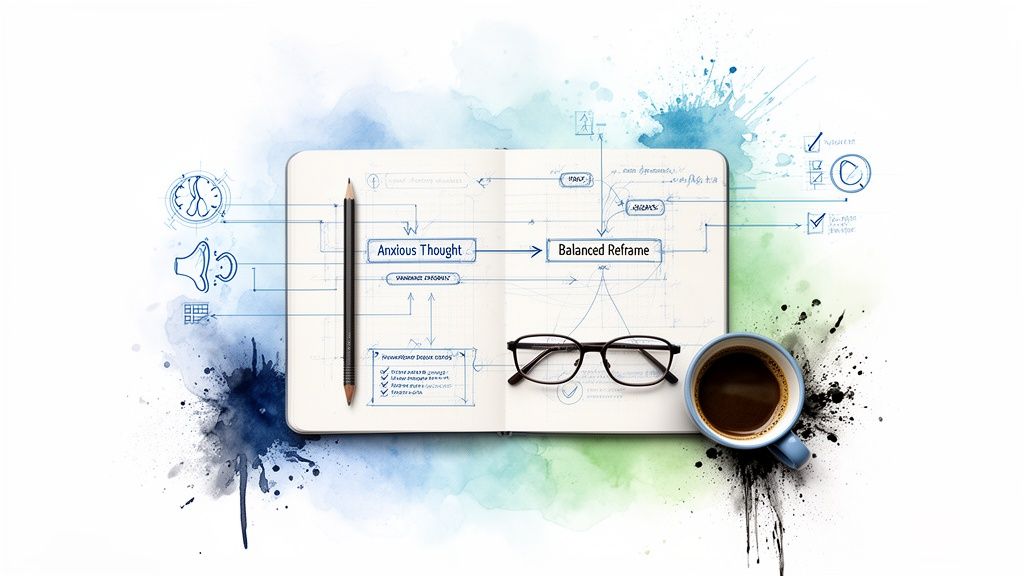
This method isn’t just about "thinking positive"; it's about thinking accurately. For instance, CBT helps you challenge catastrophic thinking, such as believing a small mistake at work will get you fired. Through techniques like thought records, you can examine the evidence for and against your anxious predictions and develop more balanced, realistic perspectives. It’s one of the most effective cognitive perspective examples because it offers a practical framework for lasting change.
How to Apply CBT for Anxiety
CBT is most effective when used consistently to build new mental habits. The goal is to move from automatically accepting anxious thoughts to questioning them with curiosity.
- Identify Negative Automatic Thoughts: Start by simply noticing the anxious thoughts that pop into your head. A common one is, "I'm going to embarrass myself in this meeting."
- Challenge and Reframe: Question the thought. Is it 100% true? What's a more likely outcome? A reframe could be, "I might feel nervous, but I'm prepared. Even if I stumble over a word, it’s not a catastrophe."
- Conduct Behavioral Experiments: Gradually face feared situations to test your anxious predictions. If you avoid social events, try attending one for just 30 minutes to see if your worst fears come true.
CBT provides the tools not just to cope with anxiety, but to fundamentally alter the cognitive patterns that fuel it, offering genuine hope for recovery. For a deeper dive into its principles and applications, you can learn more about how CBT helps with anxiety through our detailed guide.
2. Thought Challenging and Cognitive Restructuring
Thought Challenging, also known as Cognitive Restructuring, is a practical technique used to directly confront anxious thoughts. Instead of passively accepting worries as truth, this method teaches you to act like a detective, examining the evidence for and against your fears. The core principle is that our thoughts are just thoughts, not facts, and by questioning their validity, we can reduce their power and reclaim our emotional balance.
This process is a powerful example of the cognitive perspective in action because it breaks the cycle of automatic negative thinking. For instance, when anxiety whispers, "I'll never get better," thought challenging prompts you to ask, "Is that 100% true? What skills am I learning that prove I can improve?" At the core of cognitive restructuring is addressing the internal dialogue and battles, often termed a man vs self conflict, allowing us to reshape our responses to challenging thoughts. It provides a direct path to a more hopeful and realistic mindset.
How to Apply Thought Challenging
Consistent practice is key to making this skill automatic. The goal is to build a new mental habit of questioning anxious thoughts before they spiral out of control, offering real hope for a panic-free life.
- Identify the Hot Thought: Notice the specific thought causing the most distress. For example, "I'm having chest pain, so I must be having a heart attack."
- Examine the Evidence: Actively look for facts that support and contradict the thought. You might recall, "My doctor confirmed my heart is healthy," and "Chest tightness is a known symptom of my anxiety."
- Create a Balanced Alternative: Form a new thought based on the evidence. A more balanced perspective would be, "This chest tightness feels scary, but it’s a physical symptom of anxiety I've experienced before and I know how to manage it."
By systematically dismantling anxious predictions, you actively rewire your brain to be less reactive. You can learn more about the specific thought patterns this technique targets by exploring common cognitive distortions.
3. Exposure Therapy and Habituation
Exposure therapy is a powerful behavioral technique that directly challenges anxiety by confronting feared situations in a safe, controlled way. It operates on the principle of habituation: the brain's natural ability to decrease its fear response to a stimulus after repeated exposure. By gradually facing your triggers, you teach your mind that the anticipated catastrophic outcomes rarely happen, allowing the anxiety to naturally subside and giving you a profound sense of control.

This method isn't about recklessly diving into your biggest fear; it's a strategic, step-by-step process. For instance, someone with a fear of driving might start by just sitting in the parked car, then progress to driving around an empty lot, and eventually work up to highways. This incremental approach is one of the most direct cognitive perspective examples because it provides real-world evidence to disprove anxious thoughts, proving that you can handle more than your anxiety predicts.
How to Apply Exposure Therapy for Anxiety
The key to successful exposure therapy is creating a structured hierarchy and practicing consistently until your fear diminishes. The goal is to prove to your brain that the feared situation is manageable.
- Create an Exposure Hierarchy: Identify a feared situation and break it down into small, manageable steps. For social anxiety, this could start with texting a friend, then making a phone call, and eventually attending a small gathering.
- Practice and Habituate: Engage with the first step on your hierarchy until your anxiety level noticeably decreases, which typically takes 10-20 minutes. Don't move to the next step until the current one feels less intimidating.
- Track Your Progress: Monitor your anxiety levels before, during, and after each exposure session. Seeing the numbers go down provides concrete proof that you are retraining your brain and rewiring your fear response.
Exposure therapy offers a clear path to reclaiming your life from phobias, panic, and social anxiety. It empowers you by demonstrating that anxiety is a temporary feeling, not a permanent state. You can find detailed guidance on how to start with our primer on using exposure therapy for anxiety.
4. Mindfulness and Present-Moment Awareness
Mindfulness offers a gentle yet powerful way to step out of the chaotic storm of anxiety. It is the practice of paying attention to the present moment on purpose, without judgment. Instead of getting swept away by worries about the future or regrets about the past, mindfulness anchors you firmly in the now. This cognitive skill works by interrupting the cycle of anxious rumination, allowing you to observe your thoughts and feelings as temporary events rather than absolute truths, creating a direct path toward a calmer, more controlled state of mind.

This approach isn’t about emptying your mind; it's about changing your relationship with it. For example, instead of believing the thought "Something terrible is going to happen," you learn to see it as just a thought: "I am having the thought that something terrible is going to happen." This small shift in perspective creates crucial space between you and your anxiety. It is one of the most effective cognitive perspective examples because it empowers you to regulate your nervous system directly, showing that you can find peace even when anxious thoughts arise.
How to Apply Mindfulness for Anxiety
The key to mindfulness is gentle, consistent practice, especially during moments of calm, to build the skill for when you need it most. The goal is to train your attention to return to the present moment whenever it wanders into worry.
- Observe Your Thoughts: Sit quietly and simply notice the thoughts that come and go, like clouds in the sky. You don't need to engage with them or push them away. Label them gently: "worrying," "planning," "judging."
- Practice Mindful Breathing: Use a simple technique like the 4-7-8 breath before a stressful event. Inhale for 4 seconds, hold for 7, and exhale slowly for 8. This directly soothes your nervous system.
- Use Grounding Techniques: When anxiety spikes, engage your senses with the 5-4-3-2-1 method. Name 5 things you see, 4 things you feel, 3 things you hear, 2 things you smell, and 1 thing you taste.
Mindfulness gives you a practical anchor in the present, proving that you can manage anxious feelings without letting them control you and offering real hope for a panic-free life. For more structured guidance, you can explore how meditation for anxiety can build this essential skill.
5. Safety Behavior Elimination and Behavioral Activation
Safety Behavior Elimination and Behavioral Activation is a powerful, action-oriented approach to breaking the cycle of anxiety. It operates on the understanding that while safety behaviors (like repeatedly checking locks or seeking reassurance) provide temporary relief, they ultimately reinforce fear. By systematically removing these crutches and replacing them with meaningful, values-driven activities, you teach your brain that you can handle distress, effectively dismantling the foundation of chronic anxiety.
This process is a direct challenge to the cognitive belief that "I cannot cope without my safety net." For instance, instead of constantly asking a partner, "Are you sure I'm okay?" you actively resist the urge. This proves to your mind that the feared catastrophe doesn't happen, and you are more resilient than your anxiety predicts. It’s one of the most practical cognitive perspective examples because it shifts focus from analyzing thoughts to changing the behaviors that fuel them, offering a clear path toward a panic-free life.
How to Apply This Method for Anxiety
The core principle is to stop avoiding anxiety and start engaging with life. This builds confidence and provides your brain with new evidence that contradicts anxious beliefs.
- Identify Your Safety Behaviors: Start by listing the subtle things you do to feel less anxious. This could be avoiding eye contact, carrying medication everywhere "just in case," or only going to familiar places.
- Create a Graduated Plan: Don't try to eliminate everything at once. If you avoid social calls, start by making one short, low-stakes call. Gradually increase the duration or difficulty as your confidence grows.
- Activate Positive Behaviors: Intentionally schedule activities that align with your values, even if you don't feel like it. This could be a 15-minute walk, spending time on a hobby, or reaching out to a friend.
By replacing avoidance with engagement, you actively rewrite your cognitive and behavioral patterns. This method provides the tools to not just manage anxiety, but to build a rich, meaningful life in its place, demonstrating that true safety comes from self-trust, not avoidance.
6. Interoceptive Awareness and Panic Symptom Management
Interoceptive awareness is your ability to sense your body's internal signals, like a racing heart or shallow breathing. For those with anxiety and panic, this internal awareness can become a source of fear. Normal bodily sensations are often misinterpreted as signs of a catastrophic medical event, which triggers a vicious cycle of panic. By learning to accurately identify and tolerate these sensations without fear, you can break this cycle and reclaim control over your body.
This approach is not about ignoring physical symptoms but understanding their true source. For example, instead of thinking, "My heart is racing, I'm having a heart attack," you learn to recognize it as a benign adrenaline response. This shift in perspective is a powerful cognitive perspective example that dismantles the fear that fuels panic. You learn through direct experience that these feelings are uncomfortable but not dangerous, giving you the confidence to live a panic-free life.
How to Apply Interoceptive Awareness for Panic
The goal is to build tolerance for physical sensations through safe, controlled exposure, proving to your brain that they are harmless. This process systematically reduces anxiety sensitivity.
- Identify Feared Sensations: Start by pinpointing which physical symptoms are most frightening for you. Is it dizziness, a tight chest, or a racing heart?
- Practice Interoceptive Exposure: Intentionally and safely induce the sensation. If dizziness is a trigger, spin in a chair for 30 seconds. If a racing heart is the fear, do jumping jacks for a minute. Notice the sensation without judging it.
- Reframe and Tolerate: As the sensation arises, remind yourself, "This is just anxiety. I am safe. This feeling will pass." Stay with the discomfort until it naturally subsides, teaching your nervous system that it doesn't need to sound the alarm.
By practicing interoceptive awareness, you change your relationship with your body's signals from one of fear to one of understanding. To get a better grasp of the panic cycle and how to break it, you can learn more about managing a panic attack through our in-depth resources.
7. Metacognition and Worry Process Management
Metacognition, or "thinking about thinking," is the practice of observing your own thought processes from a detached perspective. For those with chronic anxiety, worry can feel like a necessary evil, a tool to prevent bad outcomes. Metacognition offers a way to step back, notice these unhelpful beliefs about worry, and break free from exhausting mental cycles. It’s about managing the process of worrying, not just the content of the worries themselves.
This approach helps you distinguish between productive problem-solving (like planning a presentation) and unproductive worry (endlessly imagining worst-case scenarios). Instead of getting caught in a loop where you worry about being anxious, you learn to see the worry itself as just a mental event. This shift is a potent cognitive perspective example because it disarms the power of worry, turning it from an overwhelming force into a manageable thought you can choose not to engage with.
How to Apply Metacognition for Anxiety
The goal is to stop fusing with your anxious thoughts and instead treat them as background noise. This creates mental space and reduces the emotional toll of constant worry.
- Practice 'Worry Postponement': When a worry arises, acknowledge it, write it down, and schedule a specific 15-minute "worry time" later in the day to address it. This teaches your brain that you are in control, not the anxiety.
- Distinguish Worry from Problem-Solving: Ask yourself, "Is this thought leading to an actionable solution right now?" If not, it's likely unproductive worry. Label it as such: "I'm noticing I'm having a worrying thought."
- Develop a 'Detached Mindfulness' Mantra: When you feel a worry spiral starting, repeat a simple phrase to yourself, like "I am noticing the thought that…" or "Worry is present, but I don't have to engage."
Metacognition provides a clear path to reclaiming your mental energy from the grip of chronic worry, proving that you can live a peaceful life even when anxious thoughts appear.
8. Values-Based Living and Acceptance and Commitment Therapy (ACT)
Values-based living, a core component of Acceptance and Commitment Therapy (ACT), offers a profound shift in how you relate to anxiety. Instead of fighting or eliminating anxious thoughts, this approach encourages you to accept their presence while committing to actions that align with your deepest personal values. The goal is not to feel less anxiety, but to live a more meaningful life, even when anxiety shows up.
This method helps you stop organizing your life around avoiding discomfort and start building it around what truly matters to you. For instance, if you value authentic relationships, ACT helps you attend a social gathering despite social anxiety because connection is more important than the temporary fear. It’s one of the most powerful cognitive perspective examples because it reorients your entire focus from the problem (anxiety) to your life’s purpose, giving you a compelling reason to move forward.
How to Apply ACT and Values-Based Living
ACT is about creating a rich, full, and meaningful life while accepting the pain that inevitably goes with it. The aim is to increase your psychological flexibility so you can pursue your values no matter what feelings arise.
- Clarify Your Core Values: First, identify what is most important to you. Is it personal growth, community, health, or creativity? A common value is authentic relationships.
- Acknowledge Anxious Thoughts Without a Fight: When anxiety appears ("They will judge me if I share my real opinion"), simply notice it. You can label it: "I'm having the thought that I will be judged." You don't have to believe it or argue with it.
- Commit to a Valued Action: Despite the anxious thought, take a small step aligned with your value. For example, share one genuine feeling with a trusted friend. This action proves you can live by your values even when anxiety is present.
By choosing your values over your fears, you loosen anxiety’s grip and build a life filled with purpose. This approach doesn't promise a panic-free existence, but it offers a path to a life you are proud to live.
Comparison of 8 Cognitive Perspective Techniques
| Technique | Implementation complexity 🔄 | Resource & training needs ⚡ | Expected outcomes ⭐📊 | Ideal use cases 📊 | Key advantages & tips 💡 |
|---|---|---|---|---|---|
| Cognitive Behavioral Therapy (CBT) | 🔄🔄🔄🔄 (structured, protocol-driven) | ⚡⚡⚡ (trained therapist, homework) | ⭐⭐⭐⭐ — measurable symptom reduction (12–20 sessions) | Generalized anxiety, social anxiety, panic, broad anxiety treatment | Structured and evidence-based; use thought records & graded exposure. |
| Thought Challenging & Cognitive Restructuring | 🔄🔄 (technique-focused, simple steps) | ⚡ (low — can be self-guided) | ⭐⭐⭐⭐ — builds resilience; immediate relief when practiced | Situational worry, negative thinking, early GAD | Target negative thoughts with ABCDE; write out challenges until automatic. |
| Exposure Therapy & Habituation | 🔄🔄🔄🔄🔄 (high planning & monitoring) | ⚡⚡⚡ (often therapist-guided, safety measures) | ⭐⭐⭐⭐⭐ — durable reduction in fear responses | Specific phobias, social anxiety, panic disorder | Create a graded hierarchy; repeat exposures until habituation. |
| Mindfulness & Present-Moment Awareness | 🔄🔄 (practice-based, low procedural complexity) | ⚡⚡ (minimal tools; guided audios useful) | ⭐⭐⭐ — reduces rumination; effects grow over weeks | Rumination, generalized anxiety, stress management | Start 5 min/day, use guided meditations; be consistent. |
| Safety Behavior Elimination & Behavioral Activation | 🔄🔄🔄 (requires behavior change planning) | ⚡⚡ (accountability helpful; moderate effort) | ⭐⭐⭐⭐ — reduces avoidance, improves mood & confidence | Avoidance-driven anxiety, comorbid depression | Gradually remove safety behaviors and replace with value-aligned activities. |
| Interoceptive Awareness & Panic Symptom Management | 🔄🔄🔄🔄 (exposure to bodily sensations) | ⚡⚡ (may need medical clearance; supervised practice) | ⭐⭐⭐⭐ — reduces panic escalation and health anxiety | Panic disorder, health anxiety | Use symptom logs, practice interoceptive exposures safely after medical checks. |
| Metacognition & Worry Process Management | 🔄🔄🔄 (abstract skill-building) | ⚡⚡ (low-moderate; practice-focused) | ⭐⭐⭐ — decreases chronic worry, improves clarity | Generalized anxiety disorder, chronic worriers | Implement worry postponement and designated "worry time"; track worry vs problem-solving. |
| Values-Based Living & ACT | 🔄🔄🔄 (philosophical shift + exercises) | ⚡⚡ (therapist helpful; self-practice possible) | ⭐⭐⭐⭐ — improves quality of life and long-term engagement | Chronic anxiety, relapse prevention, value conflicts | Clarify values and commit to actions despite anxiety; use values exercises regularly. |
Your Personal Toolkit for a Hopeful, Panic-Free Future
Throughout this article, we’ve explored a wide range of real-world scenarios, breaking down the intricate ways our thoughts can create cycles of anxiety and panic. The cognitive perspective examples provided, from social situations to sudden panic episodes, are not just theoretical ideas; they are practical demonstrations of how your internal monologue directly shapes your emotional reality. Each example reveals a specific cognitive distortion, like catastrophizing or mind-reading, and offers a clear, actionable path toward a more balanced viewpoint.
The core lesson is this: you have the power to intercept and redirect anxious thought patterns. This process, known as cognitive restructuring, is a skill. Like any skill, it requires consistent practice, but it is one you can absolutely master.
From Insight to Action: Building Your Resilience
The true value of understanding these cognitive perspective examples lies in their application. It's about moving from passively recognizing a distorted thought to actively challenging it. This is where real change begins. The journey to a life free from the grip of panic is built on these small, repeated acts of courage.
Remember these key takeaways:
- Awareness is the First Step: You cannot change what you do not acknowledge. The simple act of noticing an automatic negative thought is a significant victory.
- Challenge with Curiosity, Not Judgment: Approach your anxious thoughts like a detective. Ask questions: "What is the evidence for this thought?" or "Is there another, more helpful way to see this?"
- Action Solidifies Belief: Every time you face a feared situation, stay with the discomfort, or use a grounding technique instead of fleeing, you send a powerful message to your brain: "I am safe, and I can handle this." This is how you build lasting confidence.
A Future Defined by You, Not Your Anxiety
Mastering these cognitive tools is about more than just managing symptoms; it's about reclaiming your life. It means showing up for events you once dreaded, pursuing career goals without the fear of failure holding you back, and simply enjoying a quiet moment without the constant hum of worry. The path to a panic-free life is not about the complete absence of anxiety, but about building an unshakeable belief in your own ability to navigate it.
Romain's 15-year struggle with panic attacks, which led to the creation of The Anxiety Checklist, is a testament to this process. These very principles, applied consistently, were the keys to his recovery. Your journey is just as valid and your potential for healing is just as real. The cognitive restructuring skills you've learned here are the foundation for building a hopeful future where you are in control.
The examples in this article give you the "what" and the "why" of cognitive restructuring. To put it all into a guided, daily practice, explore the system built from these exact principles. The Anxiety Checklist provides the step-by-step templates and structure you need to turn these cognitive perspective examples into a personal, actionable recovery plan. Find the full toolkit at The Anxiety Checklist and start building your panic-free future today.