
That crushing, heart-pounding feeling of an anxiety attack is terrifying. It can make you feel completely alone, like you’re the only one caught in such a violent internal storm.
If you take one thing away from this guide, let it be this: you are not broken, you are not in danger, and a life free from the constant fear of the next attack is absolutely possible. Healing is not just a dream; it's a realistic and achievable goal.
This journey back to calm starts with understanding what’s really going on. An anxiety attack is basically your body's alarm system—the 'fight or flight' response—getting triggered at the wrong time. Your brain thinks there's a threat, so it floods your body with adrenaline to prepare you to fight or run from a danger that isn't actually there.
This is exactly why the physical symptoms feel so intense: a racing heart, shortness of breath, dizziness. It’s a completely normal biological reaction, just happening at a very inconvenient moment.
The most powerful thing you can realize is that an anxiety attack, no matter how awful it feels, is just a temporary and harmless overreaction of your body's natural defense system. It’s not a sign of weakness, but a signal that your nervous system is stuck on high alert. Healing is possible, and it begins with this understanding.
Once you can see it for what it is, the fear of the symptoms themselves starts to lose its power. You're simply demystifying the experience and taking back control.
Just How Common Is This Struggle?
Feeling isolated in this is normal, but the reality is that millions of people know exactly what you're going through. The global burden of anxiety disorders has seen a massive rise.
Data shows that from 1990 to 2021, the number of anxiety disorder cases jumped from 78.1 million to 138.3 million worldwide. That's a 77% increase. This doesn't just highlight the growing need for solid coping strategies; it confirms that what you're feeling is a shared human experience.
The sheer number of people navigating these same challenges means there's a ton of knowledge and proven strategies out there. You're walking a path that many have walked before, and they’ve found their way to lasting peace. This guide is built on their experiences and the practical, actionable steps that actually work.
Is It an Anxiety Attack or a Panic Attack?
It’s also helpful to clear up some of the confusion between anxiety and panic attacks. People often use the terms interchangeably, but there are some key differences that matter.
- Anxiety Attacks: These tend to build up slowly, usually in response to a specific stressor or worry. The symptoms can feel less intense than a full-blown panic attack but might stick around for a lot longer. Think of it as a slow burn.
- Panic Attacks: These hit you like a ton of bricks—suddenly and often without any obvious trigger. They're defined by a rapid, intense peak of fear and severe physical symptoms that usually fade within 20-30 minutes.
Ultimately, whether you're dealing with a slow-burning wave of anxiety or a sudden crash of panic, the tools you'll use to cope are very similar, and recovery is equally possible for both.
By exploring these evidence-based techniques, you're going to build a personalized toolkit for regaining control. To see just how common these conditions are, you can dive into some powerful anxiety statistics that really put things into perspective. This journey is about empowerment, and it starts right now.
Your First Aid Kit for an Anxiety Attack
When panic strikes, it feels like a tidal wave—overwhelming and uncontrollable. In that moment, trying to think logically is nearly impossible. This is why you need a pre-prepared "first aid kit" of simple, powerful actions you can take immediately to find solid ground.
These aren't complex theories; they're practical anchors designed to pull your mind out of the storm and back to the present. The key is to interrupt the cycle of panic before it takes full control. The good news? With practice, these tools become second nature, empowering you to face down anxiety with confidence and the knowledge that you can get through it.
Understanding the progression from a trigger to a full-blown attack can help demystify the experience and show you exactly where you can step in.
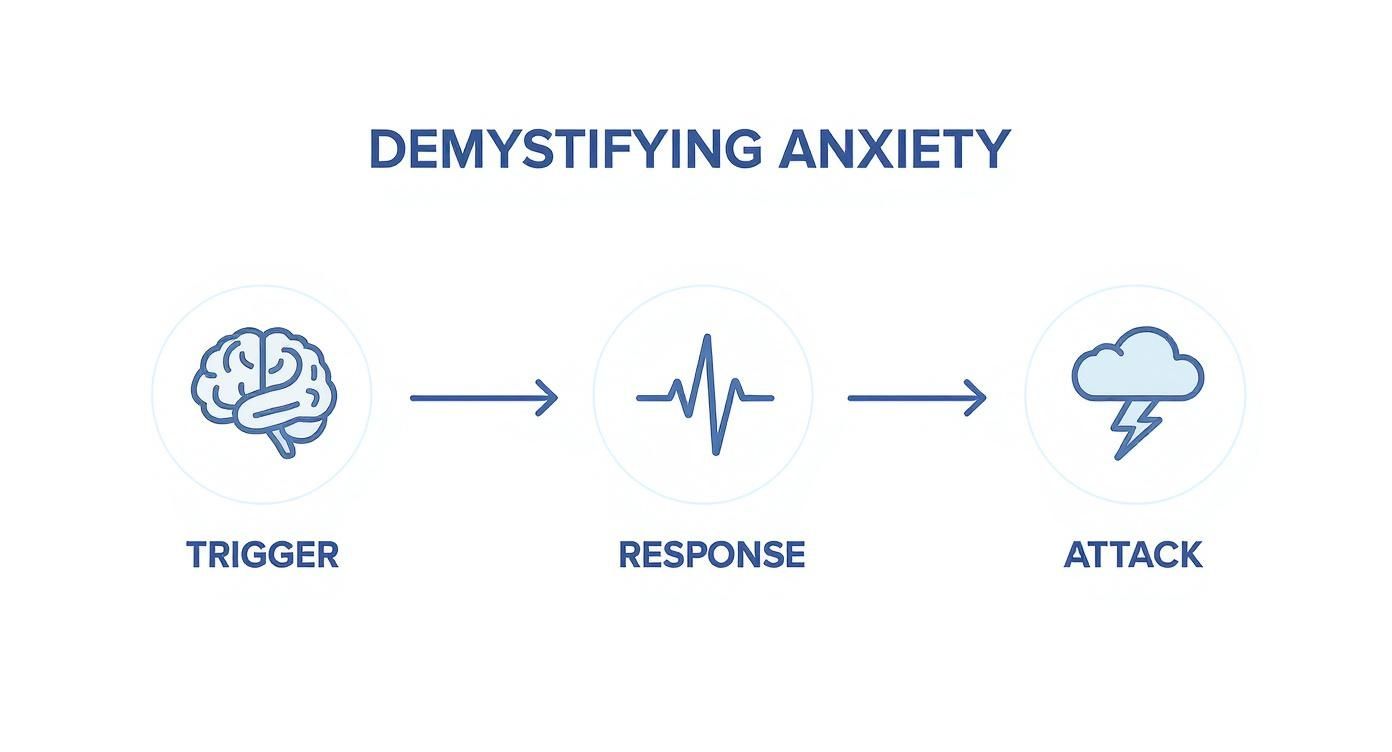
This process shows that an anxiety attack isn't a random event but a reaction that builds. That means there are opportunities to intervene and regain control.
Engage Your Senses With The 5-4-3-2-1 Method
One of the quickest ways to dial down the intensity of an anxiety attack is to pull your focus away from the frightening internal sensations and onto the external world. The 5-4-3-2-1 grounding technique does exactly this by systematically engaging all five senses.
It forces your brain to shift from abstract fear to concrete observation. Here’s how to do it the moment you feel panic rising:
- See 5 things: Look around and mentally name five objects. Don't just glance; notice details. "I see the blue pen on my desk, the grain of the wood on the door, the small crack in the ceiling, the green leaves on the plant, and the reflection in my monitor."
- Touch 4 things: Focus on the physical sensation. Feel the texture of your jeans against your skin, the cool smoothness of your desk, the soft fabric of your chair, and the weight of your phone in your hand.
- Hear 3 things: Listen carefully for sounds you might normally tune out. It could be the hum of a computer, distant traffic, or your own breathing.
- Smell 2 things: Take a slow breath. Can you smell the faint scent of coffee, the soap on your hands, or the rain outside?
- Taste 1 thing: Focus on the taste in your mouth. Maybe it's the lingering mint from your toothpaste or just a simple sip of water.
This exercise works because it interrupts the feedback loop where scary thoughts fuel physical symptoms, which in turn fuel even more scary thoughts. You are actively telling your brain, "I am safe right here, right now," and proving that you can guide yourself back to calm.
Control Your Breath, Control Your Body
During an anxiety attack, your breathing becomes shallow and rapid. This can lead to dizziness and a tighter feeling in your chest, which only escalates the panic. Regaining control of your breath is a direct way to signal to your nervous system that the danger has passed.
One of the most tested techniques is box breathing, famously used by Navy SEALs to stay calm under extreme pressure. It's simple and incredibly effective.
- Breathe in slowly for a count of four.
- Hold your breath for a count of four.
- Breathe out slowly through your mouth for a count of four.
- Hold your breath again for a count of four.
Repeat this cycle for a few minutes. The deliberate rhythm helps regulate your heart rate and sends a powerful calming message throughout your body. For a deeper dive, exploring various breathing exercises for anxiety can give you even more tools for your kit.
The moment panic hits, it’s easy to feel lost. But having a few go-to grounding exercises ready can make all the difference. Below is a quick-reference guide to techniques you can use immediately to reconnect with the present moment.
Immediate Grounding Techniques for Panic Relief
| Technique | How It Works | Simple Steps |
|---|---|---|
| The 5-4-3-2-1 Method | Engages all five senses to pull focus away from internal panic and onto the external environment. | Name 5 things you see, 4 you can touch, 3 you can hear, 2 you can smell, and 1 you can taste. |
| Box Breathing | Regulates your breathing pattern to calm the nervous system and lower your heart rate. | Inhale for 4 seconds, hold for 4, exhale for 4, and hold for 4. Repeat. |
| Deep Pressure | Applies gentle, firm pressure to the body, which can have a calming, hug-like effect on the nervous system. | Tightly hug yourself, wrap yourself in a weighted blanket, or have a pet sit on your lap. |
| Cold Shock | A sudden change in temperature can shock your system out of the panic cycle and bring you into the present. | Splash cold water on your face, hold an ice cube, or step outside into cool air for a moment. |
These aren't just tricks; they are powerful ways to communicate safety to your brain when it’s stuck in alarm mode. Practice them when you’re calm so they feel more accessible when you really need them.
An anxiety attack can make you feel powerless, but remember this: you always have your senses and your breath. These are your anchors, available anytime, anywhere, to bring you back to the present moment and prove that you are in control.
It's also worth looking into tools that leverage the science of touch. For instance, the gentle, firm pressure from weighted blankets, known as deep pressure therapy, can have a remarkably calming effect on the nervous system. Think of it as another potential tool for your arsenal.
How to Challenge and Reframe Anxious Thoughts
Grounding techniques are your first-aid kit for the heat of the moment, but long-term freedom from anxiety comes from changing your relationship with the thoughts that fuel it. A panic attack is often just a physical reaction to a catastrophic story your mind is telling you. Let's talk about the mental tools you need to question that story, take back the pen, and write a new, more hopeful ending.
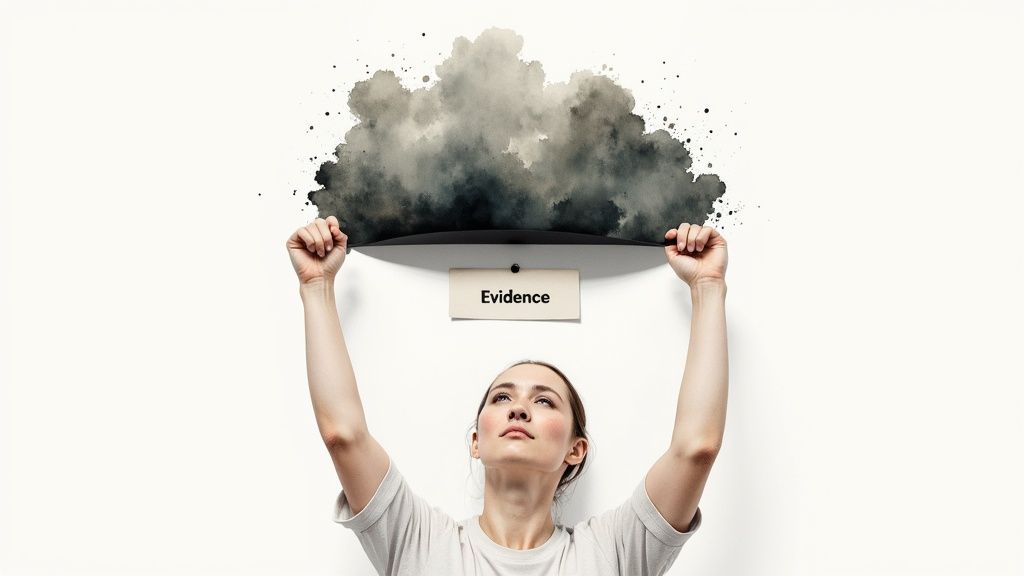
This process is all about becoming a detective of your own mind. You're going to learn to examine the evidence for your fears instead of just accepting them as facts. These are practical skills pulled straight from Cognitive Behavioral Therapy (CBT), a powerhouse approach for getting anxiety under control and finding lasting peace.
Identifying Your Anxious Thoughts
First things first: you have to notice the specific thoughts that show up right before and during an anxiety attack. They almost always fall into predictable, scary patterns.
Sound familiar? Many people experience catastrophic thoughts like these:
- "I'm losing control."
- "Something terrible is about to happen to me."
- "I'm having a heart attack."
- "I'm going crazy."
- "I can't breathe and I'm going to suffocate."
These thoughts feel incredibly real and urgent, which is exactly why they trigger such a powerful physical storm. The key is to start seeing them for what they are—mental events, just thoughts—rather than objective truths. That simple act of observation creates a sliver of space, and that space is where your power to heal begins.
Becoming a Thought Detective
Once you’ve spotted an anxious thought, your job is to put it on trial. Instead of letting it run the show, you get to cross-examine it with logic and hard evidence. This process slowly drains the thought of its power and shows your brain that the "emergency" isn't real.
Start by asking yourself these critical questions:
- What’s the evidence for this thought? And what’s the evidence against it? Be brutally honest. If you think you're having a heart attack, the evidence for it might be a racing heart. The evidence against it could be that you've felt this exact sensation before and it always passed, or that your doctor has already confirmed you're healthy.
- Am I confusing a possibility with a probability? Sure, it's possible you could lose control, but what is the actual probability? Based on every single past experience, how likely is it to happen this time?
- What's a more balanced or realistic way to look at this? Instead of "I'm losing control," a more balanced thought could be, "I'm feeling intense anxiety. It's uncomfortable, but I know this feeling will pass, just like it always does."
- What would I tell a friend who had this exact same thought? We’re often much more compassionate and rational with others than we are with ourselves. Apply that same kindness and logic to your own fears.
This isn't about pretending the fear doesn't exist. It's about acknowledging the feeling while challenging the faulty logic that’s driving it. You are teaching your brain to respond with reason instead of pure reaction, paving the way for a calmer mind.
Let's walk through a real-world scenario. Imagine you're in a crowded grocery store and the thought hits: "I'm trapped and need to get out now."
- Challenge: "Am I physically trapped? The doors are right there. I can leave anytime I want."
- Reframe: "This place feels overwhelming, and that's making me anxious. I can take a few deep breaths, focus on my grocery list for just one minute, and then decide if I still want to leave."
By challenging and reframing, you shift from a place of helpless panic to one of empowered choice. This is a core principle in CBT for anxiety, which offers a structured path to mastering these skills. To get a better grasp of the concepts behind this method, you can learn more about understanding CBT for anxiety and how it rewires your brain for calm.
Learning to Let Thoughts Float By
Here’s another powerful technique, known as thought diffusion. Instead of actively fighting or challenging a thought, you simply observe it without getting tangled up in its story. This approach, which comes from Acceptance and Commitment Therapy (ACT), is all about changing your relationship with your thoughts.
Imagine you're sitting by a river. Your anxious thoughts are like leaves floating by on the water. Your only job is to watch them come and go—without jumping into the river to grab them.
Here’s how you can practice this:
- Label it. When an anxious thought appears, mentally say, "Ah, there's the 'I'm losing control' thought again." Just labeling it creates distance.
- Visualize it. Picture the thought written on a cloud and watch it drift across the sky. See it on a billboard as you drive past.
- Thank your mind. Your brain is just trying to protect you, even if it's completely overreacting. Try saying, "Thanks, mind, for the warning. I've got it from here."
This might feel a little strange at first, but with practice, it becomes a profound way to handle anxiety attacks. You start to realize that thoughts only have the power you give them. By unhooking yourself, you drain their emotional charge, leaving them as nothing more than harmless mental noise.
Building a Lifestyle That Prevents Future Attacks
While in-the-moment tools are a lifesaver during an active attack, the real goal is to build a life where they don't happen as often—or at all. Lasting peace doesn’t come from some massive, overnight change. It comes from the small, consistent habits that create a strong foundation of calm and hope.
This is about playing the long game. It's about lowering your baseline anxiety so your nervous system isn't always on high alert, making it that much harder for panic to ever take hold. Every positive choice you make is a step towards a panic-free future.

If this journey feels isolating, know that it's far more common than you think. Recent data from England shows just how widespread this is, with 37.1% of women and 29.9% of men reporting high levels of anxiety. This just goes to show how vital it is to build resilient lifestyle habits to manage a condition affecting so many of us.
The Calming Power of Consistent Movement
When you’re feeling anxious, the absolute last thing you might want to do is move your body. But trust me, regular physical activity is one of the most powerful tools you have for heading off panic attacks.
Movement helps your body burn off excess adrenaline and cortisol—the very stress hormones that fuel panic. At the same time, it releases endorphins, which are basically your body's natural mood boosters. You don't need to sign up for a marathon. The key here is consistency, not intensity.
- Start with a daily walk. Even 15-20 minutes of brisk walking can make a huge difference in your anxiety levels and overall mood.
- Find something you actually enjoy. If you hate the gym, don't force it. Try dancing in your living room, hiking a local trail, cycling, or yoga. The best exercise is the one you’ll stick with.
- Tune into the feeling. Pay attention to how your body feels during and after you move. Notice the rhythm of your breath, the sensation of your feet hitting the ground. This simple shift turns a workout into a form of moving meditation.
A great place to start is by learning how to stay consistent with exercise, as this is a cornerstone of building a more resilient lifestyle.
Fueling Calm Through Mindful Nutrition
The connection between your gut and your brain is incredibly strong. What you eat can either soothe your nervous system or send it into overdrive. While there's no single "anxiety diet," making certain choices can have a real impact on your symptoms.
Think of it less as a diet and more as choosing foods that stabilize your body instead of causing spikes and crashes.
- Limit caffeine and sugar. These are notorious for mimicking the symptoms of an anxiety attack (hello, racing heart) and can leave you feeling jittery and much more prone to panic.
- Focus on complex carbohydrates. Foods like whole grains, oats, and quinoa provide a steady stream of energy and help promote the production of serotonin, a brain chemical that helps you feel calm.
- Stay hydrated. It sounds simple, but dehydration can cause physical symptoms like dizziness and an increased heart rate, which can easily trigger anxiety. Drinking plenty of water is an easy win.
Your diet isn't about restriction; it's about empowerment. By making conscious food choices, you are actively taking part in your own healing and building a body that is less susceptible to panic.
For a deeper dive, our guide on lifestyle and diet changes for anxiety management offers practical steps you can start implementing today.
The Critical Role of Restful Sleep
Sleep and anxiety are trapped in a vicious cycle. Anxiety makes it nearly impossible to fall asleep, and not getting enough sleep leaves you far more vulnerable to anxiety the next day. This makes prioritizing good sleep hygiene an absolute non-negotiable for anyone serious about managing panic attacks.
This means creating a solid, predictable routine that signals to your brain that it's time to wind down.
- Stick to a Schedule: Try to go to bed and wake up around the same time every single day, even on weekends. Consistency is king.
- Create a Relaxing Routine: About an hour before bed, shut down the screens. Pick up a book, take a warm bath, or listen to some calming music.
- Optimize Your Environment: Make your bedroom a sanctuary. It should be as dark, quiet, and cool as possible.
By weaving these small, consistent habits into your daily life, you’re doing more than just managing symptoms—you're fundamentally changing your body's response to stress. You're building a strong, calm foundation that makes it much harder for the storm of panic to gather, paving the way for a more peaceful, predictable life.
When to Reach Out for Professional Support
The self-help tools and lifestyle changes we’ve covered are incredibly powerful. They can absolutely equip you to handle those intense moments of panic and build a more resilient foundation over time.
But sometimes, trying to navigate this journey on your own feels like trying to read a map in the dark. You just need someone to hold the flashlight.
Reaching out for professional help isn't a sign of failure or a last resort. It's a proactive, courageous step toward taking your life back. Think of it as hiring an expert guide who knows the terrain of anxiety inside and out. They can show you the most direct path to a calmer, panic-free existence.
This journey is about giving you hope, and professional support is one of the most effective ways to find it.
Signs It Might Be Time to Talk to Someone
So, how do you know when it’s the right time to bring in a professional? There's no single answer, of course, but certain signs suggest the weight of anxiety is becoming too heavy to carry alone. Recognizing these signals is the first step toward getting the help you deserve.
You might want to consider professional support if:
- Your world is getting smaller. You find yourself avoiding places, people, or situations you fear might trigger an attack. This could be anything from grocery stores and social events to driving or even leaving the house.
- Your daily life is disrupted. Anxiety is consistently getting in the way of your work, your relationships, or your ability to simply enjoy your day. You realize you’re spending more time worrying about the next attack than actually living your life.
- Self-help strategies aren’t enough. You’ve been trying grounding techniques, breathing exercises, and lifestyle adjustments, but the attacks keep happening with the same intensity or frequency. It feels like you're spinning your wheels.
- You feel hopeless or overwhelmed. The constant struggle is draining your energy, and it's becoming difficult to see a path forward where things get better.
If any of these resonate with you, it’s a clear indicator that a professional could provide the structure and support needed to make real, lasting progress.
Demystifying Therapy for Anxiety
The idea of therapy can feel intimidating if you don’t know what to expect. In reality, therapy for anxiety is a collaborative process focused on giving you practical, real-world skills to heal.
One of the most effective and widely-used approaches is Cognitive Behavioral Therapy (CBT). At its core, CBT helps you identify, challenge, and reframe the negative thought patterns that fuel panic. It gives you the tools to stop the anxiety spiral before it takes hold.
In your first few sessions, a therapist will likely focus on just understanding your unique experience. They'll ask about your symptoms, your triggers, and what you've tried so far. This isn't an interrogation; it's about creating a personalized roadmap for your recovery.
Therapy provides a safe space to untangle the roots of your anxiety with an expert who can offer proven strategies and unwavering support. It is one of the most powerful investments you can make in your long-term well-being and freedom from panic.
There's no question that therapy is highly effective for coping with anxiety attacks. Studies show that up to 60-70% of people who get treated experience significant improvement. Despite this, a huge treatment gap still exists. In the U.S., for example, only 43.2% of adults with generalized anxiety disorder receive care. You can read more about these important mental health findings from the APA.
How to Find the Right Therapist
Finding a therapist who is a good fit is crucial. You want someone you feel comfortable talking to, who understands your goals, and whose approach aligns with what you need.
Here are a few practical tips to get your search started:
- Look for specialists: When you're searching, look for therapists who specialize in anxiety, panic disorders, or specifically mention CBT on their profiles.
- Use online directories: Websites like Psychology Today or the Anxiety & Depression Association of America (ADAA) have searchable databases that make it easy to find providers in your area.
- Schedule consultations: Many therapists offer a free 15-minute call. Use this time to ask questions, get a feel for their personality, and see if you "click." Don't be afraid to shop around.
This process is about finding a partner in your healing journey. For a deeper dive into therapeutic options, our guide on psychotherapy for anxiety offers more valuable insights.
Remember, seeking help is a profound act of strength. It's often the most reliable path toward living the panic-free life you deserve.
As you start learning new ways to handle anxiety attacks, a bunch of questions will probably pop up. That's completely normal. This whole journey is personal, and getting clear, straight answers can give you a real sense of hope and confidence.
Let's tackle some of the most common worries that come up when you decide it's time to take back control from anxiety. The most important thing to remember? Every single step you take, no matter how tiny it feels, is progress. You're building a foundation for a calmer life.
Can I Completely Stop Anxiety Attacks Forever?
This is usually the first thing people ask, and it comes from a deep desire to never feel that intense fear again. The hopeful answer is that a life where panic attacks are a thing of the past is absolutely achievable for many people. The goal is to build resilience so that anxiety no longer runs your life.
Many people find they can dramatically cut down how often and how intensely their attacks happen. They get better at spotting the early warning signs and using their coping skills to dial the anxiety down before it snowballs into a full-blown panic.
The real freedom isn't a life with zero anxiety—it's a life where you're no longer living in fear of the next attack. It's about changing your relationship with these feelings so they lose their power over you.
For a lot of people, this means getting to a point where attacks are so rare and manageable they just don't take up any mental space anymore. That’s a completely achievable reality.
How Long Does It Take for Coping Strategies to Work?
Honestly, it's different for everyone, and that's perfectly okay. Some strategies bring relief right away, while others need consistent practice before they feel like second nature.
- In-the-moment techniques like the 5-4-3-2-1 grounding method or box breathing can start working within minutes. They're designed to directly intervene with your nervous system and bring you back to the present.
- Cognitive and behavioral strategies, like challenging the anxious thoughts that fuel the fire, take more time. Think of it like building a muscle; you need to practice regularly for several weeks before it becomes an automatic reflex.
The trick is to practice these skills when you're feeling calm. The more you rehearse them, the more instinctively you'll be able to use them when you're in a moment of high anxiety. Remember, consistency is far more important than perfection, and every attempt is a step towards healing.
What’s the Difference Between an Anxiety Attack and a Panic Attack?
These terms get thrown around interchangeably all the time, but there's a clinical distinction that’s actually pretty helpful to know. Understanding the difference can help you describe what you're experiencing more clearly to a healthcare provider.
A panic attack is defined by a sudden, intense wave of fear that peaks very quickly, often within 10 to 20 minutes. The physical symptoms are usually severe and can include a racing heart, chest pain, and a terrifying feeling of impending doom. They often feel like they come out of nowhere.
An anxiety attack isn't a formal clinical term, but people use it to describe a period of intense anxiety that builds up more gradually, often in response to a specific stressor. These episodes can last longer than a panic attack, though the symptoms might feel a bit less severe.
Ultimately, the coping strategies and tools we're talking about in this guide are effective for both experiences.
Are Medication and Therapy Both Necessary for Treatment?
Not always. The right path is totally unique to you and your situation. There's no one-size-fits-all solution, and finding what works best is a personal decision you'll make with a professional.
For many people, therapy alone—especially Cognitive Behavioral Therapy (CBT)—is incredibly effective. It gives you the skills you need to manage anxiety for the long haul.
For others, especially when symptoms are severe and really disrupting daily life, a combination of therapy and medication can offer the best results. Medication can help take the edge off the physical symptoms, making it easier to lean in and do the deeper work in therapy.
A simple conversation with your doctor or a mental health professional can help you explore all the options and decide on the path that feels most supportive for you.
The journey to a panic-free life begins with practical, actionable knowledge. At The Anxiety Checklist, we've combined years of experience and proven techniques into a comprehensive system designed to put you back in control. Our Fearless Living: Beat Anxiety and Live Your Best Life program provides the tools you need—from a detailed eBook to a 93-point interactive checklist—to challenge anxious thoughts, build resilient habits, and manage panic effectively. Start building your personalized toolkit today and take the first step toward sustained mental wellness.