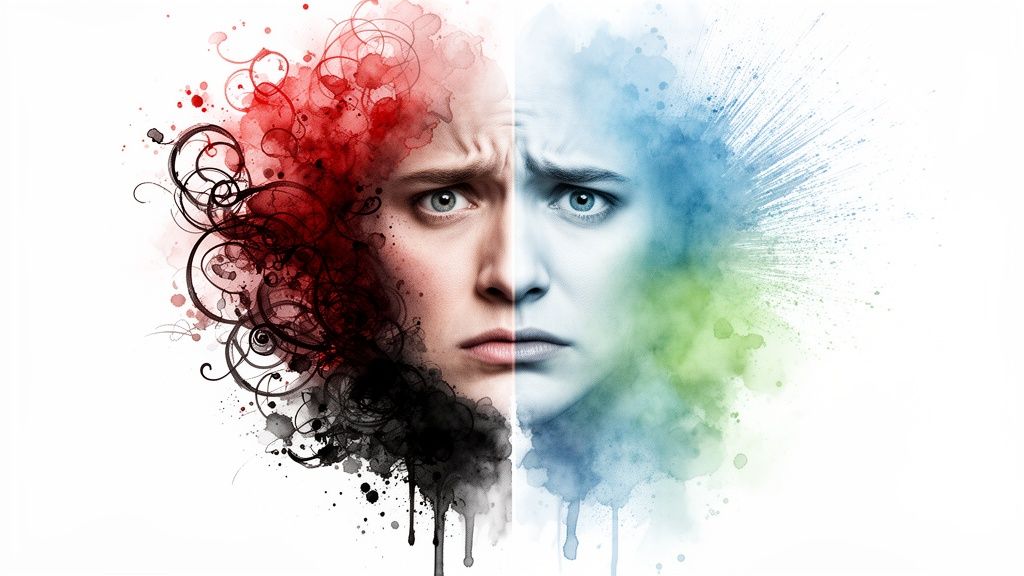
Here's the thing: everyone throws around the words "stressed" and "anxious" like they're the same, but they're not. Getting this right is the first, most powerful step you can take toward feeling in control again.
Here’s the core difference: stress is your body's reaction to an external trigger, like a looming deadline at work. Anxiety, on the other hand, is a persistent internal state of worry that can stick around long after that deadline has passed—or even show up for no reason at all.
Knowing what you’re actually feeling is the bedrock of healing. It's how you start building a path to a calmer, panic-free life, and it's a journey that is entirely possible.
Navigating Your Feelings From Stress to Anxiety
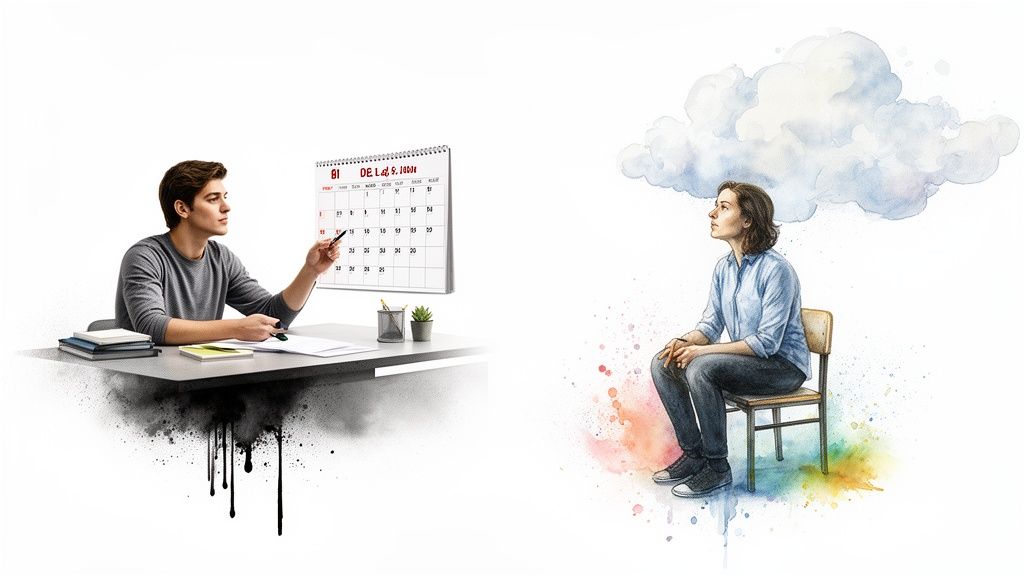
It’s completely understandable why we mix these terms up. They feel incredibly similar in the moment—a racing heart, that overwhelmed sensation, the knot in your stomach. Both are wired into our body's ancient alert system, the fight-or-flight response. You can dive deeper into the biology of it all in our detailed fight-or-flight response guide, which breaks down exactly how your body prepares to face a threat.
But the real difference comes down to the source and the timeline. Stress is a reaction to a clear, identifiable cause—a stressor. Think of it like a simple equation: tough situation + your reaction = stress. Once the situation is resolved, the stress usually fades away.
Anxiety feels different. It's often more personal and vague. It’s that internal hum of unease that doesn’t need a specific reason to exist, fueled by a constant stream of future "what-ifs." It’s that feeling that something is wrong, even when, on the surface, everything seems fine.
The Hope in Understanding
Figuring out if you're reacting to a specific pressure or stuck in an internal loop of worry isn't just some intellectual exercise. It’s a game-changer. It's an act of self-awareness that truly opens the door to getting better and reclaiming your life from panic.
By identifying the source of your distress, you shift from being a passenger to your emotions to becoming the driver of your recovery. This clarity is the first step toward building a life where you feel in control, not your anxiety.
This knowledge gives you power because it points you toward the right tools. Managing stress might mean practical fixes like setting better boundaries or getting organized. But tackling anxiety often requires a different approach, one focused on rewiring your thought patterns and soothing your nervous system—and this is a skill you can learn.
Believing you can live a life that isn't dictated by constant worry isn't just wishful thinking. It's the reality for so many people who started exactly where you are now—by simply trying to understand what they were feeling and realizing that healing is possible.
Stress vs Anxiety at a Glance
To make it even clearer, here’s a quick side-by-side look at the core differences between stress and anxiety.
| Characteristic | Stress | Anxiety |
|---|---|---|
| Primary Trigger | An identifiable external event or situation (e.g., a big presentation). | Often internal, focused on future or potential threats that may not be specific. |
| Duration | Tends to be temporary; subsides after the stressor is resolved. | Can be persistent and long-lasting, lingering even without a clear cause. |
| Emotional Focus | Frustration, irritability, and a sense of being overwhelmed by current demands. | Pervasive worry, apprehension, and a feeling of dread about what might happen. |
| Nature of Response | A direct response to a real, present challenge or pressure. | A reaction that can feel disproportionate to the actual situation, or arise from within. |
Seeing them laid out like this helps highlight the nuances. While they share symptoms, their roots and how they linger are fundamentally different, which is why the strategies to manage them have to be different, too.
Why Knowing the Difference Is a Game-Changer for Your Health
Figuring out whether you're stressed or anxious is more than just a word game—it's one of the most important things you can do for your well-being. When we brush off persistent anxiety as "just stress," we risk ignoring a real condition and putting off the targeted help we need to actually heal. Making this distinction is the first real step from just getting by to truly getting better and living panic-free.
Stress is something we all go through. It's usually a short-term reaction to a clear, external problem. Anxiety disorders, on the other hand, are recognized medical conditions that need specific, evidence-based treatment. If you treat chronic, internal worry like it's just a busy schedule, you'll burn out. Stress-management tips alone often aren't enough to quiet an anxious mind.
Moving From Just Coping to Actually Healing
The real power here is the hope this unlocks. Once you correctly identify what you're feeling, you open the door to strategies designed specifically for anxiety. This is where the journey toward a life free from panic truly begins.
Instead of feeling stuck with a constant, nameless dread, you can start to see it for what it is: a manageable condition with proven ways to recover. Realizing you're dealing with anxiety, not just a packed calendar, changes everything. It empowers you to find resources that make a real difference, moving you beyond temporary fixes and toward lasting peace.
Understanding this difference isn't about slapping on a label. It's about validating what you're going through, dropping the self-blame, and realizing that what you're feeling is real, understood by science, and—most importantly—treatable and healable.
The Scale of the Problem
Global health data shows just how important this distinction is. While feeling stressed is incredibly common, anxiety disorders are a distinct clinical issue affecting millions. For example, one major analysis found that stress affects about 25.18% of the general population. In contrast, the World Health Organization (WHO) reports that anxiety disorders impact around 359 million people worldwide, which is roughly 4.4% of the global population.
That's a huge difference. It shows why a one-size-fits-all approach to mental health just doesn't work. The tools for managing everyday, situational stress are very different from the clinical support needed to treat an anxiety disorder.
Your First Step Toward Clarity
Putting the right name to your feelings is the foundational step to taking your life back from constant worry. It’s the moment you stop fighting an invisible enemy and start using a clear, hopeful strategy to get well.
This clarity can be a huge relief. If you're wondering where you fall on the spectrum, a structured tool can help. Something like the GAD-7 anxiety test can offer real insight into your symptoms, giving you a clearer picture of what you're experiencing. It’s not a diagnosis, but it is powerful information that can guide what you do next on the path to a calmer, more controlled life. It's about taking that first, crucial step from confusion to understanding—and from there, to healing.
Comparing the Physical and Emotional Symptoms
Moving past textbook definitions, let's get into how stress and anxiety actually feel in your body and mind. They both spring from the same biological source—our hardwired fight-or-flight response—but the way they show up in our day-to-day lives can be surprisingly different.
Learning to spot these nuances isn't just an intellectual exercise; it's a powerful first step toward self-awareness. It gives you the clarity needed to find the right path to healing and, eventually, a life free from the grip of panic.
Think of stress as your body's alarm system screaming, "Deal with this now!" It’s an intense, almost primal reaction to a specific, external pressure. The physical and emotional signs hit hard and fast but usually fade once the situation is resolved.
Anxiety, on the other hand, is like that alarm getting stuck in the "on" position. The feelings can linger long after a trigger is gone, or sometimes pop up for no clear reason at all. It creates a constant, draining hum of unease that can take over your life.
The Physical Feelings of Stress vs. Anxiety
Your body isn't great at telling the difference between a looming work deadline and a genuine physical threat. This is why both stress and anxiety can kick off similar physical reactions—a racing heart, shallow breathing, and clenched muscles are hallmarks of both.
The real clues lie in the context and persistence of these feelings.
- Stress Symptoms: These usually feel like a direct result of being overloaded. You might get frequent headaches, nagging muscle tension in your shoulders and neck, deep fatigue, or digestive issues like an upset stomach. These signs tend to flare up when the pressure is on and die down when you get a break.
- Anxiety Symptoms: These are often more persistent and can feel completely disconnected from what’s happening around you. You might experience trembling or shaking, sweating, shortness of breath, dizziness, or a constant, jittery feeling of being on edge. The worst part? These physical sensations can become a source of worry themselves, trapping you in a frustrating cycle.
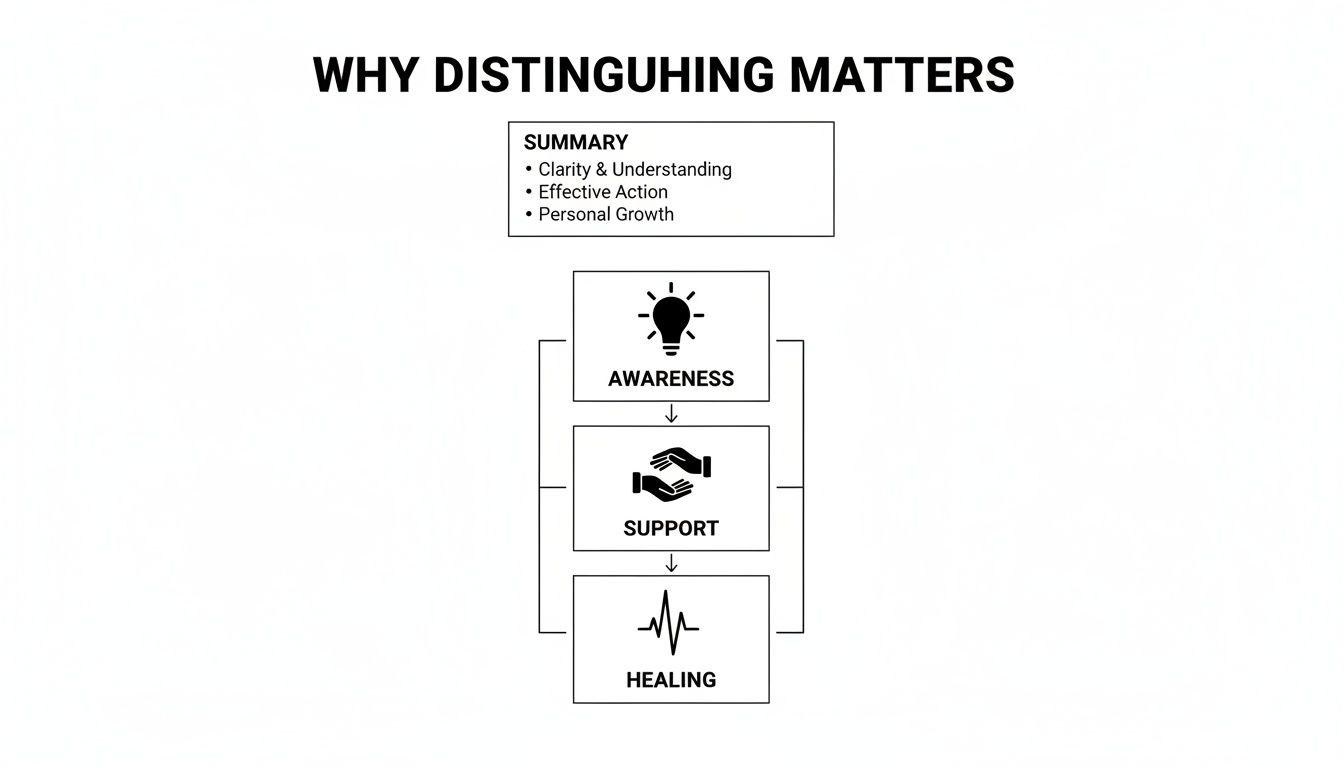
As this visual shows, this kind of awareness is the essential first step. Recognizing your specific symptoms is what opens the door to getting the right support and truly starting to heal.
Symptom Checklist Comparing Physical, Emotional, and Behavioral Signs
To make it even clearer, let's break down the common and distinct signs of stress and anxiety. While there's a lot of overlap, paying attention to the more specific anxiety symptoms can be a game-changer in understanding what you're really dealing with.
| Symptom Category | Common in Stress | More Specific to Anxiety |
|---|---|---|
| Physical | Headaches, muscle tension (neck/shoulders), fatigue, upset stomach, sleep problems. | Trembling/shaking, sweating, shortness of breath, chest tightness, dizziness, racing heart that feels out of context. |
| Emotional | Irritability, frustration, feeling overwhelmed, moodiness. | Persistent and excessive worry, a sense of dread, feeling constantly tense or on-edge, catastrophizing (imagining the worst-case scenario). |
| Behavioral | Changes in appetite, procrastination, snapping at others. | Avoidance of situations that might trigger worry, social withdrawal or isolation, restlessness, difficulty concentrating due to preoccupation with worry. |
This checklist isn't for self-diagnosis, but it can be a powerful tool for self-awareness. Seeing the patterns laid out like this can help you articulate what you're feeling, whether to a friend, a family member, or a professional.
The Emotional and Behavioral Differences
Emotionally, the biggest difference often comes down to timing and focus. Stress is usually locked on the present challenge, while anxiety is preoccupied with a future that feels threatening and uncertain.
Let's use a real-world example: preparing for a big presentation at work.
- Under Stress: You might feel irritable, frustrated, and completely overwhelmed by the sheer amount of work. Your focus is laser-sharp on the task itself. Maybe you snap at a coworker or struggle to concentrate, but the moment that presentation is over, a huge wave of relief washes over you.
- With Anxiety: The worry balloons far beyond the presentation. You might find yourself catastrophizing, vividly imagining every possible negative outcome—stumbling over your words, being harshly judged by your boss, or even getting fired. After the event, instead of relief, you might continue to ruminate, obsessing over what people thought or what could go wrong next.
The key emotional marker for anxiety is persistent and excessive worry that feels totally uncontrollable. Stress creates a sense of urgency, but anxiety creates a sense of dread.
This fundamental difference also shapes your behavior. Stress might cause you to procrastinate or notice changes in your appetite. Anxiety, however, very often leads to avoidance. You might start turning down opportunities or isolating yourself just to prevent the risk of triggering those anxious feelings.
For many, these physical and emotional symptoms can spiral into a terrifyingly intense episode. If you've ever felt a sudden, overwhelming surge of fear, it's incredibly helpful to learn the specific signs of a panic attack to make sense of what’s happening in your body and mind.
Recognizing these moments isn't a sign of weakness—it's a vital piece of information that empowers you to get the right kind of help. Remember, clarity is the first step toward control, and healing is always possible.
How Your Brain Responds Differently to Each State
Getting a handle on the biology of stress and anxiety is a game-changer. It shows you that what you’re feeling isn’t some personal flaw or a sign that you’re not strong enough—it’s a real, physiological response happening inside your brain and body. This is where you can let go of self-blame and start seeing that you have the power to influence these internal systems and find your way back to calm.
Think of stress as your body's short-term, high-alert system. When you're up against an external threat—like a looming deadline or a sudden argument—your brain triggers the famous "fight-or-flight" response. It's an ancient survival instinct that floods your system with hormones like adrenaline and cortisol.
These chemicals are designed to give you a quick burst of energy and focus, helping you tackle whatever challenge is right in front of you. Once the stressful event passes, your body is meant to recalibrate and return to balance. The alarm shuts off, and everything settles down.
The Overactive Alarm of Anxiety
Anxiety is what happens when that internal alarm gets stuck in the "on" position. The brain's fear center, the amygdala, can become chronically overactive, starting to perceive threats everywhere—even when there's no clear and present danger.
This means your brain can trigger that same flood of stress hormones without any obvious external reason. You feel all the physical symptoms—the racing heart, tense muscles, and churning stomach—but there's no specific problem to solve. Your body is constantly braced for a danger that never actually arrives, which is both physically and emotionally draining.
Your Brain Can Change, and That’s the Hopeful Part
Here's the most important thing to remember through all of this: your brain can change. While chronic anxiety can rewire your brain to be more sensitive to threats, this wiring isn't permanent. Your brain has a remarkable ability to adapt and form new connections, a process known as neuroplasticity.
Neuroplasticity means your brain can be retrained. You have the power to create new, healthier neural pathways that lead to calmness instead of fear. This isn't just wishful thinking; it's a biological fact.
Every time you practice a coping technique or challenge a negative thought, you are actively strengthening these new pathways. It’s like forging a new trail in a dense forest; the more you walk it, the clearer and easier it becomes to follow. This is the foundation of a life free from constant panic. You are not broken—your brain is simply waiting for new instructions.
The Role of Cortisol in Long-Term Stress
Understanding the biological impact is key. When the stress response is triggered over and over, cortisol levels can stay elevated. To get a better grasp of how your body’s systems react, learning about the intricate link between cortisol and stress response can clarify how stress shows up physically.
This biological insight demystifies what you’re feeling. The persistent worry that fuels anxiety often comes from deeply ingrained thought patterns. You can learn more about how to spot and reframe these patterns in our guide on challenging cognitive distortions. Recognizing these thoughts is a crucial first step in retraining your brain.
By understanding the biology, you can see that recovery is a practical process of building new mental habits. With consistent effort, you can teach your brain to turn off the false alarm, dial down the fear response, and return to a natural state of peace. Healing isn’t just possible—it’s something your brain is built to do.
When It’s Time to Reach Out for Help
It can be tough to figure out if what you’re feeling is just a rough patch or something more serious. Let's be clear: both stress and anxiety are normal parts of being human. But when they start running your life, that's a signal to get support.
Asking for help isn’t a sign of weakness. It’s a brave, smart move toward getting your life back—a life where you’re in the driver’s seat, not your worry.
The biggest red flag is when the feeling just won't quit. If stress, worry, or dread hangs around for weeks or months—long after whatever triggered it is gone—you’re likely dealing with more than temporary stress. Anxiety has a way of sticking around, coloring your days even when everything should be okay.
Another key sign is the impact on your everyday life. When these feelings start messing with your job, your relationships, or your ability to just enjoy things, it's time to pay attention. This isn't just about feeling "off." It's about your world getting smaller because of what's happening inside.
More Than Just a Bad Day
Knowing you need support is about seeing a pattern, not just having one bad day. Are you consistently ducking out of situations you used to handle just fine? Pulling away from friends and family? These are major behavioral shifts that shouldn't be ignored.
Here are a few specific signs that what you're going through might need professional guidance:
- Panic Attacks: If you’re having sudden, intense waves of fear with scary physical symptoms (and there’s no real danger), that's a clear signal. Panic attacks are terrifying and a common sign of an anxiety disorder.
- Constant Worst-Case Scenarios: Does your mind automatically leap to the most catastrophic outcome for almost any situation? That suggests your thought patterns have become hardwired for anxiety.
- Physical Symptoms with No Medical Cause: A racing heart, dizziness, or shortness of breath that your doctor can’t explain physically often points to underlying anxiety.
- Feeling Trapped or Hopeless: A persistent feeling that you can’t escape your worry or that things will never get better is a crucial sign that it's time to talk to someone.
Remember, the goal isn't to get rid of all stress or anxiety—that’s impossible. The goal is to get to a place where you are in control, not your feelings. Support is what helps you build the skills to do just that.
You Are Not Alone in This
If this sounds like you, it is so important to know you’re not the only one. Far from it. The data shows that certain age groups are hit particularly hard, which might help you feel less isolated in your experience. Young adults, for instance, often carry the heaviest burden.
Research from 2022 showed that around 66% of young adults aged 18-24 reported moderate to severe stress-related symptoms. Even more telling, data tracking from 1990 to 2021 revealed that the incidence of anxiety disorders among people aged 10-24 shot up by a staggering 52%. You can discover more about these demographic trends and how different age groups are affected.
This isn’t meant to be discouraging; it’s meant to be validating. What you're feeling is a shared human experience, one that is deeply understood by researchers and clinicians. That understanding is the foundation for effective, evidence-based treatments that have helped millions find their way back to a calmer life.
A Quick Self-Check
To help you get some clarity, run through these questions. This isn't a diagnostic tool, but if you find yourself nodding "yes" to several of them, it’s a good sign that reaching out for support would be a positive next step.
- Do my feelings of worry or stress feel way out of proportion to what’s actually happening?
- Have I been feeling on-edge, restless, or tense for several weeks or more?
- Do I find it almost impossible to control my worrying thoughts?
- Am I avoiding social events, work tasks, or new things because of how I feel?
- Is my sleep constantly messed up by worry or a racing mind?
- Have my friends or family mentioned they're concerned about me?
- Do I have a persistent feeling of dread about the future, even when there's no clear reason for it?
If these questions hit home, it's a strong sign that your feelings are significant enough to talk about with a professional. Taking that step is a powerful act of self-care. It opens the door to strategies and support that can guide you toward real, lasting healing.
Your Path Forward to a Panic-Free Life
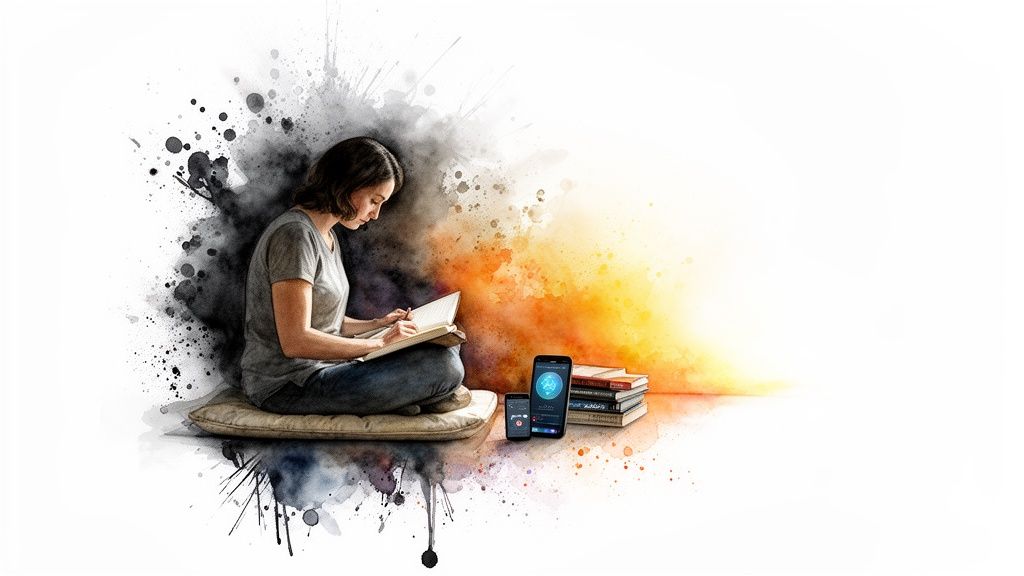
Figuring out whether you're dealing with stress or anxiety isn't just a mental exercise—it’s the starting point for taking back control. This knowledge gives you the power to pick the right tools for the job, helping you move from feeling completely overwhelmed to feeling capable. Healing isn't some far-off dream. It's a real journey made up of small, consistent steps, and it can start right now.
If anxiety has been showing up more and more in your life, you're in good company. Recent data shows that 43% of U.S. adults felt more anxious in 2024 than they did the year before. This isn't a personal failing; it's a collective response to widespread worries about the economy and current events, and it highlights just how much we need solid ways to cope.
Building Your Personal Toolkit for Calm
The path forward is all about building a personal toolkit filled with strategies that actually match what you're going through. Because stress and anxiety come from different places, they need different approaches.
When you're dealing with stress, the focus is usually on practical, external shifts. It's about getting a handle on your environment and your time.
- Effective Time Management: Break down those huge, intimidating projects into smaller, bite-sized tasks. It's a simple move, but it can turn a massive source of stress into a clear, doable plan.
- Setting Healthy Boundaries: Learning to say "no" when you're stretched thin isn't selfish—it's essential. It’s how you protect your energy and dial down the pressure from the outside world.
When it comes to managing anxiety, the work is more internal. The goal is to change the relationship you have with your own thoughts and physical sensations.
- Mindfulness and Grounding: These practices are your secret weapon for anchoring yourself in the here and now. They quiet down the endless "what-if" scenarios that fuel the anxiety engine. Simple things like specific breathing exercises for anxiety relief can make a huge difference in the moment.
- Challenging Your Thoughts: This is a cornerstone of Cognitive Behavioral Therapy (CBT). It involves learning to catch, question, and reframe those anxious thoughts that feel so real and automatic.
Here's the most hopeful truth of all: You can absolutely build the skills to manage these feelings. Recovery isn't about eliminating anxiety forever. It's about knowing exactly what to do when it shows up, so it no longer runs your life.
This journey is about building resilience, one small action at a time. To help you get started, we've laid out some practical, actionable anxiety recovery steps that offer a clear roadmap. Every step you take, no matter how small, builds momentum toward a life that feels fearless and full.
Your Questions, Answered
Getting a handle on your feelings is a huge step forward. Let's clear up a few common questions to reinforce one hopeful message: a life free from constant worry is absolutely possible.
Can Chronic Stress Turn Into an Anxiety Disorder?
Yes, it absolutely can. Think of prolonged stress as a major risk factor for developing an anxiety disorder. When your body’s stress response is always switched on, it can actually change your brain chemistry and thought patterns, leaving you more vulnerable to persistent anxiety.
It’s like forging a path in the woods—the more you walk it, the more defined it gets. In the same way, constant stress can carve deep neural pathways for worry. But this isn't a life sentence. Recognizing this link is a powerful first move, and even if anxiety has taken root, there are proven ways to create new, calmer pathways in your brain.
What Is the Best First Step if I Think I Have Anxiety?
The most empowering thing you can do right now is to educate yourself and acknowledge that what you're feeling is real and valid. Just learning the difference between being anxious and stressed is a massive leap.
From there, start gently tracking your symptoms. Notice what seems to trigger them. This simple act of mindful observation helps you step back from the feeling, seeing it as something you can manage rather than a core part of who you are. This self-awareness is the true starting point for building a fearless life and will be incredibly valuable if you decide to speak with a professional.
The most hopeful truth is that healing isn't about eliminating the normal human emotion of anxiety. It's about reducing its power until it no longer runs your life. It is entirely possible to get to a place where you are in charge, not your worries.
Is It Possible to Completely Heal From Anxiety?
Absolutely. While "cure" can be a tricky word, it is entirely possible to heal from an anxiety disorder and live a full life, free from the grip of panic and debilitating worry.
Recovery means retraining your brain’s response to triggers. It's done through consistent practice of cognitive tools, lifestyle adjustments, and effective coping strategies. Over time, these actions fundamentally change your relationship with anxiety and resolve the disorder. You can reclaim your sense of inner peace and freedom.
At The Anxiety Checklist, we believe in practical, actionable tools that guide you on this journey. Our Fearless Living system is designed to help you understand your anxiety, challenge negative thought patterns, and build the skills for a lasting sense of calm.
Learn how to start your path to a panic-free life at https://anxietychecklist.com.