
The real difference between worry and anxiety comes down to this: worry is specific and temporary, like your mind zeroing in on a single problem to solve. Anxiety, on the other hand, is a pervasive emotional and physical state that can feel vague, persistent, and overwhelming.
Getting a handle on this distinction is the first, and most powerful, step you can take toward regaining a sense of control and building a future free from panic.
Unpacking Worry and Anxiety for a Calmer Mind
Think of worry as your brain’s built-in problem-solver. It kicks into gear when you’re facing a real, identifiable challenge—an upcoming work deadline, a doctor's appointment, or a difficult conversation you need to have.
Worry lives mostly in your thoughts, often spinning out a series of "what-if" scenarios as your mind tries to find a solution. Once the situation is resolved, the worry usually dissolves with it.
Anxiety is a much bigger experience, one that involves both your mind and your body. It’s less about a specific, solvable problem and more about a lingering feeling of dread or unease that can stick around long after a stressor is gone. Sometimes, it shows up without any clear trigger at all. This isn't just a mental habit; it's a full-body physiological response that can seriously get in the way of your daily life.
The Hope in Understanding
Recognizing these signals isn’t a sign of weakness—it’s the start of a clear path toward feeling better. So many people live with the heavy weight of anxiety without realizing there are effective ways to manage it and heal. Simply being able to name what you're feeling—distinguishing a fleeting worry from a deeper anxiety—is an empowering first move toward a panic-free life.
By learning to see the difference, you shift from being a passenger in your emotional state to taking the driver's seat. This clarity illuminates the path forward, showing that a life free from constant fear and panic is not just a dream, but an achievable reality.
This understanding is key because worry and anxiety call for different approaches. You can often "solve" a worry with a plan of action. Healing from anxiety, however, means learning new skills to calm your nervous system and challenge unhelpful thought patterns. For a deeper dive, check out our guide on the connection between overthinking and anxiety.
Worry vs Anxiety: A Quick Comparison
To make it even clearer, here’s a simple breakdown of the core differences. This table can help you quickly pinpoint what you might be experiencing.
| Characteristic | Worry (Mind-Focused) | Anxiety (Body & Mind) |
|---|---|---|
| Focus | Specific and grounded in reality (e.g., paying a bill) | Often vague, free-floating, or disproportionate |
| Duration | Temporary; ends when the problem is solved | Persistent and long-lasting, even without a clear reason |
| Impact | Primarily affects your thoughts and mental state | Affects your entire being, with physical symptoms |
| Function | Can be productive, leading to problem-solving | Tends to be unproductive, causing avoidance and distress |
Seeing these differences laid out can be a relief. It helps you move from a place of confusion to one of clarity, which is the foundation for taking meaningful action toward healing.
It’s also important to remember you're not going through this alone. Globally, anxiety is the most common mental health challenge, and recognizing that fact can be a vital part of the healing process. According to the World Health Organization, anxiety disorders affected 4.4% of the global population in 2021. You can explore more about these global mental health findings on who.int.
Comparing the Physical and Mental Symptoms
Definitions are a great starting point, but the real lightbulb moment happens when you tune into how worry and anxiety actually feel—in your mind and in your body. Making this distinction isn't about self-diagnosis; it's about giving you the clarity you need to take the first step toward feeling better. When you can name what you're experiencing, you open the door to real, lasting relief and a path to a panic-free life.
Worry is almost entirely a mental exercise. It lives in your thoughts, kind of like a project manager laser-focused on a specific problem. Let's say you have a difficult conversation scheduled with your boss on Friday. Your worry might sound like this: "What are the key points I need to make? What if they push back? I should probably jot down some notes." It's a series of 'what-if' scenarios that your mind can actively try to solve. It’s contained.
Anxiety, on the other hand, is a full-body experience. It doesn't just knock on the door of your mind; it kicks it down and recruits your entire nervous system. Sticking with the same meeting example, anxiety doesn't just think—it reacts. It’s the restless nights leading up to Friday, that pit in your stomach the moment you wake up, and the tight, unshakeable tension across your shoulders. Anxiety is a visceral state of alarm.
The Mental Landscape of Worry vs. Anxiety
When you're worried, your thoughts, while maybe a bit repetitive, tend to be pretty linear and aimed at a solution. You can usually trace the line of your concern from a starting point (the problem) to a potential endpoint (the solution).
Anxiety’s mental world is far more chaotic. Instead of a straight line, it feels like a tangled storm of intrusive thoughts that loop endlessly without a clear resolution. These thoughts are often vague, catastrophic, and feel utterly out of your control, creating a sense of impending doom that isn't tied to a single, solvable issue.
Worry is like a leaky faucet—annoying, specific, and something you can fix. Anxiety is like a flood—it's everywhere at once, overwhelming your internal systems and making it impossible to find solid ground. Recognizing you're in a flood, not just dealing with a leak, is the first step to building a raft and navigating to calmer waters.
This visual summary helps break down the core feelings tied to each experience.
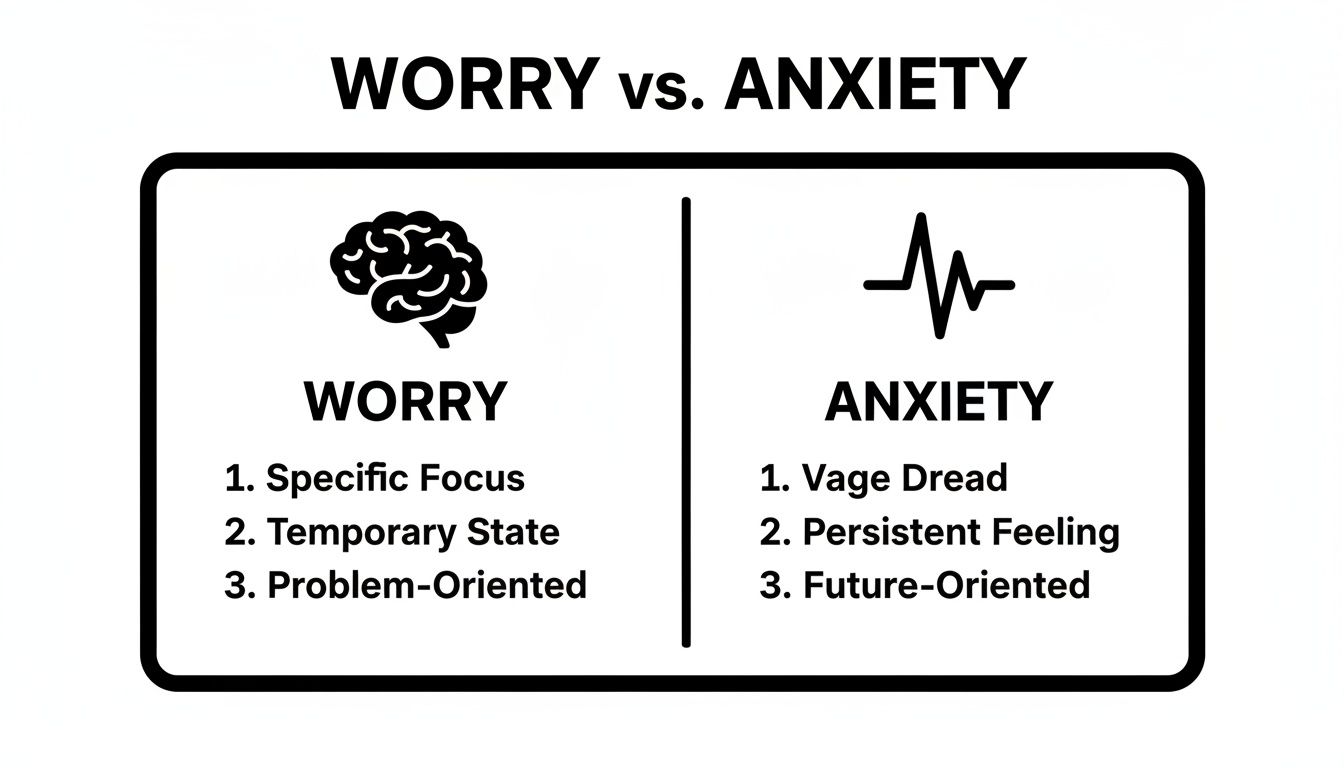
As the infographic shows, worry tends to be a specific, temporary mental event. Anxiety is a much more persistent and vague state that pulls your entire body into the experience.
How Anxiety Shows Up in Your Body
One of the clearest distinctions between the two is the profound physical toll anxiety takes. While a bout of intense worry might give you a tension headache, anxiety’s physical symptoms are widespread and persistent because they trigger your body's ancient stress response system. You can learn more about the fight or flight response in our detailed guide.
Worry typically doesn't produce these tell-tale signs of anxiety:
- A Racing Heart: That feeling of your heart pounding or fluttering, often for no clear reason.
- Shallow Breathing: A frustrating inability to get a full, deep breath, or taking rapid, shallow breaths.
- Muscle Tension: Chronic tightness that settles in your neck, shoulders, and back is a classic sign.
- Digestive Issues: Anxiety often hits the gut, leading to stomachaches, nausea, or symptoms of irritable bowel syndrome (IBS).
- Dizziness or Lightheadedness: A disorienting feeling of being unsteady or disconnected from your surroundings.
These signals aren't "all in your head"; they are very real, physiological reactions. When these symptoms show up without an obvious, immediate threat, it’s a strong clue that you're dealing with anxiety, not just worry. This awareness is so powerful because it validates what you’re feeling and points you toward real strategies for calming both your body and your mind, showing you that healing is possible.
Unfortunately, many people struggle with these symptoms without ever getting support. Globally, barriers like underinvestment in mental health mean only 27.6% of people with anxiety receive treatment, which only prolongs its hold. We saw how quickly things can escalate during the early months of the COVID-19 pandemic, when anxiety prevalence fluctuated dramatically, showing just how powerfully external stressors can trigger widespread anxiety far beyond everyday worry.
Understanding Triggers and Timelines
One of the clearest ways to tell worry and anxiety apart is to look at why they show up and how long they stick around. This isn't just a clinical distinction; it's a piece of insight that can help you see your own experience more clearly. Knowing exactly what you're dealing with is the first step toward feeling in control again and realizing a life free from panic is within reach.
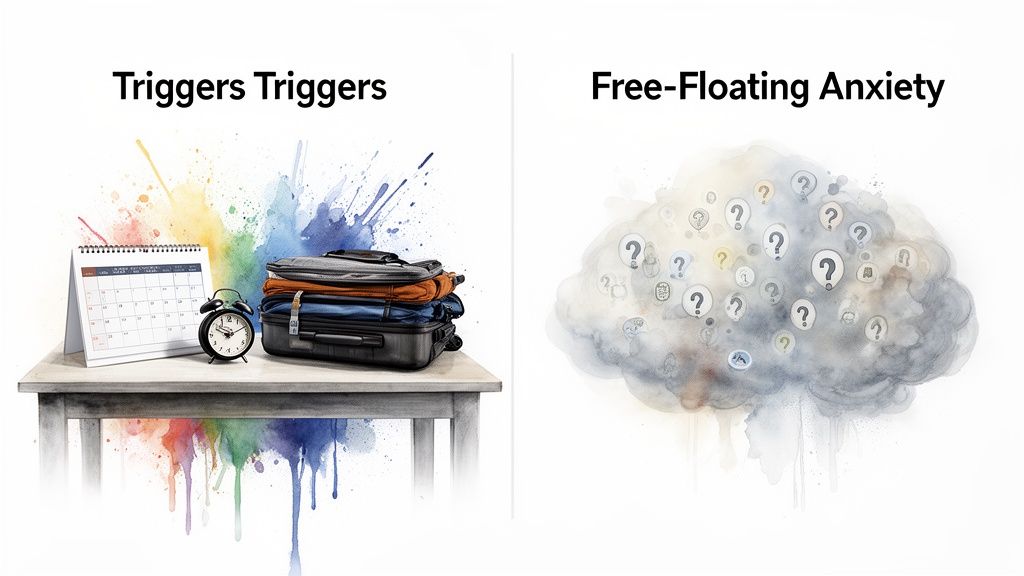
Worry is almost always connected to something specific and real. It’s your mind’s response to a tangible problem that needs solving—a looming deadline, an upcoming doctor's appointment, or a bill you’re not sure how you'll pay. You can usually point directly to the source of your concern.
Anxiety, on the other hand, can feel much more ambiguous. It’s like a fog that follows you, even on a perfectly clear day. Sometimes, it shows up without any obvious reason, leaving you with a restless, "free-floating" sense of dread that’s hard to pin down. That’s a major clue you’re in anxiety territory, not just everyday worry.
The Timeline of Concern
Just as their triggers are different, so are their timelines. Worry is a temporary guest. It arrives when a problem does and usually leaves once you've dealt with it. You worry about a presentation until you give it. You worry about the test results until they come back. Once the event is over, the worry fades.
Anxiety is more like a persistent resident. It can hang around long after a stressful event has passed or latch onto things that are months or even years away. This is what makes anxiety so exhausting. It doesn't follow a logical timeline; instead, it keeps your mind and body in a chronic state of alert.
Worry is a finite process with a clear beginning and end. Anxiety is a feedback loop, where the fear of the feeling itself can become a new trigger, creating a cycle that feels impossible to escape. But every cycle can be broken, and understanding its mechanics is the first step to dismantling it for good.
This is actually a very hopeful way to look at it. It means anxiety isn't a permanent part of who you are—it's a pattern. And patterns can be changed, paving the way for a life that isn't run by fear.
Scenario Comparison: How Worry and Anxiety Respond Differently
Let's break down how the exact same situation can trigger either a temporary worry response or a persistent anxiety response. Seeing the difference in scope and duration side-by-side can make it easier to spot your own patterns.
Recognizing these patterns is a vital part of learning how to manage them. To dig deeper, you can explore more about common anxiety triggers and gain even more insight.
| Scenario | Worry Response (Specific & Temporary) | Anxiety Response (Broad & Persistent) |
|---|---|---|
| Upcoming Flight | You double-check your flight time, pack your bags methodically, and feel a bit tense until you're through security. The feeling fades once you're settled. | You have sleepless nights for weeks, imagine catastrophic scenarios, and feel a constant dread about travel in general, not just this one flight. |
| Work Presentation | You feel nervous, so you rehearse your talking points. Once the presentation is over, you feel a wave of relief. | You fixate on every tiny detail, feel physically ill at the thought of speaking, and then ruminate on your performance for days, convinced you failed. |
| Financial Concern | An unexpected car repair bill is stressful. You create a budget, look for ways to cut costs, and make a plan. The worry lessens as you take action. | An unexpected bill triggers panic about your entire financial future, creating a constant feeling of insecurity that makes it hard to enjoy anything. |
Seeing these differences laid out so clearly is empowering. It helps you separate the experience from your identity. You are not an anxious person; you are a person experiencing a pattern of anxiety. That distinction is everything, because it means you have the power to change that pattern and live panic-free.
When Normal Worry Becomes a Clinical Concern
Knowing when everyday worry tips over into something more serious is a huge act of self-care. It’s not about being weak or flawed; it’s about recognizing that your brain and body are sending you some very important signals. This shift isn't a personal failure. It's simply the point where a normal human emotion starts to look more like a recognized medical condition—one with clear, effective ways to get better.
There’s a world of difference between worrying about life’s curveballs and being completely trapped by anxiety. The real red flags aren’t the presence of worry, but its intensity, frequency, and impact on your day-to-day life. When that feeling of dread starts calling the shots, it’s time to listen up.
Seeing your experience in this new light is the first, most powerful step you can take. It moves you out of a confusing, self-blaming headspace and into a place of clarity and action. You can finally see that what you're feeling has a name, and with that name comes a roadmap toward healing. A life free from panic is truly possible.
From Concern to Condition
The leap from worry to a clinical issue like Generalized Anxiety Disorder (GAD) happens when your internal alarm system gets stuck in the "on" position. Your mind and body are constantly braced for a threat, even when there’s nothing there.
This is when you realize your thoughts aren't productive problem-solving anymore. Instead, they've become an uncontrollable loop of catastrophic "what-ifs" that starts to spill over and disrupt everything else.
You might be crossing that line if:
- Worry feels uncontrollable: It’s like you can't turn your brain off, no matter how hard you try.
- It’s eating up your time: You spend hours every single day stuck in worried thoughts, making it impossible to focus on work, family, or things you enjoy.
- It disrupts your daily life: You find yourself avoiding social events, putting off important tasks, or struggling to sleep because the worry just won't quit.
- Physical symptoms are your new normal: You're dealing with constant muscle tension, fatigue, irritability, or stomach issues that don't have another medical explanation.
Just recognizing these signs is the first step toward getting your life back. If you want a clearer picture of where you stand, a tool like the GAD-7 anxiety test can offer some valuable, structured insight.
The Hope in Seeking Help
The statistics on anxiety can seem overwhelming, but they also carry a powerful message of hope. A huge number of people are going through this, but so many aren't getting support. It's shocking, but only about 1 in 4 sufferers actually get care, even as the global incidence hit 53.92 million new cases in 2021. This gap highlights a critical opportunity: by reaching out, you’re taking a step that millions haven't yet, putting yourself on a real path to recovery.
It's so important to understand when worry becomes a clinical issue, not just for your daily well-being but for your long-term health. Beyond the distress, there are serious risks of chronic anxiety, including its impact on your heart. Tackling it now is an investment in your future.
The most important mindset shift you can make is to see your anxiety as a treatable condition, just like any other health issue. It takes the stigma out of it and opens the door to proven strategies that can help you heal. This is not a life sentence; it’s a temporary state that you have the power to change with the right tools and support. A life free from the grip of panic and chronic fear is absolutely possible.
Your Toolkit for Managing Worry and Healing From Anxiety
Knowing the difference between worry and anxiety is the first step. Putting that knowledge into action? That’s where things really start to change and you begin to build a life free from panic.
Healing isn’t a passive waiting game. It's an active process, built on small, consistent choices that slowly but surely put you back in the driver’s seat. It's about building a personalized system—not just for coping, but for actively moving toward a life where panic and persistent fear don't call the shots. That reality is closer than you think.

The path forward really has two parts. First, you need simple, practical ways to handle the normal, everyday concerns that come with worry. Second, you need a more structured approach to calm your mind and body when anxiety starts to take over.
Taming Everyday Worry
Worry, when you keep a leash on it, is just a signal to solve a problem. The goal isn’t to get rid of it completely but to stop it from spiraling into anxiety. Here are a few solid strategies to manage those specific, temporary concerns.
Schedule a "Worry Time": Instead of letting worries hijack your day, set aside a specific 15-20 minute block to deal with them. If a worry pops up outside this time, jot it down and tell yourself you'll handle it during your scheduled session. This simple trick contains the mental chatter and helps you reclaim your focus.
Practice Structured Problem-Solving: Worry loves vague, fuzzy problems. So, get specific. Break your concern down into small, actionable steps. Ask yourself: What’s the actual problem? What are three possible solutions? What’s the very next thing I can do? This shifts your brain out of passive fretting and into active problem-solving mode.
Engage in Grounding Mindfulness: When your mind starts racing with "what-ifs," pull it back to the here and now. Use your five senses: name five things you can see, four you can touch, three you can hear, two you can smell, and one you can taste. This simple act anchors you in the present, interrupting the worry cycle before it picks up steam.
Think of these techniques as your first line of defense. They help you handle life's inevitable curveballs with a bit more calm and a lot more clarity.
A Structured Path to Healing From Anxiety
Healing from anxiety is about more than just managing your thoughts. It’s about calming your entire nervous system and building deep, lasting resilience. This is an empowering journey of teaching your body and mind that they are safe. It proves that living a life free from panic isn't just a nice idea—it's an achievable goal.
Healing from anxiety isn't about becoming fearless; it’s about becoming so skilled at managing fear that it no longer runs your life. Every small step you take to calm your system is a vote for a future where you are in charge.
A huge piece of this puzzle is building healthy habits that support your nervous system from the ground up. For instance, understanding and practicing good sleep hygiene can make a massive difference in your mental well-being and emotional regulation.
Here’s a structured way to start your healing journey:
Challenge and Reframe Anxious Thoughts: Anxiety often gets its fuel from distorted thinking patterns, like catastrophizing or all-or-nothing thinking. When an anxious thought pops up, gently question it. Ask: "What's the evidence for this? Is there a more balanced or compassionate way to see this?" This process, a cornerstone of Cognitive Behavioral Therapy (CBT), helps rewire the neural pathways that keep you stuck. To dive deeper into this powerful method, a great starting point is understanding CBT for anxiety and its core principles.
Build Resilience Through Lifestyle Adjustments: Your daily habits have a direct line to your anxiety levels. Prioritize activities that help regulate your nervous system.
- Consistent Movement: Aim for regular physical activity. It’s one of the best ways to burn off excess cortisol and adrenaline.
- Balanced Nutrition: Focus on whole foods to keep your blood sugar and mood stable.
- Mindful Connection: Carve out time for meaningful social interaction. It boosts oxytocin and pushes back against feelings of isolation.
Master In-the-Moment Calming Techniques: When the physical symptoms of anxiety hit, you need tools that signal safety to your body—right now.
- Diaphragmatic Breathing: Practice slow, deep belly breaths. This activates the vagus nerve and shifts your body out of "fight-or-flight." A simple pattern is to inhale for four counts, hold for four, and exhale for six.
- Progressive Muscle Relaxation: Systematically tense and then release different muscle groups, starting from your toes and working your way up to your head. This technique releases physical tension you might not even know you're carrying.
This toolkit isn't a quick fix; it's a sustainable system for real change. By combining practical worry management with deeper strategies for healing anxiety, you build a comprehensive defense against overwhelming fear. You are more than capable of creating a life defined not by anxiety, but by your own strength.
Your Questions on Worry and Anxiety Answered
Trying to untangle worry and anxiety naturally brings up a lot of questions. Getting clear, straightforward answers is a huge part of the journey, giving you the clarity and confidence to figure out what to do next. Every question you ask is a step away from the confusion that anxiety loves to hide in.
This isn't about finding a magic button to turn it all off. It's about realizing you have more influence over how you feel than you think. Every strategy you learn and every insight you gain builds the foundation for a life where you feel in control—not controlled by fear. A future free from constant dread is absolutely possible, and it’s built one small, powerful step at a time.
Can I Experience Both Worry and Anxiety at the Same Time?
Absolutely. In fact, it's incredibly common for them to show up together. You might have a very specific, real-world worry that ends up triggering a much bigger, more intense wave of anxiety.
Think about it this way: you’re worried about an upcoming job interview. That’s the specific concern—your performance, the outcome. But if that single event leads to weeks of sleepless nights, a racing heart every time you think about it, and a total inability to focus, anxiety has definitely joined the party.
The worry is the spark. The anxiety is the wildfire that spreads far beyond that initial problem, taking over your physical and emotional state. Seeing this overlap is the key to tackling both the specific issue and your overwhelming reaction to it, which is a vital skill for living a panic-free life.
Is It Possible for Chronic Worry to Turn into an Anxiety Disorder?
Yes, and this is a very common path. Think of worry as a mental habit. When that habit becomes chronic, uncontrollable, and starts getting in the way of your life—your job, your relationships, your sleep—it can cross the line and meet the diagnostic criteria for something like Generalized Anxiety Disorder (GAD).
The turning point isn't that you worry; it's that the worry has taken over. It's no longer a tool for problem-solving but a relentless cycle that drains your energy and steals your peace. Recognizing this transition isn't a sign of failure; it's the first, most hopeful step toward getting effective help.
When this shift happens, it means your brain's "concern" circuits are stuck in overdrive. But just like any circuit, it can be rewired. The hope lies in knowing this is a recognized condition with proven, structured treatments that can help you quiet the noise and regain control, allowing you to heal.
What Is the First Step if I Think I Have Anxiety?
The single most important first step is to talk to a healthcare professional. This could be your primary care doctor or a mental health specialist like a therapist or psychiatrist.
Taking this step is an act of real strength. A professional can give you a proper evaluation, rule out any other medical issues that might be causing your physical symptoms, and walk you through the most effective treatment options for you. Reaching out isn't admitting defeat; it’s the most direct and empowered path you can take to feeling better and starting your journey to a life without panic.
Are Coping Strategies Different for Worry and Anxiety?
While some calming techniques like mindfulness can help with both, the core strategies are often different because you're dealing with two different kinds of problems.
For Worry: Management usually centers on practical, cognitive tools. Think structured problem-solving, breaking big concerns into small, actionable steps, or even scheduling a specific "worry time" to keep it contained. These methods are designed to address the specific, solvable nature of the problem.
For Anxiety: The approach has to be broader, addressing both your mind and your body. This involves techniques to calm the physical storm—like deep breathing or progressive muscle relaxation. More importantly, it requires therapeutic work like Cognitive Behavioral Therapy (CBT) to identify, challenge, and rewire the deep-seated thought patterns fueling the anxiety cycle.
Understanding this difference helps you use the right tool for the right job, making your efforts far more effective. A life free from panic is built one skill at a time, and by being here, you've already started.
At The Anxiety Checklist, we believe understanding is the first step toward healing. Our program, Fearless Living, provides a structured, actionable system to help you move from a life dictated by fear to one defined by freedom and purpose. If you're ready to build your personalized toolkit and start your journey toward a calmer mind, we invite you to explore The Anxiety Checklist.