
Yes, anxiety can absolutely cause real, frightening chest pain. This physical sensation is a common—though deeply unsettling—result of the powerful connection between your mind and your body.
You are not imagining it, and you are not stuck with it. Understanding why it happens is the first real step toward finding lasting relief and healing.
The Surprising Link Between Anxiety and Chest Pain
If you've ever felt a sudden tightness, a sharp jab, or a dull ache in your chest during a moment of intense worry, you’ve experienced one of anxiety’s most alarming symptoms. It's so easy to jump to the worst possible conclusion.
But it’s crucial to know that emotional distress can trigger very tangible physical responses. This isn’t a sign of weakness; it’s a sign that your body's natural alert system can be recalibrated.
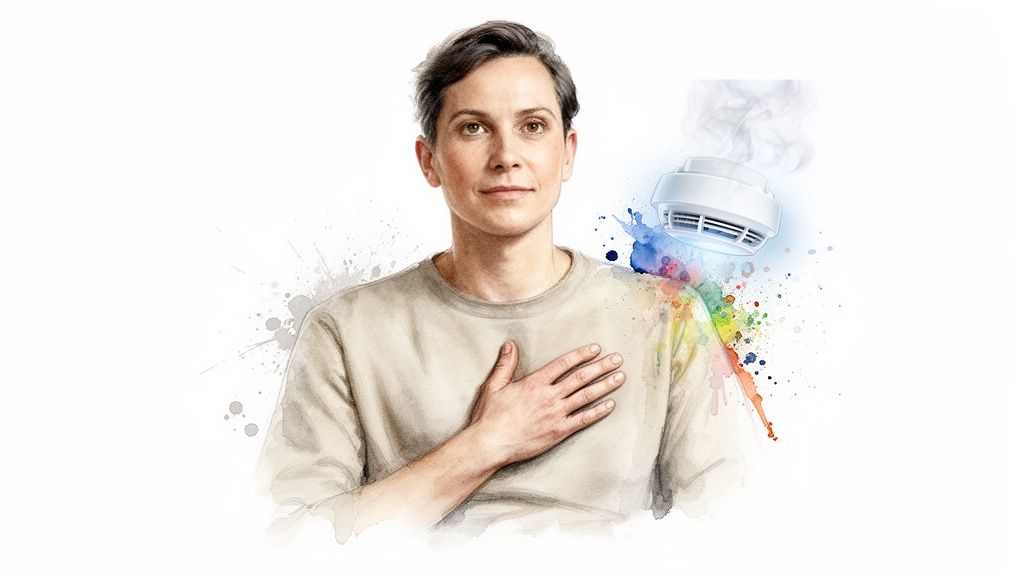
Think of your body's stress response like a highly sensitive smoke detector. A properly functioning detector is a lifesaver, alerting you to genuine danger. An overly sensitive one, though? It might blast its alarm just from a piece of burnt toast, creating sheer panic when there's no real fire. The good news is, you can learn to adjust the sensitivity.
When Your Internal Alarm Misfires
Anxiety works in a similar way. Your brain perceives a threat—whether it's a looming deadline, a tough conversation, or even just an intrusive thought—and triggers the body's emergency protocol.
This system is known as the fight-or-flight response, and it's designed for pure survival. It floods your body with hormones like adrenaline, preparing you to face a predator. But when there's no physical danger to fight or flee, these powerful physiological changes can be confusing and scary.
This is where the chest pain often comes from. The sudden muscle tension, racing heart, and changes in breathing all contribute to that very real sensation.
The key takeaway is this: The chest pain you feel is real, but the danger your mind perceives often isn't. Recognizing this disconnect is the first step toward regaining control and turning down the volume on your internal alarm. It's a skill you can build.
By understanding how anxiety causes chest pain, you can shift the narrative from fear to empowerment. You can learn to manage the physical symptoms by addressing the root cause, paving the way for a life that is no longer dictated by panic.
To better grasp this fundamental mechanism, our guide on the fight or flight response provides a deeper look into your body's programming.
How Your Body Creates Chest Pain from Worry
To get why anxiety can cause very real chest pain, let's think about your body's built-in alarm system. When your brain senses a threat—whether it’s a genuine danger or just a wave of intense worry—it doesn't stop to ask questions. It just hits the panic button.
This is your 'fight or flight' response, an ancient survival circuit designed to save your life. Your adrenal glands flood your system with a cocktail of powerful stress hormones, mainly adrenaline and cortisol. These chemicals are anything but subtle; their job is to trigger immediate, dramatic action.
And that's why your heart suddenly starts hammering against your ribs. This rapid heart rate, or tachycardia, is your body trying to pump blood to your major muscles, getting you ready to either fight off a threat or run for your life. When you’re just sitting at your desk worrying about a deadline, that powerful cardiovascular response has nowhere to go, and the force of it can feel like pressure or pain in your chest.
The Muscle Tension Factor
At the same time, adrenaline is telling your muscles to brace for impact, creating a kind of biological armor. This includes the intercostal muscles between your ribs and the pectoral muscles across your chest. When these muscles stay clenched for too long, they get tired and sore, leading to anything from a dull ache to sharp, stabbing pains.
It's like holding a heavy dumbbell with your arm extended. At first, it’s fine. But after a few minutes, your muscles start to burn and ache. Chronic anxiety puts your chest muscles in a similar state of constant tension, which is why the pain can sometimes feel like it's always there.
The pain isn't "in your head"—it's a direct physical result of your nervous system preparing for a threat that isn't actually there. Understanding this turns a terrifying sensation into a predictable, and most importantly, manageable bodily response.
The Role of Your Breathing
Maybe the biggest piece of the puzzle is how anxiety messes with your breathing. In a moment of panic, it’s common to start breathing fast and shallow. This is called hyperventilation. You start taking in too much oxygen and blowing off too much carbon dioxide.
This simple imbalance can set off a chain reaction of scary symptoms:
- Dizziness and Lightheadedness: Less CO2 in your blood can cause the blood vessels that lead to your brain to narrow slightly.
- Numbness and Tingling: Often felt in your hands, feet, or around your mouth.
- Chest Tightness and Pain: The change in your blood’s chemistry can make the muscles around your rib cage spasm, creating that classic crushing or tight feeling.
This cluster of symptoms is incredibly common during a panic attack, a sudden, overwhelming wave of intense fear. Getting familiar with what happens during a panic attack can make the experience feel less catastrophic and more manageable, transforming it from a terrifying event into a temporary one.
When Other Systems Get Involved
The body’s stress response is a full-system affair. It doesn't stop with your heart and muscles. It can also stir up trouble in your digestive system, leading to other issues that feel a lot like chest pain.
For example, anxiety can trigger esophageal spasms, which are painful contractions in the tube that connects your throat and stomach. It can also make acid reflux (GERD) worse by ramping up stomach acid production, causing a burning feeling in your chest that’s easily mistaken for something more serious.
The truth is, daily chest tightness tied to relentless worry is remarkably common. Research shows that 30% to 50% of chest pain cases brought to the ER are directly linked to anxiety, especially during high-stress periods. In fact, out of 42.5 million emergency room visits for chest pain in the U.S. between 2005-2011, over half were classified as "nonspecific"—leaving a huge window for anxiety's influence. You can learn more about the research on chest pain and its link to anxiety on Medvidi.com.
Once you see these connections, you can start to reframe the experience. The pain is a signal, not a catastrophe. It’s a sign that your body's alarm system is working overtime—it just needs to be recalibrated. And that’s a skill you can absolutely learn.
Anxiety Chest Pain vs. A Heart Attack Symptoms
In the middle of a terrifying moment, when your chest tightens and your heart hammers, one question can drown out everything else: "Is this anxiety, or am I having a heart attack?"
That uncertainty is gasoline on the fire. It feeds the panic, which in turn makes the physical symptoms even worse. Learning to spot the key differences is an incredibly powerful tool for healing. It's not a substitute for a doctor's diagnosis, of course, but it gives you a framework for understanding what's happening inside your body and reclaiming your sense of safety.
When you know what to look for, the pain from anxiety and a heart attack often feel worlds apart. Anxiety-related chest pain is usually described as sharp, stabbing, or like a localized muscle cramp. In contrast, the classic hallmark of a heart attack is an overwhelming feeling of heavy, crushing pressure—often compared to an elephant sitting on your chest.
This decision tree visualizes how the body's 'fight or flight' response can directly escalate worry into the very real physical sensation of chest pain.
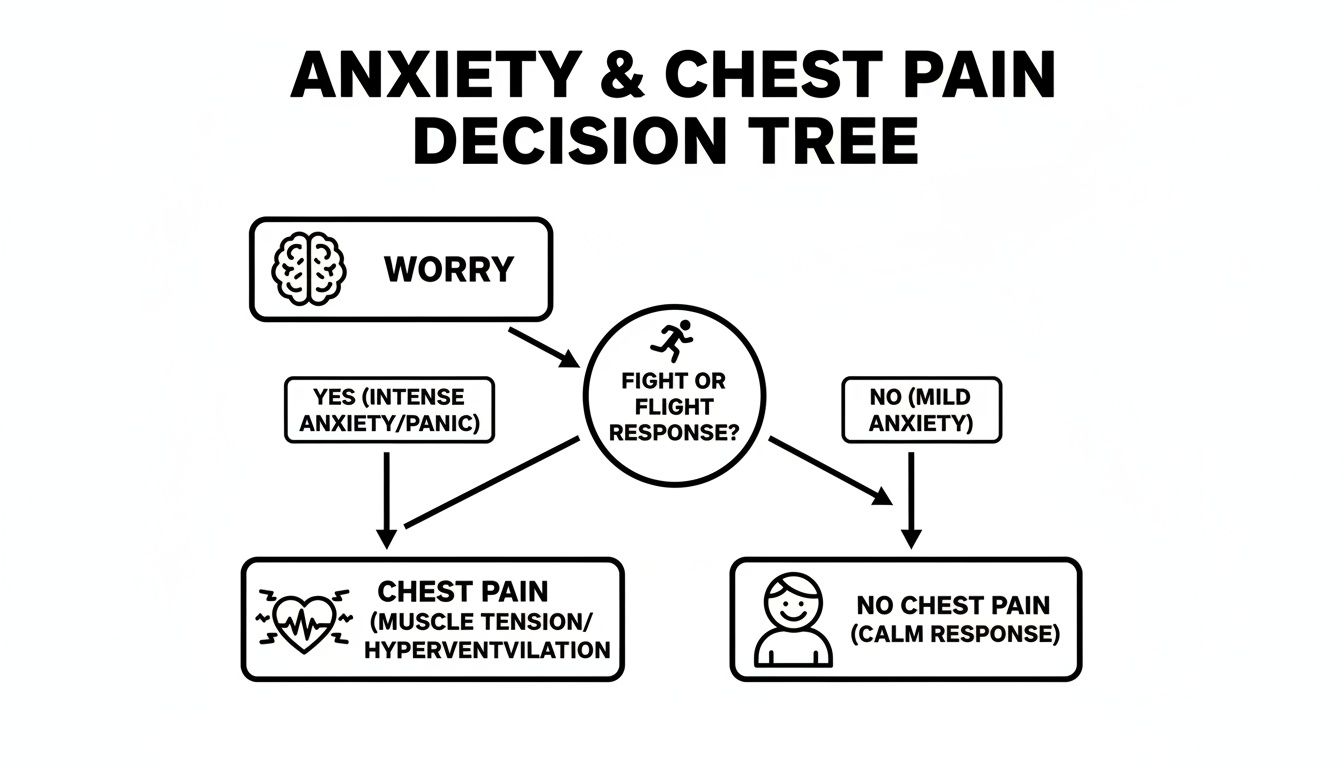
This shows that the pain, while frightening, can be a direct result of your body's intense reaction to stress.
Key Differences in Symptoms
One of the biggest clues is how the pain behaves and where it travels. Anxiety pain usually stays put. You can often point directly to where it hurts, and sometimes, pressing on the spot makes it feel worse, almost like a sore muscle.
Heart attack pain, on the other hand, often radiates from the chest. It's known to travel into the left arm, jaw, neck, back, or even the stomach. This spreading sensation is a major red flag that something more serious might be happening.
The timing offers vital clues, too. Pain from a panic attack tends to spike quickly, usually peaking within 10 to 20 minutes, and then slowly fades as your anxiety starts to come down. A heart attack is different. The pain is typically persistent and can intensify over time; it doesn't just go away when you try to calm down.
Learning to distinguish these symptoms is a vital step toward reducing fear. When you can recognize the signature patterns of anxiety, you can begin to respond with calming techniques instead of escalating panic. This is a skill that puts you back in the driver's seat.
The table below breaks down these distinctions to offer some clarity in a high-stress moment. It's a helpful guide, but remember the golden rule: when in doubt, get it checked out. Nothing is more important than your safety.
Anxiety Chest Pain vs. Heart Attack Symptoms
| Symptom Characteristic | Anxiety-Related Chest Pain | Potential Heart Attack Symptom |
|---|---|---|
| Pain Quality | Often sharp, stabbing, or a dull ache. Can feel like a muscle cramp. | Typically a feeling of intense pressure, squeezing, or crushing. |
| Pain Location | Usually localized in the center of the chest. It does not tend to move. | Starts in the chest and often radiates to the left arm, jaw, neck, or back. |
| Onset and Duration | Can come on suddenly and peaks quickly (within 10-20 mins), fading as anxiety subsides. | The pain is often persistent, may come in waves, and generally worsens over time. |
| Effect of Movement | The pain might change or worsen with movement or when pressing on the area. | The pain is typically not affected by changing your position or pressing on the chest. |
| Accompanying Symptoms | Racing heart, hyperventilation, dizziness, trembling, and a sense of impending doom. | Shortness of breath, cold sweat, nausea, vomiting, and lightheadedness. |
Knowing the typical signs can be reassuring, but it's even more critical to know when to stop guessing and get help immediately.
When You Must Seek Emergency Help
While telling the difference is powerful, there are certain red-flag symptoms that demand immediate medical attention. Don't hesitate. Call for emergency services if you experience chest pain along with any of the following:
- Pain that spreads to your arms, back, neck, jaw, or stomach.
- Shortness of breath, especially when you are at rest.
- Breaking out in a cold sweat.
- Feelings of nausea, indigestion, or vomiting accompanying the chest pain.
- Intense dizziness or lightheadedness that feels like you might pass out.
Seeking help is never an overreaction when these signs are present. Even if it turns out to be "just" anxiety, a medical evaluation provides certainty and much-needed peace of mind.
For those who are struggling to make sense of their symptoms and need support right away, exploring options to get help now can be a crucial next step. Remember, you have the power to heal, and that journey begins with both knowledge and a commitment to your own safety.
Breaking The Vicious Cycle of Pain and Panic
The chest pain itself is only half the story. The other, more powerful half is the mental spiral it kicks off—a self-feeding loop of fear that keeps you stuck. But here's the hopeful part: this cycle is a predictable pattern, and anything predictable can be interrupted and changed.
It almost always starts with a weird physical sensation. You feel a sharp jab, maybe a dull ache in your chest. Your brain, hardwired for survival, instantly leaps to the worst possible conclusion: "This has to be a heart attack." That single, catastrophic thought is the spark.
That terrifying idea immediately floods your body with a fresh wave of adrenaline, sending your anxiety through the roof. Your heart starts pounding faster, your breathing gets shallow, and those chest muscles clench even tighter. And just like that, the very pain you were afraid of gets worse.
The Feedback Loop That Fuels Fear
This sudden escalation feels like proof. Your brain thinks, "See? The pain is getting stronger. It must be serious." This confirmation triggers more panic, which in turn creates even more intense physical symptoms. You are now officially caught in the vicious cycle of pain and panic.
- Step 1 The Trigger: An unexpected physical sensation appears in your chest.
- Step 2 The Catastrophic Thought: Your mind interprets this as a sign of a life-threatening event, like a heart attack.
- Step 3 The Anxiety Spike: This terrifying thought activates your fight-or-flight response, unleashing stress hormones.
- Step 4 The Worsening Symptoms: The adrenaline rush intensifies the chest pain, muscle tightness, and heart palpitations.
- Step 5 The Confirmation: Your brain takes the worsening symptoms as proof that the initial fear was right, and the cycle repeats, gaining speed each time.
This pattern is exactly how a moment of worry can snowball into persistent health anxiety or even cardiophobia—a specific fear of heart-related problems. Before you know it, you might find yourself constantly checking your pulse, avoiding exercise, or interpreting every minor ache as a sign of impending doom.
You Are Not Alone In This Experience
If this cycle sounds painfully familiar, you are far from alone. This exact scenario plays out in emergency rooms every single day. People rush in, completely convinced they're having a heart attack, only for doctors to find their heart is perfectly healthy. It's "just" anxiety.
A key 2018 study found that anxiety contributes to chest pain symptoms in 30% to 40% of low-risk patients who visit the emergency department.
Even more telling, those with high anxiety were 2.6 times more likely to return to the ER within 30 days. For those who returned two or more times, the risk was over 9 times higher. This shows just how powerful and convincing the pain-panic cycle can be.
The most important thing to realize is that this cycle is a learned pattern, and anything that can be learned can be unlearned. Understanding how the loop works is the first, most crucial step toward dismantling it. It is not a life sentence.
Identifying this pattern in your own life is the turning point. It shifts you from being a victim of the cycle to an observer of it. A huge part of this process is learning how to stop health anxiety and reclaiming your sense of safety.
By recognizing the thoughts and feelings that fuel the loop, you can start to step in and break the chain. This is a core principle in many effective therapies. To learn more about this approach, our article on understanding CBT for anxiety is a great place to start. With awareness and the right tools, you can break free and build a life that isn't ruled by fear.
Your Toolkit for Calming Anxiety-Related Chest Pain

When chest pain strikes, the feeling of helplessness can send you spiraling. But you have far more power in these moments than you might think. This is your action plan—a set of real-world techniques for both immediate relief and long-term healing.
This isn’t just about getting through the scary moments. It's about building a foundation for a life where panic doesn't call the shots. Healing is absolutely possible, and it starts right here, with learning how to actively soothe your body and mind. Think of these strategies as the first steps on your path to lasting recovery, not just temporary fixes.
The link between a stressed-out mind and a tight chest is incredibly well-documented. What feels like a cardiac emergency is often non-cardiac chest pain (NCCP), a condition with deep roots in anxiety.
One study in Frontiers in Psychiatry found that people with NCCP had dramatically higher anxiety scores—an average of 17.18—compared to those with heart-related chest pain (8.77) and healthy individuals (6.18). This shows just how much calming your anxiety can directly soothe your physical symptoms.
Immediate Relief When Pain Strikes
When you feel that familiar tightness creeping in, your first mission is to interrupt the panic signal firing between your brain and body. These techniques are your first responders, designed to ground you in the here-and-now and dial down your nervous system.
1. Master Diaphragmatic Breathing
Anxious breathing is shallow and rapid, which only makes chest tightness worse. Diaphragmatic breathing (or belly breathing) does the complete opposite. It activates your vagus nerve, which acts like a brake pedal for your heart rate and the entire fight-or-flight response.
- Step 1: Sit or lie down somewhere comfortable. Place one hand on your upper chest and the other on your stomach.
- Step 2: Breathe in slowly through your nose for a count of four. Your goal is to feel your stomach rise and push your hand out, while the hand on your chest stays as still as possible.
- Step 3: Hold that breath for just a count of two.
- Step 4: Exhale slowly through your mouth for a longer count of six, feeling your stomach fall.
Repeat this for a few minutes. You should start to feel your body unclench. For more techniques like this, our guide on breathing exercises for anxiety can expand your toolkit.
2. Use the 5-4-3-2-1 Grounding Method
This simple exercise is a lifesaver for pulling you out of the storm of fearful thoughts. It forces your brain to switch focus from internal chaos to neutral information from your senses, breaking the panic cycle.
Look around you and name:
5 things you can see.
4 things you can feel.
3 things you can hear.
2 things you can smell.
1 thing you can taste.
This small act of observation is a powerful way to short-circuit an anxious brain and remind it that you are safe in this present moment.
Building Long-Term Resilience
While these in-the-moment tools are essential, real freedom comes from building a life where anxiety has less of a grip on you. These strategies create a foundation of calm that makes you less vulnerable to the pain-panic loop in the first place.
Challenge Fearful Thoughts
The thought "I'm having a heart attack" is pure fuel for the fire. It’s time to start questioning it. Ask yourself: "What evidence do I actually have for this? Have I felt this before? What happened the last time?" When you introduce a little logic, you weaken the thought's emotional power over you.
Incorporate Gentle Movement
You don't need a grueling workout. A simple 20-minute walk, some light stretching, or a yoga session can help your body process stress hormones like cortisol. It also releases endorphins—your body’s natural mood boosters—and helps ease the physical tension coiled in your chest muscles.
Explore Mindfulness and Supplements
Mindfulness is simply the practice of noticing your thoughts and feelings without judging them. It teaches you that a sensation (like chest pain) is just that—a sensation. It doesn't have to trigger a catastrophic story in your mind. For extra support, a magnesium glycinate supplement for sleep, anxiety, and recovery is often recommended to help calm the nervous system and improve rest.
These aren't just coping mechanisms; they are skills for life. With practice, you're building a more resilient mind and a calmer body. Every time you use one of these tools, you're actively rewiring your brain's response to fear, proving to yourself that you are in control.
Your Journey From Fear to Freedom Starts Now
You've made it this far, which tells me one thing: you're ready for a change. You've learned how anxiety can trigger very real chest pain, how to tell it apart from a heart attack, and what to do when panic strikes. But managing symptoms is just the beginning.
True recovery isn't about just coping with anxiety—it's about building a life where it no longer calls the shots. This is where you turn the page from reacting to fear to proactively building your resilience. The pain is real, but so is your power to heal and live a panic-free life.
Your New Toolkit for a Panic-Free Future
Think of it like learning to navigate a dense forest. At first, every shadow looks like a threat, and every unfamiliar sound sends your heart racing. But once you have a map and a compass—your new toolkit—you start to recognize the familiar paths. You learn to tell the difference between a rustling leaf and a real danger.
Before long, you’re walking with confidence instead of fear.
This guide is your new map. You now have a clear understanding of:
- The 'Why' Behind the Pain: You know that the fight-or-flight response is what creates those real, physical sensations. It's not "all in your head."
- How to Tell the Difference: You have a framework for distinguishing anxiety-related chest pain from a genuine cardiac emergency, giving you power over your fear.
- The Panic Cycle: You can spot the feedback loop between scary thoughts and physical symptoms, and you know how to break the chain before it spirals.
- Your Personal Toolkit: You're armed with actionable strategies for immediate relief and long-term resilience.
This knowledge is your foundation. It’s not about pretending you'll never feel anxious again, but about knowing—truly knowing—that you have the strength and the skills to move through it without letting it control you.
The path forward is about putting these insights into practice, one day at a time. Every time you use a breathing technique instead of letting panic take over, you’re literally rewiring your brain for calm. Every time you challenge a fearful thought, you weaken anxiety's grip.
This isn't an overnight fix. It’s a steady transformation from a life dictated by fear into one defined by your own choices. You have the knowledge. You have the tools. Your journey to a resilient, freer life starts with the very next step you choose to take.
Frequently Asked Questions
Getting a handle on anxiety-related chest pain is a huge step toward getting your peace of mind back. Here are some straightforward answers to the questions that come up most often when people are trying to figure this all out.
Can Anxiety Cause Chest Pain Every Day?
Yes, it absolutely can. When you're dealing with a chronic anxiety condition like Generalized Anxiety Disorder (GAD), your body can get stuck in a state of high alert. This constant "fight or flight" mode keeps your muscles clenched, especially in your chest and shoulders.
That ongoing tightness can feel like a constant, dull ache or pressure that just won't let up. It often traps you in a vicious cycle: the daily discomfort becomes another thing to worry about, which just fuels more anxiety and keeps the physical symptoms going. The hopeful news is that by learning to calm your nervous system, you can break this pattern and find lasting relief.
What Does Anxiety Chest Pain Feel Like?
It's a bit different for everyone, but some common themes pop up again and again. Many people describe a sharp, stabbing, or shooting pain, often in one specific spot. It might also show up as a general tightness, a squeezing sensation, or a dull ache that feels like you just pulled a muscle.
Unlike the pain from a heart attack, this kind of pain usually stays put—it doesn't typically radiate down your left arm or into your jaw or back. You might also notice it gets better or worse when you change position, take a deep breath, or press on the area. Almost always, it comes with other classic anxiety symptoms like a racing heart, dizziness, or that awful feeling of impending doom.
The biggest clue is often the context. If the pain flares up during a moment of high stress and arrives with a crew of other anxiety symptoms, it's very likely tied to your body's stress response—a response you can learn to manage.
How Long Can Anxiety Chest Pain Last?
The timeline is all over the place. During an intense panic attack, the chest pain often hits its peak within 5 to 20 minutes and then starts to fade as your body calms down.
But for those with more generalized anxiety, a low-grade tightness or ache can stick around for hours or even play peek-a-boo for days. The pain often acts like a mirror, reflecting your underlying anxiety levels—rising and falling with them. The best way to cut it short is to consistently use calming and grounding techniques that get to the root of the problem: the anxiety itself. This is how you move from temporary fixes to true healing.
Your journey to a calmer life is possible. At The Anxiety Checklist, we provide the structured tools and actionable strategies you need to understand your anxiety, manage your symptoms, and build a resilient, panic-free future. Start your transformation with The Anxiety Checklist today.