Living with chronic anxiety can feel like you're stuck in a storm with no compass, but this guide is your map to clear skies. We're going to explore evidence-based mental health practices—not as complicated clinical terms, but as proven, science-backed strategies that offer genuine hope and a clear path to healing.
Think of them as reliable tools that countless others have used to find their way back to a life of calm and freedom. Your journey to living panic-free can truly begin here.
Your Path to a Panic-Free Life Begins Here
If you're reading this, chances are you've felt that isolating grip of anxiety. It has a way of shrinking your world, making everyday tasks feel monumental and future plans seem impossible. It whispers that this is just how life is going to be.
But what if there was a clear, structured way forward? What if healing wasn't just guesswork, but a path lit up by science and real-world results, showing you that a peaceful life is not only possible but achievable?
This is the promise of evidence-based mental health practices. These aren't just theories; they're practical, tested methods shown to help people just like you regain control and build a life defined by joy, not fear. They offer a foundation of hope built on solid proof, assuring you that you're not alone and that solutions that actually work are within your reach.

Why Hope Is Justified
Anxiety is far from a rare struggle. In fact, anxiety disorders are the most common mental health issue on the planet, with 343.22 million cases reported worldwide.
They are incredibly common, yet the experience can feel deeply personal and isolating. The good news is that because so many people have walked this path, it has led to extensive research and the development of powerful, effective treatment strategies. If you feel overwhelmed, it's critical to know that you can get help now and start your journey toward a life of lasting peace.
"The greatest strength is admitting you need help and the greatest gift is accepting it. Healing is not a race, but a journey taken one step at a time."
This journey is about more than just managing symptoms; it’s about reclaiming your life. It involves understanding the patterns of your own mind and learning how to respond to them with compassion and skill. The goal is to live a life defined by your choices and passions, not by fear. A panic-free future is waiting for you.
What You Can Expect to Learn
Throughout this guide, we'll explore actionable and empowering ways to heal from anxiety. You don't have to feel lost in the storm any longer. Together, we'll uncover:
- Proven Therapies: We'll break down powerful methods like Cognitive Behavioral Therapy (CBT) and what makes them so effective at creating lasting change.
- Actionable Self-Help Tools: You will discover strategies you can start using today to build resilience, calm your nervous system, and step into a more peaceful way of being.
- A Personalized Plan: We'll guide you in creating a recovery plan that fits your unique needs, putting you in the driver's seat of your own healing journey.
This guide is designed to be your companion, offering clarity and encouragement every step of the way. Healing is possible, and your path to a freer, more peaceful life starts now.
What Does “Evidence-Based” Mental Health Care Actually Mean?
When you’re grappling with anxiety, the path forward can feel like a shot in the dark. You hear terms like evidence-based mental health practices, and it sounds cold or clinical. But what it really means is simple and, honestly, full of hope: your treatment isn't just guesswork. It's a proven strategy, built on a solid foundation of science and real-world success stories.
Think of it like building a bridge. You wouldn’t throw together untested materials and hope for the best. You'd rely on engineering principles that have been tested over and over again—methods proven to be strong, safe, and reliable. Evidence-based care brings that same level of rigor to your mental well-being. It ensures the approach you take has been scientifically studied and shown to help people find their way out of anxiety and into a calmer life.
The Three Pillars of Effective Care
This approach isn’t just about what some textbook says. True evidence-based practice is a partnership that rests on three essential pillars. It’s a dynamic process, blending different kinds of wisdom to create a plan that fits you perfectly.
These three components come together to form a powerful, personalized strategy for your healing:
- The Best Scientific Research: This is the bedrock. It’s built on findings from countless studies that pinpoint which therapies and techniques consistently help people reduce anxiety and live panic-free.
- The Clinician’s Expertise: A skilled therapist brings years of hands-on experience and insight to the table. They know how to take those proven methods and adapt them to your unique situation, guiding you with compassion every step of the way.
- Your Values and Preferences: This is the most crucial part. Your voice matters. Your goals, your beliefs, and what feels right to you are at the very center of a treatment plan you can truly connect with and stick with.
This balanced approach makes sure you are an active participant in your own recovery. It’s not about being told what to do; it’s about co-creating a hopeful path toward a calmer, more grounded life.
Why This Approach Offers Real Hope
The power of evidence-based practices is in their reliability. They cut through the noise and offer a clear framework for understanding and healing from anxiety. For instance, therapies like Cognitive Behavioral Therapy (CBT) have decades of research backing them up, showing just how effective they are at helping people reframe anxious thoughts and reclaim their lives. Learning more can be a powerful first step, and our guide on understanding CBT for anxiety is a great place to start.
Sadly, there’s a huge gap between the need for mental health care and the help people actually receive. Globally, only 6.9% of people with mental health or substance-use disorders get effective treatment. This staggering statistic underscores why accessible, evidence-based self-help tools are so vital. They offer proven coping mechanisms and panic-handling skills, bringing hope to those facing barriers to traditional care. You can discover more about this global treatment gap and see why accessible solutions are so important.
By grounding your recovery in proven methods, you’re building your own bridge away from the constant storm of anxiety. You’re moving toward a future where you are in control. It's a structured, hopeful, and achievable path to living panic-free.
Proven Therapies That Bring Relief from Anxiety
Navigating the world of mental health can feel like a maze, but a few powerful, well-researched therapies stand out as clear paths forward for those healing from anxiety. These aren't just theories; they are structured, practical approaches that have helped millions reclaim their lives from fear. Think of them as well-trodden trails leading back to a place of calm and control.
At its best, evidence-based mental health care creates a partnership. It blends solid scientific research with a clinician’s hands-on experience and, most importantly, your own personal needs and values.
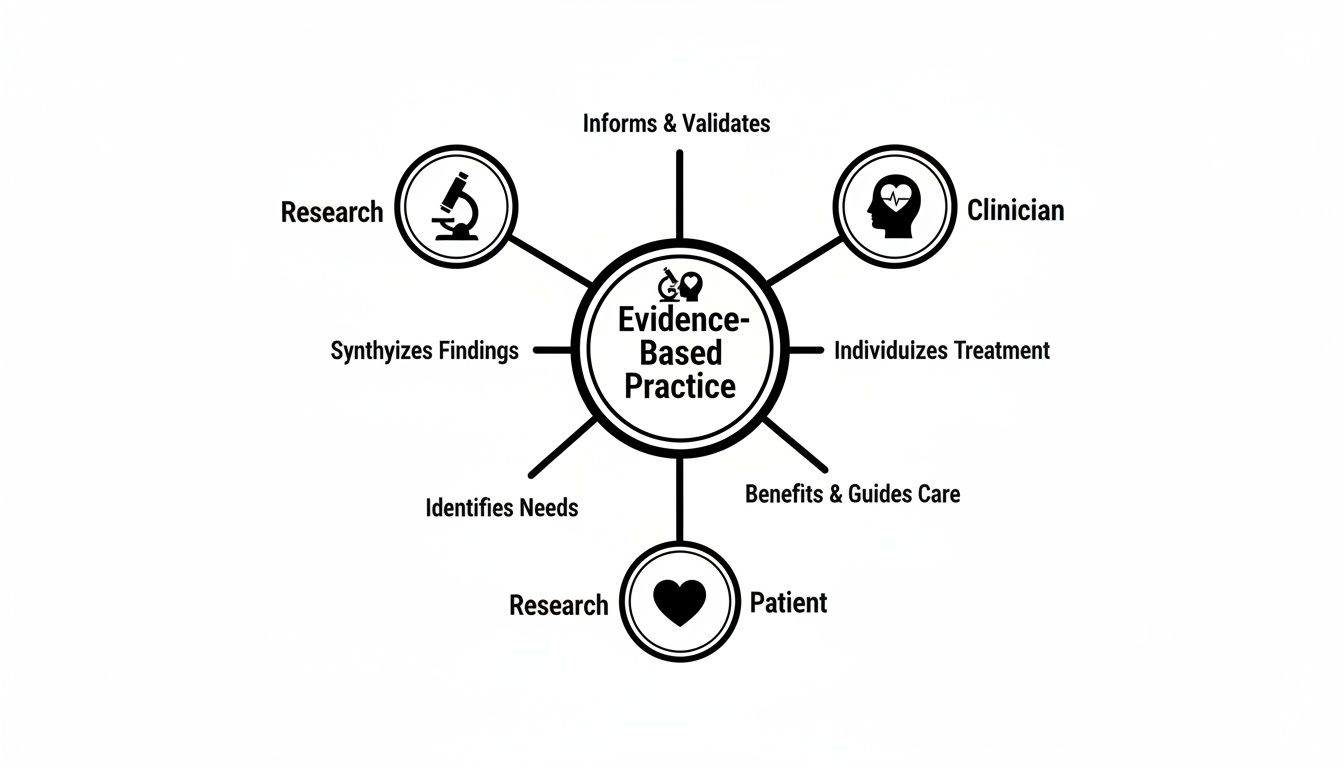
This diagram shows that your recovery isn't something dictated to you—it’s a collaborative effort. This ensures your treatment is not only proven to work but is also a perfect fit for you. Let’s dive into three of the most effective therapies for finding lasting relief from anxiety.
Cognitive Behavioral Therapy (CBT)
Cognitive Behavioral Therapy (CBT) is one of the most successful and deeply researched therapies for anxiety disorders. Its power comes from a simple, hopeful idea: our thoughts, feelings, and behaviors are all tangled together. It’s rarely the situation itself that causes anxiety, but the meaning we attach to it—and we have the power to change that meaning.
Imagine you have a big presentation coming up. A thought like, "I'm going to mess this up and everyone will think I'm incompetent," is guaranteed to trigger intense anxiety. CBT teaches you to act like a detective for these automatic negative thoughts. You learn to spot them, question their validity, and gently reframe them into something more balanced and true.
CBT isn't about slapping on a fake smile or forcing positive thinking. It’s about building a more accurate, less fear-driven perspective so you can respond to life with confidence instead of dread.
By challenging the distorted reality that anxiety creates, you fundamentally change your emotional and behavioral reactions. This is how you break the cycle of panic and avoidance for good.
Exposure Therapy
For most of us, the gut reaction to fear is to run the other way. Scared of crowded places? You stop going to the mall. Terrified of public speaking? You turn down promotions. Exposure Therapy empowers you to break free from this cycle by helping you gradually and safely face the things you fear.
That might sound intense, but it’s done in a very controlled, supportive way. It’s like slowly wading into a pool instead of being thrown into the deep end. You and your therapist will create a "fear ladder"—a list of feared situations, ranked from least to most scary. You start on the bottom rung, building confidence and only moving up when you feel ready.
Someone with a fear of dogs, for instance, might start by just looking at photos of dogs. Then they might watch a video, stand across the street from a dog on a leash, and so on.
- You start small. Each step is manageable and designed to build your confidence and prove you can handle it.
- You learn through experience. You stay in the situation long enough for your brain to realize the feared outcome doesn't happen, replacing fear with a sense of mastery.
- You retrain your brain. Your brain forms a new, safer association with the trigger, and the fear dissolves.
This process, called habituation, rewires your brain’s fear response. If you want to dig deeper into this powerful technique, you can learn more about how exposure therapy works for anxiety. Over time, the anxiety fades, and you get back the freedom that avoidance stole from you.
Acceptance and Commitment Therapy (ACT)
While CBT is about changing your thoughts, Acceptance and Commitment Therapy (ACT) takes a different, incredibly liberating route. It teaches you to change your relationship with your anxious thoughts and feelings. Instead of trying to win an endless battle against anxiety, ACT helps you make room for it without letting it run your life.
The core idea is to stop wrestling with your own mind. Imagine your anxiety is like quicksand—the more you struggle, the deeper you sink. ACT teaches you to stop struggling and, instead, observe your thoughts and feelings from a distance, like watching clouds drift by in the sky.
This is done through mindfulness techniques and by getting clear on your core values—what truly matters to you. You learn to accept the presence of discomfort while taking committed action toward a life you love.
- Acceptance: Allowing thoughts and feelings to be there without fighting them, which paradoxically reduces their power.
- Defusion: Seeing thoughts as just thoughts, not facts (e.g., "I'm having the thought that I'll fail" instead of "I'm going to fail").
- Committed Action: Moving toward your goals and living your values, even if anxiety comes along for the ride.
ACT empowers you to live a rich, meaningful life alongside your anxiety, rather than putting everything on hold until it’s gone. This simple shift in perspective can be profoundly freeing.
Comparing Top Evidence-Based Therapies for Anxiety
| Therapy | Core Principle | Best For |
|---|---|---|
| Cognitive Behavioral Therapy (CBT) | Change your relationship with your thoughts by identifying, challenging, and reframing negative thinking patterns. | Generalized anxiety, panic disorder, and social anxiety by building practical coping skills for lasting change. |
| Exposure Therapy | Gradually and safely confront feared situations to prove to your brain that you are safe and capable. | Phobias, panic disorder, social anxiety, and PTSD where avoidance has shrunk your world. |
| Acceptance and Commitment Therapy (ACT) | Accept anxious thoughts without judgment and commit to actions aligned with your personal values. | Individuals who feel stuck in a constant battle with their thoughts and want to live a fuller, more meaningful life despite anxiety. |
Each of these therapies offers a proven path toward relief, but the best one for you depends on your specific challenges and goals. The good news is you don't have to choose just one—many therapists blend these hopeful approaches to create a plan that fits you perfectly.
Powerful Self-Help Strategies You Can Use Today
Healing from anxiety doesn't just happen inside a therapist's office. Real, lasting change is often built through powerful, evidence-based practices you can weave into your daily life, moment by moment. These strategies empower you to become an active participant in your own healing journey, turning abstract concepts into concrete actions that build resilience and calm a racing mind.
Think of these self-help tools as your personal support system, available to bring you comfort and strength whenever you need them. They’re grounded in the same scientific principles as formal therapies but designed for you to use on your own terms. By embracing them, you’re taking a huge, hopeful step toward reclaiming control from anxiety.
Calming Your Mind with Mindfulness and Meditation
Mindfulness is simply the practice of paying attention to the present moment without judging it. When anxiety takes over, it loves to drag your mind into a spiral of future "what-ifs" or past regrets. Mindfulness is the gentle antidote—it anchors you firmly in the safety of the here and now, which can immediately dial down the intensity of panic.
Meditation is the workout you do to build your mindfulness muscle. Even just 5-10 minutes of daily meditation has been shown to calm the nervous system and actually reshape the brain's response to stress over time. It teaches you to observe your anxious thoughts from a distance, realizing you are the sky, not the storm cloud passing through.
Ready to start? It's simpler than you think:
- Mindful Breathing: Just focus on the feeling of your breath coming in and going out. When your mind inevitably wanders, gently and kindly guide it back. No judgment needed.
- Body Scan Meditation: Lie down and bring your attention to different parts of your body, one by one. From your toes to the top of your head, just notice whatever sensations are there with gentle curiosity.
- Guided Meditations: Don't want to go it alone? Use an app or online video to have an instructor walk you through a calming practice.
Controlled breathing is a game-changer during moments of high anxiety. If you need some practical methods you can use right away, there are many breathing exercises for anxiety that can provide immediate, powerful relief.
The Foundational Role of Lifestyle Adjustments
Your mental and physical health are deeply connected; you can’t truly have one without the other. That’s why making simple, consistent tweaks to your daily habits can build a powerful foundation of resilience, making your mind a more peaceful place to live.
By prioritizing your body's needs, you are not just improving your physical health—you are actively creating an internal environment where anxiety is less likely to thrive. It’s one of the most direct and empowering forms of self-care.
Think of these three areas as the non-negotiable pillars of your well-being:
- Sleep: Aim for 7-9 hours of quality sleep a night. When you're sleep-deprived, your brain's fear centers become more reactive. Restorative sleep is a cornerstone of a calm mind.
- Nutrition: What you eat directly impacts your mood and energy. Focus on whole foods and notice how caffeine and sugar affect you—for many, they can trigger or mimic anxiety symptoms.
- Exercise: Regular physical activity is one of the most potent anxiety reducers available. It helps burn off stress hormones like cortisol and releases feel-good endorphins. Even a simple 30-minute walk can make a world of difference.
Making lifestyle changes to improve your overall health is a fantastic way to manage stress and, in turn, heal anxiety. You can also explore natural ways to boost your immune system and manage stress to further support your well-being.
Using Structured Self-Help Tools for Consistency
The path to a calmer life is paved with consistent action, not just good intentions. This is where structured self-help tools become so valuable—they help you turn what you want to do into what you actually do. They provide a clear framework for applying all the cognitive and behavioral strategies that lead to healing.
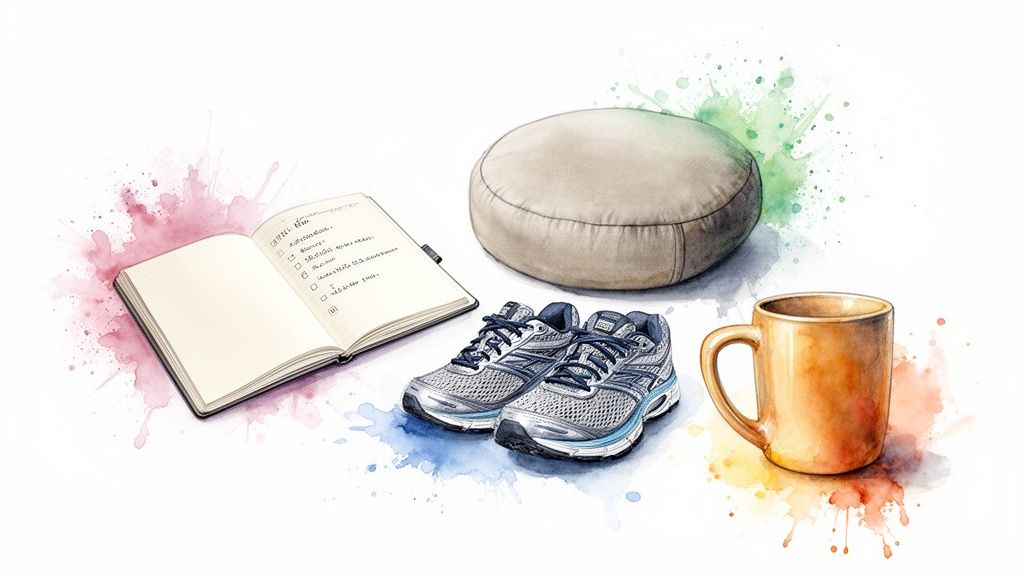
Things like checklists, journals, and progress trackers are more than just to-do lists; they become your personal accountability partners on this hopeful journey. They help you:
- Monitor Progress: Seeing how far you’ve come is incredibly motivating and proves that your efforts are creating real change.
- Identify Patterns: Tracking your symptoms and triggers can reveal powerful insights you might otherwise miss.
- Apply Strategies: A checklist can be the perfect prompt to challenge a negative thought or practice a breathing technique right when you need it most.
Tools like The Anxiety Checklist are designed specifically to bridge that gap between knowing what to do and actually doing it. They guide you in systematically building healthy habits, monitoring your mental state, and applying evidence-based mental health practices consistently. This active, manageable process gives you an immediate and actionable way to support your journey to a calmer, more fulfilling life.
How to Build Your Personalized Anxiety Recovery Plan
Your path to a calmer life is uniquely yours. While evidence-based practices offer proven roadmaps, your personal journey requires a plan that feels right for you. Crafting this plan isn't about finding a single magic bullet; it's about thoughtfully combining different strategies to create a support system that empowers you every single day.
Building this plan turns an overwhelming goal into a series of small, achievable victories. It’s a process that restores your sense of control and reminds you that healing is not just possible—it’s already happening, one step at a time.
Starting Small and Tracking Your Wins
The first step toward lasting change is often the smallest one. Don't aim to eliminate all anxiety overnight. Instead, focus on adding just one new, hopeful habit.
Maybe that's a five-minute breathing exercise each morning or a short walk after dinner. The key is to make it so manageable that it’s hard to skip, setting yourself up for success.
Once you start, tracking your progress is vital. This isn't about judging yourself; it's about gathering your own personal evidence of healing. A simple journal or a tracker can help you notice the subtle shifts—a panic attack that felt a little less intense, or a morning where you felt a bit more at ease.
Celebrating these small wins is a powerful act. It retrains your brain to look for progress instead of fixating on setbacks, building the momentum and confidence you need to keep moving forward on your healing path.
This process of starting small and tracking progress is fundamental to recovery. For a more detailed walkthrough, our guide on anxiety recovery steps provides a structured approach to help you on your way.
Knowing When to Seek Professional Support
Self-help strategies are incredibly powerful, but you never have to walk this path alone. Recognizing when it’s time to bring in professional support is a sign of strength, not weakness. You're the expert on your own experience, and trusting that gut feeling is a crucial act of self-care.
Consider reaching out for help if:
- Your anxiety consistently gets in the way of your daily life, work, or relationships.
- Your self-help efforts just aren't making a dent, or you feel completely stuck.
- You find yourself relying on unhealthy coping mechanisms to get by.
- You simply want the compassionate guidance and accountability that a trained professional can provide.
It's important to remember that the global need for mental healthcare often outpaces available resources. Over 1 billion people worldwide live with mental health conditions, yet government investment often remains low. Well-designed self-help systems, with tools like symptom trackers and in-depth guides, play a critical role in bridging this gap, bringing hope and proven, accessible strategies to everyone.
Advocating for Your Own Care
When you do decide to speak with a doctor or therapist, remember this: you are not a passive patient. You are an active partner in your own care. You have the right and the power to ask questions and advocate for the treatment that feels right for you.
Come to your appointments prepared. It helps to bring a list of your symptoms, what you’ve already tried, and what your hopes are for the future. Don't be afraid to specifically discuss evidence-based mental health practices like CBT or ACT if they resonate with you.
Here are a few questions you can ask to get the conversation started:
- What is your experience helping people heal from anxiety?
- Which evidence-based approaches do you typically use?
- How can we work together to create a personalized treatment plan?
- How will we measure progress along the way?
Taking ownership of your healing process is the most empowering step you can take. By building a personalized plan, you are not just hoping for a calmer life—you are actively creating it.
Common Questions About Managing Anxiety
Taking that first step toward recovery can feel like a mix of hope and a whole lot of "what ifs." It’s completely normal to have questions swirling around as you start looking into evidence-based practices. This section is here to tackle those common concerns head-on, giving you clear, hopeful answers that light up the path forward.
Feeling unsure is part of the process, but it doesn't have to be a roadblock. By answering these questions now, we can swap out that doubt for confidence and get you moving with a renewed sense of purpose. A calmer life isn't just a nice idea—it's absolutely possible, and these answers can help show you the way.
How Long Will It Take to Feel Better?
This is usually the first question on everyone's mind, and the most honest answer is: it's different for everyone, but change begins the moment you start. There’s no magic timeline for healing from anxiety. Your journey is uniquely yours, shaped by your own history, the specific hurdles you're facing, and how consistently you put new strategies into practice.
But that doesn't mean relief is a distant dream. Many people start noticing small, yet powerful, shifts within just a few weeks of using evidence-based tools. It might be handling a stressful moment a little more smoothly or realizing a wave of panic passed quicker than usual.
The goal isn't a race to some finish line called "cured." It's about stacking up the small wins—each one building your confidence and proving that you have the power to heal. Focus on the progress, not the clock, and trust the journey.
The real key here is consistency. Just like building muscle at the gym, your mental resilience grows with regular practice. Every single time you challenge an anxious thought or use a breathing exercise, you’re carving out a new neural pathway. You're making it easier and more natural for your brain to choose calm over panic next time.
What if I Have a Setback?
Let's get one thing straight: setbacks aren't just possible; they're an expected, normal part of any meaningful healing journey. Having a rough day or an unexpected panic attack doesn't mean you've failed or erased all your hard work. In fact, it's quite the opposite.
Think of it like learning to ride a bike. You’re going to wobble. You’ll probably fall a few times. But every fall teaches you something new about balance and how to adjust. A setback on your anxiety journey is the exact same thing—it’s a learning opportunity. It gives you priceless intel on your triggers, which coping skills are working, and where you might need a little extra support.
When a setback hits, try meeting it with compassion and curiosity instead of criticism:
- Acknowledge the feeling: Don't try to fight it off. Just name it with kindness: "Okay, I'm feeling overwhelmed right now, and that's understandable."
- Look for the trigger: What was going on right before the anxiety spiked? Was it a specific thought, a place, a conversation?
- Re-engage your tools: This is the perfect moment to put your strategies to work. Use a grounding technique, do a quick breathing exercise, or just get your thoughts down on paper.
- Remember how far you've come: Look back. One tough day can't undo all the stronger, more peaceful days you've already had.
A setback is just a detour, not a dead end. It’s a sign that you’re pushing boundaries and stepping out of your comfort zone—and that’s exactly where real, lasting growth happens.
Can I Really Overcome Anxiety on My Own?
Absolutely. Many people make incredible progress and heal from anxiety using structured self-help tools and lifestyle changes. The real power of evidence-based mental health practices is that many of their core principles—like cognitive reframing and mindfulness—are skills you can learn and apply all on your own to create profound change.
A self-led approach works best when you have a clear, reliable system to follow. Tools that offer a structured framework, like a checklist or a guided journal, can be game-changers. They turn abstract ideas into a concrete plan of action, giving you a much-needed sense of direction and control on your healing path.
But "on your own" shouldn't mean "all alone." Building a support system is a non-negotiable part of any solid recovery plan. This might look like:
- Trusted friends or family you can be open with.
- Online communities or support groups where you can connect with people who just get it.
- Structured resources that act as your guide, giving you expert advice and a steady source of encouragement.
At the end of the day, you're the one doing the work, but you don't have to do it in a vacuum. If you ever feel stuck or if anxiety is seriously impacting your life, reaching out to a therapist is a powerful and courageous next step. Many people discover that a mix of self-help and professional support is the most effective path forward. The journey is yours to shape, and you get to decide who's on your team. Recovery is possible, and there's so much hope for a future defined by freedom, not fear.
Ready to turn knowledge into action and build your personalized path to a calmer life? The Anxiety Checklist provides a complete, step-by-step system based on proven strategies. Stop letting anxiety run your life and start building the fearless future you deserve.
Take the first step and get your copy of The Anxiety Checklist today!