
Building your mental resilience isn’t about becoming unbreakable. It’s a journey of reclaiming your inner strength, one small, intentional step at a time. It’s about learning practical tools for your mind, creating daily habits that ground you, and building a support system that actually supports you.
This is how you go from a life dictated by fear to one defined by your own courage. It is your path toward healing from anxiety and living a life free from panic.
Your Path to a Panic-Free Life Begins Here

If anxiety has been steering your life and panic attacks have been stealing your peace, I want you to know something deeply: healing is possible. This guide is built on the belief that you already hold the power to reclaim your life—not just survive it, but truly live it, free from panic.
Let's start by redefining what mental resilience actually means. Forget the old idea of building an unbreakable shield or just ignoring your feelings. True resilience is the incredible ability to bounce back from adversity, learning and growing stronger each time.
It’s about feeling the fear and moving forward anyway, armed with tools that actually work. This is the path to a calmer, more peaceful life.
You Are Not Alone on This Journey
Feeling crushed by anxiety can be incredibly isolating, but you are so far from alone. The numbers are staggering—over 1 billion people worldwide live with a mental health disorder. Anxiety and depression are the most common, impacting an estimated 301 million and 280 million people, respectively.
This isn't a sign of weakness; it’s a shared human challenge in a world that asks too much of us. And just as millions share this struggle, countless people have found their way to healing—and you can too.
The goal isn't to become unbreakable. It's to become so resilient that you trust your ability to get back up, no matter what life throws your way. This is the foundation of a panic-free life, and it is entirely within your reach.
What This Guide Offers You
This is more than just a list of tips; it's a practical, compassionate roadmap grounded in real experience. Think of it as your first step toward building a life defined by courage, not by anxiety, and filled with hope for a panic-free future.
I've put this guide together to give you a clear roadmap for what we'll cover. Here’s a quick look at the core strategies we'll be diving into on your journey to resilience.
Your Resilience Toolkit At a Glance
| Strategy Area | What You Will Learn | Primary Benefit |
|---|---|---|
| Cognitive Reframing | Simple but powerful methods to challenge anxious thoughts and regain control of your mind. | Interrupts negative thought cycles and reduces their power. |
| Daily Resilience Habits | Small, consistent routines designed to soothe your nervous system and build a strong foundation of calm. | Creates a baseline of stability, making it harder for anxiety to take hold. |
| Panic Attack Protocol | A clear, step-by-step plan to use when you feel a panic attack starting, helping you stay grounded. | Empowers you to manage acute episodes, reducing the fear of the fear itself. |
| Building Support | Practical ways to identify and nurture relationships that provide genuine strength and understanding. | Ends the feeling of isolation and provides a safety net during tough times. |
| Progress Tracking | Worksheets and logs to help you monitor your journey, recognize your wins, and identify patterns. | Provides tangible evidence of your growth and keeps you motivated. |
| Relapse Prevention | Strategies to prepare for setbacks and view them as learning opportunities, not failures. | Builds long-term confidence and ensures you can handle future challenges. |
Each of these areas builds on the last, creating a comprehensive system for not just coping with anxiety, but truly thriving despite it.
Gaining a foundational understanding of emotional regulation and resilience is a vital first step. This guide gives you the tools to put that knowledge into practice. We’ll show you exactly what to do during a https://anxietychecklist.com/panic-attack to feel more in control.
Let's get started on your path to healing.
Master Your Mind with Practical Cognitive Tools

Anxiety often feels like an inner critic stuck on repeat, trapping you in endless cycles of "what ifs" and worst-case scenarios. That constant mental noise is exhausting.
But here’s the most important thing to know: you can learn to turn down the volume. There’s a clear path to healing from anxiety and living a panic-free life, and it all starts with understanding the thoughts that fuel the fire.
This section is your practical toolkit for silencing that harsh inner voice. We’re moving beyond vague advice like “just be positive” and diving straight into actionable cognitive techniques you can use the moment an intrusive thought strikes. This is how you retrain your brain to become your ally, not your enemy.
Spotting Your Anxious Thought Patterns
Before you can change your thoughts, you have to recognize them for what they are: patterns, not facts. Anxious thinking loves to rely on a few common cognitive distortions—flawed ways of seeing the world that feel completely true in the heat of the moment.
Think of these distortions as sunglasses that tint your reality with a shade of fear. Learning to spot them is the first step toward taking them off.
Here are a few of the most common culprits:
- Catastrophizing: This is the classic "what if" spiral. A small concern, like an unusual email from your boss, instantly becomes a prediction of being fired. It takes a tiny spark and turns it into a raging inferno.
- All-or-Nothing Thinking: Also known as black-and-white thinking, this distortion leaves zero room for nuance. If you aren't a runaway success, you see yourself as a total failure. One mistake at work means your entire career is doomed.
- Mind Reading: You assume you know exactly what others are thinking, and it’s almost always negative. You might walk past a coworker who seems distracted and immediately think, “They’re upset with me,” without a shred of actual evidence.
Just recognizing these patterns is a huge victory. It creates a small but powerful gap between you and the thought, giving you the space to question it instead of automatically accepting it as truth. This simple act of awareness is a profound step toward healing.
Challenging and Reframing Your Thoughts
Once you can spot a distorted thought, your next move is to challenge it. This isn't about arguing with yourself or forcing toxic positivity. It's about becoming a gentle but firm detective, looking for the actual evidence.
A powerful method for this comes from Cognitive Behavioral Therapy (CBT), a proven approach for managing anxiety. For a deeper dive into how it works, you can explore this guide to understanding CBT for anxiety.
Let’s walk through a real-world scenario.
The Scenario: You send a text to a friend, and they don't reply for several hours.
- The Anxious Thought (Catastrophizing): "They must be angry with me. I've done something wrong, and now our friendship is ruined."
- The Challenge (Gathering Evidence): Ask yourself: What's another possible explanation? Could they be busy at work? Is their phone off? Has this happened before and turned out to be nothing?
- The Reframe (A Balanced Thought): "My friend is probably just busy. I have no real evidence they're mad at me. I'll wait and see what they say when they have a moment."
This process interrupts the anxiety spiral before it can gain momentum. It teaches your brain that the first, fear-based conclusion isn't the only one—or the most likely one—available. Each time you do this, you are carving a new, more hopeful neural pathway.
Detaching from Your Thoughts with Cognitive Defusion
Sometimes, challenging a thought directly can feel like wrestling with it, which only gives it more energy. For those moments, there's another powerful technique called Cognitive Defusion.
Instead of fighting with your thoughts, Cognitive Defusion teaches you to observe them from a distance. The goal is to see your thoughts as just thoughts—passing mental events—not as commands you must obey or truths you must believe.
Imagine your thoughts are just clouds passing in the sky. You can notice them, observe their shape and color, and simply watch them float by without getting swept up in a storm.
Here are two simple ways to practice this:
- "I'm Having the Thought That…" When a difficult thought arises, like "I'm going to fail this presentation," just add this simple phrase before it. Saying, "I'm having the thought that I'm going to fail" creates immediate distance. You are not your thought; you are the one observing the thought.
- Thank Your Mind: When your brain offers up a classic worry, you can say, "Thanks, mind, for trying to protect me." This acknowledges the thought without validating it. It’s like politely declining a suggestion from a well-meaning but overly cautious friend.
These tools aren't about eliminating anxious thoughts forever. That’s an impossible goal. Instead, they are about changing your relationship with them. By practicing these techniques, you build the mental muscle to see thoughts for what they are—and choose not to let them run your life. This is a liberating step toward a panic-free existence.
Build a Daily Routine That Calms Your Nervous System
Resilience isn't something you find in a single, heroic moment. It's built quietly, day by day, in the small, intentional choices you make. If your nervous system feels like it's constantly on high alert, creating a daily routine is one of the most powerful ways to send it a clear message of safety and stability.
This isn't about piling more tasks onto an already overwhelming plate. It's about designing a simple, sustainable structure that actively soothes your body and mind, creating a buffer against the chaos that anxiety loves. This is how you lay the foundation for a life with more peace and less panic.
Start Your Day with Intention, Not Reaction
How you spend the first 30 minutes of your day can set the tone for the next 16 hours. Most of us wake up and immediately grab our phones, flooding our brains with news, emails, and social media notifications. This reactive start instantly puts our nervous system on the defensive.
Instead, let's create a simple morning ritual that grounds you before the world rushes in. This doesn't need to be complicated or take a ton of time.
- Hydrate First: Before you even think about coffee, drink a full glass of water. It's a simple act of self-care that tells your body you're starting the day by meeting its needs.
- Five Minutes of Stillness: This could be a short mindfulness exercise or just sitting quietly with your eyes closed, focusing on your breath. The goal is to connect with yourself before you connect with your phone. Our guide on meditation for anxiety has some practical starting points if you're new to this.
- Gentle Movement: A few simple stretches or a quick walk can release the physical tension that stress stores in your body. This physical release sends calming signals straight back to your brain.
This intentional start shifts you from a state of frantic reaction to one of proactive calm, building a little bit of resilience before you even face your first challenge of the day.
Fuel Your Brain and Body for Stability
The link between what you eat and how you feel is profound, yet it's often the last thing we look at when tackling anxiety. Your brain needs stable energy to function well. Blood sugar spikes and crashes—often from processed foods and sugar—can mimic or even worsen the physical symptoms of anxiety, like a racing heart or shakiness.
Try focusing on foods that support a stable mood and nervous system.
Creating a routine isn't about perfection; it's about providing your mind with predictability in an unpredictable world. This consistency is a powerful antidote to the 'what if' cycles of anxiety and a hopeful step toward lasting calm.
Think about simple swaps, not a complete diet overhaul. Adding protein to your breakfast, for instance, can help stabilize your blood sugar for hours. Choosing whole grains over white bread can prevent those afternoon energy crashes. Small, consistent nutritional choices are a form of long-term self-regulation.
Integrate Movement That Soothes, Not Stresses
When you're already feeling anxious, the thought of a high-intensity workout can feel like the last thing on earth you want to do. The good news? Gentle, consistent movement is incredibly effective at calming the body’s stress response.
The goal here isn't to push yourself to the limit. It's to help your body process and release stress hormones like cortisol and adrenaline.
Consider these more calming forms of exercise:
- Walking: A brisk 20-30 minute walk, especially if you can get out in nature, has been shown to significantly lower stress levels.
- Yoga: This practice is a powerhouse because it combines physical movement with breathwork, directly targeting the nervous system to promote relaxation.
- Tai Chi: Often described as "meditation in motion," its slow, deliberate movements are fantastic for improving balance and dialing down stress.
This consistency teaches your body that movement is a source of relief, not another source of strain. This is more critical than ever in our modern world. Recent data reveals that emotional stress is worsening globally. Researchers found that between 2007 and 2021, approximately 85% of countries showed deteriorating emotional stress levels, with an average increase of 12.5% during the pandemic period alone.
Creating these predictable structures in your day helps reduce the mental load that so often contributes to anxiety. A well-designed routine is your daily practice in building mental resilience, proving to yourself, day by day, that you have the power to create a life where you feel safe, grounded, and in control.
Your Action Plan When Panic Strikes
The first wave of a panic attack feels like a tidal wave—sudden, overwhelming, and absolutely terrifying. Your heart hammers against your ribs, your breath catches in your throat, and your mind leaps to the worst possible conclusion. In that moment, it’s easy to feel completely powerless.
But here’s a truth you can anchor yourself to: You have more control than you think. Having a pre-planned, practical protocol is your secret weapon for navigating these intense moments. It’s not about ignoring the fear, but about giving your brain a clear set of instructions to follow. This is how you turn helpless panic into focused, intentional action.
This is your emergency blueprint. It goes way beyond the simple advice to "just breathe" and gives you a multi-sensory approach designed to yank you back into the present and switch off your brain's fight-or-flight alarm. Healing from anxiety is possible, and mastering these acute moments is a giant step toward living a life free from panic.
The 5-4-3-2-1 Grounding Technique
When panic hits, your mind isn't in the present. It's trapped in the future, catastrophizing about what might happen. The quickest way to break that cycle is to pull your attention back to right here, right now. The 5-4-3-2-1 technique is a powerhouse for doing just that by engaging all your senses.
The second you feel that familiar dread rising, stop what you’re doing and deliberately walk through these steps:
- Acknowledge 5 things you can see. Look around. Name five distinct objects. Don't just glance; really see them. Notice the "blue pen on my desk," the "light reflecting off the window," or the "grainy texture of the wooden table."
- Acknowledge 4 things you can feel. Tune into the physical sensations bombarding you. This could be the "softness of your sweater against your skin," the "solid ground beneath your feet," or the "cool, smooth surface of a glass of water."
- Acknowledge 3 things you can hear. Listen intently for three distinct sounds. Maybe it's the "distant hum of traffic," the "quiet ticking of a clock," or even just the "sound of your own breathing."
- Acknowledge 2 things you can smell. This step makes you pay even closer attention. Can you smell the "faint scent of coffee" in the air or the "clean smell of soap on your hands"? If you can't identify two smells right away, just imagine two of your favorite scents.
- Acknowledge 1 thing you can taste. What’s the taste in your mouth? Is it neutral? Can you still taste the mint from your toothpaste? You could even take a tiny sip of water and focus only on that sensation.
This process forces your brain to pivot from abstract fear to concrete, present-moment awareness, effectively pumping the brakes on the panic spiral.
Building a foundation of calm starts with daily habits. Consistent routines, mindfulness, and healthy choices create a more resilient nervous system over time.
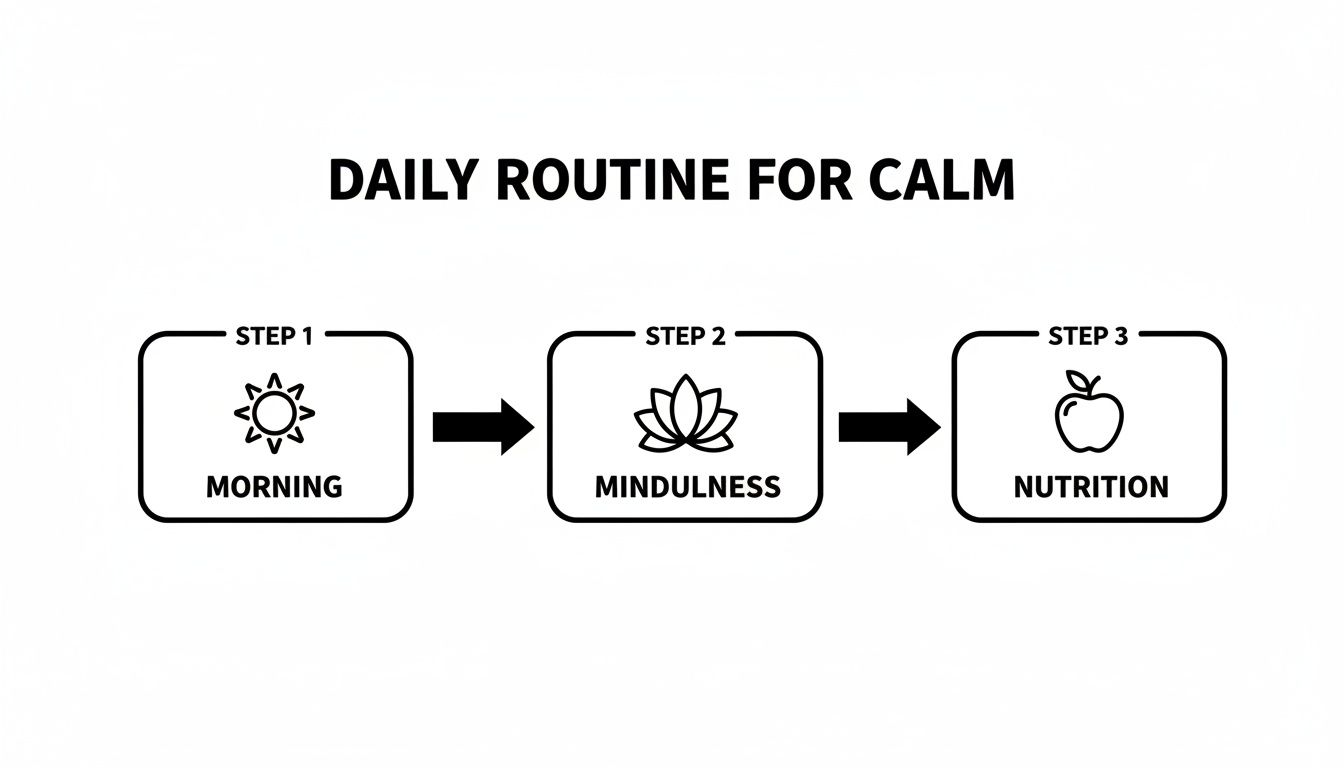
This illustrates how small, consistent actions in the morning, throughout your day, and in your diet all work together to fortify your mind against anxiety.
Calm Your Body with Your Breath
Your breathing is directly wired to your nervous system. During a panic attack, your breath becomes shallow and rapid, screaming "DANGER!" to your brain. You can hijack this signal by intentionally changing how you breathe.
A technique called box breathing is incredibly effective for this. It directly stimulates the vagus nerve, which acts like a master switch for your body's relaxation response.
The Box Breathing Method:
- Slowly exhale all the air from your lungs.
- Inhale gently through your nose for a count of four.
- Hold your breath for a count of four.
- Exhale slowly through your mouth for a count of four.
- Hold at the bottom of the exhale for a count of four.
- Repeat this cycle for at least a minute or two.
This simple, rhythmic pattern is profoundly calming. It gives your mind a simple, repetitive job to focus on instead of the panic itself. If you want to explore this further, there are many simple and effective breathing exercises for anxiety you can practice daily.
Use Powerful Self-Talk to Reassure Your Brain
Finally, the words you use inside your head during a panic attack matter immensely. Your brain is desperately searching for evidence that you're safe, and you can be the one to provide it with strong, reassuring phrases.
Don't let that anxious inner critic run the show. Have a few key phrases prepared and ready to deploy. They should be simple, true, and easy to recall when you're overwhelmed.
Here are a few I've found helpful:
- "This is just a feeling. It’s uncomfortable, but it is not dangerous."
- "I have survived this before, and I will survive it now."
- "This feeling is temporary. It will pass."
- "I am safe right now. My body is just having a strong reaction."
Saying these phrases to yourself—either in your mind or out loud—can feel like throwing a lifeline to your rational brain. It reminds you that you aren't in mortal danger, helping to counteract the primal fear signals. This three-part protocol is your proof that even when panic feels all-consuming, you have the tools to grab the wheel and guide yourself back to safety.
Create a Support System That Lifts You Up
You don't have to navigate anxiety on your own. In fact, one of the biggest truths I've learned is that human connection is a biological need, not a nice-to-have. When you’re trapped inside your own head, reaching out can feel like the absolute hardest thing to do, but it’s also the most critical.
Strategically building a network of compassion and strength is a cornerstone of getting better. There’s so much hope in knowing you can create a system that lifts you up, giving you a safety net on the tough days and a cheering section for your wins.
This isn’t about having dozens of friends. It’s about nurturing a few key relationships that genuinely energize and support you. A solid support system is proof that you’re not an island—and that a life with less panic is within reach when you let the right people in.
How to Talk About Your Anxiety
Trying to explain what anxiety feels like to someone who's never had it can be incredibly frustrating. They might offer well-meaning but totally unhelpful advice like "just relax" or "don't worry about it."
The trick is to be clear, specific, and direct about what you actually need from them.
Instead of just saying, "I'm feeling anxious," which is vague, try giving them a simple script. This gives them a clear role to play.
- For grounding: "I'm feeling really overwhelmed right now. Could you just sit with me for a few minutes and tell me about your day? Hearing your voice helps ground me."
- For reassurance: "My anxiety is telling me a story that isn't true. Could you remind me that this feeling will pass and that I'm safe?"
- For practical help: "I'm too anxious to make this phone call. Would you be willing to help me with it or just be here while I do it?"
These little scripts take the guesswork out of it for your loved ones and empower them to give you real, actionable support. This is a huge step in learning how to build mental resilience as a team.
Identifying Energizing vs. Draining Relationships
Not all relationships are created equal, especially when you're managing anxiety. Some people just naturally lift you up, while others—even without meaning to—can leave you feeling exhausted and more stressed.
Part of building a resilient support system is learning to spot the difference.
Take a moment to think about the people in your life. After you spend time with them, do you feel lighter and more hopeful, or do you feel exhausted and heavy? Your energy is a precious resource—invest it in the connections that replenish it.
It's completely okay to gently create some distance from relationships that consistently drain you. This isn't about being harsh or cutting people off; it's about protecting your own well-being so you have the strength you need to heal.
Globally, the need for better mental health support has never been clearer. In 2023, it was estimated that 15% of the world's population was experiencing a mental health disorder. Yet, there’s a massive gap between need and investment—the median government spending on mental health is just 2% of total health budgets. You can find more insights on the state of global mental wellness on Healthdata.org. This really highlights why accessible tools and strong personal support networks are so vital for recovery.
The Power of Shared Experience
Sometimes, the best support comes from people who just get it without you having to explain a thing.
Connecting with others who have walked a similar path can instantly dissolve that intense feeling of isolation that anxiety creates. There’s something incredibly healing about that shared understanding.
Consider looking into a few of these options:
- Support Groups: Whether you find one in your community or online, these groups offer a safe space to share your experiences and coping strategies without any fear of judgment.
- Online Communities: Forums and social media groups dedicated to anxiety can provide 24/7 access to peer support from people all over the world. It can be a lifeline at 3 a.m. when you're struggling.
- Professional Guidance: While peer support is invaluable, a therapist can provide structured, evidence-based tools to speed up your progress. Understanding different therapeutic approaches, like the ones in this guide on psychotherapy for anxiety, can help you find the right professional to partner with on your journey.
Building your support system is an act of profound self-compassion. It's you declaring that you're worthy of help and that you believe in your own ability to heal. When you combine those personal connections with professional guidance, you create a powerful foundation for a resilient, panic-free life.
Your Questions About Building Resilience, Answered
Starting the journey to build mental resilience is a big deal, and it's completely normal to have questions pop up. Wondering about the road ahead is a good sign—it means you're engaged, hopeful, and ready to take back your life from anxiety.
This is your space for clear, honest answers. Think of it as a conversation about what to expect as you move forward.
How Long Does This Actually Take?
This is usually the first question on everyone's mind, and the most honest answer is this: building resilience is a personal journey, not a race. There's no one-size-fits-all timeline. Your progress is shaped by your own unique circumstances, your history with anxiety, and how consistently you put these new tools to work.
Some people feel small but incredibly powerful shifts within just a few weeks. Maybe it's the first time you successfully talk back to an anxious thought, or you navigate a stressful meeting without spiraling. Those are huge wins. For others, it might take a few months to feel a deep, foundational change in their day-to-day life.
The goal isn't to cross some imaginary finish line where you're suddenly "cured." True resilience is an ongoing practice. It's a muscle that gets stronger the more you use it. Celebrate every small victory, because each one is a concrete step toward a life that isn't dictated by panic.
Remember, this is about progress, not perfection. You're not just learning a few tricks; you're fundamentally rewiring your relationship with your own mind. That's deep work, and it's worth being patient with yourself. Healing is happening with every step you take.
Can I Do This on My Own, or Do I Need a Therapist?
You can absolutely start this journey on your own. In fact, you have the power to make incredible progress right where you are. Guides like this one are designed to give you the foundational tools you need—from cognitive reframing techniques to daily habits that help calm your nervous system.
Many people find amazing success with a self-guided approach. It puts you in the driver's seat, helping you become your own best advocate as you learn what works for your mind and your life.
However, a therapist can be a game-changing partner in this process. Here’s how I like to think about it:
- Self-Help Tools: This is your daily workout routine, the equipment you use to build mental muscle. They're essential for day-to-day strength and maintenance.
- A Therapist: This is your personal trainer. They can offer personalized guidance, help you unpack deeper issues that might be stuck, and provide the kind of accountability that keeps you moving forward.
They aren't mutually exclusive options. They actually work incredibly well together. Starting on your own is a huge, powerful step. You can always decide to bring in professional support later if you feel stuck or just want to go deeper. The choice is always yours.
What if I Have a Setback? Does It Mean I'm Failing?
Let's get one thing straight: setbacks are a normal, expected, and even valuable part of healing. They are not a sign of failure. In fact, they often mean you're pushing your boundaries and growing. Having a tough day after a string of good ones doesn't erase all your progress. Not even close.
The most important thing is how you frame it.
Instead of letting your mind jump to, "See? I'm back at square one," try asking, "What can I learn from this?"
- What were the triggers that led to this moment?
- Was I slacking on any of my resilience habits, like sleep or getting outside?
- Which coping tool could I have used? What might I do differently next time?
True resilience isn't about never falling down; it's about getting back up a little wiser each time. Treat yourself with compassion. Acknowledge the tough feeling without judgment, give yourself credit for how far you've come, and then gently get back to the practices that you know work. Every setback is just data helping you build a stronger, more sustainable strategy for the long haul.
Are There Physical Habits That Actually Matter for Mental Resilience?
Absolutely. Your mind and body aren't two separate systems; they're deeply connected. Trying to build mental strength while ignoring your physical health is like trying to build a house on a shaky foundation. It's just not going to work.
There are three physical habits that are non-negotiable for building a strong base for mental resilience.
- Guard Your Sleep: Aim for a consistent 7-9 hours a night. Sleep is when your brain processes emotions and solidifies learning. When you're exhausted, your emotional fuse gets dramatically shorter, making you way more vulnerable to anxiety.
- Move Your Body Regularly: You don't have to train for a marathon. A brisk daily walk is powerful enough to burn off stress hormones like cortisol and release mood-lifting endorphins. When it comes to movement, consistency beats intensity every single time.
- Fuel Yourself with Good Food: What you eat directly impacts your mood and nervous system. Processed foods, loads of sugar, and too much caffeine can easily trigger or amplify the physical symptoms of anxiety, trapping you in a vicious cycle.
Think of these habits as the physical bedrock for your mental strength. They are simple, powerful acts of self-respect that send a clear signal to your brain: You are safe, you are cared for, and you are capable of healing.
At The Anxiety Checklist, we believe everyone deserves to live a life free from the grip of anxiety. Our Fearless Living system is more than just an eBook; it's a complete, actionable toolkit designed to put you back in control. With our 93-point interactive checklist, practical worksheets, and evidence-based strategies, you get a clear roadmap to building lasting mental resilience. Start your journey to a calmer, more confident life today.