
When you see someone you care about spiraling into anxiety, it’s easy to feel completely helpless. You want to help, but what do you even say? Where do you start?
The most important thing is to stay calm yourself, use simple language, and gently guide them back to solid ground. Your steady presence is the most powerful tool you have, and it can be the first step in showing them that a life beyond panic is possible.
How to Be a Calming Presence
When someone is in the grip of anxiety, your job isn't to fix them or make their fear disappear. It's to be an anchor in their storm. This guide will help you shift from being a worried observer to a supportive, calming force, reinforcing the hopeful truth that these moments do not define their future.
It all starts with creating a space that feels safe and accepting. Your own demeanor is the foundation. If you can regulate your own breathing and speak in a soft, reassuring tone, you send a signal to their nervous system that the immediate danger has passed. This simple act of co-regulation is incredibly powerful.
Fostering Hope and Healing
Your support goes far beyond just getting through one tough moment. It’s about building their belief that healing is not just possible, but achievable. Every time you offer a non-judgmental ear or a patient presence, you reinforce the message that a panic-free life is within their reach.
Here’s how your support can lay the groundwork for their recovery:
- Validation: You show them their feelings are real and acknowledged, which helps reduce any shame they might feel.
- Connection: You break through the intense isolation that anxiety so often creates.
- Empowerment: You help them find their own strength to navigate the episode, building their confidence for the future.
Your consistent, compassionate presence can be the encouragement they need to believe in a future beyond anxiety. You aren't just calming a moment of panic; you're contributing to their long-term journey toward wellness and a life lived without fear.
Before diving into specific techniques, it's helpful to have a quick-reference guide for those first critical moments. This table summarizes the immediate actions you can take.
Immediate Actions for Anxiety Support
| Action | Why It Works | Example Phrase |
|---|---|---|
| Stay Calm Yourself | Your calmness co-regulates their nervous system, signaling safety. | "I'm right here with you. We'll get through this together." |
| Speak Softly & Simply | Complex sentences are hard to process during high anxiety. | "Just focus on my voice." |
| Validate Their Feelings | Acknowledging their fear reduces shame and isolation. | "I can see how scared you are right now. That sounds really tough." |
| Offer Physical Presence | Your proximity provides a grounding anchor in reality. | "Can I sit here with you? You're not alone." |
Remember, these initial steps are about establishing safety and connection before moving on to more structured techniques.
Creating a calm atmosphere is also key. Something as simple as using an aromatherapy essential oil diffuser can help set a peaceful tone in the room.
This, combined with your steady support, builds a foundation for them to practice other strategies. A great next step is to familiarize yourself with specific grounding techniques for anxiety you can gently guide them through.
Practical Grounding and Breathing Techniques That Actually Work
When anxiety sends the mind into a tailspin, the body isn't far behind. A racing heart, shallow breathing, and that dizzying feeling of detachment are all part of the body's alarm system screaming "threat!"—even when there isn't one. Your job is to help them gently turn off that alarm. The best way to do that is with simple, physical tools that anchor them back in the present moment.
Think of these techniques as more than just distractions. They are direct, physiological messages of safety to the nervous system. This is a critical first step in showing someone they can regain control and that these intense feelings won't last forever. That knowledge alone can be a powerful seed of hope for a calmer future.
This simple three-step visual is a great mental reminder for your approach.
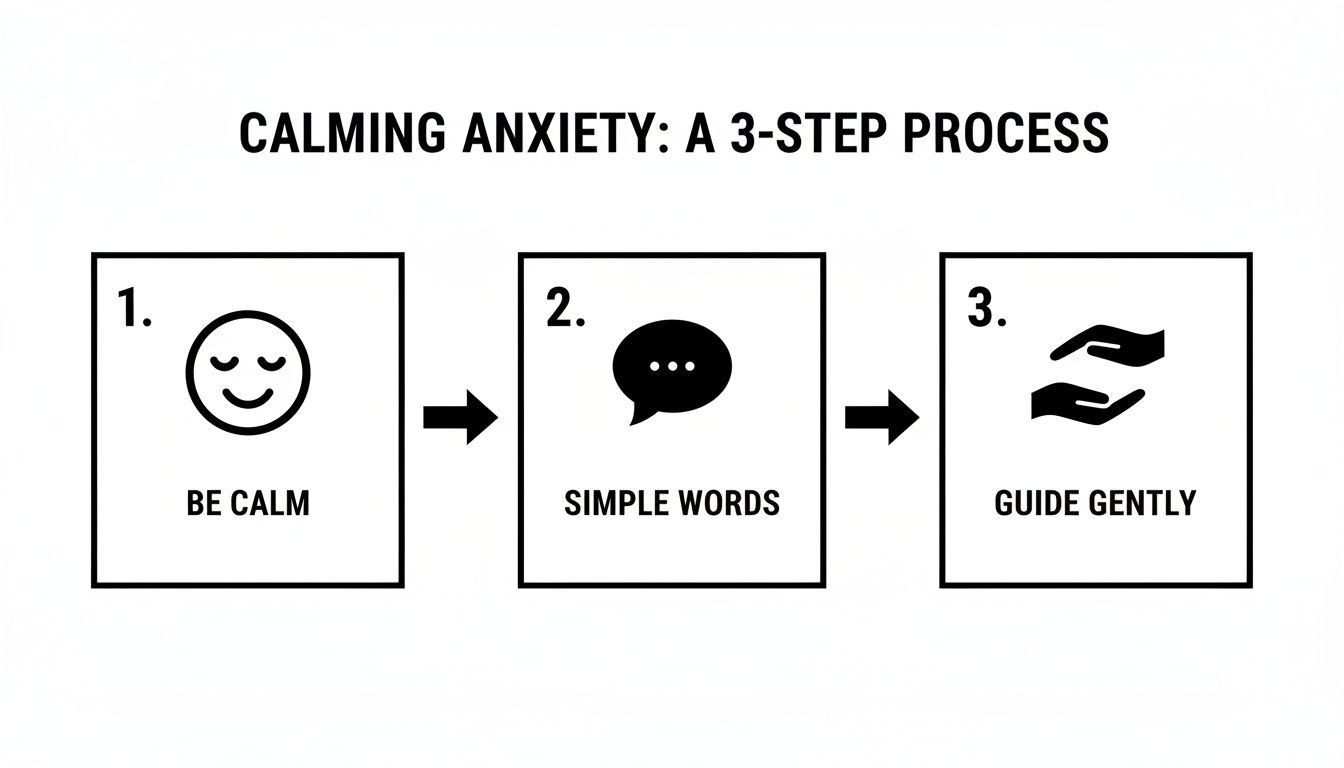
The key takeaway? Your calm presence and simple, gentle guidance are the foundation that makes these techniques work.
Guide Them with Paced Breathing
The common advice to "just take a deep breath" can feel completely impossible—and even a little dismissive—in the middle of a panic attack. A much better approach is to model and guide them through a structured breathing pattern. One of the simplest and most effective is the 4-5-6 technique.
Here’s how you can do it:
- Model it first. Start doing the breathing yourself, calmly and visibly. Don't ask them to do anything yet, just start.
- Invite them to join. In a soft, gentle voice, say something like, "Can you try breathing with me? We're going to breathe in for four, hold for five, and then breathe out slowly for six."
- Count for them. Guide them through a few cycles, counting out loud. "In, two, three, four… Hold, two, three, four, five… Out, two, three, four, five, six."
That long exhale is the most important part. It stimulates the vagus nerve, which activates the body's built-in relaxation response. By doing it with them, you create a shared rhythm and a powerful, non-verbal sense of support. For a deeper dive, our guide on breathing exercises for anxiety has other methods you can learn together.
Use the 5-4-3-2-1 Grounding Method
When anxiety pulls someone deep into their own head, grounding techniques reconnect them to the physical world through their five senses. This is a fantastic way to interrupt the loop of fearful thoughts by shifting their focus to the solid, tangible reality of their immediate surroundings.
Clinical research shows that brief grounding interventions can reduce panic symptom intensity and distress ratings by approximately 25–45% within just 5–10 minutes. These techniques are powerful because they directly calm the body's overactive stress response.
Here’s a simple script to guide them through the 5-4-3-2-1 method:
- (Sight): "Let's find five things you can see right now. Just name them out loud. I see the blue lamp… the wooden table…"
- (Touch): "Okay, great. Now, what are four things you can feel? Maybe the texture of your jeans? The warmth of your hands?"
- (Hearing): "Good. Now let's listen for three things you can hear. I can hear the clock ticking… a car outside…"
- (Smell): "What are two things you can smell? Maybe my coffee, or the soap on your hands?"
- (Taste): "And finally, can you name one thing you can taste? Even just the taste of your own mouth is one."
Each step gently pulls their attention away from the internal chaos and back to the safety of the present. It proves to them, one sense at a time, that they can steer their focus and find solid ground again—a skill that is foundational to living a panic-free life.
Supportive Words That Help and Hurt
When someone's in the thick of anxiety, their whole world can feel like it's closing in. In that moment, your words can either add to the chaos or be the first ray of light. This is your chance to offer real hope—not by trying to fix the problem, but simply by showing them they aren't alone in their fear.
The right words build a bridge back to safety. They validate the struggle, sending a powerful message that this feeling is real, but it won't last forever and doesn't have to control their life.
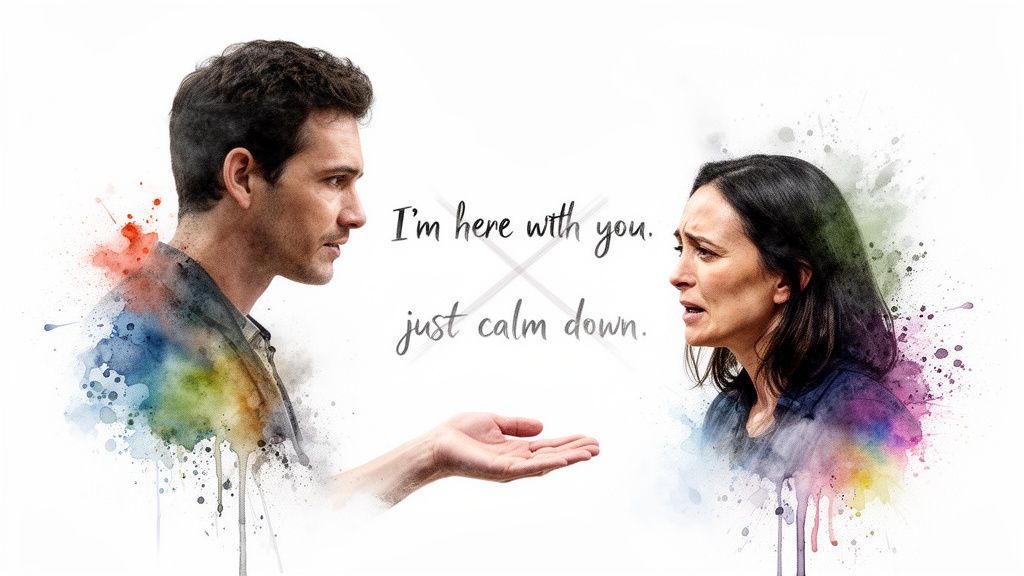
On the flip side, some of the most common, well-meaning phrases can feel like a total dismissal. Things like "Just calm down" or "You're overreacting" can accidentally make someone feel ashamed or isolated, which only cranks up the anxiety.
The goal isn't to find some magic phrase that instantly shuts off the anxiety. It's about communicating safety, presence, and unwavering support. That feeling of being seen and heard is what can help them feel secure enough to start calming their own nervous system.
What to Say Instead of Unhelpful Platitudes
Knowing what not to say is half the battle. But what do you say instead? Replacing knee-jerk reactions with words that validate and empower can make all the difference, planting seeds of hope for their healing journey.
It's tough to think on your feet when someone you care about is struggling. Here’s a quick comparison to help guide your conversations away from common pitfalls and toward genuine connection.
Helpful vs. Unhelpful Phrases for Anxiety Support
| Instead of This (Unhelpful) | Try This (Helpful) |
|---|---|
| "Just calm down." | "I'm here with you. Take your time." |
| "There's nothing to be afraid of." | "I can see this is really scary for you. I'm not going to leave." |
| "You're being irrational." | "It sounds like your thoughts are overwhelming right now. Let's just focus on your breath." |
| "It's all in your head." | "This feeling is real, but it will pass. We'll get through this together." |
These alternatives prove you're actually listening and respecting their reality, which is one of the most powerful things you can do.
When anxiety puts a strain on a relationship, learning how to talk to each other is a game-changer. For couples navigating this, understanding the dynamic between love vs. anxiety in a relationship is often a huge step toward healing for both partners.
Practical Scripts for Real-World Scenarios
It helps to have a few go-to phrases in your back pocket so you can respond confidently when you're feeling flustered yourself.
Scenario 1: During a Sudden Panic Attack in Public
- "Let’s step over here where it's a bit quieter. I'm right here with you."
- "Focus on my voice. You are safe. This feeling will pass."
- "Can you feel your feet on the ground? Just focus on that sensation for a moment."
Scenario 2: A Late-Night Talk About Persistent Worries
- "It sounds like you're carrying a heavy weight. Thank you for telling me about it."
- "I'm here to listen for as long as you need to talk. There's no judgment."
- "What is one small thing we could do right now that might bring you a little bit of comfort?"
Your words can be a powerful tool for hope. By choosing empathy over instruction, you remind them of their own strength and reinforce the truth that they have the capacity to navigate these moments and find their way back to calm.
Adapting Your Support for Different Kinds of Anxiety
Anxiety isn’t a one-size-fits-all experience, and your support shouldn't be either. The way you help someone through a sudden, intense panic attack is worlds away from how you’d support them through the slow burn of chronic worry.
Recognizing these differences is the key to providing help that actually lands.
One of the most powerful things you can do is show them that no matter what form their anxiety takes, a path to a panic-free life exists. Your tailored support can be a huge part of them building the confidence to heal and believe in their own resilience.
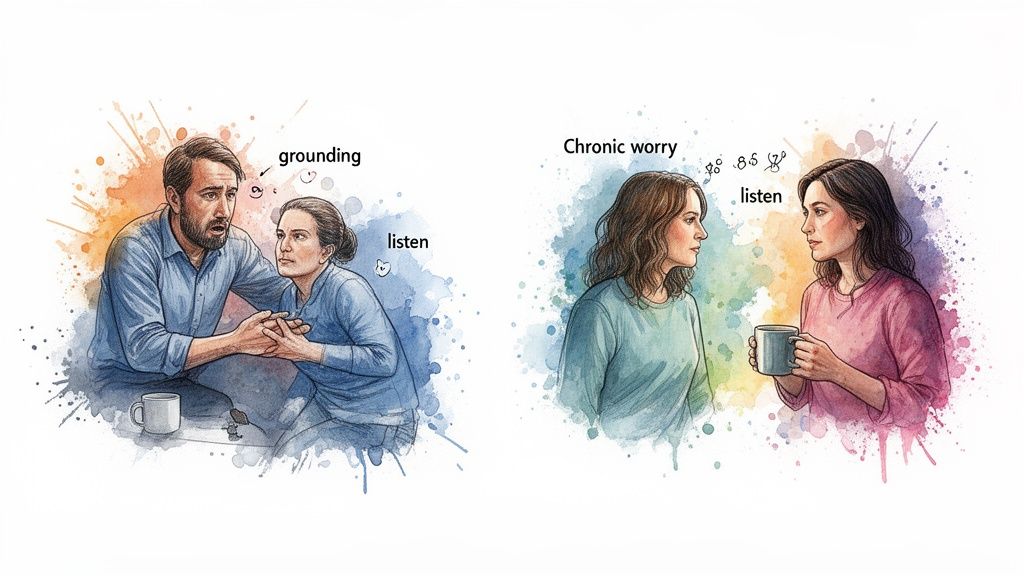
Supporting Someone During a Panic Attack
When a panic attack hits, the brain is flooded with fight-or-flight signals. Their body genuinely believes it's in immediate, life-threatening danger, even if the room is perfectly safe. Logic and complex conversation are completely off the table.
In this moment, your job is to be a calm, grounding presence. The goal is what we call co-regulation—essentially, helping their nervous system borrow calm from yours.
Here’s how you can adapt your approach on the fly:
- Keep it simple. Use short, reassuring phrases like, "I'm right here," or "You are safe." Don't overwhelm them with questions or chatter.
- Focus on the physical. Guide them through sensory exercises like the 5-4-3-2-1 method or paced breathing. Don't just tell them to do it—do it with them.
- Create a safe bubble. If possible, gently lead them to a quieter space. Give them physical space unless they specifically ask for touch, like holding a hand.
During a panic attack, you can't talk someone out of it. Your role is to be a safe anchor until the physiological storm passes. Think of it as a short-term, in-the-moment intervention. For a deeper dive, check out this guide on understanding a panic attack.
Supporting Someone with Chronic Worry or GAD
Helping someone with generalized anxiety (GAD) or chronic worry is a completely different ballgame. This is less about crisis management and more about long-term encouragement and validation. This kind of anxiety is often a constant, low-grade hum of "what ifs" and fears about the future.
Your support here is a marathon, not a sprint. It’s about creating an environment where they feel safe to share what's on their mind without being judged or "fixed." This steady support helps them build the skills and hope they need for lasting recovery.
Here, the focus shifts to a softer, more consistent approach:
- Practice active listening. Just give them the space to voice their fears without immediately jumping in to solve them. Ask open-ended questions like, "What does that feel like for you?"
- Offer gentle validation. Acknowledge their feelings. Simple phrases like, "That sounds incredibly stressful to carry around all day," can make a huge difference.
- Encourage healthy routines. Gently support positive habits around sleep, nutrition, and movement. These are absolute game-changers for managing long-term anxiety.
By understanding these key distinctions, you can become a more effective and compassionate ally. You’re showing them that no matter the challenge, they aren't alone and a calmer, more peaceful life is absolutely within reach.
Encouraging Long-Term Healing and a Hopeful Future
Your support during a moment of high anxiety is incredibly powerful. But while those in-the-moment strategies are vital, your role can also extend to something even more meaningful: fostering hope for a future where anxiety doesn't call the shots.
This is about gently shifting the focus from just surviving the storm to believing in the calm that can follow.
A life free from the grip of panic isn't some far-off dream; it's an achievable reality. By consistently offering support without judgment, you help them see their own strength. You become a steady reminder that recovery is possible and that a more peaceful life is waiting for them.
Opening the Conversation About Next Steps
Talking about professional help can feel like walking on eggshells, but it’s one of the most hopeful conversations you can have.
The key is to frame it not as "fixing a problem," but as an empowering step toward adding more tools to their wellness toolkit. Timing is everything here. Wait for a calm moment—not during or immediately after an anxious episode.
You could try saying something like:
- "I’ve noticed how much strength it takes for you to navigate these feelings. Have you ever considered talking with someone who specializes in this? It could give you even more strategies for healing."
- "I was reading about different ways people heal from anxiety, and there are so many options out there now. I'm happy to help you look into them if you're ever curious about living a panic-free life."
The goal is to offer support without pressure. You’re just planting a seed of possibility, letting them know they don’t have to figure this all out alone. Your encouragement might be the gentle nudge they need.
Championing Their Progress Every Step of the Way
Recovery from anxiety is rarely a straight line. It’s more like a winding path with lots of small victories that deserve to be celebrated. Acknowledging their progress, no matter how minor it seems, reinforces their efforts and builds momentum toward lasting healing.
Your consistent validation of their hard work is a powerful antidote to the self-doubt that anxiety loves to create. When you highlight their wins, you help rewrite the narrative from one of struggle to one of growing strength and hope.
For instance, if they use a breathing technique on their own or manage to face a situation they used to avoid, acknowledge it. A simple, "That was amazing how you handled that moment," can be incredibly affirming. These small acknowledgments build the confidence they need to take the next brave step.
And this isn't just a nice idea—it's backed by research. Social encouragement and guided self-help dramatically improve the chances that a person will seek treatment. Globally, only about 27.6% of people with anxiety disorders get any kind of care. But when friends or family provide structured encouragement, help-seeking rates can jump by 30–60%. You can dig into more of these global mental health trends from the World Health Organization.
As part of this long-term view, exploring different therapeutic approaches can be helpful. For example, some people find great relief in modalities like Swedish massage therapy for anxiety and stress reduction.
And for those ready to take a more proactive role, our guide on anxiety recovery steps offers a structured path forward. Your role isn't to be their therapist, but to be their biggest champion as they find their own way to a more hopeful, panic-free future.
Common Questions About Supporting Someone with Anxiety
When you’re trying to help someone you care about, it’s completely normal to have questions and feel a little uncertain. This isn't easy, and navigating it requires patience—both with them and, just as importantly, with yourself.
Let's walk through some of the most common challenges people face in this role. Remember, your steady presence is a powerful anchor, helping them believe in a future free from panic. Every small effort you make matters more than you know.
What If My Support Isn't Working?
It's easy to feel disheartened when the breathing exercise or grounding technique you suggest doesn't seem to land. You might even feel like you're failing them.
Here's the thing: the goal isn't to instantly "fix" their anxiety. It's to offer a safe, grounding presence while the storm passes.
If a specific technique isn’t working, don't push it. The single most helpful thing you can do is stay calm and present yourself. Fall back on simple, validating phrases. "I'm right here with you." "We'll get through this moment together." Your quiet, steady support is often the most powerful tool you have.
Sometimes, just being a non-anxious presence in the room is enough to help their nervous system begin to downshift on its own. It’s about co-regulation, not control.
How Do I Handle My Own Frustration?
Let's be real: supporting someone through intense anxiety can be emotionally draining. Feeling stressed, tired, or even frustrated doesn't make you a bad person. It makes you human. It's vital to acknowledge your own feelings without piling on any guilt.
Supporting someone on their journey to heal from anxiety is a marathon, not a sprint. To be a sustainable source of comfort, you have to protect your own well-being. Setting boundaries isn't selfish; it's essential for both of you.
Here are a few ways to manage your own emotional state when things get tough:
- Take a breather. It's okay to step away for a few minutes. Go to another room, take your own deep breaths, or splash some water on your face. You can't pour from an empty cup.
- Talk it out. Debriefing with a friend, partner, or therapist can help you process what you're feeling and release some of that built-up tension.
- Be kind to yourself. Seriously. Remind yourself that you're doing the best you can in a really difficult situation. Self-compassion is non-negotiable.
Can I Encourage Them to Track Their Progress?
Absolutely. In fact, when done gently, encouraging someone to track their own patterns and progress can be an incredibly empowering step. It shifts the focus from feeling helpless to actively participating in their own healing, which is the cornerstone of a panic-free life.
Research actually backs this up. Studies show that when people use structured tools like daily symptom logs or checklists, they see real results. For instance, one study found that users reported 15–20% greater adherence to helpful strategies and saw response rates climb by an additional 8–12%. You can dig into the data on guided self-help in this study from Frontiers in Public Health.
By offering tools that help them see their own progress—even the small wins—you reinforce their ability to heal. You're helping them build a life where they are in control, not their anxiety.
At The Anxiety Checklist, we're all about empowering people with practical, actionable tools that create lasting change. Our Fearless Living system is designed for exactly that. It combines a comprehensive eBook with a 93-point interactive checklist and habit-tracking worksheets, giving you or your loved one a personalized toolkit for managing anxiety and reclaiming life.
If you're ready for a structured path toward a calmer, more fearless future, we're here to help.
Learn more about The Anxiety Checklist and start your journey to fearless living