
Feeling overwhelmed by workplace anxiety is an incredibly common experience, but it’s a burden you don’t have to carry forever. This guide is built on a foundational belief: you can heal from anxiety, reclaim your peace of mind, and build a genuinely panic-free professional life. It all starts with understanding that you have the power to influence your own mental state, even when external pressures feel immense.
This isn’t about just "coping" with endless stress; it's about actively building a new, hopeful future. The journey to a panic-free professional life begins with small, manageable actions that create a ripple effect of positive change. By mastering a few immediate techniques, you prove to yourself that control is not only possible but is your first step toward lasting healing.
The Scale of Workplace Anxiety
If you feel like you're the only one struggling with anxiety at your job, you're not. Far from it. The economic impact of this shared struggle is staggering. The World Health Organization estimates that anxiety and depression lead to about 12 billion lost working days each year, costing the global economy roughly US$1 trillion annually in lost productivity.
Closer to home, polls in North America show that 40–50% of workers experience frequent work-related stress. That number climbs to as high as 59% for employees under 35. These statistics aren't just numbers; they are a powerful reminder that you are not alone in this and that healing is possible for everyone. You can dig deeper into the data by exploring current https://anxietychecklist.com/anxiety-statistics.
The good news? Simple, evidence-informed actions can offer powerful relief and pave the way for recovery. Controlled breathing (inhaling for 4-6 seconds, then exhaling for 6-8 seconds) can calm your physical response in minutes. Even a quick 5-10 minute break to clear your head helps lower that feeling of being overwhelmed and brings your focus back.
Your First Steps to Immediate Relief
When anxiety strikes, having a go-to plan is critical. Instead of letting your thoughts spiral, you can interrupt the pattern with a clear, three-step process you can use anywhere, anytime. This is your first taste of freedom.
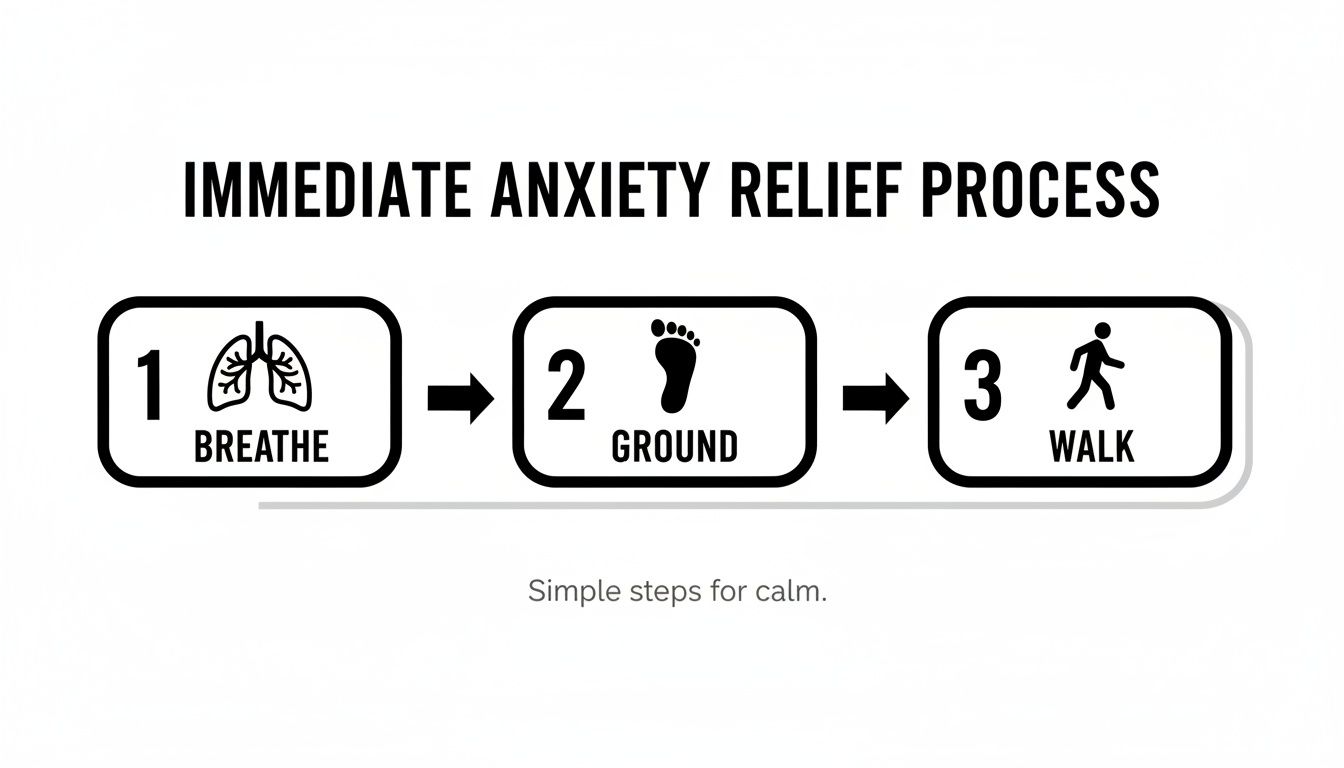
This sequence—Breathe, Ground, Walk—acts as a "pattern interrupt" for your anxiety. It forces your focus away from the internal storm of worry and onto external, physical sensations, giving your nervous system a chance to reset and remember what calm feels like.
Think of these techniques as your personal first-aid kit for anxiety. They're simple, discreet, and incredibly effective for bringing you back to the present moment, proving that relief is always within reach.
Your Immediate Anxiety Relief Toolkit
| Technique | How It Works | When to Use It |
|---|---|---|
| Controlled Breathing | Slow, deep breaths activate your parasympathetic nervous system, signaling your body to calm down. It reduces heart rate and muscle tension. | The moment you feel your heart start to race, before a big meeting, or when you feel overwhelmed by your to-do list. |
| Grounding (5-4-3-2-1) | This technique pulls you out of anxious thoughts by focusing your senses on your immediate environment. Name 5 things you see, 4 you feel, 3 you hear, 2 you smell, and 1 you taste. | When your mind is racing with "what-if" scenarios or you feel disconnected and detached from the present. |
| A Short Walk | Physical movement helps burn off nervous energy and adrenaline. Changing your environment, even for a few minutes, can break a negative thought cycle. | After a tense conversation, when you're stuck on a problem, or you just feel trapped at your desk. |
These aren't just temporary fixes. They're foundational skills that build your resilience and give you a sense of empowerment, transforming how you experience your workday. To build on this foundation, it's key to understand the bigger picture; explore these proven tips to reduce workplace stress that can help you truly start to thrive.
Key Takeaway: Hope is not a passive wish; it's an active strategy. By learning and applying these simple techniques, you are taking the first and most important step toward creating a work life defined by calm and confidence, not fear.
Identifying Your Personal Workplace Anxiety Triggers
To truly heal from anxiety, you have to understand its roots. Think of yourself as a detective investigating your own mind—moving beyond just knowing you feel anxious and into discovering exactly why and when those feelings spike at work.
This is where lasting change begins. It’s the foundation for building a calmer, more controlled professional life where you are in charge.
The goal here is to start noticing patterns. Is it the vague subject line on an email from your boss? The sound of a specific Slack notification? Or maybe it’s the quiet pressure that builds before a weekly team meeting. When you pinpoint these moments, you drain them of their power and start to take back control.
Uncovering Common Workplace Triggers
While everyone's triggers are unique, most fall into a few predictable buckets. Recognizing these common sources can help you zero in on what’s really getting to you. See if any of these scenarios feel familiar.
- Social Situations: Do you feel a knot in your stomach during team lunches or find yourself actively avoiding the breakroom? That could be social anxiety, where unstructured interactions feel draining and high-stakes.
- Performance Pressure: The fear of not being good enough—often called imposter syndrome—can be a huge trigger. This might pop up during project kickoffs, performance reviews, or anytime you have to present your work.
- Heavy Workload: An endless to-do list, tight deadlines, and the feeling of being constantly behind are classic culprits. This leads to a state of perpetual overwhelm, where even small tasks feel monumental.
- Interpersonal Conflicts: Disagreements with a colleague, getting critical feedback, or navigating a tough conversation with your manager can leave your nervous system on high alert long after the chat is over.
If any of these resonate, you are far from alone. Factors like excessive workload and poor management are consistently named as leading causes of workplace anxiety. In fact, for younger workers (Gen Z and millennials), the rate of feeling stressed or anxious is around 40%.
Understanding these bigger patterns is a great first step. You can dig even deeper into the most common anxiety triggers to get more context.
Start Your Investigation with a Trigger Log
The single most effective way to connect the dots between a situation and your body’s response is to track it. This doesn’t need to be complicated. A simple log in a notebook or a note-taking app on your phone is all you need to start seeing the connections.
For just one week, make an effort to jot down moments when you feel your anxiety rise. This practice trains you to observe your feelings without judgment and gives you concrete data to work with.
Hopeful Insight: Tracking your triggers isn't about dwelling on the negative. It's an act of empowerment. Each entry is a clue that brings you one step closer to understanding and mastering your own mind on your path to healing.
Using a simple worksheet like the one below can help you start identifying and tracking what sets off your anxiety in different work situations.
Workplace Anxiety Trigger Identification Log
| Date/Time | Situation/Event | Anxiety Level (1-10) | Physical Sensations | Accompanying Thoughts |
|---|---|---|---|---|
| Mon, 9:05 AM | Received a last-minute meeting invite from my director. | 8 | Heart racing, tight chest. | "I've done something wrong. This is about the report." |
| Tues, 2:30 PM | Colleague asked for help on a task I wasn't familiar with. | 6 | Sweaty palms, stomach churning. | "They're going to think I'm incompetent if I say I don't know." |
| Thurs, 4:50 PM | Looking at my packed calendar for the next day. | 7 | Headache, tense shoulders. | "There's no way I can get all of this done. I'm going to fail." |
After just a few days of logging, you’ll start to see a clear map of your personal anxiety landscape emerge. This isn't just an exercise in data collection; it's a huge step toward reclaiming your power.
You're no longer just reacting blindly to a wave of panic. Instead, you're identifying the source, which gives you the ability to choose your response. This knowledge is your first and most powerful tool on the road to a panic-free life.
Practical Techniques for In-The-Moment Calm
When anxiety surges during a busy workday, it can feel like a tidal wave—overwhelming and totally out of your control. But you can learn to build a lifeboat, right at your desk, to instantly find your footing and ride out the storm.
This isn't about wishful thinking. It's about learning practical, powerful skills that hand the controls back to you.
These techniques are your emergency response kit. They work by interrupting the anxiety cycle, pulling your focus away from spiraling thoughts and planting you firmly back in the present moment. They are powerful proof that a panic-free workday is not just a dream, but an achievable reality.
Ground Yourself with the 5-4-3-2-1 Method
When your mind is racing with "what-if" scenarios, grounding is your most reliable strategy. It reconnects you to the physical world, making it nearly impossible for anxious thoughts to keep their momentum. The 5-4-3-2-1 method is a simple yet profoundly effective way to do this.
The beauty of this technique is its subtlety. No one even needs to know you're doing it. Just pause and mentally identify:
- 5 things you can see: Look around and notice the small details. The grain on your wooden desk, the specific shade of a colleague's sweater, a plant in the corner, the light hitting the window.
- 4 things you can feel: Bring your awareness to physical sensations. The solid pressure of your feet on the floor, the fabric of your chair against your back, the cool surface of your mouse, the weight of your watch.
- 3 things you can hear: Tune into the ambient sounds around you. The low hum of the air conditioner, the distant ring of a phone, the quiet tapping of keyboards.
- 2 things you can smell: This one might require a bit more focus, which is part of the point. Can you catch the faint aroma of coffee, the clean scent of hand sanitizer, or the paper of a nearby book?
- 1 thing you can taste: Simply notice the lingering taste of your morning coffee or tea, or even just the neutral taste inside your mouth.
By systematically engaging all your senses, you force your brain to shift its focus from internal worry to external reality. This simple act provides immediate relief and a clear path back to the present.
Master Your Breath to Master Your Calm
Your breath is one of the most powerful tools you have for managing anxiety because it directly communicates with your nervous system. When you feel anxious, your breathing becomes shallow and rapid. By intentionally slowing it down, you send a signal to your brain that the danger has passed and it's safe to relax.
Box breathing is a simple, rhythmic technique used by everyone from Navy SEALs to nurses to stay calm under intense pressure. It's easy to remember and you can do it anywhere.
- Inhale slowly through your nose for a count of four.
- Hold your breath for a count of four.
- Exhale slowly through your mouth for a count of four.
- Hold at the bottom of the exhale for a count of four.
Repeat this cycle four or five times. The steady, predictable rhythm helps regulate your heart rate and quiet the physical symptoms of panic. If you want to expand your toolkit, there's a whole world of powerful breathing exercises for anxiety you can explore.
A Hopeful Truth: These techniques are not just temporary fixes; they are skills for life. With each deep breath and each moment you ground yourself, you are actively rewiring your brain's response to stress. You're building a foundation for lasting calm and a panic-free future.
Putting Your New Skills to Work
Knowing the techniques is one thing, but using them when the pressure is on is what really counts. Here’s how these tools can help you navigate specific, high-stress work scenarios:
- Before a big presentation: Your heart is pounding, your palms are sweaty. Before you walk in, find a quiet space—even a bathroom stall works—and do three cycles of box breathing. As you walk to the front of the room, use the 5-4-3-2-1 method to stay grounded in the space, not lost in your fear.
- After getting unexpected critical feedback: You just left a meeting where your work was picked apart, and your mind is replaying every word. Instead of letting the shame spiral, immediately engage your senses. Feel the chair you're in, listen to the office sounds, and focus on your breath. This creates a buffer between the event and your emotional reaction, giving you space to process it constructively.
These are more than just tricks. They're demonstrations of your own power to self-regulate. Each time you successfully calm yourself, you build confidence and create undeniable proof that you can handle whatever the workday throws at you. You are learning to live panic-free.
How to Communicate Your Needs and Set Boundaries
Anxiety has a way of silencing you right when you need your voice the most. The very idea of speaking up at work, whether to your boss or a coworker, can feel paralyzing. But learning to do so is one of the most powerful and hopeful steps you can take to reclaim your professional life.
This isn't about confrontation. It's about clear, confident communication that fosters a more supportive workplace. Learning this skill is a genuine act of hope—it’s you proving to yourself that you can shape your circumstances instead of just enduring them, paving the way for a healthier work environment.
Reframe Your Requests from Problems to Solutions
A huge barrier to speaking up is the fear of being seen as weak or incapable. Anxiety loves to whisper that asking for help is the same as admitting failure. The secret is to shift your communication to focus on shared goals: productivity, quality work, and team success.
You aren't presenting a problem (your anxiety); you're proposing a solution that helps everyone. This change in perspective is incredibly empowering. It turns a vulnerable moment into a demonstration of strategic thinking.
Instead of saying, "I'm completely drowning in work," which centers on your internal struggle, try framing it as a solution.
Example Script: "To deliver the high-quality work you expect on Project A, it needs my full focus this week. Could we discuss adjusting the timeline for Project B to ensure both projects get the attention they deserve?"
This simple script accomplishes a few key things:
- It frames the conversation around quality and success, not personal stress.
- It shows you are proactively managing your workload to meet company standards.
- It makes a collaborative request ("Could we discuss…") instead of lodging a complaint.
With that small tweak, you go from someone who's struggling to a strategic partner invested in getting the best results.
Learning to Say No Gracefully
For anyone wrestling with anxiety, the word "no" can feel like a four-letter word. It often triggers fears of disappointing people or burning professional bridges. But setting boundaries isn’t about rejection; it’s about protecting your energy so you can heal and do your job well.
Saying no gracefully is a skill. And like any skill, it gets easier the more you practice. The idea is to be clear, professional, and concise, without feeling the need to over-explain or apologize for your limits.
Here are a few ways to decline a request while keeping the relationship intact:
- The "I Can't Right Now, But…" Approach: "I can't take that on this week since I'm at full capacity with the marketing report. However, I’d be happy to show you where to find the resources I used last time."
- The Deferral: "My plate is full at the moment, but I might have some availability next week. Can we circle back then?"
- The Recommendation: "I don't have the bandwidth to give that the attention it deserves right now. Have you considered asking Sarah? Her expertise in this area is excellent."
If you want to go deeper on establishing healthy professional limits, there are some great practical strategies for setting boundaries at work that can help you do it without guilt. Remember, every time you set a boundary, you’re sending a powerful message to yourself: your well-being matters, and you deserve to protect it.
Preparing for the Conversation
Walking into a discussion about your needs is nerve-wracking, no doubt about it. A little prep work can make a world of difference, helping you feel more in control and confident. Before you sit down with your manager or colleague, get clear on what you actually want to achieve.
Jot down a few bullet points covering what you need to discuss and what your ideal outcome looks like. Practice saying your key phrases out loud—it feels silly, but it works. Even your physical posture can affect your mindset; simple things like power poses can boost confidence right before a tough talk.
The goal here is to create a work environment where you can be both sustainable and productive. Each time you successfully communicate your needs, you're not just solving an immediate issue—you're building a new reality where you can thrive, free from the constant weight of anxiety.
Building a Proactive Routine to Minimize Anxiety
True, lasting relief from workplace anxiety isn't just about reacting in the moment. While those immediate skills are crucial, the real game-changer is building a proactive daily routine. This is how you start to dismantle anxiety's power over you, one small, sustainable habit at a time, moving you closer to a panic-free life.
This isn't about a massive, intimidating life overhaul. It's about making minor, consistent adjustments that create a powerful buffer against stress. These small wins build momentum, giving you tangible proof that you're the one in control and that healing is happening.

Transform Chaos into Calm with Structure
Anxiety thrives in chaos. A long, intimidating to-do list can feel like an ambush waiting to happen. When you add structure to your day, you replace that suffocating uncertainty with a clear, manageable plan.
One of the most effective ways to do this is time blocking. Instead of a vague list, you assign specific blocks of time in your calendar to tackle each task. "Finish report" feels huge and overwhelming. But a calendar block from 10:00 AM to 11:30 AM labeled "Draft report conclusion" feels achievable.
This simple method turns your schedule from a source of stress into a road map for success. It eliminates the constant mental energy you waste deciding what to do next, freeing you up to actually do the work.
Work in Focused Bursts, Not Marathons
Another powerful tool to bring into your routine is the Pomodoro Technique. This time management method breaks your workday into focused 25-minute intervals separated by short breaks. It’s deceptively simple but incredibly effective at preventing the mental burnout that so often fuels anxiety.
Here’s the basic rhythm:
- Set a timer for 25 minutes and work on a single task with zero distractions.
- When the timer dings, take a 5-minute break—completely away from your work. Stretch, grab some water, or just stare out a window.
- After four of these "pomodoros," take a longer 15-30 minute break.
This approach makes large tasks feel less daunting and helps you maintain high energy throughout the day. You’re only ever focused on the next 25 minutes, not the entire day's workload, which is a huge relief when you're feeling overwhelmed.
Schedule Your 'Reset' Moments
Just like you schedule meetings and deadlines, you absolutely must schedule moments to reset. Think of these as non-negotiable pressure release valves during your day. Without them, stress just accumulates until it boils over into full-blown anxiety.
Try scheduling two or three 10-minute "reset breaks" directly into your calendar. During this time, you consciously and completely step away from work.
- Take a short walk, even if it’s just to another floor or around the block if you're remote.
- Listen to a calming song or a short guided meditation.
- Do some simple stretches at your desk to release the physical tension that builds up in your shoulders and neck.
This isn't about wasting time; it's a strategic investment in your productivity and well-being. A 10-minute reset can prevent an hour-long anxiety spiral later on. It’s an act of self-preservation and a key to sustainable healing.
Create a 'Shutdown' Ritual
How you end your workday is just as important as how you start it. Without a clear boundary, work stress bleeds into your personal time, robbing you of the chance to truly recharge. A simple "shutdown ritual" signals to your brain that the workday is officially over.
This doesn't have to be complicated. Your ritual could involve:
- Tidying up your workspace: A clean desk can symbolize a clear mind.
- Reviewing tomorrow's priorities: Jot down your top 2-3 tasks for the next day so you aren't spinning on them all night.
- Closing all work-related tabs and applications: This is a crucial physical and digital boundary.
- Changing your clothes: This simple act helps you mentally shift from "work mode" to "home mode."
These are the kinds of consistent, proactive steps that build real resilience. They are the daily actions that create a life where you manage anxiety, rather than it managing you.
Frequently Asked Questions About Workplace Anxiety
Let's be honest: navigating anxiety at work brings up some tough, messy questions. Below are a few of the most common ones, with straightforward guidance to give you clarity and hope. The big goal here is to show you that a calmer professional life is genuinely within your reach and that healing is possible.
What if My Manager Is the Main Source of My Anxiety?
This is an incredibly difficult spot to be in, but it is one you can navigate. The key is to shift your focus to what you can actually control.
First, start documenting. Write down specific interactions and feedback as objectively as you can, without adding emotional color. "On Tuesday at 2 PM, I was told the project direction was changing for the third time this week." This isn't about building a case; it's about creating a factual record you can refer to.
Next, lean on the communication scripts we talked about earlier. Frame the conversation around professional needs, not personal feelings. For instance, instead of saying "Your feedback style makes me anxious," try something like, "To do my best work, I find clear, consolidated feedback in our one-on-ones most helpful." It’s constructive and solution-focused.
If a direct chat feels unsafe or just doesn't work, your next stop is HR. A confidential conversation with an HR rep can help you understand your options, which might include mediation or even exploring a transfer to a different team.
Your well-being has to be the priority. Realizing when a situation needs outside support isn't a sign of weakness—it's a sign of profound strength. Taking these steps is how you build a real pathway to a panic-free workday.
Is This Just Normal Stress or a More Serious Anxiety Problem?
It’s so important to know the difference here. Stress is usually a short-term reaction to a specific, identifiable challenge—think of a huge project deadline or a big presentation. Once the event is over, the stress tends to fade away.
Anxiety, on the other hand, often sticks around even when there’s no obvious, immediate threat. It’s that feeling of excessive, prolonged worry that can become completely overwhelming.
The real distinction is the impact it has on your life. If your symptoms are chronic and are seriously getting in the way of your ability to function at work and at home, that's a strong signal you could use more support. The tools in this guide are fantastic for managing symptoms, but true healing often benefits from speaking with a healthcare professional who can guide your journey.
Can I Really Get Better Without Quitting My Job?
Absolutely, and this is a message of pure hope. For most of us, walking away from a job isn't a realistic—or even desirable—first move. The entire point of these strategies is to empower you to fundamentally change your experience within your current role and heal from within.
When you start identifying your triggers, mastering in-the-moment calming skills, and sharpening your communication, you create a kind of psychological armor. This dramatically dials down the impact of all those external stressors. You're learning to manage your internal responses, which hands you back a profound sense of control and freedom.
To get a better handle on these powerful internal shifts, you can learn more about how Cognitive Behavioral Therapy (CBT) helps reframe anxious thoughts. Putting these techniques into practice is the single most powerful step you can take toward making your job feel manageable, and eventually, joyful again. A panic-free life is not just a possibility; it's your destination.
At The Anxiety Checklist, we believe that living a fearless, fulfilling life is possible for everyone. Our Fearless Living system is more than just an eBook; it’s a complete toolkit designed by a 15-year anxiety survivor to give you actionable strategies for managing anxiety and panic attacks. It combines a 93-point interactive checklist with practical worksheets to help you build resilience and regain control. Start your journey toward a calmer, more confident you by visiting https://anxietychecklist.com.