
Trying to explain anxiety to someone who's never felt it can feel like trying to describe a new color. The key is to frame it correctly right from the start. This isn't just about "worrying too much." It's a very real condition with physical, mental, and emotional symptoms that needs real support to manage and heal.
Starting the conversation by emphasizing that it's a manageable condition can open the door for a hopeful, productive talk. It's not a life sentence; it's a challenge that can be overcome.
Laying the Groundwork for a Productive Conversation

Before you can get someone else to understand what you're going through, it helps to have a solid grip on it yourself. This isn't about knowing everything, but finding the right words to build a bridge toward understanding and, ultimately, healing.
First, let's draw a clear line between everyday stress and clinical anxiety.
Stress is usually tied to something specific—a big deadline at work or a tough exam. Once it's over, the stress goes away. Anxiety, on the other hand, just lingers. It’s a persistent feeling of dread, often without a clear or logical reason. It’s the difference between a sudden, loud noise and a constant, low hum in the background of your life that you just can't tune out.
Making this distinction is vital. It shifts the conversation from, "So, what are you worried about?" to "How does this actually feel for you?"
More Than Just Feelings
Anxiety isn't just in your head; it’s a full-body experience. It trips the body's internal alarm system, often for no reason at all. That's why explaining the physical side of it is so important for someone who's never been through it.
You might experience things like:
- A Racing Heart: That pounding in your chest that feels like you just sprinted up a flight of stairs, even when you're sitting perfectly still.
- Shortness of Breath: The terrifying feeling that you can't get enough air into your lungs, making your chest feel tight and heavy.
- Intrusive Thoughts: A relentless loop of "what-if" scenarios your mind can't shut off, leaving you mentally exhausted.
- A Constant Sense of Dread: An unshakable feeling that something terrible is about to happen, casting a shadow over everything you do.
These symptoms aren't imaginary. They’re the direct result of your body's survival mechanism getting stuck in overdrive. Getting familiar with the fight-or-flight response guide can give you the language to explain exactly why your body is reacting with such intensity.
When you frame anxiety as a physiological response rather than just a feeling, you help demystify it for others. It’s not a choice or a personality flaw—it’s an internal alarm system that's malfunctioning, and it can be recalibrated.
The Hope in Understanding
Getting these points across does more than just inform; it empowers. When you can clearly describe the physical, mental, and emotional weight of your anxiety, you make an invisible struggle tangible. This clarity is the foundation for a much more hopeful conversation.
It shows you've taken the time to understand your own condition, which is the first—and most important—step toward managing it and living panic-free. And most of all, it reinforces the fact that anxiety is a recognized and treatable condition. With the right support and tools, living a full, vibrant life isn't just possible—it's an achievable goal.
How to Prepare for the Talk and Find Your Voice

A good conversation doesn't just happen. It often starts long before you even say a word. Taking a little time to prepare can turn what feels like a terrifying talk into an empowering moment of connection.
This isn’t about rehearsing a perfect speech. It's about finding your own clarity and confidence before you dive in. The act of turning chaotic feelings into a clear message is a huge step forward in itself on the road to recovery.
Set the Stage for Success
The right environment can make or break this conversation. Pick a time and place where you both feel calm, private, and unhurried. Think a quiet walk in the park, a relaxed evening at home, or a cozy corner in a coffee shop.
Try to avoid high-stress moments, like right after a brutal day at work or in the middle of a family disagreement. You're aiming for a conversation, not a confrontation. Setting a calm scene minimizes external stress, making it much easier for your message of hope and need for support to land.
Define Your Goal for Sharing
Before you start, ask yourself one simple question: "What do I hope to achieve with this conversation?" Knowing your 'why' is like having a compass; it guides your words and keeps the discussion from getting lost.
What you're looking for might be:
- Emotional Validation: You just want them to listen and acknowledge that what you're going through is real and really, really hard.
- Practical Help: You need them to pitch in with specific things that anxiety makes feel impossible, like making phone calls or going to a crowded grocery store.
- Deeper Understanding: You want to help them see why you might suddenly cancel plans or seem distant, so they stop taking it personally.
Figuring out your goal helps you articulate exactly what you need. That clarity isn't just for them—it’s a powerful tool for you, too. It reinforces that your needs are valid and that asking for help is a sign of incredible strength. In fact, learning how to ask for the right kind of support is one of the most important anxiety recovery steps on the path to a panic-free life.
Your goal isn’t to make them an expert on anxiety. It’s to help them become an expert on supporting you. This shifts the focus from a clinical lecture to a personal, heartfelt request for connection and support on your healing journey.
This kind of preparation puts you back in the driver's seat. Sometimes, having the right words for a specific experience, like understanding social anxiety, can make all the difference. By organizing your thoughts beforehand, you're not just getting ready for a talk; you're actively taking part in your own healing.
Using Analogies to Make the Invisible Tangible
For someone who’s never experienced it, anxiety can feel abstract. Illogical, even. Trying to explain the constant hum of dread feels like trying to describe a color they’ve never seen.
This is where analogies become your secret weapon. They transform an invisible, internal struggle into something tangible and relatable, building a bridge from your reality to their understanding. It’s not just about finding the right words; it’s about painting a picture that resonates with hope.
The Overactive Smoke Detector
One of the most powerful ways to explain the feeling of anxiety is to compare it to a smoke detector that’s just way too sensitive.
A properly working smoke detector is a lifesaver, right? It alerts you to real danger. But an anxious brain is like a smoke detector that shrieks for burnt toast, a steaming kettle, or even a puff of dust.
The alarm is just as loud and terrifying as it would be for a real fire. Your body reacts exactly as it should—heart pounding, breath catching, muscles tensing—even when there is no actual threat. This analogy is perfect for explaining why your reaction can seem so disproportionate to the situation. It’s not an overreaction; it’s a faulty alarm system you're working hard to recalibrate.
Running a Marathon with the Parking Brake On
Another analogy that really clicks for people is the one that explains the profound, bone-deep exhaustion that comes with chronic anxiety.
Imagine trying to live your daily life—going to work, running errands, talking to friends—but you’re doing it all while running a marathon with the parking brake partially engaged. You’re expending twice the energy just to accomplish simple tasks that look effortless for others.
This helps explain why a routine trip to the grocery store can leave you feeling drained, or why social events feel utterly depleting. It's not a lack of motivation; it’s the constant, invisible resistance that wears you down physically and mentally. It helps others see the immense effort behind your everyday actions and fosters empathy for your need to rest and recharge on the path to healing.
"Anxiety is like having a hamster wheel in your brain—thoughts keep circling, never letting you rest. It's not a switch you can just turn off; it's an engine that won't idle down, but you can learn to tune it."
Analogies are incredible tools for translating the internal chaos of anxiety into something others can grasp. To help you find the right words, here are a few more comparisons that contrast common misunderstandings with a more accurate picture.
Bridging the Gap From Misconception to Understanding
| Common Misconception | A Better Analogy to Explain It |
|---|---|
| "It's just worrying a lot." | It’s more like being forced to listen to a radio station playing static at full volume, 24/7. You can try to tune it out, but it’s always there, making it hard to focus on anything else. |
| "Why can't you just calm down?" | It’s like being in a car where your foot is stuck on the accelerator. You know you need to slow down, but your body isn’t responding to the command. It takes practice and new skills to regain control. |
| "Everyone gets nervous." | It’s like the difference between a puddle and a tidal wave. Nerves are a puddle you can step over. Anxiety is a tidal wave that can sweep you off your feet without warning. |
| "Just think positive." | That's like telling someone with a broken leg to "just walk it off." The internal system is injured and needs more than willpower to heal. |
Choosing the right analogy for the right person can be a game-changer, fostering genuine connection instead of confusion.
Making Sense of the Mental Static
The mental side of anxiety often involves a storm of intrusive thoughts and worst-case scenarios. These aren't just simple worries; they're persistent, looping thoughts that can hijack your focus and drain your energy.
These unhelpful thinking patterns, known as cognitive distortions, can make it incredibly difficult to see situations clearly. Learning about the different types of common cognitive distortions can give you more specific language to explain what’s happening in your mind and how you're learning to challenge them.
Ultimately, these analogies are more than just clever comparisons. They are invitations for empathy, helping someone step into your shoes, even for just a moment. They transform the confusing question of, "Why are you so anxious?" into the compassionate realization, "That must be incredibly difficult."
And that shift in perspective is a crucial first step in building the kind of supportive environment where healing isn't just possible, but expected.
Adapting Your Explanation for Different Relationships
Explaining anxiety to your partner is going to sound completely different from how you bring it up with your boss. While the core message stays the same—"this is what I'm dealing with"—the context, your specific needs, and the relationship dynamics change everything.
Learning to tailor your approach is what builds a truly effective support system. Your goal isn't just to get the words out; it's to be understood in a way that actually strengthens the relationship and helps the other person know how to help you heal. It's about building bridges, not walls.
Talking with Your Partner
Your romantic partner is often on the front lines, seeing anxiety’s impact up close. The conversation here needs to be about partnership, about framing anxiety as a "we" problem, not just a "you" problem.
Focus on how anxiety shows up in your shared life. Explain why you might suddenly need to bail on a dinner date or why you seem distant even when you’re sitting right next to them. It’s not a reflection of your feelings for them; it’s just the anxiety turning up the volume.
Always try to use "I feel" statements. This shares your experience without sounding like you're pointing a finger.
- Instead of: "You just don't get it when I need to leave a party."
- Try: "I feel really overwhelmed in loud, crowded places, and sometimes I need to leave early to feel safe. Could we maybe come up with a quiet signal for next time?"
This small shift turns a potential conflict into an invitation for them to be part of the solution. Learning to navigate the tricky intersection of love vs anxiety in a relationship is a journey you take together, and honest communication is your map toward a stronger, healthier partnership.
Explaining Anxiety to a Friend
With friends, the conversation usually revolves around your social life and staying connected. They might feel hurt or confused when you turn down invitations or seem withdrawn. Explaining what's going on can save those friendships and strengthen them.
Be direct, but keep it gentle. Start by telling them how much you value their friendship so they know your behavior isn't personal.
"I love hanging out with you, but sometimes my anxiety makes big social things feel like a huge mountain to climb. It’s never about you, and I still want to see you. Maybe we could do something quieter next time, like just grabbing coffee or watching a movie at my place?"
This script does two crucial things: it reassures your friend that they're important to you and it offers an alternative that feels manageable. It opens the door for more flexible plans and helps them understand that your social battery just works a little differently sometimes, especially while you're focused on healing.
The flowchart below gives you a simple way to think about starting these conversations.
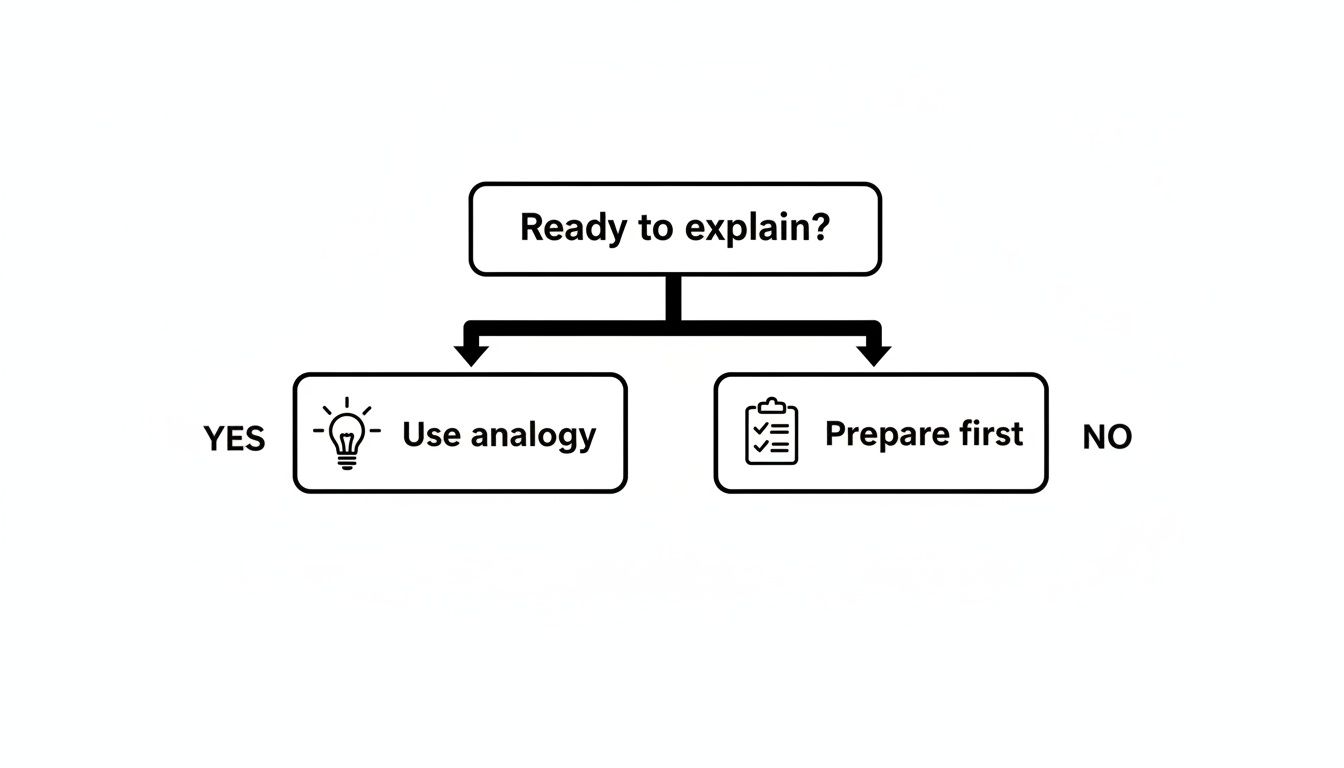
It’s a good reminder that the first step is always checking in with yourself. A productive chat can only happen when you feel ready for it.
Discussing Anxiety with a Parent
Talking to a parent about anxiety can be an emotional minefield. They often want to "fix" it for you, and their worry can sometimes come across as judgment. They might even feel guilty, wondering if they did something wrong.
Your job here is to guide them toward helpful support while calming their fears. Anticipate their reactions and get ahead of them. Start by acknowledging their love and then gently educate them on what you actually need.
- "I know this might be hard to hear, but I wanted to let you know I've been struggling with anxiety. It’s a real and treatable health condition, and I'm already taking steps to manage it and get better."
- "What would be most helpful from you right now isn't advice, but just your patience and understanding. Honestly, just knowing you’re in my corner makes a huge difference as I work through this."
This sets clear boundaries in a loving way. It shifts their focus from frantic problem-solving to providing the steady, quiet support that actually helps you heal.
How to Explain Anxiety to Your Manager
In a professional setting, the conversation needs to be practical, private, and focused on solutions. You are never obligated to disclose a diagnosis. Instead, you can simply explain the functional impact of your symptoms to get the support you need to do your job well.
Keep it brief and tie it directly to work-related accommodations.
- "I do my most focused work in a quieter environment. Before big presentations, would it be possible for me to use one of the focus rooms for an hour to prepare?"
- "I've found that having an agenda a day before high-pressure meetings helps me prepare my thoughts so I can contribute more effectively."
This approach frames your needs as tools for success, not personal problems. It shows you're committed to your role while advocating for an environment that lets you perform at your best, which is a key part of maintaining stability while you heal.
Navigating Reactions and Setting Healthy Boundaries

Once you open up about your anxiety, you're going to get a whole spectrum of reactions. Some people will be wonderfully empathetic, offering exactly the kind of support you were hoping for.
Others, however, might hit you with well-meaning but totally unhelpful clichés like "just think positive" or "you just need to relax." It can be deflating, to say the least.
It’s crucial to remember that their reaction isn’t about you—it’s a reflection of their own understanding and comfort level. Preparing for these mixed responses ahead of time will help you protect your own emotional energy. Your experience is valid, period, and you are on a path to feeling better.
Responding to Unhelpful Advice
When someone offers simplistic advice, it almost never comes from a bad place. They want to help; they just don't have the right tools. The goal isn't to win an argument but to gently steer them toward what you actually need to support your healing.
It helps to have a few calm, go-to phrases ready in your back pocket.
- For "Just be positive": "I appreciate that. It's just that my brain doesn't always work that way, but what really helps me is when someone just listens without trying to fix it."
- For "You worry too much": "It feels like more than just worry; it’s a physical response my body has. Honestly, just knowing you're here for me as I work on this makes a huge difference."
These kinds of replies softly correct the misunderstanding while clearly stating what would feel supportive. This approach builds bridges, not walls. If you want to give them more resources, you could even point them to a practical guide on how to support someone with anxiety.
Setting Boundaries to Protect Your Peace
Setting boundaries isn't about pushing people away. It's about creating a safe space for your own well-being and recovery.
If someone consistently dismisses your feelings or their comments leave you feeling drained, it is 100% okay to limit how much you discuss your anxiety with them. You don’t owe anyone a front-row seat to your mental health journey.
A healthy boundary can be as simple as saying, "I really appreciate you wanting to help, but this isn't something I have the energy to talk about right now." This is a powerful act of self-care and a vital part of healing.
Your recovery is the priority here. That means building a support system with people who listen, respect what you're going through, and offer genuine encouragement.
Focusing your energy on these positive relationships is what fuels the journey forward. It also helps to build your own toolkit; exploring different grounding techniques for anxiety gives you immediate, personal strategies to pull yourself out of overwhelming moments. This whole process reinforces one hopeful truth: the right support is out there, and you absolutely can heal.
Got Questions About Opening Up?
Even with the best intentions, it's totally normal to have some last-minute jitters about having "the talk." Let's walk through some of the most common worries that come up when you're trying to figure out how to explain your anxiety to someone.
What if I Have a Panic Attack While Trying to Explain It?
This is a real and valid fear. If it happens, the first thing to know is: it's okay. You are not failing. In fact, it's a raw, real-time look at what you're dealing with and why you're seeking to heal.
Give yourself permission to hit pause. A simple, "I need a minute, this is harder to talk about than I thought," is more than enough.
If you have a go-to grounding technique, like the 5-4-3-2-1 method, now’s the time to use it. You can even bring them into it: “See this? This feeling right now? This is a little taste of what I’m talking about.” Your well-being comes first. You can always pick up the conversation later.
How Much Is Too Much to Share?
You're in the driver's seat here. The right amount of detail comes down to who you're talking to and what you hope to get out of the conversation.
- For a partner or best friend: You might feel safe sharing specific triggers, irrational fears, or how it felt growing up.
- For a manager: Keep it focused on the practical stuff. Think: "Sometimes, to do my best work on a big project, I need a quiet space to focus and manage my nerves beforehand."
A good rule of thumb is to start with the basics. Let them ask questions if they want to know more. And remember, you never, ever have to share anything that makes you feel unsafe or uncomfortable.
What if They Use This Against Me?
This fear is exactly why choosing the right person is so critical. Start with someone who has a proven track record of being trustworthy, kind, and respectful. Think about who in your life has consistently shown up for you without judgment.
If someone in your personal life weaponizes your vulnerability, that’s not a reflection on you—it’s a giant red flag about them. A huge part of getting better is learning to build a support system that genuinely has your back. It also means learning to set firm boundaries with people who prove they can't be trusted.
They Seemed to Get It at First, but Now They’re Back to Dismissing It. What Do I Do?
People forget. Life gets busy. It’s frustrating, but it's also pretty common for the initial understanding to fade. Building true empathy is a marathon, not a sprint, and so is healing.
A gentle reminder can work wonders.
Try something like, "Hey, remember that chat we had about my anxiety? Today’s a rough one, so I might need a bit of extra patience." Consistent, calm reminders are your best tool. This isn't a one-and-done conversation. Real support is built through these small, ongoing moments of honesty. It reinforces that with the right people in your corner, a calmer, more present, and panic-free life is absolutely possible.
Opening up about your anxiety is a massive step forward. At The Anxiety Checklist, we're here to give you the tools for the next steps—understanding your triggers, managing the physical symptoms, and building a life you love. Check out our self-guided system and start taking back control today.