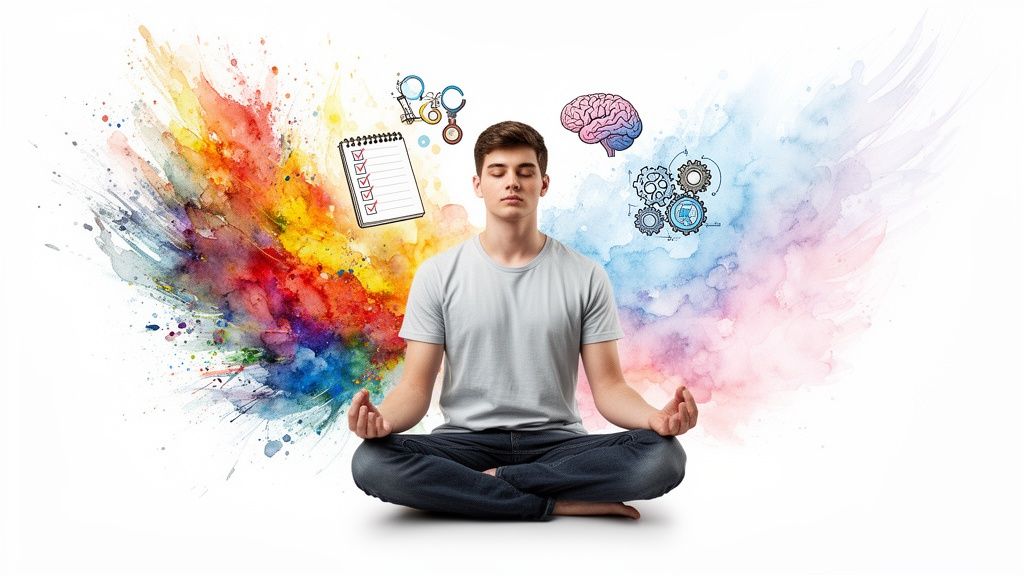
Learning to manage anxiety is the first step toward a profound truth: you can heal. This guide is your roadmap to building a personal toolkit—a set of skills to disarm panic, rewire worried thoughts, and create daily habits that lead to lasting calm. This isn't about erasing a normal human emotion. It's about taking back control so anxiety no longer controls you. Hope is a strategy, and this guide provides the actionable steps to turn that hope into your new, peaceful reality.
Your Path From Overwhelmed To In Control
Feeling trapped by anxiety is more than just a thought; it's a deeply physical and emotional experience. If you’ve ever felt your heart pound, your chest tighten, or your mind race with uncontrollable "what ifs," you know just how isolating it can be.
This guide is built on a simple, powerful truth: you can absolutely learn to manage your anxiety and reclaim a life free from panic. We're moving past abstract advice to give you a concrete, actionable plan that puts you back in the driver's seat, on a journey toward healing.
Understanding You're Not Alone
First things first: you are far from alone in this. Globally, anxiety is a widespread challenge, but it is also a treatable one.
Before the pandemic, an estimated 301 million people were already living with an anxiety disorder. The intense pressures of COVID-19 then caused that number to spike by nearly 28% in 2020 alone.
Despite effective treatments being available, a staggering gap in care remains. Fewer than a third of people ever get the help they need. You can learn more about these global mental health trends from the World Health Organization.
The data below from the WHO highlights just how common anxiety disorders are compared to other mental health conditions worldwide.
This visual is a powerful reminder that what you're feeling is a shared human experience, and it validates the hope that comes with finding accessible and effective strategies to manage it.
A Journey of Actionable Steps
Consider this guide your starting line for moving from a life dictated by worry to one defined by your own choices and peace. We’ll walk through practical, in-the-moment techniques to handle panic, build a foundation of daily habits for resilience, and learn to challenge the thought patterns that fuel the anxiety cycle. This is the path to living panic-free.
"Hope is not just a feeling; it's a strategy. Your strategy for a calmer, more controlled life starts now by taking the first step."
As you get started, it's also important to address the coping mechanisms that might be getting in your way. For instance, many people turn to food for comfort, and learning how to stop emotional eating and regain control can be a powerful part of your toolkit.
To begin, it helps to get a clear picture of where you stand. Taking a moment to assess your symptoms can provide a valuable baseline. You can use a confidential tool like this Generalized Anxiety Disorder test (GAD-7) to better understand your personal experience with anxiety.
Ground Yourself When Panic Strikes
When your heart pounds and the room feels like it's closing in, you need tools that work right now. That sudden rush of panic is your body's alarm system—the fight-or-flight response—misfiring. During these moments, your logical brain takes a backseat, and the emotional, primitive part of your brain grabs the steering wheel.
This section is your emergency toolkit for those acute moments. It's all about pulling your brain out of that terrifying spiral and anchoring it firmly in the present. These aren't just distractions; they are proven methods to regain control and prove to yourself that you are stronger than the panic.
Use Your Senses to Anchor Your Mind
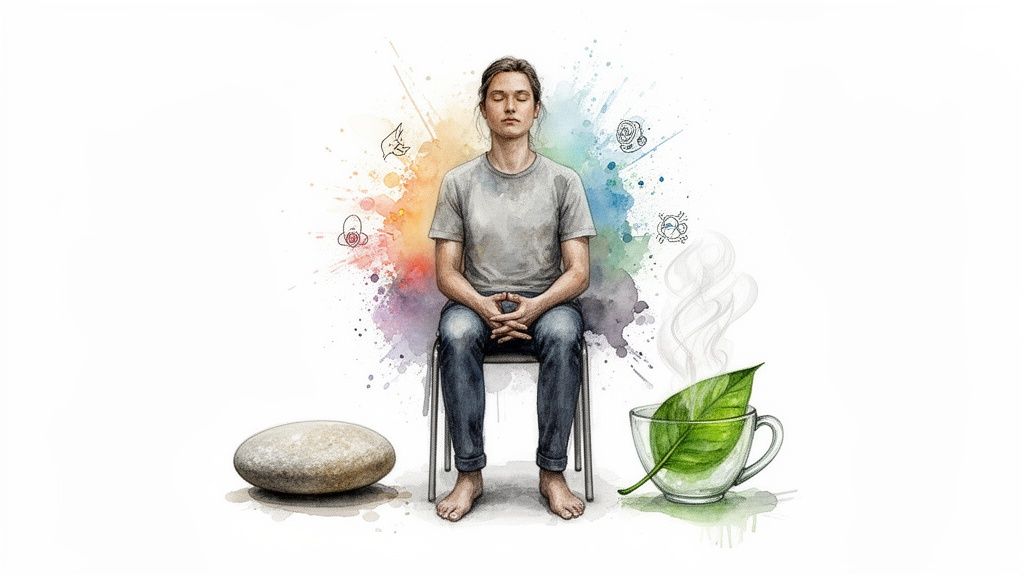
One of the most powerful ways to interrupt a panic attack is to engage your five senses. This simple act forces your brain to focus on the tangible world around you instead of the frightening sensations happening inside you. A structured and easy way to do this is with the 5-4-3-2-1 grounding technique.
The best part? You can do it anywhere, anytime, without anyone even knowing.
- 5 Things You Can See: Look around and name five objects. Don't just list them; notice the details. Instead of "desk," see "the dark grain of the wood on my desk" or "the small scratch on the corner of my phone screen."
- 4 Things You Can Touch: Actively feel four different textures. Notice the smooth coolness of your tabletop, the soft fabric of your shirt, the rough texture of a wall, or the solid weight of a pen in your hand.
- 3 Things You Can Hear: Listen carefully and identify three distinct sounds. It could be the low hum of a computer, distant traffic, or even the sound of your own breathing. Isolate each one.
- 2 Things You Can Smell: What can you smell right now? Maybe it's the faint scent of coffee, the soap on your hands, or the clean smell of paper. If you can’t smell anything obvious, just imagine two of your favorite scents.
- 1 Thing You Can Taste: Focus on one thing you can taste. This might be the lingering flavor of your morning tea or toothpaste. You can also take a sip of water and notice its clean, simple taste.
This exercise yanks your attention out of the chaotic, future-focused "what if" thoughts and plants it firmly in the real, non-threatening present. By focusing on sensory input, you're sending a direct signal to your nervous system that you are safe right now. For more ideas on how to manage these intense moments, there are many practical grounding techniques for anxiety you can add to your toolkit.
Regulate Your Breathing to Regain Control
When panic hits, your breathing often becomes rapid and shallow, which only intensifies feelings of dizziness and fear. Intentionally slowing your breath is one of the fastest ways to tell your body it's safe to calm down. Box breathing is a fantastic—and discreet—tool for this.
Imagine drawing a box with your breath. Here’s how you do it:
- Breathe in slowly through your nose for a count of four seconds.
- Hold your breath for a count of four seconds.
- Exhale slowly through your mouth for a count of four seconds.
- Hold your breath at the end of the exhale for four seconds.
Repeat this cycle four or five times. The slow, rhythmic nature of this exercise helps regulate your heart rate and activates the parasympathetic nervous system—your body’s natural relaxation response.
Key Takeaway: You don't have to be a victim of a panic spiral. By intentionally directing your attention to your senses and your breath, you are actively taking back control from anxiety, one moment at a time. This is the first step toward a panic-free life.
When anxiety strikes, having these practical tools can make a huge difference. To find the eye of the storm and reclaim your peace, you might also want to explore these science-backed 10 Powerful Mindfulness Exercises for Anxiety that can further strengthen your ability to stay present.
Build Your Foundation for Lasting Calm
While grounding techniques are your emergency response team for acute panic, the real secret to long-term healing is building a solid foundation of daily habits. These aren't about dramatic, life-altering overhauls. Instead, think of them as small, consistent choices that regulate your nervous system, lower your baseline anxiety, and make you far more resilient when life throws you a curveball.
Picture your anxiety level as a bucket of water. Daily stressors—traffic, work deadlines, a tough conversation—are the drips that fill it up. When your foundational habits are out of sync, your bucket starts the day already half-full, making it much easier to overflow into a full-blown panic attack.
The goal here is to keep that bucket as empty as possible each day. This gives you more capacity to handle whatever comes your way without feeling overwhelmed, creating the space for healing to happen.

Fuel Your Brain for Stability
The connection between what you eat and how you feel is incredibly powerful. Your gut and your brain are in constant communication. In fact, an estimated 95% of your body's serotonin—a critical neurotransmitter for mood regulation—is produced right in your gut. This means your diet directly impacts your mental state.
You don't need a super restrictive or complicated diet to feel the benefits. It's more about crowding out the junk and adding in nutrients that support a calm mind.
- Bring on the Omega-3s: Fatty fish like salmon, plus walnuts and chia seeds, are packed with omega-3 fatty acids. Studies have consistently linked these healthy fats to reduced anxiety symptoms.
- Opt for Complex Carbs: Swap sugary snacks and white bread for whole grains like oatmeal, brown rice, and quinoa. These give you a steady stream of energy, preventing the blood sugar crashes that can feel terrifyingly similar to a panic attack.
- Watch the Caffeine and Alcohol: That morning coffee might feel essential, but caffeine is a stimulant that can easily dial up anxiety. Alcohol might seem like it helps you relax, but it messes with your sleep and can lead to a spike in anxiety the next day. A simple swap, like replacing your second coffee with herbal tea, can make a noticeable difference.
Master Your Sleep Hygiene
Poor sleep and anxiety are locked in a vicious cycle—one almost always makes the other worse. Getting consistent, high-quality sleep isn't just a nice-to-have; it's a non-negotiable part of managing anxiety effectively. When you create a solid sleep routine, you're sending clear signals to your brain that it's time to power down and heal.
Key Takeaway: A restful night is not a luxury; it's a core component of your anxiety management plan. Prioritizing sleep is one of the most effective ways to lower your baseline anxiety and improve your emotional resilience.
A simple, repeatable pre-bed ritual is a great place to start. This could be as easy as turning off all screens an hour before bed, taking a warm bath, or listening to calming music. Consistency is what helps regulate your body's internal clock and makes falling asleep easier.
Move Your Body to Process Stress
When you feel anxious, your body is swimming in stress hormones like cortisol and adrenaline. Physical activity is one of the quickest and most effective ways to burn off those hormones and trigger the release of mood-boosting endorphins. The most important thing is finding a type of movement you genuinely enjoy, because that's what you'll actually stick with.
It doesn't have to be a punishing hour-long gym session. Even short bursts of moderate exercise can have a huge impact.
- For a Calming Effect: A simple 20-minute walk, especially in nature, can significantly lower cortisol levels and quiet a racing mind.
- For Releasing Anxious Energy: Higher-intensity activities like running, dancing, or boxing can be a fantastic outlet for all that pent-up tension.
- For Mind-Body Connection: Practices like yoga or tai chi are brilliant because they combine physical movement with mindfulness, tackling both the physical and mental symptoms of anxiety at the same time.
Many people find that combining movement with mindfulness is where the real magic happens. For a deeper look, our guide on meditation for anxiety offers practical techniques you can weave into your physical routine. Remember, the goal is consistency, not perfection.
To help you stay on track, a simple tracker can be a game-changer. It's not about being perfect; it's about building awareness and celebrating small, consistent wins.
My Weekly Resilience Habit Tracker
Use this sample checklist to track the foundational habits that lower your baseline anxiety. Customize it to fit your personal routine and goals.
| Habit | Monday | Tuesday | Wednesday | Thursday | Friday | Saturday | Sunday |
|---|---|---|---|---|---|---|---|
| Sleep | |||||||
| 7-9 Hours Sleep | ☐ | ☐ | ☐ | ☐ | ☐ | ☐ | ☐ |
| No Screens 1 Hr Before Bed | ☐ | ☐ | ☐ | ☐ | ☐ | ☐ | ☐ |
| Nutrition | |||||||
| Ate a Balanced Breakfast | ☐ | ☐ | ☐ | ☐ | ☐ | ☐ | ☐ |
| Limited Caffeine to 1 Cup | ☐ | ☐ | ☐ | ☐ | ☐ | ☐ | ☐ |
| Drank 8 Glasses of Water | ☐ | ☐ | ☐ | ☐ | ☐ | ☐ | ☐ |
| Movement | |||||||
| 20+ Mins of Movement | ☐ | ☐ | ☐ | ☐ | ☐ | ☐ | ☐ |
| Mindfulness | |||||||
| 10 Mins of Meditation/Deep Breathing | ☐ | ☐ | ☐ | ☐ | ☐ | ☐ | ☐ |
Don't let the checklist intimidate you. Even checking off one or two boxes each day is a huge step forward. Over time, these small actions build on each other, creating a powerful foundation of resilience that makes anxiety much easier to manage.
Rewire Your Anxious Thought Patterns
Once you've started building a solid foundation with daily habits, it's time to go straight to the source: your thoughts.
Anxiety isn’t just a feeling in your body; it's a powerful narrative, a story your mind tells itself that runs on a loop of negative, distorted thinking. The good news? You can learn to become the editor of that story.
This is all about learning to see your thoughts for what they are—just thoughts, not facts. Using the core ideas from Cognitive Behavioral Therapy (CBT), you can start to spot, question, and ultimately change the mental habits that keep you stuck. This is where you truly start to heal and take back control.
Identifying Your Cognitive Traps
First things first, you have to recognize the common thinking errors, often called cognitive distortions, that fuel your anxiety. Think of them as mental filters that twist reality, making normal situations seem far more dangerous than they actually are.
Learning to spot these is like turning on a light in a dark room. Suddenly, you can see what you're tripping over.
Here are some of the biggest culprits to watch for:
- Catastrophizing: This is the classic "what if" spiral. You take one small concern and your mind immediately leaps to the absolute worst-case scenario. A minor typo in an email becomes, "I'm definitely getting fired."
- Black-and-White Thinking: Also known as all-or-nothing thinking, this trap leaves no room for a middle ground. Things are either perfect or a complete disaster. You might think, "If I'm not the best at this, I'm a total failure."
- Mind Reading: This is when you assume you know exactly what other people are thinking about you—and it's almost always negative. You walk into a room and your brain whispers, "Everyone here thinks I'm awkward."
- Fortune Telling: Here, you predict the future as if your anxious guesses are proven facts. Before a party, you might think, "I just know I'm going to have a terrible time and say something stupid."
Just recognizing these patterns is a game-changer. It creates a tiny bit of space between you and the thought, which allows you to observe it without automatically buying into it. If you want to dive deeper into this powerful approach, you can learn more by understanding CBT for anxiety in our detailed guide.
The Three-Step Process to Challenge Anxious Thoughts
Once you can spot these mental traps, you need a simple, repeatable process to disarm them. This isn't about fighting your thoughts or forcing yourself to "just be positive." It’s about becoming a detective of your own mind—examining the evidence and choosing a more balanced, realistic perspective.
A simple yet incredibly effective method for this is the "Catch It, Check It, Change It" framework.
1. Catch It: The moment you feel that jolt of anxiety, pause. Ask yourself, "What thought just went through my mind?" The goal is to catch that automatic negative thought right in the act. For example, your phone buzzes with an unknown number, and your immediate thought is, "This is terrible news."
2. Check It: Now, put that thought on trial. Is it 100% true? What's the real evidence for and against it? Are you falling into one of the cognitive traps we just talked about?
- Evidence For: "Well, sometimes bad news does come via phone calls."
- Evidence Against: "Most unknown numbers are spam. It could be a delivery driver. I have zero actual information that anything is wrong."
- Cognitive Trap: This is a classic case of Catastrophizing.
3. Change It: Finally, come up with a more balanced and realistic thought to replace the anxious one. It doesn’t have to be sunshine and rainbows—just more grounded in reality. Instead of "This is terrible news," a much better thought would be, "This is probably just a spam call, but I'll see. Even if it's something I wasn't expecting, I can handle it."
This three-step process is a skill, not a one-time fix. Every single time you practice it, you're weakening the old, anxious neural pathways and building new, more rational ones. It gets easier with practice, and it is the key to lasting healing.
Putting It All Together: A Real-World Example
Let's walk through a super common scenario: you have a social event coming up this weekend that you're dreading.
- Anxious Thought (The Catch): "I'm going to be so awkward. Everyone will notice how anxious I am, and I won't have anything interesting to say. I should just cancel."
- The Check: Is this thought 100% true? You're using mind-reading ("everyone will notice") and fortune-telling ("I won't have anything to say"). Looking back, have you ever had a pleasant conversation at a party, even a short one? Probably. Are you really the center of everyone's attention? Unlikely.
- The Change: A more balanced thought could be: "I'm feeling anxious about this party, and that's okay. I might feel a bit awkward when I first get there, but I can just focus on listening to people. I don't have to be the life of the party; I can just aim to have one or two nice conversations."
This shift is incredibly powerful. It takes an overwhelming catastrophe and shrinks it down to a manageable challenge, giving you the power to act instead of avoid.
And these techniques matter. A lot. Anxiety isn't a small problem; it's widespread, as this chart from SingleCare shows.
Anxiety impacts people at every stage of life, which is why having effective, accessible strategies like CBT is so critical.
Anxiety is the most common mental health issue worldwide, yet studies show that only about one in four people (27.6%) who need treatment actually get it. This is where self-guided methods become so crucial. Evidence-based tactics like the ones here can reduce symptoms by 50-60%, proving that you have the power to create profound change for yourself.
Create Your Personal Anxiety Management Plan
This is where everything we’ve talked about—the grounding techniques, the daily habits, the mental reframing—comes together. Think of those strategies as the raw materials. Now, it's time to build a system that works for you, a personalized plan that you can lean on as you heal.
This isn't about just collecting a list of tips. It's about creating a living, breathing feedback loop for your own mental health. Why? Because the journey toward a calmer mind can feel incredibly slow, and your anxious brain is a master at telling you "nothing is working."
A structured plan with real data is your best defense against that voice of doubt. It gives you concrete, undeniable proof that you're making progress toward a panic-free life, even when it doesn't feel like it.
The Power of Tracking Your Journey
Monitoring your progress isn't just about keeping a diary; it's a powerful psychological shift. When you start tracking your triggers, symptoms, and the coping skills you use, you stop being a passive victim of anxiety and become an active observer of your own experience. That change in perspective is huge.
It helps you spot the small wins you’d otherwise miss. Maybe you used a breathing technique during a tense meeting and it actually helped. Perhaps you notice that your anxiety is consistently lower on days you get in a morning walk. These little insights are gold because they show you what’s effective for your unique nervous system.
You stop guessing and start using real-world data from your own life to make smarter decisions about your well-being. This process of tracking and reviewing is one of the most vital anxiety recovery steps you can take.
How to Build Your Plan
You don't need a complicated spreadsheet or fancy software. A simple notebook or a dedicated tool like The Anxiety Checklist works perfectly. The only thing that matters is consistency. Here’s a simple framework to turn tracking into real action.
- The Daily Log: At the end of each day, take just five minutes. Note your overall anxiety level (a simple 1-10 scale is fine), any specific triggers you noticed, and what coping skills you tried.
- The Weekly Review: Once a week, set aside 15 minutes to look back at your daily entries. This is where the magic happens. Do you see any patterns? Maybe your anxiety spikes after too much caffeine, or perhaps box breathing is your go-to tool for sudden panic.
- Adjust and Adapt: Based on what you find, make small tweaks for the week ahead. If you see your sleep routine has been slipping, make that a non-negotiable priority. If a specific negative thought pattern keeps popping up, make a conscious effort to challenge it.
This turns all the advice from this guide into a dynamic blueprint for your life. It’s no longer a list of ideas; it’s a structured, hopeful path forward.
Hope isn't a passive wish; it's an active process. By tracking your journey, you are creating tangible evidence of your own resilience. You're proving to yourself, day by day, that a life without constant panic is absolutely within your reach.
This is where you put cognitive tools into practice. The simple but powerful CBT cycle of catching, checking, and then changing your thoughts is a core skill you'll use in your plan.
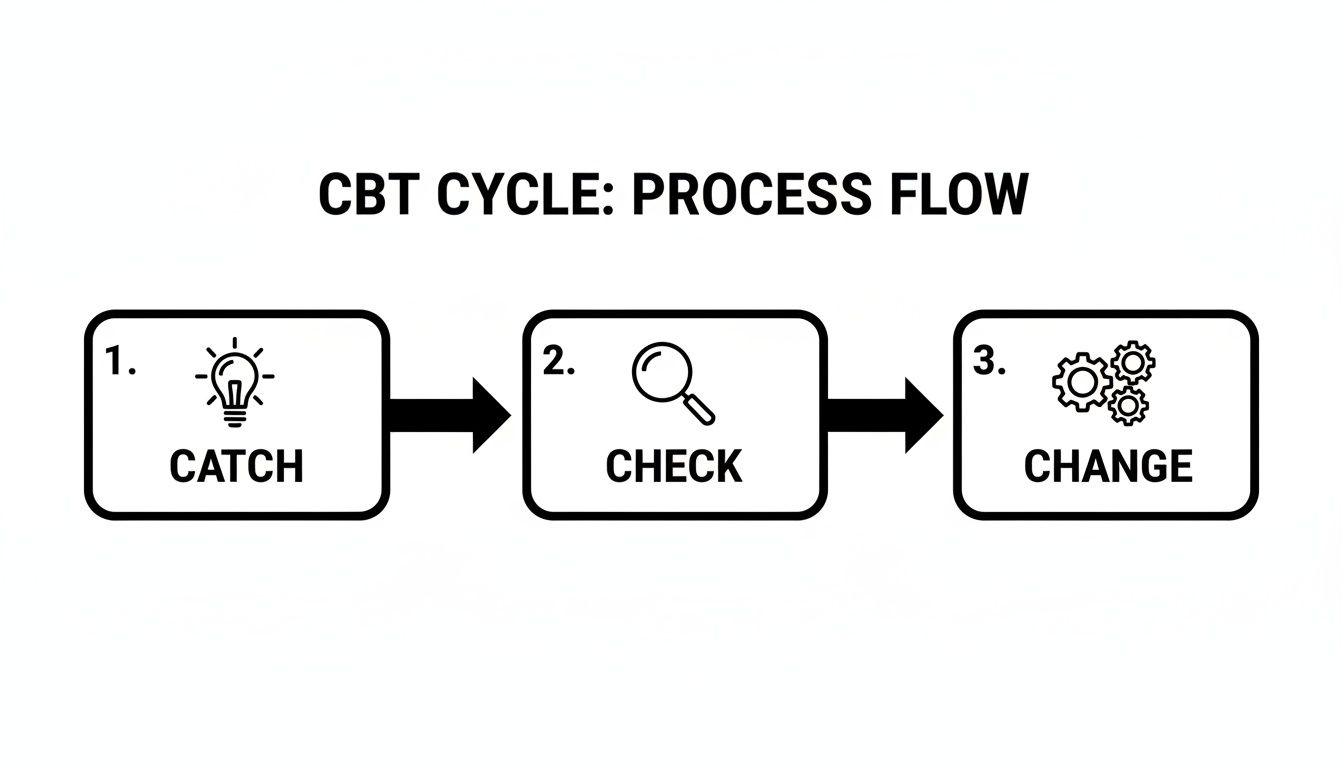
This visual is a great reminder that challenging anxiety isn't a one-time fix, but a repeatable skill you can practice anytime an anxious thought takes hold.
Got Questions About Managing Anxiety? Let's Talk.
Taking that first step to manage anxiety is huge, and it’s totally normal for questions to pop up along the way. In fact, it's a great sign—it means you're committed to understanding yourself better and finding what truly works.
Let’s get into some of the most common questions I hear. My goal here is to give you clear, honest answers that empower you on this journey.
This isn’t about flipping a switch and becoming anxiety-free overnight. It’s about building a life where you feel in control, armed with tools and self-knowledge, so you can move forward with real confidence and hope.
How Long Until I See Results from These Techniques?
This is easily one of the most common—and important—questions people ask when they start. The honest answer comes in two parts.
You can absolutely feel relief almost immediately. Grounding techniques like the 5-4-3-2-1 method or box breathing are designed to be your anchor in the very moment panic tries to take over. You can often feel their calming effect within minutes.
But building that deep, long-term resilience is more of a slow burn. After a few weeks of consistently practicing your daily habits and challenging those anxious thoughts, you'll likely notice a real drop in the frequency and intensity of your anxiety. Lasting, deep-rooted change often takes a few months of dedication. Be patient with yourself and use your tracking tool to celebrate those small wins—they really do add up to massive progress.
Your path to healing is a marathon, not a sprint. Celebrate every small step, because each one is a testament to your strength and commitment to a calmer, more fulfilling life.
Can I Really Manage Anxiety Without a Therapist?
For sure. Many people find incredible success managing their anxiety with self-guided strategies just like the ones in this guide. For some, learning and applying these tools is enough to regain control and dramatically improve their quality of life. Think of this guide as a powerful standalone toolkit or a fantastic sidekick to professional therapy.
That said, seeking professional support is a sign of strength, never weakness.
If your anxiety is consistently getting in the way of your work, relationships, or just getting through the day, a therapist can offer invaluable, personalized strategies. A professional can help you navigate deeper issues and provide a level of accountability that can make your journey smoother and more effective.
What Should I Do If I Have a Setback?
First things first: setbacks are not just possible; they are a completely normal and expected part of the process. They aren't failures—they're data. When anxiety feels like it's creeping back in, the single most important thing you can do is practice self-compassion.
Instead of beating yourself up, get curious. Pull out your tracker or journal and look for clues.
- Can you pinpoint a specific trigger?
- Did your foundational routine (sleep, nutrition, movement) get thrown off?
- Have you been slacking on your thought-challenging exercises?
A setback is really just an opportunity to learn more about what you need, double down on the strategies that work, and prove to yourself that you have the skills to get back on track. Every single time you navigate a rough patch, you're reinforcing your own resilience and proving that you can—and will—overcome these challenges.
The path to a panic-free life is built on action and hope. By applying these strategies consistently, you are not just managing symptoms; you are building a new relationship with yourself. To help structure this journey, The Anxiety Checklist provides a complete system with an interactive spreadsheet and detailed eBook to guide you every step of the way. Take control and start building your fearless life today at https://anxietychecklist.com.