
It starts with that white-knuckle grip on the steering wheel, a heart that pounds at the thought of merging onto the highway. If this sounds familiar, the first step to overcoming driving anxiety is simply acknowledging the fear and understanding you can get back in control. It's a hopeful journey of learning real-world coping skills and slowly, safely reintroducing yourself to driving in a way that feels manageable.
You Can Overcome Driving Anxiety
If the idea of getting behind the wheel fills you with dread, the most important thing to know is this: you are not alone, and there is a clear, hopeful path forward to a life free from panic.
Driving anxiety is far more common than people realize, and the feelings it creates are real and powerful. But they don't have to be permanent. Hope isn't just a nice thought; it's the foundation of your recovery. A life where you can drive calmly is not a distant dream—it's an achievable reality.
This guide is built on the truth that amaxophobia—the clinical term for a fear of driving—is a challenge you can absolutely overcome. It's about taking the fear apart, piece by piece, armed with the right strategies and a bit of self-compassion. You can learn to manage panic, rebuild your confidence, and find freedom on the road again. This is your path to healing.
Understanding the Scale of Driving Anxiety
The sense of isolation that comes with this fear can be one of its toughest parts. But the data shows just how many people are in the same boat.
Driving anxiety affects a staggering 17-20% of people in mild forms, while 4-6% deal with severe versions. In fact, up to 66% of Americans feel some level of driving anxiety. Highways top the list of triggers, and 62% can point to a specific traumatic event that kicked it all off.
This isn't just a small inconvenience; it's a major roadblock in daily life for millions. The good news? People are actively looking for—and finding—solutions every single day.
The journey from fear to fearlessness starts with understanding that your anxiety is a manageable condition, not a life sentence. With consistent effort using proven methods, you can teach your brain to respond differently to driving triggers. Healing is possible.
Your First Step Toward Fearlessness
Feeling empowered starts with a solid plan. The path to overcoming driving anxiety isn't about just gritting your teeth and "facing your fears." It's a methodical approach that combines several key pieces to calm your nervous system and rebuild your confidence from the ground up, leading to a panic-free life.
You will learn to:
- Pinpoint Your Triggers: Get specific about the situations, thoughts, or even physical sensations that set your anxiety in motion.
- Reframe Negative Thoughts: Challenge the catastrophic "what-if" stories that keep the fear cycle spinning.
- Practice Gradual Exposure: Gently and safely reintroduce yourself to driving at a pace that feels right for you, not one that overwhelms you.
- Use In-the-Moment Coping Skills: Learn quick, practical techniques to stay grounded when panic starts to creep in behind the wheel.
This process retrains your brain's automatic response. By following proven anxiety recovery steps, you build resilience and prove to yourself, one drive at a time, that you are safe and in control.
Getting to the Root of Your Driving Fear
To truly heal from driving anxiety, you first have to understand what’s feeding it. Think of yourself as a detective, and your own fear is the case you can solve. Once you can pinpoint the specific thoughts, memories, or situations that kickstart your anxiety, you can begin to dismantle them, piece by piece. This self-awareness isn't just a feel-good exercise; it's the first real step toward taking back control and living a life free from panic.
Your fear didn't just show up one day out of the blue. It has roots. Digging them up is incredibly empowering. For most people, driving anxiety isn’t some vague, constant hum—it’s a sharp, pointed reaction to very specific triggers. When you start recognizing those patterns, you go from feeling overwhelmed by a powerful, mysterious force to facing a known opponent. That knowledge is your greatest asset.
Common Triggers for Amaxophobia
Driving anxiety, or amaxophobia, can grow from all sorts of places. More often than not, it's a combination of factors that creates the perfect storm of fear. Let's walk through some of the most common origins.
- Past Traumatic Events: A previous car accident is a huge one, even if it was just a minor fender-bender. But it doesn't stop there. Just witnessing a bad crash or even hearing a vivid story about one can plant a seed of fear that grows over time.
- Fear of Losing Control: This is a biggie. For many, the anxiety isn't actually about other drivers—it's about their own body's reaction. The fear of having a panic attack, fainting, or getting dizzy while stuck in traffic can feel way more terrifying than the act of driving itself.
- Specific Driving Scenarios: Certain situations are notorious anxiety hotspots. These usually include high-speed highways, merging into fast-moving traffic, crossing bridges, navigating tunnels, or driving at night or in bad weather.
Getting specific is the key here. Is it the physical act of driving that gets you, or is it the thought of what could happen? Understanding your personal triggers is critical for making real progress.
Becoming a Detective of Your Own Anxiety
To get to the bottom of your fear, you need to start asking some direct questions. The goal isn't to dwell on the fear but to gather intel. Grab a notebook or open a notes app and think through these points the next time you feel that wave of anxiety about driving.
- What was I thinking right before I felt anxious? Were you imagining a worst-case scenario? Were you criticizing your own driving skills?
- Where was I, or where was I planning to go? Anxiety often spikes when driving to unfamiliar places or on roads you already associate with fear, like a busy highway.
- What physical sensations did I notice first? A racing heart, sweaty palms, or a tight chest are often the first signs that your fight-or-flight system has been activated.
Just recognizing these early warning signs is a huge step forward. By identifying these patterns, you can start seeing them as signals rather than threats, giving you a chance to intervene before the anxiety spirals. For a deeper dive into this, exploring these common anxiety triggers can shed even more light on the process.
The most hopeful part of this is realizing your fear has a logic to it. It’s not random. Once you understand its rules, you can learn how to rewrite them.
For many, the fear of accidents or a deep distrust in their own driving skills is the primary issue, sometimes even more than the fear of a panic attack itself. This is a huge reason why people avoid highways, where the perceived risk feels so much higher. Research backs this up, showing that 42-77% of individuals experience significant post-collision anxiety. This is a crucial piece of the puzzle, and you can learn more about how freeway phobia develops on RTOR.org. Unpacking this root cause is a vital step toward healing.
Your Personal Roadmap to Confident Driving
Alright, this is where the real work begins—and where you start to see real change. Healing from driving anxiety isn't about white-knuckling it through terrifying situations. It’s about methodically, and gently, proving to your brain that you are safe and in control.
The best way to do this is with a graduated exposure plan. It's the gold-standard approach for a reason: it works.
The idea is simple but incredibly powerful. You'll reintroduce yourself to driving in small, manageable steps, starting with something that feels almost ridiculously easy. You are in the driver's seat, both literally and figuratively—you control the pace completely. By stacking these small wins, you slowly dismantle the fear and build a new foundation of confidence.
Designing Your Exposure Hierarchy
An exposure hierarchy sounds clinical, but it's really just a list of driving-related tasks that you rank from least scary to most scary. Think of it as your personal roadmap to getting back on the road comfortably.
Your first step might be something that barely nudges your anxiety, while the final step is your ultimate goal—maybe it's driving on the highway during rush hour or making a long-distance trip alone.
The beauty of this method is that you never have to jump into the deep end. You only move to the next item on your list after the current one feels manageable and your anxiety has noticeably dropped. This process rewires your brain, teaching it a crucial lesson: the fear you anticipate is almost always bigger and badder than the reality.
Before you start building your plan, it helps to understand what's happening internally when fear hits. A trigger sets off a chain reaction, which you can learn to analyze and interrupt.
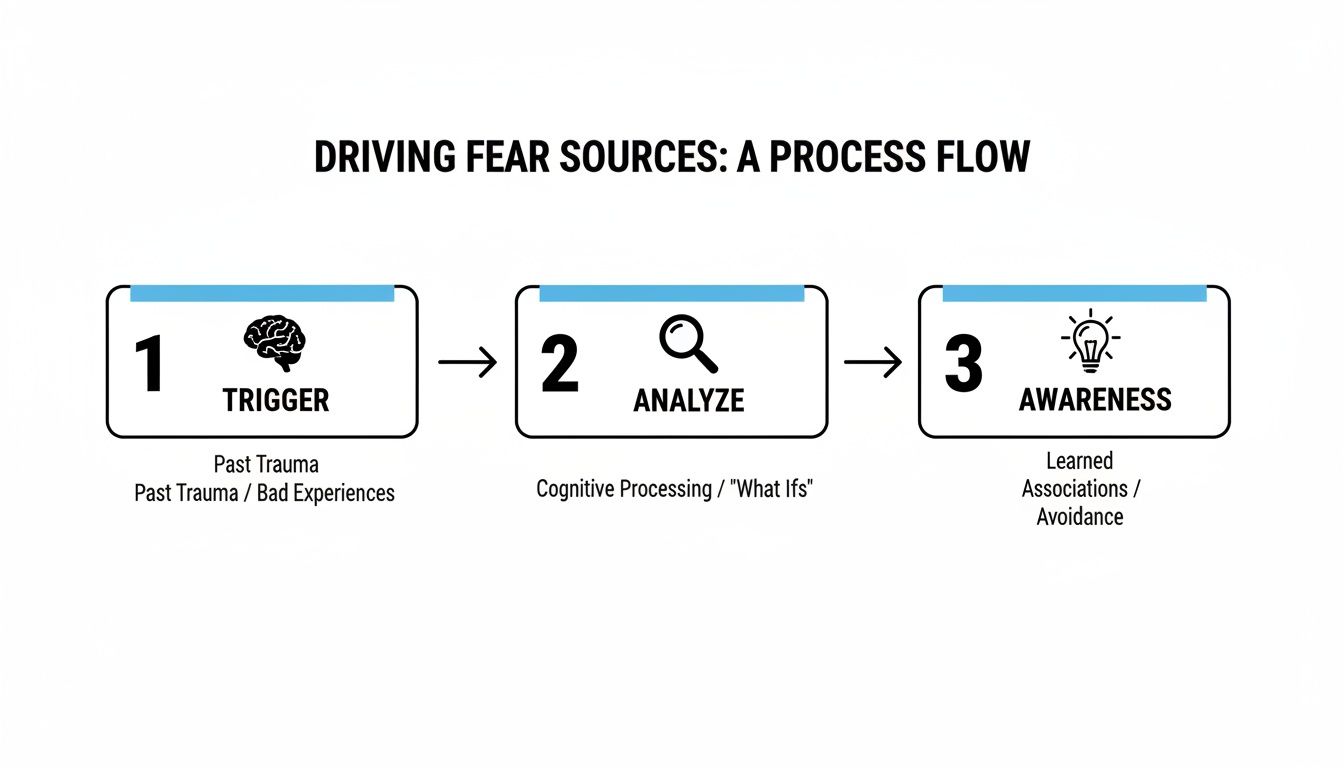
This shows us that by becoming aware of our reactions to triggers, we gain the power to manage that anxiety response instead of letting it control us.
Building Your Step-by-Step Plan
Let's get practical. Grab a notebook or open a new doc and just start brainstorming every single driving scenario that makes you nervous. Don't censor yourself. Write it all down, from sitting in the car to merging onto a six-lane freeway.
Got your list? Now, rank each item on a scale from 1 to 100, where 1 is "no anxiety at all" and 100 is "full-blown panic." This little rating system is how you'll organize your list into a logical, step-by-step ladder.
For instance, the beginning of your hierarchy might look something like this:
- Step 1 (Anxiety: 5/100): Sit in the driver's seat of the parked car in the driveway for 5 minutes, engine off.
- Step 2 (Anxiety: 10/100): Now do the same, but with the engine running for 5 minutes.
- Step 3 (Anxiety: 20/100): Back the car out of the driveway and pull it right back in. Repeat 3 times.
- Step 4 (Anxiety: 30/100): Drive around the block on a quiet Sunday morning.
- Step 5 (Anxiety: 40/100): Drive to a familiar store less than a mile away on local roads with light traffic.
Your list will be completely unique to your fears. The real key is making sure the jump between steps feels small and doable. If a step seems too big, just break it down into even smaller micro-steps. We cover this process in more detail in our guide on using exposure therapy for anxiety safely and effectively.
The goal of each practice session isn't to be totally anxiety-free. The real goal is to stay in the situation just long enough for that first wave of anxiety to crest and then naturally come down on its own. That's how you retrain your nervous system and heal.
Putting Your Plan Into Action
Once your hierarchy is ready, it's time to start. Remember, consistency beats intensity every time. Short, frequent practice sessions are far more effective than one long, overwhelming drive that leaves you feeling defeated.
You can use the table below to start building your own exposure plan. Tracking your progress is a game-changer for staying motivated.
Sample Graduated Exposure Plan for Driving
Use this customizable template to build your step-by-step plan for facing driving fears. Track your anxiety level to see your progress.
| Step | Description of Task | Target Duration/Frequency | My Anxiety Rating (1-10) |
|---|---|---|---|
| 1 | Sit in the driver's seat, engine off, listening to music. | 10 minutes, 3x per week | |
| 2 | Sit in the driver's seat with the engine running. | 10 minutes, 3x per week | |
| 3 | Back the car to the end of the driveway and pull back in. | 5 reps, 2x per week | |
| 4 | Drive around the block once on a quiet weekend morning. | 1 lap, 1x per week | |
| 5 | Drive to the corner store and back during off-peak hours. | 1 round trip, 2x per week |
This is just a starting point—make it your own! The important thing is to create a plan you can stick with.
Track Your Progress Diligently
After every single practice, take a minute to rate your peak anxiety level on a scale of 1-10. Jot down a few notes, too. What felt good? What was tough? This log becomes concrete proof that you're making progress, which is pure gold on days you feel stuck.
Celebrate Every Single Victory
I'm serious about this. Did you just sit in the car for five minutes without bolting? That's a huge win. Drove to the end of the street? Celebrate it. Acknowledging these successes reinforces the new, positive pathways you're building in your brain.
As you get more comfortable, you can actively look for ways to how to improve driving skills which will only boost your confidence further. Taking a defensive driving course or just practicing your three-point turns in an empty parking lot adds another layer of competence that directly shuts down those anxious "what if" thoughts.
Mental Tools for a Calmer Drive
Driving anxiety is a mental game, plain and simple. Right now, your mind is probably running a non-stop loop of catastrophic 'what if' thoughts, creating a cycle of fear that feels absolutely unbreakable. But here's the hopeful truth: you have the power to interrupt that loop and rewrite the script.
This is the point where you stop being a passenger to your fear and get back in the driver's seat of your own mind. Using proven cognitive and mindfulness techniques, you can calm your nervous system, call out irrational thoughts for what they are, and build a foundation of mental resilience that serves you both on and off the road. It’s about learning to work with your mind, not against it.
Think of these mental exercises as your secret weapon for staying centered and confident, no matter what the traffic throws at you.
Spot, Challenge, and Reframe Your Thoughts
This three-step process is a cornerstone of Cognitive Behavioral Therapy (CBT), one of the most effective methods out there for managing anxiety. It works by targeting the negative thought patterns that are fueling your fear.
First, you have to get good at spotting the anxious thought the second it pops into your head. These things are often automatic and lightning-fast.
Next, you challenge it. You have to ask yourself: Is this thought 100% true? Is there a more realistic, balanced way to look at this situation?
Finally, you reframe the thought by consciously replacing the catastrophe with something more rational and calming. This isn't about slapping on a fake smile; it's about finding the actual truth of the matter.
Anxious thoughts thrive in the absence of evidence. When you start questioning them, their power diminishes significantly. You're not ignoring the fear; you're fact-checking it.
Let's walk through a common driving fear to see how this works in real-time:
- Anxious Thought: "I'm going to merge onto the highway and cause a huge, fiery accident."
- Challenge: "Have I ever caused an accident while merging? Did I not pass a driving test to get my license? What are the actual odds of this happening if I just follow the rules of the road like everyone else?"
- Reframe: "I am a capable and cautious driver. I will check my blind spot, use my signal, and find a safe gap to merge smoothly. Millions of people do this every single day, and I can too."
This mental shift is a skill. The more you practice, the stronger and more automatic it becomes.
In-the-Moment Mindfulness Behind the Wheel
Mindfulness is simply the practice of paying attention to the present moment without judging it. It’s a powerful antidote to anxiety, which almost always lives in worries about the future. You can use simple mindfulness techniques right in your car to ground yourself when you feel panic starting to creep in.
Grounding with Your Senses at a Red Light
Next time you come to a stop, instead of letting your mind race, pull your awareness back to your physical senses.
- Feel: Notice the specific texture of the steering wheel under your hands. Can you feel the weight of your body in the seat? The gentle pressure of your feet on the pedals?
- Listen: What do you actually hear? The low hum of the engine, the music on the radio, the rhythmic tick-tock of your turn signal. Just listen, without labeling the sounds as good or bad.
- See: Really look at the color of the car in front of you. Notice the little details on your dashboard or the way the leaves are moving on a nearby tree.
This simple exercise, sometimes called the 5-4-3-2-1 technique, yanks your attention out of the anxious "what ifs" and plants you firmly in the present moment—where you are safe.
The Power of Your Breath
Your breath is the most direct tool you have for telling your body's anxiety response to stand down. When you get anxious, your breathing becomes shallow and quick, which screams "DANGER!" to your brain. By consciously slowing down your breath, you send a powerful message back that says, "Everything is okay. I am safe."
A simple and incredibly effective technique is box breathing. You can do this discreetly at a stoplight or even while cruising down a quiet road.
- Inhale slowly through your nose for a count of four.
- Hold your breath gently for a count of four.
- Exhale slowly through your mouth for a count of four.
- Hold again for a count of four.
Repeat this cycle a few times until you feel your heart rate start to come down. Mastering simple breathing exercises for anxiety gives you an immediate, portable tool to manage panic whenever it strikes.
It's also helpful to realize that these tools aren't just for driving. Many effective stress management techniques can be adapted for any high-pressure situation you face. Learning these skills gives you hope because it proves you aren't helpless. You have the ability to change your mental state and get back to living your life.
Building Your Resilience on and off the Road
Overcoming driving anxiety isn't just about what you do in the car. It’s also about building a strong foundation of well-being in your daily life. Think of your resilience as a muscle—the stronger it is off the road, the better equipped you are to handle challenges when you’re behind the wheel.
This is where you get to be proactive. Instead of just managing panic, you’re building a life where anxiety has less power over you. These lifestyle habits are your secret weapon, lowering your baseline anxiety so you can approach driving from a place of genuine calm and strength.
The Power of Your Support System
You absolutely do not have to go through this alone. Facing a fear as big as driving anxiety can feel incredibly isolating, but building a support network is one of the most powerful and hopeful things you can do. The right support provides encouragement, accountability, and a safe space to practice.
It all starts with communicating your needs. Be open with a trusted friend or family member about what you're experiencing. You might be surprised by how willing people are to help once they understand.
- Ask for a "Driving Buddy": Having a calm, supportive person in the passenger seat during your first few practice drives can make a world of difference. Their presence alone can be incredibly grounding.
- Set Clear Boundaries: Explain what helps and what doesn't. You could say something like, "It would be really helpful if you could just chat with me calmly and not give driving advice unless I ask."
- Celebrate Wins Together: Share your progress! When you successfully drive around the block, let them know. Sharing these victories reinforces your progress and keeps you both motivated.
Having someone in your corner transforms a solitary struggle into a team effort. It’s a constant reminder that you are capable and supported on your journey to healing.
Strengthening Your Mind and Body
Your mental and physical health are deeply connected. The choices you make every day have a direct impact on your nervous system's reactivity. By making small, consistent changes, you can lower your overall anxiety levels, making you less susceptible to panic on the road.
Get Consistent, Quality Sleep
Sleep deprivation is a massive anxiety amplifier. Research shows that a lack of sleep can increase activity in the brain's anticipatory anxiety centers by up to 30%. When you're well-rested, your brain is simply better at managing emotions and thinking rationally.
Embrace Regular Physical Activity
Exercise is one of the most effective natural anxiety relievers out there. Even a brisk 20-minute walk can reduce anxiety by releasing endorphins and calming your entire system down. Regular physical activity helps burn off excess cortisol (the stress hormone) and improves your overall mood.
Think of these lifestyle habits not as chores, but as direct investments in your freedom. Every good night's sleep and every walk around the block is another step toward a life where anxiety doesn't call the shots.
Manage Your Caffeine Intake
Caffeine is a stimulant. For many people, it can mimic or worsen the physical symptoms of anxiety, like a racing heart and trembling hands. If you’re sensitive to its effects, consider cutting back, especially before a practice drive. Switching to decaf or herbal tea can help keep your nervous system calm and prevent unnecessary spikes in anxiety.
Navigating Setbacks and Seeking Professional Support
Let's be realistic: the journey to overcoming driving anxiety is rarely a straight line. There will be good days where you feel on top of the world, making progress you're proud of. But there will also be tough days where the fear feels as strong as ever.
It is absolutely essential to remember that a setback is not a failure—it's just a normal part of the healing process. Everyone experiences them. This is part of the path to living panic-free.
When you have a difficult drive, the most important thing you can do is show yourself some compassion. Instead of seeing it as proof that you can't succeed, reframe it as a valuable piece of information. A tough day often just means it’s time to dial back your exposure plan to a level that feels more manageable. This small step back reinforces your control and helps you rebuild confidence without letting avoidance creep back in.
Recognizing that healing isn't linear is a sign of strength. The goal is progress, not perfection. Every time you get back in the car after a hard day, you are proving to your anxiety that you are in charge and on the road to recovery.
When to Bring in an Expert
While self-help strategies are incredibly powerful, sometimes you just need more support. Knowing when to call in a professional is a proactive and courageous step toward getting the lasting relief you deserve. There is so much hope in getting expert guidance.
It might be time to speak with a therapist if:
- Your anxiety feels completely debilitating, stopping you from doing essential daily tasks.
- You’re consistently getting stuck and can't seem to make progress with your exposure hierarchy on your own.
- The anxiety is directly tied to a significant traumatic event, like a serious car accident.
Therapies like Cognitive Behavioral Therapy (CBT) and Eye Movement Desensitization and Reprocessing (EMDR) have proven highly effective for driving anxiety. These evidence-based approaches give you a structured, supportive environment to reframe your thoughts and process trauma, helping you find healing and peace.
To learn more about how a professional can guide you, explore the different types of psychotherapy for anxiety and find what might work best for your situation.
Got Questions About Driving Anxiety? Let's Clear Them Up.
Starting the journey to overcome driving anxiety always brings up a few key questions. Trust me, you're not the only one asking these. Getting some clear answers can give you the hope and direction you need to finally move forward.
Can Driving Anxiety Be Completely Cured?
While "cured" might feel like a high bar, it's absolutely possible to get your driving anxiety to a point where it no longer runs your life. The real goal here is freedom—freedom from avoiding places and freedom from that feeling of panic. You can heal from this.
Through consistent work with the tools in this guide, like cognitive reframing and exposure therapy, you're essentially teaching your brain to stop hitting the panic button every time you get in the car. Fear can learn to be a quiet passenger instead of the one grabbing the wheel.
How Long Does This Actually Take?
Honestly, the timeline is different for everyone. It really depends on things like how severe your anxiety is and, most importantly, how consistently you practice the techniques. Some people feel a real shift in just a few weeks. For others, it might be a few months.
The key is to forget the deadline and focus on steady, gentle progress. Every small win—like driving around the block without that intense, gripping fear—is a massive step toward lasting change and a panic-free life.
What If a Past Accident Is the Cause?
It's incredibly common—and completely understandable—to develop driving anxiety after an accident. The strategies laid out here are still highly effective for this exact situation. There is absolutely a way to heal from this.
However, if that trauma feels particularly deep-rooted, you might want to consider working with a therapist trained in trauma-focused methods. An approach like Eye Movement Desensitization and Reprocessing (EMDR) can be a powerful addition to your plan, helping you process the specific memory and truly reclaim your sense of peace behind the wheel.
Ready to take that first step toward less anxiety and more freedom? The Anxiety Checklist gives you a structured, actionable system to understand your triggers, challenge anxious thoughts, and build a personalized toolkit for lasting relief. Learn more and grab your copy at https://anxietychecklist.com.