
When you feel the first tug of that familiar anxiety spiral, your world can shrink in an instant. One "what if" thought quickly snowballs into a catastrophic avalanche, leaving you feeling powerless and overwhelmed.
But there's a powerful truth to hold onto in these moments: you can interrupt this cycle, and it is possible to heal. The first step isn’t about solving every problem at once; it’s about pulling the emergency brake on your racing mind and reminding yourself that a panic-free life is within reach.

Taking immediate action is your first glimmer of hope. It’s the proof you need that you aren't powerless against the storm in your mind. By learning how to stop an anxiety spiral with a simple, direct technique, you start building the confidence and skills to face these feelings and create a calmer future.
Notice, Name, and Neutralize
Our first instinct is often to fight a spiral, but that can accidentally add more fuel to the fire. Instead, try a gentler approach: Notice, Name, and Neutralize. It’s a simple three-part process designed to create a bit of distance between you and the overwhelming thoughts, giving you back a sense of control.
-
Notice: The first step is just simple awareness. Acknowledge that your thoughts are starting to race and your body is tensing up. You might say to yourself, "Okay, I'm starting to feel that familiar sense of dread. I know what this is."
-
Name: Give the experience a label, but without judgment. Instead of "I'm losing control," try something more objective like, "This is an anxiety spiral." Naming it helps you see it as a temporary, separate event rather than a permanent part of who you are. This simple act is a powerful step towards healing.
-
Neutralize: Now it's time to ground yourself back in the present moment. The goal is to shift your brain's focus from the internal chaos to your external reality. This is where a powerful grounding technique comes in.
Use the 5-4-3-2-1 Grounding Method
The 5-4-3-2-1 method is such an effective "emergency brake" because it forces your brain to engage with your five senses. It pulls your attention out of the abstract world of worry and plants it firmly in the concrete, safe world around you.
"The moment you feel that whirlwind of emotions, pause. A few deep breaths can make a world of difference. Mindfulness can be a game-changer. It helps pull you back to the here and now."
Here’s how to do it, wherever you are:
- Look for 5 things you can see. Scan your surroundings slowly. Acknowledge the color of the wall, a plant on the windowsill, the texture of your desk, a crack in the ceiling, the light from a lamp.
- Acknowledge 4 things you can feel. Notice the sensation of your feet on the floor, the fabric of your shirt against your skin, the coolness of a glass of water, or the weight of your phone in your hand.
- Listen for 3 things you can hear. Really tune into the sounds around you. It could be the low hum of a computer, birds chirping outside, distant traffic, or even just the sound of your own breathing.
- Identify 2 things you can smell. This one might take a little more focus. Maybe you can smell coffee brewing, the scent of soap on your hands, or the faint smell of rain outside.
- Name 1 thing you can taste. What is the taste in your mouth right now? You could take a sip of a drink, pop a mint, or simply notice the lingering taste of your last meal.
Your Immediate Anxiety First-Aid Kit
When you're in the thick of it, remembering what to do can be tough. The table below is a quick-reference guide for the very first actions to take when you feel that spiral beginning. Think of it as your go-to first-aid kit, a reminder of your own power.
| Technique | How to Do It | Why It Works |
|---|---|---|
| Notice, Name, Neutralize | 1. Notice the physical and mental signs. 2. Name the feeling ("This is an anxiety spiral"). 3. Neutralize with a grounding technique. |
It creates mental distance and turns an overwhelming feeling into a manageable event. |
| 5-4-3-2-1 Grounding | Engage your senses: identify 5 things you see, 4 you feel, 3 you hear, 2 you smell, and 1 you taste. | It pulls your brain out of future-focused worry and into the present, physical moment, interrupting the thought loop. |
| Deep Diaphragmatic Breathing | Inhale slowly through your nose for 4 counts, hold for 4, and exhale slowly through your mouth for 6. Focus on your belly rising and falling. | This activates your parasympathetic nervous system, which sends a signal to your body to calm down and counters the "fight or flight" response. |
Bookmark this page or take a screenshot so you have these tools ready when you need them most. Having a plan is an act of hope and a step towards a panic-free life.
It’s so important to remember you're not alone in this. Anxiety is the most common mental health condition worldwide, with an estimated 359 million people living with an anxiety disorder as of 2021. This isn't a personal failing; it's a shared human challenge with real, hopeful solutions.
Learning to manage an anxiety spiral is a critical step in preventing it from escalating into something more severe. For more detailed guidance, our guide on the differences between an anxiety attack and a panic attack can be a huge help.
Each time you successfully use these techniques, you're doing more than just surviving the moment—you are actively teaching your brain a new, calmer way to respond. You’re building a pathway to healing and a more peaceful you.
Grounding Techniques That Actually Work
When an anxiety spiral hits, your mind gets hijacked. It’s a chaotic storm of future fears and worst-case scenarios that feels completely real. The key to finding your way back to calm isn't fighting the storm head-on—it's about finding an anchor. That anchor is your connection to the present moment, and it is always available to you.
That's exactly what grounding techniques do. They pull your awareness out of the mental chaos and plant it firmly in the physical reality of right here, right now.

These methods are powerful because they use your body's sensory system to cut the circuit on that anxious thought loop. By intentionally focusing on what you can see, hear, touch, taste, and smell, you send a direct message to your brain: "I am safe in this moment."
Think of it as a skill you can build. It's a muscle you can strengthen, proving to yourself, over and over, that you have the power to guide your attention back to a place of safety and build a life free from panic.
Engaging Your Senses to Break the Cycle
The best grounding techniques are often the simplest ones because they rely on what you always have with you—your senses. The goal is to pick a sensation strong enough to cut through the mental noise and demand your brain's attention.
Here are a few practical, sensory-based methods that work wonders:
- Temperature Shock: Grab a piece of ice and hold it in your hand. You can also splash cold water on your face. That intense, sharp sensation of cold is nearly impossible for your brain to ignore, effectively short-circuiting the spiral.
- Aromatic Anchors: Keep a small bottle of peppermint or lavender essential oil with you. When you feel anxiety rising, take a deep sniff. Scent is directly linked to the brain's memory and emotion centers, making it a powerful, fast-acting tool for shifting your state of mind.
- Taste and Texture: Mindfully eat something with a strong or complex flavor. A sour candy, a piece of dark chocolate, or even a spicy mint can hijack your focus. Pay attention to every little detail—the texture on your tongue, the way the flavor evolves, the simple act of swallowing.
These techniques are your personal toolkit for reclaiming control. Each time you use one, you reinforce the undeniable truth that you are capable of navigating these intense moments and on the path to healing.
By focusing on the tangible sensations of the present, you create a buffer between yourself and your anxious thoughts. This small space is where you find your power to choose a different response, a calmer path forward.
How to Ground Yourself Discreetly
Let's be real—one of the hardest parts is feeling anxious in public. Whether it's during a work meeting or in a crowded store, the fear of others noticing can make the spiral ten times worse.
The good news? Many grounding techniques can be done so discreetly that no one will ever know. They are your secret tools for reclaiming peace anywhere.
Imagine you're in a stressful meeting and feel your heart start to pound. Instead of letting the panic build, you can quietly try these:
- Touch: Press your feet firmly into the floor. Feel the solid ground beneath you, supporting you. You can also gently dig your fingernails into the palm of your hand or run your thumb over the texture of your pants.
- Sound: Tune into one specific, neutral sound in the room—the hum of the air conditioner, the soft clicking of a keyboard—and focus all your attention on it for 30 seconds.
- Sight: Pick a color in the room and silently find every object that contains that color. This small mental game acts as a much-needed detour for your focus, guiding it away from the internal panic.
These subtle actions can be your secret weapon against anxiety. They are a quiet, powerful declaration that you are in control, even when it feels like everything is spinning.
Reconnecting With Your Body Through a Body Scan
Anxiety has a sneaky way of making us feel disconnected from our bodies, as if we’re just a bundle of racing thoughts floating in space. A body scan meditation is a simple yet profound way to reconnect with your physical self. It gently shifts your focus from the "what ifs" in your head to the actual sensations in your body, reminding you that you are whole and safe.
Here’s a simple script to guide you:
- Get comfortable, either sitting or lying down. If it feels right, close your eyes.
- Bring your awareness to your breath. Don't try to change a thing; just notice the sensation of the air moving in and out of your body. If you want to dive deeper, exploring different breathing exercises for anxiety can add even more powerful tools to your calm-down kit.
- Now, direct your attention to your feet. Notice whatever is there without judgment. Do you feel warmth, coolness, tingling, or the pressure of your shoes? Simply observe.
- Slowly move your awareness upward through your legs, your torso, your arms, and all the way to the crown of your head. Spend a few moments on each body part, just noticing what you feel.
- If your mind wanders (and it will), gently guide it back to the part of the body you were focusing on. This isn't a failure; it's just part of the practice of healing.
This exercise is proof that you can direct your own attention. You are not at the mercy of your thoughts. You have the ability to guide your focus from a place of fear to a place of physical presence and safety. And that is a hopeful truth worth holding onto.
How to Rewire Anxious Thought Patterns
Grounding techniques are your emergency brake—perfect for stopping an anxiety spiral dead in its tracks. But what about preventing the car from skidding out in the first place? For that, you need to go a little deeper and heal the thought patterns that fuel the fire. This is where lasting freedom from anxiety is born.
Anxiety loves a good story. It's the voice that whispers, "If I make a tiny mistake at work, I'll definitely get fired," or "This flutter in my chest has to be a heart attack." Learning to challenge these thoughts isn't about slapping on a fake smile and "being positive." It's about learning to see the situation with more clarity and compassion. That's where the real power is.
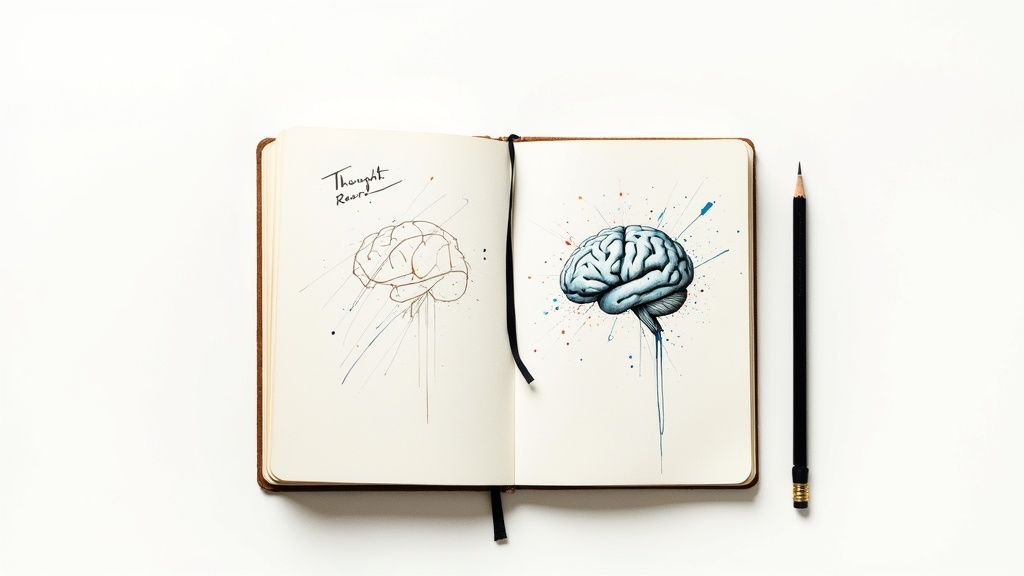
Think of this process like building a new mental muscle. It feels awkward at first, but with practice, you are literally carving out new neural pathways in your brain. You’re creating new roads for your thoughts to travel down—ones that lead to calm instead of panic, proving that healing is not just possible, but happening.
Spotting Common Thought Distortions
The first step is simply learning to recognize the sneaky ways your anxious mind twists reality. These cognitive distortions are incredibly common, and just being able to put a name to them can strip them of their power. See if any of these sound familiar.
- Black-and-White Thinking: You see things in extremes—it's either perfect or a total disaster. After a slightly awkward conversation, you might think, "I'm just so terrible with people."
- Fortune-Telling: You predict a negative future with absolute certainty, even with zero evidence. Before giving a presentation, your mind screams, "Everyone is going to think my ideas are stupid."
- Catastrophizing: This is taking one small negative event and blowing it up into a worst-case scenario. A simple headache becomes a brain tumor. A friend not texting back immediately means the friendship is over.
- Mind Reading: You assume you know exactly what other people are thinking, and it's never good. You walk past a coworker who seems distracted and immediately conclude, "She's definitely mad at me for something."
Just recognizing these patterns is a huge win. It creates a tiny but crucial gap between the thought and your reaction to it. In that gap, you'll find your freedom.
A Script to Challenge Your Anxious Mind
Once you’ve spotted a distorted thought, you can start to question it. The goal isn't to get into a mental fistfight but to approach it with gentle curiosity. This simple script can become one of your most powerful tools for healing.
When an anxious thought pops up, just pause and ask yourself these two questions:
- "What evidence do I actually have for this fear?" Look for the cold, hard facts—not just feelings. If the fear is "I'm going to get fired for that typo," the evidence against it is probably your solid performance record and all the positive feedback you've received.
- "What is a more realistic or compassionate thought?" This isn't about pretending everything is rosy. It’s about finding a more balanced perspective. A more realistic thought might be, "It was a small mistake. I'll correct it, and it’s very unlikely to have any real impact. People make mistakes; it’s okay."
This practice isn't about dismissing your feelings. It's about investigating the thoughts that create those feelings. When you shine a light on them, you often discover they aren't as solid or scary as they first seemed.
For instance, social anxiety is often fueled by intense fortune-telling and mind-reading. It's far more common than people realize; one seven-country study found that over a third (36%) of people met the criteria for Social Anxiety Disorder. This shows just how many people are struggling with—and healing from—these same thought patterns.
Creating a Thought Record for Lasting Change
To turn this into a real habit, try using a thought record. This is just a simple journal or a note on your phone where you can track and dismantle anxious thoughts over time, creating a powerful log of your own healing journey.
Your thought record can have a few simple columns:
| Situation | Anxious Thought | Distortion | Realistic Reframe |
|---|---|---|---|
| My boss sent a one-word email: "Hi." | "He's upset with me." | Mind Reading | "He's probably just busy. I'll wait for more context." |
| I felt a weird flutter in my chest. | "I'm having a heart attack." | Catastrophizing | "I had coffee an hour ago. It's likely just caffeine." |
| I said something awkward at a party. | "I've ruined everything." | Black-and-White Thinking | "It was one awkward moment. Most people probably didn't notice." |
Keeping a thought record is an active form of self-care and a testament to your commitment to healing. It gives you tangible proof that your thoughts are not facts and that you have the power to shift your perspective. This entire process is a core principle of Cognitive Behavioral Therapy (CBT), a powerhouse for anxiety treatment. To get a better handle on this approach, you can learn more by understanding CBT for anxiety in our detailed guide.
Over time, you'll start to spot your own go-to distortions and get much quicker at challenging them. This is how you stop an anxiety spiral before it even has a chance to build momentum, proving to yourself that a calmer, more present life is entirely possible.
Building a More Panic-Proof Lifestyle
Grounding techniques and thought reframes are your go-to tools when a spiral hits, but the long game is about building a life that’s more resistant to panic in the first place. This is where you strengthen your foundation for lasting peace. It’s about creating a lifestyle that naturally dials down your baseline anxiety, making those spirals far less likely to even start.
This isn’t about some massive, stressful overhaul. It’s about gentle, consistent habits that add up. By focusing on core areas like sleep, nutrition, movement, and your digital world, you’re essentially building a buffer that makes you more resilient when life inevitably throws stressors your way.
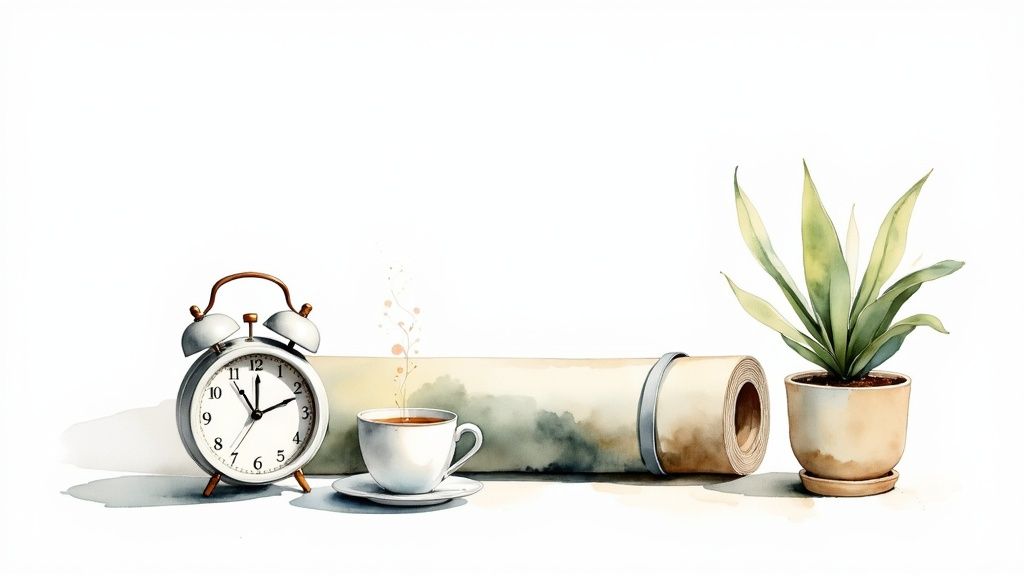
This approach gives you back a sense of control and hope. It proves that through small, daily actions, you can create a life where calm is your default state, not something you’re constantly fighting to achieve. A panic-free life is built one hopeful choice at a time.
Prioritize Restorative Sleep
Anxiety and sleep have a complicated relationship. When you're running on empty, your brain's emotional centers go into overdrive, making you way more susceptible to anxious thoughts. A solid sleep schedule is one of the most powerful gifts you can give your mental health and a cornerstone of healing.
Try to stick to a regular bedtime and wake-up time, even on weekends. This simple act helps regulate your body’s internal clock and dramatically improves sleep quality. A calming pre-sleep routine—like reading a book (not your phone!) or taking a warm bath—signals to your brain that it's time to power down. Understanding the intricate link between sleep and mental health is a game-changer; quality rest truly acts as a buffer against anxiety.
Nourish Your Gut and Your Mind
There's a reason the gut is often called our "second brain." A huge chunk of your body's serotonin—a key player in mood regulation—is produced in your digestive tract. This means what you eat has a direct line to how you feel.
You don't need a super restrictive diet. Just focus on adding more whole foods that are known to support brain health. Small shifts can make a surprisingly big difference:
- Bring in Probiotics: Foods like yogurt, kefir, and kimchi promote a healthy gut microbiome, which is increasingly linked to lower anxiety levels.
- Boost Your Omega-3s: Fatty fish, walnuts, and flaxseeds are packed with omega-3 fatty acids, which are fantastic for reducing inflammation and supporting brain function.
- Keep Blood Sugar Stable: Wild swings in blood sugar can trigger that "hangry" feeling that so easily tips into anxiety. Pairing carbs with protein and healthy fats helps prevent those crashes.
If you want to dig deeper, exploring specific lifestyle and diet changes for anxiety management can offer more targeted strategies for your needs.
Creating a panic-proof lifestyle is about small, sustainable acts of self-care. It’s the gentle consistency of a daily walk, a nourishing meal, or an hour of screen-free time that builds a fortress of well-being, one brick at a time.
Embrace Mindful Movement
When you feel anxious, exercise is probably the last thing on your mind. But moving your body is one of the fastest ways to burn off that restless, nervous energy and release mood-boosting endorphins. The secret is finding something you actually like doing, not something that feels like another chore.
Think mindful movement. It’s all about connecting your body and your mind. This could be a gentle yoga flow, a walk in nature where you actively notice the sounds and sights around you, or even just putting on your favorite song and dancing around the living room. The goal isn't a punishing workout; it's to get out of your head and back into your body.
Curate Your Digital World
In our hyper-connected world, it's incredibly easy to get trapped in a doomscrolling cycle of news alerts and social media comparisons that pour fuel on the anxiety fire. Taking back control of your digital intake is non-negotiable for building a calmer life.
Start with clear boundaries. Maybe that means turning off news notifications on your phone or setting a timer for social media. Go through your feeds and curate them to be more positive and inspiring. Unfollow accounts that trigger feelings of inadequacy, fear, or envy. This isn't about sticking your head in the sand; it's about consciously protecting your peace so you have the mental space to heal.
Knowing When You Need More Support
While self-help strategies are incredibly powerful, there's immense strength in knowing when to call in reinforcements. Reaching out for professional support isn’t a sign of failure—it’s a proactive, courageous step toward lasting healing and a life free from panic.
Learning to interrupt an anxiety spiral on your own is a huge victory. But if you find that anxiety is consistently getting in the way of your daily life, work, or relationships despite your best efforts, it might be time to talk to someone who can guide you.
Think of it this way: you’ve been trying to navigate a dense, foggy forest with a compass. Sometimes, what you really need is an experienced guide who knows the terrain and can point you toward the clearest path out. True healing is possible, and you don't have to do it alone.
Recognizing the Signs It's Time for Help
It can be tough to know when your struggle has crossed the line from manageable to something that requires professional guidance. If you're on the fence, see if any of these situations feel familiar.
- Your anxiety spirals are happening more often or feel more intense.
- You're actively avoiding situations, places, or people you once enjoyed because you're afraid of having another anxiety attack.
- The self-help techniques you’ve tried only provide temporary relief or feel like they aren't working anymore.
- Your physical health is taking a hit from the stress—think poor sleep, digestive issues, or constant muscle tension.
- The people who care about you have started to express their concern.
If these points are hitting a little too close to home, it’s a clear signal that a mental health professional can offer the structured support you need to make real progress and heal for good.
Understanding Your Options for Professional Support
Navigating the world of mental health can feel confusing at first. The good news is that there are different types of support designed for various needs, and understanding them can make the whole process feel less intimidating and more hopeful.
- Therapy/Counseling: This is where you talk with a trained professional—like a psychologist or a licensed counselor—in a safe, confidential setting. The goal is to develop coping strategies, get to the root causes of your anxiety, and change the thought and behavior patterns that keep you stuck.
- Psychiatry: A psychiatrist is a medical doctor who specializes in mental health. They can diagnose conditions, provide therapy, and are licensed to prescribe medication if it's determined that it could be a helpful part of your treatment.
Seeking help is an investment in your well-being. It gives you a dedicated space to untangle your anxious thoughts with a trained professional who can offer evidence-based tools and unwavering support on your journey to a panic-free life.
What to Expect from Therapy
One of the most effective and widely used approaches for anxiety is Cognitive Behavioral Therapy (CBT). This type of therapy is all about identifying, challenging, and reframing the distorted thought patterns that fuel your anxiety spirals.
In a CBT session, you and your therapist will work as a team to pinpoint your specific triggers and the unhelpful thought cycles they kick off. You’ll learn practical skills to question those thoughts and replace them with more balanced, realistic ones. For a deeper dive, you can explore more about psychotherapy for anxiety and see how it can be tailored to what you’re going through.
Finding the right therapist is a crucial first step. Look for someone who specializes in anxiety disorders, and don't be afraid to schedule a few consultation calls to see whose approach feels like a good fit. Getting ready for your first session can be as simple as jotting down what you've been experiencing and what you hope to get out of it. This is your journey, and asking for help is a powerful step toward reclaiming your calm.
Frequently Asked Questions About Anxiety
It's completely normal to have a ton of questions on this journey. Actually, it’s a great sign—it means you're getting curious, seeking answers, and ready to take back control. Let's tackle some of the most common ones that come up.
Can I Ever Completely Stop Anxiety Spirals?
Yes, absolutely. The real goal isn't to get rid of the feeling of anxiety altogether—it’s a normal human emotion. The aim is to heal your relationship with it so it no longer controls you.
As you get more comfortable with the techniques we’ve talked about, you'll start to notice the spirals happen less often and feel way less intense. For many people, a full-blown spiral becomes a rare thing, if it happens at all. You learn to spot the very first warning signs and step in before it gets out of hand.
It’s about building a deep, unshakable confidence in your own ability to handle your thoughts and live a full, joyful life. That confidence is what truly sets you free.
How Long Does It Take for These Techniques to Work?
That’s a great question, and there are really two parts to the answer. The immediate, in-the-moment grounding techniques—like the 5-4-3-2-1 method or grabbing a piece of ice—are designed to work fast. Think of them as your emergency circuit-breakers. You should feel some relief within minutes.
But the deeper, long-term healing that comes from rewiring thought patterns and building a panic-proof lifestyle? That’s a journey. Some people notice a big difference in their baseline anxiety in a few weeks. For others, it might be a few months.
The key here is patience and kindness toward yourself. Progress isn't a straight line. But every single time you practice these skills, you’re carving out new, calmer pathways in your brain. Every step forward, no matter how small, is a win on the road to healing.
What Is the Difference Between an Anxiety Spiral and a Panic Attack?
Knowing the difference here is huge because it helps you know how to respond. The simplest way to think about it is that an anxiety spiral is the build-up, and a panic attack is the intense, overwhelming peak.
- An anxiety spiral is mostly in your head. It’s that runaway train of thought where one catastrophic "what if" feeds the next, creating a tornado of worry and fear.
- A panic attack is what can happen at the end of that spiral. It’s a sudden, terrifying episode where your body takes over with intense physical symptoms—racing heart, can’t catch your breath, dizziness, and a feeling like you're completely losing control.
Learning how to stop an anxiety spiral is your best defense against a panic attack. When you intervene early, you cut off the fuel before the fire has a chance to roar. This skill is a foundational part of living a panic-free life.
Are There Any Apps or Tools That Can Help?
Absolutely. The right tech can be an incredible ally, offering guided practices and gentle reminders right from your phone.
Here are a few types of tools that people find really helpful:
- Guided Meditation Apps: Apps like Calm and Headspace are fantastic for building a consistent mindfulness practice. They have huge libraries of meditations and breathing exercises for just about any situation.
- Cognitive Tool Apps: Tools like Sanvello or MoodKit are built on CBT principles. They give you a structured way to practice things like thought records and journaling to systematically challenge those anxious thoughts.
- A Simple Notes App: Honestly, don't overlook the power of what's already on your phone. A basic notes app is a perfect, no-fuss place to keep a thought record or just jot down small wins and track your progress.
These tools aren't a replacement for the work, but they can make it feel more manageable and a little less lonely. They help you weave these new habits of healing into the fabric of your daily life.
At The Anxiety Checklist, we believe you deserve a life that isn’t dictated by worry. Our Fearless Living system is more than just an eBook—it’s a complete toolkit designed by someone who’s been there, a 15-year anxiety survivor. It gives you the structured guidance, worksheets, and practical steps you need to challenge anxious thoughts, build resilient habits, and finally feel calm again. Start your journey toward a more fearless life by exploring The Anxiety Checklist today.