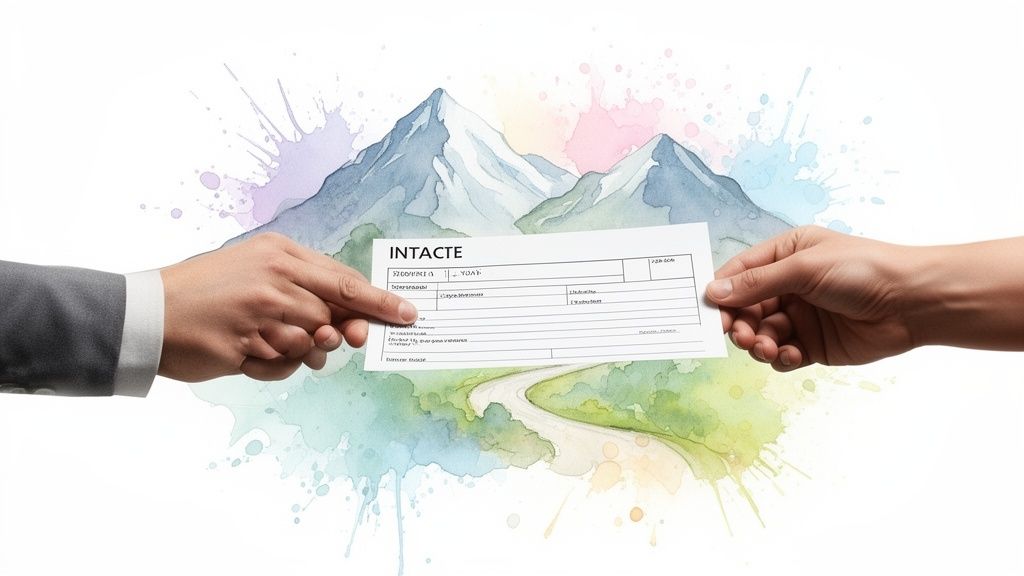
When you’re grappling with anxiety, the last thing you want is another piece of paperwork. A mental health intake form can feel like one more mountain to climb when you’re already exhausted.
But this isn't a test—it's the beginning of a conversation. It's the first step in sharing your story so a professional can understand exactly what you're going through and guide you on the path to a life free from panic.
Your First Step Toward a Calmer Life
Imagine you're lost in a dense forest, feeling the panic rise with every unfamiliar sound. The intake form is like sending your exact coordinates to a skilled guide. It tells them where you are—the specific thoughts, feelings, and physical symptoms you're experiencing—so they can chart the safest, most direct path out of the woods and toward a place of calm and healing.
This document is the first, brave step you take on a journey you and your therapist will walk together. It’s a foundational tool that helps them understand your world before you even say a word, allowing them to prepare and make your first session as effective as possible on your journey toward recovery.
The more accurately you can describe where you are, the better they can help you navigate toward a life where anxiety no longer controls you.
Why This Form Is an Act of Hope
Filling out a form might seem like just another administrative chore, but in this context, it’s a powerful act of hope. It’s you, taking a tangible step, declaring that you’re ready for support and believe a life free from constant anxiety is not just possible, but achievable.
Think of it this way:
- It's an investment in yourself. You're taking real action to prioritize your well-being and future happiness.
- It's a declaration of hope. You're signaling your belief in recovery and a brighter, panic-free future.
- It's the start of a partnership. You're giving a mental health professional the essential information they need to become your ally in healing.
This initial paperwork is more than just questions and answers; it's the bridge between feeling stuck and moving forward. It’s your way of saying, “I am here, this is what I'm going through, and I am ready to heal.”
This perspective can shift the entire experience from a burden to a beginning. It’s not about being judged on your answers but about being truly understood so healing can begin. For those just starting out, getting familiar with the anxiety recovery steps can also provide a hopeful roadmap for what lies ahead.
And if you're interested in the general design and importance of these documents, this guide to Medical Intake Forms is a great resource. Every detail you share is a stepping stone on your path to feeling better, and it all begins with this powerful first step.
Decoding the Mental Health Intake Form
At its heart, a mental health intake form is a structured conversation starter. It’s a completely confidential tool designed to get a holistic view of your life and well-being—moving beyond just symptoms to understand your personal history, daily routines, and support systems.
Think of it as the first step in building a roadmap for your healing. It bridges the gap between what you're feeling on the inside and what your therapist needs to know to guide you effectively. This is where your journey from anxiety to calm really begins to take shape.
This process can feel intimidating, but remember this: there are no 'right' or 'wrong' answers. Your honest experience is the only thing that matters. This form isn't a test; it's an invitation to be seen and understood, setting the stage for profound and lasting healing.
Your Story in Black and White
The structure of these forms helps a therapist see patterns and connections they can use to build your personalized treatment plan. Instead of spending your entire first session trying to recall every important detail, the form gives them a head start on your path to recovery.
Each question is like a single dot, and your answers connect those dots into a clearer picture of your unique situation. This preliminary sketch allows your therapist to walk into your first session with genuine insight, making that time more focused, productive, and immediately helpful for you.
This image shows the simple, direct path of information from you, through the form, to your therapist.
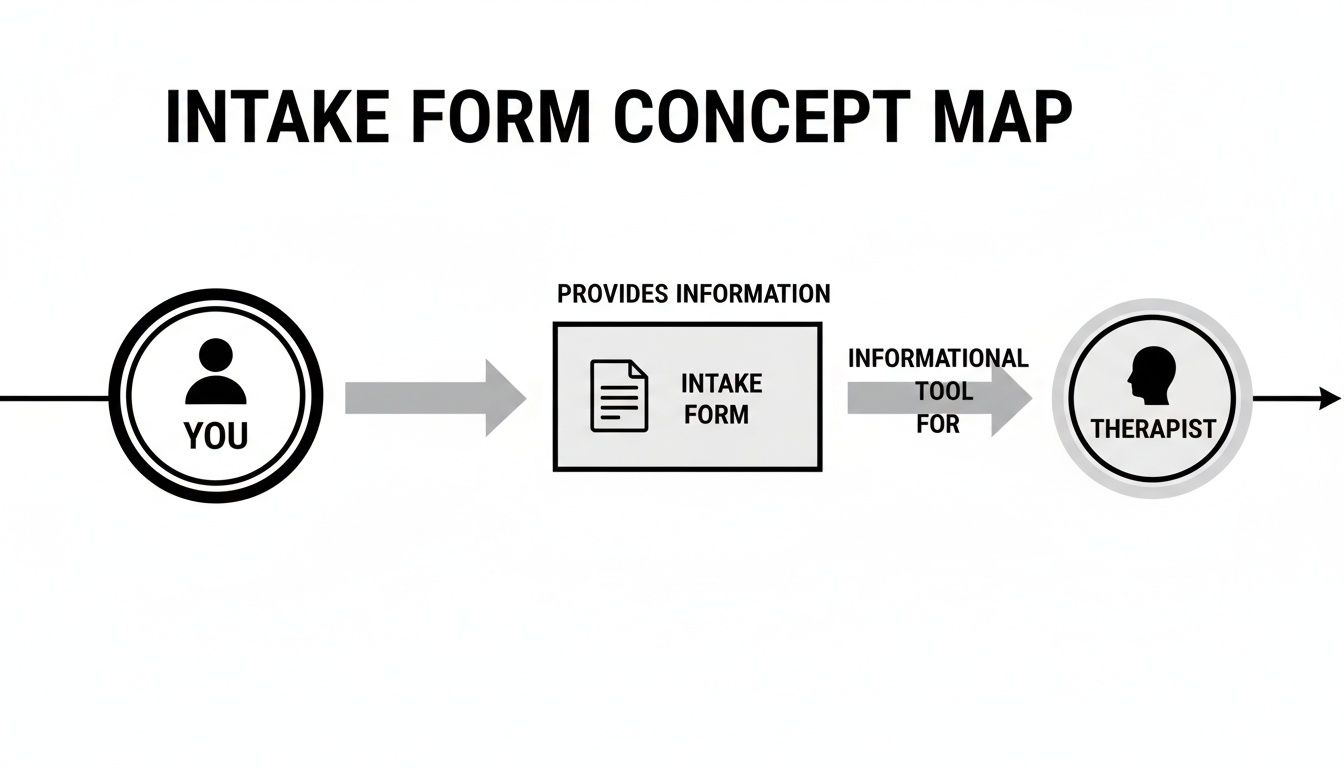
As you can see, the form is just a channel—a quiet, organized way to communicate your needs so your journey to a panic-free life can begin.
A Standard Step on the Path to Healing
Filling out paperwork is a standard and vital part of starting almost any kind of healthcare, and mental health is no different. The global mental health screening market, which leans heavily on these forms, was valued at USD 2.2 billion in 2023 and is expected to nearly double by 2030.
This growth highlights just how critical these tools have become, especially after anxiety disorders saw a 25% rise, now affecting 374 million people worldwide.
The intake form is not a bureaucratic hurdle; it is a clinical instrument. It represents a methodical, proven approach to understanding complex human experiences, demonstrating that your path to living panic-free is built on a foundation of care and expertise.
Seeing this form as a standard procedure can help demystify the process and ease some of the anxiety around it. It confirms you’re in a professional setting where established protocols are used to provide the best possible care, offering a clear path toward healing.
Standardized tools are often part of this process, providing a consistent way to measure symptoms. For example, many therapists use the GAD-7 test is used to assess anxiety to get a baseline understanding. This structured approach is actually a sign of hope—it means there's a clear, manageable process for getting you the help you need to heal.
How to Tackle the Most Common Questions
Staring at a blank mental health intake form can feel like you're about to climb a mountain. The questions seem personal, maybe even a bit overwhelming. But think of each question as a foothold—a small, solid step to begin your climb toward a life free from anxiety. This is your first real chance to map out what you've been going through, giving your therapist the landmarks they need to guide you toward lasting peace.
The goal isn't to be perfect; it's to be honest. Answering these questions is really just about sharing your story in a way that helps someone understand what it’s like to be you right now. When you look at it that way, the form stops being an intimidating test and becomes a structured, supportive way to start a conversation that leads to healing.

Let's walk through a few common sections together. We'll turn these abstract prompts into concrete examples you can approach with confidence and hope.
Presenting Concerns: Your Reasons for Seeking Help
This is usually the first big section, and it boils down to one simple but profound question: "What brings you here today?" For someone dealing with anxiety or panic, the answer can feel huge and tangled. The trick is to be specific and focus on your direct experiences.
Instead of just writing, "I have anxiety," try to describe what that anxiety actually feels like. Think about it in terms of:
- Physical Sensations: "My heart pounds, and I get dizzy when I think about going to crowded places."
- Emotional Impact: "I carry this constant sense of dread, like something awful is about to happen."
- Behavioral Changes: "I’ve started avoiding social events and even the grocery store because I'm terrified of having a panic attack."
Details like these give your therapist a clear starting point. They help them see the specific ways anxiety is showing up in your life, which is the first step toward building a plan that will help you reclaim your life from fear.
Your Mental Health History
This part of the form is all about your past experiences with mental health. It might ask about previous diagnoses, therapy sessions, or medications. Don't stress if you can't remember every single detail or the exact dates. The goal is just to understand your journey so far, so the next steps can be the most effective ones for your healing.
You might see questions like:
- Have you ever been diagnosed with a mental health condition before?
- Have you been to therapy in the past? If so, what was helpful or unhelpful about it?
- Have you ever taken medication for your mental health?
Answering these helps your new therapist understand what has and hasn't worked for you before. That knowledge is gold. It ensures your new treatment plan is built on your personal history, giving you the best possible chance to live panic-free.
Triggers and Avoidance Behaviors
When it comes to anxiety and panic, understanding your triggers is a game-changer. The intake form will likely have questions designed to pinpoint the specific situations, thoughts, or feelings that set off your anxiety. Being honest here isn't just helpful—it's an act of empowerment on your path to healing.
Think about these prompts as you reflect:
- When do you feel most anxious? (e.g., "in the morning before work," or "when I'm driving on the highway")
- What situations do you actively avoid? (e.g., "public speaking," or "unfamiliar social gatherings")
- Are there physical symptoms that scare you? (e.g., "a racing heart, which makes me think I'm having a heart attack")
Identifying these patterns is a huge step in the right direction. Once you know your triggers, you and your therapist can start developing strategies to manage and eventually overcome them. Digging into a list of common anxiety triggers can also help you find the right words for your own experiences.
Your answers provide the raw data for your recovery plan. Each detail you share about a trigger or an avoided situation is a clue that helps your therapist craft a strategy to help you reclaim your life and live without fear.
These initial forms are vital for getting a baseline of your well-being, from your mood to your cognitive function. This is especially critical when you consider that in 2023, 27% of over 500,000 global respondents were classified as Distressed or Struggling on the Mental Health Quotient (MHQ) scale. Intake forms are the tools that help professionals collect the detailed data needed to create interventions that work specifically for you, paving the way for real change.
How Forms Are Tailored for Anxiety and Panic
When you're dealing with something as specific as anxiety or panic, a generic intake form just doesn't cut it. It’s like trying to use a map of the entire country to find a single street. A well-designed form, however, is a sign that your therapist already knows the territory you’re navigating and has a clear map to guide you out.
These specialized forms are more than just paperwork. They move past the broad, vague questions and get right to the heart of your struggle. By using targeted questionnaires, therapists get a much clearer picture of what you're going through, which is the first step toward building a plan that actually works to set you free.
Seeing these kinds of questions can be a message of hope in itself. It confirms that your condition is understood, studied, and treatable. It signals that you've found a professional who knows exactly what to ask to help build your bridge to a calmer, panic-free life.
Using Specialized Tools for a Clearer Diagnosis
To get a precise read on your symptoms, therapists often rely on clinically validated screening tools. These aren't just random checklists; they're carefully designed instruments built to measure the frequency and severity of anxiety. Think of them as a way to get a clear, objective baseline so you can track your progress over time and see how far you've come.
One of the most common tools is the GAD-7 (Generalized Anxiety Disorder 7-item scale). It’s a straightforward questionnaire that helps quantify how intense your anxiety has been over the past two weeks. Similarly, panic attack logs are often used to pinpoint patterns and triggers, turning the chaotic feeling of anxiety into measurable data that can be used to defeat it.
This process gives your therapist vital information, including:
- Symptom Severity: How deeply is anxiety actually impacting your day-to-day life?
- Trigger Identification: What specific situations, thoughts, or feelings tend to provoke panic?
- Progress Tracking: A clear benchmark to celebrate your improvements as you heal and move toward a life without anxiety.
This systematic approach can be incredibly reassuring. It shows there’s a science to recovery and that your healing journey is being guided by proven methods, not guesswork.
The Hope in the Details
There's a profound sense of relief that comes from seeing questions on a form that perfectly describe your inner world. When a mental health intake form asks about the physical sensations of panic, the urge to avoid certain situations, or specific intrusive thoughts, it’s a clear sign of expert understanding. You realize you aren't alone, and that there is a way out.
This level of detail is a powerful affirmation. It's the form's way of saying, "We see what you're going through, we understand its complexity, and we have a specific plan to help." It’s often the first tangible evidence that a life free from panic isn't just a dream, but an achievable goal.
For instance, postpartum anxiety and obsessive-compulsive symptoms are surprisingly common. One study revealed that 11.2% of new mothers screened positive for OCD just two weeks after giving birth. Specialized forms can screen for these specific issues, ensuring new moms get the exact support they need to heal and thrive.
Understanding the nuances of a panic attack is crucial, and these forms are designed to do just that. Every targeted question is another step on a clear, well-trodden path to recovery and a peaceful mind.
Understanding Your Privacy and Confidentiality
Sharing your most personal thoughts on a mental health intake form can feel incredibly vulnerable. If you’re already struggling with anxiety, it’s completely natural to wonder, "Where is this information going? Who’s going to see it?"
These aren't just anxious thoughts; they're valid questions. And the answers are designed to be a source of deep reassurance, reinforcing that this is a safe, protected first step toward healing.
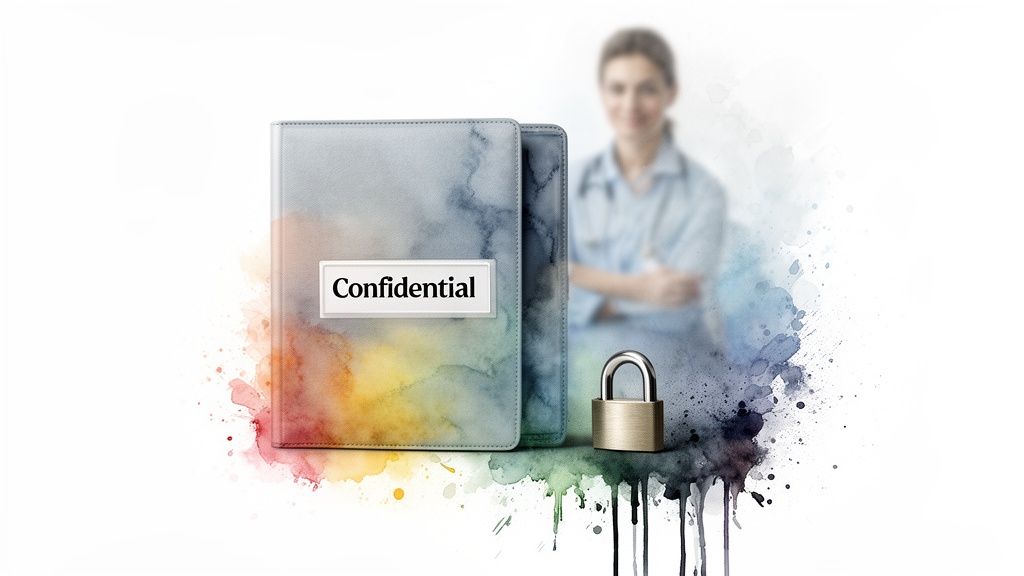
The entire therapeutic relationship is built on a foundation of trust. Think of confidentiality as a protective vault built around your story. From the moment you start typing or writing, powerful legal and ethical safeguards lock into place to protect your privacy and create a secure space for you to heal.
This isn't just a casual promise; it's the law. Your personal health information is shielded, creating a space where you can be open and honest without fear of exposure.
HIPAA and Your Right to Privacy
The most important of these legal shields is the Health Insurance Portability and Accountability Act (HIPAA). It’s a federal law that sets a strict national standard for protecting sensitive patient health information from being disclosed without your knowledge or consent.
So, what does that actually mean for you?
- Strict Control: Your therapist cannot share what you've written with anyone—not your boss, your partner, or your parents—without your explicit, written permission.
- Secure Storage: Whether your intake form is digital or on paper, it must be stored securely to prevent anyone from accessing it who shouldn't.
- Limited Use: The details you provide are used for one reason and one reason only: to help your therapist understand your situation, make an accurate diagnosis, and build a treatment plan that will effectively guide you toward a panic-free life.
Knowing this is crucial. It shifts the intake process from an act of vulnerability to one of empowerment. You are in the driver's seat of your own healing journey.
This legal and ethical commitment to confidentiality is what makes therapy a uniquely safe space. It’s a guarantee that you can share the difficult truths of your anxiety, knowing your vulnerability will be honored and protected on your journey toward a panic-free life.
The Role of Informed Consent
Another key concept you'll see is informed consent. This is way more than just scribbling your signature on a form. It's an ongoing conversation that makes sure you understand and agree to every part of the treatment process. It's a clear signal that you are an active partner in your own healing.
Informed consent also clarifies the limits of confidentiality—for example, in rare situations involving immediate harm to yourself or others, which therapists are legally required to report. This kind of transparency builds trust right from the start. For more on our mission and the team behind this approach, you can learn more about us and our commitment to your healing journey.
And since so much happens online these days, it’s also smart to be aware of the general principles of understanding privacy for online services whenever you share personal information digitally. By pulling back the curtain on these protections, we hope to quiet some of your fears, allowing you to focus on what truly matters—your recovery.
Common Questions About Intake Forms
Even after you understand what an intake form is for, a few last-minute worries might pop up. That’s completely normal. These concerns are valid, but they don't have to stop you from starting your journey to a better life. Let's walk through some of the most common questions and give you the clear, reassuring answers you need to move forward with hope.
Think of this as the final check-in before you start your journey. Answering these last few questions can help quiet that anxious inner voice, so you can take your first step with a little more clarity and a lot more confidence.
What If I Can’t Remember All the Details for My History?
This is one of the most common worries, and it's completely understandable. The intake form is not a memory test. You aren’t expected to recall every single date or detail with perfect accuracy. Your therapist knows that stress and anxiety can make memory fuzzy.
Just do your best. Put down what you can remember. See the form as the starting point for a conversation that leads to healing, not a final exam. You’ll have plenty of time in your sessions to fill in the gaps, add more detail, and explore your history when you’re ready.
How Honest Should I Be About Sensitive Topics?
Being honest is the most direct path to getting the help you actually need to heal. A therapist's office is a confidential, judgment-free zone built for your safety and recovery. While it can feel incredibly difficult to share sensitive information, doing so allows your therapist to create a treatment plan that’s truly effective and tailored to help you live panic-free.
Remember, your therapist is a trained professional. They’re equipped to handle these topics with care and compassion. If you’re not ready to share everything at once, that’s okay. Start with what feels manageable and build trust from there.
This whole process moves at your pace. The goal is to build a partnership where you feel safe enough to be seen, because that’s the foundation for overcoming anxiety and learning to live a life free from panic.
Can a Friend or Family Member Help Me Fill It Out?
Absolutely. If you’re feeling overwhelmed by the form, asking a trusted friend or family member to sit with you can be a huge source of support. They can offer encouragement, help you jog your memory for certain details, or just be a comforting presence while you work through it.
The most important thing, however, is that the answers are genuinely yours. They need to reflect your own experiences, thoughts, and feelings. It's your story that needs to be told so your healing can begin, but you definitely don't have to write it alone.
What Happens After I Submit the Form?
Once you submit the form, your therapist will review it to get a solid understanding of your situation before you even walk in the door. This preparation helps make your first session more focused and productive right from the start, accelerating your path to feeling better.
In that first appointment, your therapist will probably go over some of your answers, ask a few clarifying questions, and start working with you to set some initial goals. The form is the foundation; that first session is where you start building your plan for a calmer life, together.
At The Anxiety Checklist, we believe everyone deserves to live a life free from the grip of anxiety. Our Fearless Living system provides a practical, action-oriented toolkit to help you understand your triggers, manage panic, and build lasting resilience. To start your journey toward a calmer future, check out The Anxiety Checklist today.