
When you’re in the thick of a panic attack—heart pounding, walls closing in—the idea of a life free from that terror can feel like an impossible dream. It’s easy to feel like panic owns you, casting a shadow over every part of your life and stealing your hope for the future.
But I want to start by telling you something crucial: you can absolutely heal. You can reclaim your life from anxiety and live panic-free.

This guide isn’t just theory. It's a hopeful and practical roadmap filled with actionable steps you can start using today. We'll get into how to handle those overwhelming feelings in the moment, but more importantly, how to build a foundation of resilience that leads to lasting freedom from panic.
The Journey to a Calmer Mind
The path to a calmer, panic-free life doesn’t start with a giant leap. It begins with a single, hopeful step. The whole point of effective panic attack self help is empowerment—arming yourself with a toolkit of techniques that work for you, so you can move from feeling like a victim of panic to the confident leader of your own healing.
And you're not alone in seeking this path. The National Institute of Mental Health (NIMH) estimates that 2.7% of U.S. adults have experienced panic disorder in the past year. That figure shows just how widespread the need for accessible support is, and it's why so many people are successfully turning to self-help resources to find relief and recovery.
This guide is about learning that while the feelings are terrifyingly real, they are not actually dangerous. And they will pass. More than that, you can learn to stop them from starting.
The goal isn't to never feel anxiety again—it's to change your relationship with it. It’s knowing that when panic knocks, you have the tools and the strength to answer the door calmly, without letting it take over your home. True healing is possible.
Practical Tools for Real Progress
First things first, let's focus on grounding techniques. Think of these as your first line of defense—powerful tools that anchor you firmly in the present moment, pulling your focus away from the frightening chaos and back to a place of safety. When you have these ready to go, you immediately start to reclaim your sense of control and hope.
Here's a quick look at some simple but powerful methods we'll dive into.
Quick Grounding Techniques For Immediate Relief
| Technique | How It Works | When to Use |
|---|---|---|
| 5-4-3-2-1 Method | Engages all five senses to pull your focus away from internal panic and into your external environment, proving you are safe. | The moment you feel the initial signs of panic, like a racing heart or shortness of breath. |
| Deep Belly Breathing | Slows your heart rate and activates the body's natural relaxation response, sending a powerful signal of calm to your brain. | During a panic attack to calm physical symptoms or daily to lower baseline anxiety and build resilience. |
| Mindful Observation | Involves choosing a single object and noticing every detail about it, which interrupts racing thoughts and anchors you in reality. | When your mind is spiraling with "what if" scenarios or you feel disconnected from the world around you. |
Mastering these simple techniques is a huge part of the key https://anxietychecklist.com/anxiety-recovery-steps you can take toward healing. You have the innate capacity to get better, and this is where you begin to unlock it.
What to Do When a Panic Attack Hits
That sudden, overwhelming wave of fear is terrifying. Your heart starts pounding, your chest tightens, and the world feels like it's closing in. It's a primal, visceral experience that can make you feel utterly powerless.
The natural instinct is to fight it—to push back against the tide of panic. But the most powerful first move toward healing is the exact opposite. Don't fight it. Anchor yourself.
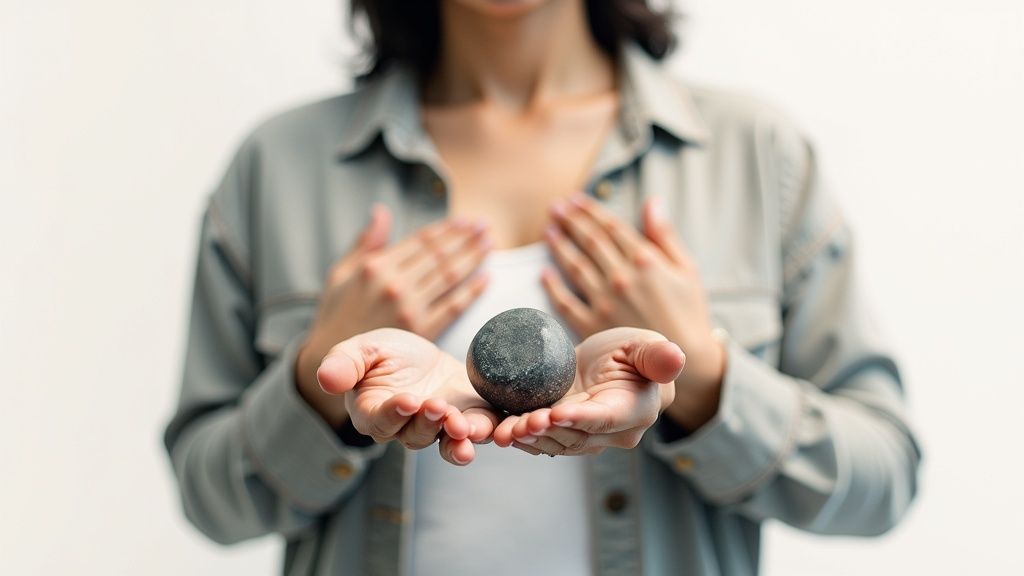
Let’s say you’re in a busy grocery store. The fluorescent lights feel blindingly bright, the noise swells into a roar, and that familiar tightness spreads across your chest. This is the moment. This is when you pivot from the storm inside your head to the tangible, safe world around you. Practical panic attack self help becomes your lifeline, reminding you that you are in control and this feeling will pass.
Anchor Yourself with Grounding Techniques
Right now, your mind is stuck in a catastrophic fear loop. Grounding techniques are designed to pull the emergency brake on that loop. They are deliberate actions that force your brain to process the present moment, sending a clear signal to your nervous system that you are, in fact, safe and okay.
One of the most reliable and empowering methods is the 5-4-3-2-1 technique. It’s incredibly effective because it systematically engages each of your senses, pulling you out of your head and back into the safety of your body.
- 5 Things You Can See: Look around and mentally name five objects. Notice the bright red of the "Sale" sign, the metallic sheen on the shopping cart handle, the specific pattern of the floor tiles. This proves your eyes are working and you are present.
- 4 Things You Can Touch: Actively feel four different textures. This could be the cool, smooth metal of the cart, the soft fabric of your shirt, or the waxy skin of an apple. This connects you to the real, physical world.
- 3 Things You Can Hear: Listen past the roaring in your ears. Try to isolate three distinct sounds. Maybe it's the distant beep of a checkout scanner, the low hum of the refrigerators, or the sound of your own, steadying breath.
- 2 Things You Can Smell: This one can be tricky, but give it a shot. Can you pick up the smell of fresh bread from the bakery aisle? Or maybe the faint, clean scent of floor polish?
- 1 Thing You Can Taste: Focus on a single taste. This might be the lingering flavor of your morning coffee, or you can pop a mint to create a new, grounding sensation.
It sounds almost too simple to work, but the effect is profound. This process shifts your brain's focus from fear to fact, effectively short-circuiting the panic response and restoring a sense of calm.
Regain Control with Mindful Breathing
While you’re grounding yourself, your breath is your most powerful ally for calming the physical chaos. During a panic attack, you’re likely taking short, shallow breaths. By consciously changing this, you can change how you feel.
Slow, controlled breathing sends a direct message to your nervous system, telling it that the danger has passed and it's time to calm down. You are in command.
"I am safe, and this feeling of panic will subside." This is more than just a phrase; it's a command you can give your body through your breath. By controlling your exhale, you actively tell your nervous system to stand down.
A classic and highly effective pattern is box breathing. It’s easy to remember and you can do it anywhere.
- Breathe in slowly through your nose for a count of four. Feel your belly expand.
- Hold your breath for a count of four.
- Exhale slowly and completely through your mouth for a count of four. Feel the tension leaving your body.
- Hold at the bottom of the exhale for a count of four.
Repeat this cycle. The magic is in the slow, controlled exhale; that’s the part of the breath that signals deep relaxation and safety to your brain. For a deeper dive, check out our guide on breathing exercises for anxiety.
Ride the Wave—Don't Fight It
It's easy to feel completely alone when panic hits, but you're not. In the UK, an estimated 5.6% of the population has an anxiety disorder, and many of these individuals learn to manage and overcome their symptoms with self-help strategies. This isn't a life sentence; it's a challenge you can absolutely meet. You can learn more from these insightful anxiety statistics from Priory Group.
This data all points to one vital truth: you can learn to master this. The ultimate goal during an attack isn’t to stop it cold—which usually backfires—but to ride the wave with confidence.
Acknowledge the feeling without judgment. Say to yourself, "This is a panic attack. It feels awful, but I know it is temporary and harmless. It will pass."
By simply labeling the experience and reminding yourself of its transient nature, you strip away the secondary layer of fear—the fear of the fear itself. You are not going crazy. You are not having a heart attack. You are experiencing a powerful but temporary surge of adrenaline that your body is fully equipped to handle. Your job is to anchor, breathe, and let it pass through you, knowing you are safe and capable.
Rewiring Your Brain to Prevent Future Panic
Managing a panic attack in the heat of the moment is a crucial skill, but the real, life-changing goal is to create a life where they stop happening. This means going deeper than just coping—it requires actively changing the thought patterns that fuel the panic cycle.
The wonderful news? Your brain is changeable. You can learn to become the calm, logical voice that anxiety often shouts down, giving you lasting power over your fear and opening the door to a panic-free future.
This is where the principles of Cognitive Behavioral Therapy (CBT) come in. The core idea is simple: our thoughts, feelings, and actions are all connected. By spotting and changing distorted thoughts, we can change how we feel and react, effectively rewiring the brain’s response to fear triggers.
Becoming a Detective of Your Thoughts
The first step is awareness. Panic attacks often feel like they strike out of nowhere, but they're almost always kicked off by a chain of anxious thoughts. Your mission is to slow this process down and become a compassionate detective of your own mind.
Think back to the last time you felt that surge of panic. What was the very first thought that popped into your head? It was probably a "what if…" scenario.
- "What if this chest tightness is a heart attack?"
- "What if I faint right here in the checkout line?"
- "What if I lose control and everyone stares at me?"
These are catastrophic thoughts. They take a normal physical sensation or a minor worry and immediately leap to the absolute worst-possible conclusion. Recognizing these thoughts is the first, most crucial part of any effective panic attack self help plan for healing.
Creating Your Thought Record
A thought record is a practical tool for putting these automatic negative thoughts on trial. It helps you pause, examine the evidence for and against your fear, and arrive at a more balanced, hopeful truth. You don't have to believe the new thought instantly; the goal is simply to introduce a more rational alternative.
Here’s a simple way to get started:
- Situation: Briefly note what was happening when the anxious thought hit. (e.g., "Driving on the highway.")
- Anxious Thought: Write down the exact thought. (e.g., "My heart is beating so fast, I'm going to have a panic attack and crash the car.")
- Evidence For: List the objective facts supporting this fear. (e.g., "My heart is beating faster than it was a few minutes ago.")
- Evidence Against: Now, act as your own best friend. List all the reasons the anxious thought might not be true. (e.g., "I've felt this exact sensation before and I was always safe. It's just adrenaline. A fast heartbeat has never made me crash. I am a safe and capable driver.")
- Balanced Thought: Based on the evidence, craft a new, more realistic thought. (e.g., "My heart is beating fast because I'm feeling anxious, but I am safe. I can keep driving carefully and use my breathing techniques to help my body calm down.")
A thought is just a thought—it is not a fact. By examining your thoughts, you separate your feelings from reality, which is the key to breaking the cycle of panic and unlocking your own resilience.
This process trains your brain to stop accepting anxious thoughts as gospel. Over time, this rational response starts to become your new automatic habit. To get a better grasp of the core concepts, you can explore our detailed guide on understanding CBT for anxiety.
Challenging Anxious Thoughts: A Practical Comparison
Putting this into practice helps make it feel more real. Below is a simple comparison to show how you can reframe common fears into balanced, realistic responses that build hope.
| Anxious Thought (The Fear) | Balanced Response (The Reality) |
|---|---|
| "This dizziness means I'm going to faint." | "Dizziness is a common symptom of anxiety. It feels strange, but it's harmless and I know from experience that I am not going to faint." |
| "Everyone is looking at me and can see I'm panicking." | "Most people are focused on their own lives. Even if they notice, I can handle this. This feeling is temporary and will pass." |
| "I'm losing control and going crazy." | "This is a panic attack, a known and temporary rush of adrenaline. It's a physiological response, not a sign of losing my mind. I am in control of my actions." |
This isn't about ignoring fear. It's about meeting that fear with logic, evidence, and compassion. By consistently questioning your anxious thoughts, you are fundamentally rewiring the neural pathways that lead to panic, building a brain that is more resilient and calm. This is how you move from just surviving panic attacks to truly healing and preventing them.
Building a Panic-Resistant Lifestyle
Beyond managing moments of panic, the ultimate goal is to build a life where they become rare, and eventually, a thing of the past. This isn’t about a rigid overhaul of your life. It's about making small, consistent choices that send a steady signal of safety and calm to your nervous system.
Think of it like an "anxiety bucket." Daily stressors slowly fill it up. When a bigger stressor hits, the bucket overflows, and a panic attack strikes. These lifestyle shifts are all about keeping that baseline water level low, giving you more capacity and resilience to handle whatever life throws your way.
Nourish Your Nervous System
What you eat and drink has a direct, powerful impact on your mental state. Simple changes can have a huge effect on creating a calmer internal environment.
- Watch Your Caffeine Intake: A racing heart, jitters, restlessness…sound familiar? For someone prone to panic, caffeine can mimic anxiety symptoms and trigger an attack. Try cutting your intake in half or switching to decaf after lunch and notice the difference.
- Keep Your Blood Sugar Steady: Spikes and crashes from sugary snacks can cause mood swings and shakiness. Focusing on whole foods, protein, and healthy fats helps keep your energy and mood stable all day long.
- Don't Forget to Hydrate: Even mild dehydration can increase feelings of anxiety. Keeping a water bottle with you is a simple and powerful act of self-care.
Making these mindful choices is a powerful form of panic attack self help. For a deeper dive, check out our guide on how lifestyle and diet changes can impact anxiety management.
Move Your Body to Calm Your Mind
Regular, gentle movement is one of the most effective long-term strategies for reducing anxiety. It helps your body burn off excess stress hormones and releases endorphins, which act as natural mood lifters and create a sense of well-being.
This doesn't mean you need to start training for a marathon. In fact, for people sensitive to a racing heart, super-intense exercise can sometimes be a trigger.
The goal is consistency, not intensity. A simple 20-minute walk each day does more for your nervous system than a punishing, infrequent gym session.
This daily movement helps regulate your body's stress response, making it far less likely to overreact with a panic signal. You might also look into natural supplements for stress and anxiety that can offer additional support.
Prioritize Rest and Mindfulness
Sleep is absolutely non-negotiable for a calm mind. A sleep-deprived brain is an anxious brain. Prioritizing rest is one of the kindest and most effective things you can do for your healing.
- Create a Sleep Sanctuary: Your bedroom should be a haven for rest. Stick to a consistent sleep schedule and create a relaxing wind-down routine that tells your brain it's time to power down.
- Start with Just Five Minutes of Stillness: You don't need to become a meditation guru. Just starting your day with five minutes of focused breathing can, over time, fundamentally lower your baseline anxiety and build a foundation of inner peace.
These self-care practices build a powerful buffer against panic, giving you a real sense of hope and agency on your journey to a calmer, happier life.
Knowing When to Seek Professional Support
Self-help strategies are incredible. They empower you, give you control, and build the foundation for a life free from panic. But it's just as important to recognize that the bravest act of self-help can be reaching out for professional support.
Taking this step isn't a sign of failure—it's a sign of profound strength and a deep commitment to your healing. It means you're ready to add a trained expert to your team. Think of it not as a last resort, but as a powerful step forward on your path to recovery.
Signs It’s Time for More Support
How do you know when professional guidance could accelerate your healing? Certain patterns suggest that a more structured approach could make a world of difference.
See if any of these feel familiar:
- Increasing Frequency: Your panic attacks are happening more often, or the fear of the next one is constantly on your mind.
- Growing Avoidance: Your world is shrinking. You've started avoiding places or activities you used to enjoy because you're afraid of triggering an attack.
- Daily Life Disruption: Anxiety is consistently getting in the way of your work, your relationships, or your ability to enjoy life.
- Self-Help Plateau: You've been trying these techniques, but you feel stuck and need more guidance to break through to the next level of healing.
Seeking professional help is an act of empowerment. It’s choosing to invest in yourself and your future—one where anxiety doesn’t call the shots and you are free to live fully.
Demystifying the Process of Getting Help
The world of mental health can seem confusing, but it boils down to finding the right person with the right tools to guide you. The two main types of professionals you'll encounter are therapists and psychiatrists.
A therapist—like a psychologist or licensed counselor—focuses on talk therapy to help you change the thought and behavior patterns that fuel your anxiety. A psychiatrist is a medical doctor who can prescribe medication if that's considered a helpful part of your treatment plan.
For panic attacks, one of the most effective and hopeful approaches is Cognitive Behavioral Therapy (CBT). This is a practical, goal-oriented therapy that gives you skills to manage anxiety right here, right now. You’ll work with a therapist to pinpoint the specific thought patterns that trigger your panic and learn how to challenge and reframe them, building on the exercises we've talked about. You can learn more about how psychotherapy can be a powerful tool for anxiety in our detailed guide.
It can also be helpful to explore if your anxiety symptoms overlap with other conditions. For example, understanding the difference between anxiety and ADHD can point you toward the most effective treatment.
Making that first call can feel daunting, but it’s a brave and hopeful step toward lasting freedom. You deserve a life that isn't dictated by fear, and a professional guide can be an invaluable ally on your journey there.
Your Path Forward to a Panic-Free Life
Navigating anxiety can feel relentless, but I want you to remember this: a life with more freedom, joy, and peace is genuinely within your reach. This guide has handed you a toolkit—not just theories, but real, practical panic attack self help strategies to help you heal.
You now have ways to ground yourself, cognitive tools to challenge anxious thoughts, and a blueprint for a lifestyle that builds resilience from the ground up. You are equipped for this journey.
Embrace Progress, Not Perfection
Recovery isn't a straight line. There will be good days and hard days. That’s not just okay—it's a normal part of healing. Some days, using these tools will feel easy. Others, it will feel like a struggle. Be kind to yourself through it all.
The goal isn't to be perfect. It's to feel empowered, knowing you have what it takes to respond to anxiety differently than you did before.
Your journey starts with one small, intentional step. It might be trying a single breathing technique today. Or it could be simply acknowledging that you have the power to guide your own healing.
Every time you use a grounding technique or reframe an anxious thought, you are actively rewiring your brain for peace. You are taking back control, one choice at a time. This is about the steady, consistent practice of small, hopeful actions.
You Are Capable of Healing
If you take one thing away from all of this, let it be this unshakable truth: healing from panic and anxiety is absolutely possible for you. You've learned that these intense feelings are temporary and that you are far more capable of navigating them than you believe.
This path forward is all about building confidence in your own ability to heal, one moment at a time. Trust in your capacity for change—because a calmer, more empowered, and panic-free life is waiting for you.
Got Questions About Panic Attack Self-Help?
Starting this journey of reclaiming your life from panic is a huge, hopeful step, and it's normal to have questions. Being curious is a sign that you're invested in your own healing. Getting clarity can give you the confidence you need to stick with it.
One of the first questions people ask is, "How long will this take?" While there's no magic number, you can feel a shift almost right away. Just knowing you have tools is empowering. Many people notice a real drop in panic symptoms within a few weeks of consistently using techniques like grounded breathing and thought challenging. Lasting change is built one day at a time.
What if a Technique Isn't Working for Me?
Another common fear is that a specific strategy won't click. And sometimes, it won't. That’s perfectly okay. Healing isn't about following a rigid script; it's about discovering what makes you feel safe and strong.
Maybe the 5-4-3-2-1 method feels like too much when your anxiety is peaking. No problem. Try something simpler, like just focusing all your attention on the feeling of your feet planted firmly on the floor. The goal isn't to give up—it's to get curious and try a different tool.
Think of this as building your own personal toolkit. You're looking for strategies that feel like home base—the ones you can always count on to bring you back. Progress isn't about mastering every technique. It's about finding what makes you feel safe and confident again.
If you keep feeling stuck, it might be a good time to revisit the section on seeking professional support. Remember, this is all about progress, not perfection. Every single step forward, no matter how small it feels, is a victory. Each one builds on the last, moving you toward the calm, panic-free future you deserve.
Ready to build your complete toolkit for a panic-free life? The Anxiety Checklist provides a step-by-step system with an interactive checklist, worksheets, and an in-depth eBook to guide you. Start your journey to fearless living today.