
It starts with a terrifying tightness in your chest. A sudden, horrifying feeling that you just can't get enough air, no matter how hard you gasp.
If you've felt that, you know it's one of the most frightening parts of a panic attack. But here's what I want you to know right from the start: you are not alone in this, and there is a clear path to regaining control and living a life free from panic.
That Terrifying Feeling When You Cannot Breathe
This guide is built on one hopeful truth: you can overcome this. We’re going to walk through why your body reacts this way and give you practical, step-by-step strategies to calm the storm when it hits.
Think of this as your roadmap to recovery. We'll start with understanding the 'why' behind the feeling, then move to mastering the 'how' of finding your breath and building a life where you are in control.
When panic attacks and shortness of breath take hold, it can feel incredibly isolating. It’s an overwhelming sensation, almost as if your own body has turned against you.
You Are Not Alone in This Fight
This feeling is surprisingly common. Research shows that for many people, breathing difficulties are a central feature of a panic attack. In fact, a major U.S. survey found that 50.1% of people with panic disorder were part of a "respiratory subgroup" where shortness of breath was a primary symptom.
For this group, the odds of other frightening sensations—like choking, chest pain, and a fear of dying—were also much higher. Another study in Europe revealed that shortness of breath was a key symptom in 70% of reported panic attacks across six different countries.
These numbers aren't here to scare you; they're here to reassure you. What you’re feeling is a known, documented, and—most importantly—manageable part of anxiety.
"The goal is not to eliminate anxiety, but to manage it. Your feelings are valid, and the path to controlling them is real. Hope is the first step, and a plan is the second."
This guide gives you that plan. By learning the mechanics of a panic attack, you start to strip away its power. Knowledge, as you'll soon see, is a powerful tool for taking back control.
For a deeper dive, you can learn more about the complete list of panic attack symptoms in our detailed article. This journey is about transforming fear into confidence, one breath at a time.
Why Panic Hijacks Your Breathing
To understand why panic attacks feel like they’re stealing your breath, we need to look at what’s happening under the hood. Think of your brain’s anxiety response as a highly sensitive smoke alarm. Most of the time, it’s a life-saving system designed to alert you to real danger.
During a panic attack, though, that alarm system gets a false positive. A stray thought, a weird physical feeling, or sometimes nothing at all can be mistaken for a major threat—like the alarm screaming over a piece of burnt toast. This false alarm instantly kicks your body into its fight-or-flight response, a survival program hardwired into our biology.
The Adrenaline Rush and Your Lungs
Once that alarm is pulled, your body gets flooded with adrenaline. This powerful hormone is all about getting you ready to either fight off a threat or run like hell. It does this by cranking up your heart rate and—you guessed it—your breathing. You suddenly start breathing much faster and shallower, a state known as hyperventilation.
This is where things get weird. It feels like you’re suffocating, desperately gasping for air you can’t get. But in reality, you're actually taking in too much oxygen, too quickly. This rapid breathing messes with the delicate balance of oxygen and carbon dioxide in your blood. As your carbon dioxide levels plummet, some of the scariest physical symptoms of panic kick in.
The feeling of breathlessness during a panic attack isn't a sign that you're running out of air. It's the exact opposite—a signal that your body has taken in too much, too fast, and needs to recalibrate.
From Chemical Imbalance to Physical Symptoms
That shift in your blood chemistry is the direct cause of the dizziness, lightheadedness, and tingling fingers that so often come with shortness of breath. Your brain, already on high alert, senses these bizarre signals, pairs them with the pounding heart and chest tightness, and screams, "See! I told you we were in danger!" This creates a terrifying feedback loop that fuels the panic.
But here’s the most powerful piece of knowledge you can arm yourself with: this is all a temporary, harmless overreaction. It's just a biological process running its course, not a sign you’re dying or losing your mind. You can dive deeper into this process with our complete fight-or-flight response guide to really understand the mechanics.
Getting a handle on this biological chain of events is the first real step toward freedom. It demystifies the experience, turning it from a terrifying, life-threatening crisis into a predictable—and manageable—body-based reaction. Instead of thinking, "I'm in danger," you can start to recognize, "My body's alarm is overreacting, and I know how to reset it." This shift in perspective is everything. It’s the foundation for taking back control and living a life where you're in charge, not the fear.
Is It Panic or a Medical Emergency?
During the full-blown chaos of a panic attack, one terrifying question tends to drown out everything else: “Am I dying?” The crushing tightness in your chest and the desperate gasps for air feel so real, so life-threatening, that telling the difference between panic attacks shortness of breath and a genuine medical crisis feels impossible. That uncertainty is a huge part of what fuels the attack itself.
But knowledge is power, and it's the first step to breaking that vicious cycle. While it's always smart to get checked out by a doctor to rule out any underlying health issues, learning to spot the key differences can arm you with confidence and dial down the terror in the moment. Think of it as an anchor you can throw out when your mind and body are caught in a storm.
Key Distinctions You Can Recognize
The way your symptoms start and progress tells you a lot. Panic attacks usually hit like a lightning strike, spiking suddenly and peaking within 10 to 20 minutes before they start to fade. They almost always come with a tidal wave of psychological symptoms, too—like a crushing sense of doom, feeling detached from reality, or a fear that you’re “going crazy.”
Symptoms of a heart attack, on the other hand, are often more constant and can build up slowly. The pain is usually described as a squeezing pressure that might spread to your arm, jaw, or back. An asthma attack is a different beast altogether, typically marked by wheezing—that distinct whistling sound when you breathe—which isn't something you normally see with a panic attack.
This flowchart breaks down how a single triggering thought can spiral into the physical sensation of shortness of breath during a panic attack.
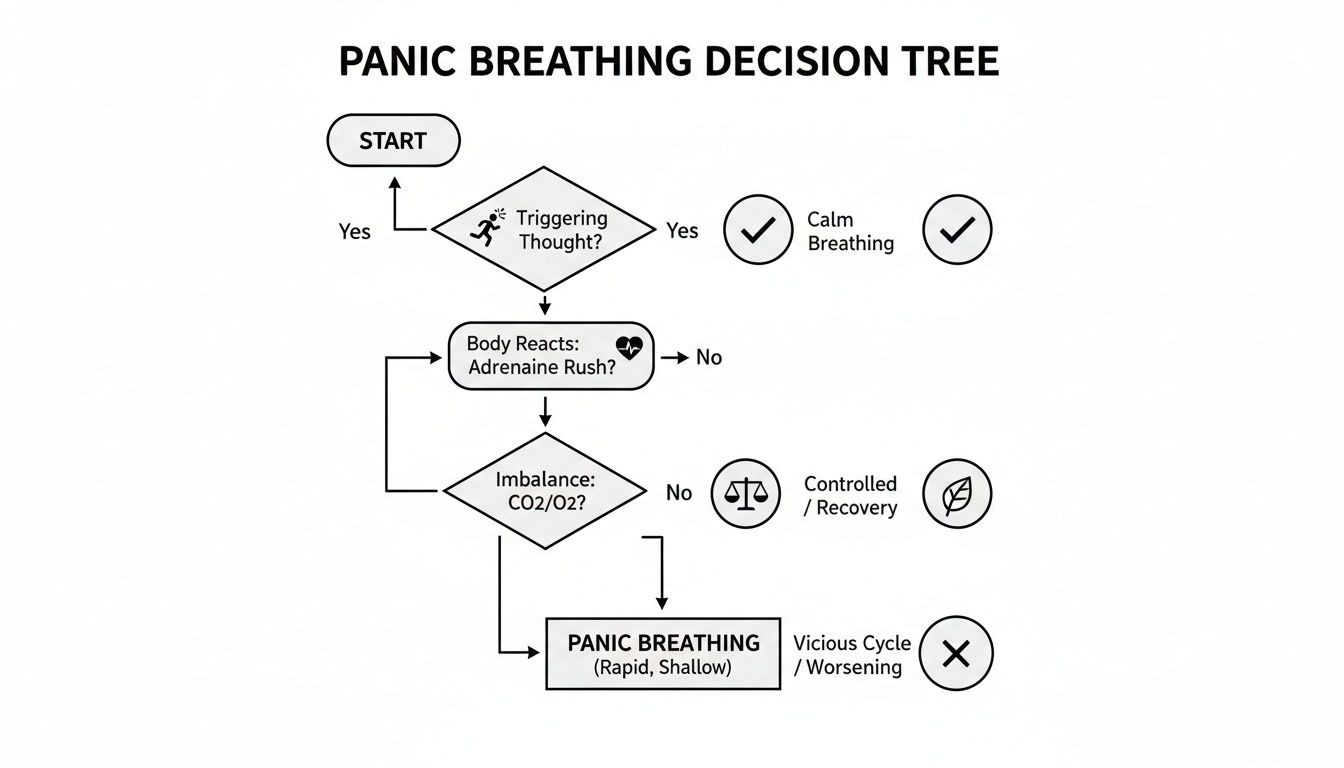
As you can see, the body’s reaction, while scary, is a predictable chain of events. And once you know the chain, you can learn how to break it.
To help you get a clearer picture, this table lays out the key differences between shortness of breath from a panic attack and common medical emergencies.
Panic Attack vs Medical Emergency Key Differences
| Symptom/Characteristic | Panic Attack | Heart Attack | Asthma Attack |
|---|---|---|---|
| Onset | Sudden and rapid, peaking within minutes. | Can be sudden or build gradually over hours. | Can develop quickly or over several hours. |
| Duration | Typically subsides within 20-30 minutes. | Pain is persistent and doesn't ease with rest. | Symptoms can last until treated with medication. |
| Breathing Pattern | Rapid, shallow breaths (hyperventilation). | May be difficult, but often without wheezing. | Characterized by wheezing and coughing. |
| Accompanying Symptoms | Intense fear, doom, trembling, tingling. | Squeezing chest pain, pain in arm/jaw, nausea. | Coughing, chest tightness, audible wheezing. |
| Triggers | Can be triggered by stress or appear random. | Often triggered by physical exertion or stress. | Triggered by allergens, exercise, or illness. |
| Pain Location | Chest pain is often sharp or stabbing. | Pressure or squeezing in the center of the chest. | Chest tightness, not typically sharp pain. |
Knowing these distinctions helps you reframe what's happening and regain a sense of control when you feel like you're losing it.
Building Your Confidence and Reducing Fear
Understanding these patterns isn't just an academic exercise—it’s a real-world survival tool. It lets you relabel the experience from "I'm having a heart attack" to "This is a false alarm from my body's anxiety system." That mental shift is absolutely fundamental to getting better.
When you're trying to figure out if your shortness of breath is from panic or a health problem, it can be helpful to look at a guide to medical oxygen to understand the scenarios where professional medical support is actually needed for breathing issues.
The most powerful realization is that while a panic attack feels incredibly dangerous, it is not life-threatening. By learning to recognize its signature, you take away its greatest weapon: the fear of the unknown.
Every single time you correctly identify an attack and ride it out, you prove to yourself that you can handle it. This builds a deep, unshakable sense of mastery and hope. You start to trust your body again, knowing you have the skills to get through these episodes—and that’s a massive step toward living a life free from panic.
How to Reclaim Your Breath in the Moment
When the storm of a panic attack hits, and that all-too-familiar shortness of breath takes over, you need an immediate, reliable action plan. These moments call for simple tools that cut through the chaos, right when you feel most out of control.
This is your in-the-moment guide to finding your footing and getting your breath back. Think of these techniques not as flimsy tricks, but as anchors proving you can ride out these waves. Every time you use one, you're actively retraining your nervous system and reminding yourself that you are in the driver's seat.
Reset Your Rhythm with Structured Breathing
That suffocating feeling of breathlessness during a panic attack? It’s caused by hyperventilation—your body is breathing too fast and too shallow. The fix is to intentionally slow things down and restore your body’s natural rhythm. Two highly effective methods can pull you back, even when the stress feels unbearable.
Box Breathing: This technique is so reliable that it's used by military personnel to stay calm under fire. It’s incredibly easy to remember: just picture a box with four equal sides.
- Breathe in slowly through your nose for four seconds.
- Hold your breath for four seconds.
- Breathe out slowly through your mouth for four seconds.
- Hold your breath for four seconds.
- Keep repeating this cycle until you feel the tension start to loosen its grip.
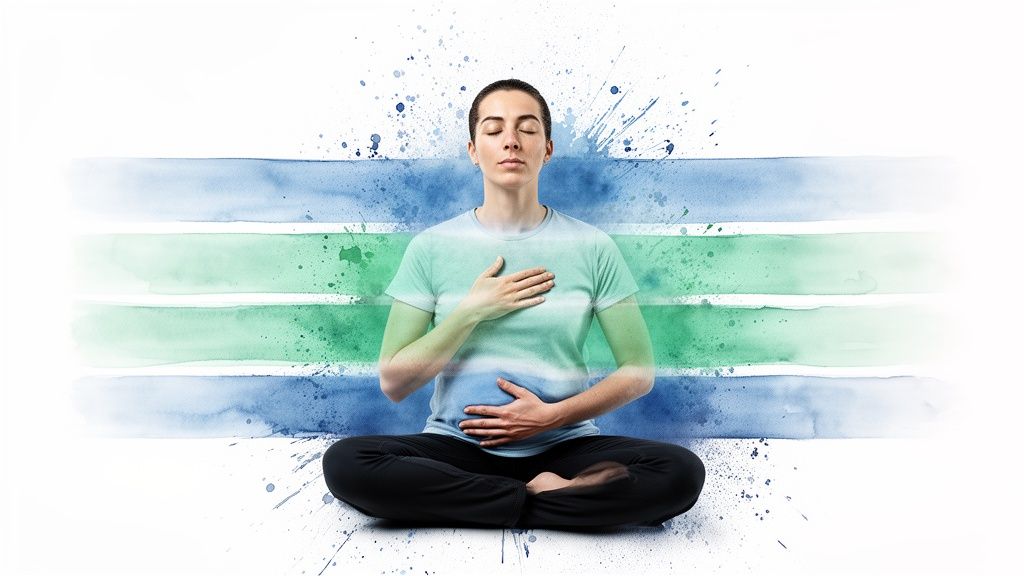
Diaphragmatic (Belly) Breathing: This is how we breathe naturally when we’re relaxed. It engages your diaphragm, the large muscle at the base of your lungs, to pull in deep, steadying breaths.
- Place one hand on your chest and the other on your stomach.
- Breathe in slowly through your nose, concentrating on making your stomach rise while your chest stays relatively still.
- Breathe out slowly through your mouth, feeling your stomach gently fall.
- This type of breathing sends a powerful "all clear" signal to your brain. If you want more guidance, check out our full guide to breathing exercises for anxiety.
Ground Yourself in the Present Moment
Breathing is the first step, but you also need to pull your focus away from the frightening physical sensations. Grounding techniques are designed to tether you to your immediate environment, breaking the terrifying feedback loop of panic. The 5-4-3-2-1 method is a fantastic tool for this.
"The goal is to interrupt the cycle of frightening thoughts that worsen panic attacks. Grounding techniques are a way to anchor yourself in the present moment when you feel overwhelmed."
Wherever you are, just stop and gently notice:
- 5 things you can see: Look around and name them. The color of the wall, a crack in the pavement, a single leaf on a tree.
- 4 things you can feel: Bring your attention to the texture of your clothes, the solid floor beneath your feet, the air on your skin.
- 3 things you can hear: Listen for the subtle sounds you might normally tune out. A distant car, a bird chirping, the hum of a refrigerator.
- 2 things you can smell: Try to pick out any scents in the air, whether they're pleasant or just neutral.
- 1 thing you can taste: Focus on the taste in your mouth, or take a deliberate sip of water.
These techniques are more than just coping skills; they're proof of your own resilience. They show that even when panic attacks shortness of breath feels completely overwhelming, you have the power to regain control, find your calm, and get back to your life.
Your Long-Term Strategy for a Panic-Free Life
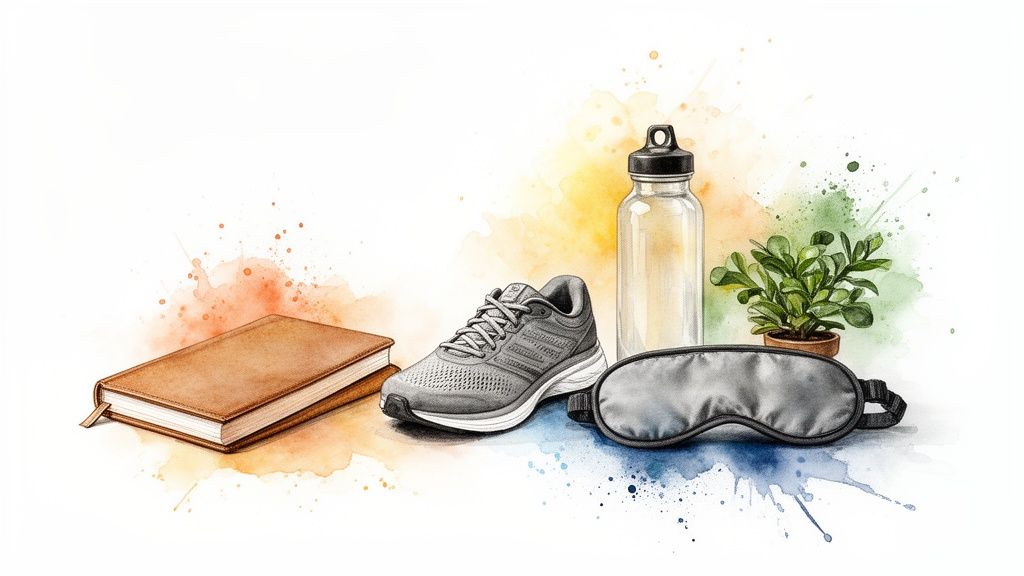
True freedom from the cycle of panic attacks and shortness of breath isn't about just getting through the next episode. It's about building a life where those episodes become rare, and eventually, a thing of the past. This is where you move from surviving the moment to building sustainable resilience.
Think of your nervous system like a bucket. When it's already full from stress, poor sleep, or unhealthy habits, it only takes one small thing to make it overflow into a full-blown panic attack. The goal here is to keep that bucket from getting so full in the first place.
This is a journey built on small, consistent actions that lower your overall anxiety load, turning hope into a concrete plan.
The Pillars of Lasting Calm
Your long-term strategy really comes down to two key areas: rewiring your thoughts and making smart lifestyle adjustments. When you tackle both your mind and your body, you create a powerful, proactive defense against anxiety.
Instead of living in fear of the next trigger, you learn to respond with confidence, putting yourself back in the driver's seat.
Challenging Catastrophic Thoughts: That terrifying thought, "I can't breathe," is a classic hallmark of a panic attack. A core long-term skill is learning to catch that thought and challenge it with something more rational, like, "This is just a feeling, and it will pass." This technique is central to Cognitive Behavioral Therapy (CBT) and helps rewire your brain's automatic fear response over time.
Identifying Your Triggers: Keep a simple journal to note when panic symptoms show up. You might start seeing patterns you never noticed before—maybe it's after your second cup of coffee, a night of poor sleep, or in specific social settings. Knowing your triggers is the first step toward getting ahead of them.
Healing from panic isn’t about becoming fearless; it’s about becoming so skilled at managing fear that it no longer controls your life. You are building a toolkit that puts you back in charge.
Creating a Resilient Lifestyle
You'd be surprised how much simple daily habits can impact your neurological and psychological health. Start by focusing on a few key areas that directly dial down your body's stress response.
- Prioritize Sleep: Seriously. Aim for 7-9 hours of quality sleep a night. A well-rested brain is far less likely to spiral into anxiety and panic.
- Move Your Body: Regular physical activity is nature's anxiety-reducer. You don't have to run a marathon; even a brisk 20-minute walk can help regulate stress hormones and boost your mood.
- Mind Your Diet: Pay attention to stimulants like caffeine and sugar. For some people, they can mimic or even trigger panic symptoms. A balanced diet helps keep both your body and mind on a more even keel.
These aren't just nice suggestions; they're proven methods for building a calmer, more predictable life. The National Institute of Mental Health reports that while 4.7% of U.S. adults will experience panic disorder at some point, effective treatments are available. However, a big gap in treatment still exists, which makes accessible self-help tools and strategies more important than ever. You can discover more insights about panic disorder statistics on nimh.nih.gov.
When you combine these cognitive and lifestyle adjustments, you build a comprehensive defense system against panic. If you're interested in digging deeper into the cognitive side of things, you can learn more about CBT for anxiety in our guide. This journey is a series of small, achievable steps, and each one takes you closer to lasting peace and empowerment.
When Should You Seek Professional Help?
While self-management skills are powerful tools, the journey to a panic-free life sometimes requires a guide. Knowing when to team up with a professional isn’t a sign of weakness. It's a proactive, courageous step toward lasting recovery.
Combining your own efforts with expert guidance can dramatically speed up your healing.
There are definitely clear signs that it’s time to reach out. If your shortness of breath is new, severe, or comes with other concerning symptoms like chest pain that radiates or a feeling of confusion, you need to seek immediate medical care. This is critical to rule out other causes—safety always comes first.
Taking the Next Step Toward Recovery
Once any underlying medical conditions have been cleared, a mental health professional can offer structured, targeted support. Therapies like Cognitive Behavioral Therapy (CBT) are incredibly effective for panic disorder. They help you fundamentally change the thought patterns that kick your fight-or-flight response into overdrive.
Seeking help is an act of hope and strength. It means you believe in a future where you are in control, and you are willing to take the steps necessary to get there.
Working with a professional gives you a personalized roadmap. They can help you untangle your specific triggers and build a robust toolkit of coping strategies that actually work for you. For those wondering about options for a medical assessment, a UK online doctor consultation can provide convenient and regulated support right from home.
Ultimately, professional help empowers you. It provides validation that what you're experiencing is real and, most importantly, treatable. With the right support system, the hope of living without the constant fear of panic attacks can become your reality.
To understand your options better, you can learn more about finding the right psychiatrist for anxiety in our comprehensive guide.
Common Questions About Panic and Breathing
Getting a handle on panic is a brave journey, and it's totally normal to have questions pop up along the way. Going over what you've learned can cement your confidence and give you that extra bit of reassurance when you need it most.
Here are some straightforward answers to the things people worry about most when it comes to panic attacks and shortness of breath. Think of each one as a reminder that what you're feeling is manageable. A calmer future isn't just a nice idea—it's completely within your reach.
Can I Stop Having Panic Attacks Completely?
Yes, a life that isn't dictated by panic attacks is absolutely possible. The goal isn't to magically erase anxiety forever—that's a normal, even helpful, human emotion. The real win is building such strong coping skills that panic attacks become rare, way less intense, or just fade away completely.
When you consistently practice the cognitive and breathing techniques you've learned, you are literally retraining your brain's fear response. This puts you back in the driver's seat, ready to face challenges with calm and confidence because you know you have the tools to handle them.
Why Do I Feel Breathless After the Panic Passes?
This is incredibly common, and it doesn't mean another attack is on its way. A panic attack is a massive physiological event—think of it as an unplanned, full-body sprint that your nervous system just ran. Afterward, your body needs a minute to catch its breath and get back to normal.
That lingering muscle tension in your chest, combined with a sudden, intense awareness of your breathing, can easily create that residual feeling of breathlessness. Gentle belly breathing and simple grounding exercises are perfect for this. They help soothe your system and gently guide you back to a state of balance.
"Hope is the belief that recovery is possible. A life free from the grip of panic isn't a distant dream; it's a destination you can reach with consistent practice and the right tools."
Does Focusing on My Breathing Sometimes Make It Worse?
It absolutely can, especially when you're just starting out. If you've started to associate the sensation of breathing with fear, paying close attention to it can actually ramp up your anxiety. This is a normal and very common hurdle.
If this happens to you, don't try to force it. Back off the breathing exercises for a moment and switch to a grounding technique, like the 5-4-3-2-1 method, to pull your focus outward. Once you feel a bit more settled, you can gently try again with a structured exercise like Box Breathing. The key here is patience. You're building new, positive connections, and that takes time.
Getting control over anxiety and panic is a journey of small, consistent steps. To help you build a personalized action plan, The Anxiety Checklist offers a structured system with practical tools, cognitive strategies, and tracking worksheets. It's designed to help you move from just surviving panic to truly building a life of fearless living. Learn more and grab your toolkit at https://anxietychecklist.com.