Agoraphobia is one of those words that gets tossed around, often mistakenly used to mean a simple fear of open spaces. But if you’re living with it, you know it’s so much more complex—and so much more personal—than that.
At its core, agoraphobia is an intense anxiety about being in situations where escape might feel difficult or where help might not be available if panic-like symptoms strike. It’s a fear that can methodically shrink a person's world, but it is absolutely not a life sentence. Healing is possible, and a life free from panic is within your reach.
Understanding Agoraphobia Beyond the Myths
If you're reading this, you might feel trapped by your anxiety, as if invisible walls are closing in around you. It can be an incredibly isolating experience, but I want you to know you’re not alone in this. The path toward a bigger, braver life starts right here, with understanding what’s really happening inside your mind and body.
Agoraphobia is a treatable condition. Let that sink in, because it’s the most important truth to hold onto. This isn't a character flaw or a sign of weakness; it's a recognized anxiety disorder with clear patterns and, more importantly, effective solutions. Healing happens one small, manageable step at a time, and this guide is here to walk that path with you.
What Agoraphobia Actually Feels Like
Imagine your internal alarm system—the one designed to protect you from legitimate threats—has become overly sensitive. This system is tied to the body's natural fight-or-flight response, but instead of being triggered by a real danger, it starts going off in everyday places. Suddenly, a grocery store, a movie theater, or even an open highway can feel as menacing as a life-or-death emergency.
The central fear in agoraphobia isn't about the places themselves, but about the feeling of being trapped with overwhelming panic. This anticipatory anxiety creates a vicious cycle of avoidance that can shrink your world, one "safe" zone at a time. But this cycle can be broken.
Agoraphobia is less about the fear of a place and more about the fear of a feeling. It's the terror of experiencing panic and feeling helpless, trapped, and unable to escape to a place of safety.
To help clear up some common confusion, let’s break down what agoraphobia is—and what it isn't.
Agoraphobia at a Glance
| Core Fear | What It Looks Like in Real Life |
|---|---|
| Fear of being trapped and unable to escape. | Avoiding public transportation, standing in long lines, being in crowded theaters, or even driving on a highway. The place itself isn't the problem; it's the feeling of being stuck there if panic hits. |
| Fear of losing control or having a panic attack in public. | Worrying about embarrassing yourself, fainting, or needing urgent help with no one to turn to. This can lead to staying home where you feel a sense of control and safety. |
| Fear of physical distance from a "safe" person or place. | Feeling unable to travel far from home, a specific family member, or a hospital. The world starts to feel manageable only within a very small radius. |
This table simplifies a complex condition, but it highlights the key difference: the fear is directed inward at the experience of panic, not outward at the world itself.
You Are Not Alone in This Experience
Feeling isolated is a huge part of this struggle, yet agoraphobia is more common than most people think. An estimated 0.9% of U.S. adults experienced it in the past year, with the lifetime prevalence reaching 1.3% among American adults. Research from the National Institute of Mental Health also shows it tends to appear more in adolescents and older adults.
These aren't just statistics; they represent millions of people who know exactly what it's like to feel their world getting smaller. More importantly, they represent millions who have found a path forward. Healing is absolutely possible, and simply by learning about this condition, you've already taken a brave and powerful first step.
Recognizing the Common Symptoms of Agoraphobia
To really get what agoraphobia is, you have to understand its patterns. It’s not just one feeling. Think of it as a tangled web of fearful thoughts, intense physical sensations, and behaviors specifically designed to sidestep panic. Seeing these signs for what they are is the first—and most powerful—step toward breaking the cycle.
These symptoms feed each other, creating a feedback loop that can feel impossible to escape. But by shining a light on each part, you start to see them not as permanent states, but as manageable patterns. This shift in perspective is everything; it turns an overwhelming unknown into a clear, addressable challenge.
Fearful Thoughts: The Cognitive Loop
The engine driving agoraphobia runs on “what if” thinking. These aren't just passing worries. They're persistent, intrusive thoughts that blow everyday situations way out of proportion, painting vivid mental pictures of losing control, being humiliated, or getting trapped without help.
This is the internal monologue of anxiety, constantly scanning for danger where there is none.
- "What if I have a panic attack here?" This is the core fear, usually imagined in a place where escape feels tough—like a packed movie theater, a traffic jam, or a plane on the runway.
- "What if I lose control or embarrass myself?" The dread of public judgment can be paralyzing. You might imagine fainting, throwing up, or showing obvious signs of panic in front of everyone.
- "What if I can't get out?" This thought turns ordinary places into cages. A long checkout line, a crowded elevator, or a seat in the middle of a row can suddenly feel suffocating and dangerous.
Physical Sensations: The Body's False Alarm
When those "what if" thoughts take root, your body reacts as if the threat is real. It floods your system with adrenaline, kicking off a cascade of intense physical symptoms that can be downright terrifying. It’s so jarring that people often mistake it for a heart attack or another serious medical emergency, which only cranks up the fear.
These are the exact same sensations you'd feel during a panic attack, and the fear of them is what fuels most of the avoidance in agoraphobia. If panic is a struggle for you, our guide on managing panic attacks can help you navigate those moments.
These physical symptoms are not dangerous—they are the body's natural alarm system firing at the wrong time. Understanding this is a foundational step in learning to dial down the panic response and regain a sense of safety in your own body.
Learning to recognize these sensations as false alarms is a huge part of recovery. Common physical signs include:
- Racing heart or chest palpitations
- Shortness of breath or a feeling of being smothered
- Dizziness, lightheadedness, or feeling like you might faint
- Trembling, shaking, or sweating
- Nausea or stomach distress
- A feeling of being detached from reality (derealization)
Avoidance Behaviors: The Shrinking World
Avoidance is the most obvious sign of agoraphobia and the one that messes with daily life the most. It’s a logical response—if something makes you panic, you avoid it. But it's a trap. Every time you dodge a situation, your brain learns that avoidance equals safety, which only makes the fear stronger and your world smaller.
This pattern usually starts small, maybe by skipping one specific store. Before you know it, it can grow until the thought of leaving home at all feels impossible.
- Refusing to go to specific places: Actively steering clear of malls, public transport, bridges, stadiums, or wide-open spaces.
- Altering daily routines: Only going to small, local shops at odd hours or taking a much longer route just to avoid a highway.
- Needing a "safe" person: Feeling like you absolutely cannot leave the house without a trusted friend or family member by your side.
- Developing safety rituals: Always carrying medication, a water bottle, or a fully charged phone, convinced these items are what keep a catastrophe at bay.
Breaking this cycle of thought, sensation, and behavior is the heart of healing from agoraphobia. By simply identifying these patterns in yourself, you've already started the process of taking your life back. Every single symptom is treatable, and every step you take toward understanding is a step toward freedom.
Exploring the Roots: Causes and Risk Factors
If you’re grappling with agoraphobia, it's easy to fall into the trap of asking, "What's wrong with me?" or "Why is this happening?" But understanding where this condition comes from is the first step toward moving away from self-blame and toward real, compassionate healing.
Let’s be clear: agoraphobia is not a sign of personal weakness. It's a complex condition that grows from a mix of factors—much like a plant needs the right combination of soil, water, and light to sprout. There’s almost never a single cause. Instead, it’s usually a blend of your biological wiring, your personal history, and your unique temperament that sets the stage. Knowing this can feel incredibly freeing.
The Interplay of Biology and Environment
Our genes can definitely play a part in how vulnerable we are to anxiety. If you have family members who struggle with anxiety disorders or panic attacks, you might have a biological predisposition. Think of it like having a more sensitive internal alarm system—it doesn't mean the alarm is guaranteed to go off, but the wiring is a bit more reactive than someone else's.
Of course, genes are only part of the story. Stressful life events or past trauma often act as the trigger that flips the switch on that sensitivity. This combination of nature and nurture can create the perfect storm for agoraphobia to take hold. You can learn more about how these factors often overlap by reading about the common causes of anxiety.
Understanding your unique blend of risk factors isn't about assigning blame; it's about gathering intelligence. Each insight is a clue that can help you and a professional create a targeted, effective path toward a life free from panic and fear.
This diagram shows how fearful thoughts, physical sensations, and avoidance behaviors lock you into a self-sustaining cycle.
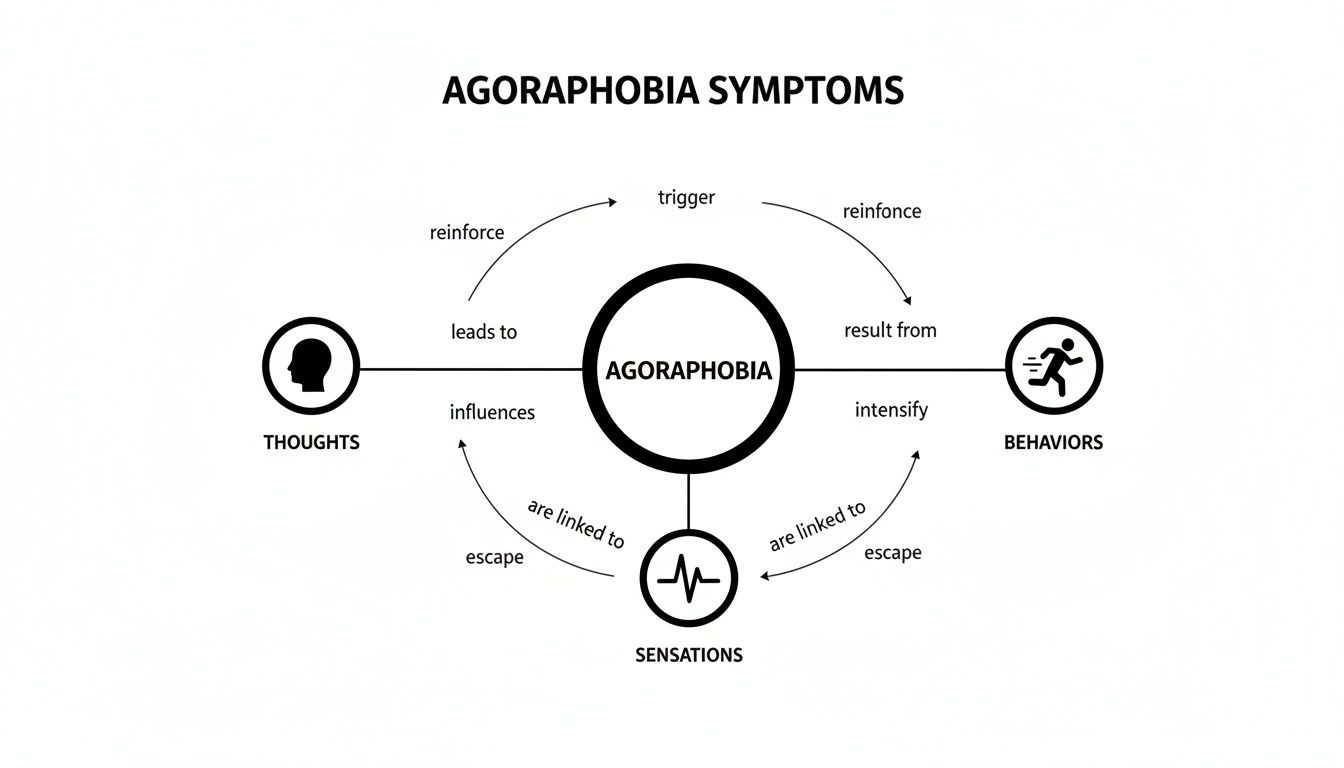
As you can see, a single trigger can set off a chain reaction. The thoughts amplify the physical feelings, which then drive behaviors that only reinforce the original fear. But the most hopeful part of this cycle is that you can intervene at any point to break it.
The Spark of the First Panic Attack
For so many people, the path to agoraphobia starts with a single, terrifying event: an unexpected panic attack in a public place. It could be a grocery store, a crowded bus, or even just being stuck in traffic. The experience is so jarring that the brain forges a powerful, negative connection to that specific location. Suddenly, that place becomes a symbol of danger.
This creates a fear of the fear itself. Your brain, in its attempt to protect you, starts flagging any similar situation as a potential threat. This is what kicks off the cycle of avoidance. You start to shrink your world, bit by bit, to prevent another panic attack—inadvertently strengthening the agoraphobia with every situation you dodge.
Understanding Key Risk Factors
While anyone can develop agoraphobia, a few factors can increase the likelihood. Seeing if any of these resonate can help you make sense of your own experience.
- A History of Panic Disorder: The vast majority of people with agoraphobia had a panic disorder first. The fear of future attacks becomes the central organizing principle of their life.
- A Tendency Towards Anxiousness: If you’ve always had a more nervous or anxious temperament, you might be more susceptible.
- Stressful Life Experiences: Major life events like the death of a loved one, a serious illness, or experiencing violence can act as a catalyst.
- Gender Disparity: Research consistently shows a notable gender gap. The lifetime prevalence among adolescent females is 3.4% compared to 1.4% for males, a vulnerability that becomes especially pronounced during the teenage years.
Ultimately, knowing the causes and risk factors is about empowerment. It’s the first step toward dismantling the fear, understanding that this condition has a logical (though painful) structure, and recognizing that what has been learned can also be unlearned. There is always a path back to a full, unrestricted life.
Your Path to Healing With Evidence-Based Treatments

When you're living with agoraphobia, a life without constant fear can feel like a distant dream. But it is absolutely within your reach. Lasting recovery isn’t just a hopeful fantasy; it’s a reality for millions who have reclaimed their freedom through proven, evidence-based treatments.
This is where the journey shifts from just understanding the problem to actively solving it.
Healing is really a process of unlearning the fear that has kept your world small. It's about retraining your brain to feel safe again. It takes courage and patience, for sure, but the path is well-traveled and backed by decades of solid research. You don’t have to walk it alone—effective help is out there, and it really works.
Cognitive Behavioral Therapy: The Foundation of Change
One of the most effective and trusted treatments for agoraphobia is Cognitive Behavioral Therapy (CBT). Think of CBT as a practical toolkit for rewiring your brain's automatic fear response. It’s built on a simple but powerful idea: your thoughts, feelings, and actions are all deeply connected.
CBT helps you pinpoint the specific, fearful thought patterns—like "I'm going to have a panic attack and lose control"—that keep the cycle of anxiety and avoidance going. A therapist guides you in challenging these automatic negative thoughts, looking at the actual evidence for and against them, and swapping them for more balanced, realistic perspectives. This isn't about "just thinking positive"; it's about developing a more accurate and less frightening view of the world.
For many, just leaving home is the first major hurdle. Learning how to feel safe while navigating your first trauma-informed online counselling session can be a game-changing first step.
Exposure Therapy: Reclaiming Your World, Step by Step
Within the CBT framework, Exposure Therapy is the gold-standard treatment for agoraphobia. The name might sound a little intimidating, but it’s a gradual, controlled, and deeply empowering process. The core idea is simple: gently and systematically re-enter the situations you’ve been avoiding to prove to your brain that they aren’t actually dangerous.
Imagine your fear is a muscle that’s grown too strong from constant use. Exposure therapy is like physical therapy for your brain—it slowly weakens that fear muscle while building up your confidence. You and your therapist will create a list of feared situations, starting with something that feels just a little bit scary, and work your way up.
The goal of exposure therapy is not to get rid of anxiety completely, but to teach you that you can handle the feeling. You learn, through direct experience, that anxiety is just a temporary, non-dangerous sensation that will pass on its own—without you needing to escape.
This process literally retrains your nervous system. With each small success, your brain’s alarm system starts to recalibrate, learning that a crowded store or a bus ride isn't a true threat. For a deeper dive into how this works, check out our detailed guide on using exposure therapy for anxiety.
The Supportive Role of Medication
While therapy is the key to long-term change, medication can play a crucial supporting role, especially at the beginning. It can act like a stabilizer, turning down the volume on intense anxiety just enough to make therapy feel more manageable and effective.
The most commonly prescribed medications for agoraphobia are a class of antidepressants called Selective Serotonin Reuptake Inhibitors (SSRIs). These work by adjusting the levels of serotonin, a chemical in the brain that helps regulate mood and anxiety.
Here’s what you should know about medication:
- It’s a Tool, Not a Cure: Medication helps manage symptoms, creating a window of opportunity for you to do the real therapeutic work in CBT and exposure therapy.
- It Takes Time: SSRIs usually take several weeks to become fully effective, so patience is key.
- Collaboration is Essential: Your doctor will work with you to find the right medication and dosage, keeping an eye out for side effects and making adjustments as needed.
Ultimately, the most effective treatment plans often combine therapy and medication. This two-pronged approach tackles the condition from both a psychological and a biological angle, giving you the best possible foundation for building a life free from fear. Your path to healing is real, and it starts by taking that first courageous step toward getting help.
Practical Coping Strategies You Can Start Today
While professional therapy is a game-changer for healing from agoraphobia, your journey toward a life with less panic doesn't have to wait for your next appointment. There are powerful, practical things you can start doing right now to calm your nervous system and build momentum.
Think of these strategies as small, steady anchors in the storm of anxiety. They won't make the fear vanish overnight, but they give you real tools to manage the intensity of the moment and create a foundation you can stand on. Every small step you take is a vote of confidence in your ability to heal.
Regulate Your Nervous System with Mindful Breathing
When panic starts to swell, your breathing is usually the first thing to go haywire. It gets shallow and fast, screaming "danger!" at your brain. The good news? You can send a powerful message right back by consciously slowing your breath down. This simple act can short-circuit the body's alarm response.
One of the best ways to do this is with diaphragmatic breathing, also known as belly breathing. It directly stimulates the vagus nerve, which is like a brake pedal for your body's "fight or flight" system, calming the physical sensations of panic. We've got more techniques in our guide on breathing exercises for anxiety.
Here’s a simple exercise you can try right now:
- Get Comfortable: Sit or lie down. Place one hand on your chest and the other on your stomach, just below your ribs.
- Breathe In Slowly: Inhale through your nose for a count of four. Feel the hand on your stomach rise while the hand on your chest stays relatively still.
- Hold Gently: Hold your breath for a second or two.
- Exhale Slowly: Breathe out through your mouth for a count of six, feeling the hand on your stomach fall as you release the air.
Repeat this cycle for a few minutes whenever you feel anxiety creeping in. The key is making your exhale longer than your inhale—it has a naturally calming effect on your body.
Anchor Yourself in the Present with Grounding Techniques
Agoraphobia thrives on "what if" thinking that drags you into an imagined, terrifying future. Grounding techniques are your secret weapon to pull your attention out of that spiral and plant it firmly in the present moment. They reconnect you with your senses and remind your brain that you are here, now, and safe.
Grounding is the practice of noticing the world outside of your anxious thoughts. By focusing on what you can see, hear, touch, smell, and taste, you interrupt the panic loop and create mental space.
One of the most popular methods is the 5-4-3-2-1 technique. It’s easy to remember and you can do it anywhere.
- 5: Name five things you can see around you. (A scuff on the floor, a picture frame, the color of your shirt.)
- 4: Acknowledge four things you can feel. (The fabric of your pants, the cool air on your skin, your feet flat on the ground.)
- 3: Listen for three things you can hear. (The hum of a fan, birds chirping, your own breath.)
- 2: Identify two things you can smell. (The faint scent of coffee, the soap on your hands.)
- 1: Name one thing you can taste. (That lingering hint of toothpaste, or just the taste of your own mouth.)
Build a Foundation of Stability and Wellness
Your mind and body are deeply connected. Creating a stable daily routine can seriously boost your resilience to anxiety. When your world feels chaotic, having consistency in the basics provides a sense of predictability and control that can be incredibly soothing.
Focus on these foundational habits:
- Prioritize Sleep: Aim for 7-9 hours of quality sleep each night. A consistent sleep schedule is a powerhouse for regulating mood.
- Nourish Your Body: A balanced diet with plenty of whole foods supports brain health. Try to limit caffeine and sugar, as they can sometimes trigger or worsen anxiety symptoms.
- Incorporate Gentle Movement: You don’t need to run a marathon. Regular physical activity is a proven anxiety-buster, and something as simple as a daily walk or some gentle stretching can make a world of difference.
Some people also find complementary practices helpful. For instance, discovering how Swedish massage therapy can help reduce anxiety and stress might add another valuable tool to your coping kit. Each of these strategies is a small, manageable step you can take today to start reclaiming your peace.
How to Build a Strong Support System
Navigating agoraphobia can feel like a profoundly isolating experience, but here’s one of the most powerful truths about recovery: you don't have to go through it alone.
Building a strong, understanding support system isn't just helpful—it’s a core part of lasting healing. Connection is the ultimate antidote to the isolation that anxiety breeds, giving you the encouragement needed to take those brave first steps.
The road to a panic-free life is so much smoother when you have people in your corner. This network—friends, family, peers who get it, and professionals—becomes your team, offering strength when yours is running low and celebrating every single win, no matter how small it feels.
Talking to Your Family and Friends
Opening up to your loved ones about what you're going through can be one of the toughest—and most rewarding—conversations you'll have. They might not understand at first, and that's okay. That's why clear, honest communication is key.
Try framing the conversation around how you feel, not just what you avoid.
For instance, instead of just saying, "I can't go to the mall," you could explain it like this: "When I'm in a huge, crowded place like the mall, I feel this overwhelming fear that I’ll have a panic attack and won't be able to leave. It's not the mall itself—it's the feeling of being trapped."
That kind of vulnerability opens the door for empathy instead of confusion. It helps them see the incredible courage it takes for you to even think about facing these situations.
Finding People Who Truly Understand
While support from family and friends is vital, there's a unique power in connecting with people who've walked in your shoes. Support groups, whether you find them online or in your community, create a space where you don't have to explain yourself. Everyone there already gets it.
Sharing your story with peers who are also healing from agoraphobia validates your struggle and serves as a powerful reminder that you are not broken or alone. This shared understanding can dramatically dial down feelings of shame and isolation.
These groups can be amazing sources of practical tips, encouragement, and most of all, hope. Hearing success stories from others who have reclaimed their lives is solid proof that recovery isn't just possible—it's what you can expect.
Taking the Courageous Step of Seeking Help
Finally, the most critical member of your support team is often a qualified therapist who specializes in anxiety disorders. Reaching out for professional help is not a sign of weakness; it’s an act of profound strength and self-care.
A good therapist is like a guide and a strategist all in one. They equip you with evidence-based tools like CBT and exposure therapy, creating a safe, non-judgmental space where you can face your fears at your own pace. Finding the right professional is a courageous and essential investment in your future—a future defined by freedom, not fear.
Common Questions About Agoraphobia
Digging into what agoraphobia is usually sparks more questions. And that’s a good thing. Getting clear, straightforward answers can break down the barriers to getting help and show you that a life free from panic isn’t just a nice idea—it's completely achievable.
Let’s tackle some of the most common concerns. Every question you ask is a step toward taking your power back. Healing is built on understanding, and these answers can help light the way forward.
Can Agoraphobia Be Cured Completely?
While "cure" can be a tricky word in mental health, it is absolutely possible to manage agoraphobia so well that it no longer runs your life. That’s the goal, right? Through proven treatments like Cognitive Behavioral Therapy (CBT) and exposure therapy, countless people get to a place of full recovery.
The point of treatment isn’t to erase every last trace of anxiety. It’s about reclaiming your freedom. It’s about getting to a place where fear no longer makes your decisions for you.
You get back to living on your own terms, confident that you can handle anxiety if it ever shows up again. A life free from panic is a realistic and attainable goal.
How Is Agoraphobia Different From Social Anxiety?
This is a big one, and it's easy to see why they get confused. The core fears, though, are worlds apart.
Social anxiety is driven by a fear of being judged, scrutinized, or embarrassed by other people. Someone with social anxiety might skip a party because they’re terrified of saying something stupid or being seen as awkward.
On the other hand, agoraphobia is driven by a fear of having a panic attack and not being able to escape or get help. A person with agoraphobia would avoid that same party because they’re afraid of feeling trapped in the crowd if panic hits. The fear is internal—it’s about the terrifying experience of panic itself.
What If I’m Too Scared to Leave Home for Therapy?
This is one of the most common and understandable hurdles. If the problem is a fear of leaving home, how are you supposed to get to an appointment? Thankfully, therapy has evolved to meet you where you are.
Many therapists specializing in agoraphobia offer teletherapy sessions over secure video calls. This means you can start your healing journey right from the safety of your living room. There is always a way to begin.
Some therapists even do initial in-home visits to get the ball rolling. Another powerful approach is to start with practical self-help strategies, build a little confidence on your own, and then step into therapy. You can start right where you are.
If you're ready to build a life defined by freedom instead of fear, The Anxiety Checklist offers a structured, step-by-step system to guide you. Our program gives you the tools to understand your anxiety, challenge fearful thoughts, and take real steps toward lasting recovery. Start building your personalized toolkit today at https://anxietychecklist.com.