
At its heart, avoidance behavior is a natural response to fear that promises safety but often delivers a smaller, more restricted life. It's that gut instinct to sidestep people, places, or tasks that stir up uncomfortable feelings—anxiety, embarrassment, or just plain dread. And while it offers a quick hit of relief, it's a tempting shortcut that can lead you straight to a dead end. But the most important thing to know is that this path is not permanent; there is always a way back to a fuller, more joyful life.
Understanding The Cycle of Avoidance Behavior

Ever turned down a party invitation because you were terrified of awkward small talk? Or maybe you've put off making an important phone call because the very thought of it made your stomach churn. These are classic examples of avoidance in action. You spot a potential threat to your comfort, you veer around it, and—poof—you instantly feel better.
The problem is, that wave of relief is an incredibly powerful reward. Each time you dodge something that scares you, your brain learns a simple but damaging lesson: avoidance works. This reinforces the cycle, hard-wiring you to do the same thing next time. What starts as a small detour can, over time, become a major roadblock that keeps you from living the life you actually want.
The Hopeful Path Forward
It's so important to know that falling into this pattern isn't a personal failure; it's a deeply human response. Avoidance behavior is a core feature of anxiety disorders, which are among the most common and treatable mental health struggles in the world. In fact, an estimated 359 million people were navigating an anxiety disorder back in 2021. This guide is meant to be a supportive roadmap, showing you that real, meaningful change is completely possible. If you want to see how our minds can get tangled up in these unhelpful patterns, you can check out our guide on cognitive distortions.
The most important truth is this: You are not broken, and you are not alone. Understanding avoidance is the first, most powerful step toward reclaiming your life from fear.
To get a better handle on the "why" behind this behavior, it can be helpful to delve into topics like abnormal psychology. While the avoidance cycle can feel incredibly isolating, it’s a well-understood psychological process. And because it's a learned behavior, it can be unlearned. The strategies in this article are designed to help you gently break that cycle, build your confidence, and find a new path toward a life free from panic.
Why We Learn to Avoid What Scares Us
To get a handle on avoidance, we first need to look at why it feels so compelling in the moment. This isn't some kind of character flaw or a sign that you're weak; it’s a learned behavior, powered by a very strong psychological engine. At its heart, avoidance is just your brain trying to shield you from what it thinks is a threat.
Think of your anxiety like a smoke detector that’s dialed up way too high. When you walk into a situation that triggers it—a crowded grocery store, a looming presentation—that alarm starts blaring, flooding you with all sorts of uncomfortable feelings.
By backing away from that situation, you’re basically hitting the snooze button on the alarm. The immediate quiet and wash of relief you feel is an incredibly powerful reward.
This is a classic case of what psychologists call negative reinforcement. It’s a bit of a confusing term, but it doesn't mean punishment. It means you’re rewarded by having something unpleasant taken away (the anxiety). Your brain quickly learns a simple but potent lesson: "Hey, when I dodged that scary thing, the bad feelings stopped." This makes you far more likely to do it again next time, locking the cycle in place.
The Subtle Traps of Safety Behaviors
Avoidance doesn't always mean bolting for the door or calling in sick. More often, it shows up in sneaky ways through what experts call safety behaviors. These are the little rituals and crutches we use to feel more secure in a nerve-wracking situation. The problem is, they quietly reinforce the belief that we can't handle things on our own.
These subtle habits can look like:
- Excessive Rehearsal: Going over a conversation in your head dozens of times before it actually happens.
- Positional Safety: Always grabbing a seat near the exit in a movie theater or restaurant, "just in case" you feel overwhelmed and need to escape.
- Social Crutches: Glancing at your phone constantly at a party to look busy and sidestep having to make small talk.
- Relying on Others: Only agreeing to go to a new place if a trusted friend or partner can come along.
While these actions might feel like they're helping you get by, they’re actually preventing you from ever learning that the situation itself isn’t really dangerous. They send a constant message to your brain: “You only survived because you had your safety net.” It’s a crucial way avoidance behavior puts down roots and grows stronger over time.
By understanding these mechanisms, you can start to see your own patterns not as a permanent part of you, but as a system that has simply been calibrated too high. The good news is that any system can be recalibrated.
This entire process is wired directly into your body's ancient threat detection system. To learn more about the physical sensations driving this cycle, our fight-or-flight response guide is a great place to start. Recognizing that these patterns are learned is the first, most powerful step toward unlearning them. It opens the door to the hopeful truth that you can teach your brain a new way to respond—and start living a life that isn't dictated by fear.
How Avoidance Shows Up In Everyday Life

Avoidance isn't always some dramatic, life-halting decision. It’s rarely about refusing to leave the house. More often, it shows up as a quiet pattern of small, seemingly harmless choices that slowly shrink your world.
It’s the career-defining project you keep putting off until "tomorrow." It’s the important doctor’s appointment you cancel at the last minute because something "came up." These actions tend to fly under the radar, disguised as simple preferences or just being practical.
But learning to spot these patterns is the first step toward getting your freedom back. When you can see what avoidance actually looks like day-to-day, you can start making different choices—the kind that lead you toward growth, not retreat.
It's really important, though, to draw a line between avoidance that keeps you safe and avoidance that holds you back.
Protective Vs Limiting Avoidance
Here’s the thing: not all avoidance is bad. Deciding to walk away from a genuinely dangerous situation isn't a sign of weakness; it's a healthy, adaptive survival instinct. It's your brain doing exactly what it's supposed to do.
The trouble starts when avoidance becomes your go-to strategy for managing potential discomfort, not actual danger. This is where it crosses the line from protective to limiting.
Healthy Vs Unhealthy Avoidance At A Glance
To make it easier to see the difference in your own life, let's compare some common scenarios. This isn't about judging your choices, but about bringing clarity to the patterns that might be running on autopilot.
| Situation | Healthy Avoidance (Protective) | Unhealthy Avoidance (Limiting) |
|---|---|---|
| A Social Gathering | You leave a party where someone is being aggressive and making you feel unsafe. | You decline every invitation because you're terrified of awkward small talk. |
| Work Responsibility | You delegate a task that's way outside your expertise to make sure it’s done right. | You repeatedly call in sick on presentation days to avoid the fear of public speaking. |
| Health Concern | You switch doctors after a really bad experience to find one you actually trust. | You ignore a nagging health symptom and avoid making an appointment out of fear of bad news. |
Seeing it laid out like this can be pretty empowering, right? The goal isn't to become completely fearless. It's to stop letting fear be the one making all your decisions for you.
Common Examples In Daily Life
Maladaptive avoidance has a knack for seeping into almost every corner of our lives, often in ways we don't even notice.
A huge one in our modern world is mindlessly scrolling through social media to numb out or distract from difficult feelings. If you want to dig deeper into that specific pattern, this guide on how to stop social media addiction has some great insights.
This pattern is also incredibly common when it comes to our health. A massive analysis covering over 564,000 people found that nearly 1 in 3 actively avoid seeking medical information about their health. It just goes to show how universal the urge to dodge uncomfortable truths really is.
Here are a few other ways it shows up:
- Social Avoidance: Routinely turning down invitations to parties, dates, or even casual get-togethers. This is a core feature for people struggling with social anxiety disorder.
- Cognitive Avoidance: This is more subtle. It's quickly changing the subject when a tough topic comes up or diving into distractions like TV or video games to escape upsetting thoughts.
- Situational Avoidance: Refusing to drive on highways, get in elevators, or go to crowded places like malls, concerts, or theaters because the thought alone is too much.
Recognizing these behaviors in yourself isn't a reason for shame. Think of it as a moment of clarity—like finally getting a map that shows where anxiety has been leading you.
And once you can see the map, you get to choose a new destination.
The True Cost of a Life Ruled by Avoidance
Avoidance is tricky. In the moment, sidestepping something that makes you anxious feels like a win. It delivers a quick, comforting hit of relief. But while you're winning these small battles, you're slowly losing the war.
Think of your life as a sprawling, beautiful garden. Every time you dodge a feared situation—a social event, a tough conversation, a new opportunity—it's like deciding not to water a small patch. At first, you hardly notice. But over time, those untended patches wither and spread until your vibrant space feels small and closed off.
The Shrinking World of Avoidance
This gradual shrinking isn't just about one thing; it bleeds into every corner of your life. What begins as skipping a single party can morph into chronic social isolation, leaving friendships strained and loneliness in its place. Avoiding one challenging project at work can cascade into missed promotions and a career that feels stuck.
And this pattern can dig its roots in fast. Research shows that the shift from initial social fears to a full-blown habit of avoidance often happens within the first year. This is why it’s so critical to catch these patterns early. You can learn more about these findings on the development of avoidance.
The real cost of avoidance isn't just the opportunities you miss. It's the person you stop believing you can be. It chips away at your self-confidence, reinforcing the false narrative that you're too fragile to handle life's challenges.
Building Your Motivation for Change
Pointing out these costs isn't about making you feel worse. It’s about building motivation. It's about seeing the trade-off clearly: the temporary comfort of avoidance is robbing you of a richer, more connected future. The life you actually want is waiting on the other side of this pattern.
Understanding this is the first real step toward taking back your garden. Every small act of courage, every time you choose to face a fear instead of backing away, is like planting a new seed. It's proof that you are far more capable than your anxiety lets you believe. Acknowledging the true price of avoidance clarifies what's at stake and gives you the powerful "why" you need to start moving forward.
Practical Steps to Reclaim Your Life from Anxiety
Recognizing the price you pay for avoidance is the first step. This is where you turn that understanding into action. You absolutely can break the cycle and begin the healing journey toward a panic-free life.
The strategies that follow aren't about snapping your fingers and making anxiety disappear. Instead, they're about teaching your brain a new, more courageous way to respond when fear shows up. These are powerful, evidence-based tools from Cognitive Behavioral Therapy (CBT), designed to be accessible and empowering.
They work by gently, but firmly, challenging the core belief that you can't handle discomfort. Every small step forward proves you're far more capable than you think.
Face Your Fears with Graded Exposure
The single most effective way to dismantle avoidance is through a process called graded exposure. It sounds intense, I know. But it’s actually the opposite of throwing yourself into the deep end.
Think of it like wading into the water one small, deliberate step at a time.
The idea is simple: you make a list of situations you fear, ranking them from just a little scary to really scary. Then you start with the easiest one. You stay in that situation until your anxiety naturally starts to come down on its own.
This process, often called creating a "fear ladder," does two critical things:
- It teaches your brain that the catastrophic thing you're worried about almost never happens.
- It proves that even when you do feel anxious, you can handle it. The feeling will pass.
This structured approach builds real confidence with every single rung you climb. You can learn more about the mechanics behind this in this guide to exposure therapy for anxiety.
Create Your Own Fear Ladder
Let's imagine someone who avoids social gatherings. Their fear ladder might look something like this:
- Step 1 (Mild Anxiety): Text a friend just to ask how their day was.
- Step 2 (Mild-Moderate Anxiety): Have a five-minute phone call with a family member.
- Step 3 (Moderate Anxiety): Go to a coffee shop and just sit by yourself for 15 minutes.
- Step 4 (Moderate-High Anxiety): Attend a small get-together with a few close friends for 30 minutes.
- Step 5 (High Anxiety): Go to a larger party and commit to staying for at least one hour.
The key is to go at your own pace. You only move to the next step after you feel reasonably comfortable with the one you're on. Each successful step is a victory that starts rewiring your brain’s response to fear.
The infographic below shows exactly what these strategies help reverse—the cascading negative effects of long-term avoidance.
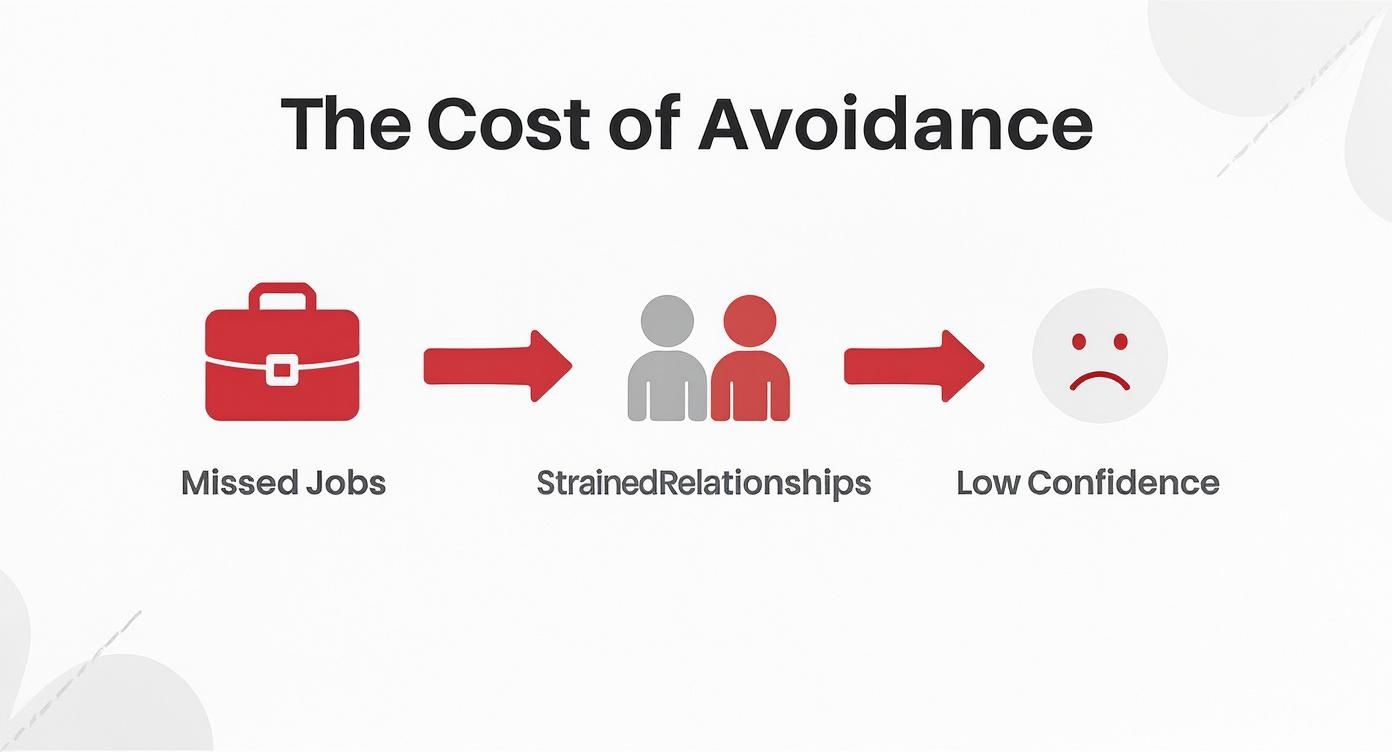
As you can see, unchecked avoidance can spiral from missed opportunities to strained relationships and, ultimately, a massive hit to your self-confidence.
Reignite Your Life with Behavioral Activation
Another powerful strategy is behavioral activation. When anxiety and avoidance take over, it’s all too easy to stop doing the things that once brought you joy, meaning, or a sense of accomplishment.
Behavioral activation is the simple but profound act of scheduling these positive activities back into your life, even when you don't feel like it.
By engaging in rewarding activities, you directly counteract the pull of avoidance and depression. It’s a way of acting yourself into feeling better, rather than waiting for motivation to strike.
Start small. Seriously small. Schedule just one or two positive activities for the week. Maybe it’s taking a walk in a park, listening to a favorite album without distractions, or working on a hobby for just 15 minutes.
This creates positive momentum. It reminds your brain that life is more than just managing threats. It’s about building a life that is so rich and meaningful that anxiety no longer gets to be the main character.
Knowing When to Seek Professional Support
While the self-help tools in this guide are incredibly powerful, sometimes the journey to reclaim your life requires a trusted guide. Reaching out for professional support isn't a sign of failure—it's a courageous step toward building a fuller, more vibrant life. It is an act of hope.
So, how do you know when it’s time to take that step?
Clear Signs It May Be Time for Help
Consider connecting with a mental health professional if avoidance is:
- Severely impacting your life: Is it getting in the way of your job, damaging key relationships, or making it hard just to manage daily tasks?
- Causing overwhelming distress: If the anxiety feels unmanageable or you feel completely stuck despite your best efforts, a therapist provides structure and support.
- Showing up with other concerns: Avoidance often walks hand-in-hand with issues like depression or substance use, which really benefit from integrated professional care.
Therapy isn't a last resort. Think of it as a dedicated space where you can learn proven strategies, tailored specifically to your situation. Professionals trained in Cognitive Behavioral Therapy (CBT) can help you create a personalized plan to face your fears safely and effectively.
Seeking help is a profound act of self-awareness and strength. It’s an investment in your own well-being and a declaration that you are ready to live a life that isn’t dictated by fear.
Working with a professional demystifies the process. It also provides the compassionate accountability that's often needed to make lasting changes. To explore your options further, our guide on psychotherapy for anxiety offers valuable insights into what you can expect.
Have Questions About Avoidance? We've Got Answers
Digging into avoidance patterns is bound to bring up questions. That’s a good thing—it means you’re getting curious about what drives your choices. Getting clear answers helps you move forward with confidence, proving to yourself that you can change your relationship with anxiety.
Is Procrastination a Form of Avoidance Behavior?
Yes, it absolutely is. Think of procrastination as a mental form of avoidance. Instead of ducking out of a social event, you're sidestepping a task that kicks up feelings of anxiety, dread, or a fear of not doing it perfectly.
That wave of relief you feel when you decide, "I'll do it tomorrow"? That's negative reinforcement in action. It temporarily eases the discomfort, which makes you more likely to put it off again next time. Recognizing that procrastination is just avoidance in disguise is a game-changer.
Can I Overcome Avoidance Behavior on My Own?
For milder habits, absolutely. Many people find that self-help strategies, like the gradual exposure steps we talked about earlier, are incredibly effective. These tools empower you to build confidence and slowly reclaim the territory that fear has taken over. This is a journey of healing, and many find the strength to navigate it using these tools.
But if avoidance has become a severe, long-standing pattern that’s really getting in the way of your life, working with a therapist is the best path forward. A professional trained in CBT offers the personalized guidance, structure, and compassionate support needed to tackle deep-rooted fears safely and effectively.
How Long Does It Take to See Progress?
This is different for everyone, but most people start to notice a real shift in momentum pretty quickly once they commit to consistent action. The secret isn't intensity; it's consistency.
Facing small, manageable fears on a regular basis builds a powerful sense of self-trust. It’s like building a muscle.
The goal isn't to get rid of fear overnight. It's about learning, through direct experience, that you can handle the feeling of anxiety and that it always passes. This is where the real freedom begins.
Every small step you take is a win. It’s tangible proof that a life free from the constraints of fear isn't just a nice idea—it’s completely within your reach.
At The Anxiety Checklist, we've built a complete system to guide you on this journey. Our Fearless Living eBook and interactive checklist give you the structure and tools you need to create a personalized, action-based plan. Start building your more fearless life today.