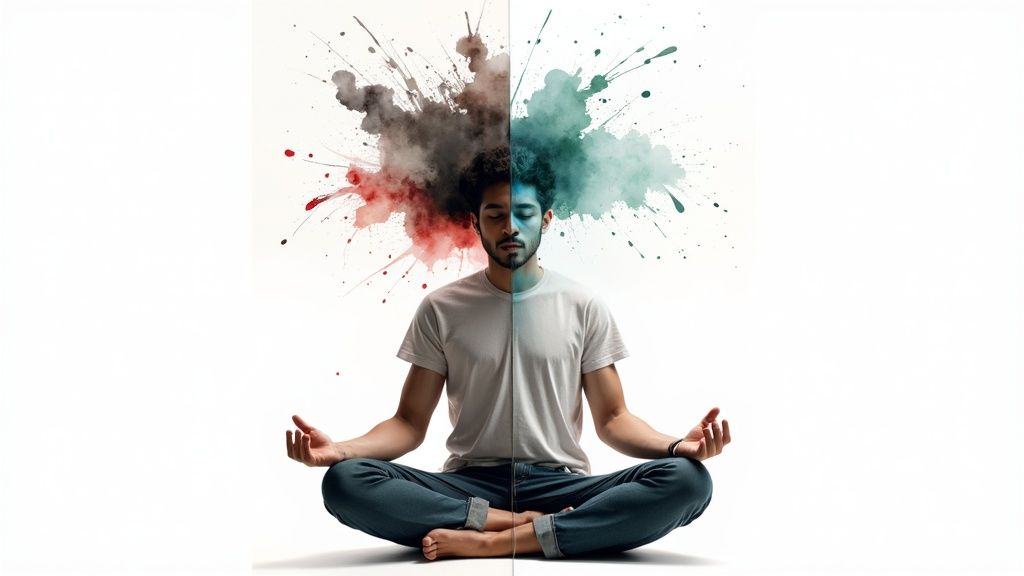
Ever feel like your mind’s fire alarm is stuck in the “on” position?
A normal alarm blares a warning during a real fire. But this one? It goes off at the slightest hint of smoke—and sometimes, for no reason at all. That’s what it’s like to live with chronic anxiety. It isn't a personality flaw or a sign of weakness. It's a treatable condition where the brain’s natural threat-detection system has become overactive and persistent.
The key word here is persistent. Unlike the fleeting worry you might feel before a big presentation, chronic anxiety is a constant companion. It's an umbrella term for conditions like Generalized Anxiety Disorder (GAD) or Panic Disorder, all defined by excessive, uncontrollable worry that gets in the way of your ability to work, socialize, or just relax.
This flowchart helps visualize the difference between the everyday worry everyone experiences and the disruptive patterns of chronic anxiety.
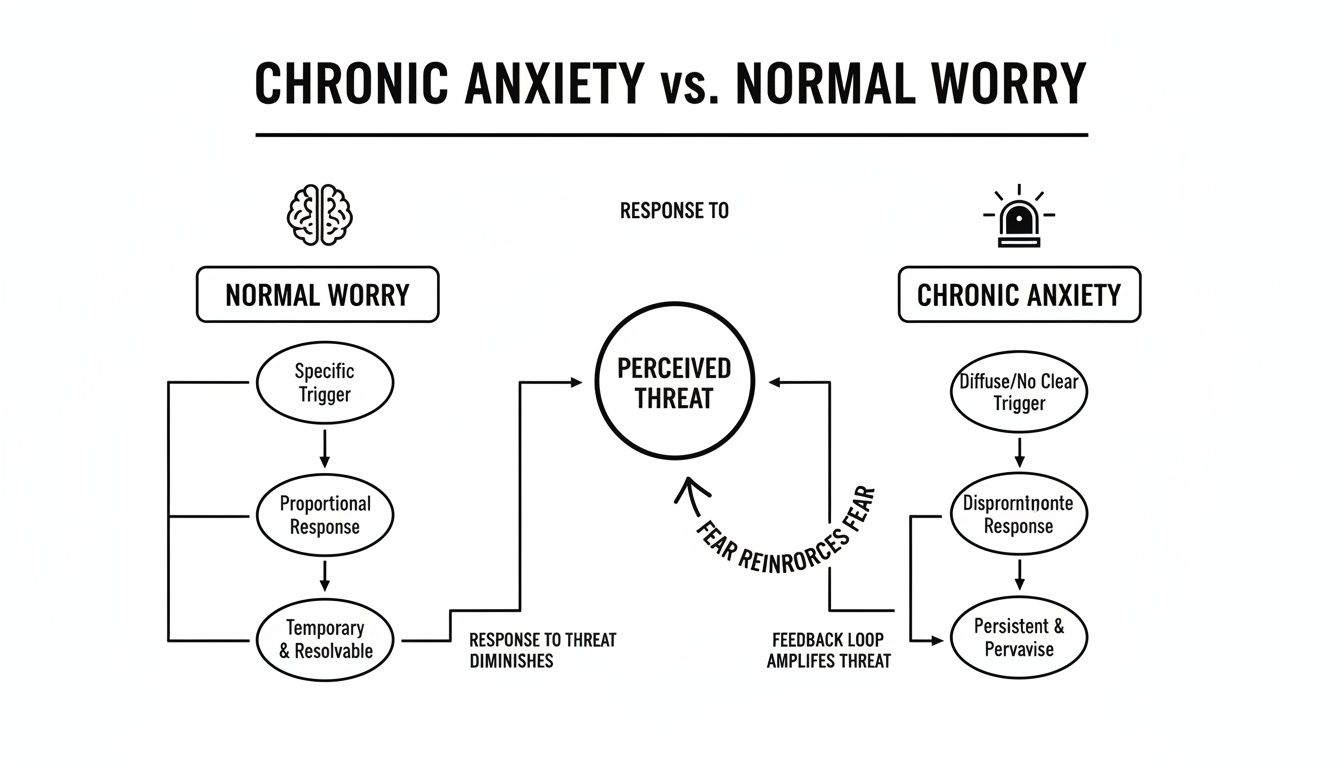
As you can see, the critical distinction is that normal worry is usually tied to a specific problem and fades when the situation is resolved. Chronic anxiety, on the other hand, is often pervasive and long-lasting, latching onto anything and everything without a clear trigger.
Chronic Anxiety vs Normal Worry at a Glance
Sometimes, seeing the differences side-by-side makes it all click. This table breaks down the core characteristics of everyday worry versus a chronic anxiety disorder to help you see where your experiences might fall.
| Characteristic | Normal Worry / Acute Anxiety | Chronic Anxiety Disorder |
|---|---|---|
| Duration | Temporary, lasting for a limited time | Persistent, lasting for months or years |
| Trigger | Specific, identifiable cause (e.g., job interview) | Often lacks a clear trigger; attaches to anything |
| Intensity | Proportional to the situation | Excessive and overwhelming, even for minor issues |
| Impact on Life | Minimal disruption to daily activities | Significantly interferes with work, social life, and sleep |
| Controllability | Generally manageable; you can "turn it off" | Feels uncontrollable and all-consuming |
| Physical Symptoms | Mild and temporary (e.g., butterflies in stomach) | Frequent and draining (e.g., muscle tension, fatigue) |
Remember, this is just a guide. Everyone's experience is unique, but if the right-hand column feels a little too familiar, it might be a sign that what you're dealing with is more than just stress.
A Condition Rooted in Biology, Not Character
It's so important to understand that this state of constant high alert is a real medical issue, not something you can just "get over" with positive thinking. The number of people living with anxiety disorders has been climbing steadily, growing from an estimated 311 million in 1990 to 458 million by 2019.
The feelings are real, the physical symptoms are draining, and the impact on your life is significant. These conditions often develop from a complex mix of genetics, brain chemistry, and life experiences. Recognizing this is the first step toward self-compassion and finding support that actually works.
The most important message is one of hope: You are not broken. Your brain's alarm system can be recalibrated. Regaining a sense of calm and control isn't just a distant dream—it is an achievable reality with the right tools and support.
This journey starts with understanding the specific ways anxiety shows up. Learning about the different types of anxiety disorders can bring clarity, helping you identify the patterns affecting your life. With this knowledge, you can begin the path toward healing and living a life that isn't dictated by fear.
Recognizing the Symptoms of Chronic Anxiety
Living with chronic anxiety can feel like trying to hear a quiet song while a fire alarm is blaring right next to your ear. It’s not just in your head; it’s a full-body experience that weaves a tangled web of physical, emotional, and mental symptoms. It can be confusing and incredibly isolating.
But learning to spot these signs is the first, most crucial step toward confirming what you’re going through and finding your way back to a calmer, more grounded life.

For many people, the physical toll is the first thing they notice. When your body is stuck in a state of high alert, it starts showing signs of exhaustion from a threat that never actually arrives. These aren’t imaginary symptoms—they are real physiological responses.
Recognizing that these symptoms are part of a bigger picture can be incredibly validating. It helps you shift the story from, "What's wrong with me?" to "How can I start addressing this condition?" That simple change in perspective is a huge move toward healing.
The Physical Footprint of Constant Alertness
When your nervous system is always on edge, it kicks off a chain reaction of very real physical effects. These are often the most noticeable symptoms and can even make you think you have a serious medical illness, which only adds more fuel to the worry cycle.
Common physical signs include:
- Persistent Muscle Tension: Are your shoulders always sore? Do you clench your jaw or get frequent tension headaches? This is a classic sign. Your body is basically bracing for a danger that isn't there.
- Chronic Fatigue: Being on high alert 24/7 is exhausting. You might get a full night's sleep but wake up feeling completely drained because your mind and body never truly get to power down.
- Digestive Issues: The gut-brain connection is powerful. Chronic anxiety often shows up as nausea, diarrhea, or symptoms that feel a lot like irritable bowel syndrome (IBS).
- Sleep Disturbances: You might lie awake for hours with a racing mind, or wake up multiple times during the night. Either way, you're left feeling groggy and unrested.
These symptoms are your body's way of telling you its internal alarm system needs a reset. They're not a sign of weakness, but a clear signal that your system is overloaded. Healing starts the moment you learn to listen to these signals without judgment.
Emotional and Cognitive Symptoms: The Inner Turmoil
Beyond the physical side, chronic anxiety is an internal battle. The emotional and mental symptoms are just as draining, coloring how you see the world and everyone in it.
Emotionally, you might live with a constant sense of dread or a feeling that something terrible is about to happen, even when life is going fine. Irritability is also common—when you’re always on edge, your patience wears thin, which can strain your relationships. Another hallmark is restlessness, that antsy feeling that you just can't sit still or relax.
Cognitively, chronic anxiety completely hijacks your thought patterns.
Catastrophic thinking becomes your default setting. Your mind automatically leaps to the worst-possible-case scenario in any situation. A minor headache becomes a brain tumor; a partner’s late text means the relationship is over.
This constant mental noise makes it incredibly difficult to concentrate. You might find your mind going blank during a meeting or in the middle of a conversation. To cope, you may start avoiding places, people, or situations that trigger your anxiety. This shrinks your world and, unfortunately, only makes the fear stronger.
If this all sounds painfully familiar, it might be helpful to see how your symptoms line up with established screening tools. Taking a free resource like the GAD-7 anxiety test can give you a clearer picture. It offers a structured way to understand what you're experiencing and can be a great starting point for a conversation with a doctor or therapist.
Recognizing these patterns is the first, most hopeful step toward finally turning off the alarm and finding the peace you deserve.
Unpacking the Causes of Chronic Anxiety
If you’re living with chronic anxiety, one of the most important things to know is that this is not your fault. It’s not a character flaw or some kind of personal failure. Far from it. Chronic anxiety is a complex health issue, rooted in a mix of factors that have nothing to do with weakness.
Think of it this way: no single gene or event is to blame. Instead, it’s the interplay between your unique biology and your life experiences that sets the stage. Understanding this helps move the conversation away from self-blame and toward something far more productive: self-compassion.

You aren’t broken. Your system is simply reacting to a powerful combination of internal and external influences. Seeing anxiety as a response—not a defect—is the first real step toward healing. It allows you to address each piece of the puzzle with kindness and the right strategies, paving the way for lasting change.
Your Biological Blueprint
Your body's internal wiring plays a huge part in how you experience anxiety. This is the foundational blueprint you were born with, and it has a major say in how your nervous system responds to stress.
Two main biological factors come into play:
- Genetic Predisposition: Anxiety disorders often run in families. You don't inherit the disorder itself, but you might inherit a more sensitive "alarm system." This can make you more vulnerable to developing anxiety when other factors are introduced.
- Brain Chemistry: Your brain relies on chemical messengers called neurotransmitters to regulate your mood. When key chemicals like serotonin and dopamine are out of balance, it can be much harder for your brain to pump the brakes on worry and fear.
The Impact of Life Experience and Environment
Of course, your biology is only half the story. Your personal history and the world you move through are just as critical in shaping how those innate tendencies show up. Past events can essentially teach your nervous system that the world is a dangerous place, keeping it on high alert long after a threat is gone.
A critical factor is trauma or significant life stressors. Chronic stress, loss, or difficult childhood experiences can recalibrate your brain's fear response, leaving it stuck in overdrive. This is a normal biological response to abnormal events, not a sign of weakness.
In fact, research shows that emotional abuse—reported by 36% of adults globally—is a powerful trigger strongly linked to lifelong anxiety. It’s a stark reminder of how deeply our experiences can shape our mental health. If you're curious about how these pieces might connect to your own life, you can explore the common anxiety causes in more detail.
This is where your power lies. While you can't change your genes or erase the past, you absolutely can learn new ways to manage your brain's response. By developing coping skills and working through past experiences, you can effectively rewire those neural pathways and teach your internal alarm system that it’s safe to stand down.
This is the heart of healing. Your past doesn't have to dictate your future, and a life with less panic is truly within reach.
How a Professional Diagnosis Provides Clarity
Taking that first step to get a diagnosis can feel like a huge, intimidating leap. But honestly? It’s one of the most powerful and hopeful things you can do to get back in the driver's seat of your own life.
A formal diagnosis isn’t a label that’s meant to stick to you forever. Think of it more like a map. It takes that vague, terrifying feeling of "what's wrong with me?" and turns it into a specific, treatable condition with a clear path forward. It replaces the unknown with actual answers, and that alone can be incredibly calming.
Translating Symptoms into a Clear Diagnosis
When you finally sit down with a professional, they aren't just guessing. They use well-established criteria, like those in the Diagnostic and Statistical Manual of Mental Disorders (DSM-5), to make sense of what you're experiencing. This isn't just about ticking boxes; it's a real conversation where your story is heard and understood within a trusted medical framework.
For something like Generalized Anxiety Disorder (GAD), one of the most common forms of chronic anxiety, a professional looks for excessive worry happening more days than not for at least six months. That timeframe is key—it helps separate a rough patch of stress from a persistent, underlying condition that needs a different kind of support.
This step is crucial because it unlocks access to proven, evidence-based treatments designed specifically for what you're going through.
Distinguishing Between Types of Chronic Anxiety
Chronic anxiety isn't a one-size-fits-all problem, and a professional diagnosis helps pinpoint exactly what you’re up against. It's kind of like a doctor figuring out if you have a bacterial or viral infection—getting the diagnosis right is the only way to get the right medicine.
A trained clinician can help you understand the nuances. Maybe your anxiety isn't just a shapeless fog but has a more specific name and pattern. This clarity is what moves you from fighting a monster in the dark to facing a known opponent with a solid game plan.
To help you see the differences, here’s a quick breakdown of the most common types of chronic anxiety disorders:
Common Types of Chronic Anxiety Disorders
| Disorder Type | Core Feature | Primary Focus of Worry |
|---|---|---|
| Generalized Anxiety Disorder (GAD) | Persistent, excessive, and uncontrollable worry | A wide range of everyday topics like health, finances, work, or family |
| Panic Disorder | Recurrent, unexpected panic attacks | The intense fear of having another panic attack and its consequences |
| Social Anxiety Disorder | Intense fear of social situations | Being negatively judged, scrutinized, or embarrassed in front of others |
| Obsessive-Compulsive Disorder (OCD) | Unwanted, intrusive thoughts (obsessions) and repetitive behaviors (compulsions) | Specific fears or themes, leading to rigid rituals to reduce distress |
| Post-Traumatic Stress Disorder (PTSD) | Re-experiencing a traumatic event | Intrusive memories, nightmares, and severe emotional distress related to the trauma |
Understanding these distinctions is incredibly empowering. It validates that your experience is real and shared by many others. For instance, the lifetime prevalence of GAD alone is estimated to be between 4% and 7%, showing just how many people are on a similar journey. You can explore the full research on GAD's prevalence to learn more.
Seeking a diagnosis is a profound act of self-care. It’s the moment you stop struggling in the dark and finally turn on the lights. If you're thinking about taking this step, learning more about how to find the right psychiatrist for anxiety is a great way to prepare for that hopeful conversation.
Your Path Forward with Proven Treatments
Getting a diagnosis like "chronic anxiety disorder" can feel like a one-two punch. First comes the relief of finally having a name for what you’ve been going through. But that’s often followed by a wave of fear about what it all means.
So, let me be very clear about the most important thing you need to hear right now: treatment works. You are not broken, and you are not destined to live a life dictated by fear. Millions of people have walked this path before you, and there is a clear, well-established road to getting your life back.
Recovery isn't about erasing anxiety or becoming someone you're not. It’s about recalibrating your internal alarm system so you can feel like yourself again. The goal is to get to a place where anxiety is just a passing visitor, not a permanent resident in your mind. With the right tools and support, that’s not just a possibility—it’s the expected outcome.
Cognitive Behavioral Therapy: The Skill of Changing Your Mind
One of the most powerful, evidence-based treatments for chronic anxiety is Cognitive Behavioral Therapy (CBT). Forget the old-school image of "talk therapy"—CBT is more like a practical training program for your brain.
It’s built on a simple but profound idea: your thoughts, feelings, and actions are all connected. Change one, and you can change the others.
Think of your anxious thoughts as well-worn shortcuts your brain automatically takes out of habit. CBT teaches you how to pause, spot these automatic negative thought patterns, and intentionally carve out new, more helpful neural pathways. It's a hands-on approach where you learn tangible skills to:
- Pinpoint Your Triggers: You’ll get good at recognizing the specific thoughts or situations that set off your internal alarm.
- Challenge Worst-Case Scenarios: A huge part of CBT is learning to question your catastrophic thoughts. Is that fear based on actual evidence, or is it just a story your anxiety is telling you?
- Change Your Behavior: You'll start to gradually and safely face situations you've been avoiding. This is how you prove to your brain, through experience, that you can handle them, which slowly dismantles the power fear has over you.
CBT isn't about slapping on a filter of "positive thinking." It’s about building genuine mental resilience and learning a set of practical skills that can stick with you for a lifetime. If you want to dive deeper, our guide on understanding CBT for anxiety breaks down exactly how this powerful therapy works.
Medication: A Supportive Tool on Your Journey
While therapy gives you the long-term skills to manage anxiety, medication can be an incredibly useful tool to stabilize your system enough so you can actually do that work.
Think of it like putting up scaffolding around a building under construction. The scaffolding doesn't build the structure for you, but it provides the support and safety needed for the real work to get done.
Medications are prescribed and managed by a doctor or psychiatrist, who will partner with you to find what works best for your unique biology.
The most common and effective medications for chronic anxiety are Selective Serotoni Reuptake Inhibitors (SSRIs). These work by adjusting the levels of serotonin—a key neurotransmitter that helps regulate mood and anxiety—allowing your brain's communication systems to run more smoothly.
Other options, like certain antiseizure drugs or, for short-term relief, benzodiazepines, might also be part of the conversation. It's crucial to see medication not as a "magic bullet" or a sign of weakness, but as a legitimate medical treatment that can quiet the internal noise enough for you to fully engage in therapy and build lasting coping strategies. The choice to use medication is always a personal one, made with a healthcare provider you trust.
The Power of an Integrated Approach
The most effective treatment plans rarely rely on just one thing. They weave different approaches together. Therapy gives you the "how," medication can provide the "breathing room," and lifestyle changes support your overall well-being from the ground up. This integrated toolkit is what helps you build a truly robust and sustainable recovery.
For some, digging deeper into the roots of their anxiety is a game-changer. Exploring methods for bio-emotional healing for trauma, beliefs, and anxiety liberation can be a critical step in their journey toward profound and lasting change.
Ultimately, your path forward is about finding the unique combination of support that resonates with you. Remember, healing isn't a race. Every step you take, no matter how small it feels, is a victory.
Building Your Daily Anxiety Management Toolkit
While therapy and medication are often the cornerstones of healing from a chronic anxiety disorder, the small, intentional things you do every day are what truly build the foundation for a lasting recovery. Think of it as creating a personal toolkit—a collection of strategies you can pull from to manage symptoms in the moment and build resilience over the long haul.
This isn't about finding some magic cure. It's about learning to skillfully work with your own nervous system. It’s about creating pockets of calm and regaining a sense of control, even when the internal alarm bells are screaming. These are real, practical tools that put you back in the driver's seat.
Grounding Techniques to Anchor Your Mind
When panic or a wave of anxiety hits, it can feel like you’re being swept away by a powerful current. Grounding techniques are like dropping an anchor—they pull your focus out of the storm of anxious thoughts and back into the safety of the present moment.
One of the most effective and easy-to-remember methods is the 5-4-3-2-1 technique. It essentially forces your brain to concentrate on the here and now, interrupting that relentless anxiety spiral.
- 5: Name five things you can see around you. (Your desk lamp, a crack in the ceiling, a blue pen.)
- 4: Acknowledge four things you can physically feel. (The texture of your jeans, the cool surface of your desk, your feet flat on the floor.)
- 3: Listen for three things you can hear. (The hum of your computer, distant traffic, your own breathing.)
- 2: Identify two things you can smell. (The scent of coffee, a nearby plant, or even just the air in the room.)
- 1: Name one thing you can taste. (The lingering flavor of your last meal, a sip of water, or the taste of your own mouth.)
This simple exercise shifts your focus from the chaos inside to the reality outside, and that shift can provide immediate relief.
The Power of Mindful Breathing
Believe it or not, your breath is one of the most powerful tools you have for regulating your nervous system. When you're anxious, your breathing naturally becomes shallow and rapid, which signals danger to your brain. Intentionally slowing it down sends the opposite message: you are safe.
Box Breathing is a simple yet potent technique used by everyone from Navy SEALs to therapists. Just visualize a box and breathe along its four sides: Inhale for four seconds, hold for four, exhale for four, and hold again for four. Repeating this cycle just a few times can lower your heart rate and quiet a racing mind.
To add even more to your daily management toolkit, you might want to explore these powerful mindfulness exercises for stress relief.
Lifestyle Adjustments that Build a Stronger Foundation
Your daily habits have a huge impact on your mental well-being. Think of them as the support beams that make your mind more resilient to stress. Focusing on just a few key areas can make a significant difference in managing the symptoms of a chronic anxiety disorder.
- Prioritize Sleep: Anxiety and poor sleep love to feed off each other, creating a vicious cycle. Try to stick to a consistent sleep schedule and create a relaxing bedtime routine to signal to your body that it's time to wind down.
- Nourish Your Body: Stable blood sugar is crucial for a stable mood. Focusing on whole foods and balanced meals helps you avoid the energy spikes and crashes that can make anxiety symptoms feel so much worse.
- Embrace Movement: You don't need to run a marathon. A simple 20-minute walk can reduce anxiety by releasing feel-good endorphins and helping your body process excess adrenaline. The goal is consistent, gentle movement.
These strategies aren't isolated fixes; they work together to create a powerful system of self-support. Each time you use one, you're not just coping—you're actively retraining your brain and proving to yourself that you have the power to find your own peace.
Frequently Asked Questions About Chronic Anxiety
Even after learning a lot about chronic anxiety, some questions still tend to surface. That's completely normal. Getting clear, direct answers is a huge part of feeling confident and hopeful as you move forward. This section is here to tackle those lingering questions and make sure your understanding is solid.

Think of this as the final piece of the puzzle—not about memorizing facts, but about truly internalizing the truth that you can get better.
Can Chronic Anxiety Ever Be Completely Cured?
While the word "cure" might sound like you can erase anxiety completely, the real goal is recovery and management. And yes, you absolutely can get to a place where anxiety no longer runs your life.
Through good therapy and the right coping strategies, you learn how to recalibrate your internal "alarm system" so it stops misfiring. Many people reach a point where their symptoms are minimal and they live full, vibrant lives, completely free of panic.
The aim isn't a life with zero anxiety—that wouldn't be human. It's about getting back to a life where anxiety is a manageable, appropriate emotion, not a constant, overwhelming state. Healing is all about reclaiming your freedom.
How Do I Know If This Is Chronic Anxiety or Just My Personality?
The single biggest difference is impairment. Being a natural "worrier" might be a personality trait, but a chronic anxiety disorder is a medical condition that actively gets in the way of your life.
If the anxiety is persistent, feels out of your control, and significantly messes with your relationships, your job, or just getting through the day, that's a sign it's crossed the line into a disorder. It’s the difference between having a trait and having that trait hijack your well-being.
What Is the Very First Step I Should Take?
The best first step you can take is to schedule an appointment with a trusted healthcare professional. This could be your primary care doctor or a mental health specialist like a psychologist or psychiatrist.
They can give you a proper evaluation, rule out any other medical issues that could be causing your symptoms, and point you toward the right diagnosis and treatment plan. Just being open and honest is the key that unlocks the help you deserve.
Here at The Anxiety Checklist, we're all about providing practical, action-oriented tools to support you on this journey. Our Fearless Living system is a powerful combination of an in-depth eBook and a 93-point interactive checklist designed to help you understand your anxiety, challenge those sticky negative thoughts, and build a personalized toolkit for lasting relief. It's time to regain control and start building a more fearless life today.
Learn more and get your checklist at https://anxietychecklist.com.