
Ever felt your heart suddenly start pounding like a drum, your palms get sweaty, and your thoughts race a million miles a minute before a big presentation or a difficult conversation?
That's your fight-or-flight response kicking in. It's your body's ancient, hardwired alarm system, and its only job is survival. It's not a flaw or a sign that you're broken; it's a powerful protective mechanism designed to instantly prep you for action when you sense a threat. Understanding this system is the first step toward healing, and a life free from constant panic is absolutely possible.
Understanding Your Body's Ancient Alarm System

Think of it this way: your sympathetic nervous system is the commander of a highly efficient internal army. The second your brain perceives danger—whether it’s a real physical threat like a speeding car or a psychological one like a looming deadline—it hits the panic button.
This floods your system with hormones like adrenaline and cortisol, which are responsible for all those intense physical sensations. The goal is simple: make you stronger, faster, and more focused so you can either fight the danger or run away from it.
While these feelings can be completely overwhelming, understanding them is the first step toward reclaiming your peace. This isn't about battling your own biology. It's about learning to work with it to heal.
Shifting From Fear to Understanding
The fight-or-flight response isn't some new-age concept; it was first described way back in 1914 by American physiologist Walter Bradford Cannon. His work showed how this response rapidly ramps up heart rate and sends blood rushing to your muscles—all to give you the physical boost needed to survive.
When you shift your perspective from fearing these sensations to understanding them, everything changes. Those physical feelings aren't a sign that something is terribly wrong. They are simply your body’s ancient alarm system doing its job perfectly.
This knowledge is a game-changer. It helps you start to tell the difference between a genuine emergency and the common anxiety causes that trick your system into sounding a false alarm.
The most important thing to remember is this: a panic-free life is possible. Your body is not your enemy. By understanding its signals, you can learn to recalibrate this system, turning down the sensitivity and teaching it that you are safe.
To make this crystal clear, let's break down exactly what you're feeling during a fight-or-flight response and the incredibly clever survival reason behind each sensation.
Your Body's Fight or Flight Response Explained
| What You Feel (The Symptom) | Why It Happens (The Survival Purpose) |
|---|---|
| Pounding Heart | Your heart pumps faster to send more oxygen and blood to your major muscles, preparing you to fight or run. |
| Rapid, Shallow Breathing | Taking in more oxygen quickly boosts your energy supply for immediate action. |
| Sweaty Palms & Skin | Sweating helps cool your body down in anticipation of physical exertion and makes your skin more slippery, which could help you escape a predator's grasp. |
| "Butterflies" in Stomach or Nausea | Blood is diverted away from your digestive system and sent to your muscles and limbs where it's needed most for action. |
| Shaking or Trembling Muscles | Your muscles are tensing up and priming themselves with energy, getting ready for a burst of speed or strength. |
| Tunnel Vision | Your pupils dilate to let in more light, and your focus narrows onto the immediate threat, filtering out distractions. |
| Dry Mouth | Saliva production is paused because digestion isn't a priority when you're facing danger. |
| Racing Thoughts | Your brain is working overtime, rapidly assessing the threat and planning your escape route. |
Seeing the direct link between a physical symptom and its survival purpose can make the whole experience feel a lot less random and scary. It's not a system malfunction; it's a masterpiece of evolutionary design you can learn to manage.
Why Your Alarm System Gets Stuck On
If fight-or-flight is a perfectly normal survival tool, why does it feel so overwhelming and exhausting? The answer lies in the profound mismatch between our ancient biology and our modern world.
Your internal alarm system was designed for short, intense bursts of danger—like escaping a predator—followed by long periods of rest and recovery.
Today, the "predators" look very different. They’re the constant ping of notifications, the pressure of a looming deadline, the stress of sitting in traffic, or even the subtle tension of scrolling through social media.
Your brain, however, often can’t tell the difference. To your nervous system, these modern pressures can feel just as urgent as a genuine, life-threatening emergency. This constant, low-grade stress effectively keeps your alarm system stuck in the "on" position, day in and day out. It's like the sensitivity dial on your internal smoke detector has been cranked all the way up.
When Burnt Toast Feels Like a House Fire
Imagine your smoke alarm is supposed to go off for a real fire. But when it’s overly sensitive, it starts blaring for something as harmless as a piece of burnt toast. This is exactly what happens when you’re living with chronic anxiety.
Your nervous system becomes so primed for danger that it overreacts to minor stressors. A critical email from your boss or an unexpected bill can trigger the same intense physiological cascade as a true crisis. This isn't a sign of weakness or a personal failing; it's your protective system working overtime in a world it was never built for.
The most powerful realization you can have is that this state is not permanent. Your alarm system can be recalibrated. You can learn to turn down the sensitivity and teach your body the difference between a real threat and a perceived one.
This constant activation is what leads to feelings of burnout, exhaustion, and the sense that you’re always on edge. It’s draining to live as if you're constantly bracing for impact. Getting clear on the wide array of common anxiety triggers is a critical step in figuring out what's setting off your own internal alarm.
The good news is that you have the ability to soothe this overactive system. Living a life free from constant panic isn't just a hopeful idea—it is an achievable goal. By learning to send your body signals of safety, you can begin to rewire these old patterns and build a more resilient, peaceful state of being. Healing is possible.
Decoding Your Body's Warning Signals
When that internal alarm bell starts ringing, the feelings can be intense. Downright terrifying, even. A heart that suddenly feels like it’s going to pound out of your chest, a dizzy spell that hits out of nowhere, or a wave of dread that washes over you can make you feel like you’re in serious, immediate danger.
While it feels incredibly scary, this experience is a universal part of being human.
The single most powerful thing you can do is learn to see these feelings for what they are: signals. They aren’t a sign that you’re broken or losing your mind. They're just the physical and mental receipts of your body’s fight-or-flight response doing exactly what it was designed to do—get you ready for a threat.
Physical Warning Signs
The physical symptoms are usually the first thing you notice—and often the most alarming. They’re the direct result of adrenaline flooding your system to gear you up for action.
- Pounding Heart and Chest Tightness: Your heart ramps up to pump oxygen-rich blood to your major muscles, getting them ready to move.
- Shallow, Rapid Breathing: Your body is trying to take in more oxygen, fast, to fuel a potential escape.
- Sweating or Chills: This is your body's built-in air conditioning system, prepping you for intense physical effort.
- Trembling or Shaking: Your muscles are literally tensing up, primed and ready for immediate action.
- Nausea or "Stomach Butterflies": Blood is being diverted away from non-essential systems like digestion and sent to your arms and legs.
- Dizziness or Lightheadedness: Those shifts in breathing and blood flow can leave you feeling disoriented.
Just understanding that these are simply physiological shifts—uncomfortable, but not dangerous—can strip them of their power. Sometimes, though, these feelings can snowball into what feels like a full-blown medical emergency. Learning the specific signs of a panic attack can help you tell the difference and regain a sense of control.
Emotional and Mental Signals
Beyond the physical, the fight-or-flight response also hijacks your thoughts and emotions, narrowing your focus down to one thing: survival.
The key to healing is breaking the cycle of fear. When you become afraid of the symptoms themselves, you create a feedback loop that keeps the alarm ringing. By decoding these signals, you reclaim your power.
This ancient response can go haywire when it's triggered by modern psychological stress. For instance, your heart rate might double to pump blood to your muscles—a perfect response for escaping a predator, but not so helpful for dealing with a stressful email. Globally, it's estimated that this kind of over-activation contributes to anxiety disorders affecting 4-10% of the population at any given time.
You might also experience:
- An intense feeling of dread or impending doom.
- Difficulty concentrating, often described as "brain fog."
- A bizarre feeling of being detached from reality or yourself.
- A sudden surge of irritability or anger.
Recognizing these signals is the first step toward getting your life back. It’s proof that you aren't going crazy—you are simply human. And there is profound hope in knowing that this system can be calmed.
How to Calm Your Nervous System in Minutes
When you feel that familiar wave of panic starting to build, it can seem like an unstoppable tidal wave. But you have far more influence over your own body than you might think. The key is to consciously send your brain and nervous system one powerful, undeniable message: You are safe.
This isn't about ignoring the fear or just "powering through." It's about using simple, practical tools that work with your biology, not against it. When you do this, you prove to yourself that you are not helpless against these sensations. And that’s the first step toward building real, lasting confidence.
These techniques are effective because they break the panic feedback loop. When you intentionally slow your breathing or anchor yourself in your senses, you’re telling that ancient, primal alarm system, "False alarm. There is no predator here. We can stand down."
Quick Grounding Techniques That Work Anywhere
The best part about these tools? They’re simple and you can use them anywhere. You don’t need a quiet room or any special equipment. You can do them discreetly in a meeting, in a crowded store, or in the middle of the night to stop panic in its tracks.
Here are a few quick grounding techniques that can help you find your footing when you feel overwhelmed.
| Technique | How It Works | Best For |
|---|---|---|
| Box Breathing | Directly regulates heart rate by creating a predictable, slow breathing rhythm. Inhale for 4, hold for 4, exhale for 4, hold for 4. | Quickly calming the physical storm of a racing heart and shortness of breath. |
| Progressive Muscle Relaxation (PMR) | Systematically tensing and then releasing muscle groups, which sends a powerful relaxation signal to the brain. | Releasing the intense muscle tension that comes with panic and high anxiety. |
| 5-4-3-2-1 Senses | Pulls your attention out of racing thoughts and into the present moment by engaging all five senses. | Interrupting mental spirals and obsessive worry when your thoughts are out of control. |
Each of these techniques sends a different "safety" signal to your nervous system. If you want to dive deeper into breathwork, you can find more targeted breathing exercises for anxiety to add to your toolkit.
The fight or flight response is a full-body experience, impacting everything from your heart rate to your thought patterns.
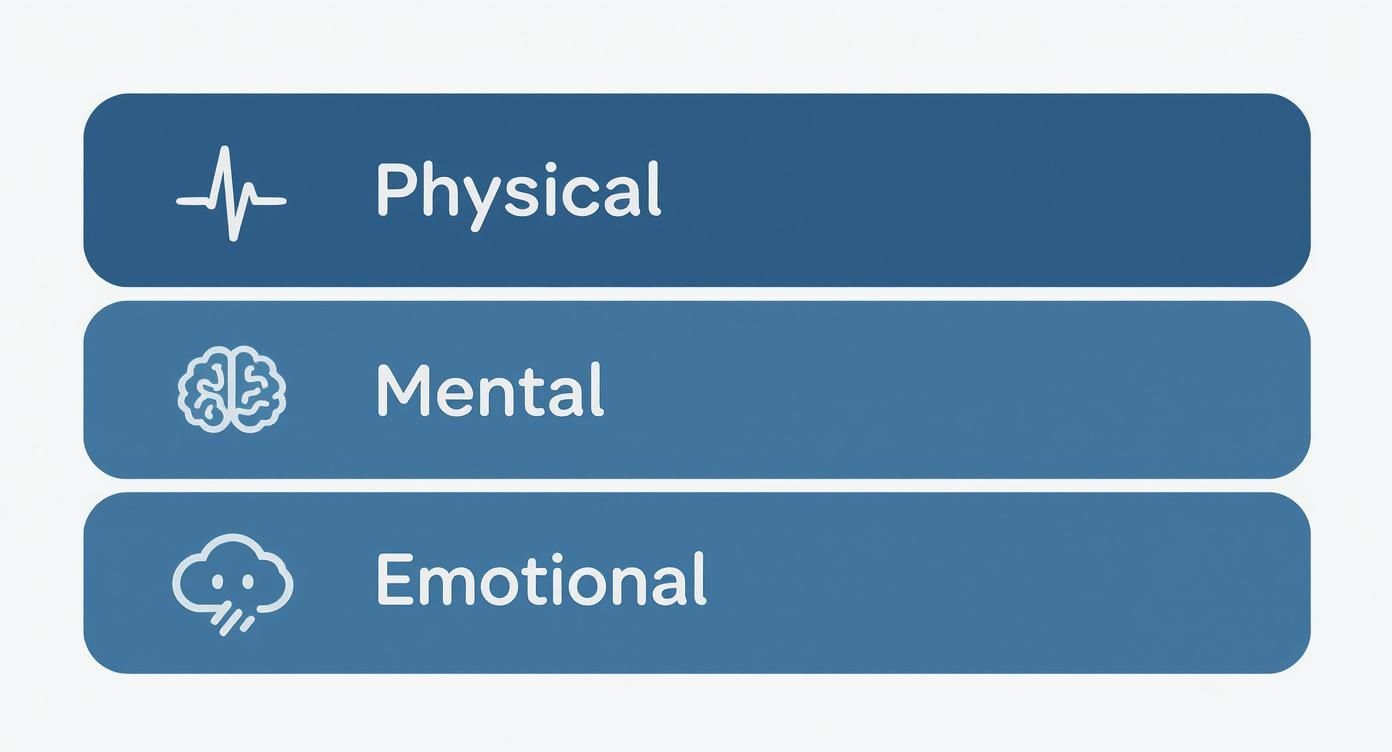
Understanding this helps you see why these physical and sensory grounding techniques are so effective at calming the mind.
The 5-4-3-2-1 Grounding Method
When your thoughts are spiraling out of control, the 5-4-3-2-1 method is a fantastic way to pull yourself out of your head and back into the physical world. It works by forcing your brain to focus on the immediate, tangible environment through your five senses.
Wherever you are, just pause and calmly name:
- Five things you can see (a crack in the wall, the color of your shirt, a pen on the desk).
- Four things you can feel (the texture of your chair, your feet on the floor, the fabric of your pants).
- Three things you can hear (the hum of a computer, distant traffic, your own breathing).
- Two things you can smell (coffee, hand soap, the air in the room).
- One thing you can taste (the lingering taste of your last drink or meal).
This simple exercise makes it almost impossible for your brain to continue its panicked, future-focused spiral. It’s an incredibly effective circuit-breaker. For more strategies to quiet a racing mind, especially at night, resources like this guide to bedtime stories for adults with anxiety and stress can be a huge help.
The goal is to empower you with the undeniable proof that you can influence how you feel. Each time you use one of these tools, you're casting a vote for a calmer future and actively rewiring your brain to feel safer and more secure.
Your Path to Lasting Calm and Resilience

While grounding techniques are your lifeline in the heat of the moment, the real journey to a calmer life is about building a more resilient nervous system for the long haul. This isn’t just wishful thinking; it’s rooted in the science of neuroplasticity—your brain's incredible ability to physically change and rewire itself based on what you do and think.
This means you are not stuck with an overactive alarm system forever.
With consistent practice, you can carve out new, calmer neural pathways, essentially teaching your brain not to freak out over everyday stressors. It’s like recalibrating your internal threat detector, turning down its sensitivity so it no longer mistakes a traffic jam for a tiger.
This is where the real work begins—and where you’ll find the most profound hope. You have the power to actively reshape your brain's responses and build lasting calm from the inside out.
Retraining Your Brain For Safety
The secret to long-term healing is to consistently send your nervous system signals of safety. Little by little, this convinces your ancient survival brain that you aren't in constant danger, allowing that fight-or-flight switch to finally turn off.
Sustainable strategies for this kind of retraining include:
- Mindfulness Practices: Regular mindfulness meditation helps you observe your thoughts without getting tangled up in them. This creates a critical pause between a trigger and your reaction, weakening the automatic panic response over time.
- Consistent Movement: Gentle, regular exercise like walking, yoga, or swimming is a fantastic way to burn off excess stress hormones like cortisol and adrenaline. It also releases endorphins, your body’s natural mood-lifters, creating a sense of well-being.
- Optimizing Sleep: Deep, restorative sleep is when your brain and body do their most important repair work. A solid sleep routine helps regulate the very hormones that control your stress response, making you far less vulnerable to anxiety triggers.
This journey is about more than just managing symptoms; it's about fundamentally changing your relationship with anxiety. It’s the process of proving to your body, one day at a time, that it is safe, secure, and capable of profound healing.
The fight-or-flight response is an ancient piece of our hardware, conserved across vertebrates for over 340 million years. Research shows how our earliest experiences can calibrate this system, making it more or less reactive later in life. You can discover more about how our stress systems develop from the Smithsonian Magazine.
Rewriting Old Patterns With Professional Guidance
Sometimes, rewriting these deep-seated patterns requires a more structured game plan. This is where therapy can be an incredibly powerful tool for creating lasting change.
Cognitive Behavioral Therapy (CBT), for instance, is a proven approach that helps you identify, challenge, and reframe the negative thought patterns that keep your fight-or-flight response on a hair trigger. It gives you a practical framework for seeing how your thoughts, feelings, and actions are all connected.
Working with a professional, you can learn to dismantle the mental habits that keep your internal alarm blaring. Exploring different forms of psychotherapy for anxiety can offer a structured path to untangle old fears and build new, more resilient ways of thinking.
Healing isn't about erasing your past—it's about building a new future. That goal is absolutely within your reach, and every small step you take is an investment in a calmer, stronger you.
Got Questions About Fight or Flight?
As you start to unpack your body's ancient alarm system, it's totally normal for a few questions—and maybe some fears—to bubble up. In fact, that's part of the process. Getting straight answers can build your confidence and hammer home the most important message: healing is absolutely possible. A life without constant panic isn't some far-off dream; it's an achievable goal.
Let's clear the air and tackle some of the most common questions head-on.
Can the Fight or Flight Response Actually Hurt Me?
This is probably the first thing on your mind when your heart is pounding out of your chest and the room starts to feel a little wobbly.
The honest answer? No. The response itself, while it feels terrifying, isn't dangerous. Your body is incredibly resilient and built to handle these intense—but temporary—surges of adrenaline and cortisol.
Think of it as a protective mechanism that's just a bit overeager. The real problem isn't the occasional alarm bell; it's when that alarm gets stuck in the "on" position. Chronic, long-term activation is what leads to burnout and exhaustion. The goal here is to teach your body that it's safe, so the alarm can finally stand down.
How Long Does It Take to Calm Down From Fight or Flight?
Once the perceived threat is gone, the initial adrenaline rush typically starts to fade within 20 to 60 minutes. That's about how long it takes for your body to metabolize all those stress hormones and get back to a state of balance.
But here's the catch: if your mind keeps replaying worried thoughts, you can accidentally keep the response going for much, much longer. It's like hitting the snooze button on your anxiety.
This is exactly why grounding techniques are so powerful. When you use tools like box breathing or the 5-4-3-2-1 method, you're sending direct "all clear" signals to your brain. This can seriously shorten the recovery time and help you find your calm a whole lot faster.
Is It Really Possible to Live Without Constant Panic?
Yes. A thousand times, yes. This is the core message of hope that should be your north star on this journey. It is entirely possible to live a life that isn't dictated by the fear of your next panic attack. You are not broken, and your brain is not permanently wired for fear.
Through consistent practice, you can tap into your brain's own ability to change—a process known as neuroplasticity—to forge new, calmer neural pathways. You're essentially retraining your nervous system to be less jumpy.
Healing doesn’t mean you'll never feel stress again. It just means your internal alarm system becomes way less sensitive. You’ll have the tools to manage it when it does go off, and you'll regain a deep, unshakeable sense of control over your own well-being. A life free from the grip of panic is not just a nice idea—it's a realistic, attainable goal.
What Is the Difference Between This Response and a Panic Attack?
This is a fantastic question, and getting this straight can be a game-changer.
Think of the fight or flight response as the underlying engine—the physiological system of hormones and nerve signals ready to go at a moment's notice.
A panic attack is what happens when that engine suddenly revs to its absolute maximum for no apparent, external reason. It’s the fight or flight response firing at full blast, creating an overwhelming and terrifying experience that feels like it comes completely out of the blue.
By understanding the engine (the response), you start to demystify the panic attack itself. This knowledge chips away at your fear of the experience, which is a critical step in finally breaking the cycle of panic.
At The Anxiety Checklist, we believe understanding is the first step to overcoming. Our program gives you a structured, actionable path to help you recalibrate your alarm system and build resilience that lasts. Learn more about how you can start your journey to a calmer life.