
It all boils down to a pretty simple distinction: fear is a reaction to a real, immediate danger, while anxiety is a reaction to a potential or imagined future threat.
Think of it this way: fear is the smoke alarm blaring when your kitchen is actually on fire. Anxiety is that same alarm going off because you’re worried a fire might start sometime next week.
The Critical First Step: Understanding the Difference
Kicking off your healing journey starts with one powerful realization: anxiety isn't a personal failing or a sign of weakness. It's a protective system that has simply gone into overdrive.
Recognizing this distinction is the first and most empowering step you can take toward reclaiming control and finally living a calmer, panic-free life.
This key difference is visualized below, showing how fear is rooted in survival while anxiety is a state of overdrive.
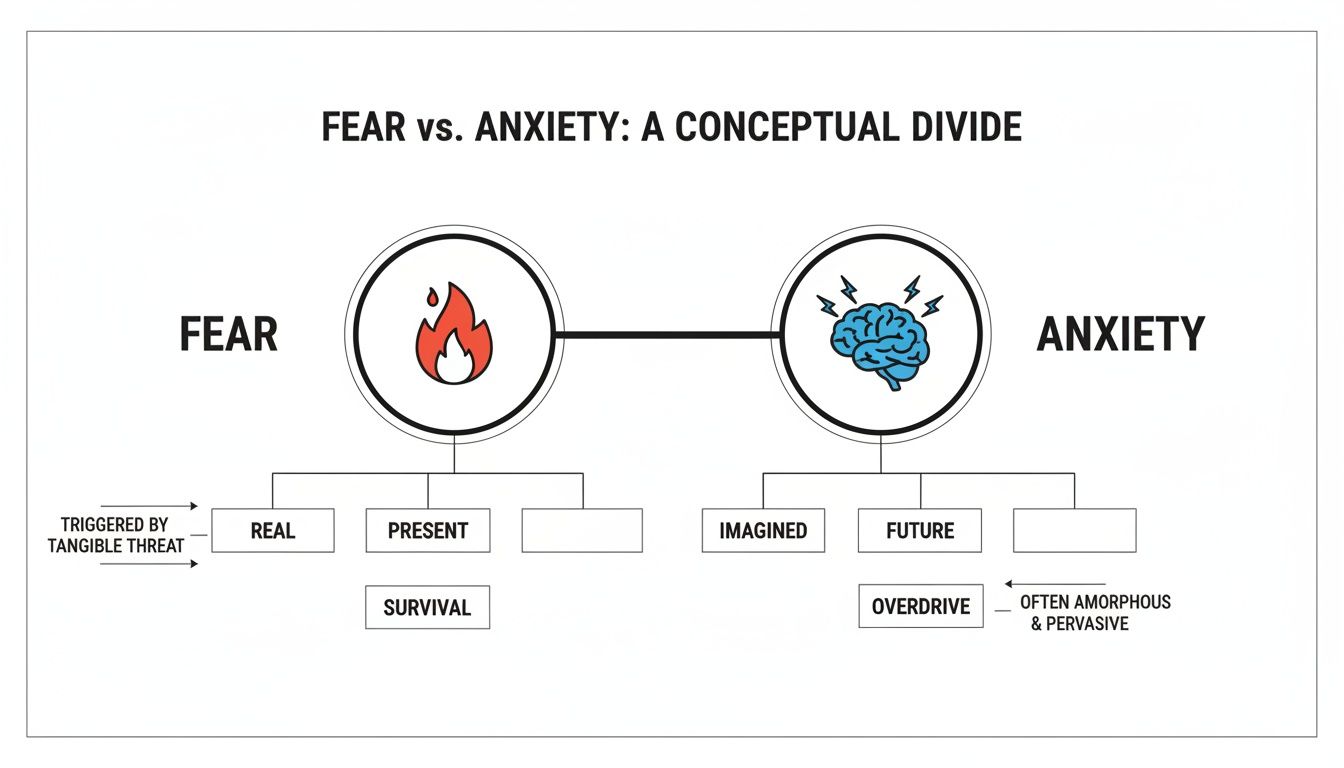
As you can see, fear is a present-focused survival instinct. Anxiety, on the other hand, is future-oriented and often driven by "what-if" scenarios that haven't happened yet.
Let's break down the key differences between these two powerful emotions in a quick-reference table.
Fear vs. Anxiety at a Glance
| Characteristic | Fear | Anxiety |
|---|---|---|
| Trigger | Specific, identifiable, and present threat | Vague, future-oriented, or imagined threat |
| Focus | The "here and now" | The "what-if" |
| Duration | Short-lived; ends when the threat is gone | Can be long-lasting and persistent |
| Physical Response | Intense, immediate fight-or-flight activation | Chronic state of alertness, tension, dread |
| Purpose | Immediate survival and escape from danger | Prepares for potential future challenges |
Understanding these distinctions helps you label what you're feeling more accurately, which is the first step toward managing it and finding a path to healing.
Deconstructing Your Internal Alarm System
Fear is a primal, instinctual emotion. When you're faced with a tangible threat—like a car suddenly swerving into your lane—your brain triggers an immediate, automatic response to keep you safe.
This reaction is sharp, intense, and, most importantly, temporary. Once the danger passes, your body is designed to return to a state of calm.
This biological safeguard is part of our evolutionary wiring. It activates what many call the fight-or-flight response, a cascade of physiological changes designed for immediate survival. To understand more about what happens inside your body during these moments, you can explore our detailed fight or flight response guide.
Anxiety, however, operates differently. It’s that persistent feeling of dread or unease about what could happen. It’s the worry about a presentation next week, the concern over finances, or that nagging feeling that something bad is just around the corner.
Anxiety is essentially your brain’s threat-detection system becoming overly sensitive. It’s a survival mechanism that has stopped distinguishing between a real tiger and a paper one. The good news is that you can learn to recalibrate this system and heal.
Why This Distinction Gives You Power
Grasping the difference between fear and anxiety is liberating. When you can see anxiety not as some mysterious force but as a predictable (and treatable) pattern, you shift from being a victim of your feelings to an active participant in your own healing.
You start to recognize that the racing heart, shortness of breath, and looping thoughts aren't signs that you're in immediate danger, but signals that your internal alarm system just needs a tune-up.
This insight opens the door to hope and practical action. It's the foundation upon which you can build strategies to calm your nervous system, challenge worried thoughts, and finally break free from the cycle of panic. You are not broken; your protective instincts are just working too hard, and you can teach them to rest.
How Fear and Anxiety Show Up in Your Body
Ever wondered why anxiety feels so physical? Why your heart races, your stomach churns, or your muscles ache even when nothing is visibly wrong?
Understanding what’s happening inside your body can turn those scary, confusing sensations into predictable signals you can learn to manage. When you know why your body is reacting, you take back control. This isn’t just about knowledge; it’s about realizing you’re not broken and that feeling better is entirely possible.
Fear triggers the classic "fight-or-flight" response—a brilliant, hardwired survival mechanism.
Imagine you're crossing the street and a car suddenly speeds toward you. Instantly, your brain's alarm system, the amygdala, sounds the alarm. This sends your adrenal glands into overdrive, flooding your body with adrenaline. Your heart pounds to pump blood to your muscles, your breathing gets faster to take in more oxygen, and your senses sharpen.
This entire biological explosion is designed for one thing: to help you survive a real, immediate threat. Once the car is gone and the danger has passed, your body starts to stand down.
The Constant Simmer of Anxiety
Anxiety, on the other hand, plays a different game. Instead of a sudden, intense flood of adrenaline that resolves quickly, anxiety keeps your body's alarm system on a low but constant simmer.
It's like the fight-or-flight response is stuck in the "on" position, even when there's no car speeding toward you.
This means your body is continuously releasing stress hormones like cortisol. While fear causes a brief spike, anxiety leads to a chronic drip-drip-drip of these hormones. This is exactly why the physical symptoms of anxiety feel so persistent and draining. You're not facing a sudden crisis, but your body is acting as if you are, day in and day out.
The crucial insight here is that the physical sensations of anxiety—the muscle tension, the upset stomach, the fatigue—are not random. They are the direct result of a biological system working overtime. Recognizing this is a hopeful first step; it means you can learn techniques to help that system stand down and find its balance again.
How Chronic Alertness Affects You
When your body stays in this heightened state of alert, it can lead to a whole range of physical symptoms that mess with your daily life. It’s not just in your head; your entire system is feeling the strain.
Common physical signs of anxiety include:
- Persistent Muscle Tension: Your shoulders, neck, and jaw might feel constantly tight or sore, as if you're permanently braced for an impact that never comes.
- Chronic Fatigue: Keeping your nervous system on high alert is flat-out exhausting. This can leave you feeling drained, even after a full night's sleep.
- Digestive Issues: The gut-brain connection is incredibly strong. Chronic stress can wreak havoc on digestion, leading to stomachaches, nausea, or even irritable bowel syndrome (IBS).
- Headaches and Dizziness: That constant tension, along with changes in blood flow from the stress response, can contribute to frequent headaches or feeling lightheaded.
Seeing these symptoms as predictable biological signals is incredibly empowering. They aren't signs of some mysterious illness but rather messages from an overactive nervous system.
And the good news? There are so many ways to calm this system down. Simple but powerful techniques, like targeted breathing exercises for anxiety, can directly signal to your body that it's safe to relax, helping you regain control and feel better.
Fear triggers a sharp, immediate response from your sympathetic nervous system, but it's short-lived. Anxiety involves a sustained dysregulation of your body's stress-response system (the HPA axis), leading to chronically elevated cortisol that can impact long-term health. Thankfully, effective treatments like Cognitive Behavioral Therapy (CBT), which has a 60-80% efficacy rate, exist to help people heal, although global access to these treatments still has a long way to go. To get a clearer picture of this global health issue, you can explore more about anxiety disorders worldwide from the World Health Organization.
Recognizing Fear and Anxiety in Your Daily Life
Knowing the dictionary definitions is one thing, but really getting the difference between fear and anxiety comes from seeing how they show up in our own lives. When we can connect these concepts to real, everyday situations, we start to spot our own patterns.
This isn't about judging yourself. It's about validation. It’s about gaining the clarity to see that what you’re experiencing is a common human response—one that countless people learn to navigate and overcome.
Let’s make this real. Picture yourself driving when another car suddenly cuts into your lane, forcing you to slam on the brakes. That immediate jolt of panic—your heart pounding, your knuckles white on the steering wheel—that’s fear. It’s a direct, life-saving reaction to a clear and present danger.
Anxiety is what might follow. It’s the worry that sticks around for days or weeks after the fact. You might start avoiding that highway altogether, replaying the near-miss in your mind, or feeling a wave of panic every time a car gets a little too close. Anxiety takes the memory of that real threat and projects it onto future possibilities, turning a single moment into a chronic state of high alert.

To really illustrate this, let’s look at a few more side-by-side examples. The same trigger can spark two very different reactions, depending on whether the threat is happening now or just in your head.
Real-World Scenarios Distinguishing Fear and Anxiety
| Situation | Fear Response (Present Threat) | Anxiety Response (Future/Imagined Threat) |
|---|---|---|
| Public Speaking | Feeling your heart race right before you step on stage. | Spending weeks worrying about stumbling over your words or being judged. |
| Health Concern | A jolt of concern after a doctor calls with abnormal test results. | Obsessing over a minor headache, convinced it's a sign of a serious illness. |
| Social Gathering | A moment of shyness when you first walk into a party full of strangers. | Dreading the party for days, imagining all the awkward conversations you might have. |
| Job Interview | Feeling nervous in the waiting room just before you're called in. | Lying awake the night before, replaying potential questions and fearing you'll fail. |
Seeing these distinctions helps you start to label your own experiences more accurately. That simple act of naming—"This is anxiety, not fear"—can create just enough space between you and the feeling. It gives you room to breathe and choose how to respond.
Anxiety in Professional Settings
At work, anxiety often shows up disguised as imposter syndrome. You get great feedback on a project, but instead of feeling proud, you’re hit with a wave of worry that you’re about to be “found out” as a fraud.
This isn’t a fear of an immediate, specific threat. It's a vague, persistent anxiety about future judgment and failure. It’s what drives you to over-prepare for meetings to a paralyzing degree or turn down opportunities because you’re convinced you aren’t qualified, even when all the evidence says you are.
Anxiety in Social Situations
Social events are another prime territory for anxiety. You get invited to a party and spend the entire week leading up to it worrying about what you'll say, how you'll look, or if anyone will even like you. That’s social anxiety.
A fear response would be that brief, normal nervousness when you first walk into the room. The anxiety response is the obsessive loop of negative “what-ifs” that might make you cancel your plans or spend the whole night feeling disconnected and self-conscious.
The key takeaway here is that you are not alone. Seeing your own experiences reflected in these examples is a crucial step toward realizing that these feelings are not a personal failing. They are a recognized pattern, and because it’s a pattern, it can be understood, managed, and ultimately, healed.
Anxiety Related to Health
Health anxiety provides another powerful example. Fear is the appropriate, focused concern you feel when a doctor shares a worrying test result. It’s immediate and based on concrete information.
Anxiety, on the other hand, is when you fixate on a minor symptom—like a muscle twitch or a fleeting headache—and your mind spirals into worst-case scenarios. You might spend hours Googling symptoms, convinced you have a rare disease despite a total lack of medical evidence. This fixation turns a neutral physical sensation into a perceived catastrophe, keeping your nervous system on constant high alert.
Learning to spot the difference between fear and anxiety in these moments is a skill you can build. It often starts with understanding what sets these feelings off in the first place. Exploring the most common anxiety triggers can shed more light on the events and circumstances that tend to activate these responses for so many people.
When Normal Anxiety Becomes a Disorder
Everyone gets anxious. It’s that familiar wave of worry before a job interview or the flutter of nerves on a first date. Those feelings are a totally normal, even helpful, part of being human. They show up for a reason, and then they leave.
But what happens when that feeling overstays its welcome?
The shift from everyday anxiety to an anxiety disorder isn't a sudden snap. It’s more like a gradual creep, where anxiety goes from being a temporary guest to an unwelcome resident who rearranges all your furniture. The real difference isn't the presence of anxiety, but its persistence, intensity, and impact on your life.
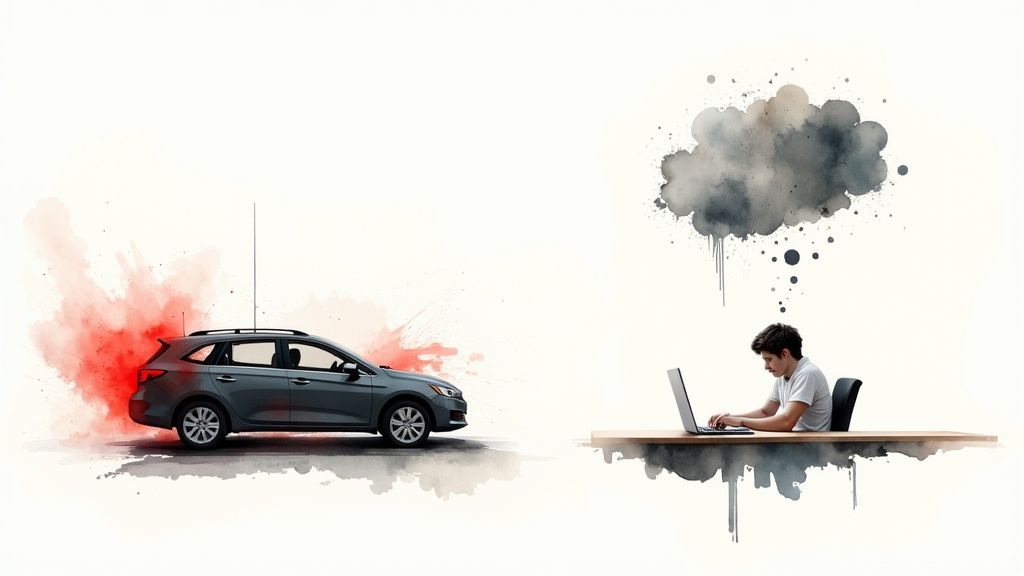
Think of it this way: normal anxiety is like a car alarm that goes off when someone’s actually trying to break in. It’s useful. An anxiety disorder is like a car alarm that’s so sensitive it goes off every time a leaf falls nearby, draining your battery and making it impossible to focus on anything else.
When Worry Starts to Steal Your Life
The clearest sign that anxiety has crossed a line is when it starts disrupting your day-to-day life. It’s the point where you begin making your world smaller just to avoid that feeling of dread.
This might look like:
- Dodging social events because the idea of making small talk feels paralyzing.
- Saying no to a promotion because it involves public speaking.
- Needing constant reassurance from loved ones that everything is okay.
- Losing hours to worrying about "what-if" scenarios that almost never happen.
When you start rearranging your life to accommodate the anxiety, that’s a red flag. It’s not a sign of weakness; it’s a sign that a natural, protective system has gone into overdrive and needs a little help recalibrating. This is the moment when reaching out for help becomes an act of strength.
Giving a Name to Your Experience
While you should never self-diagnose, learning the language that professionals use can be incredibly validating. It helps you see that what you’re feeling is a recognized—and more importantly, treatable—condition.
For instance, Generalized Anxiety Disorder (GAD) is defined by persistent, excessive worry about a wide range of things—work, health, family—for at least six months. It feels like your mind is stuck in a constant state of scanning for the next disaster.
Then there's Panic Disorder, which involves sudden, intense episodes of fear (panic attacks) and a crippling worry about having more of them. This often leads to avoiding any place or situation where an attack might happen. Learning about the different types of anxiety disorders can give you the words to explain your experience to a doctor.
A diagnosis isn't a life sentence or a label that says you're "broken." It's a roadmap. It provides a clear direction for treatment, offering targeted strategies that can guide you back to a life of freedom.
The thought of having an anxiety disorder can be scary, but it’s actually a profoundly hopeful step. It's the moment you stop fighting a shapeless, nameless fog and start walking a clear path toward getting better. With the right support and tools, you can absolutely learn to manage your symptoms and live a full, vibrant life.
Practical Strategies to Reclaim Your Peace
Understanding the mechanics of anxiety is a huge first step. But this is where the real work—and the real hope—begins. Knowing why your internal alarm is ringing is one thing; learning how to gently turn it off is another.
This is your toolkit for healing. These aren't just theories; they're actionable, evidence-based strategies that put you back in the driver's seat. A calmer, panic-free life isn't a distant dream. It's a skill you can learn, starting right now.
Grounding Yourself in the Present Moment
When anxiety pulls you into a storm of future worries or past regrets, grounding techniques are your anchor. They bring you back to the safety of the present moment, signaling to your nervous system that you are okay right here, right now.
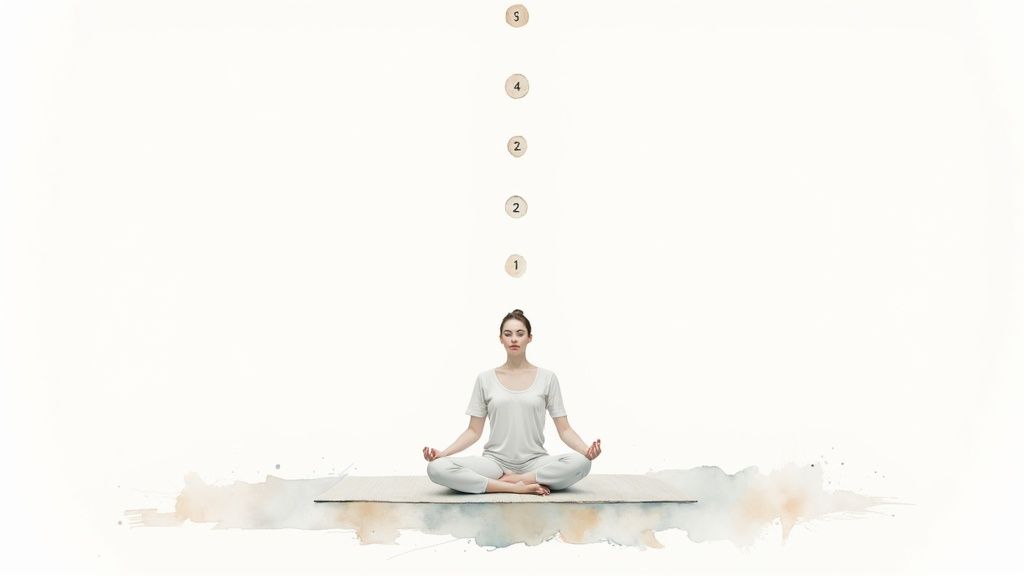
One of the most effective and discreet methods is the 5-4-3-2-1 technique. You can do it anywhere, anytime.
- 5: Look around and name five things you can see. Notice their color, shape, and texture.
- 4: Pay attention to your body and notice four things you can feel. It could be the texture of your chair, the feeling of your feet on the floor, or the fabric of your shirt.
- 3: Listen for three distinct sounds. Maybe it’s the hum of a computer, distant traffic, or your own breathing.
- 2: Identify two things you can smell. This might be your coffee, a scented candle, or the fresh air from an open window.
- 1: Name one thing you can taste. You could take a sip of water or simply notice the current taste in your mouth.
This exercise forces your brain to shift focus from abstract worries to concrete, sensory details. It effectively short-circuits a spiral of panic and tells your body there’s no immediate threat to fear.
Calming Your Nervous System with Your Breath
Your breath is one of the most powerful tools you have for influencing your physiological state. When you're anxious, your breathing becomes shallow and rapid. By intentionally slowing it down, you send a direct message to your brain that it's time to relax.
A simple yet profound technique is box breathing.
- Inhale slowly through your nose for a count of four.
- Hold your breath for a count of four.
- Exhale slowly through your mouth for a count of four.
- Hold your breath again for a count of four.
Repeat this cycle for a few minutes. This rhythmic pattern helps regulate your autonomic nervous system, moving you out of the frantic "fight-or-flight" state and into a calmer "rest-and-digest" mode.
Learning to Challenge Anxious Thoughts
Much of anxiety's power comes from the stories it tells us—the catastrophic "what-ifs" that feel incredibly real. Cognitive Behavioral Therapy (CBT) is a proven approach that helps you become a detective of your own thoughts, learning to spot and reframe these negative patterns.
The core idea is simple: your thoughts, feelings, and behaviors are all interconnected. If you can change a negative thought, you can change how you feel and act. You learn to ask questions like, "Is this thought 100% true?" or "What's a more balanced way of looking at this?"
You are not your thoughts. Mindfulness teaches you to observe your anxious thoughts from a distance, like watching clouds pass in the sky, without getting swept away by them. This creates a crucial space between you and the anxiety, reminding you that feelings are temporary visitors, not permanent residents.
For a deeper dive into how this works, our guide on understanding CBT for anxiety provides a clear and hopeful overview. For more structured approaches, understanding how to apply principles like cognitive behavioural therapy for social anxiety can be profoundly helpful for specific fears.
These tools offer a structured path toward healing. The Anxiety Checklist, for instance, provides a system for tracking your symptoms and applying these very strategies, turning abstract feelings into manageable data.
This screenshot shows how you can actively monitor your progress and identify patterns. By using a tool like this, you transform from a passive recipient of anxiety into an active participant in your recovery, armed with knowledge and a clear plan.
Why You Are Not Alone in This Fight
Anxiety can be an incredibly isolating experience. It has a cruel way of whispering in your ear that you're the only one struggling this much, that you're somehow broken or different from everyone else.
But that feeling, as powerful as it is, couldn't be more wrong. What you're going through is one of the most shared human experiences on the planet. You’re part of a massive, unseen global community, and the numbers are staggering—and in a way, deeply reassuring.
They prove that your struggle isn't a personal failure. It’s a fundamental, though difficult, part of the human condition. While understanding the what is the difference between fear and anxiety is critical for finding the right treatment, grasping the sheer scale of this experience is a crucial part of healing.
A Shared Global Experience
Just how common is it? Anxiety disorders will affect nearly one in three adults at some point in their lives. The World Health Organization estimated that 359 million people were living with an anxiety disorder in 2021.
And in the United States alone? The National Institute of Mental Health reports that 31.1% of adults will experience an anxiety disorder. You can find out more about what these widespread numbers mean from UC Davis Health.
These statistics aren't just numbers on a page. They are a powerful antidote to the shame and isolation that anxiety thrives on.
Every one of those millions represents a person who understands the racing heart, the looping thoughts, and the feeling of dread. Each number is a quiet voice saying, "Me too." This shared reality is the foundation of hope.
Knowing you're part of such a large community completely changes the narrative. It means that solutions, strategies, and pathways to feeling better not only exist but are well-traveled.
If so many people navigate this challenge, then a life free from panic and constant worry isn't just a possibility—it's an achievable reality. The journey toward peace is one that countless others are on, and many have successfully completed. You can, too.
Your Questions on Fear and Anxiety Answered
Navigating the journey from anxiety back to peace always brings up questions. Getting clear, supportive answers can build the confidence you need and reinforce a powerful truth: healing is absolutely possible for you.
Can a Single Fearful Event Cause an Anxiety Disorder?
Yes, a traumatic experience can essentially recalibrate your brain's threat-detection system. What starts as a normal, acute fear response can sometimes evolve into a chronic anxiety condition, like PTSD or a specific phobia.
Your internal alarm system can become hyper-sensitive to anything that even remotely reminds you of the event. But the hopeful news is that targeted therapies can help reset this system and bring it back into balance.
Is It Possible to Feel Fear and Anxiety at the Same Time?
Absolutely. Imagine you have to give a big presentation. The moment you step on stage, you might feel an immediate jolt of fear (a present, tangible threat). At the same time, you could be flooded with anxiety about potential future outcomes—what if they judge me? What if I forget my words?
These two emotions often mix, creating a complex cocktail of distress. The good news is that the right strategies can help you manage both sides of that coin.
What Is the Most Helpful First Step I Can Take Right Now?
While the most effective first step is always speaking with a healthcare professional for personalized guidance, there's a simple and empowering action you can take on your own: start gently observing your symptoms without judgment.
Using a tool to track when your anxiety shows up helps you recognize patterns in your own experience. This isn't just data; it's valuable information you can share with a professional, putting you in the driver's seat on your path to healing.
You have the power to live a panic-free life. At The Anxiety Checklist, we've created a complete system to give you the tools and clarity needed to understand your anxiety and take back control. Start your journey toward fearless living today at https://anxietychecklist.com.