Anxiety coping mechanisms are the conscious actions you take to navigate stress and fear, transforming them from overwhelming forces into manageable feelings. Think of them less as a temporary fix and more like a powerful mental toolkit you can build to create lasting change. These are practical, learnable skills designed to calm your nervous system, gently challenge worried thoughts, and build a deep well of emotional resilience. This guide is built on the unwavering belief that healing isn't just a possibility—it's your achievable reality.
Your Path to Empowerment and a Panic-Free Future Starts Here
Feeling overwhelmed by anxiety can be incredibly isolating, but this is the exact starting point for your journey toward calm, control, and a life free from panic. This guide is about tangible, practical tools you can use to reclaim your life from the grip of chronic worry. It’s about shifting the narrative from just ‘managing’ symptoms to actively building a peaceful, centered, and hopeful future.
Imagine creating a personal toolkit for your mind, filled with strategies that bring you back to safety. Some are for quick relief when a sudden wave of panic hits, proving you can regain control in any moment. Others are for the long haul, helping you construct a stronger, more resilient foundation so that panic has less and less room to exist. Our goal is to empower you with the know-how to pick the right tool for the right moment, reinforcing the hopeful truth that you can and will heal.
A Journey of Hope and Practical Steps
A panic-free life is a real and attainable goal. It’s about discovering what works for you and then committing to small, consistent actions that build momentum every single day. The best part? You don’t have to figure it all out on your own. Learning to distinguish between quick-fix methods for intense moments and sustainable habits for lasting peace is the first crucial step on this healing path. For a deeper look, our guide on the essential anxiety recovery steps offers a structured roadmap for this journey.
"Healing from anxiety is not about becoming a person who never feels fear. It’s about becoming a person who knows how to hold that fear without letting it hold you back. It's about taking your power back, one hopeful step at a time."
Understanding the Global Context of Anxiety
It’s crucial to remember you are not alone in this. The need for effective anxiety coping tools has grown across the globe. Research shows that the global rate of anxiety disorders in young people shot up by 52% between 1990 and 2021.
This study also pointed out something important: access to resources makes a huge difference. Positive strategies like mindfulness and seeking support are more common in high-income regions. Meanwhile, avoidance coping is more prevalent where mental health services are harder to come by. This reinforces how vital accessible, practical information is—and that’s what this guide is all about. Your journey to a panic-free life starts with knowing that you can learn and use these skills, no matter where you're starting from.
Building Your Anxiety Coping Toolkit
To find your way to a calmer, more panic-free life, it helps to first understand what anxiety coping mechanisms really are. Think of them not as abstract concepts, but as a collection of practical, learnable tools you can assemble over time.
You're essentially building two distinct kits to support yourself on the path to healing.
The first is your "mental first-aid kit." This is filled with fast-acting techniques for immediate relief when you feel a wave of panic or overwhelm. These are your emergency responders, designed to calm your nervous system right in the moment and prove you can handle it.
The second is a "long-term resilience plan." This involves strategies that act more like preventative care, helping you build emotional strength and a more resilient, less anxious baseline over time. This is how you create lasting freedom from panic. Grasping this distinction is the first step toward consciously choosing strategies that lead to genuine, lasting healing.
Adaptive vs Maladaptive Coping
A crucial part of this journey is learning to tell the difference between healthy and unhealthy coping strategies. This isn't about judging yourself; it's about empowering yourself with knowledge. Knowing which is which helps you make choices that guide you toward healing, not deeper into the cycle of anxiety.
- Adaptive (Healthy) Mechanisms: These are constructive strategies that build you up. They either directly address the root of the problem or help you manage your emotional response to it in a healthy, empowering way.
- Maladaptive (Unhealthy) Mechanisms: These are often avoidance-based behaviors. They offer a temporary escape but can make anxiety worse down the road. Think of it like putting a small patch on a leaky pipe—it stops the drip for a minute but does nothing to fix the real issue.
This diagram shows how building a solid toolkit is the central path from understanding to true resilience.
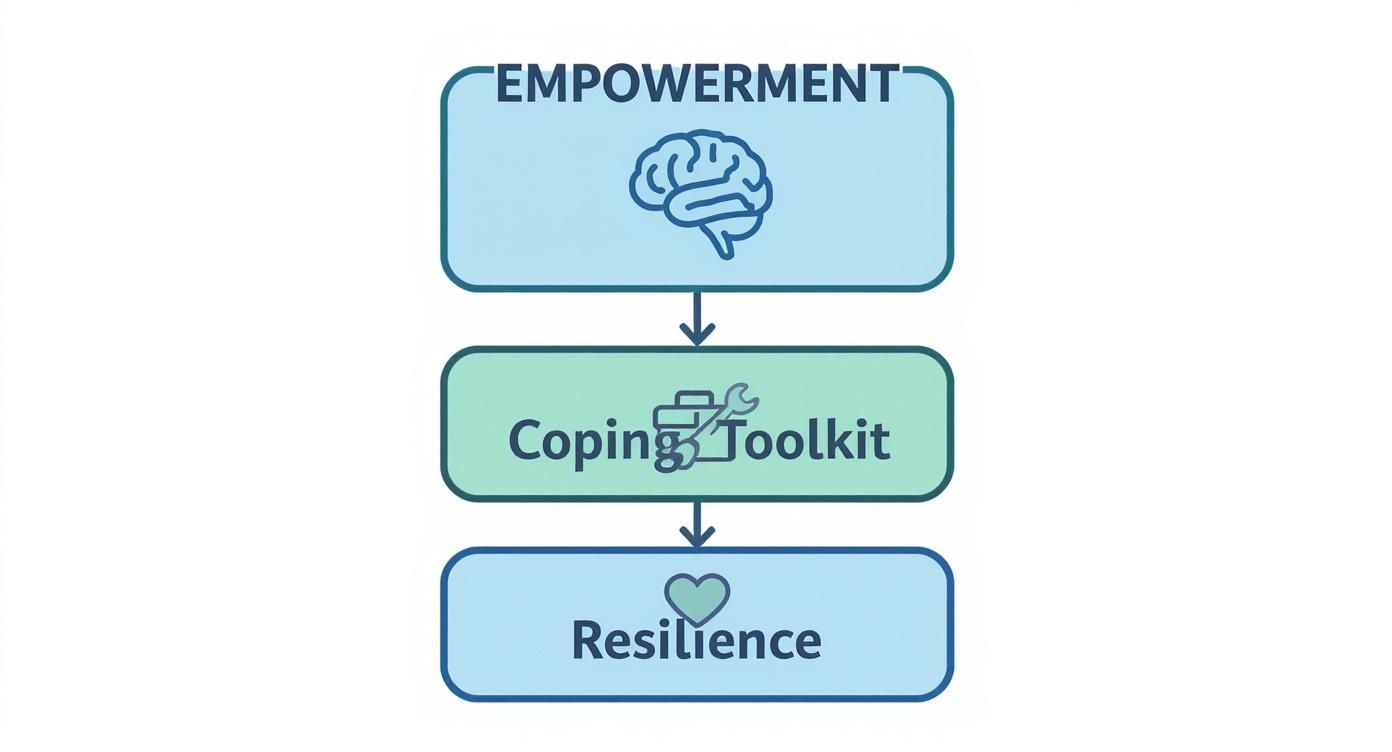
As you can see, the progression is clear: genuine empowerment allows you to build a functional coping toolkit, which is what ultimately creates lasting emotional resilience and a life free from panic.
Recognizing Your Coping Patterns
Understanding this distinction in your own life is where the real power for change lies. For instance, after a stressful work meeting, an adaptive response might be to go for a short walk and do some deep breathing. A maladaptive one? Numbing out by scrolling social media for hours, avoiding the feelings altogether.
The table below breaks this down further, offering a side-by-side look at how these coping styles play out. Use it to start recognizing your own patterns with compassion.
Adaptive vs Maladaptive Coping At a Glance
| Coping Style | Adaptive (Healthy) Example | Maladaptive (Unhealthy) Example | Long-Term Outcome |
|---|---|---|---|
| Problem-Focused | Breaking a large, overwhelming task into smaller, manageable steps. | Procrastinating on the task and avoiding it until the last minute. | Increased confidence and competence. |
| Emotion-Focused | Talking about your feelings with a trusted friend or therapist. | Venting frustrations through anger or withdrawing from social contact. | Stronger emotional regulation and support systems. |
| Avoidance-Based | Taking a short, intentional break (like a 10-minute walk) to reset. | Using alcohol, overeating, or excessive TV to escape the feeling. | Worsening anxiety and potential for new problems. |
| Seeking Support | Asking a colleague for help on a difficult project. | Isolating yourself and refusing to admit you're struggling. | Improved problem-solving and stronger relationships. |
Seeing your behaviors laid out like this can be a real eye-opener. It's not about shame, but about awareness. This is the first step toward making a different, more healing choice next time.
Choosing adaptive coping mechanisms is an act of profound self-compassion. It's telling yourself, "I am worthy of real solutions that lead to healing, not just temporary distractions." This shift in mindset is where true freedom begins.
Becoming aware of these patterns in your own life is a game-changer. Think about how you typically react to stress. Do your go-to behaviors actually solve the problem, or do they just postpone it? Asking that simple question can illuminate the path toward healthier habits and a calmer life.
For example, controlled breathing is a simple yet powerful adaptive tool. You can explore a variety of simple yet effective breathing exercises for anxiety that can be used anywhere, anytime to calm your nervous system. By consciously choosing these healthier responses, you begin to actively build a life with less panic and more peace.
Immediate Relief for Panic and Overwhelm
When your heart starts pounding, your breath catches, and your thoughts begin to spiral, you need something that works right now. In those moments of intense anxiety, long-term strategies feel a million miles away. This is where your mental first-aid kit comes in—a set of powerful, fast-acting techniques designed to pull you back from the edge and show you that relief is possible.
These aren’t just distractions; they are physiological tools that interrupt your body’s alarm system. They work by hijacking your focus, engaging your senses, and regulating your nervous system, proving that you have the power to regain control. With practice, they become second nature—reliable anchors in the storm, guiding you back to safety.
The 5-4-3-2-1 Grounding Method
When anxiety pulls you into a whirlwind of future worries, grounding yanks you back to the safety of the present moment. The 5-4-3-2-1 method is one of the most effective ways to do this because it forces your brain to focus on your immediate environment, not the chaos in your head.
Here’s how to do it, step-by-step:
- Look for 5 things you can see. Acknowledge them. Notice the color of a book, the light from a window, or the pattern on the floor.
- Focus on 4 things you can touch. Feel the texture of your shirt, the cool surface of a table, or the weight of your phone in your hand.
- Listen for 3 things you can hear. Tune into the hum of a computer, birds chirping outside, or the sound of your own breathing.
- Identify 2 things you can smell. Maybe it’s the faint scent of coffee, soap on your hands, or the pages of a nearby book.
- Name 1 thing you can taste. This might be the lingering taste of your last meal, or you can take a sip of water to focus on that sensation.
By systematically walking through your senses, you are redirecting your brain's attention away from the panic signal. This simple exercise breaks the feedback loop of spiraling thoughts, reminding your body that you are safe right here, right now. For more ways to reconnect with the present, check out our complete guide to grounding techniques for anxiety.
Regulate Your Body with Box Breathing
Your breath is one of the most powerful tools you have for managing anxiety because it has a direct line to your nervous system. Quick, shallow breathing signals danger; slow, deep breathing signals safety. Box Breathing is a simple, rhythmic technique that activates the body’s “rest and digest” response, effectively hitting the brakes on the fight-or-flight instinct.
The power of controlled breathing lies in its ability to tell your body a different story. While your mind is screaming 'panic,' your breath can calmly whisper, 'you are safe, and this will pass.'
This technique is easy to remember and can be done anywhere without anyone even noticing.
- Step 1 Inhale: Breathe in slowly through your nose for a count of four.
- Step 2 Hold: Gently hold your breath for a count of four.
- Step 3 Exhale: Exhale slowly through your mouth for a count of four.
- Step 4 Hold: Hold your breath again for a count of four.
Repeat this cycle for a few minutes. Visualizing a box as you count can help you maintain focus and rhythm. This structured breathing pattern helps lower your heart rate, reduce blood pressure, and bring a sense of immediate calm.
Release Tension with Progressive Muscle Relaxation
Anxiety isn’t just mental; it lives in your body as physical tension. You might clench your jaw or tighten your shoulders without even realizing it. Progressive Muscle Relaxation (PMR) is a technique where you systematically tense and then release different muscle groups.
This process has two key benefits. First, the act of tensing and then letting go makes you acutely aware of the difference between tension and relaxation. Second, the physical release sends a powerful signal to your brain that the perceived threat has passed, allowing your mind to relax as well.
Find a comfortable position, close your eyes, and take a few deep breaths. Then, work your way through your body:
- Hands and Arms: Clench your fists tightly for 5 seconds, then release for 10-15 seconds, noticing the feeling of warmth and release.
- Shoulders and Neck: Tense your shoulders by pulling them up toward your ears for 5 seconds, then let them drop completely.
- Face: Scrunch your facial muscles—your forehead, eyes, and jaw—for 5 seconds, then relax them fully.
- Legs and Feet: Tightly curl your toes and tense your calves and thighs for 5 seconds, then release.
Continue this process through all major muscle groups. By the end, your body will feel noticeably looser, and your mind will likely follow suit. These in-the-moment coping skills are your lifeline, proving that even in the peak of panic, relief and healing are within your reach.
Building Long-Term Resilience for a Panic-Free Life
True freedom from anxiety isn't just about managing a panic attack when it hits. It's about building a life where those attacks become less frequent, less intense, and eventually, a thing of the past. While in-the-moment techniques are your emergency toolkit, these long-term strategies are how you build a stronger, more peaceful foundation.
This is where you shift from reacting to anxiety to proactively creating a buffer against it, making your mind a safer place to be.
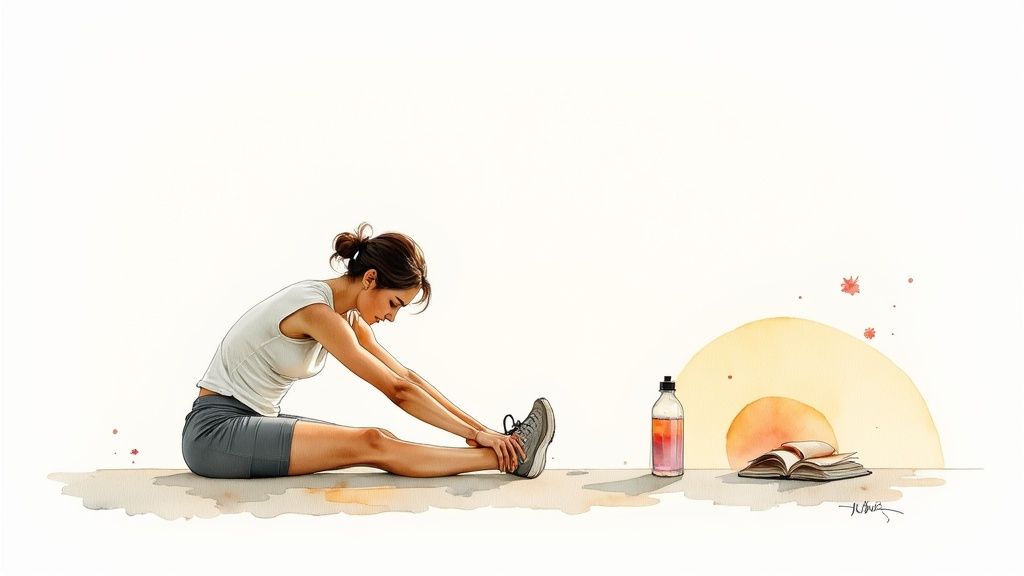
The key here is consistency over intensity. Small, daily habits might not feel revolutionary at first, but they compound over time into powerful protection. Think of it like making small, regular deposits into a mental wellness account—over time, they grow into a wealth of resilience that can carry you through anything.
Train Your Awareness with Mindfulness
Mindfulness and meditation are arguably the most powerful long-term anxiety coping mechanisms you can cultivate. Why? Because they train your brain to simply observe anxious thoughts without getting swept away by them.
Even 5-10 minutes a day is enough to start creating a crucial gap between a trigger and your reaction. In that space, you find your power. You start to see a worry for what it is—just a thought, not a command or a prophecy. This practice isn't about emptying your mind; it's about changing your relationship with everything that fills it, giving you freedom.
"Between stimulus and response there is a space. In that space is our power to choose our response. In our response lies our growth and our freedom."
This shift is monumental. It teaches you that you are the observer of your anxiety, not its victim. That realization alone is an incredibly hopeful and empowering step toward living a life free from panic.
The Powerful Role of Physical Activity
Regular movement is one of the most effective ways to burn off stress hormones while releasing mood-lifting endorphins. You don’t need to train for a marathon. What truly matters is finding movement you enjoy and making it a consistent, joyful habit.
Find what works for you:
- A brisk 30-minute walk: Simple, free, and incredibly effective at lowering anxiety.
- Yoga or stretching: These combine physical movement with mindfulness, helping to release the tension that anxiety stores in your body.
- Cycling or swimming: Rhythmic exercises like these can feel almost meditative and are fantastic for your physical and mental resilience.
Exercise gives all that restless, nervous energy a productive outlet. It also helps regulate your sleep, which anxiety often disrupts. It's a non-negotiable for lasting mental well-being and a calmer life.
Fuel Your Mind with Nutrition and Sleep
What you eat and how well you sleep directly impact your brain's chemistry and its ability to manage emotions. A diet built around whole foods—packed with things like omega-3s and magnesium—can help stabilize your mood. On the flip side, processed foods and sugar can send it on a rollercoaster. For those looking into supportive botanicals, learning about natural adaptogens like Ashwagandha for stress relief can also be a helpful piece of the puzzle.
Just as important is sleep. Aiming for 7-9 hours of quality sleep a night is critical for healing. A sleep-deprived brain is a primed-for-anxiety brain. Creating a simple wind-down routine—like shutting off screens an hour before bed—sends a clear signal to your body that it’s time to rest and repair.
Rewire Your Brain with Cognitive Tools
Drawing from the principles of Cognitive Behavioral Therapy (CBT), you can train yourself to challenge the negative thought patterns that fuel anxiety. It’s like becoming a compassionate detective of your own mind. Instead of accepting an anxious thought as fact, you can learn to question it. Is it really true? What's the evidence? To dig deeper into how this works, our guide on understanding CBT for anxiety is a great place to start.
This kind of proactive mental work is part of a bigger, more positive shift in how we approach mental health. A global review found that during the COVID-19 pandemic, people who actively used strategies like meditation and positive reframing fared much better. The study found that resilience was the single strongest predictor of stress management, proving that building these skills directly leads to less anxiety. You can read the full study about these positive coping strategy findings.
By weaving these long-term strategies into your life, you're doing more than just coping. You are fundamentally rewiring your brain and building a resilient foundation for a life defined by peace, not panic.
Creating Your Personalized Anxiety Action Plan
We’ve covered the techniques for immediate relief and the strategies for building long-term resilience. Now comes the most empowering part: turning that knowledge into your personalized action plan. This is the single most powerful step you can take on your healing journey.
Think of this as a commitment to yourself, a practical, go-to resource for when your thoughts start to race. There’s no one-size-fits-all fix for anxiety, and this plan puts you squarely in the driver's seat of your own recovery.
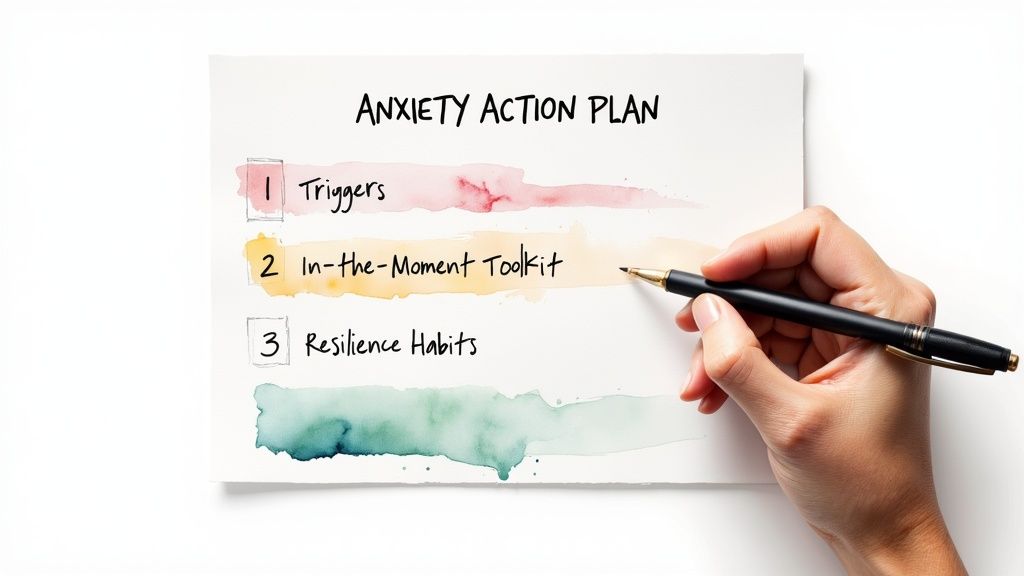
When you write your strategies down, they become tangible and real. In a moment of high stress, trying to remember what to do can feel impossible. Your action plan does the heavy lifting for you, acting as a compassionate guide back to calm and reminding you of your own strength.
Step 1: Identify Your Personal Triggers
The first step to managing anxiety is getting to know what sets it off. Triggers are the specific situations, thoughts, or feelings that can lead to fear and panic. The goal isn't to avoid them forever, but to become so aware of them that you can prepare your response with confidence.
This calls for some honest self-reflection. Grab a notebook and think through these prompts without judgment.
- What situations consistently put me on edge? (e.g., public speaking, crowded stores, deadlines.)
- Are there specific thought patterns that send me spiraling? (e.g., "what if" scenarios, self-criticism.)
- Do certain times of day or physical states come before my anxiety? (e.g., late at night, feeling exhausted, or after too much coffee.)
Spotting these patterns is incredibly empowering. It allows you to anticipate challenges and use your anxiety coping mechanisms proactively instead of being caught off guard. For a more structured look at your symptoms, you might find it helpful to take a GAD-7 anxiety test to get a clearer baseline.
Step 2: Build Your In-the-Moment Toolkit
This is your mental first-aid kit. When panic strikes, you need a short, reliable list of moves that you know work for you. The idea is to have a few go-to strategies that feel almost automatic, so you can act with confidence when you’re overwhelmed.
Look back at the immediate relief strategies we discussed and pick 3 to 5 that resonate with you.
Example Toolkit:
- Box Breathing: My anchor to slow down my heart rate. Inhale for 4, hold for 4, exhale for 4, hold for 4.
- 5-4-3-2-1 Grounding: This pulls me out of my head and plants me firmly in the present moment.
- Cold Water Splash: A quick sensory shock to hit the reset button on my nervous system.
- Listen to a Specific Calming Song: I'll have it downloaded and ready on my phone, no searching required.
"Your action plan is a living document. It's a promise to yourself that you have tools, you have a strategy, and you are far more powerful than your anxiety. It is your roadmap to a panic-free life."
This toolkit is your immediate line of defense. Practice these techniques when you're calm, so they become second nature when you truly need them.
Step 3: Commit to Your Resilience Habits
Finally, this part of your plan is all about the long game toward a panic-free life. These are the preventative practices that build your emotional foundation, making you less vulnerable to anxiety over time. Unlike your toolkit, these are about consistency, not just emergencies.
Choose 2 to 3 sustainable habits you can realistically weave into your daily or weekly routine.
Example Resilience Habits:
- Daily Morning Walk: I will walk for at least 15 minutes every morning—phone-free—to get natural light and move my body.
- Mindfulness Practice: I will use a guided meditation app for 5 minutes before my workday to practice observing my thoughts.
- Digital Wind-Down: I will put my phone away one hour before bed and read a book to improve my sleep quality.
These habits are your investment in a calmer, more hopeful future. By creating this simple, three-part plan, you’re not just wishing for a more peaceful life—you're building the roadmap to get there. You are actively participating in your own healing, armed with a clear path forward.
When to Seek Professional Support
Building a toolkit of anxiety coping skills is one of the most empowering things you can do for yourself. But it’s also important to know you don’t have to walk this path alone.
Reaching out for professional support isn’t a sign of failure. Far from it. It’s a sign of incredible strength and a powerful, hopeful step toward lasting well-being.
Think of a therapist as a skilled guide or even a personal trainer for your mental health. You're the one doing the work, but they bring expert direction, proven strategies, and a supportive presence to help you get where you want to go—often faster and more effectively than going it alone.
They can help you spot the blind spots you didn't know you had and equip you with tools tailored to your unique situation. Seeking therapy is a proactive, courageous choice—a true investment in your healing.
Signs It Might Be Time for Support
So, how do you know when it’s time to bring a professional onto your team? Everyone's journey is different, but there are a few common signals that suggest it's a good time to reach out for more support.
It might be time to get support if you notice that:
- Anxiety is consistently getting in the way of your life. Your worries are making it tough to focus at work, connect with loved ones, or handle daily tasks.
- Your coping mechanisms just aren't cutting it. Despite your best efforts, you feel stuck, overwhelmed, or like the anxiety is only getting stronger.
- You're leaning on unhealthy coping strategies. If you find yourself avoiding situations or relying on maladaptive habits, a therapist can help you build healthier, more effective alternatives.
- The physical symptoms are becoming disruptive. Frequent panic attacks, digestive issues, chronic headaches, or the fatigue that comes with anxiety are taking a toll on your physical health.
Recognizing these signs is the first step. The next is knowing that effective, hopeful help is out there.
What to Expect from Therapy
The thought of therapy can feel intimidating, but at its core, it’s just a safe, confidential space to learn new skills for navigating your mind. A good therapist will tailor their approach to you, but several methods are especially effective for anxiety.
Therapy isn't about "fixing" something that's broken. It’s about learning the skills to navigate your mind with confidence, so you can build the peaceful, vibrant life you deserve.
Two of the most respected, evidence-backed approaches are Cognitive Behavioral Therapy (CBT) and Acceptance and Commitment Therapy (ACT).
CBT helps you identify and reframe the negative thought patterns that fuel anxiety, while ACT teaches you how to accept difficult feelings without letting them run the show. Both are practical, skills-based therapies focused on giving you the tools to live a fuller life.
Finding the right therapist is a key part of the process. Resources like the National Alliance on Mental Illness (NAMI) or the Anxiety & Depression Association of America (ADAA) offer directories to help you find qualified professionals in your area. Taking this step is a powerful move toward a future defined by peace, not panic.
Common Questions About Coping With Anxiety
Starting this journey always brings up a few practical questions. That’s a great sign—it means you’re already thinking about how to weave these hopeful tools into your life. Let’s tackle some of the most common ones.
Think of every question as another step forward. You're moving toward a calmer, more empowered you, and that process starts now.
How Long Until These Coping Mechanisms Start Working?
This is a great question, and the answer is wonderfully two-part. Immediate relief tools, like the 5-4-3-2-1 grounding method or a few rounds of box breathing, are designed to work within minutes. They are proof that you have the power to dial down panic the moment it strikes.
Long-term strategies, like building a consistent mindfulness habit, are more like training a new muscle. You’ll likely start feeling a real, noticeable shift after a few weeks of dedicated practice. Be patient and compassionate with yourself. You are literally rewiring your brain's pathways for peace, and that incredible healing process takes a little time.
Can I Completely Cure Anxiety With These Methods?
The goal isn't so much a "cure," but a fundamental change in your relationship with anxiety. These methods are designed to shrink anxiety's power over you until it no longer runs your life. You’re building the skills to handle anxious feelings when they arise, which puts you firmly back in the driver's seat.
It’s not about erasing a normal human emotion. It's about building a full, vibrant life where anxiety is just a passenger, not the one steering the car. With these tools, you can manage it effectively and live without the constant fear of panic. That is freedom.
That’s the real path to living a life free from panic—one where you are in control, not the anxiety.
What if a Coping Technique Stops Being Effective?
This is completely normal and expected. Just like your muscles get used to the same workout, your brain can adapt to a specific coping strategy. This isn't a sign of failure; it’s a signal that it’s time to switch things up.
This is exactly why building a diverse toolkit is so important. If one method starts feeling stale, simply rotate to another one from your action plan. It might also be a good moment to check in and see if your underlying stressors have changed, or to get curious and explore a new technique. This kind of adaptability is a huge sign of your growing resilience and a normal part of the healing process.
At The Anxiety Checklist, we believe everyone deserves to live a life free from the grip of panic. Our Fearless Living system is designed to give you that power back, transforming proven strategies into a personalized toolkit for lasting peace.
Take the next step on your journey to a calmer, more confident life. Learn more and get your checklist today.