An anxiety disorder checklist is a powerful tool designed to help you pinpoint and understand your anxiety symptoms, giving you a clear map for your journey toward healing. It's a way to transform that overwhelming cloud of feelings into specific, manageable insights, marking the very first step on your path back to a life of freedom and peace.
Finding Your Way Back From Overwhelm
Feeling trapped by anxiety is incredibly isolating. When your heart hammers in your chest and your thoughts spiral, it’s easy to believe you’re stuck forever. But that feeling isn't the truth of your situation; it’s a symptom, and symptoms can heal.
You are not alone in this, and more importantly, there is a clear and hopeful path forward. The journey to a panic-free life starts with one powerful step: understanding what’s really going on inside your mind and body. This guide is here to be your first companion on that path, showing you that recovery is not just possible, but achievable.
Your Personal Map to a Hopeful Future
We're going to introduce the anxiety disorder checklist not as a clinical test, but as your own personal map to recovery. It’s a tool for exploration that helps you navigate the complex terrain of your own feelings with compassion and curiosity.
With it, you can start observing the patterns behind the panic, which is the first step toward regaining a sense of control and hope. You’ll begin to see that anxiety isn't an unbeatable monster, but a series of signals—signals you can learn to interpret, manage, and ultimately, heal from. By using a checklist, you start translating that vague distress into insights you can work with. This process reveals a fundamental truth:
Hope isn't just a feeling; it's a strategy. When you have a map and a clear direction, you can start moving toward a life where you are in control, not your anxiety. This guide provides the first steps of that strategy.
From Worry to Empowered Action
Our goal here is to walk you through how to use this checklist to build profound self-awareness—the foundation of all healing. You'll learn to spot triggers, recognize thought patterns, and see how physical sensations are connected to your emotional state. This clarity is the bedrock of real, meaningful change.
It shifts you from a passive state of worry into one of empowered action. As you start this process, you’ll discover that healing is entirely possible. Each symptom you identify is a clue, and each pattern you uncover is another stepping stone on your path to building a life defined by freedom, purpose, and peace.
Of course, sometimes the fog is too thick to navigate alone. If you find yourself struggling, seeking personalized guidance can offer the tailored support needed to light the way.
This is the beginning of transforming your relationship with anxiety. You can learn more about the entire journey by exploring these essential anxiety recovery steps, which lay out the path to lasting peace. Your journey to a panic-free life starts right now.
What Is an Anxiety Checklist and How Can It Help?
Ever feel like your anxiety is just a big, overwhelming cloud of dread? An anxiety checklist is a tool designed to cut through that fog and bring in the light of understanding.
Think of it less like a test and more like a personal inventory—a structured way to observe your own experiences with curiosity instead of judgment. It helps you become a compassionate detective in your own life, gathering the clues needed to pave the way for healing. This simple process is often the first, most hopeful step toward taking back control from the grip of worry and panic.
From Vague Fear to Concrete Data
Anxiety rarely shows up as one neat, tidy symptom. It's usually a messy combination of physical feelings, looping thoughts, intense emotions, and knee-jerk behaviors. Trying to make sense of it all at once feels impossible.
An anxiety checklist is like flipping on the lights. It helps you see each of those threads clearly. By going through specific items, you start turning those abstract feelings into tangible data points you can work with.
- Physical Sensations: Pinpointing things like a racing heart, shallow breathing, or clenched jaw.
- Cognitive Patterns: Identifying specific worry loops, imagining worst-case scenarios, or your mind going blank.
- Emotional Responses: Naming feelings like dread, irritability, or a constant sense of being on edge.
- Behavioral Shifts: Noticing actions like avoiding certain places, withdrawing from friends, or procrastinating on important tasks.
This act of observation is incredibly powerful. It demystifies the experience. You start to see anxiety not as some unbeatable monster, but as a series of connected signals from your body and mind—signals you can learn to work with, and heal from, one by one.
Gaining this kind of clarity is the foundational step toward building a personalized, effective plan for getting better. It shifts you from feeling like a victim of your anxiety to becoming an active participant in your own healing.
You Are Not Alone in This
If you look at a checklist and feel like you’re ticking off almost every box, take a deep, hopeful breath. You are far from alone, and this awareness is the start of your recovery. Anxiety disorders are the most common mental health condition in the world, affecting hundreds of millions of people who go on to find healing and relief.
In the United States alone, an estimated 42.5 million adults live with an anxiety disorder. You can learn more about anxiety prevalence from these statistics. Using a checklist is a powerful, proactive step to make sure you’re part of the group that finds a path forward to a better life.
That initial self-awareness is everything. Simple tools like a Generalized Anxiety Disorder (GAD-7) screening test can give you a structured place to start your observations.
Ultimately, an anxiety disorder checklist is a tool of hope. It provides the structure you need to make sense of the chaos, giving you a solid foundation from which you can start building new skills for a peaceful life. It’s the first real, concrete action on a path that leads away from fear and toward a life of freedom and control.
Anxiety rarely shows up in a neat, tidy package. It’s more like a tangled mess of physical sensations, racing thoughts, overwhelming feelings, and knee-jerk reactions that can leave you feeling completely lost.
To start untangling that knot and find your way to relief, it helps to sort your experiences into four key areas, or "pillars." This is the same framework that grounds any good anxiety disorder checklist, and it’s your first step toward clarity and healing.
When you see anxiety this way—not as some single, unbeatable monster, but as a set of interconnected symptoms—you start to regain a sense of control. Each pillar is a clue, and once you start decoding them, a clear path toward a panic-free life begins to appear.
The Physical Pillar: Your Body's Alarm System
This is anxiety at its most primal, rooted in your body's "fight-or-flight" response. The problem with an anxiety disorder? That alarm system gets stuck in the "on" position. But the hopeful truth is that you can learn to regulate it.
These physical symptoms are often the scariest because they feel so urgent and real. You might genuinely worry you’re having a heart attack or can’t breathe, which just adds more fuel to the panic cycle.
Common signs include:
- A Pounding Heart: Your heart races or skips beats.
- Shallow Breathing: You can't seem to get a full breath, leading to dizziness.
- Muscle Tension: Your shoulders, neck, and jaw feel perpetually clenched.
- Stomach Issues: Nausea, indigestion, or "nervous stomach" become constant companions.
Learning to spot these physical signals is the first step toward calming your body's overactive alarm. Recognizing a racing heart as a symptom of anxiety—not a medical emergency—is a game-changing shift that puts you back in the driver's seat on your road to recovery.
The Cognitive Pillar: The Mental Merry-Go-Round
Your mind is often where anxiety builds its fortress. The cognitive pillar is all about your thought patterns—the relentless worry loops and catastrophic predictions. It’s like having a radio in your head that’s permanently stuck on the "worst-case scenario" station.
These mental habits can feel automatic, but they are just that—habits. And habits can be changed. Bringing awareness to your thoughts is how you start to break the cycle and build new, healthier ones. Learning to question those automatic negative thoughts is a core skill for lasting recovery. If this sounds familiar, you can learn more about challenging cognitive distortions in our detailed guide.
The goal isn’t to stop thinking altogether—that’s impossible. It’s about changing your relationship with your thoughts. You can learn to see them as passing mental events, not absolute truths, and this skill is the key to mental freedom.
This is exactly what a checklist helps you do. It provides a simple but powerful structure to move from chaotic experience to clear observation, and finally, to empowering clarity on your path to healing.
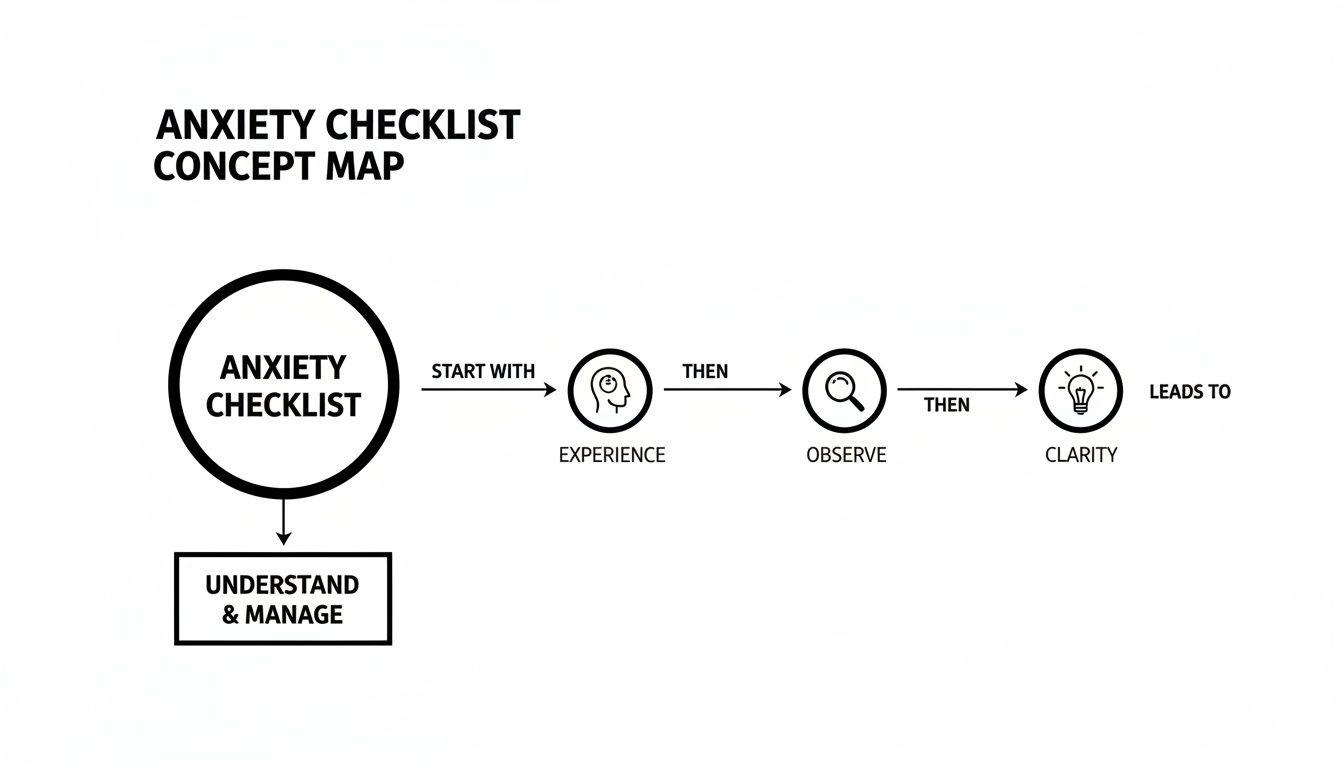
This visual shows how a checklist transforms those overwhelming feelings into actionable insights you can use to build a better life.
The Emotional Pillar: The Weight of Your Feelings
The emotional pillar covers the core feelings that define the experience of anxiety. While "worry" is a cognitive activity, emotions are the felt sense of that mental state. These feelings can be heavy, but they are not permanent.
Common emotional symptoms include:
- A Sense of Dread: A constant, nagging feeling that something terrible is about to happen.
- Irritability: Snapping at loved ones because your nervous system is completely overloaded.
- Restlessness: An inner agitation that makes it impossible to relax.
These emotions are exhausting, but they are not you. They are simply signals that your system is out of balance. By naming and acknowledging them without judgment, you start to take away their power and create space for peace to return.
The Behavioral Pillar: How Anxiety Changes Your Actions
Finally, the behavioral pillar is about what you do—or don't do—because of the other three pillars. These actions are your attempts to cope, but they usually end up shrinking your world and making the anxiety stronger.
For example, if you have a panic attack in a grocery store (physical and emotional), you might start thinking all grocery stores are dangerous (cognitive). The result? You start avoiding them entirely (behavioral). This avoidance brings a moment of relief, but it reinforces the underlying fear.
Other behavioral symptoms include procrastination or pulling away from friends. By recognizing how anxiety is steering your actions, you can start to make conscious choices that align with the life you want to live, not the one fear is dictating for you. This is how you reclaim your world, one brave step at a time.
The Four Pillars of Anxiety Symptoms
To help you put this all together, here's a quick breakdown of what these pillars look like in real life. Seeing them side-by-side can help you spot your own patterns more clearly as you begin your journey to wellness.
| Symptom Pillar | Common Manifestations | What It Feels Like |
|---|---|---|
| Physical | Racing heart, shortness of breath, dizziness, sweating, muscle tension, stomach upset. | "Am I having a heart attack?" "I can't breathe." "I feel like I'm going to pass out." |
| Cognitive | Constant worrying, "what if" scenarios, catastrophic thinking, racing thoughts. | "Something awful is about to happen." "I can't turn my brain off." "I'm losing control." |
| Emotional | Dread, irritability, restlessness, feeling on edge, overwhelming fear. | "I just feel scared all the time." "Why am I so agitated?" "I can't relax." |
| Behavioral | Avoiding places or situations, procrastination, social withdrawal, seeking reassurance. | "I'll just stay home." "I can't face that right now." "Are you sure everything's okay?" |
This four-pillar framework gives you a complete picture, showing you exactly where to focus your energy for a life with less fear and more freedom.
How to Use Your Checklist for Real Insight
You’ve gone through the list and checked the boxes. Now what? This is the point where your completed anxiety disorder checklist transforms from a simple list into a powerful tool for real, lasting change. This is where the healing work—and the real hope—truly begins.
The goal here isn't to judge yourself. It’s about getting curious. Think of yourself as a detective, gently investigating the patterns of your own mind and body. Every symptom you’ve noted is a clue that can guide you toward recovery.
This process is about turning that overwhelming, vague feeling of "anxiety" into a concrete roadmap for healing. It’s how you start to see that a life free from the grip of panic isn't just possible—it's your future.
Creating the Right Environment for Reflection
To get the most out of this, be intentional. Carve out a quiet moment for yourself where you won't be interrupted. Grab a cup of tea, find a comfortable chair, and take a few slow, deep breaths. This small ritual does more than just relax you; it sends a signal to your nervous system that you're in a safe space to heal. It allows you to approach your checklist with a calm, open mind, ready for honest reflection.
Becoming a Pattern-Finder
With your checklist in hand, it's time to look for patterns over time. A single checklist is a snapshot, but tracking your symptoms reveals the bigger story. This is how you uncover the triggers and cycles that keep anxiety going, and how you find the keys to unlock them.
Start by asking yourself a few gentle questions:
- When do these symptoms seem to get worse? Is it on Sunday nights? After your morning coffee, or when you haven't had enough sleep?
- What thoughts are running through my head when I feel most anxious? Do you notice a recurring theme of "what if" scenarios?
- How do my behaviors connect to my feelings? Do you find yourself avoiding social events after a week where your physical anxiety was high?
Pinpointing a specific trigger, like caffeine, or a common thought pattern, like 'all-or-nothing' thinking, gives you a tangible starting point for action. This is a complete game-changer. Instead of fighting a shapeless monster called "anxiety," you can now address a specific problem. These small, targeted actions are the building blocks of profound and lasting change.
The purpose of your checklist isn’t self-diagnosis; it’s self-awareness. It moves you from being a passive victim of your symptoms to an active participant in your healing, empowering you with the knowledge to create a panic-free life.
Turning Insights into Actionable Steps
Once you start seeing these patterns, the path to feeling better becomes so much clearer. The checklist transforms into a dynamic guide for your personal recovery plan.
For example, if you notice your physical symptoms spike every time you have a presentation at work, you now have a specific target. You can start researching breathing exercises to calm your body. If you realize your cognitive loops are at their worst late at night, you can explore journaling to get those swirling thoughts out of your head and onto paper.
This is exactly how healing happens—not in one giant leap, but through a series of small, informed steps. Each insight you gain from your checklist illuminates another piece of the puzzle, giving you the power to build new habits and coping mechanisms. You begin to prove to yourself, one day at a time, that you are more than your anxiety and that a life of peace is within your reach.
Building Your Toolkit for a Life Without Fear
Understanding the patterns behind your anxiety is a monumental first step. But real power comes from turning those insights into action. This is where you shift from being an observer of your anxiety to becoming the architect of your own well-being, actively building a toolkit of strategies that will lead you to a life defined by freedom, not fear.
Let's walk through how to construct that personalized toolkit for lasting relief and recovery.

This is where The Anxiety Checklist comes in—a complete system designed to guide you from awareness to implementation. It's more than a list of symptoms; it's the bridge connecting what you're feeling to what you can actually do about it. The journey toward a panic-free life is absolutely possible, and it all starts with equipping yourself with the right tools.
Beyond Symptom Tracking Into Action
A simple anxiety disorder checklist helps you see the "what." A comprehensive system like The Anxiety Checklist shows you the "how." It moves beyond just cataloging symptoms and gives you a structured framework for building new, healthier habits for a peaceful mind.
This system is built on three core pillars designed to create a strong foundation for resilience:
- Cognitive Strategies: These are the techniques you'll use to rewire the negative thought loops that fuel anxiety. You learn to challenge catastrophic thinking and replace it with more balanced, realistic perspectives.
- Lifestyle Adjustments: Small, consistent changes in your daily routine can have a huge impact on your nervous system. This pillar focuses on optimizing sleep, nutrition, and movement to build a body and mind that are naturally more resilient.
- In-the-Moment Techniques: When panic strikes, you need practical tools that work right now. This involves learning simple methods to ground yourself, calm your body's fight-or-flight response, and navigate those acute moments with confidence.
Creating Your Personalized Action Plan
The Anxiety Checklist provides customizable worksheets that help you translate these broad strategies into a concrete plan tailored to your life. Instead of feeling overwhelmed, you can focus on small, manageable steps that build on each other.
For example, your plan might start with a simple commitment: a five-minute breathing exercise each morning. As you gain confidence, you might add a weekly goal to challenge one specific anxious thought. These targeted actions create momentum, proving to you, step by step, that change and healing are within your reach. To round out your toolkit, exploring practical mind-body connection exercises can be a powerful addition.
The goal isn't to eliminate the normal human emotion of anxiety. It's to recover from an anxiety disorder—a state where symptoms disrupt and control your life—so you can live without constant, debilitating fear. This is an achievable goal.
Hope, Healing, and Taking Back Control
The impact of untreated anxiety is staggering. People with social anxiety disorder often suffer for an average of 10 years or more before seeking help—a decade where life is smaller than it needs to be.
This is exactly why taking proactive steps with a structured system is so crucial. It shortens that gap between suffering and relief, and brings hope back into your life.
Every tool you add to your toolkit is an act of empowerment. Whether it's learning powerful grounding techniques for anxiety or simply scheduling time for rest, you are actively participating in your own healing. You are building a life where you are in control, free to pursue your goals and passions without fear holding you back.
Got Questions About Anxiety Checklists? Let's Clear Things Up.
Taking that first step toward understanding your anxiety can bring up a lot of questions. It's completely normal to feel a mix of hope and nervousness when you start using an anxiety disorder checklist. This section is designed to answer those common questions, giving you clear, straightforward answers so you can move forward with confidence and hope.
Think of this as a conversation to smooth out the road ahead. Our goal is to clear up any doubts and make sure you feel supported every step of the way. Healing is possible, and getting clear on where you're starting from is the first big move.
Can This Checklist Actually Diagnose My Anxiety?
This is the most important question: no, a self-guided checklist cannot give you a formal diagnosis. It’s critical to see this tool for what it is—a powerful way to build self-awareness and hope, not a replacement for a clinical assessment from a qualified mental health professional.
Think of it this way: if you felt physically sick, you might track your symptoms before going to the doctor. That list doesn't diagnose you, but it makes your conversation with the doctor incredibly productive.
An anxiety checklist does the same for your mental health. It helps you gather and organize the data of your own life, turning vague distress into a clear overview. This process makes you an empowered partner in your own healing, whether you work with a therapist or use self-guided strategies. A formal diagnosis can only come from a professional, but this checklist is an invaluable first step in truly understanding what you're going through and seeing that a path forward exists.
What if My Results Are Really High?
Seeing a long list of checked boxes can be a shock. Before you panic, take a deep breath and let's reframe what you're looking at. A high score isn't a life sentence or a sign that you're broken.
In fact, think of it as validation. It's undeniable proof that what you've been feeling is real, significant, and deserves compassionate attention. It confirms that you haven't been "overreacting." Your struggle is valid.
More importantly, this is your starting line for healing. This information is a powerful motivator to start taking action. It's a clear signal that it's time to prioritize your well-being, explore coping strategies, and consider reaching out for support. High results don't mean you're in a worse position; they mean you now have a much clearer picture of what needs your care on your journey to recovery.
How Often Should I Use a Checklist?
After your first detailed assessment, you might wonder what the right rhythm is for checking in again. When tracking your mental wellness, consistency is more valuable than intensity. You don’t need to obsessively monitor your symptoms.
A really effective approach is to use the checklist for weekly or bi-weekly check-ins. This timing is frequent enough to help you spot new patterns and track your healing progress, but spaced out enough that it doesn't become another source of anxiety.
Think of it like a wellness journal. That first assessment gives you a baseline. The check-ins that follow show you how the new coping strategies you're trying are working.
- Did your physical symptoms ease up after you started a daily walk?
- Are those looping thoughts less intense now that you've been practicing mindfulness?
- Did cutting back on caffeine lead to better sleep and fewer feelings of dread?
Regular check-ins help you stay mindful, make smart adjustments to your toolkit, and—just as importantly—celebrate the small wins along your path to a panic-free life.
Is It Actually Possible to Heal From an Anxiety Disorder?
Yes. Unquestionably, yes. Healing from an anxiety disorder is absolutely possible. Millions of people do it. But it's important to be clear on what "healing" really means here.
The goal isn't to erase the normal human emotion of anxiety forever. In healthy doses, anxiety is a natural and helpful part of life.
Healing from an anxiety disorder means recovering from a state where that alarm system is stuck in the "on" position—where symptoms are chronic, overwhelming, and get in the way of you living your life.
Recovery means:
- Bringing your symptoms down to a manageable, non-disruptive level.
- Learning how to navigate moments of panic without letting them spiral.
- Building the resilience and coping skills to live without that constant background noise of fear.
Ultimately, healing is about getting your life back. It’s the process of moving from a life defined by limitations to one where you are in the driver’s seat—free to chase the relationships, career, and experiences that truly matter to you. It's about reclaiming your world from the grip of fear, and with the right tools and support, it is an achievable reality.
The path to a panic-free life begins with understanding. With The Anxiety Checklist, you get more than just a list of symptoms; you get a complete system designed to guide you from insight to action. This eBook and interactive spreadsheet provide the cognitive strategies, lifestyle adjustments, and in-the-moment techniques you need to build your personalized toolkit for lasting freedom.
Take the first step toward reclaiming your life today. Learn more and get your copy at The Anxiety Checklist.