
No, stress and anxiety are not the same thing, but they often feel like two sides of the same coin. Most of us use the words interchangeably, and it's easy to see why—they share a lot of the same physical and emotional symptoms.
But understanding the one key difference is the first hopeful step toward managing these powerful feelings and reclaiming your life. It's the moment you realize that what you're feeling is not a life sentence, but a challenge you can absolutely learn to navigate.
Stress is your body's reaction to a specific, external trigger, like a looming work deadline or a difficult conversation. Anxiety, on the other hand, is a persistent feeling of apprehension that can linger long after the trigger is gone, or even show up without any clear reason at all.
Understanding the Core Difference Between Stress and Anxiety
If you’ve ever felt your heart pound before a big presentation, you know what stress feels like. It’s your body’s natural alarm system, a direct response to a clear and present challenge.
Think of it like a fire alarm that blares when it detects smoke—it’s loud, urgent, and focused on an immediate threat. Once you deal with the situation, like putting out the small kitchen fire, the alarm stops.
Anxiety, however, is like a faulty smoke detector that keeps chirping softly in the background, even when there's no fire. It’s an internal state of worry that doesn't always need a specific reason to show up. This feeling can stick around, creating a constant sense of unease or dread about things that may or may not happen.
Stress as a Reaction vs. Anxiety as a Condition
Stress is almost always a temporary response. The symptoms—like tense muscles or focused worry—typically fade once the external pressure is gone. The tension you feel during a traffic jam usually disappears once the road clears.
Both stress and anxiety can activate the body’s emergency alert system, which you can learn more about in our detailed fight-or-flight response guide.
Anxiety, however, often has a life of its own. It can become a self-sustaining condition that persists even in the absence of an immediate threat. And it's more common than you might think.
According to the National Institute of Mental Health, 19.1% of U.S. adults experienced an anxiety disorder in the past year, and the lifetime prevalence is a staggering 31.1%. This shows how a persistent state of worry can evolve far beyond a temporary reaction.
The most empowering realization is this: distinguishing between stress and anxiety isn't just an academic exercise. It's the first practical tool you can use to start dismantling fear. When you can name what you're feeling, you can begin to heal it.
This infographic breaks down the core differences in a simple, visual way.
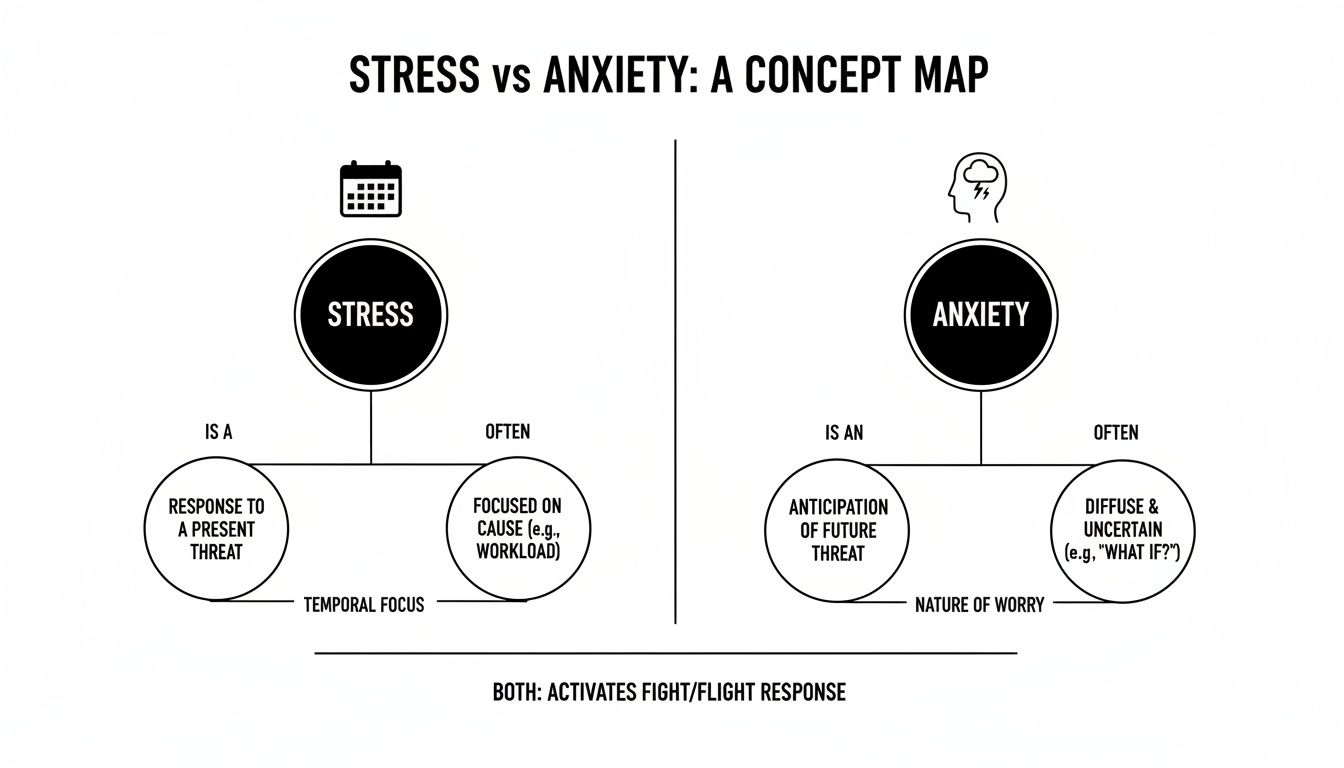
As you can see, stress is tied to what's happening to you, while anxiety is more about what's happening inside of you.
To make this even clearer, let's break down the key differences in a simple table. This is a great way to quickly check in with yourself and identify what you're truly feeling.
Stress vs Anxiety at a Glance
| Characteristic | Stress | Anxiety |
|---|---|---|
| Cause | An external trigger (e.g., a deadline, an argument) | Often internal; can occur without a clear trigger |
| Duration | Temporary; ends when the stressor is gone | Persistent; can last long after a stressor is gone, or be ongoing |
| Emotional Focus | Frustration, irritability, nervousness | Worry, apprehension, fear, a sense of dread |
| Time Focus | Focused on the present challenge or demand | Focused on the future and potential (often negative) outcomes |
| Physical Symptoms | Headache, muscle tension, fatigue, digestive issues | Similar to stress, but can also include trembling, sweating, and rapid heartbeat that feels disconnected from the situation |
| Nature | A response to a threat | A reaction to the emotion of stress itself, or to an internal feeling of unease |
Seeing it laid out like this really highlights the distinction, doesn't it? Stress is about dealing with a problem in front of you. Anxiety is often about the feeling of being threatened, even when the threat isn't obvious.
Recognizing this distinction is a game-changer because it shapes your approach. You manage stress by tackling the external problem. But you heal from anxiety by learning to work with your internal response. This isn't a life sentence; it is a challenge you can absolutely learn to navigate. With the right tools and understanding, you can learn to quiet the alarm and live a calm, present life.
Recognizing How Stress and Anxiety Show Up in Your Life
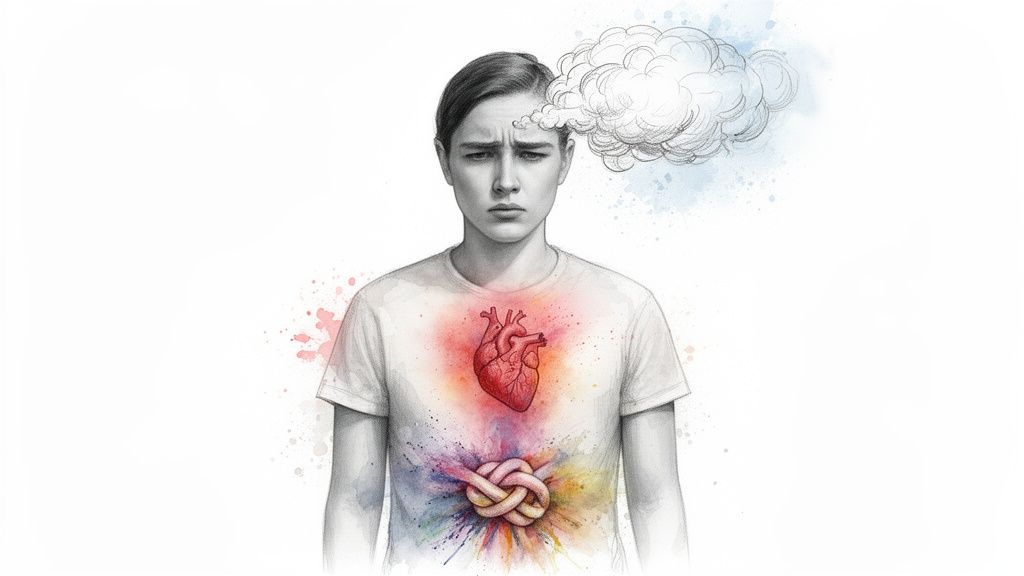
Knowing the definitions is a good start, but the real power comes from recognizing how these feelings actually show up in your own body and mind. Both stress and anxiety can sound the same internal alarm—your fight-or-flight response—triggering a cascade of physical and mental signals. But learning to spot the subtle differences is what allows you to respond with intention instead of just reacting out of fear.
This is where you become the expert on your own experience. That self-awareness is the foundation of getting better. By paying close attention, you can start connecting the dots between your feelings and what triggers them, giving yourself a roadmap to regain control.
The Physical Footprint of Stress
When you’re dealing with stress, your body often sends you clear, immediate clues. Think about the last time you had a big deadline looming. Did you feel that familiar tightness in your chest or a knot twisting in your stomach? These physical symptoms are tied directly to the stressful event itself.
The key identifier here is that stress symptoms are situational. They flare up because of a specific, identifiable cause and—most importantly—they usually disappear once the situation is over. The headache you get from a demanding project often fades the moment you finally hit "send."
Common physical signs of stress include:
- Tense Muscles: Your shoulders might feel like they're creeping up toward your ears.
- Digestive Issues: A sudden upset stomach right before an important meeting is a classic sign.
- Fatigue: Feeling completely drained after a particularly demanding day.
- Headaches: Tension headaches that seem to build throughout a challenging situation.
Once the source of stress is gone, your body starts to return to its normal state. This direct cause-and-effect relationship is a crucial distinction when you’re trying to figure out if what you're feeling is stress or something more.
How Anxiety Feels in Your Body and Mind
Anxiety, on the other hand, often feels like a lingering echo. Its symptoms can become chronic, showing up as a persistent feeling of being on edge for no apparent reason. The physical sensations can feel just as intense as stress, but they lack a clear "off" switch.
This is the difference between a temporary reaction and a persistent state of being. You might feel a constant sense of dread, or your heart might race while you’re simply sitting on the couch watching TV.
A key sign of anxiety is when the physical and mental symptoms feel disproportionate to the situation—or have no obvious trigger at all. This feeling of being "on alert" when there's no visible threat is a hallmark of anxiety.
Anxiety often shows up as:
- A constant knot of dread: A feeling in your stomach that just won't go away.
- Relentless 'what-if' thoughts: Your mind races with catastrophic scenarios about the future.
- Feeling on edge: A persistent sense of unease and hypervigilance, like you're always waiting for the other shoe to drop.
- Chronic muscle tension: The tightness in your neck and shoulders never seems to fully release.
These symptoms can disrupt your sleep, make it hard to concentrate, and create a cycle of worry that feeds on itself. It stops being just a response to a problem; it becomes a problem in its own right. If you're noticing these patterns in yourself, you might want to learn more by taking a clinically validated GAD-7 anxiety test to get a clearer picture of your experience.
This shift from situational stress to chronic anxiety is a critical turning point. Recognizing it isn't a sign of weakness—it's a moment of profound clarity. It's the point where you stop asking, "What's wrong with me?" and start asking, "What can I do about this?" This is where the journey to living panic-free truly begins.
When Does Everyday Worry Tip Into an Anxiety Disorder?
Everyone gets anxious. It’s part of the human package. But what happens when that quiet hum of worry in the background cranks up to a constant, deafening roar? There’s a line where everyday anxiety crosses into a clinical anxiety disorder, and seeing that line is the first, bravest step you can take.
Let’s be clear: this shift has nothing to do with personal weakness or a flaw in your character. It’s a medical distinction, the same way a passing headache is different from chronic migraines. The three things that signal this change are intensity, duration, and interference.
When worry becomes excessive, sticks around for months, and actively gets in the way of your life—that's the tipping point. It’s when the fear of what might happen starts shrinking your world, messing with your job, your relationships, and your ability to just feel okay.
The Shift from a Feeling to a Disorder
Think of normal anxiety as a helpful alarm. It’s the thing that makes you double-check that you locked the door or look both ways before crossing the street. It’s useful.
But an anxiety disorder is like that alarm getting stuck in the "on" position, blaring a five-alarm fire when you’re perfectly safe at home.
This isn’t just a feeling; it’s a constant state of high alert that takes a serious toll. The COVID-19 pandemic gave us a clear picture of this. We saw how acute stress from lockdowns spiked temporarily, but anxiety disorders became a much longer-lasting public health challenge. Even though it's a leading mental health issue globally, only about 1 in 4 people worldwide get treatment.
Here in the United States, the numbers show just how common this is. In 2022, Generalized Anxiety Disorder (GAD) affected 3.1% of adults (that’s 6.8 million people). Panic Disorder hit 2.7% (6 million), and Social Anxiety was a reality for 7.1% (15 million). What’s really concerning is that for something like social anxiety, 36% of people wait 10 years or more before even asking for help, often because of stigma or just not knowing where to start.
Common Types of Anxiety Disorders
"Anxiety" is a big, vague word. But when it becomes a disorder, it often takes on specific shapes. Putting a name to what you're feeling can be incredibly validating. It's not just "being a worrier"—it’s a recognized condition with a clear path forward.
Here are a few of the most common types, put simply:
- Generalized Anxiety Disorder (GAD): This is chronic, over-the-top worry about everyday things. If you have GAD, you might constantly expect the worst about money, health, or family, even when there's no real reason to.
- Panic Disorder: This involves sudden, intense waves of fear that trigger severe physical reactions when there’s no actual danger. These panic attacks are so terrifying that people often start living in fear of the next one, which can seriously limit their lives.
- Social Anxiety Disorder: This is an intense fear of being watched and judged by others. It can make work, school, and just about any social situation feel impossible, making it incredibly hard to connect with people.
If any of these sound familiar, it's worth looking into them more. You can read our guide to learn more about the different types of anxiety disorders and what they feel like.
Recognizing the signs of an anxiety disorder is not an admission of defeat—it is the beginning of your recovery. A diagnosis is not a label that defines you; it is a map that shows you the way out.
This is the most important thing to take away. Understanding that what you’re facing has a name—and that there’s a well-traveled road to getting better—is incredibly empowering. Real, evidence-based treatments exist, and countless people have used them to build lives free from the grip of constant fear. You are not alone, and help is out there.
Actionable Techniques to Manage Stress in the Moment
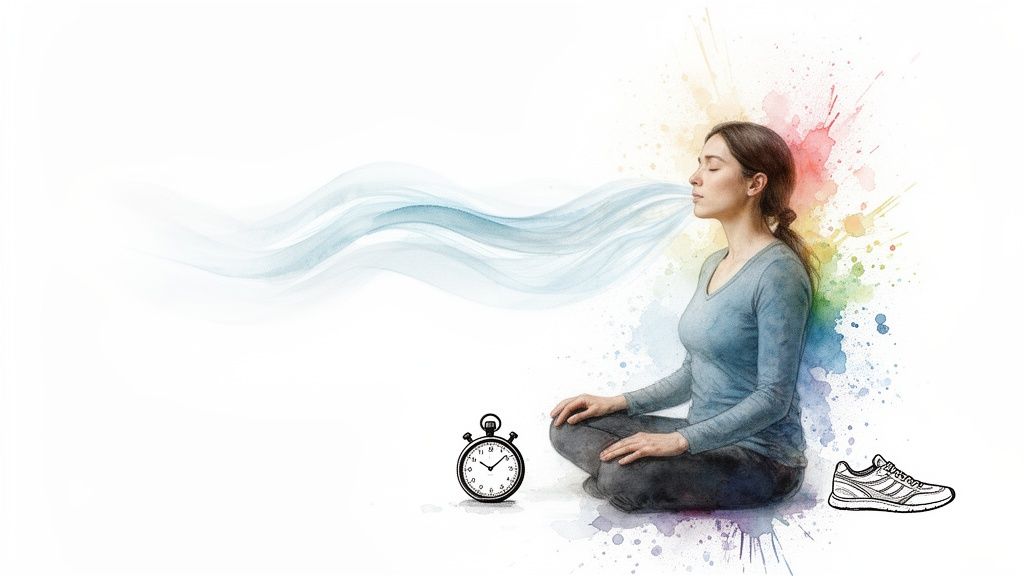
Now that you can spot the subtle differences between stress and anxiety, it's time to build a toolkit of practical, in-the-moment strategies. While tackling chronic anxiety is a much deeper journey, learning to manage immediate stress gives you instant relief.
More importantly, it builds confidence. Every time you successfully calm your nervous system, you're proving to yourself that you have the power to change how you feel.
These techniques are simple by design—no special equipment or tons of time needed. They are concrete actions you can take right now, wherever you are, to dial down the intensity and get back in the driver's seat.
Grounding Your Body and Mind
When stress hits, it’s like your body's alarm system goes into overdrive. The fastest way to turn it down is to use your body to send a "safe" signal to your brain. This is where simple physical and mental resets come in.
Your most accessible tool is your own breath. The 4-7-8 breathing technique is a surprisingly powerful way to soothe your nervous system almost instantly. It works by flipping the switch on your body's relaxation response, the parasympathetic nervous system.
Here’s the simple breakdown:
- Inhale quietly through your nose for a count of 4.
- Hold your breath for a count of 7.
- Exhale completely through your mouth, making a whoosh sound, for a count of 8.
Repeat this cycle three or four times. That long exhale is the real secret—it slows your heart rate and tells your body the danger has passed. If you want to explore this further, you can find a whole range of other powerful breathing exercises for anxiety that offer similar relief.
The goal isn't to stop feeling stress forever—it's to get better at responding to it. These small, intentional actions interrupt the stress cycle before it can escalate, giving you a crucial moment of clarity and calm.
Another great technique is a five-minute mindfulness exercise. Just find a quiet spot, close your eyes, and focus on your senses. What do you hear? What do you feel against your skin? This pulls your mind out of worrying about the future and grounds it firmly in the present. Even a quick walk around the block can do the trick, combining light movement with a change of scenery to clear your head.
Breaking Down Overwhelming Tasks
Stress often feels like a massive, insurmountable wall, especially when it’s tied to a huge project or a never-ending to-do list. The Pomodoro Technique is a brilliant little hack that helps you fight that feeling of overwhelm by breaking the wall down into small, manageable bricks.
It couldn't be simpler:
- Pick one single task.
- Set a timer for 25 minutes and work on only that task, no distractions.
- When the timer dings, take a 5-minute break.
- After four of these "Pomodoros," take a longer break of 15-30 minutes.
This method makes starting feel less intimidating and gives you a built-in structure for rest. For those looking for other ways to quiet the noise, exploring how to unlock the benefits of using a sauna for mental clarity and stress relief can also offer a direct path to immediate calm. Each 25-minute block is a small victory that proves you can make real progress, one step at a time.
Your Hopeful Path to Living Panic Free
While knowing how to manage stress in the heat of the moment is a crucial skill, building a life that isn’t constantly overshadowed by chronic anxiety is a deeper, more meaningful journey. This is where we shift from putting out fires to rebuilding the foundation. It all starts with one core belief: healing from anxiety isn't just a nice idea—it's an achievable reality.
This isn’t about just wishing the fear away. It’s about taking intentional, structured steps to get your life back. A full, fearless life isn’t some far-off dream; it's a destination you can absolutely reach with the right map.
Retraining Your Brain with Evidence-Based Strategies
For years, anxiety might have felt like it was in the driver's seat, hijacking your thoughts and calling the shots. But what if you could learn how to talk back? That’s the entire idea behind powerful, evidence-based methods that have helped millions of people find lasting relief.
One of the most effective tools out there is Cognitive Behavioral Therapy (CBT). Think of CBT as a practical, hands-on workshop for your mind. It teaches you to become a detective of your own thoughts, spotting the anxious patterns that keep the cycle of fear going.
With CBT, you learn to:
- Catch negative thoughts: You get good at noticing those automatic, unhelpful thoughts that sneak in when you feel anxious (like, "I'm going to bomb this presentation, and everyone will think I'm a fraud").
- Challenge them: Then, you put that thought on trial. Is it 100% true? Is there a more balanced, realistic way to see this?
- Reframe them: Finally, you replace the anxious thought with one that’s actually helpful (e.g., "I've prepared for this. It’s normal to be nervous, but I can handle it even if I stumble over a word or two").
This process isn't about pretending you don't have certain feelings. It's about fundamentally changing your relationship with your thoughts, proving to yourself that a thought is just a thought—not a prophecy carved in stone.
The Power of Empowering Lifestyle Choices
While retraining your mind is a game-changer, building a solid foundation for mental wellness involves your whole body. Making strategic lifestyle shifts isn't just another chore to add to your list; these are empowering choices that create an internal environment where anxiety simply has a harder time taking root.
This is all about making small, consistent changes that add up to a massive difference over time. It’s not about perfection; it’s about progress.
Think about these three core areas:
- Nutrition: What you eat directly feeds your mood and brain function. Focusing on whole foods, keeping your blood sugar stable, and cutting back on caffeine can have a surprisingly calming effect on your entire nervous system.
- Sleep: Anxiety and poor sleep are notorious for feeding each other in a vicious cycle. Getting into a consistent sleep routine is one of the most powerful and restorative things you can do for your mental health.
- Movement: Regular physical activity is a potent anxiety-buster. It helps burn off stress hormones like cortisol while releasing mood-boosting endorphins, acting as a natural balm for a worried mind.
Taking charge of these areas gives you real, tangible proof that your daily actions matter. Every healthy meal, restful night, or brisk walk is a vote you cast for a calmer, more resilient you.
A Structured Approach to Lasting Change
Trying to overcome anxiety can feel like a lonely, uphill battle, especially when you have no idea where to even begin. The statistics show just how many people are in the same boat. While the lifetime prevalence of anxiety disorders in the U.S. is a staggering 31.1% for adults and 31.9% for teens, a huge treatment gap remains. Only 43.2% of adults with Generalized Anxiety Disorder (impacting 6.8 million people) are actually getting treatment. These numbers highlight how many people are trying to figure this out on their own. You can discover more insights about the global impact of anxiety disorders and the importance of accessible care in this comprehensive study.
A full and fearless life is built not on the absence of anxiety, but on the presence of skills to manage it. You have the capacity to learn these skills and rewrite your story.
This is exactly where a structured, supportive approach can light the way. It takes the overwhelming goal of "beating anxiety" and breaks it down into a series of manageable, actionable steps. Instead of feeling lost, you have a clear plan to follow, which builds momentum and confidence with every step forward. Our guide on concrete anxiety recovery steps is designed to help you create this exact kind of structured plan.
Your journey to living panic-free begins with the hopeful belief that you are not broken. You are simply a person who needs a better set of tools—and those tools are absolutely within your reach.
A Few Lingering Questions
As you start putting these ideas into practice, a few questions are bound to pop up. That's a good thing—it means you're engaged and thinking critically. Let's clear up some of the most common ones right now.
Can Stress Actually Turn into an Anxiety Disorder?
Yes, it absolutely can. Think of it this way: chronic, unmanaged stress is like leaving your body's alarm system switched on, 24/7.
Initially, that alarm is helpful—it gets you through a tough deadline or a family emergency. But when it never shuts off, your brain starts to rewire itself. It learns that "high alert" is the new normal. Before you know it, you're feeling anxious and on-edge even when the original stressor is long gone.
This is why getting a handle on stress isn't just about feeling better today. It's one of the most powerful, proactive things you can do to protect your mental health for the long haul.
Is It Possible to Be Completely "Cured" of Anxiety?
While "cure" isn't quite the right word—anxiety is a normal human emotion, after all—it is 100% possible to manage it so effectively that it no longer runs your life.
The real goal isn't to silence anxiety completely. It's to turn the volume down from a deafening roar to a manageable background hum.
Success looks like catching a panic attack before it takes hold. It's learning to observe an anxious thought without getting swept away by it. Millions of people have done this, reclaiming their lives from the grip of chronic anxiety. That freedom is not just possible; it's waiting for you.
Your support can be a powerful force for healing. The goal isn't to 'fix' them, but to offer a steady, non-judgmental presence that reminds them they are not alone on their path to recovery.
How Can I Support a Loved One with Chronic Anxiety?
This is one of the most important questions, and the answer is simpler than you might think. Your presence is the most powerful tool you have.
Start by just listening. You don't need to solve their problems; you just need to hear them. Simple phrases like, "That sounds incredibly hard," or "I'm here with you," can make a world of difference.
Here are a few other practical things you can do:
- Educate yourself. Understanding what they're going through helps you offer more meaningful support.
- Encourage professional help. Gently suggest they explore therapy or other resources, without pressure.
- Offer practical support. Sometimes anxiety makes small tasks feel huge. Offer to go with them to an appointment, help with groceries, or just sit with them while they make a difficult phone call.
Most of all, remind them of their own strength. Your belief in them can help them rediscover their belief in themselves.
At The Anxiety Checklist, we believe everyone deserves to live a life free from the constraints of fear. Our program, Fearless Living, provides a structured, step-by-step system to help you understand, manage, and overcome chronic anxiety and panic attacks. Take the first step toward a calmer, more confident you by exploring The Anxiety Checklist today.