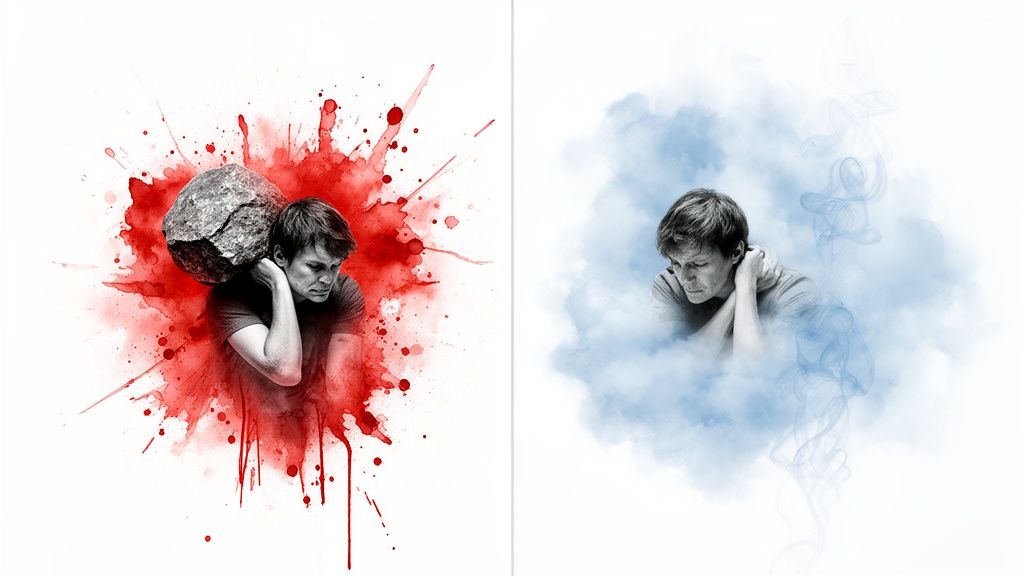
It’s a question I hear all the time: what’s the real difference between stress and anxiety? People often use the words interchangeably, but knowing how to tell them apart is the first crucial step toward feeling in control again. This understanding is the start of a hopeful journey towards healing and living a life free from panic.
Here’s the simplest way to think about it: stress is a reaction to a specific, external trigger, like a looming deadline at work. In contrast, anxiety is persistent worry that often continues even without a clear cause.
Stress usually fades once the situation is resolved. That deadline passes, and you feel the tension release. But anxiety can linger, creating a constant, nagging feeling of apprehension that sticks around long after the trigger is gone—or if there even was one to begin with.
Your Path From Worry to Wellness Begins Here

Feeling overwhelmed is part of being human, but stress and anxiety aren’t the same experience. Getting clear on the difference is more than just a semantics game; it’s an act of empowerment. It’s the moment you stop seeing your struggle as a vague, unbeatable monster and start identifying it for what it truly is.
This clarity is the foundation for healing. It allows you to build a life defined by confidence, not by fear, and to know in your core that recovery is possible.
Both stress and anxiety can activate your body’s internal alarm system, but they operate on different timelines and for different reasons.
- Stress is your body’s response to a present-tense challenge. Think of it as a short-term sprint. Your heart pounds before a big presentation because your body is gearing you up to perform under pressure.
- Anxiety is a state of apprehension about a future-tense threat. It’s a marathon of “what ifs” that can feel absolutely endless. You might worry about that same presentation for weeks, imagining every possible thing that could go wrong.
This distinction is crucial because it helps you pinpoint the source of your distress. While both can feel all-consuming, recognizing that one is a direct reaction and the other is a persistent state of being opens the door to targeted, effective solutions and a future free from fear.
Quick Comparison Stress vs Anxiety
To break it down even further, here’s a table highlighting the key characteristics of stress and anxiety at a glance. Seeing them side-by-side can make the differences crystal clear.
| Characteristic | Stress | Anxiety |
|---|---|---|
| Primary Trigger | A specific, identifiable external event (e.g., traffic jam, work project). | Often internal; persistent worry that may lack a clear trigger. |
| Duration | Temporary; subsides after the stressful event ends. | Can be long-term and chronic, lasting for weeks, months, or longer. |
| Focus | Rooted in the present moment and a specific situation. | Future-oriented, focusing on potential negative outcomes and "what ifs." |
| Response Type | A reaction to a real or perceived threat in the here and now. | A state of apprehension or dread, often disproportionate to the actual situation. |
Both stress and anxiety kickstart the body's natural alert system. If you want to dive deeper into this reaction, our detailed guide on the fight-or-flight response offers valuable insights into how your body responds to perceived threats.
Knowing the difference is the first, most powerful step you can take. It moves you from being a passenger in your own emotional storm to becoming the navigator who can steer toward calmer waters. A panic-free life is not just a hopeful idea—it’s an achievable reality.
The Physical and Mental Fingerprints of Each

To really get the difference between anxiety and stress, you almost have to feel it. Both can set off your body’s alarm system, but they leave profoundly different marks on your body and mind. Learning to spot these distinct “fingerprints” is the first step toward finding relief—and realizing that a calm, panic-free life is absolutely possible.
Stress usually makes its presence known with sharp, temporary physical reactions. Think about giving a speech: your heart pounds, your palms get sweaty, and your stomach does a little flip. These are classic, acute responses to a specific trigger, designed to get you through a challenge. As soon as the speech is over, your body typically goes back to normal.
Anxiety, however, plays a different game. It can dig in for the long haul, creating a state of chronic physiological arousal. Instead of a temporary racing heart, you might find yourself with persistent muscle tension in your shoulders, ongoing digestive problems, or even a weakened immune system from being stuck on high alert.
The Physical Manifestations
While both can make your heart race, their physical signatures diverge in intensity and how long they stick around. Pinpointing these differences can help you make sense of what you’re experiencing.
- Stress Symptoms: These tend to be sudden and directly tied to a stressful event. Think headaches, short-term muscle aches, fatigue, and temporary digestive upset. The key is that these symptoms usually disappear once the stressor is gone.
- Anxiety Symptoms: These are often more persistent and can feel disconnected from any specific event. You might experience trembling, shortness of breath, dizziness, chronic jitters, and a feeling of being constantly on edge, even when everything seems fine.
Here's the crucial insight: stress is a temporary storm, but anxiety can feel like a constant, oppressive climate. Recognizing this is empowering. It helps you see that what you're feeling isn't a personal failing but a specific condition with specific, manageable symptoms. Hope begins the moment you understand what you're up against, because what is understood can be healed.
This distinction is more than just a feeling; it’s a global health reality. Anxiety disorders differ from everyday stress in their persistence and their impact on daily life. In 2021, an estimated 359 million people worldwide—about 4.4% of the global population—had an anxiety disorder, making them the most common mental disorders on the planet. This isn't just about a looming deadline; it's a condition that can disrupt work, health, and relationships. You can learn more about the global impact of anxiety disorders from the World Health Organization.
The Mental Landscape of Stress vs. Anxiety
Mentally, the contrast is just as stark. Stress tends to narrow your focus, concentrating all your mental energy on the problem right in front of you—the project deadline, the tough conversation, the traffic jam. Your worry is targeted and grounded in the present moment.
Anxiety, on the other hand, creates a diffuse, future-oriented dread. It’s less about a specific problem and more about a whole cascade of "what ifs." The mental chatter is persistent, looping through worst-case scenarios that often have little basis in reality.
Here’s a quick look at their mental profiles:
| Mental Aspect | Stress | Anxiety |
|---|---|---|
| Focus of Worry | Concentrated on a specific, current problem. | Broad, vague, and focused on future uncertainties. |
| Thought Pattern | Problem-solving oriented, even if overwhelmed. | Catastrophizing, imagining worst-case scenarios. |
| Sense of Control | Feeling pressured but believing the stress will end. | A persistent sense of powerlessness and impending doom. |
| Emotional Tone | Primarily frustration, irritability, or pressure. | Dominated by fear, dread, and pervasive unease. |
Telling these mental states apart isn't just an intellectual exercise; it’s a practical tool for getting better. If you're wrestling with persistent, future-focused worry that feels way out of proportion, you might be dealing with more than just stress. A great starting point is to get a clearer picture of your own symptoms, and you can do that with an insightful self-assessment based on the GAD-7 scale. Taking this step gives you the clarity to choose the right strategies and start your journey toward a life where you are in control, not your worries.
The Tipping Point from Stress to an Anxiety Disorder
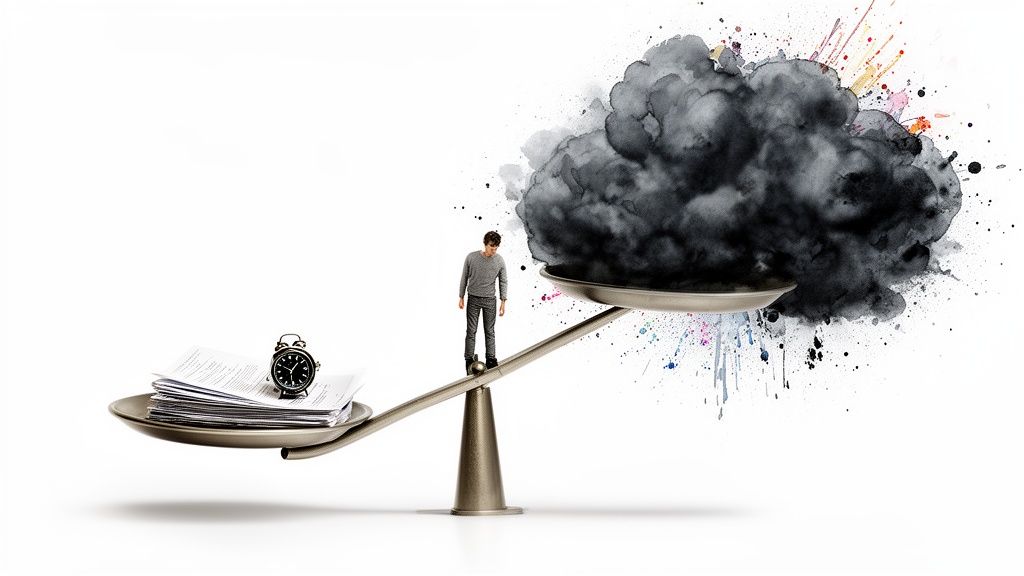
Everyone gets stressed. It’s just a non-negotiable part of being alive. But there’s a critical line where that familiar, manageable stress can morph into a full-blown anxiety disorder.
Recognizing this tipping point isn’t about slapping on a label. It’s about gaining the clarity you need to take back control. The most empowering thing you can do is understand when your body’s natural alarm system has shifted into something more persistent and pervasive.
This transition is rarely sudden. It’s more of a gradual creep, where feelings of worry and unease no longer fade when the stressful situation is over. Instead, they linger, grow, and start to color your everyday experiences—even when there’s no obvious reason. This is where the difference between stress and anxiety becomes a life-altering distinction.
Hope begins the moment you realize this tipping point isn’t a sign of weakness. It's a clear signal that it’s time to find a new path toward healing. A life free from constant worry isn’t just a dream; it's an achievable reality, and understanding this boundary is the first step on that journey.
The Three Pillars of Distinction
Mental health professionals use a few key criteria to tell the difference between everyday stress and a clinical anxiety disorder. These aren't just abstract ideas; they are practical benchmarks focused on how your symptoms are actually affecting your life. Looking at your own experiences through this lens can offer some profound insight.
The three key differentiators are duration, intensity, and impairment.
- Duration (How Long It Lasts): Stress is temporary. It’s the tension you feel during a hectic work week that melts away by the weekend. An anxiety disorder, on the other hand, involves chronic worry that lasts for six months or more on most days.
- Intensity (How Strong It Feels): The emotional kickback from stress is usually proportional to its cause. But with anxiety, the distress often feels completely out of proportion to the actual situation. A small mistake at work might trigger a terrifying spiral of catastrophic thinking that feels totally overwhelming.
- Impairment (How It Affects Your Life): Stress can leave you feeling frazzled, but you can generally still handle your responsibilities. An anxiety disorder actively gets in the way of your daily life. It’s the force that stops you from doing things you want or need to do.
The most hopeful realization is that anxiety is not a life sentence. It is a treatable condition. By identifying these patterns—the long duration, the high intensity, the daily impairment—you are no longer lost in the fog. You are on solid ground, ready to build a new foundation for a calmer, more confident life.
Real-World Scenarios and The Difference They Make
Let's translate these concepts into real-life situations to make the distinction even clearer. Seeing these scenarios side-by-side can illuminate where you might fall on the spectrum and empower you to choose the right course of action.
Scenario 1: Job Hunting
- Stress: You feel nervous and get a racing heart before a big job interview. You practice your answers, feel the pressure, but you still show up for the interview.
- Anxiety: The fear of rejection is so intense that you avoid applying for jobs altogether. You ruminate for weeks about potential questions, catastrophize every possible outcome, and feel paralyzed—unable to even update your resume.
Scenario 2: Social Gatherings
- Stress: Feeling a bit drained or irritable after a long, loud party and needing some quiet time to recharge.
- Anxiety: You dread social events for weeks beforehand, worrying excessively about what others will think of you. You might cancel plans at the last minute or spend the entire event feeling on edge, unable to engage, and then replay every conversation in your head for days.
Recognizing these patterns is the first step toward getting targeted support. To better understand the specific ways anxiety can manifest, you can learn more about the different types of anxiety disorders and their unique characteristics. This knowledge is power—and it’s the key to unlocking a future where you are in charge, not your fear.
Actionable Strategies for Managing Stress and Overcoming Anxiety
Knowing the difference between anxiety and stress is one thing; doing something about it is where the real change happens. This is the part where you move from just identifying the problem to actively solving it. The game plan for managing stress looks different from the one for overcoming anxiety because they tackle different root causes—one is about handling outside pressures, and the other is about rewiring your internal responses.
This isn't just theory. Think of it as a practical toolkit you can start using today to build a calmer, more confident future. A life free from panic isn't some far-off dream. It's an achievable reality built on small, consistent actions.
Taming Stress with In-the-Moment Tactics
Because stress is a reaction to something specific happening right now, the best strategies are direct and solution-focused. They're designed to dial down the immediate pressure and help you feel back in control. This is your first-aid kit for stressful moments.
-
Effective Time Management: A lot of stress comes from feeling buried under too many demands. Techniques like the Pomodoro Method (working in focused 25-minute sprints) or the Eisenhower Matrix (sorting tasks by urgency and importance) can break a mountain of work into a series of manageable steps.
-
Setting Healthy Boundaries: Learning to say "no" is one of the most powerful stress busters out there. Clearly defining your limits, both at work and in your personal life, stops you from taking on more than you can handle—a classic recipe for chronic stress.
-
Simple Relaxation Exercises: When stress hits, your body clenches up. Quick relaxation techniques can offer instant relief. Progressive muscle relaxation—where you intentionally tense and then release different muscle groups—is a great way to physically let go of the tension your body is holding.
For anyone in a leadership role, finding specific ways to support anxious staff and minimise workplace stress can make a huge difference in creating a healthier work environment for the whole team.
Rewiring Your Brain to Overcome Anxiety
Getting a handle on anxiety requires a deeper game plan. It’s not about a single trigger; it’s about changing those persistent, looping patterns of worry and fear. These strategies are all about building long-term resilience and fundamentally changing your relationship with anxious thoughts.
This is where the real hope lies: you have the power to change how your brain responds.
The most empowering truth about anxiety is that your brain can learn new ways of thinking. By consistently practicing new mental habits, you can create new neural pathways, making calm and clarity your new default state. Healing isn't about eliminating worry; it's about making it powerless.
The long-term nature of anxiety is what truly sets it apart from stress. Data from the pandemic showed that while emotional stress shot up to 29.41% in early 2020 and then fell back to just 5.10% as the initial crisis eased, anxiety’s global prevalence stuck around, affecting 359 million people in 2021. This really shows how stress ebbs and flows with events, while anxiety can dig in and become a chronic condition that doesn't just go away.
Foundational Strategies for Lasting Change
Building a panic-free life means creating new habits that support your mental well-being over the long haul. These practices aren't quick fixes; they are the pillars for a lasting sense of calm.
1. Challenge Your Negative Thoughts
This is a core idea from Cognitive Behavioral Therapy (CBT). When you feel anxious, your mind often defaults to the worst-case scenario. The goal here is to catch those automatic negative thoughts and put them on trial. Ask yourself: "Is this thought 100% true? What's a more balanced way to look at this?"
2. Practice Mindful Breathing
Anxiety loves to trap you in a cycle of worrying about the future. Mindfulness yanks you back into the present moment. Simple, controlled breathing is one of the quickest ways to settle your nervous system down. Our guide to breathing exercises for anxiety has easy, step-by-step techniques you can use absolutely anywhere.
3. Make Impactful Lifestyle Adjustments
Certain choices can either pour fuel on the anxiety fire or build up your defenses against it.
- Limit Caffeine and Alcohol: Both are well-known for triggering or worsening feelings of anxiety and panic.
- Prioritize Sleep: A brain that's well-rested is far less likely to get stuck in anxious thinking. Aim for 7-9 hours of quality sleep a night.
- Move Your Body: Regular physical activity is a potent anxiety reducer. Even a 15-minute walk can make a real difference in your mood and stress levels.
By using these different strategies, you can effectively manage the immediate stressors that pop up while also building the mental strength to overcome anxiety for good.
Knowing When to Seek Professional Help
Deciding to get support is one of the bravest things you can do for yourself. It’s not a sign of weakness or a last resort; it's a proactive, hopeful step toward feeling better for good. Honestly, it's a sign of incredible strength.
If your symptoms feel like they're running the show, it might be time to reach out. The path to a life without constant panic is real, and you don’t have to walk it alone.
Key Indicators It Is Time for Support
Sometimes it’s tough to know if what you're feeling is "bad enough" for professional help. If stress has morphed into a persistent anxiety that’s messing with your life, that’s your signal.
Here are a few signs that getting professional support could be the best next step:
- You experience panic attacks: Sudden, overwhelming episodes of intense fear that feel completely out of your control are a major red flag.
- You avoid everyday activities: If you find yourself dodging social events, work tasks, or even simple errands out of fear, anxiety is actively shrinking your world.
- Your symptoms feel unmanageable: When your usual coping tricks aren’t cutting it anymore and you feel constantly overwhelmed, a professional can offer new, effective tools.
This decision tree helps visualize the different paths for managing those overwhelming feelings, showing the split between problem-solving for stress and rewiring your brain for anxiety.
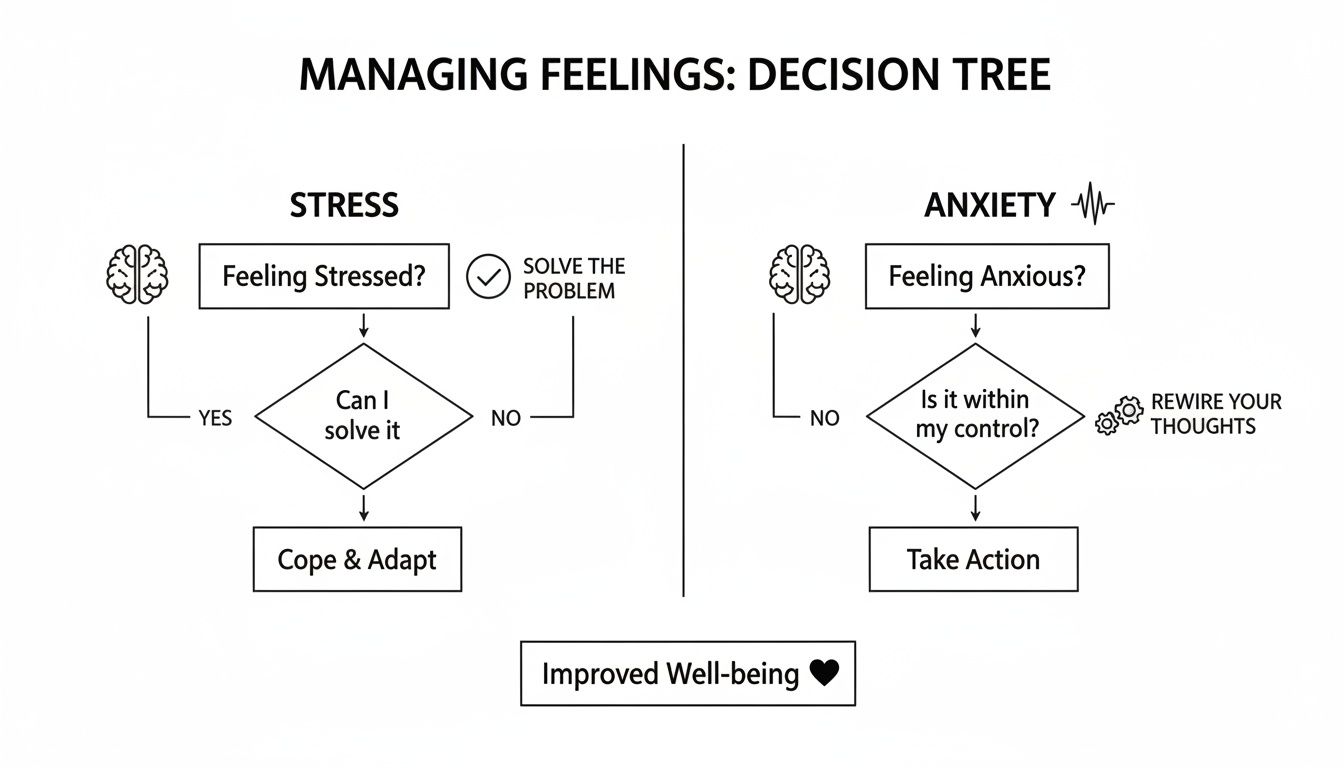
The key takeaway here? Stress often needs external solutions, while anxiety benefits from internal rewiring—a process that therapy is perfectly designed to guide.
Demystifying the Process of Getting Help
Thinking about getting help can feel intimidating, but knowing what to expect makes it much more approachable. Mental health professionals are trained to provide proven treatments that bring profound relief. They create a safe, non-judgmental space where you can figure out your thought patterns and build skills for a calmer future.
The most hopeful part of this journey is realizing that treatments for anxiety are highly effective. You are not broken; you just need the right map to find your way back to peace. Healing is not only possible—it's expected.
Globally, the treatment gap really separates persistent anxiety from everyday stress. Despite proven therapies, only 27.6% of the 359 million people with anxiety disorders in 2021 actually received treatment. This is exactly why taking that first step is so vital and so brave.
Different professionals offer different kinds of support. A therapist can provide talk therapy like CBT, while understanding the role of a psychiatrist for anxiety can clarify your options for medical treatment. For those whose stress or anxiety has spiraled into more severe conditions, looking into support like evidence-based addiction treatment can be a crucial step toward recovery. The right support system is out there, ready to help you build a hopeful, fearless future.
Your Path to a Fearless and Hopeful Future
This entire journey of understanding the difference between anxiety and stress is the first real step toward a life that isn't dictated by fear. Just recognizing what you’re feeling is the moment you start to take back control. You begin shifting your focus from just surviving anxious moments to building a future driven by your values, not by worry.
Recovery isn’t some distant, abstract dream. It’s an achievable reality that begins with the knowledge you have right now.
You’ve learned that stress is a reaction to a specific threat right in front of you, while anxiety is a persistent state of apprehension about what’s to come. This distinction is your roadmap. It makes it clear why stress-management techniques, like setting boundaries, help with immediate pressures. It also shows why deeper strategies, like challenging negative thoughts, are essential for breaking the long-term grip of anxiety.
Embracing a Panic-Free Reality
The path forward is built on this clarity. You now have the tools to tell the difference between a temporary storm and a pervasive climate, letting you respond with the right actions instead of feeling lost in an overwhelming fog of emotion. This is where real hope starts to take root.
Living a panic-free life is about more than just managing symptoms—it's about reclaiming your world. It's about confidently applying for that job, enjoying social gatherings without dread, and making daily decisions from a place of empowerment, not apprehension. The actionable steps we've talked about are your building blocks for this new foundation.
The most empowering takeaway is this: You have the capacity to heal. Understanding the mechanics of stress and anxiety demystifies them. It transforms them from terrifying unknowns into manageable conditions. Your mind can learn new responses, and your life can expand beyond the limits fear has set.
This knowledge serves as a powerful reminder that you are not defined by your anxiety. You are equipped with insights and strategies to build a vibrant, more peaceful existence. Your journey toward sustained mental wellness starts today, grounded in the hopeful understanding that a fearless future is not just possible—it's waiting for you.
Every step you take, armed with this clarity, moves you closer to a life of freedom and fulfillment.
Still Have Questions About Stress and Anxiety?
Even after laying it all out, it's normal to have a few questions lingering. Let's tackle some of the most common ones head-on. Getting clear on these points is a huge step toward building the knowledge you need to move forward.
Can Stress Turn into an Anxiety Disorder?
Yes, it absolutely can. Think of chronic stress as a major risk factor for developing an anxiety disorder. Your ability to cope is like a muscle—if you constantly overwork it with stress and never give it a chance to recover, it becomes exhausted and weak.
This constant state of high alert can actually change your brain chemistry. It essentially recalibrates your internal alarm system to be way too sensitive. Before you know it, your body can get stuck in that "fight-or-flight" mode, leading to the kind of persistent, free-floating worry that’s the hallmark of an anxiety disorder. Just knowing this connection exists is a powerful first step toward preventing it.
Is It Possible to Experience Both at the Same Time?
Definitely. In fact, it's incredibly common to feel stressed and anxious simultaneously, and they often feed into each other in a frustrating loop. It can feel confusing and overwhelming, but you're not alone in this experience.
For example, you might feel stressed about a specific, upcoming presentation at work—that’s your external trigger. At the same time, you could be feeling a general, nagging anxiety about your overall job performance and future career path. That’s a worry that sticks around long after the presentation is over.
The key is to realize you can tackle the immediate stressor (the presentation) with practical steps while also addressing the underlying anxiety with deeper strategies. This dual approach is fundamental to finding lasting calm and is a hopeful path forward.
Are the Treatments for Stress and Anxiety Different?
They are. The approaches are often quite distinct because they're designed to solve different core problems. Stress management usually zeroes in on practical solutions to deal with an external trigger.
- Stress Management: This is all about problem-solving. Think effective time management, learning to set boundaries, and using relaxation techniques to calm your body’s immediate reaction to a stressor.
- Anxiety Treatment: This often requires deeper work to change the underlying thought patterns fueling the persistent worry. Therapies like Cognitive Behavioral Therapy (CBT), mindfulness, and sometimes medication are used to help rewire the brain's response to fear.
Understanding this difference is empowering. It means you can pick the right tools for the right job, building an effective strategy for a more peaceful future. This isn't just about coping; it's about healing and creating lasting change.
If you're ready to move from understanding to action, The Anxiety Checklist provides a structured, self-help system to guide you. Our program combines practical tools, cognitive strategies, and lifestyle changes into a personalized toolkit, helping you build a life defined by confidence, not fear. Take the first step toward sustained mental wellness at https://anxietychecklist.com.