
Feeling stuck in a loop of worry, dread, or what-if scenarios? You’re not alone, and more importantly, you’re not powerless. There is a hopeful, practical path out of that cycle, and it starts with a powerful truth: you can learn how to break negative thought patterns and reclaim your peace.
The entire process boils down to three core actions: first, you spot the automatic negative thoughts as they happen. Next, you question them—really poke holes in their logic. Finally, you swap them out for more balanced, realistic ways of thinking. This isn't about slapping on a fake positive attitude; it’s about rewiring your brain's default settings to build a foundation for a calm, panic-free life.
Your Path From Anxious Thoughts to Lasting Calm
If you feel trapped by your own mind, this guide is your starting point toward healing. We're going to move past the usual advice and get into the practical, evidence-based strategies that have helped countless people find real, lasting relief from anxiety.
This isn't about ignoring genuine problems. Instead, it’s about developing the awareness and skills to dismantle the mental habits that fuel anxiety and panic. Think of it like training a muscle—with consistent practice, you can build a new foundation of mental peace and prove to yourself that a life without constant panic is possible.
This whole framework can be visualized as a simple, three-step flow.
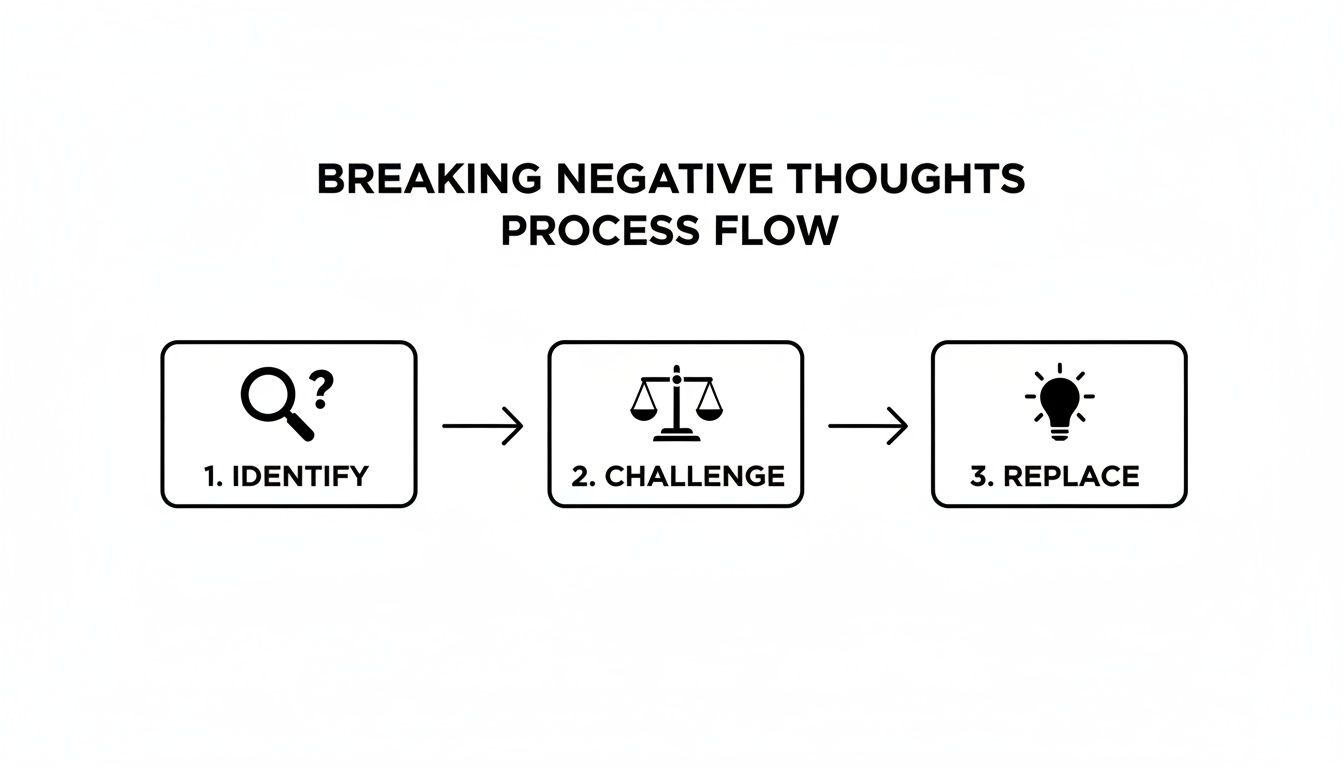
Each of these steps builds on the one before it, creating a powerful system for taking back control of your inner world and paving the way to a brighter future.
Understanding the Cycle of Negative Thinking
Negative thoughts often feel so convincing because they run on autopilot, creating a feedback loop that just keeps anxiety going. This pattern has a name: Repetitive Negative Thinking (RNT). It’s the mental habit of worrying and ruminating that sits at the heart of many mood disorders.
The research is clear: RNT is a huge player in both anxiety and depression. One major analysis found that these thought patterns accounted for a staggering 37.0% of the total variation in symptoms across different disorders. This is actually great news. It means if we can target RNT directly, we can make a real, significant impact on the symptoms and start to heal.
Getting to a calmer headspace really comes down to a few key ideas:
- Awareness comes first. You can't change a pattern you don't even see.
- Thoughts aren't facts. Just because you think something doesn't make it true. Learning to question your thoughts is a game-changer.
- Consistency is everything. Rewiring your brain isn't a one-time fix. It takes intentional, repeated practice, and every effort is a step toward freedom.
The hopeful truth is that your brain is capable of change. By intentionally practicing new ways of thinking, you are creating new neural pathways, making balanced thoughts the new automatic response.
While these cognitive techniques are powerful, they work even better when combined with other practices. Some people find that body-focused therapies like Swedish massage therapy for anxiety relief can be a fantastic addition to their mental toolkit.
By mixing mental and physical strategies, you build a much stronger defence against anxiety. To see how all these pieces fit into a larger recovery plan, check out our guide on the complete https://anxietychecklist.com/anxiety-recovery-steps.
How to Identify Your Automatic Negative Thoughts
Before you can change your thinking, you first have to become an observer of your own mind. This is where the real work begins, and it’s the most empowering first step you can take toward healing. It’s all about tuning into that constant stream of inner dialogue that, until now, may have been running completely on autopilot.
Negative thoughts are sneaky. They’re often so quick and automatic that we don't even notice them—we just feel the emotional punch they deliver. You might suddenly feel a wave of anxiety, a pang of dread, or a dip in your mood, without consciously registering the thought that triggered it.

The goal here is to shift from being a passive recipient of these feelings to an active listener of the thoughts behind them. And just to be clear, this process isn't about judging yourself. It’s about gathering information with curiosity and kindness.
Becoming a Thought Detective
Think of yourself as a detective on a case. Your mission is to pinpoint the exact triggers and the specific thoughts that follow. These triggers can be anything—truly anything—that sets off a cascade of negativity.
For example, a vague email from your boss might instantly trigger the thought, "I've done something wrong, and I'm going to get fired." Or maybe a strange physical sensation sparks the thought, "This is a sign of a serious illness." See how fast that happens?
To start catching these thoughts in the act, we're going to borrow a simple but incredibly effective tool from Cognitive Behavioral Therapy (CBT): the Thought Record. This is just a structured way of writing down your thoughts as they happen, getting them out of your head so you can see them clearly.
The act of writing down a thought separates it from you. It moves from being an internal, all-consuming "truth" to an external object that you can examine, question, and ultimately, dismantle.
This is the foundational practice for regaining control. It's how you begin to see that your thoughts are just thoughts—not unchangeable facts that dictate your future.
Using a Thought Record to Capture Your Thoughts
Getting started with a Thought Record is straightforward. You don't need a fancy journal; a simple notebook or a note-taking app on your phone works just fine. The real key is consistency. Whenever you feel your mood shift, just pause and jot down a few things.
Here’s a simple framework to follow:
- The Situation: What was happening right before your mood changed? Be specific. Who were you with? What were you doing? (e.g., "Reading an email from my manager.")
- Your Feelings: List the emotions you felt and rate their intensity on a scale of 1-100. (e.g., "Anxiety 80%, Dread 60%.")
- The Automatic Negative Thought (ANT): Write down the exact thought or image that went through your mind. Try to capture it word-for-word. (e.g., "She thinks my work is terrible. I'm going to lose my job.")
Capturing your ANTs is the critical first step. You'll quickly notice that these thoughts often fall into predictable, unhelpful patterns known as cognitive distortions—basically, mental shortcuts that convince us of things that aren't necessarily true.
For example, the thought above is a classic case of catastrophizing, or jumping to the worst-possible conclusion. Recognizing these patterns is a huge leap forward. If you want to get better at spotting these mental traps, you can learn more about the common types of cognitive distortions that fuel anxiety.
By consistently recording your thoughts, you're creating the raw material needed to challenge and change them later. This simple act of noticing and writing is the beginning of the end for the unchecked power of anxiety. It is tangible proof that you can interrupt the cycle and start building a new, more peaceful way of being.
Challenging and Restructuring Your Thoughts
Once you’ve started capturing those automatic negative thoughts, something incredible happens. You finally have a chance to stop being a passive passenger on your anxiety rollercoaster and start actively questioning the thoughts that are fueling it. This is where real, hopeful change begins.
We're talking about a technique at the core of CBT called cognitive restructuring. This isn't about slapping on a fake smile or forcing yourself to "just think positive." Instead, it's about becoming a fair and objective judge of your own thoughts—separating what’s actually true from the fear-driven fiction your anxious mind loves to create.

This isn't just a mental trick, either. Neurophysiological studies have shown that constant negative thinking actually creates measurable "signatures" in the brain, priming it to expect the worst. Cognitive restructuring directly targets this altered brain processing, helping to correct the bias over time. This is scientific proof that you can heal.
Putting Your Thoughts on Trial
The most powerful way to dismantle a negative thought is to put it on trial. Think of yourself as a detective or a lawyer examining a piece of evidence. Your job isn't to believe the initial, emotionally charged story your mind presents; it's to find the objective truth.
Start with a negative thought you wrote down in your thought record. Let's use a classic, anxiety-inducing one: "I'm going to fail this presentation and everyone will think I'm an idiot."
Now, let's cross-examine it with a few key questions.
- What is the evidence that this thought is 100% true?
- The "evidence": "I feel really nervous. I stumbled over my words once when I practiced."
- What is the evidence this thought is not entirely true?
- The counter-evidence: "I’ve spent hours preparing. I know the material inside and out. I've given good presentations before. Being nervous doesn't mean I'm going to fail."
- What is the worst that could realistically happen? Could I survive it?
- The worst case: "I might forget a point or two. A couple of people might look bored. I’d feel embarrassed for a bit, but I would absolutely survive. My career won't end."
- What is a more balanced or realistic way of looking at this situation?
- The balanced thought: "It's normal to be nervous about my presentation, but I'm well-prepared and capable of doing a good job. Even if it’s not perfect, it's just one presentation. It doesn't define my competence or my worth."
See the shift? The emotional charge drops dramatically when you move from a catastrophic prediction to a balanced perspective. This process is a cornerstone of many therapeutic approaches. If you're curious about the framework behind these techniques, you can explore our detailed guide on understanding CBT for anxiety.
By consistently questioning your thoughts, you weaken their power. You teach your brain that the initial alarm is often a false one, creating new, more resilient neural pathways for the future.
Identifying Unhelpful Thinking Styles
As you get the hang of this, you’ll start to notice that your negative thoughts often fall into predictable patterns, sometimes called cognitive distortions. Spotting these is like finding a glitch in a computer program—once you see it, you can start to fix it.
Here are a few common culprits to watch for:
- Catastrophizing: Taking a small negative event and blowing it up into a worst-case scenario. (e.g., "This headache must be a brain tumor.")
- Black-and-White Thinking: Seeing things in all-or-nothing terms. If it’s not perfect, it’s a total failure. (e.g., "I ate one cookie, so my diet is completely ruined.")
- Mind Reading: Assuming you know what others are thinking without any real evidence. (e.g., "My friend hasn't texted back; she must be angry with me.")
- Personalization: Blaming yourself for things that are completely out of your control. (e.g., "It rained on the day of the picnic; I have the worst luck and ruined it for everyone.")
Just being able to label a thought in the moment—"Oh, that's just catastrophizing again"—is a massive step. It instantly robs the thought of its credibility, turning it from a profound truth into a familiar, unhelpful mental habit you can choose to dismiss. For those looking for deeper insights into these kinds of mental shifts, you might find valuable approaches to help you transform your thoughts and reprogram your mind. This practice is your path to living panic-free, armed with the knowledge that you can challenge and reshape the very thoughts that once held you captive.
Using Behavioral Experiments to Create New Beliefs
Challenging your thoughts on paper is a massive step forward, but the real, lasting change happens when you take those new beliefs out for a test drive in the real world.
True confidence isn't built by thinking alone; it's built by doing. This is where we bring in a powerful technique called Behavioral Experiments.
Think of yourself as a scientist investigating your own mind. Your automatic negative thoughts are just hypotheses—untested guesses about what might happen. A behavioral experiment is your way of gathering cold, hard data to see if those theories actually hold up.
This approach is your ticket out of the anxiety loop, offering tangible proof that your fears are often wrong and that you can live a much bigger life.
So many of our deepest anxieties are kept alive by a single behavior: avoidance. When we consistently sidestep situations that trigger our fears, we never give ourselves the chance to learn that the catastrophe we're predicting probably won't happen. The fear just grows bigger and bigger in the absence of any real evidence to challenge it.
Designing Your First Experiment
The goal here isn't to be reckless or throw yourself into the deep end. It's about designing small, manageable tests that let you gather evidence safely. You start by picking a specific negative thought and then creating a simple action to test if it's true. The key is to be specific and realistic.
Let's walk through a common scenario.
- The Negative Thought (Hypothesis): "If I speak up in the meeting, everyone will dismiss my idea and think I'm incompetent." This is classic social anxiety—a fear of looking foolish.
- The Behavioral Experiment: "At the next team meeting, I will share one small, well-thought-out point during a low-stakes part of the discussion."
- The Prediction: "My heart will be pounding, people will look confused, and my boss will quickly move on. I'll feel totally humiliated."
- The Outcome: You track what actually happens. Did the world end? Or did a colleague nod in agreement, your boss thank you for the input, and the meeting just… continue?
This process gives you direct, personal evidence that punches holes in your anxious predictions. More often than not, reality is far less dramatic than the story your anxiety spins.
This method shares a similar foundation with a powerful therapeutic approach for overcoming fear. To learn more about facing fears in a structured way, check out these principles of exposure therapy for anxiety.
Each behavioral experiment you complete is like laying a new brick in the foundation of a more confident, calm self. You are building undeniable proof, from your own experience, that your negative thoughts are not accurate fortune-tellers.
From Hypothesis to New Belief
The real magic of this method is its ability to create profound shifts in your core beliefs. When you only challenge a thought in your head, a part of you can still whisper, "Yeah, but what if…?" But when you gather real-world data, there's no room left for that doubt.
Here’s how to set up your experiments for the biggest impact:
- Isolate the Belief: Pinpoint the exact fear. Is it rejection? Failure? Embarrassment? Get specific.
- Design a Small Test: Don't try to conquer your biggest fear on day one. If you're terrified of social rejection, your first experiment isn't giving a public speech; it's asking a cashier how their day is going.
- Record Your Findings: After the experiment, write down what happened. Compare the reality to your anxious prediction. The difference is often staggering.
This hands-on approach is how you break negative thought patterns for good. You're moving beyond just understanding it in your head and into living the proof. It's the practical, hopeful path to showing yourself, once and for all, that you are far more capable and resilient than your anxiety has led you to believe.
What to Do When Panic Hits (and How to Get Back on Track)
Let’s be honest: learning to rewire years of negative thinking isn't a straight line. Some days you’ll feel like you’re on top of the world, easily catching and challenging those old, unhelpful thoughts. On other days, they might sneak back in, and that’s completely normal on the path to healing.
Progress isn’t about being perfect. It's about having the right tools ready for when things get tough.
Think of this section as your go-to toolkit for those moments. These are the practical, in-the-moment strategies you can pull out when you feel overwhelmed. A setback is just that—a temporary detour, not a dead end on your journey to a panic-free life.

Write a Coping Script for High-Anxiety Moments
When panic takes over, your rational brain checks out. Trying to logically challenge a spiraling thought in that state is like trying to reason with a hurricane. It’s nearly impossible. This is where a Coping Script can be a game-changer.
A Coping Script is a short, realistic statement you write down ahead of time, while you're calm, to read when panic strikes. It’s an anchor that pulls you back to reality when your mind is spinning out.
Here’s how you can make one:
- Pinpoint a recurring fear: What's a catastrophic thought that shows up often? Maybe it's, "I'm losing control," or "This awful feeling is never going to end."
- Write a balanced, believable response: Acknowledge the feeling, but gently introduce a more rational, hopeful truth.
- Keep it handy: Save it on your phone’s lock screen, jot it down on an index card you keep in your wallet, or stick it on your desk. Make it impossible to miss.
Here are a few examples to get you started:
| Anxious Thought | Coping Script Example |
|---|---|
| "I'm having a heart attack." | "This is a surge of adrenaline. I've felt this before, and it always passes. My body is strong and I am safe." |
| "I'm going to lose control." | "These feelings are uncomfortable, but they are not dangerous. I can ride this wave until it subsides. I am in control." |
| "I'll never get over this anxiety." | "Healing isn't linear. This is just one tough moment. I have tools and I am capable of getting through this. I am healing." |
Pull Yourself Out of a Thought Spiral with the 5-4-3-2-1 Trick
When you're trapped in an anxious thought loop, your focus narrows and turns inward, which only cranks up the fear. Grounding techniques are designed to break that cycle by yanking your attention back to the present moment.
The 5-4-3-2-1 method is one of the simplest and most effective ways to do this.
Wherever you are, just pause and silently name:
- 5 things you can see. (The pen on your desk, a cloud outside, a scuff on your shoe.)
- 4 things you can physically feel. (The texture of your jeans, the cool surface of the table, your feet flat on the floor.)
- 3 things you can hear. (The hum of your computer, birds chirping, your own breath.)
- 2 things you can smell. (The coffee on your desk, the scent of hand soap.)
- 1 thing you can taste. (That lingering mint from your toothpaste, or just take a sip of water.)
This simple sensory scan gives your brain a different job to do, helping to calm your nervous system. If you want more ways to soothe your body during stressful moments, you might find these breathing exercises for anxiety really helpful.
Troubleshooting the Inevitable Bumps in the Road
Even with the best strategies, you're going to hit roadblocks. It’s part of the process.
Some days you'll feel unmotivated. Other times, you'll run into a stubborn belief that just refuses to budge. The key is to meet these moments with self-compassion and a tactical shift, not frustration.
Remember that every setback is just data. It’s not a sign of failure; it’s a chance to learn more about your patterns and fine-tune your approach with kindness.
This is exactly why having self-guided tools is so crucial. The World Health Organization estimates that about 1.1 billion people were living with a mental disorder in 2021, yet a staggering number lack access to care. Scalable, practical strategies like the ones here help bridge that gap, giving you tools you can use anytime, anywhere, on your own terms.
Still Have Questions About This Process?
Starting the journey to rewire your thinking is a huge act of self-care, but it's totally normal to have questions pop up along the way. Understanding what to expect can help you navigate the ups and downs with more confidence and a lot less self-judgment. This is your path toward a life where anxiety doesn't call the shots.
Let's tackle some of the most common concerns people have when they first start learning how to break negative thought patterns. The answers here are meant to give you clarity and, more than anything, remind you of a hopeful truth: you can heal and live a life free from panic.
How Long Until I See a Real Difference?
This is usually the first thing people ask, and the honest answer is: it really varies. There's no magic timeline, but you'll probably notice small, encouraging shifts much sooner than you think. In the beginning, just the act of noticing your thoughts without getting swept away by them is a massive win.
Within the first few weeks of consistent practice, many people say they feel less like a victim of their thoughts and more like an empowered observer. The intense emotional sting of a negative thought might start to fade simply because you’re no longer accepting it as 100% true.
The goal isn't to get rid of every negative thought forever—that’s just not how our brains work. The real victory is when a negative thought can pass through your mind without ruining your day or kicking off a panic attack.
Lasting change, where balanced thinking becomes your new normal, is a longer process. Think of it like physical fitness. You wouldn't expect to be in peak condition after just a few trips to the gym. Rewiring neural pathways takes time and repetition, but every little effort you make strengthens that new, healthier mindset. It is absolutely possible to build a future where calm is your baseline.
What if I’ve Believed These Thoughts My Whole Life?
Many negative thoughts, especially the big ones about our self-worth ("I'm not good enough") or safety ("The world is a dangerous place"), can be deeply ingrained. They might feel less like thoughts and more like fundamental truths about the universe. Trying to challenge them can feel intimidating, but it is entirely possible.
For these deeply rooted beliefs, the process just requires a bit more patience and consistent effort.
- Start small. Don't try to dismantle your biggest core belief on day one. Instead, focus on the smaller, situational thoughts that branch off from it. Proving to yourself that you can handle a small social interaction is a stepping stone to challenging the bigger belief that "everyone dislikes me."
- Gather evidence relentlessly. This is where behavioral experiments become your best friend. Every time you act against the old belief and the catastrophe you feared doesn't happen, you're collecting undeniable proof that weakens its foundation.
- Practice self-compassion. Acknowledge that this belief probably served a purpose at one point—maybe it was a way to protect you. Thank your brain for trying to keep you safe, then gently guide it toward a new, more accurate understanding of your life today.
You are not stuck with the thoughts you've always had. Your brain is capable of changing at any age. It’s a hopeful process of unlearning old habits and creating new ones that serve the person you are right now.
When Should I Think About Getting Professional Help?
Self-guided tools are incredibly powerful and can create life-altering change for many people. But knowing when to bring in professional support is a sign of strength, not weakness. A good therapist can act as both a guide and a coach, speeding up your progress in a safe, structured environment.
Consider reaching out for professional help if you find that:
- Your negative thoughts are seriously impacting your ability to function at work, in school, or in your relationships.
- You feel constantly overwhelmed and just can't seem to get a handle on your anxiety, no matter how hard you try.
- The thought patterns are tied to past trauma that feels too heavy or complicated to process on your own.
- You're experiencing physical symptoms of anxiety that are causing you significant distress.
A therapist trained in Cognitive Behavioral Therapy (CBT) can offer personalized strategies and help you navigate the more stubborn thought patterns. Remember, the goal is to build a life where you feel in control and at peace. Whether you get there on your own or with a professional guide, the destination is the same: a calmer, more fearless you.
At The Anxiety Checklist, we believe everyone deserves the tools to manage anxiety and live a full, fearless life. Our Fearless Living system provides a practical, step-by-step program to help you identify, challenge, and replace the thought patterns holding you back. Ready to take the next step? Explore our comprehensive self-help system.