
To calm anxiety before bed, you need to create a consistent "buffer zone"—a routine that basically tells your brain it's safe to power down. This means disconnecting from screens, trying some gentle relaxation like deep breathing or journaling, and turning your bedroom into a cool, dark sanctuary. This whole process is about intentionally quieting the mind’s alarm system so you can actually drift off to sleep, taking a hopeful step towards a panic-free life.
Why Anxiety Hijacks Your Mind at Night
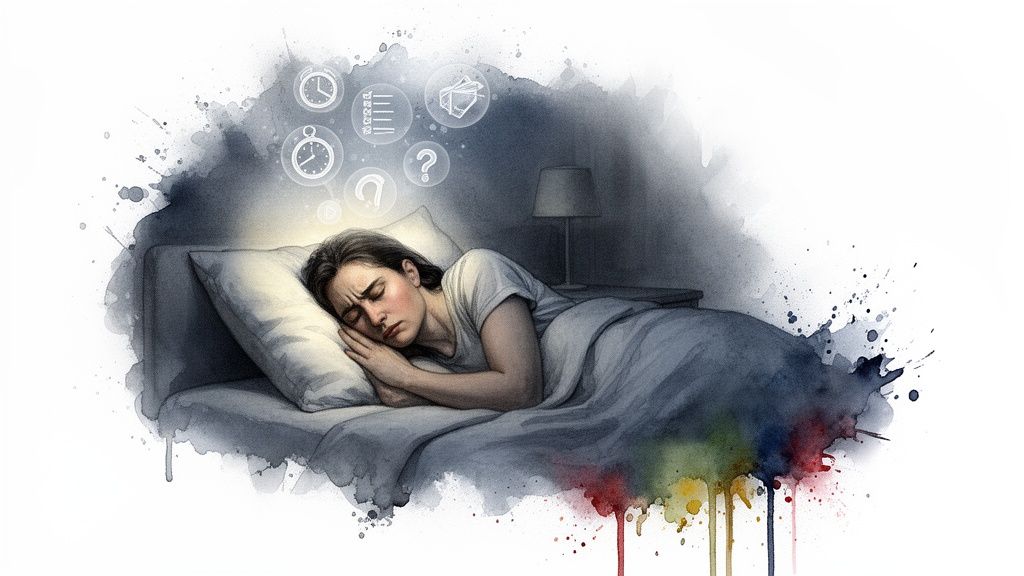
It’s a frustratingly common story: the day is done, the world is quiet, but the second your head hits the pillow, your mind decides to run a marathon. If you feel ambushed by worry right when you want to rest, you are far from alone.
There's a simple reason for this. When the distractions of the day finally fade away, your brain's internal alarm system gets a much louder microphone.
During the day, you’re juggling tasks, conversations, and a constant stream of information. All that busyness keeps any underlying worries on the back burner. But at night, the silence creates a vacuum, and anxious thoughts rush in to fill it. Your brain shifts from solving external problems to processing internal ones, and any unresolved stress from the day comes roaring to the surface.
This isn't a personal failing; it's a physiological response. Your body's alert system, known as the fight-or-flight response, doesn't always know the difference between a real, immediate threat and a perceived one, like a looming deadline or a difficult conversation. You can learn more about the fight-or-flight response in our detailed guide.
You Are Not Alone in This Struggle
This nightly battle is part of a much larger, growing trend. Globally, an estimated 359 million people had an anxiety disorder in 2021. The COVID-19 pandemic alone triggered a staggering 27.9% surge in cases back in 2020. This makes learning how to manage anxiety before bed an increasingly critical skill for millions of people just trying to get a good night's sleep.
The most important thing to understand is that there is a way forward. A life free from nightly panic isn't just a dream—it's an achievable reality. You can learn to regain control and quiet the noise.
This guide provides a practical, step-by-step framework for building a personal protocol that actually works for you. We'll walk through actionable steps to dismantle the anxiety cycle before it even starts. Consider this your first move on a clear path toward reclaiming your peace and your sleep.
Building Your Pre-Sleep Buffer Zone
Jumping from a chaotic day straight into the quiet darkness of your bedroom is a recipe for a racing mind. That abrupt shift is often the very thing that lets anxiety take the wheel. The secret is creating a deliberate transition—a 30-to-60-minute "buffer zone" that proactively calms your nervous system before anxiety even gets a foothold.

This isn’t about just "trying to relax." It's about building a practical, repeatable blueprint that signals to your body and mind that the day is over and it's safe to rest. This is where you start proving to yourself, night after night, that you can guide your mind toward calm.
Start with Scheduled Worry Time
One of the most effective ways to quiet nighttime anxiety is to give your worries a designated time and place—one that isn't your pillow. It’s a technique called Scheduled Worry Time, and while it might sound counterintuitive, it’s a powerful way to regain control.
Here’s how it works:
- Set a Timer: About an hour or two before bed, set a timer for just 15 minutes.
- Write It All Down: Grab a notebook and let it all out. Write down every single thing that’s making you anxious. Don't filter, don't judge; just get it out of your head and onto the paper.
- Close the Book: When the timer goes off, you stop. Close the notebook and physically put it away. This symbolic act tells your brain, "I have acknowledged these worries, and their time is up for tonight."
This simple act gives your brain permission to let go of these thoughts later. You’re not ignoring them; you’re managing them.
Curate Your Calming Activities
The rest of your buffer zone should be filled with activities that soothe, not stimulate. The goal is to lower your mental and physical arousal levels. What works for you might not work for someone else, but the principle is the same: find what brings you a sense of quiet.
Creating a buffer zone is an act of empowerment. It's a declaration that you are in charge of your evenings, not your anxiety. With consistency, this routine can transform dread into a peaceful and predictable wind-down, paving the way for a panic-free life.
Some proven activities include:
- Reading a Physical Book: Ditch the tablets and phones. Their blue light can mess with melatonin, the hormone that tells your body it's time for sleep. A real book gives your mind a single point of focus without the digital buzz.
- Listening to Ambient Music: Look for playlists made for sleep or relaxation. Things like instrumental music, nature sounds, or binaural beats work wonders.
- Dimming the Lights: Lowering the lights an hour before bed is a powerful cue for your internal clock to start producing melatonin. To take this a step further, you can explore using candles for sleeping to enhance your bedtime rituals and signal that it's time to unwind.
These activities, combined with healthy habits, create a strong defense against nighttime anxiety. For a deeper dive, you can explore our other guide on supportive https://anxietychecklist.com/lifestyle-diet-changes-anxiety-management. Remember, this routine is more than just a checklist; it’s a commitment to your own well-being and a testament to your ability to heal.
Your In-the-Moment Physical Rescue Kit
When a wave of anxiety hits just as your head hits the pillow, your body is often the first to sound the alarm. Your heart starts pounding, your breathing gets shallow, and every muscle in your body tenses up. This is your physical rescue kit—a handful of powerful, in-the-moment techniques you can use right in bed to break that physical panic cycle.
Think of these not just as distractions, but as somatic tools. They're designed to communicate directly with your nervous system, sending a clear signal that you are safe. This allows your body to release that pent-up tension, and your mind will follow its lead.
Master Box Breathing to Regulate Your Nervous System
When anxiety spikes, your breathing is the first thing to go haywire. Getting it back under control is the fastest way to dial down your body's panic response. One of the most effective methods out there is Box Breathing, a technique used by Navy SEALs, athletes, and doctors to stay calm under intense pressure.
It's so powerful because its simple, four-part rhythm gives your racing mind a single, calming thing to focus on. It also helps regulate the carbon dioxide levels in your blood, which often get out of whack during anxious, shallow breathing, helping to calm your entire nervous system.
Here’s how to do it right now:
- Inhale for 4 seconds: Gently and slowly, breathe in through your nose for a count of four.
- Hold for 4 seconds: Pause and hold your breath for a count of four. Don't strain.
- Exhale for 4 seconds: Breathe out slowly and completely through your mouth for a count of four.
- Hold for 4 seconds: Pause again for a final four-count before starting over.
Repeat this square pattern for a minute or two, or until you feel your heart rate start to settle. The simplicity is what makes it work. There are plenty of other methods, too. You can learn more about different breathing exercises for anxiety to find what feels best for you.
Dissolve Hidden Tension with Progressive Muscle Relaxation
You're probably holding tension in your body right now without even realizing it. A clenched jaw, hunched shoulders, a tight stomach—these are the classic physical signs of anxiety. Progressive Muscle Relaxation (PMR) is a fantastic way to teach yourself to find and release this stored-up tension, one muscle group at a time.
The process is straightforward: you systematically tense a specific muscle group for about five seconds, and then you let it go completely for ten seconds. By focusing on that stark contrast between tension and relaxation, you get much better at noticing where you're holding stress and can actively let it go.
A Quick PMR Script:
Start with your feet. Squeeze the muscles in your toes and feet, hold for five seconds, then release. Feel that wave of warmth and looseness? Now, slowly work your way up your body—calves, thighs, glutes, stomach, hands, arms, shoulders, and finally, your face. Tense and release each area, really paying attention to that feeling of relief.
Anchor Yourself with the 5-4-3-2-1 Grounding Technique
When your mind is caught in a spiral of "what-ifs," grounding is what pulls you back to the present moment. The 5-4-3-2-1 technique is a sensory-based exercise that yanks your focus away from the chaos inside your head and plants it firmly on the tangible world around you. It basically forces your brain to stop ruminating and start observing.
Lying in bed, just gently guide your attention through your senses:
- 5: Name five things you can see. (The shadow on the ceiling, the texture of your blanket, the glow from your alarm clock.)
- 4: Identify four things you can feel. (The coolness of your pillow, the weight of the comforter, the soft fabric of your pajamas.)
- 3: Acknowledge three things you can hear. (The hum of the air conditioner, a distant car, your own breath.)
- 2: Notice two things you can smell. (The clean scent of your sheets, maybe some leftover lotion.)
- 1: Bring to mind one thing you can taste. (The minty echo of toothpaste.)
This exercise is incredibly effective at hijacking an anxious thought loop, bringing you back to the safety and reality of your own bedroom.
To make it even easier to remember these tools when you need them most, here's a quick-reference table. Keep these in your back pocket for immediate relief.
Your Bedtime Anxiety Toolkit Quick-Relief Techniques
| Technique | Estimated Time | Primary Benefit |
|---|---|---|
| Box Breathing | 1-3 minutes | Rapidly calms the nervous system and slows a racing heart. |
| Progressive Muscle Relaxation | 5-10 minutes | Releases physical tension you may not even be aware of. |
| 5-4-3-2-1 Grounding | 2-5 minutes | Pulls your mind out of worry spirals and into the present moment. |
Having these simple, powerful techniques ready to go can make all the difference. They remind you that you have the ability to steer your body back to a state of calm, even when anxiety feels overwhelming. This is a profound step towards healing.
How to Untangle Your Racing Thoughts
While physical relaxation techniques are a game-changer, calming anxiety for good means dealing with the source of the storm: your racing thoughts. This is where lasting freedom from panic begins.
Here's the problem: trying to fight or ignore anxious thoughts almost always backfires. It’s like trying not to think about a pink elephant—suddenly, that's all you can see. The real key is to learn how to gently untangle them, changing your relationship with your own mind.
This sounds complicated, I know, but it starts with one simple shift. Instead of getting swept up in the thought-storm, you’re going to become a calm observer, watching it from a safe distance. This isn’t just a mindset trick; it’s a core principle from Cognitive Behavioral Therapy (CBT) that helps you question, reframe, and ultimately drain the power from anxious thoughts.
Become an Observer, Not a Participant
First thing's first: you are not your thoughts. Anxious thoughts are just mental events, like clouds passing in the sky. They aren’t necessarily true, and they definitely don’t have to control you.
When a worry pops into your head, just try labeling it. Silently say to yourself, "Ah, there's that 'what if I fail' thought again," or "I'm noticing the feeling of worry." This simple act of naming creates a tiny but crucial bit of space between you and the thought, which immediately dials down its emotional punch.
This visual guide shows a simple three-step process to interrupt the physical anxiety that often comes hand-in-hand with racing thoughts.
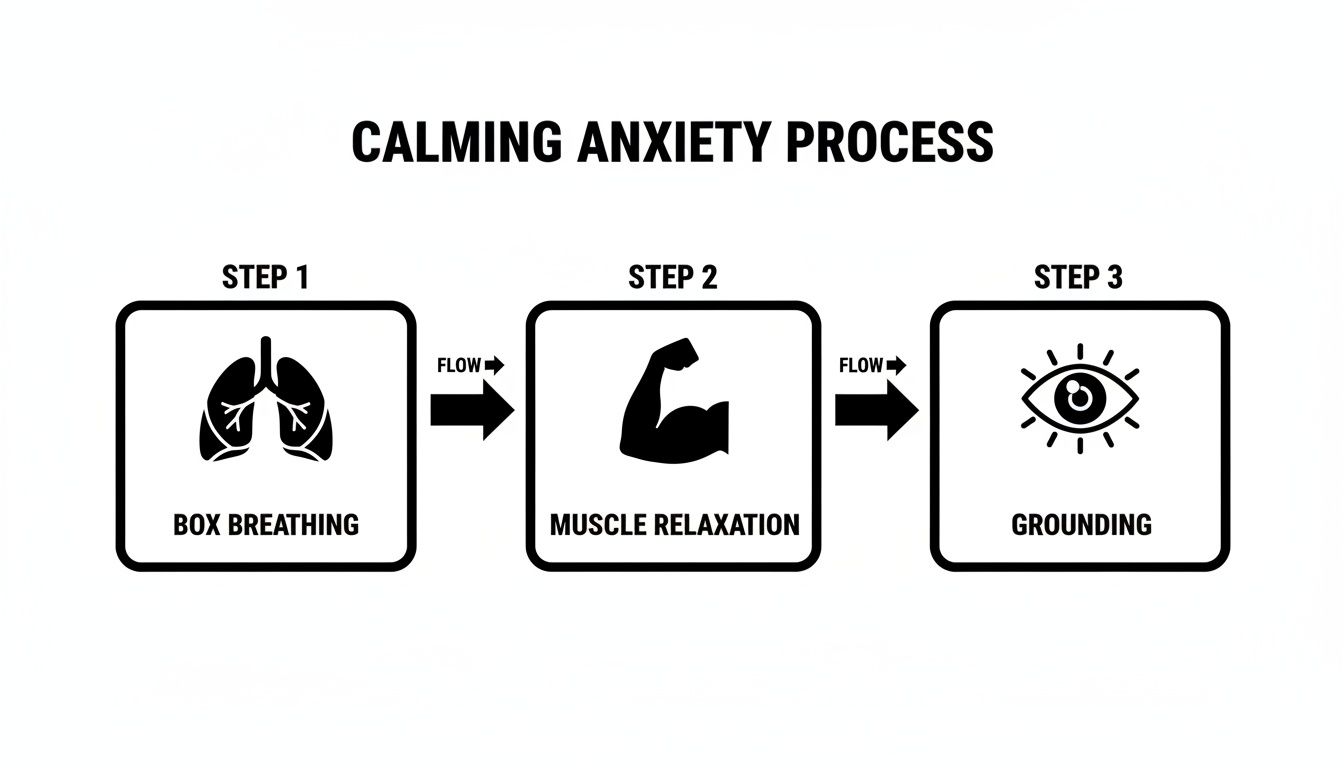
As you can see, using physical grounding techniques helps create the mental space you need to actually address the thoughts themselves without getting overwhelmed.
Use a Bedside Thought Journal
One of the most powerful things you can do is get your worries out of your head and onto paper. Keep a simple notebook and pen by your bed just for this. When your mind starts spinning, write it all down.
But don’t just stop at listing your worries. For every anxious thought you write, challenge it with two straightforward questions:
- Is this thought 100% true? Anxiety loves to deal in worst-case scenarios that often have very little basis in reality.
- What is a more helpful or balanced perspective? This pushes you to find a rational counter-statement.
Here’s what this looks like in the real world:
- Anxious Thought: "I'm never going to fall asleep, and I'll be a complete mess at my presentation tomorrow."
- Helpful Perspective: "I've felt this way before and still managed to get through the day. Even a little rest is better than none. I am prepared for my presentation."
This isn't about forced positivity; it's about finding what’s actually true. Over time, this practice literally trains your brain to automatically challenge those negative thought loops. The link between these cognitive loops and anxiety is huge, and you can learn more in our deep dive on overthinking and anxiety.
Create Distance with Gentle Visualization
If journaling feels like too much effort when you're exhausted, visualization is a much softer approach. This technique is all about helping you see your thoughts as separate from you, which lessens their emotional weight.
Try this simple exercise tonight:
- Close your eyes and take a few slow, gentle breaths.
- Imagine you are sitting beside a calm, slowly moving stream.
- As each anxious thought enters your mind, just place it on a leaf and watch it float gently down the stream and out of sight.
- Don't try to push the thoughts away. Just acknowledge each one, place it on its leaf, and let it go.
This mental practice reinforces the idea that thoughts are temporary. They can come, and they can go, without sweeping you away with them. This is a skill, and like any skill, it gets stronger and easier with practice. A life free from nightly panic isn't just possible—it’s within your reach.
Transform Your Bedroom Into a True Sanctuary
Your environment sends powerful, subconscious signals to your brain. Think about it: if your bedroom has become the place where you work, scroll on your phone, and toss and turn with worry, your brain starts to associate that space with stress, not rest.
Turning your room into a genuine sanctuary isn’t just a nice idea—it’s a critical step toward calming anxiety before bed. This is about more than basic sleep hygiene; it's about intentional design. Every element in your room can either fuel a state of alertness or invite a state of calm. By making a few conscious choices, you can create a space that tells your nervous system it's safe to power down.
Engineer Your Environment for Calm
Simple environmental tweaks can have a profound impact on your body's ability to relax. It starts with managing two key elements that directly influence your sleep-wake cycle: temperature and light.
- Cool It Down: Your body temperature naturally needs to drop to initiate sleep. Keeping your bedroom between 60 and 67 degrees Fahrenheit (15-19°C) helps this process along, signaling to your body that it's time for restorative rest.
- Embrace Total Darkness: Even tiny amounts of light can disrupt melatonin production and keep your brain on high alert. When you're serious about creating a calming space, understanding the difference when choosing between room darkening vs blackout shades is key to getting full control over the light in your room.
Redefine the Purpose of Your Bed
Psychologically, it's vital that your brain has one clear association with your bed: rest. When you use your bed as an office, a dining room, or a place to have stressful conversations, you inadvertently create a conditioned response of wakefulness and anxiety.
Reclaim your bed for only two things: sleep and intimacy. This single change is an act of hope and a powerful way to break the cycle, re-teaching your brain that this space is exclusively for peace and restoration.
If you find your mind racing once the lights are out, a white noise machine or even a simple fan can work wonders to mask disruptive sounds. Some people also find that specific audio frequencies help quiet a busy mind. If you're curious, you can explore our guide on using binaural beats for anxiety relief to see if this might be a good fit for you.
This strategy is particularly crucial during life's high-stress chapters. Research shows that anxiety disorders often first emerge or peak during adolescence and young adulthood, with those aged 18-29 showing the highest susceptibility. Creating a true sleep sanctuary during these peak anxiety years can build a foundation for a lifetime of more panic-free nights. You can learn more about these age-related anxiety patterns and their impact on sleep from recent studies.
Your Questions on Managing Nighttime Anxiety Answered
Putting these strategies into practice is a huge step forward, but it almost always brings up new questions along the way. Think of this journey less like a straight line and more like a series of small, steady adjustments. Below are answers to the most common concerns I hear, designed to help you troubleshoot any snags and stay on track.
Every small step you take is proof that you are more than capable of guiding yourself back to a place of peace. This whole process is about empowerment—reinforcing the core truth that a life with calmer nights isn't just possible, but completely within your reach.
What if I Wake Up with Anxiety in the Middle of the Night?
Waking up with a racing heart can feel incredibly defeating. The absolute key here is to not stay in bed fighting it. If you're wide awake and anxious, get up for about 15-20 minutes and move to another dimly lit room.
This brief change of scenery is a powerful psychological trick. It helps break the brain's association between your bed and that feeling of panicked wakefulness.
- Avoid Your Phone at All Costs: The blue light and stimulating content are the enemies of sleep. Seriously, don't even touch it.
- Use a Tool from Your Rescue Kit: Now’s the time to pull out a technique you’ve practiced, like Box Breathing or the 5-4-3-2-1 grounding exercise.
- Do Something Mind-Numbingly Boring: Read a dull book (the user manual for your dishwasher, perhaps?) or listen to some calm, instrumental music until you feel sleepy again, then head back to bed.
How Long Will It Take for These Techniques to Work?
On this journey, consistency is far more important than perfection. Some tools, like deep breathing, can offer immediate relief in a tense moment, which is great. However, truly rewiring long-term patterns of nighttime anxiety takes time and patience.
Aim to practice your wind-down routine every single night, even on the evenings when you feel less anxious. You might notice small improvements within a week or two—maybe falling asleep a few minutes faster or having one less spiraling thought. More significant, lasting changes tend to develop over several weeks as your brain and body learn a new, calmer way to respond to stress.
Remember to be patient and kind to yourself. Celebrate the small wins. Falling asleep five minutes faster is a victory. Having one less anxious thought is a victory. Each one is a building block toward a life free from panic.
When Should I Consider Seeking Professional Help?
While these self-help strategies are powerful, they aren't a replacement for professional care when it's needed. It's really important to reach out for help if your anxiety is severely impacting your daily life, your relationships, or your ability to function at work.
If you experience frequent panic attacks, feel your anxiety is just completely unmanageable, or have any thoughts of self-harm, please contact a therapist or doctor right away. A professional can provide a proper diagnosis and offer treatments like Cognitive Behavioral Therapy (CBT) or medication. These can work hand-in-hand with the techniques in this guide, creating a strong, supportive framework for your healing.
You have the strength to reclaim your nights, and you absolutely don't have to do it alone.
At The Anxiety Checklist, we believe in providing practical, actionable tools to help you move from a life of fear to one of freedom. Our Fearless Living system is designed to give you a clear, structured path to manage anxiety and live your best life.