
When you’re caught in the terrifying grip of a panic attack, feeling your way back to solid ground can seem impossible. Your heart pounds, your thoughts race, and the world just shrinks. In that moment, the idea of a life free from this kind of fear feels like a distant dream.
But here’s the most important truth to hold onto: healing is entirely possible. You are not broken, and you are definitely not alone in this. This guide is built on a foundation of hope, designed to show you that a panic attack is a temporary storm, not a life sentence, and a panic-free life is a real possibility.
Finding Hope and a Path Forward from Panic

The first step in learning how to calm down during a panic attack is simply accepting the feeling without judgment and then shifting your focus to grounding yourself. This guide offers practical, hope-filled strategies that reframe panic—not as a permanent state, but as a manageable response you can learn to control and, eventually, move past completely.
You Are Not Alone in This
It’s so easy to feel isolated when panic hits, but it helps to know just how common this experience is. Anxiety disorders are the most common mental health issue internationally, affecting an estimated 4.4% of the global population in 2021.
Even more specifically, data pulled from 25 different countries showed that about 13.2% of people have a panic attack at some point in their lives. These numbers prove that millions share this struggle, which is exactly why accessible, self-management strategies are so vital. You can explore more global anxiety statistics to see the full scope.
This journey isn't just about "coping." It's about fundamentally shifting your relationship with anxiety and realizing you have the power to regain control. Every technique you learn is a step toward a future where you are in charge, not your fear.
Think of panic as a learned response—and anything that has been learned can be unlearned. The strategies that follow are more than just quick fixes. They are practical, actionable steps toward building a life where the constant dread of the next attack no longer dictates your choices. You can learn to navigate these moments and move toward a future defined by freedom and peace.
Immediate Grounding Techniques to Reclaim Your Senses
When a panic attack hits, it can feel like your mind has completely disconnected from your body. The world might seem blurry, distant, or unreal—a terrifying sensation that only pours fuel on the fire of your fear.
This is exactly where grounding techniques come in. They are your most powerful, in-the-moment tool for pulling yourself out of the chaotic storm in your head and planting your feet firmly back in the present. This is a skill that proves you have power even in the most intense moments.
The idea behind grounding is simple but incredibly effective. By intentionally shifting your focus to your physical senses, you interrupt the feedback loop of catastrophic thoughts that feeds the panic. You’re essentially telling your brain, “Hey, I’m physically safe, right here, right now.”
Using the 5-4-3-2-1 Sensory Method
One of the most reliable and widely-used grounding techniques is the 5-4-3-2-1 method. It works because it forces your brain to stop its frantic spiral and engage with your immediate surroundings in a structured, deliberate way. You can do it anywhere, anytime, without anyone even knowing.
Here’s the breakdown:
- 5 Things You Can See: Look around and mentally name five different objects. Don't just glance—really observe them. Notice the tiny scuff mark on your shoe, the unique wood grain on a table, or a specific cloud shape in the sky.
- 4 Things You Can Touch: Shift your focus to four things you can feel. This could be the rough texture of your jeans, the smooth coolness of your phone screen, the solid feeling of your feet on the floor, or the soft fabric of your sleeve.
- 3 Things You Can Hear: Listen closely and pinpoint three distinct sounds. It might be the distant hum of traffic, the ticking of a clock, or the sound of your own breathing. Just listen.
- 2 Things You Can Smell: Try to isolate two different scents in your environment. Maybe you can smell coffee brewing, the clean scent of soap on your hands, or even the faint smell of rain on the pavement.
- 1 Thing You Can Taste: Focus on one thing you can taste. This could be the lingering mint from your toothpaste, or you can simply notice the neutral taste inside your mouth.
Real-World Scenario: Imagine you’re in a crowded grocery store when panic suddenly strikes. The bright lights and noise feel overwhelming. You duck into a quieter aisle and start: See the price tag on a can of soup. Feel the cold metal of the shopping cart handle. Hear the beep of a distant scanner. You are methodically pulling your focus away from the internal chaos and back to the tangible world, proving you still have control.
Tactile Anchors for Quick Relief
Beyond structured exercises like the one above, sometimes all you need is a simple physical sensation to act as a powerful anchor. Tactile grounding uses your sense of touch to snap your awareness back to your body and away from those racing thoughts.
Think of it as giving your mind a very concrete, simple job to do. Holding a cold can of soda or a small ice cube can be surprisingly effective. That intense sensation of cold demands your brain's attention, short-circuiting the panic response.
Similarly, focusing on a strong texture can work wonders. Rub your thumb over the metal rivets on your jeans or trace the embossed pattern on a textured wall. The goal is to find a sensation that is strong enough to cut through the mental noise.
For more quick-action strategies to manage these intense feelings, these 7 tips for calm anxiety fast can be a huge help. And if you want to dive deeper into these methods, our full guide to grounding techniques for anxiety offers even more strategies you can practice and master.
Mastering Your Breath to Tame the Panic Response
When panic strikes, your breath is often the first thing to betray you. It becomes shallow and quick—a pattern called chest breathing. This sends a firestorm of frantic signals to your brain, cranking up physical symptoms like a racing heart and dizziness. It's a vicious cycle that fuels the very panic you're desperate to escape.
But what if you could flip the script? What if you could use your breath not as an accelerator for fear, but as a direct line to your nervous system's brake pedal? This isn't about just "taking a deep breath." It’s about learning a tangible skill that can actively de-escalate your body’s alarm system and is a cornerstone of knowing how to calm down during a panic attack.
The trick is to shift from that shallow chest breathing to deep, diaphragmatic breathing, also known as belly breathing. When you breathe from your belly, you're engaging the diaphragm, a large muscle just below your lungs. This simple action stimulates the vagus nerve, which in turn activates the parasympathetic nervous system—your body's built-in "rest and digest" mode.
Why Slow Breathing Is a Game-Changer
Slowing your breath down is a powerful physiological command for calmness. When you practice paced respiration—aiming for about 4-6 breaths per minute—you send a clear, undeniable message to your brain: the danger has passed. This one action can interrupt the panic cycle right at its source.
And this isn't just theory; the science backs it up. Studies have shown that even short, guided breathing interventions can slash subjective panic ratings by 20–40% and lower physiological markers like heart rate. It’s concrete proof that you have more influence over your body's response than you think. You can find more on the physiological effects of paced breathing on the NIMH website.
This flowchart gives you a quick visual guide for grounding yourself the moment you feel panic starting to build.
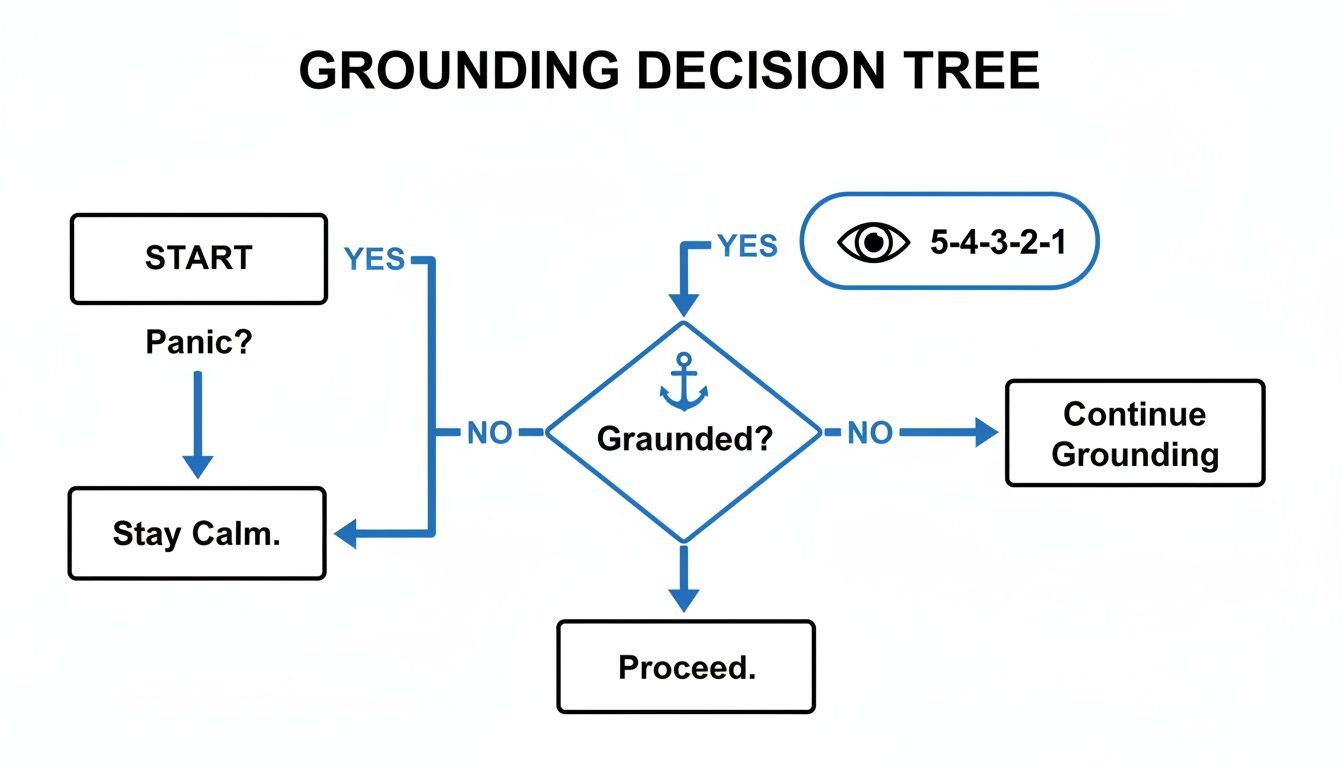
As you can see, simple, sensory-based actions are your first line of defense to break the panic cycle and bring yourself back to the present moment.
How to Practice Diaphragmatic Breathing
To make this work in a crisis, you have to practice when you're calm. Think of it like a musician running through scales—you do the boring work so the music flows effortlessly during the performance. Your breath is no different.
Here’s a simple way to get started:
- Find a comfortable spot: Lie down or sit in a relaxed position. Put one hand on your upper chest and the other on your belly, right below your rib cage.
- Breathe in slowly: Inhale slowly and deeply through your nose for a count of four. Your goal is to make your belly rise, pushing your hand up. The hand on your chest should stay relatively still.
- Breathe out completely: Exhale slowly through your mouth for a count of six. Feel your belly fall as you gently squeeze all the air out.
- Keep going: Repeat this cycle for 5-10 minutes. Making the exhale slightly longer than the inhale is key, as it sends an even stronger signal to your body to relax.
By practicing this daily, you are not just learning an exercise; you are building a new relationship with your body. You are teaching it that you have a tool to restore balance, which builds immense confidence and offers a tangible path toward a panic-free life.
This type of breathwork is a true cornerstone of anxiety management. For a deeper dive, you can explore a whole range of breathing exercises for anxiety to add to your toolkit. Remember, consistency is what transforms this from a conscious effort into a natural, automatic reflex against panic.
How to Shift Your Thoughts in the Middle of Panic
While grounding techniques and deep breathing are incredible anchors for your body, a panic attack is also a battle fought in the mind. Catastrophic thoughts can spiral with breathtaking speed, convincing you that the absolute worst is happening. A huge part of learning how to calm down during a panic attack is learning how to talk yourself through the fear instead of letting it run the show.
This is all about reclaiming your internal dialogue. It’s a skill, and just like any other, it gets stronger and more automatic the more you practice. The goal isn't to pretend the feelings aren't there, but to challenge the terrifying stories your anxious mind creates about them.
Create and Practice Coping Statements
In the heat of a panic attack, your brain isn't exactly open to complex, logical debates. That's why short, powerful, and pre-rehearsed coping statements are your best friend. These are simple truths you can repeat to yourself, either in your head or out loud, to counteract the tidal wave of fearful thoughts.
Think of them as your personal mantras for moments of crisis. The key is to make them feel believable and genuinely reassuring to you.
Here are a few ideas you can tweak and make your own:
- "This feels awful, but it is not dangerous."
- "I've felt this before, and it always, always passes."
- "This is just a misfire in my body's alarm system. I am safe."
- "I can ride this wave of feeling. I don't have to get swept away by it."
Write your favorites down. Say them out loud when you're feeling calm. The more you rehearse them, the more easily they'll pop into your head when you need them most, acting as a lifeline of reason in the middle of the chaos.
These statements are fantastic for interrupting the common thinking errors that pour fuel on anxiety's fire. You can learn more about these patterns in our guide to recognizing cognitive distortions.
Observe Your Panic Without Judgment
Another powerful mental shift is to practice becoming an observer of your panic rather than a participant in it. This is a mindfulness-based technique that asks you to treat the symptoms and thoughts like clouds passing in the sky. You notice them, you acknowledge they're there, but you don’t have to grab onto them or get carried away by their story.
Imagine your panic is a frantic, temporary storm. Instead of running out into the rain and wind, you're watching it safely from inside a sturdy house. You can see the lightning and hear the thunder, but you know you are separate from it, and that it will eventually pass.
This approach creates a tiny but crucial bit of space between you and the overwhelming feelings. You might say to yourself, "Okay, I am noticing my heart is beating very fast," or "There is a thought that I am losing control."
By simply labeling the experience without judging it, you strip away some of its power. You are not your panic; you are the person experiencing the panic. That distinction is the first step toward freedom and a life where you're back in control.
Building a Long-Term Strategy for a Panic-Free Life
Learning how to pull yourself out of a panic attack is a crucial skill, but let's be honest—the real goal is to stop them from happening in the first place. This isn't about gritting your teeth and pushing through fear. It's about proactively building a life where those moments become rare, or maybe even a thing of the past.
Thinking long-term shifts the focus from just surviving panic to actually thriving. It moves you from a place of reacting to a place of creating genuine well-being. This is a hopeful path, one that reinforces a powerful truth: you can have a future where anxiety doesn't call the shots.

Identifying Your Triggers and Lifestyle Factors
A huge part of any long-term strategy is becoming a detective in your own life. Start paying gentle attention to what comes before the intense anxiety. What situations, thoughts, or even physical states seem to set the stage? Is it that second cup of coffee? A night of restless sleep? A specific social setting that always leaves you on edge?
Beyond the immediate coping techniques, a solid long-term plan means looking at the foundations of your well-being. This includes prioritizing good sleep to support your overall mental health and really tuning into your nutrition. It's amazing how much more resilient a well-rested and well-nourished body is against stress.
Consider making a few small, consistent adjustments:
- A Consistent Sleep Schedule: Try to get 7-9 hours of quality sleep each night. It's not just about feeling rested; it's about regulating the very hormones that manage stress.
- Mindful Nutrition: Start noticing how certain foods make you feel. For many people, cutting back on caffeine and processed sugars can make a surprisingly big difference in their baseline anxiety levels.
- Regular Movement: You don't have to run a marathon. Gentle, consistent exercise like a daily walk or some simple yoga helps your body metabolize stress hormones and releases endorphins that naturally lift your mood.
The Power of Professional Support
While self-help strategies are fantastic, getting professional guidance can seriously speed up your progress and give you tools tailored specifically for you. Seeing a therapist isn't a sign of weakness—it's a courageous step toward taking back control and building a life you love.
One of the most effective treatments out there for panic is Cognitive Behavioral Therapy (CBT). This isn't just talk therapy; it's a practical approach that helps you identify, challenge, and ultimately reframe the negative thought patterns that fuel panic attacks. It gives you a structured way to change your relationship with anxious thoughts.
Recovery is a journey, not a destination. Embracing professional support is an act of profound self-compassion, giving you a dedicated space to heal and build the skills for a lasting, panic-free life. It celebrates the courage it takes to work towards a future you deserve.
Working with a therapist creates a safe space to dig into the roots of your anxiety and build a personalized game plan. To get a better sense of what's out there, you can explore more about psychotherapy for anxiety and find an approach that feels right. Reaching out is a powerful move toward lasting peace.
Frequently Asked Questions About Panic Attacks
Navigating the world of panic attacks brings up a ton of questions and deep-seated fears. Getting clear, reassuring answers is a huge part of learning how to ride out an attack and build the confidence you need to move forward. Let’s tackle some of the most common concerns I hear.
Can a Panic Attack Actually Harm Me or Cause a Heart Attack?
This is easily the most terrifying fear during an attack, but let me be direct: the answer is a firm no.
While the symptoms—a racing heart, chest pain, and breathlessness—feel incredibly dangerous and absolutely mimic a heart attack, a panic attack itself is not physically harmful.
It’s your body's "fight-or-flight" system misfiring. Think of it as a smoke alarm going off when you've just burnt some toast; it's loud, jarring, and distressing, but the house isn't actually burning down. Understanding this is a massive step in stripping the fear away from the symptoms themselves.
That said, if you have underlying health conditions or this is your first time experiencing these symptoms, getting a medical evaluation can provide essential peace of mind.
The realization that a panic attack, while intensely uncomfortable, is not life-threatening is a turning point for so many people. It shifts the goal from "I need to stop this or I'll die" to "I know this will pass, and I have the tools to handle it."
What if These Calming Techniques Don’t Work for Me in the Moment?
First off, it’s completely normal if a technique doesn't work perfectly the first time, especially when you're in the throes of intense panic. Don't get discouraged. Think of these calming strategies as skills—like learning to play an instrument. They get stronger and more effective with repetition.
- Practice When You're Calm: Rehearse breathing and grounding exercises when you're not anxious. This builds a kind of muscle memory, making the techniques more automatic and accessible when you actually need them.
- Find Your Fit: Not every tool resonates with every person. If box breathing feels impossible, maybe the 5-4-3-2-1 grounding method will click. Your toolkit should be personalized to what makes you feel anchored.
The goal isn't to instantly eliminate every symptom. It's about having tools that help you ride the wave, shorten its duration, and prove to yourself that you are still in control. Be patient and give yourself some grace during this learning process.
Will I Have to Deal with Panic Attacks Forever?
Absolutely not. This is the most crucial message of hope to hold onto. While there may not be an instant magical fix, it is entirely possible to reduce the frequency and intensity of panic attacks to the point where they no longer run your life.
For a deeper look into the nature of this experience, our complete guide to understanding a panic attack can offer more insight.
Many people, through consistent practice of calming techniques, lifestyle adjustments, and therapies like CBT, get to a place where panic attacks become a rare and manageable event—or stop altogether. Recovery isn't about never feeling anxiety again; it's about building resilience and confidence, knowing that even if you feel the stirrings of panic, you have the skills to face it head-on. You can, and will, live a full and joyful life beyond panic.
At The Anxiety Checklist, we believe everyone deserves a life free from the grip of anxiety. Our Fearless Living system provides the structured tools and actionable strategies you need to build resilience, challenge anxious thoughts, and reclaim your peace. Start your journey toward a calmer, more confident life with The Anxiety Checklist today.