
Challenging negative self-talk isn't about ignoring your inner critic. It's about actively listening to that voice, identifying the harsh or untrue things it says, and then consciously replacing them with something more balanced and compassionate.
Think of it as a skill you can master. You're learning to interrupt the cycle of anxiety by proving your negative thoughts wrong, which carves out a hopeful pathway to genuine mental peace and a panic-free life.
Your Hopeful Path to Quieting Your Inner Critic

If you're reading this, I'm guessing you're tired. Tired of that relentless inner voice that whispers doubts, fuels your anxiety, and makes every day feel like a battle. It's exhausting, and it can leave you feeling completely stuck in a loop of panic and self-doubt.
But here’s the most important thing I want you to hold onto: you absolutely can heal from this. A life free from the grip of constant anxiety and panic isn't just a daydream; it's a reality you can achieve.
This guide is designed to be your practical roadmap to hope. We're going to move beyond just wishing those thoughts would disappear and dive into actionable strategies that put you back in control, paving the way for a calmer, panic-free future.
You are far from alone in this. A landmark study found that the average person has thousands of thoughts a day, and a staggering 80% of them can be negative. Globally, depression—a condition often fed by these exact thought patterns—affects an estimated 5.7% of adults.
But here's the hopeful part: techniques that reframe these thoughts have been proven to significantly reduce depressive symptoms. Simply shifting "I always fail" to "I failed this time, but I can learn from it" can make a world of difference. This is proof that change is possible.
A New Way Forward
Feeling overwhelmed by your own mind is a deeply human experience. The journey to challenge negative self-talk is really about building a new relationship with yourself—one rooted in compassion, not constant criticism.
This process isn't about trying to eliminate all negative thoughts forever. That's impossible. It's about stripping them of their power so they no longer control your emotions or your life. You'll learn to see them, acknowledge them, and then consciously choose a more hopeful and helpful perspective.
This shift is the cornerstone of your healing. By learning these skills, you are taking the essential anxiety recovery steps that pave the way for real, lasting change. For some, adding external resources like mindfulness day retreats can also provide a supportive environment to practice these new ways of thinking.
Recognizing Your Inner Critic's Favorite Tricks
Before you can quiet your negative self-talk, you have to learn to speak its language. The good news is that your inner critic isn't very creative. It tends to recycle the same old playbook of distorted thought patterns to keep you anxious and stuck.
Learning to spot these tricks is the first, most powerful step toward taking back control and realizing these thoughts are not facts. They're just warped lenses that twist your perception of reality. And once you can see them for what they are, you can start to dismantle them and find freedom. Think of it like learning how to break bad habits—by identifying the mental loop, you rob it of its automatic power.
Let's break down the four most common tricks your anxiety loves to play on you.
Catastrophizing: The Worst-Case Scenario Replay
Does a tiny mistake at work immediately send your mind spiraling into visions of getting fired? Does a weird noise from your car engine instantly conjure images of a massive breakdown on the side of the highway?
If that sounds familiar, you've met Catastrophizing.
This is one of anxiety's all-time favorite tools. It takes a small, often neutral event and blows it up into the absolute worst-possible outcome. This pattern keeps your nervous system on constant high alert, forcing you to brace for disasters that almost never actually happen. It's draining, and it makes it impossible to ever feel truly safe.
The hopeful truth is that recognizing this pattern is halfway to defeating it. The moment you can label a thought as "catastrophizing," you create distance. It stops being a terrifying prophecy and becomes what it really is: just a thought you can choose to let go of.
Personalizing: Taking All the Blame
Personalizing is that sneaky voice that whispers, "This is all your fault." It's the automatic assumption that you are to blame for things that are partially or even completely out of your control.
Maybe a friend seems quiet or distant, and your first thought is, What did I do to upset them? Or perhaps a team project hits a snag, and you immediately shoulder all the responsibility, even if other factors were at play.
This distortion puts you at the center of every negative event, whether it makes logical sense or not. Over time, it chips away at your self-esteem and saddles you with a heavy, unnecessary burden of guilt. The healing starts when you learn to separate what you can actually influence from what you can't, freeing yourself from needless blame.
Polarizing: The All-or-Nothing Trap
Also known as black-and-white thinking, Polarizing leaves zero room for nuance or middle ground. In this mindset, everything is one extreme or the other. You're either a smashing success or a complete failure. Things are either perfect or an absolute disaster.
- Miss one day at the gym? "Well, my entire fitness goal is ruined now."
- Get a single piece of critical feedback on a project? "I'm obviously terrible at my job."
This rigid way of thinking sets you up for a constant emotional roller coaster because life is rarely perfect. The key to challenging it is learning to embrace the gray areas—the reality that life is a messy, beautiful mix of successes, setbacks, and learning experiences. This flexibility is a direct path to inner peace.
Filtering: Outing the Good Stuff
Filtering is like wearing a pair of sunglasses that only let you see the negative. You could get ten compliments and one critique, but what do you fixate on all day? That one negative comment.
This mental filter magnifies your perceived flaws and failures while completely dismissing your strengths and accomplishments. It paints a bleak and totally inaccurate picture of you and your life.
By learning to spot it, you can make a conscious choice to take off those glasses and see the whole view—the good, the bad, and everything in between. This balanced view is where hope lives.
To help you get better at spotting these patterns in the wild, here's a quick reference table.
Identifying Your Negative Self Talk Patterns
| Pattern Type | What It Sounds Like | How It Feels |
|---|---|---|
| Catastrophizing | "If I fail this test, my life is over." "This headache is definitely a brain tumor." | Overwhelming, terrifying, panicked |
| Personalizing | "My boss is in a bad mood. It must be something I did." "They didn't invite me; they must hate me." | Shameful, guilty, isolating |
| Polarizing | "I'm either a total success or a complete failure." "If I'm not perfect, I'm worthless." | Unstable, stressful, disappointing |
| Filtering | "I got nine positive reviews, but that one negative one proves I'm no good." | Hopeless, inadequate, self-critical |
Becoming fluent in the language of your inner critic is the first step to talking back. To dive even deeper, check out our detailed guide on the most common cognitive distortions.
Alright, you’ve learned how to spot your inner critic’s go-to moves. Now, it's time to build your toolkit for talking back with confidence.
This is where you get practical. You're going to learn how to challenge negative self-talk—not by fighting it head-on, but by calmly dismantling it with logic and reason. You are not powerless against these thoughts; you just need the right tools to get back in the driver's seat.
The goal here is to shift from being a passive bystander to your own anxiety into an active participant in your healing. This process is called cognitive reframing, and it’s one of the most powerful skills you can learn for living a calmer, more hopeful life free from panic. It's really about learning to see things more clearly, without the funhouse-mirror distortions that anxiety creates.
The Courtroom Technique: Weighing The Evidence
One of the most effective ways to challenge a negative thought is to put it on trial. Imagine you're an impartial judge, and your negative thought is the accusation. An accusation isn't a conviction. Your job is to look at the cold, hard evidence.
Let's say the negative thought is: "I'm going to completely fail this presentation."
Instead of just accepting this as fact, the judge inside you needs to ask:
- What's the evidence for this thought? "Well, I feel really nervous. And there was that one presentation five years ago that didn't go perfectly."
- What's the evidence against this thought? "I've spent ten hours preparing for this. I know the material inside and out. I've gotten positive feedback on my last three projects, and my boss trusts me enough to give me this task."
When you lay it all out like that, the verdict becomes pretty obvious. The initial thought is fueled almost entirely by feelings, while the counter-evidence is based on actual facts. This simple technique drains the negative thought of its power by showing it for what it is: an unreliable witness.
This chart breaks down some of the most common distorted thought patterns that cognitive reframing helps you correct.
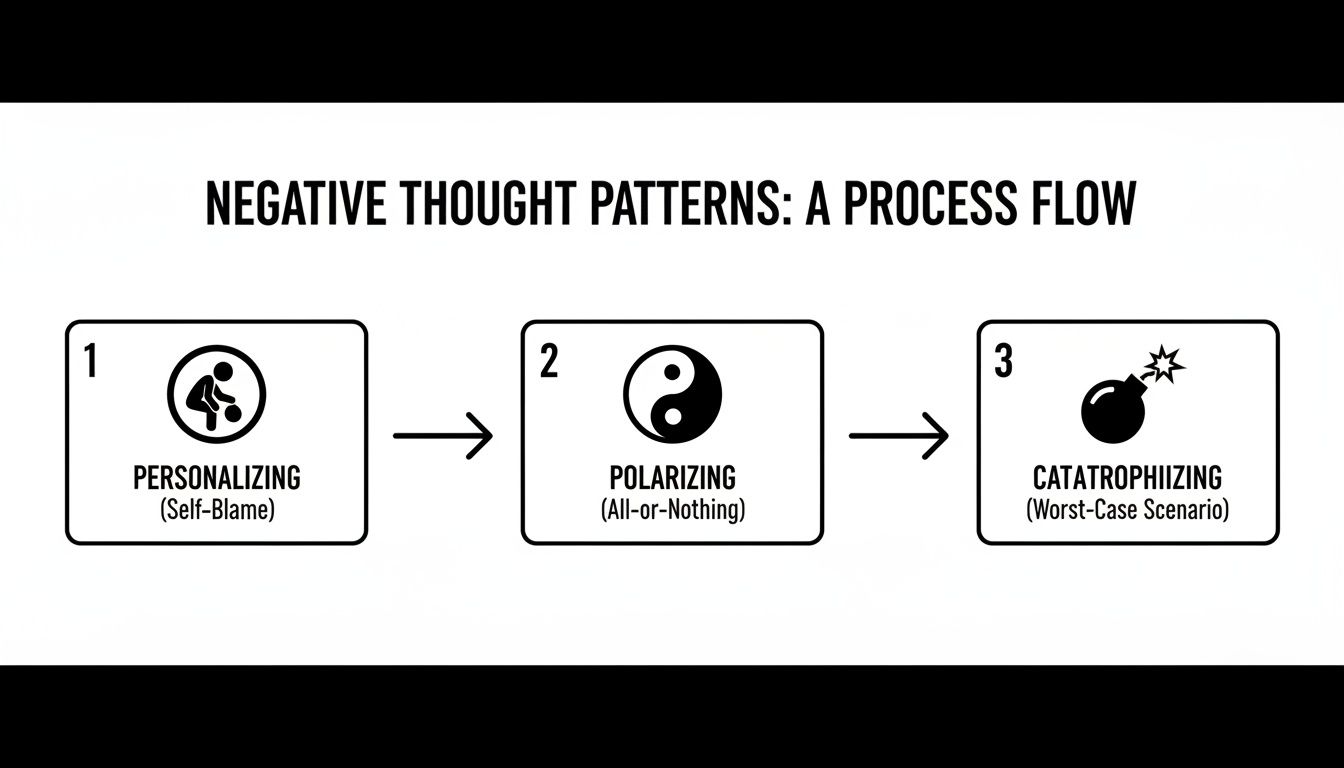
Visualizing these patterns—from Personalizing blame to Catastrophizing outcomes—makes it way easier to catch them in the act before they spiral out of control.
The Three-Column Technique For Balanced Thinking
Here's another incredibly practical tool: the "Three-Column Technique." It’s a straightforward, structured way to get your thoughts out of your head and onto paper, which instantly creates mental distance and clarity.
You just draw three columns on a piece of paper:
- The Negative Thought: Write down the automatic negative thought exactly as it popped into your head.
- The Cognitive Distortion: Identify the mental shortcut your brain is taking (e.g., Catastrophizing, Filtering).
- The Balanced, Realistic Thought: Craft a new, hopeful thought that acknowledges how you feel but is grounded in the actual evidence.
Let's walk through a real-world scenario. Say you’re dreading the idea of speaking up in a team meeting. To challenge that fear, you'd use the three columns to transform "Everyone is going to think my idea is stupid" into something more like, "I've prepared my points, and my contributions have been valued in the past. It's okay if not everyone agrees."
If you want to go deeper into these principles, you can learn more about how cognitive behavioral therapy for anxiety works.
Neuroscience research gives us a compelling reason to do these exercises. A study with 79 participants found that people with current depression had 93% higher rates of negative self-focused thoughts. This really drives home how crucial reframing is for your overall mental health and healing.
This isn't just a mental trick; it's a proven way to rewire your brain’s response to stress. With consistent practice, you're paving the way for a much more peaceful, panic-free way of being.
Moving from Self-Criticism to Self-Compassion

While learning to reframe your thoughts is a game-changer, there’s another layer to this work that goes even deeper. It’s about shifting from analyzing your thoughts to actively practicing kindness toward yourself.
This is where real, lasting healing from anxiety and panic begins to take hold.
Self-criticism is easily the most painful and stubborn form of negative self-talk. It doesn't just question what you do; it attacks who you are. This creates a vicious cycle of shame and self-doubt that can feel absolutely impossible to escape.
But there’s a gentle—and incredibly powerful—way forward: self-compassion.
What Is Self-Compassion?
Pioneered by researcher Dr. Kristin Neff, self-compassion is about treating yourself with the same kindness, care, and support you’d instinctively offer a good friend. It’s a profound shift that quiets that inner critic, not by fighting with it, but by introducing a more soothing, supportive voice.
This isn't about letting yourself off the hook or pretending mistakes didn't happen. It’s about acknowledging your struggles and your humanity with warmth instead of cold judgment.
It’s the difference between saying, “I’m such an idiot for messing that up,” and, “That was a tough situation, and I did the best I could. It's okay to be imperfect.”
Self-criticism is often the harshest driver of shame, paving the way for anxiety and depression. Studies confirm a strong link, showing that higher depression severity directly predicts a greater proportion of negative, self-focused thoughts. You can find more details in this research on self-referential emotions and mental health.
This gentle approach is a direct antidote to the harsh inner voice that so often fuels panic and anxiety, and it is a cornerstone of living a panic-free life.
Putting Self-Compassion into Practice
Learning to be compassionate with yourself can feel completely unnatural at first, especially if your default setting is harsh self-criticism. The key is to start with small, practical exercises that slowly build this new mental muscle of hope.
One of the most effective ways to start is with the Friend Test.
The next time you catch yourself in a spiral of harsh self-judgment, just pause. Ask yourself one simple question: “What would I say to a dear friend if they were in this exact situation?”
Chances are, you wouldn’t call your friend a failure or tell them they were worthless. You’d offer encouragement, perspective, and unconditional support. The goal is to learn how to redirect that same energy inward.
Here’s what that might look like:
- Self-Critical Thought: “I can’t believe I got so anxious during that meeting. I’m so weak.”
- Applying the Friend Test: “Hey, it’s understandable you felt anxious. Meetings can be really stressful. You showed up, and that alone takes courage. It’s okay that it felt hard.”
This simple reframe doesn’t deny the anxiety, but it meets that feeling with warmth instead of more criticism, which is key to stopping the shame spiral in its tracks.
Another powerful exercise is to start a self-compassion journal. At the end of each day, write down one thing you struggled with. Then, write a compassionate response to yourself about it. If you need more ideas on getting started, you can explore the benefits of journaling for anxiety.
By consistently practicing these small acts of inner kindness, you aren't just managing anxiety in the moment. You're fundamentally rewiring your relationship with yourself, building the kind of resilience and inner peace needed for a truly panic-free life.
Building a Life with Less Anxiety and More Hope
Learning how to challenge negative self-talk is about so much more than just getting through an anxious moment. It’s about rewiring your inner world to build a life with more peace, more confidence, and a genuine sense of hope. Just by being here, you've taken a huge, courageous step toward healing.
You now have a powerful set of tools to work with. You've learned how to spot your inner critic's favorite tricks, from catastrophizing a small mistake to personalizing a situation that has nothing to do with you. And you've practiced tangible reframing techniques—like putting your thoughts on trial—to start separating anxious fiction from grounded fact.
Most importantly, you've started exploring the gentle but profound power of meeting your struggles with self-compassion instead of more criticism. This is often the final piece that unlocks lasting change and helps you build a more resilient, panic-free life.
Weaving These Skills into Your Everyday Life
Real transformation doesn’t happen in one big, dramatic moment. It’s built through small, consistent actions, repeated day after day. Challenging that inner critic is a practice, just like exercising a muscle. The more you do it, the stronger and more automatic that supportive inner voice becomes.
To help you turn this from an idea into a habit, we're going to map out a simple daily practice. This isn't about adding another overwhelming task to your list. It’s a quick, five-minute check-in with yourself that actively builds hope.
Think of it as your daily mental hygiene routine.
This consistent practice is what actually rewires your brain. Each time you consciously choose a more balanced thought or offer yourself a moment of kindness, you are literally carving out new neural pathways. You're making hope and calm your new default settings, creating a foundation for a panic-free life.
Your Daily Hope-Building Practice
At the end of each day, grab a notebook and create three simple sections. This little exercise pulls together the core strategies we've covered into one manageable routine.
- Identify the Thought: Write down one negative or anxious thought that really stuck with you today. For example: "I felt so awkward during that team call; everyone probably thinks I'm incompetent."
- Reframe with Kindness: Now, use the "Friend Test." How would you respond if your best friend said that about themselves? Write down that compassionate, realistic alternative. Maybe something like: "It's okay that I felt nervous. Speaking up can be hard, but my contributions are still valuable."
- Note a Small Win: Acknowledge one positive thing, no matter how tiny it seems. Did you drink enough water? Get through a tough email? Honestly, just showing up for yourself is a win. For example: "I made it through a stressful day and am taking this time for myself right now."
This simple act, performed daily, reinforces the truth that you have the power to shape your inner narrative. Your journey toward a calmer, more hopeful life isn't built on perfection. It's built one kind thought at a time. Consistency and self-compassion are your most powerful allies for healing.
Common Questions About Quieting Your Inner Critic
It’s completely normal to have questions as you start this work. Learning to challenge that nagging inner critic is a new skill, and just like any other, it takes a bit of practice to get the hang of it. Let’s clear up a few common hurdles so you can move forward with confidence and hope.
Knowing you’re not alone in these struggles can make all the difference. Honestly, most people run into the same roadblocks when they first start out on their path to healing.
How Long Does It Take to See Results?
There’s no magic timeline, but many people start noticing small, encouraging shifts in their mood and outlook within just a few weeks of consistent practice. The keyword here is consistency.
At first, it might feel like a chore, but over time, catching and challenging those negative thoughts becomes more second-nature. Real, lasting change—the kind where you’re literally rewiring your brain for a more peaceful, panic-free state—often takes a few months to solidify.
Be patient and kind to yourself through the process. Every small step forward is a huge win on your healing journey.
What if I Cannot Find Any Evidence Against My Negative Thoughts?
This is a big one, and it happens all the time, especially when a negative belief has been hanging around for years. If you get stuck, pull out the "Friend Test" we talked about earlier.
What would you say to a close friend who was telling you this exact same thought about themselves? Chances are, you’d be a lot kinder and see the situation more clearly.
You can also hunt for "exceptions to the rule."
- If your thought is, "I always mess everything up," can you remember one single time—no matter how tiny—where you didn't?
- That one exception is powerful proof that your thought is not 100% true.
This isn't about finding a mountain of evidence to prove the thought wrong. It’s about finding a single crack in its certainty. That’s where the hope gets in.
Can These Techniques Help During a Panic Attack?
While these cognitive tools are rockstars for long-term prevention, you can absolutely use a stripped-down version in moments of intense anxiety or panic. Instead of trying to do a full-blown analysis, just grab onto a simple, grounding "anchor thought."
For example, you could repeat a short, true statement like, "I am safe right now," or "This feeling is temporary and it will pass." Think of it as a mental anchor in the middle of a storm.
Pairing this with intentional breathing is a game-changer for bringing down the intensity of panic. If you need some help in that area, you can learn more about specific breathing exercises for anxiety that work beautifully with these mental strategies.
The daily work you do challenging your inner critic is what builds the mental muscle to make these in-the-moment tools so much more effective when you really need them. It's all part of the journey to living panic-free.
At The Anxiety Checklist, we believe everyone deserves to live a life free from the grip of chronic anxiety. Our Fearless Living system provides a complete, step-by-step framework to help you regain control, challenge your inner critic, and build lasting resilience. To start your journey toward a calmer, more hopeful future, learn more at https://anxietychecklist.com.