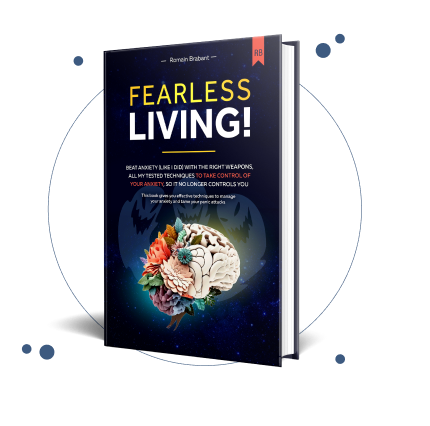

Feeling trapped by fear and anxiety can feel like you’re living someone else’s life, but I promise you, a life with more peace is not just a fantasy. This guide is the culmination of a 15-year journey—my own journey—from being completely ruled by anxiety to finally figuring out a system that works in the real world. Together, we'll walk through a practical framework to not just cope, but to truly overcome fear and anxiety by understanding its roots, building a toolkit for fast relief, and making lifestyle changes that actually stick.
Your Path to a Calmer Life Starts Now

The road to managing anxiety isn’t about pretending fear doesn't exist. It's about learning to call the shots so it no longer controls you. Hope isn't just a nice feeling; it's a strategy. The very first step—and honestly, the most important one—is believing you can heal and live without the constant dread of panic. This belief is what turns a vague wish into a concrete, achievable goal.
This guide gives you a structured, actionable path forward. Forget abstract theories. Everything in here is designed to be used in your actual life, based on years of what worked and what didn't. It's built to give you a sense of control right from the start.
First, What Are We Really Dealing With?
To get anywhere, we need to draw a clear line between a normal stress response and a disorder that requires active management. Everyone feels anxious sometimes. That's just our built-in alarm system doing its job. The trouble starts when that system gets stuck in the "on" position, disrupting everything.
Understanding this difference is incredibly freeing. It lets you step back and see anxiety not as a personal failure, but as a pattern of responses that you can understand, interrupt, and change.
For an even deeper dive into tackling specific fears and building back your self-assurance, I highly recommend this article on how to overcome fear and reclaim your confidence. Adopting this perspective is the foundation for everything we're about to do.
The goal is not a life without any anxiety. The goal is a life where you have the confidence and the tools to manage it, so you can pursue what matters to you without fear holding you back.
This table helps you differentiate between everyday stress responses and chronic anxiety patterns that may require specific management techniques.
Normal Fear vs Disordered Anxiety What Is the Difference
| Characteristic | Normal Fear and Anxiety | Disordered Anxiety |
|---|---|---|
| Trigger | Tied to a specific, real stressor (e.g., job interview, exam). | Often feels random, disproportionate, or has no clear trigger. |
| Duration | Lasts only as long as the stressful situation is present. | Persistent, lasting for weeks, months, or longer. |
| Intensity | The reaction is proportional to the actual threat. | The emotional response is excessive and feels uncontrollable. |
| Impact | Doesn't significantly interfere with daily life or relationships. | Disrupts work, school, social activities, and overall functioning. |
| Focus | Worry is specific to the immediate problem. | Worry is widespread, often focused on "what if" scenarios. |
| Physical Symptoms | Mild and temporary (e.g., butterflies, sweaty palms). | Frequent and severe (e.g., panic attacks, muscle tension, fatigue). |
Recognizing where your experience falls on this spectrum helps clarify the path forward. One is a normal part of life; the other is a signal that it's time to build a new set of skills.
The strategies ahead are designed to help you:
- Gain Immediate Control: Learn techniques to calm your nervous system the moment anxiety spikes.
- Understand Your Triggers: Pinpoint the specific situations, thoughts, and feelings that fuel your anxiety.
- Build Lasting Resilience: Create solid lifestyle habits that form a strong foundation for your mental well-being.
This is about more than just coping—it's about reclaiming your life, piece by piece. By moving forward with the right tools and a clear intention, you can transform your relationship with anxiety and build a future you're excited to live in.
Understanding Your Personal Anxiety Profile
To get a handle on fear and anxiety, you first have to become a detective of your own mind. Right now, anxiety might feel like this huge, terrifying force that runs your life, but it’s not. It’s actually just a collection of specific thoughts, feelings, and physical reactions that follow predictable patterns.
The key to taking back control is to map out those patterns—to create your own personal anxiety profile.
This process transforms a vague, overwhelming enemy into a solvable problem. Instead of fighting an unknown monster, you’ll be addressing specific triggers and responses. This shift in perspective is the first and most empowering step toward a life where you feel in control, not your anxiety.
Identifying Your Unique Triggers
Triggers are the sparks that ignite the fire of anxiety. Think of them as the specific buttons that, when pushed, activate your body’s internal alarm system. Learning to spot them is crucial because they're unique to each person.
Your triggers will likely fall into a few common categories:
- Situational Triggers: These are external events or environments. Think public speaking, crowded supermarkets, driving on the highway, or even just an upcoming deadline at work.
- Thought-Based Triggers: Sometimes, the trigger isn't an event but a specific thought pattern. This could be a "what if" spiral about the future, self-critical thoughts about a past mistake, or just assuming the worst in a neutral situation.
- Physical Sensation Triggers: For many people, certain bodily feelings can set off a wave of anxiety. A racing heart after climbing stairs might get misinterpreted as the start of a panic attack, creating a feedback loop of fear. A sudden dizzy spell can do the same.
Start by keeping a simple journal. When you feel anxiety creeping in, jot down what was happening right before it started. What were you doing? Thinking? Feeling physically? Over time, you’ll start to see your personal trigger map take shape.
Recognizing the Early Warning Signs
Panic attacks rarely just appear out of nowhere. There are almost always subtle, early warning signs that your anxiety is starting to ramp up. Recognizing these signs gives you a crucial window of opportunity to intervene before things escalate.
These early signals are your body’s way of saying, "Hey, I'm starting to get stressed." They can be physical, mental, or emotional.
By learning to spot the first flicker of anxiety, you give yourself the power to extinguish the flame before it becomes a wildfire. This isn't just about coping; it's about proactively managing your mental state.
Common early warning signs include things like:
- A slight tightness in your chest or throat.
- Feeling restless, fidgety, or just "on edge."
- Finding it hard to concentrate on a single task.
- A subtle increase in your heart rate.
- Becoming irritable or having a shorter temper than usual.
To get a clearer picture of your specific symptoms, taking a standardized screening tool can be really helpful. Our free GAD-7 Anxiety Test can give you a baseline understanding of your anxiety levels and help you pinpoint the key symptoms you need to watch for.
Mapping Your Anxiety Patterns for Lasting Change
Once you understand your triggers and early signs, you can start connecting the dots. You'll begin to see the full sequence: Trigger → Early Signs → Escalating Anxiety → Peak Panic.
Mapping this out demystifies the entire experience. For example, you realize the dread you feel every Sunday night isn't just random "anxiety"; it's a response triggered by the thought of a Monday morning team meeting, which produces early signs like a tight stomach and irritability.
This knowledge is incredibly powerful, and it highlights just how common these struggles are—especially for younger generations. In fact, anxiety has become a surging global epidemic among the young. From 1990 to 2021, incident cases in adolescents and young adults (ages 10-24) ballooned by 52%, reaching 16.67 million new cases in 2021 alone.
But the good news is that overcoming it is a proven process. Effective treatments exist, but many people don't get the help they need. Actionable systems like The Anxiety Checklist's Fearless Living program teach you how to distinguish normal vs. disordered anxiety and manage panic, mirroring the success of methods where 70% of people reduce their symptoms long-term. You can read the full research on these trends and treatments to understand the bigger picture.
By building your personal anxiety profile, you are taking the first concrete step on a proven path to recovery. You're moving from being a passive victim of anxiety to an active participant in your own healing, armed with the knowledge to make real, lasting change.
Your Toolkit for Immediate Anxiety Relief
When a wave of anxiety hits, it can feel like you're caught in a storm with no land in sight. In those moments, you don’t need complex theories; you need a lifeline. This section is your practical, in-the-moment toolkit, designed to give you back a sense of control right when you need it most.
The feeling of panic can make you believe you’re powerless, but that's a lie anxiety tells. You have an incredible ability to influence your own nervous system. These aren't just coping mechanisms; they are active skills that interrupt the anxiety cycle and ground you firmly in the present.
Let's walk through three powerful techniques you can use anywhere, anytime.
Calm Your Nervous System With 4-7-8 Breathing
When anxiety spikes, your breathing often becomes shallow and rapid, signaling to your brain that there's danger. This kicks off a vicious feedback loop. The 4-7-8 breathing technique is a simple yet profound way to break that cycle by deliberately slowing your heart rate and calming your nervous system.
It’s like hitting a reset button on your body's alarm system. Here’s how to do it:
- Exhale completely through your mouth, making a whoosh sound.
- Close your mouth and inhale quietly through your nose for a count of four.
- Hold your breath for a count of seven.
- Exhale completely through your mouth with another whoosh sound for a count of eight.
Repeat this cycle three to four times. The long exhale is the secret sauce—it activates your parasympathetic nervous system, your body's natural "rest and digest" response. The next time you feel that familiar tightness in your chest, find a quiet space and practice this. It’s discreet and powerful.
For an even more detailed look at how different patterns can help, check out this guide to breathing exercises for anxiety.
The process of gaining control starts with simple, actionable steps like identifying what you're feeling and mapping out your response.

Ground Yourself in the Present With the 5-4-3-2-1 Method
Anxiety loves to pull you out of the present moment and trap you in a spiral of "what if" thoughts about the future. The 5-4-3-2-1 grounding method yanks you out of that thought storm and anchors you in the here and now by engaging all five of your senses.
It works by forcing your brain to focus on your immediate environment, leaving less mental space for anxious thoughts to run wild.
Here’s the process:
- 5 Things You Can See: Look around and name five distinct objects. Don't just list them; truly observe their color, shape, and texture.
- 4 Things You Can Touch: Feel the texture of your jeans, the coolness of a table, the warmth of your skin. Acknowledge the physical sensations.
- 3 Things You Can Hear: Tune into the sounds around you. It could be the hum of a refrigerator, distant traffic, or your own breath.
- 2 Things You Can Smell: What scents are in the air? Maybe it's the faint smell of coffee or the fresh scent of outdoor air from an open window.
- 1 Thing You Can Taste: Focus on the taste in your mouth. You could take a sip of water or pop a mint to make this step more distinct.
Real-World Scenario: Imagine you're in a crowded supermarket and your heart starts racing. Instead of rushing for the exit, pause. Name five items on a shelf. Feel the cold metal of the shopping cart. Listen for the beep of a scanner. This simple act can stop a panic attack in its tracks.
Challenge Anxious Thoughts on the Spot
Your thoughts are not always facts, especially when anxiety is driving them. A quick "Thought Challenge" is a mini-CBT exercise that helps you question and reframe a negative thought before it takes root.
When an anxious thought appears, ask yourself three simple questions:
- Is this thought 100% true? Can I be absolutely certain this worst-case scenario will happen?
- What's a more realistic or balanced way to see this? What's another possible outcome?
- What would I tell a friend who had this same thought? Often, we offer more compassionate and rational advice to others than we do to ourselves.
This isn't about ignoring your fears but about examining them with a dose of reality. For more practical strategies, you can explore a range of anxiety coping skills helpful for all ages. Having these tools ready means you're prepared to face anxiety with strength and hope.
Rewiring Your Brain for Long-Term Calm
The tools we've covered so far are your lifeline in a storm. They offer immediate relief when you need it most. But to truly conquer fear and anxiety for good, the real goal is to stop the storm from ever gathering in the first place. This means we have to go deeper than in-the-moment fixes and start the work of retraining your brain for lasting calm.
Think of your anxious brain like a well-worn hiking trail in a forest. Over time, chronic worry carves deep, familiar ruts, making it incredibly easy for your thoughts to tumble down the same negative paths. A tiny worry can escalate into a full-blown panic because that route is so established.
The good news? You can become a trail blazer. You can forge new, healthier neural pathways.
This process is called cognitive restructuring, and it’s at the heart of how people truly heal from anxiety. It’s a skill that lets you stop being a passenger in your own thought spirals and become the driver, consciously choosing a different direction. With practice, these new, calmer pathways become your brain's default setting.
Unmasking Your Cognitive Distortions
The first step in rewiring your brain is learning to spot the faulty thought patterns that are fueling your anxiety. We call these cognitive distortions.
They're essentially warped, exaggerated thinking habits that twist reality, making situations seem far more threatening than they actually are. Think of them like funhouse mirrors for your mind—they take a perfectly manageable reflection and distort it into something terrifying.
Just learning to recognize these traps is incredibly empowering. It shows you that your anxiety is often built on a foundation of distorted thinking, not objective reality. Once you can name the distortion, you can start to dismantle its power over you.
Here are a few of the most common cognitive traps that keep people stuck:
- Catastrophizing: This is the king of the "what if" spiral. You take one small negative event and blow it up into a chain reaction of disaster. A simple thought like, “My boss seemed a little quiet in that meeting,” quickly spirals into, “She hates my work, I’m definitely getting fired, and I’ll never find another job.”
- Black-and-White Thinking: Also known as all-or-nothing thinking, this distortion sees everything in extremes—no gray areas allowed. If you aren’t a complete success, you're a total failure. If you make one tiny mistake during a presentation, the entire thing was a catastrophe in your mind.
- Mind Reading: This is when you assume you know what other people are thinking, and it’s almost always something negative about you. You might walk past a coworker who doesn't say hello and immediately think, “He's mad at me,” without considering a dozen other possibilities—like he was just distracted, stressed, or didn’t even see you.
This process isn’t about blaming yourself for having these thoughts. It’s about becoming a curious detective of your own mind. You're just observing these patterns without judgment so you can begin to challenge and change them.
Becoming a Detective of Your Thoughts
Identifying these distortions is just the beginning. The real magic happens when you start to actively challenge them. Our "Cognitive Traps Worksheet" from the Fearless Living eBook is designed for exactly this. It guides you through capturing an anxious thought, identifying the distortion at play, and then creating a more balanced, realistic response.
If you want to go deeper into the principles behind this work, you can learn more about how Cognitive Behavioral Therapy (CBT) helps anxiety in our detailed guide. It’s a proven, structured way to take back control of your thought patterns.
The scale of anxiety worldwide is massive, but the statistics on recovery offer so much hope. Globally, anxiety disorders affected 311 million people back in 1990, and that number continues to shift with world events. Yet, the victory stats are what matter: treatments work for the vast majority of people, though only about 27.6% are currently getting them. Proven methods show that targeted strategies like lifestyle changes and CBT can slash the chance of relapse by 50-70%, empowering people to move forward without fear holding them back. You can find more on these global health trends and successful treatment outcomes in recent studies.
From Theory to Daily Practice
Rewiring your brain isn't a one-and-done event; it's a daily practice. It’s like learning a new language—it feels clumsy and awkward at first, but with consistent effort, it starts to become second nature.
Here’s a simple, actionable way you can start today:
- Catch the Thought: The moment you feel a surge of anxiety, pause. Ask yourself, "What specific thought just went through my mind?"
- Identify the Distortion: Look at that thought. Is it catastrophizing? Is it mind reading? Put a name to the trap you’ve fallen into.
- Challenge and Reframe: Actively question the thought. "Is there any actual evidence this is true? What’s a more balanced, realistic way to see this?"
For example, if the thought is, "I'm going to completely mess up this entire project," you can reframe it to, "I'm feeling nervous about this project, but I have the skills to handle it. I can break it down into smaller steps and ask for help if I get stuck."
This skill, when you practice it consistently, doesn’t just help you manage anxiety—it fundamentally changes your relationship with your own mind. It’s the path from short-term relief to long-term freedom. You're building a brain that is resilient, calm, and hopeful by default.
Building a Lifestyle That Resists Anxiety

While the tools and mindset shifts we've talked about are gold for handling anxiety in the moment, the real long game is building a life that naturally pushes back against fear. Think of your daily habits as the literal foundation of your mental health. Small, steady choices add up to create a powerful buffer, making you way less vulnerable to anxiety's grip.
This isn’t about flipping your life upside down overnight. Not at all. It’s about making smart, sustainable tweaks to the four core pillars of your well-being: sleep, nutrition, exercise, and social connection. When these are in sync, they work together to regulate your mood, stabilize your energy, and soothe your nervous system.
Let's get past the fluffy advice and into the real-deal strategies you can start using today. The goal here is to create a lifestyle where feeling calm is your baseline, not something you have to constantly fight for.
Fueling Your Mind The Right Way
What you eat has a direct line to how you feel, and for an anxious brain, nutrition can be a complete game-changer. This isn't about strict diets; it’s about stabilizing your body's systems so your mind can follow. One of the biggest, sneakiest culprits behind anxiety spikes is unstable blood sugar.
When your blood sugar takes a nosedive, your body pumps out stress hormones like cortisol and adrenaline to fix it. For someone prone to anxiety, that hormonal rush feels almost identical to a panic attack, sparking a nasty cycle of physical symptoms and worried thoughts.
To keep your blood sugar steady and your mind calm, focus on these simple principles:
- Prioritize Protein at Breakfast: Starting your day with protein—think eggs, Greek yogurt, or a smoothie—helps prevent that classic mid-morning energy crash and mood dip.
- Pair Carbs with Fiber and Fat: When you eat carbs, make sure to pair them with fiber or healthy fats like avocado or nuts. This slows down sugar absorption and keeps you on an even keel.
- Limit Caffeine and Alcohol: Both can mess with your sleep and send your body’s stress response into overdrive. If cutting them out feels like too much, try reducing your intake, especially in the afternoon and evening.
Making just these small adjustments can have a massive impact on your day-to-day anxiety levels. For a deeper dive, you can learn about lifestyle and diet changes for anxiety management on our site.
Creating a Sanctuary for Sleep
Sleep deprivation is like pouring gasoline on the fire of anxiety. When you're exhausted, your brain's emotional control center—the amygdala—goes into overdrive, making you way more reactive to stress. For anyone serious about overcoming fear, quality sleep is absolutely non-negotiable.
Instead of just chasing more hours, focus on creating a powerful, anxiety-busting bedtime routine. This routine acts as a signal to your brain, telling it that it’s time to wind down and shut off the worry machine for the night.
Your bedroom should be a sanctuary for rest, not an extension of your office or a hub for anxious thoughts. Protecting this space is crucial for your mental well-being and a key part of your journey to overcome fear and anxiety.
Here’s a simple routine you can start tonight:
- Set a Tech Curfew: Power down all screens—phone, TV, tablet—at least 60 minutes before you plan to sleep. That blue light messes with melatonin, the hormone that tells your body it's nighttime.
- Engage in a Calming Activity: Pick up a physical book, listen to some chill music, or do some gentle stretching. Anything that feels relaxing and low-key.
- Perform a "Brain Dump": Keep a notepad by your bed and jot down any lingering worries or to-do list items. Getting them out of your head and onto paper stops them from circling around while you're trying to sleep.
Moving Your Body to Calm Your Mind
Exercise is one of the most potent, fast-acting, and overlooked anti-anxiety tools we have. It burns off that jittery cortisol, releases mood-lifting endorphins, and helps hit the reset button on your nervous system. And no, you don't need to run a marathon to get the benefits.
The secret is consistency, not intensity. A simple 20-30 minute walk each day can dramatically reduce anxiety symptoms. Rhythmic activities like walking, jogging, or swimming are especially great because they help pull you out of your head and back into your body.
The Critical Role of Social Connection
Anxiety absolutely thrives in isolation. It wants you to feel like you're the only one going through this. That's why meaningful social connection is such a powerful antidote—it’s a direct reminder that you are not alone. This isn't about forcing yourself to go to huge parties if that's a trigger for you.
It's about intentionally cultivating genuine connections with people you trust. Just sharing what you're going through with a supportive friend or family member can dial down the feelings of shame and offer a much-needed reality check when your anxious thoughts are running wild.
The statistics around anxiety can seem daunting, but they also contain a powerful message of hope. Back in 1990, 78.1 million women of childbearing age grappled with anxiety disorders, a number that swelled to 138.3 million by 2021. However, the empowering truth is that these conditions are highly treatable with the right strategies. Cognitive behavioral techniques, which are the backbone of systems like Fearless Living, boast success rates of 60-80% in reducing anxiety symptoms.
Your Questions About Overcoming Anxiety Answered
Embarking on the path to manage fear and anxiety is a huge act of courage, but it's completely normal to have questions and doubts along the way. Think of this as a conversation to address those lingering concerns, reinforcing the hope and truth that a calmer, panic-free life isn't just possible—it's waiting for you.
You've learned how to spot your triggers, use in-the-moment relief tools, rewire negative thoughts, and build a resilient lifestyle. Now, let’s tackle the big questions that often come up as you put this all into practice.
Can I Truly Overcome Anxiety Completely?
This is usually the first question on everyone's mind, and the answer is incredibly hopeful. For most of us, "overcoming" anxiety doesn't mean it vanishes forever. It means it no longer controls your life.
Think of it less as a "cure" and more as gaining mastery. The goal is to transform anxiety from a terrifying, unpredictable force into a manageable signal—one you have the skills to handle. You become the one in the driver's seat again.
With consistent practice of the techniques in this guide, complete freedom from anxiety's control is a realistic and achievable goal. It no longer dictates what you can or cannot do.
How Long Does It Take to Feel Better?
You can start feeling better in two distinct ways, and one of them is immediate.
Relief techniques like 4-7-8 breathing or the 5-4-3-2-1 grounding method can bring a sense of calm within minutes. They are your first-aid kit for those acute moments of distress.
For deeper, long-term change, consistency is everything. Most people report a noticeable shift in their baseline anxiety levels after consistently practicing the cognitive and lifestyle strategies for just a few weeks. The journey is a marathon, not a sprint, but every small step forward builds powerful momentum and reinforces hope.
What If I Still Have a Panic Attack?
First and most importantly: having a panic attack is not a failure. It is simply a sign that your body’s alarm system is still a bit overactive, and that's okay. See it as a learning opportunity, not a setback.
During an attack, your only job is to ride the wave. Remind yourself that it's a temporary surge of adrenaline that will pass.
- Don't fight the feelings: Observe them without judgment. Let them be there.
- Focus on grounding: Press your feet firmly into the floor or hold onto a solid object. Feel its texture and temperature.
- Breathe slowly: Even one slow, deliberate exhale can make a difference.
Afterward, treat it as valuable data. What might have triggered it? This information helps you prepare better for the future.
If attacks are frequent or feel unmanageable, it's a strong sign that seeking professional support is a great next step. For more guidance on finding the right help, you can explore these resources for getting help now. This journey is about progress, not perfection.
At The Anxiety Checklist, we've built a system based on years of experience to guide you on this path. The Fearless Living program provides the structure and tools you need to build a life where you are in control. Learn more and start your journey today at https://anxietychecklist.com.