
To stop overthinking at night, you first have to understand why your brain decides to run a marathon the second your head hits the pillow. Then, you can build a calming pre-sleep routine that signals safety and rest to your mind and body.
It’s about creating intentional space between your daytime worries and your nighttime peace. This is a skill, and it's one you can start developing tonight. You absolutely have the power to quiet the mental noise and reclaim the restorative sleep you deserve, paving the way for a life that isn't dictated by anxiety.
Why Your Brain Goes Into Overdrive at Bedtime
It’s a feeling most of us know all too well: the house is quiet, the lights are off, but your mind is buzzing. If you've ever found yourself replaying conversations from three years ago, stressing about tomorrow's to-do list, or spiraling into worst-case scenarios, you are definitely not alone.
This isn't some personal flaw or a sign of weakness. It's a common—almost predictable—human response to the pressures of modern life. During the day, we’re constantly busy, distracted by tasks, meetings, and endless stimulation. But at night, when those distractions finally fade, all the unresolved stress and anxiety of the day get a wide-open stage.
The Mind After Midnight
Psychologists have a term for this late-night worry fest: the 'mind after midnight.' When you're tired, the logical, problem-solving part of your brain (the prefrontal cortex) is running on low battery. This allows the more emotional, reactive parts of your brain to hijack the show, making small worries feel like massive, urgent threats.
Your brain isn't trying to sabotage you; it’s actually trying to protect you. This heightened state of alert is a leftover piece of our primal survival instincts. Understanding the powerful mechanisms behind the fight or flight response can demystify why your body reacts so strongly to perceived threats, even when you're perfectly safe in bed. The problem is, in the quiet of the night, your brain starts treating a work email or a past mistake with the same urgency as a real, physical danger.
"Your racing mind isn't an unbeatable monster; it's a solvable problem. By understanding the 'why' behind your nighttime overthinking, you take the first and most powerful step toward reclaiming peaceful nights and proving to yourself that you can break the cycle and heal."
Common Nighttime Worries vs Proven Calming Strategies
It helps to see these common thought traps for what they are—and to know you have a practical, empowering solution for each one. Think of this table as a quick look at the kind of mental loops that keep you awake and the strategies we'll explore in this guide.
| Common Overthinking Trigger | Your Proactive Calming Solution |
|---|---|
| "Did I say the right thing in that meeting?" (Replaying past events) | Thought Challenging (CBT): Actively question the evidence for your self-criticism and reframe the narrative. |
| "What if I fail the presentation tomorrow?" (Worrying about the future) | Scheduled Worry Time: Designate a specific time earlier in the day to "worry productively," so it doesn't spill into your sleep. |
| "I can't believe I made that mistake." (Ruminating on perceived flaws) | Mindful Self-Compassion: Acknowledge the feeling without judgment and offer yourself the same kindness you'd give a friend. |
| "I have so much to do, I'll never get it all done." (Overwhelming to-do lists) | Brain Dump Journaling: Get all your tasks and thoughts out of your head and onto paper before bed, creating a plan for tomorrow. |
Each of these strategies gives you a tangible way to interrupt the cycle of overthinking, so you can stop reacting and start responding with intention.
Biological Triggers and Modern Life
Our internal clocks, or chronotypes, also play a huge part in this. Nighttime overthinking isn't just random; it's often a chronotype clash made worse by our 24/7 culture.
A large-scale sleep study found that evening chronotypes—natural 'night owls'—who stay up late face 20-40% higher odds of mental health diagnoses like depression and anxiety compared to those with earlier sleep schedules. As our brain chemistry shifts in the wee hours, it can foster impulsivity and those draining negative thought loops.
Figuring out what stimulates your brain at night is the first step toward managing it. The blue light from your phone, a late-night cup of coffee, or even a stressful conversation before bed can all put your brain in a state of high alert. To help you identify and manage these common culprits, it’s worth exploring these helpful insights on 3 things to avoid before bedtime.
When you start to see nighttime anxiety not as some mysterious force but as a combination of psychological habits and biological responses, you can begin to dismantle it piece by piece. You have the power to create an environment and a mindset that fosters calm, proving that panic-free nights are entirely within your reach.
In-the-Moment Techniques to Calm a Racing Mind
It’s two in the morning, and your thoughts are spiraling. Right now, you don’t need a long-term strategy—you need an emergency brake. And the good news is, you already have one. These body-focused exercises are your first-aid kit, designed to pull you out of the storm in your head and plant you firmly back in the present moment.
Think of these less as chores and more as simple, powerful acts of self-compassion. They are proof that you can reclaim control, even when your mind feels totally hijacked. This isn't about fighting your thoughts; it's about gently shifting your focus to something more calming and real, giving your brain that much-needed break and showing yourself that a calmer state is always accessible.
Sometimes it's hard to tell if your mind is just active or if it's truly stuck. This flowchart can help you see the difference.
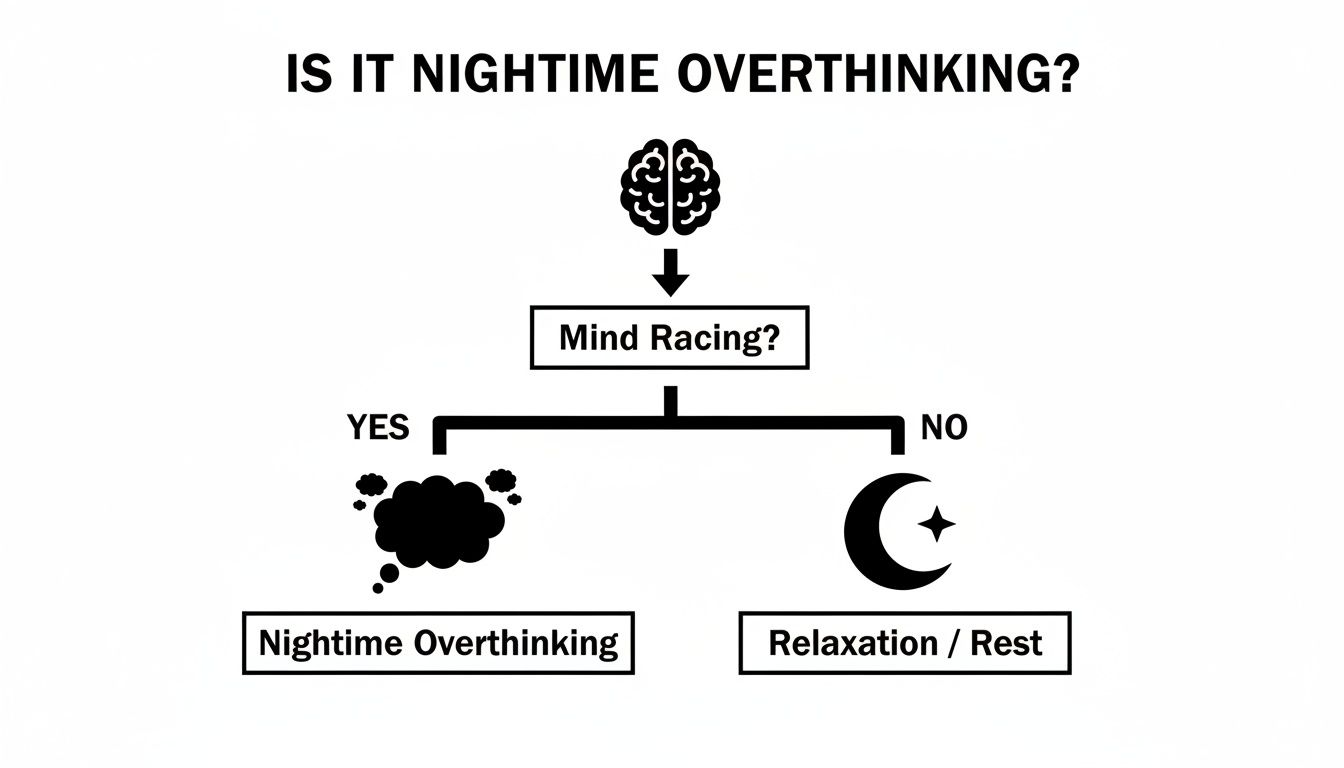
It shows that critical moment where a racing mind can either tip into restless overthinking or settle into productive thought. That junction is exactly where you can step in.
Anchor Yourself with the 5-4-3-2-1 Grounding Technique
When your mind is lost in a fog of "what ifs," grounding is the fastest way back to solid ground. The 5-4-3-2-1 technique uses your senses to short-circuit anxious thought loops by forcing your brain to notice the tangible world right here, right now.
Lying in bed, gently bring your awareness to:
- 5 things you can see: The shadow on the ceiling, the texture of your blanket, the glow of your alarm clock, the outline of the door, a book on your nightstand.
- 4 things you can feel: The coolness of your pillowcase, the weight of the comforter, the air on your skin, the fabric of your pajamas.
- 3 things you can hear: The hum of the refrigerator, the distant sound of traffic, the quiet rhythm of your own breathing.
- 2 things you can smell: The scent of laundry detergent on your sheets, the faint aroma of lotion on your hands.
- 1 thing you can taste: The lingering taste of toothpaste, or simply the neutral taste in your mouth.
This works because it’s impossible to focus on your senses and your anxious thoughts at the same time. It’s a gentle but firm way of telling your brain, "Not now. We are safe and present."
Regulate Your Nervous System with Box Breathing
Overthinking sends your body's stress response into overdrive, leading to shallow breaths and a pounding heart. You can manually reset this system with a simple, rhythmic breathing exercise known as box breathing.
Imagine tracing a box in your mind as you breathe:
- Inhale slowly through your nose for a count of four.
- Hold your breath for a count of four.
- Exhale slowly through your mouth for a count of four.
- Hold your breath again for a count of four.
Repeat this cycle for just a few minutes. This controlled pattern activates your parasympathetic nervous system—your body’s natural relaxation response. It lowers your heart rate and signals to your brain that the danger has passed. If you're looking for more ways to manage anxiety through breathwork, these breathing exercises for anxiety offer a fantastic starting point.
By intentionally slowing your breath, you send a direct message to your anxiety: you are in control. This small act of regulation can feel profoundly empowering when your thoughts feel anything but controllable.
Gently Redirect Your Focus with the Alphabet Game
Sometimes, the best way to stop the spiral is to give your brain a simple, low-stakes job to do instead. The Alphabet Game is a cognitive trick that redirects your attention without adding more stress.
The rules are simple: pick a category, like "animals," "foods," or "cities," and try to name one for each letter of the alphabet.
- A is for armadillo.
- B is for bison.
- C is for capybara.
The task is just engaging enough to occupy your racing mind but not so challenging that it causes frustration. It gently nudges the chaotic thoughts aside, replacing them with a neutral, linear activity. It’s a quiet, effective way to guide your mind away from the cliff-edge of worry and toward a state of calm, making it easier to drift back to sleep.
Design a Pre-Sleep Sanctuary to Prevent Overthinking
Instead of waiting to fight anxiety when it strikes in the dark, you can build a powerful evening routine that stops it from taking hold in the first place. Think of it as creating a pre-sleep sanctuary—a fortress of calm that signals to your brain and body that the day is officially done.
This isn't about adding more stressful tasks to your list. It’s about carving out a small, intentional space for peace.
Transforming your evening into a protective wind-down ritual is one of the most profound acts of self-care you can practice. It sends a clear message to your anxious mind: this space is for rest, not for worry. You’re essentially creating a boundary that protects you from those late-night intruders, giving you a sense of control and hope that peaceful nights are absolutely possible and achievable.
Schedule a Daily Worry Appointment
One of the most effective ways to quiet your mind at night is to give your worries their own designated time and place to exist—one that isn't your bed. This is often called a "worry appointment," and while it might sound counterintuitive, it's incredibly freeing.
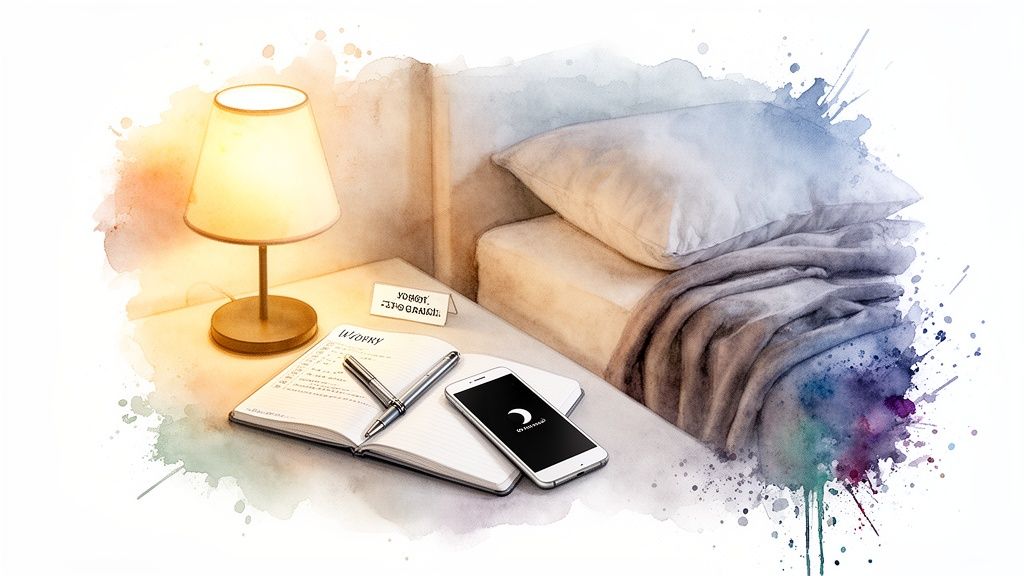
Set aside 15-20 minutes in the late afternoon or early evening. During this window, you are allowed to worry productively. Grab a notebook—let's call it your Worry Journal—and dump every single concern, fear, and unresolved problem bouncing around your head onto the page.
- Get specific. Instead of just writing "work stress," break it down: "I'm worried about the deadline for the Q3 report and what my boss will think of the draft."
- Find one next step. For any actionable items, quickly jot down one small thing you can do about it tomorrow. Just one.
- Close the book. When the timer goes off, you physically close the notebook. This is a powerful symbolic act. You’ve given your worries their airtime, and now their shift is over for the day.
This practice trains your brain to understand that there is a proper time for problem-solving, and bedtime isn't it. To go deeper, you can explore what journaling is and its many benefits for gaining mental clarity.
By getting your thoughts onto paper, you take away their power. They’re no longer chaotic, abstract fears swirling in your mind; they’re just manageable words on a page that you can deal with in the light of day.
Declare a Digital Sunset
The constant glow of our screens is one of the biggest enemies of a quiet mind. The blue light from phones, tablets, and computers tricks your brain into thinking it's still daytime, suppressing the production of melatonin—the hormone that tells your body it's time for sleep.
Creating a "Digital Sunset" is a non-negotiable part of your pre-sleep sanctuary. This means setting a firm cutoff time for all screens at least 60-90 minutes before you plan to hit the pillow.
This break does more than just help your hormones; it cuts off the firehose of stimulating information that fuels late-night anxiety. No more scrolling through stressful news, comparing your life on social media, or checking that one last work email that sends your mind spinning. If you have to be on a screen, it's worth learning about unlocking the benefits of blue light glasses for better sleep.
Cultivate a Sensory-Calm Environment
Your bedroom should be a haven for rest, not an extension of your office or living room. Tweaking your environment to be more sensory-calm can make a huge difference in your ability to wind down.
Think about engaging all your senses in a soothing way:
| Sense | Calming Action | Example |
|---|---|---|
| Sight | Dim the lights. Use warm, low-wattage bulbs instead of harsh overhead lighting. | A soft bedside lamp with a warm-toned bulb creates a cozy, cave-like vibe. |
| Sound | Introduce calming noises like a white noise machine, a gentle fan, or ambient sounds. | The sound of gentle rain can be incredibly soothing and helps drown out street noise. |
| Smell | Use calming scents. A diffuser with lavender or chamomile essential oil can trigger relaxation. | A few drops of lavender oil on your pillow can create a peaceful scent association with sleep. |
| Touch | Focus on comfort. Think soft, breathable bedding and a cool room temperature (around 65°F or 18°C). | Switching to bamboo or cotton sheets feels great and helps regulate body temperature. |
These small, intentional changes add up. They create powerful, multi-sensory cues that tell your entire being it’s time to let go. You’re not just hoping for a peaceful night; you are actively designing an environment where calm is the default.
Rewiring Your Thought Patterns for Long-Term Peace
Quick calming techniques are fantastic first aid for nighttime anxiety, but lasting peace comes from going deeper. We need to rewire the very thought patterns that kickstart the anxiety spiral in the first place. This is where you shift from playing defense to playing offense, building a mind that doesn't just get through the night but actually finds it restful.
The best part? Your thoughts aren't commands—they're just suggestions. You absolutely have the power to step back, question them, and choose not to buy into the scary stories they're selling. This skill, which is a core idea in Cognitive Behavioral Therapy (CBT), is like building a new mental muscle. It feels tough at first, but with practice, it becomes a powerful, almost automatic habit.
This isn't just about coping; it's about giving yourself real hope, backed by proven methods. It's about knowing you can live a life that isn’t run by panic, where you are the one in charge of your inner world.
The Catch, Check, and Change Method
One of the most powerful ways to stop overthinking dead in its tracks is a simple three-step process: Catch the thought, Check its accuracy, and Change it to something more realistic. Think of it as a pattern interrupt for your brain's negative feedback loop.
We’ve all been there—lying in bed, mind racing like a hamster on a wheel. And you're far from alone in this. One global sleep survey found that a staggering one-third of people have trouble sleeping at least three nights a week. The top culprits? 57% blamed stress and 46% pointed to anxiety. This isn't just a bad night's sleep; it's a crisis where people lose nearly three full nights of good rest every single week.
This is where "Catch, Check, and Change" becomes your lifeline. Let's walk through how it works in a real-world scenario.
-
Catch it: The first step is just noticing. You catch the anxious thought as it pops up, without judging yourself for having it. The thought is: "I'll never get this project done on time. I'm going to fail, and everyone at work will think I'm incompetent." You've caught it before it pulls you under.
-
Check it: Now, you put on your detective hat and gently question it. Is this thought 100% true? Is there any evidence that contradicts it? You might realize, "Well, I actually made good progress this week, and I have a clear plan for tomorrow. Plus, I've handled huge projects before." This step shines a light on how much the original thought was exaggerating.
-
Change it: Finally, you reframe the thought. It doesn't have to be blindly positive—just more balanced. "This project is a challenge, but I'm capable and I have a plan. I will focus on making progress tomorrow. Worrying about it tonight is not productive."
This process isn't about fooling yourself. It's about seeing the whole picture, not just the distorted, scary one your anxiety is painting. These kinds of mental traps are incredibly common. Getting familiar with the different types of cognitive distortions can make it way easier to spot and challenge them when they show up at 3 AM.
Postponing Worries Until Morning
Let's be real: sometimes a worry feels too big or sticky to challenge when you're exhausted. Trying to fight it can feel like wrestling with smoke—it just gets stronger. A much kinder and more effective approach is to simply postpone it.
One of the most powerful phrases you can repeat to yourself is: "This thought can wait."
You’re not pretending the thought isn’t there. You're just acknowledging it and making a conscious choice to deal with it when your brain is actually equipped for problem-solving—during the day. It’s about setting a healthy boundary with your own mind.
Imagine putting that worry into a "thought jar" on your nightstand. You can literally say to yourself, "Okay, I see you, worry about that presentation. I'm putting you in the jar for now, and I promise I'll look at you first thing in the morning with my coffee." This simple act strips the urgency away—the very thing anxiety feeds on—and allows your nervous system to finally settle down.
This is a skill, and it takes practice. Your mind might push back the first few times. But with gentle repetition, you teach it that nighttime is for rest, and daytime is for solving. This is a real step towards healing.
Creating a Consistent Practice: Your 14-Day Plan
Building these new mental habits doesn't happen overnight. It requires consistency. Think of it like starting a new workout routine for your brain. To help you stay on track, here is a simple plan to guide you for the first two weeks.
Your 14-Day Overthinking Action Plan
A structured plan to help you implement these strategies. This table breaks down daily and weekly goals, making the journey feel manageable and progressive.
| Timeframe | Focus Area | Key Action |
|---|---|---|
| Days 1-3 | Awareness | Just notice your thoughts. When an anxious thought appears, simply say, "There's that thought again." No need to change it yet. |
| Days 4-7 | Gentle Postponement | Practice using the "thought jar" or "This can wait" technique for at least one worry each night before trying to sleep. |
| Week 2 (Days 8-11) | Catch & Check | Start actively using the "Catch" and "Check" steps. When a worry pops up, catch it and ask, "Is this 100% true?" |
| Week 2 (Days 12-14) | Full Method | Practice the full "Catch, Check, and Change" method. Aim to reframe at least one major worry each night into a more balanced thought. |
This isn't about perfection; it's about progress. Even practicing for just a few minutes each night builds momentum. Stick with it, and you'll be building a powerful foundation for long-term peace and proving to yourself that a life free from panic is truly possible.
Troubleshooting Setbacks on Your Path to Quiet Nights
Let's be real for a second: healing is never a straight line. You can follow every piece of advice, build the perfect routine, and still find yourself wide awake, staring at the ceiling. The most important thing to know is that this is completely normal.
A rough night isn't a sign that you've failed. It's a sign that you're human, and you're bravely working to undo years of deeply ingrained thought patterns. This journey has bumps, and learning to navigate them is where your real strength grows. It shows you’re committed to the process, not just a flawless outcome.
This is where lasting change happens—not on the easy nights, but in how you gently guide yourself back on track after a tough one. This is how you build a panic-free life.
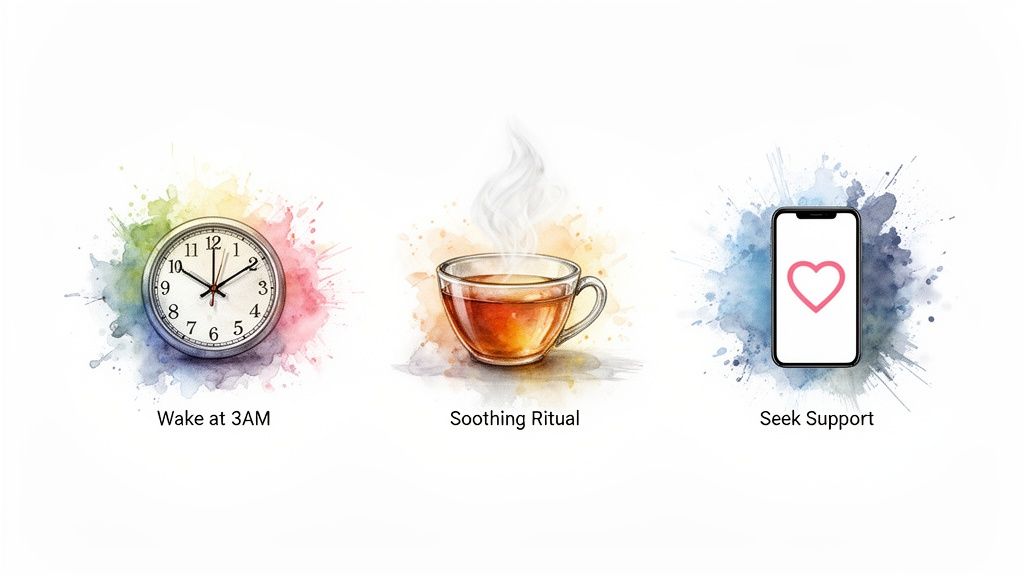
What to Do When You Wake Up at 3 AM Anyway
You did everything right, but your eyes just snapped open. It’s the middle of the night, your heart is pounding, and that familiar dread is creeping back in. The first instinct is always to fight it—to force yourself back to sleep—which, of course, just pumps more adrenaline into your system.
Instead of fighting, try a strategy of gentle acceptance. A simple but powerful phrase to keep in your back pocket is: "This thought can wait."
You aren't ignoring the worry or pretending it doesn't exist. You're just postponing it. Acknowledge the thought without getting into a tug-of-war, and give your mind a compassionate reminder that nighttime is for rest, not problem-solving. This simple act reinforces your ability to hit the pause button, which is a crucial skill for managing anxiety.
A single bad night doesn't erase your progress. Think of it as a data point. Get curious, not critical. Ask yourself, "What was different yesterday?" Use that insight to make small adjustments, not to give up. The goal here is progress and healing, not perfection.
When You’re Just Too Tired for the Routine
Some days, you're just completely drained. The idea of journaling or doing a full meditation feels like climbing a mountain. On these nights, give yourself permission to lower the bar.
Perfectionism is anxiety's best friend, so don't let it sabotage you. Instead of scrapping your routine altogether, just simplify it.
- Can't face the journal? Scribble three words on a sticky note about your day.
- Too tired for a 10-minute meditation? Just do three deep, slow box breaths.
- No energy to tidy the room? At least put your phone on its charger across the room.
These tiny acts of consistency are far more powerful than grand gestures you only do once in a while. They keep your momentum going and send a signal to your brain that even on your hardest days, your well-being still matters. This is how you build real, lasting resilience.
Finding Hope in the Journey
Remember that learning how to stop overthinking at night is a skill, a lot like learning an instrument. You wouldn’t expect to nail a concerto after just a few lessons, so don’t expect a perfectly silent mind overnight.
Every single time you choose a grounding technique instead of spiraling, you're carving out new neural pathways. Each small win builds on the last, creating a solid foundation for a future where peaceful sleep is just your new normal. You're not just managing anxiety; you are actively rewiring your relationship with your own thoughts, proving that a calm, panic-free mind is absolutely within your reach.
When It's Time to Reach Out for More Support
The strategies in this guide are fantastic for taking back your nights, but it's just as important to know when you might need to bring in some backup. Realizing you need help isn't a sign of weakness—it's a brave, powerful act of self-care. It's the moment you decide your peace of mind is non-negotiable and that you are worthy of healing.
If your nighttime anxiety feels completely overwhelming, messes with your daily life, or leaves you feeling hopeless, it might be time to talk to a doctor or a therapist. Those feelings are your mind's way of telling you that you deserve dedicated support.
Recognizing the Signs It’s Time for Help
Night after night of overthinking can easily spiral into chronic insomnia, trapping you in an exhausting cycle you can't seem to break. It's more common than you think. Worldwide, over 30% of adults struggle with insomnia symptoms, but so many just suffer in silence. Some studies show nearly one in four people simply put up with bad sleep instead of doing something about it, which shows just how many people are struggling without a solution. You can discover more insights about these sleep statistics on SingleCare.com.
It might be time to reach out if you're experiencing:
- Anxiety or panic that feels out of control most nights.
- Sleep problems that are hurting your work, relationships, or health.
- A persistent feeling of sadness, irritability, or exhaustion during the day.
Seeking professional help is a huge step toward real, lasting recovery. It’s a way of telling yourself that you're ready to heal and believe in a future where you can live a full life, free from the grip of panic and anxiety.
This journey is all about building your toolkit, and sometimes that means adding an expert to your team. All the notes you’ve taken and the routines you’ve tried are not wasted effort; they become incredibly valuable information to share with a professional. Having a structured way to track what you're going through can make those first conversations feel much more productive.
If you're not sure where to even begin, there are resources available to help you get help now and find the support you deserve.
Frequently Asked Questions
Learning how to quiet your mind at night is a process, and it’s totally normal to have questions pop up. Let's tackle some of the most common ones I hear. Think of this as a conversation to help you feel confident that you have what it takes to find lasting peace. Every small step you take is a win.
Can Nighttime Overthinking Be a Sign of an Anxiety Disorder?
That’s a great question, and the honest answer is: sometimes, yes. While a bit of nighttime worry is just part of being human, it crosses a line when it becomes persistent, intense, and feels completely out of your control.
If your thoughts are consistently ruining your sleep night after night and causing you real distress, it could be a symptom of something like Generalized Anxiety Disorder (GAD). If that sounds familiar, it's a really good idea to chat with a healthcare professional.
Reaching out for support is a sign of incredible strength, not weakness. Acknowledging you might need a hand is often the bravest and most effective first step toward feeling better and taking your life back from anxiety.
Healing from anxiety isn't just some far-off dream; it's a real, tangible possibility. With the right strategies and support, you can absolutely learn to manage your thoughts and live a full, calm, panic-free life.
How Long Until These Techniques Actually Start Working?
You can feel a difference almost immediately. Body-focused exercises like grounding or box breathing are designed for in-the-moment relief, and they can calm your nervous system the very first time you try them. Seriously, they're that powerful.
Building lasting change—the kind where you don't even have to think about it anymore—takes a bit of consistency. Most people start to notice a real, sustainable shift within a few weeks of dedicated practice with new routines and thought-challenging exercises.
Remember, the goal isn't instant perfection. It's about steady progress. Every single time you practice, you're building momentum toward a future where deep, restorative sleep is your new normal.
What if My Partner's Habits Are Making My Anxiety Worse?
This is such a common and tricky situation. You're trying to create a calm, quiet sanctuary, and meanwhile, your partner is scrolling on their phone with the brightness turned all the way up.
The key here is open, gentle, and non-blaming communication.
Try explaining that you’re working on new habits to manage anxiety and get better sleep. You could frame it as a team effort. Something like, "Hey, it would really help me wind down if we could try making our bedroom a no-screen zone after 10 PM. Maybe we could both benefit from it?"
When you present it as a positive change for both of you, your partner is much more likely to be supportive. Who knows, they might even discover they love the new routine, too.
You have the power to build a life that isn't controlled by anxiety. The Anxiety Checklist provides a structured, step-by-step system to help you challenge negative thoughts, manage panic, and create lasting peace. Start your journey toward fearless living today.